Reynolds Number Effects on Aerodynamic Characteristics of Compressor Cascades for High Altitude Long Endurance Aircraft
Taiki Kodama, Toshinori Watanabe, Takehiro Himeno, Seiji Uzawa
Department of Aeronautics and Astronautics, School of Engineering, University of Tokyo 7-3-1 Hongo, Bunkyo-ku, Tokyo 113-8656, JAPAN
[email protected]
Keywords: Aerodynamics, Cascade Flow, Reynolds Number, CFD, CIP-CUP
Abstract
In the jet engines on the aircrafts cruising at high altitude over 20 km and subsonic speed, the Reynolds number in terms of the compressor blades becomes very low. In such an operating condition with low Reynolds number, it is widely reported that total pressure loss of the air flow through the compressor cascades increases dramatically due to separation of the boundary layer and the secondary-flow. But the detail of flow mechanisms causes the total pressure loss has not been fully understood yet. In the present study, two series of numerical investigations were conducted to study the effects of Reynolds number on the aerodynamic characteristics of compressor cascades. At first, the incompressible flow fields in the two-dimensional compressor cascade composed of C4 airfoils were numerically simulated with various values of Reynolds number. Compared with the corresponding experimental data, the numerically estimated trend of total pressure loss as a function of Reynolds number showed good agreement with that of experiment. From the visualized numerical results, the thickness of boundary layer and wake were found to increase with the decrease of Reynolds number.
Especially at very low Reynolds number, the separation of boundary layer and vortex shedding were observed. The other series, as the preparatory investigation, the flow fields in the transonic compressor, NASA Rotor 37, were simulated under the several conditions, which corresponded to the operation at sea level static and at 10 km of altitude with low density and temperature. It was found that, in the case of operation at high altitude, the separation region on the blade surface became lager, and that the radial and reverse flow around the trailing edge become stronger than those under sea level static condition.
Introduction
In recent years, high altitude long endurance aircrafts come into cooperation for several objectives.
An example of their aircrafts is the Global Hawk, and some examples of their main missions are to investigate environment and to become platform for wireless communications 1) . The aircrafts that accomplish these missions are requested to fly at high altitude (about 20[km]) and at subsonic speed. The reason to fly at high altitude is not only to see further at wider angle, but also to fly above commercial
aircrafts. And flying at an altitude of around 20 km, the aircrafts experience relatively benign winds. The reasons to fly at subsonic speed are that the drag is kept down for long endurance, and the aerodynamic heating and shock associated with transonic or supersonic flight cause changes to the air sample.
At high altitude and low speed, the Reynolds number in terms of the compressor blades becomes low as small as 10 5 . Figure 1 shows the total pressure loss of the flow through various compressor cascades as a function of the Reynolds number. It is widely known that total pressure loss increase dramatically with the decrease of Reynolds number.
Indeed, related to the aerodynamic characteristics of compressor cascade operating at low Reynolds number, a lot of experimental studies were conducted with low subsonic wind tunnels. For example, Rhoden et al. 3) conducted the experiment and investigated the performance changes in a series of C4 blade cascades.
Hobson et al. 4) investigated the flow over the suction surface of a second-generation controlled-diffusion compressor stator blades by laser-doppler anemometry measurements. But there were not so many investigations on the compressor cascade at the combination of low Reynolds number and high Mach number.
Fig.1 Reynolds number effects on loss of compressor cascade Reproduced
from Ref.(2)
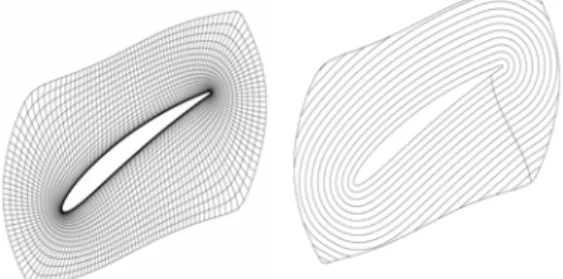
In the present paper, the numerical simulation of low speed compressor was conducted to understand the mechanisms of loss generation due to the unsteady behavior of viscous flow. Then, as to high altitude long endurance aircraft, transonic flows in compressor cascade under high altitude condition were also numerically investigated.
Numerical Method
In the present study, two kinds of numerical codes were applied to conduct two different series of simulations to investigate changes of the flow field in compressor with decrease of with the decrease of Reynolds number. For the flows in transonic compressor cascade, the SHUS scheme with the third order MUSCL interpolations was employed, where the viscous fluxes were calculated in the central differential manner and time integration was implemented by the Euler implicit method with the LU-SGS scheme. On the other hand, for the unsteady flows at low Mach number in linear cascade, the Thermo CIP-CUP (TCUP) scheme 5) .
Thermo CIP-CUP
In the computation for low speed compressor cascade, the flow fields were described by Reynolds Averaged Navier-Stokes (RANS) equations as,
( ) u u
t + ⋅ ∇ = − ∇ ⋅
∂
∂ ρ ρ ρ , (1)
( ) ⋅ ∇ = ∇ ∏
∂ +
∂ u u :
t u ρ
ρ , (2)
( ) u e { } u q
t
e + ⋅ ∇ = ∏ ∇ ⋅ − ∇ ⋅
∂
∂ ρ :
ρ . (3) Figure 2 shows the algorithm of TCUP schematically, which is the modification of the original CIP-CUP 6) . The combination of independent variables was selected as Q = ( ) u , T , p
T. Based on the fractional-step method, the change of Q
Tin a time step
Δ t is divided into the change in advection phase, diffusion phase and acoustic phase.
In the advection phase, the convection equation of Eq.(4) are solved with CIP scheme.
0 ) ( r r r r
=
∇
⋅
∂ +
∂ u Q
t
Q (4) For instance, suppose that the convection equation
0 r r r r
∂ = + ∂
∂ + ∂
∂
∂
η ξ
V Q U Q t Q
c c
(5)
is solved with CIP scheme on a generalized coordinate system. The profile of the variable Q is interpolated with cubic polynomial. Then, according to the theoretical solution, the cubic-interpolated profile is shifted and the value at grid point ( ξ 0 , η 0 , ζ 0 ) is calculated by
) ,
( ) , ,
(
0 0 0 * 0 0*
Q U t V t
Q r ξ η ζ = r
CIPξ −
cΔ η −
cΔ (6)
In the diffusion phase, the changes of variables Q
caused by the dispersion of momentum and heat were solved. Since the density remains unchanged in this phase, the variations in pressure and temperature are calculated by
( ) C
pQ
DIFt
T
T ~
*
*
*
*
*
ρ
= γ Δ
− , (7)
( C
p J) Q
DIFt p
p ~
1 1
*
*
*
*
*
μ ρ γ +
= − Δ
− , . (8) Heat input denoted by Q ~
DIFis calculated as
[ T u q ] u t
Q
DIF∂
− ∂
−
⋅
∇
=
* 2
*
: 2
~ ρ
ν
. (9) In the acoustic phase, on the assumption of isentropic change, the acoustic equation described as;
t u p C
S= −∇ ⋅
∂
∂
2
1
ρ (10) is discretized in time-wise direction into
( ) C p t p u p t
n n
S
⎟⎟ Δ
⎠
⎜⎜ ⎞
⎝
∇ ⎛ ∇ +
⋅
−∇
Δ =
−
++
*
*
* 1
* *
* 1
* 2*
1 ρ ρ
, (11) where C
srepresents sound velocity, and solved implicity by BiCG-STAB method. The accompanying change of temperature is calculated by
( )
( )
** **(
1 **)
*
*
1
1
p p C T C
T
np J
n
+
p−
=
−
++
ρ μ
ρ . (12)
Turbulence Model
As for turbulence model, the low Reynolds number
ω
−
k turbulence model (Wilcox, 1994) 7) was employed to estimate the eddy viscosity. This model has been proven to be superior in numerical stability to the k − ε model in the viscous sub layer near the wall. In the logarithmic region, the model gives good agreement with experimental results for adverse pressure gradient flows.
Distance Function
In general, to estimate the eddy viscosity based on turbulence model near the solid wall, the information of the distance from the wall is required. This is sometimes not a trivial task, especially in the CFD analysis of turbomachinery with body-fitted meshes.
In the present study, as a preprocessing, the distance function φ which indicates the normal distance from the surface of airfoil was generated by Level Set Method (LSM) 8) . In the LSM, the Hamilton-Jacobi type equation
) 1 )(
~ ( φ φ
φ = − ∇
∂
∂ sign t
(13) is solved iteratively with the boundary condition,
φ =0 on surface of airfoil. (14) If it converge, the property of distance function
= 1
∇ φ (15)
= 0 t D D ρ
= 0 t D Du
= 0 t D De
t u p C
S∂ = −∇ ⋅
∂ ρ
21
= 0
∂ t
∂ρ t
vu = ∇ : T
∂ ρ ∂
{ } u q
t e
v