저작자표시-비영리-변경금지 2.0 대한민국 이용자는 아래의 조건을 따르는 경우에 한하여 자유롭게
l 이 저작물을 복제, 배포, 전송, 전시, 공연 및 방송할 수 있습니다. 다음과 같은 조건을 따라야 합니다:
l 귀하는, 이 저작물의 재이용이나 배포의 경우, 이 저작물에 적용된 이용허락조건 을 명확하게 나타내어야 합니다.
l 저작권자로부터 별도의 허가를 받으면 이러한 조건들은 적용되지 않습니다.
저작권법에 따른 이용자의 권리는 위의 내용에 의하여 영향을 받지 않습니다. 이것은 이용허락규약(Legal Code)을 이해하기 쉽게 요약한 것입니다.
Disclaimer
저작자표시. 귀하는 원저작자를 표시하여야 합니다.
비영리. 귀하는 이 저작물을 영리 목적으로 이용할 수 없습니다.
변경금지. 귀하는 이 저작물을 개작, 변형 또는 가공할 수 없습니다.
공학석사 학위논문
Halide Perovskite Solar Cells Prepared from Electrodeposited Precursor Films
2018년 8월
서울대학교 대학원 재료공학부
이 동 석
Halide Perovskite Solar Cells Prepared from Electrodeposited Precursor Films
지도교수 김 진 영
이 논문을 공학석사 학위논문으로 제출함
2018년 8월
서울대학교 대학원 재료공학부
이 동 석
이동석의 석사학위논문을 인준함
2018년 6월
위 원 장 남 기 태 (인)
부위원장 김 진 영 (인)
Abstract
Halide Perovskite Solar Cells Prepared from Electrodeposited Precursor Films
Dong Seok Lee
Department of Materials Science and Engineering
The Graduate School
Seoul National University
Hybrid organic-inorganic perovskite thin films have become promising materials for next-generation photovoltaic devices such as solar cells, photodetectors, and the
light-emitting diode. As for the solar cell, the perovskite solar cells (PSCs) has gained much interest due to low-cost, simple solution-process, and high power conversion efficiency (PCE). Recently, single-junction perovskite solar cell’s PCE had reached higher than 22 % using solution spin-coating process. Also, the relatively large bandgap of perovskite materials enables the fabrication of tandem solar cells with Si thin film solar cells which have small band gaps. However, Si cell usually has random pyramid textures for efficient light harvesting, which makes it hard to form compact and crystalline perovskite layer through conventional solution spin-coating technique. To address these issues, electrochemical deposition is used, which is simple and applicable to large substrate area and rough surface. In this thesis, uniform and compact CH3NH3PbI3 (hereafter MAPbI3) film was formed through chronoamperometric electrodeposition method followed by sequential chemical vapor conversions.
First, PbO2 films were electrodeposited on ITO substrate with thin NiOx layer.
PbO2layer’s thickness and grain size were controlled through changing deposition potential and time, which greatly affected the converted MAPbI3 thickness and surface morphology. Then, the PbO2film was reduced to PbO film with hydrogen gas and sequentially converted to MAPbI3 with CH3NH3I (hereafter MAI) vapor.
This thesis suggests a possible solution to address perovskite solar cell issues such as large-area cell and application to the tandem solar cell. Electrodeposition and vapor conversion are proved to be simple and scalable methods and thus are expected to address to low-cost and large scalable production of PSCs.
Keywords : electrodeposition, vapor conversion, textured surface, large-area, perovskite solar cells, lead oxide
Student Number: 2016-20808
Table of Contents
Abstract ...i
Table of Contents ...iv
Table of Figures...vii
Chapter 1. Introduction...1
1.1 Perovskite Solar Energy for Future Renewable Energy... 1
1.2. Current Issues for Perovskite Solar cell... 2
Chapter 2. Background ...8
2.1 Perovskite Solar Cell... 8
2.1.1 Perovskite Material ... 8
2.1.2 Device Structure... 9
2.1.3 Operating Principle ... 10
2.1.4 Fabrication Process ...11
2.2 Electrodeposition ... 22
2.3 Avrami Equation ... 25
Chapter 3. Experimental Details...27
3.1 Preparation of Substrate ... 27
3.1.1 Spin-coated NiO
xLayer... 27
3.1.2 Electrodeposited PbO
2Layer... 28
3.2 Fabrication of Perovskite Layer ... 29
3.2.1 PbO
2Reduction... 29
3.2.2 Conversion to MAPbI
3... 29
3.3 Characterization... 31
Chapter 4. Results and Discussion...32
4.1 Electrochemical Deposition of Uniform PbO
2Layer ... 32
4.2 PbO
2Reduction to PbO... 43
4.3 Conversion to MAPbI
3by MAI Vapor Reaction ... 57
5. Conclusion ...65
Bibliography...67
국 문 초 록...72
Table of Figures
Figure 1.1.1 Time-dependent changes of annually averaged power demand in 139 countries.[1] ………...5 Figure 1.1.2 A plot of certified efficiencies for various cells from 1975 to
present.[4] …………...6 Figure 1.2.1 Design of the perovskite/silicon tandem cell.[7]
………..….7
Figure 2.1.1 3-dimensional schematic figure of perovskite structure. ..……...12
Figure 2.1.2 Simplified energy diagram of MAPbI3 solar device.[15]
……….13
Figure 2.1.3 Absorption coefficient of MAPbI3 and other light absorbing
materials for solar cells.[11]
………14
Figure 2.1.4 Schematic of (a) n-i-p (b) p-i-n type planar structure of perovskite
solar cells.
….………...15
Figure 2.1.5 Energy levels of different ECMs used in PSC.[16]
…….……….16
Figure 2.1.6 Energy levels of different HCMs used in PSC.[16]
……….17
Figure 2.1.7 Schematic of the operating principle of MAPbI3 PSC.
…………18
Figure 2.1.8 Schematic of the one-step and two-step solution process for
MAPbI3 formation.
………..19
Figure 2.1.9 Schematic of the dual-source thermal evaporation system for MAPbI3
formation.[17]……...……….20
Figure 2.2.1 Schematic diagram of the 3-electrode electrodeposition system.
……….23 Figure 4.1.1 Cyclic voltammogram for 3 cm2of NiOx/ITO glass substrate in 2
mM Pb(NO3)2 aqueous solution.
……….…35
Figure 4.1.2 X-ray diffraction patterns of PbO2 films electrodeposited at different voltage (a) at room temperature (b) at 50 ºC.
……….…36
Figure 4.1.3 Morphologies of PbO2 films deposited for 100s at (a) 1.1 V (b)
1.3 V (c) 1.5 V (c) 1.7 V.
……...………...37
Figure 4.1.4 Cross-view of PbO2films deposited for 200s at (a) 1.1 V (b) 1.3
V (c) 1.5 V (d) 1.7 V.
………...38
Figure 4.1.5 Dependence of PbO2 films thickness to (a) time (b) total charge
for various deposition potential.
………...39
Figure 4.1.6 X-ray diffraction patterns of PbO2 on textured ITO/Si wafer. ..…40
Figure 4.1.7 Morphology and cross-veiw of PbO2 film deposited on ITO/Si wafer.
………...41 Figure 4.2.1 X-ray diffraction patterns of MAPbI3 films from PbO2 films
converted by MAI solution immersion at different solution temperature. ………45 Figure 4.2.2 Morphologies of MAPbI3 films from PbO2 films converted by
MAI solution immersion at (a) room temperature (b) 50 ºC (c) 70 ºC. ………...46 Figure 4.2.3 X-ray diffraction patterns of MAPbI3 films from PbO2 films
converted by MAI vapor conversion.
………..…47
Figure 4.2.4 MAPbI3 films from PbO2 films converted by MAI vapor conversion for (a) 25 min (b) 30 min.
………..48
Figure 4.2.5 X-ray diffraction patterns of PbO films reduced at different temperature. ………49 Figure 4.2.6 X-ray diffraction patterns of PbO films reduced at 250 ºC for
different time.
………..50
Figure 4.2.7 (a) Photographs of the PbO films reduced at 250 ºC for different time (b) morphology of PbO film reduced at 250 ºC for 30 min. ..51
Figure 4.2.8 SAED image of PbO2/PbO reduced at 250 ºC for 10 min (50%
converted). ………..52 Figure 4.2.9 XPS spectra of Pb 4f7/2 for (a) PbO2 (b) PbO film.
………...53
Figure 4.2.10 Avrami plot of PbO2 reduction at 250 ºC. ………..
………..54
Figure 4.2.11 Mechanism for PbO2 reduction at 250 ºC…...55
Figure 4.3.1 (a) X-ray diffraction patterns of MAPbI3 films reacted under different temperature, photographs of MAPbI3film under (b) 100
ºC (c) 130 ºC (d) 150 ºC.
………..……58
Figure 4.3.2 X-ray diffraction patterns of MAPbI3 films reacted at 250 ºC for different
temperature. ...59
Figure 4.3.3 (a) Photographs of the MAPbI3films converted for different time (b) morphology of PbI2 (c) morphology of MAPbI3 film.
……....60
Figure 4.3.4 (αhν)2 plot against the energy of the MAPbI3 film.
………..61
Figure 4.3.5 Avrami plot of (a) PbO / PbI2 (b) PbI2 / MAPbI3 conversion.
…...62
Figure 4.3.6 Mechanism for MAPbI3conversion through MAI vapor reaction.
……….63
Chapter 1. Introduction
1.1 Perovskite Solar Energy for the Future Renewable Energy
The fossil fuel had commonly used for the energy source from the industrial revolution. However, much pollutants, including carbon monoxide and nitrogen oxide, are emitted through burning fossil fuel, causing serious environmental concerns such as air pollution and global warming. Also, the fossil fuel resource is rapidly depleting due to reckless use of fossil fuel. To address these issues, there is a worldwide effort to develop a renewable energy source which can be low-cost and eco-friendly. Figure 1.1.1 shows the international power supply plan for replacing fossil fuel.[1] According to this report, it is anticipated that all of the global energy demand can be satisfied through solar, wind, hydropower and geothermal energy.
Solar energy is receiving a great deal of attention for the new source of energy for
various reasons. First, the average global solar radiation is 238 W/m2 and never gets depleted for the next 1010 years.[2] Also, solar panels can be installed to any place regardless of the region’s topography and its maintenance cost is low.[3]
Finally, solar cells do not produce any pollutants during the process of converting light into electricity.
One of the ways of utilizing solar energy is through photovoltaic devices.
Amongst the other types of solar cell, PSCs have received the most interest in photovoltaics community. Starting from 10% in 2012, PSCs’ PCE has been rapidly increasing over the few years, exceeding 22% according to NREL data (Figure 1.1.2).[4] This PCE already outperforms the other forms of solar cells, such as Si solar cell (21.3 %), CdTe (22.1%), and CIGS (22.3%) cells. This high-efficiency PSC can be fabricated by a low-cost solution process and low-temperature process.
Therefore PSC is a promising candidate for the next-generation PV.
1.2. Current Issues for Perovskite Solar cell
By improving the film quality of perovskite film and developing solar cell’s
interface structure, the PSC’s PCE has increased to be more than 22%. The certified highest PCE of single-junction PSC is 22.7% according to NREL efficiency chart.[5] However, the ideal PCE of MAPbI3 PSC is assumed to be 31%.[6] Thus, higher efficiency can be achieved through enhanced experimental measures. These measures include the improvement of uniformity and crystallinity of perovskite film, band gap tuning through changing composition of perovskite material, and interface engineering between the perovskite layer and other contact layers. However, these measures conducted in single-junction perovskite solar cell are difficult to produce the evident effect on PCE. Another approach is the multi- junction tandem solar cell. The PSC is connected in series with the low bandgap solar cell such as Si wafer cell, CZTS, and CIGS. Among them, Si wafer cell is often chosen for the bottom sub-cell of the tandem device since its PCE is as high as 21.2% and its band gap energy aligns well with perovskite material’s bandgap.
Figure 1.2.1 shows typical structure for Si/perovskite tandem solar cell.[7] By directly stacking perovskite cell on top of silicon bottom cell, PCE 23.6% was achieved which is already higher than single-junction perovskite solar cell.
Therefore, research on the tandem solar cell is crucial for developing high- efficiency devices.
PSCs with the highest PCE have device areas less than 0.1 cm2. However, it is difficult to produce the uniform film through the conventional solution process for the larger active area. In order to achieve high PCE, PSC’s layers should be formed with high uniformity. Thus, developing the new scalable process for large-area devices is becoming more significant.
Figure 1.1.1 Time-dependent changes of annually averaged power demand in 139 countries.[1]
Figure 1.1.2 A plot of certified efficiencies for various cells from 1975 to present.[4]
Figure 1.2.1 Design of the perovskite/silicon tandem cell.[7]
Chapter 2. Background
2.1 Perovskite Solar Cell
2.1.1 Perovskite Material
The chemical formula of perovskite for PSC is ABX3 where A is monovalent organic (e.g., methylammonium (MA), formamidinium (FA) ) or inorganic (e.g., Cs, Rb) cation, B is divalent metal (e.g., Pb, Sn) cation and X is halide anion (I, Br, Cl). The crystal structure of the ABX3 compound is illustrated in Figure 2.1.1.
Large cation A is at the center of the cubic unit cell, and smaller cation B is at the corners of the unit cell. The cation B is octahedral-coordinated to the anions X that lie at the center of the edges of the cubic unit cell. The commonly used perovskite, MAPbI3, is tetragonal with lattice parameter a = 8.825 Ǻ, b = 8.835 Ǻ, and c = 11.24 Ǻ.[8]
Perovskite materials have several advantages as a light absorbing layer for solar cells. First, the perovskite materials’ band gap is suitable for photovoltaic devices.
Figure 2.1.2 shows energy level diagram for typical solar cell against vacuum.[9]
The band gap of MAPbI3 is known to be 1.5 ~ 1.6 eV and absorption onset is at approximately 800 nm. The ideal bandgap for panchromatic absorption is 1.3 eV, so bandgap should be tuned to extend the absorption to longer wavelengths. The perovskite’s bandgap can be tuned by changing A site into other organic cation or direct modification of M-X bond in the ABX3perovskite. M-X bond length can be adjusted by changing halide anions in the M-X bond.[10]
Furthermore, the perovskite material has good optical properties. MAPbI3’s absorption coefficient was measured to be more than 106cm-1at visible light range (Figure 2.1.3).[11] Thus, the absorption depth of perovskite is expected to be less than 1 μm. Also, perovskite materials exhibit superb dielectric properties, with high dielectric constant, high carrier mobility (μ ~ 1-10 cm2 V-1 s-1) and long carrier lifetime (1.7 μs for MAPbI3).[12]
2.1.2 Device Structure
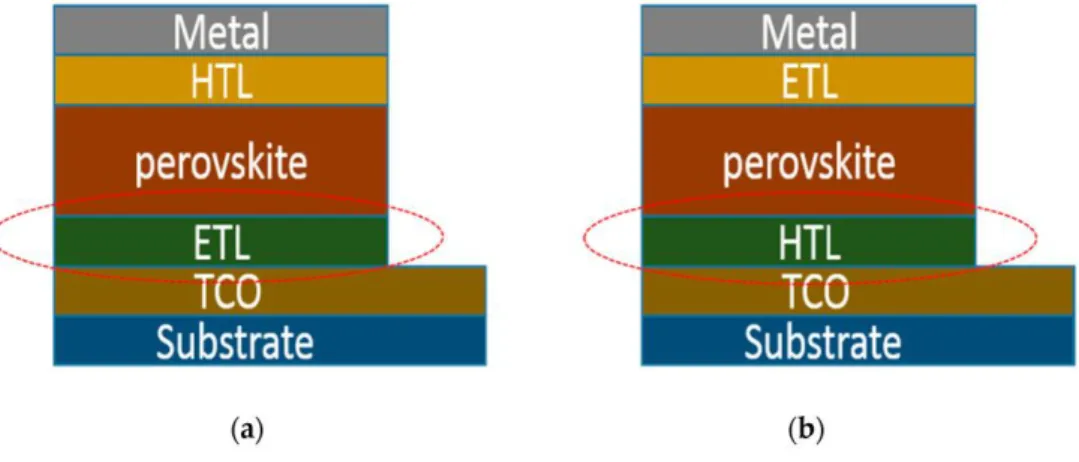
Figure 2.1.4 depicts a schematic structure of 2 types of planar PSCs. which is also called normal and inverted structure. The n-i-p type MAPbI3 planar PSCs, which
are also called normal type PSCs, are composed of TCO / electron transport layer (ETL) / perovskite / hole transport layer (HTL) / metal and p-i-n type PSCs, also called as inverted type, are consisted of TCO / HTL / perovskite / ETL / metal. For n-i-p PSC, TiO2 layer and 2,2`,7,7`-tetrakis(N,N-di-p-methoxyphenylamine)-9,9`- spirobifluorene (spiro-OMETAD) are used as ETL and HTL, respectively. For p-i-n type, Phenyl-C61-butyric acid methyl ester (PCBM) and poly(3,4- ethylemedioxythiophene):poly(styrene-sulfonic acid) (PEDOT:PSS) are used as HTL and ETL, respectively. Figure 2.1.5 and 2.1.6 shows other possible alternatives as HTL and ETL for PSCs. The n-i-p type PSC exhibits higher power conversion efficiency than p-i-n type PSC. However, p-i-n type PSC can be fabricated at the relatively low processing temperature and easy to apply to tandem solar devices.
2.1.3 Operating Principle
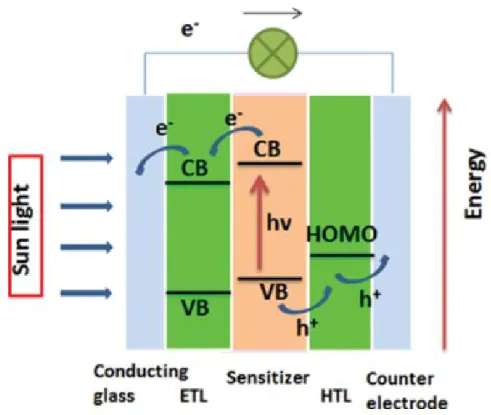
Figure 2.1.7 depicts operation principle for PSC.[13] First, the light is absorbed into the perovskite layer and the electron-hole pair is generated. Electron and hole are extracted by ETL and HTL, respectively and form the electric field. By this electric field, the current and voltage are generated across the solar cell. If the
electron and hole are recombined at the interfaces of ETL / perovskite or HTL / perovskite layer, electron-hole pair is lost and no current or voltage can be generated. For higher PCE, the recombination should be slower than charge generation and extraction process.
2.1.4 Fabrication Process
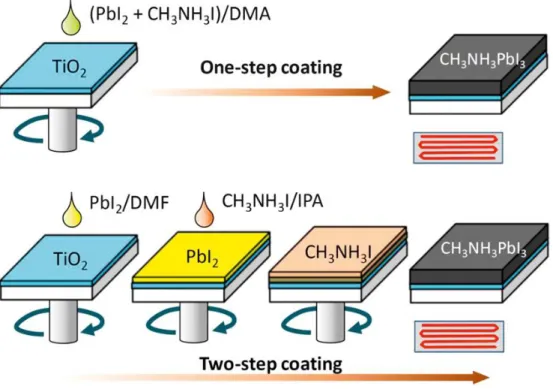
MAPbI3 can be formed by spin-coating solution process. Figure 2.1.8 shows 2 procedures for solution process – one-step and two-step method.[14] For one-step process, a precursor solution, mixed PbI2 and MAI in the polar solvent such as N,N-dimethylformamide (DMF) or gamma-butyrolactione(GBL), is spin-coated onto the ETL or HTL. For two-step process, PbI2 layer is formed first, then converted to MAPbI3 layer by spin-coating MAI solution onto PbI2 layer or dipping PbI2layer into MAI solution.
Aside from solution process, perovskite layer can be produced by co-evaporation of MAI and PbCl2 (Fig 2.1.9).[15] MAI and PbCl2 are heated and deposited simultaneously onto the substrate under a high vacuum atmosphere. Through thermal vacuum evaporation deposition, it is easy to control the perovskite film
thickness and uniformity. However, thermal evaporation requires high vacuum and temperature condition.
Figure 2.1.1 3-dimensional schematic figure of perovskite structure.
A site : FA, MA, Cs B site : Pb, Sn
X site : Cl, Br, I
Figure 2.1.2Simplified energy diagram of MAPbI3solar device.[15]
Figure 2.1.3Absorption coefficient of MAPbI3and other light absorbing materials for solar cells.[11]
Figure 2.1.4 Schematic of (a) n-i-p (b) p-i-n type planar structure of perovskite solar cells.
Figure 2.1.5 Energy levels of different ECMs used in PSC.[16]
Figure 2.1.6 Energy levels of different HCMs used in PSC.[16]
Figure 2.1.7Schematic of the operating principle of MAPbI3PSC.
Figure 2.1.8 Schematic of the one-step and two-step solution process for MAPbI3 formation.
Figure 2.1.9 Schematic of the dual-source thermal evaporation system for MAPbI3
2.2 Electrodeposition
Figure 2.2.1 depicts a schematic diagram of electrodeposition. The electrodeposition reaction is based on oxidation-reduction reaction driven by the potential difference of two electrodes. The whole system consists of electrodes and electrolyte. Two or three electrodes (working, counter, and reference electrodes are connected to an external power source (e.g. potentiostat) which can apply potential or current between them. The electrolyte contains the positive and negative ions and other additives for sufficient electric conductivity.
The electrodeposition in Pb(NO3)2 solution can be expressed as below. Pb2+ ions move to the cathode and the elemental electrodeposition process can be expressed as
Pb2++ 2 H2O → PbO2+ 4 H++ 2 e– E0= + 1.70 V (vs. NHE)
E0is standard reduction potential defined under standard condition (25 ºC, 1 atm, 1 M) with respect to NHE reference. When the electrodeposition condition is shifted, E0will change according to Nernst equation:
= −
When applied potential E` is different from E, the difference between E`and Eis defined as overpotential. The overpotential is an important factor in electrodeposition which influences the morphology and the other properties of deposited films.
Figure 2.2.1Schematic diagram of the 3-electrode electrodeposition system.
2.3 Avrami Equation
For the phase transformation in most materials, two consecutive processes takes place: nucleus of the new phase are formed, and these nucleus grow from initial sites.[18] Assuming that rates of nucleation and growth separately, rate of phase transition can be obtained through the equation called Avrami equation.
The total rate of transition from phase α to phase β is dependent to both nucleation and growth rates. When nucleus grow into a certain size, nucleus tend to occupy contiguous volumes and their growth is hindered. New parameter, expanded volume fraction of nuclei ϕx = Vβe / V0 is introduced where Vβe is volume of nucleus β if they aren’t hindered by each other and V0 is the total volume of the phases. Real volume fraction ϕ = Vβ/ V0, is also added where V is the real volume fraction occupied by new phase β to consider steric hindrance. It can be assumed that only the untransformed part of the system contributes to real volume of the nuclei dVβ, the expression can be made:[19]
1 − =
1 − = −
= 1 − (− )
If the nucleus are spherical and controlled by constant mass transfer, it can be assumed that nucleus radius r(t) increases linearly with growth rate G. If the nucleus grow by diffusion of atoms or molecules of the initial phase to nucleation sites, ∝ √ . Thus the volume of nucleus will be
=4
3 / = /
If I(r) is set to be nucleation rate, I dt nucleus will be formed during dt. Thus,
= 1
=2 5
= 1 − (− )
If nucleation rate is a function of time ∝ , ϕcan be expressed as
∝ 1 − (− )
Chapter 3. Experimental Details
3.1 Preparation of Substrate
3.1.1 Spin-coated NiO
xLayer
Tin-doped indium oxide (ITO) glass was cleaned with diluted detergent (Hellmanex Ⅲ, Sigma-Aldrich), deionized water, acetone and ethyl alcohol consecutively. After it was dried with the N2gas stream, the ITO glass surface was UV-ozone treated for 15 min to remove the organic impurities. 0.1 M nickel(Ⅱ) acetate tetrahydrate (Sigma-Aldrich, ≥99.0% purity) in ethyl alcohol was used for NiOxlayer precursor solution. This nickel oxide solution was spin-coated onto the ITO subatrate at 4000 rpm for 45 s and annealed at 300 ºC for 1 hr.
3.1.2 Electrodeposited PbO
2Layer
2 mM Pb(NO3)2 (Sigma Aldrich, ≥99.99% purity) aqueous solution was used as electrodeposition electrolyte. Electrodeposition procedure was all conducted under chrnoamperometric method in the three-electrode system. ITO glass with spin- coated NiOx layer, Pt foil, and Saturated Caromel Electrode (hereafter SCE) was used as working, counter, and reference electrodes, respectively. A PMC 1000 workstation was selected for electrodeposition and electrolyte was held at 50 ºC by the water bath. The deposition potential and time was ranged from 0.9 V to 1.7 V (vs. SCE) and 100 s to 300 s. After the deposition, the PbO2films were rinsed with DI water and annealed at 150 ºC for 10 min.
For electrodeposition on textured Si wafer, pulse electrodeposition was conducted. 150 nm ITO film on textured Si wafer was used as substrate. The initial deposition is 1.3 V and 0.3 s on-time and 0.7 s off-time. The deposition was conducted for 1 to 2 hr to adjust PbO2film thickness.
3.2 Fabrication of Perovskite Layer
3.2.1 PbO
2Reduction
Reduction of PbO2to PbO was conducted in the tube furnace. PbO2film was put into a tube furnace and purged with 4% H2/Ar gas for more than 10 min. The tube furnace was annealed at the different temperature ranging from 200 ºC to 250 ºC for the different time under the constant flow of 4% H2/Ar (1000 cc/min). For all conditions, the substrates were heated to their reaction temperature in less than 1 min. After the completion of reaction, the substrates were quickly taken out and cooled down to room temperature under ambient air.
3.2.2 Conversion to MAPbI
3Conversion of PbO to MAPbI3 was carried out in 2-zone vacuum tube furnace.
300 mg of MAI powder (Greatcell Solar) was put into silicon crucible and transferred inside the first chamber of the tube furnace, while PbO film was placed
and sealed. The first chamber was heated to 250 ºC and the second chamber was heated to the different temperature ranging from 100 ºC to 180 ºC for the different time. After the reaction was complete, the substrate was quickly taken out of the tube furnace and cooled down to room temperature under ambient air.
3.3 Characterization
PMC 1000 workstation with the 3-electrode system was used to measure cyclovoltammetric and chronoamperometric data. X-ray diffraction (XRD) patterns of PbO2, PbO, and MAPbI3 were recorded by New D8 advance, Bruker, using Cu Kα radiation (λ=0.1542nm). The morphology and thickness of films were evaluated by FESEM, SU70, Hitachi at an accelerating voltage 2, 5, and 15 kV.
The HRTEM and SAED images were taken with TEM, JEM-2100F. The XPS spectra were measured by PHI 5000 VersaProbe, ULVAC-PHI. The optical properties were measured by UV-vis-NIR spectrophotometer (Cary series, Agilent Technologies).
Chapter 4. Results and Discussion
4.1 Electrochemical Deposition of Uniform PbO
2Layer
Anodic electrochemical deposition of PbO2 has been reported to proceed to following equation.[20]
Pb2++ 2H2O → PbO2+ 4H++ 2e– (1)
For voltammateric evidence for electrochemical deposition of PbO2, the cyclic voltammetric curve of the PbO2film in 2 mM Pb(NO3)2aqueous solution is shown in Figure 4.1.1. Several characteristic peaks can be observed. Two cathodic peaks at ER1 = – 0.4 V, ER2 = 0.67 V were observed on positive scan, corresponding to Pb(Ⅲ) and Pb(Ⅳ) reduction. Two anodic peaks EA1 = – 0.03 V, EA2 = 0.8 V were observed on negative scan, which is Pb(Ⅱ), Pb(Ⅲ) oxidation respectively. The mechanism for PbO2 electrodeposition on platinum has been reported to be the following equations.[21]
Pb2+aq+ H2O → Pb(OH)+aq+ H+ (2) Pb(OH)+aq+ H2O → Pb(OH)2++ H++ e– (3) Pb(OH)2+→ Pb(OOH)++ H++ e– (4)
Pb(OOH)+→ PbO2+ H+ (5)
Hence, it can be suggested that PbO2 deposition can thermodynamically start at higher potential than 1.0 V.
Figure 4.1.2 compares the XRD spectra of PbO2 film deposited at the various deposition potential and temperature for 100 s. For the room-temperature electrolyte, 2 diffraction peaks at 25.4º and 32.0º appeared which can be indexed to (110) and (101) plane of tetragonal β-PbO2. When the electrolyte’s temperature was raised to 50 ºC, additional diffraction peak at 28.3º and 32.5º could be observed which corresponds to (111) and (002) plane of orthorhombic α-PbO2. At potential 0.9 V, no PbO2peaks were observed regardless of reaction temperature, which was in good agreement with cyclic voltammetry. As deposition potential got higher, more PbO2 films were deposited on the NiOx/ITO substrate due to larger overpotential value. For oxidation reaction, kinetic factor k is proportional to exponential form of overpotential ( ∝ )[22], thus increasing overpotential
leads to faster electrochemical deposition. This explanation can also be applied to temperature condition. For higher temperature, reaction kinetic factor also increases thus facilitates the PbO2oxidation reaction.
The morphologies and cross-view images of the PbO2films deposited for 100 s at various potential were displayed in Figure 4.1.3 and Figure 4.1.4. The deposition temperature was all set to 50 ºC. In all PbO2 deposition conditions, dense and uniform PbO2 films were formed. The color of PbO2 film changed from bright beige to dark orange with increasing film thickness. Both grain size and thickness of PbO2 films increased by increasing deposition potential and time. This was because both PbO2 grain size and thickness growth rate were increased due to higher kinetic factor value.
Figure 4.1.5 shows the relationship between time and total charge with deposited PbO2 film thickness. In all deposition potential, as the deposition time and total charge were increased, PbO2film’s thickness was also increased linearly. However, for the same total charge, film thickness was decreased as the deposition potential was increased. This is because of the side reaction induced at higher potential range such as oxygen evolution reaction.[22-23] Thus, since less charge will be used for PbO2 oxidation reaction at the higher potential, appropriate deposition potential
should be selected for further conversion to MAPbI3. Since the molecular volume of MAPbI3 is six times of the volume of PbO2[24-25], 80 nm thick PbO2 film is necessary for conventional p-i-n type perovskite solar cell. In this work, electrodeposition at 1.3 V, 50 ºC for 100 s was selected.
PbO2 electrodeposition on textured film was also conducted. Pulse electrodeposition was conducted on textured ITO/Si wafer. Figure 4.1.6 and Figure 4.1.7 show XRD spectra and SEM of thin PbO2 film on the textured substrate.
Deposited PbO2 film consisted mainly of α-PbO2 and the less than 100 nm thick PbO2film was formed along with Si textured surface.
Figure 4.1.1 Cyclic voltammogram for 3 cm2of NiOx/ITO glass substrate in 2 mM Pb(NO3)2aqueous solution.
Figure 4.1.2 X-ray diffraction patterns of PbO2films electrodeposited at different voltage (a) at room temperature (b) at 50 ºC.
Figure 4.1.3 Morphologies of PbO2films deposited for 100s at (a) 1.1 V (b) 1.3 V (c) 1.5 V (c) 1.7 V.
1 μm
(a) (b)
(c) (d)
Figure 4.1.4 Cross-view of PbO2films deposited for 200s at (a) 1.1 V (b) 1.3 V (c) 1.5 V (d) 1.7 V.
1 μ
(b)
(c) (d)
(a)
Figure 4.1.5 Dependence of PbO2 films thickness to (a) time (b) total charge for various deposition potential.
Figure 4.1.6 X-ray diffraction patterns of PbO2on textured ITO/Si wafer.
Figure 4.1.7Morphology and cross-veiw of PbO2film deposited on ITO/Si wafer.
4.2 PbO
2Reduction to PbO
Many papers about electrodeposition and conversion to MAPbI3 start with PbO precursor films, not PbO2 films.[26-29] In order to elucidate the need to reduce PbO2 film into PbO film, attempts to convert from PbO2 to MAPbI3 films have been made through solution immersion and vapor conversion. Figure 4.2.1 shows XRD spectra of MAPbI3films by MAI solution (10 mg/ml in IPA) immersion and Figure 4.2.2 shows the morphologies of the MAPbI3 films. For MAI vapor conversion, abundant MAI powder was placed inside the vacuum tube furnace with PbO2substrate. Figure 4.2.3 and Figure 4.2.4 show XRD spectra and morphologies of the MAPbI3films through vapor conversion.
In both cases, the PbO2 film was converted to MAPbI3 film. However, too many impurities, including PbI2, was present in the MAPbI3film. Also, the film coverage was poor compared to the MAPbI3 film made by the conventional spin-coating method. It can be assumed that the perovskite formation from PbO2can be difficult since it must be reduced back to Pb2+state. Thus, the reduction to PbO is crucial for dense and compact MAPbI3film fabrication.
PbO2reduction by hydrogen is known to begin at 189 ºC.[30] Figure 4.2.5 displays the XRD analysis for PbO films converted at the different temperature. After the reduction completed, 28.3oand 32.5owhich corresponds to (101) and (110) peak of PbO, replaced the PbO2(110) peak. At lower temperature (200, 210 ºC), reduction took more than 3 hr to complete. For temperature higher than 250 ºC, the reaction took less than 1 hr to complete. In this work, 250 ºC was chosen to be the reduction temperature condition. Figure 4.2.6 shows XRD spectra of PbO films reduced at 250 ºC for different time and Figure 4.2.7 reveals the films’ surface condition. After 30 min, the film color changed from bright beige to opaque pink which indicated the completion of the reduction.
TEM and XPS analysis were used as the further evidence of the PbO2 reduction.
Figure 4.2.8 shows SAED image of PbO film reacted for 10 min (50% converted).
Both PbO2and PbO lattice was present. XPS analysis of PbO2and PbO films were presented in Figure 4.2.9. The Pb 4f7/2 core level spectrum was consistent with reported results for PbO2and PbO.[31]
The avrami equation was applied to explain the phase transformation from PbO2 to PbO. By calculating the molar fraction of PbO / PbO2 through XRD result shown in Figure 4.2.6, the rate of isothermal transformation can be expressed as
Figure 4.2.10. The fitted value of n is 2.224, which falls into the range of 1.5 and 2.5. The avrami constant indicates that the PbO2 reduction is controlled by diffusion and PbO nucleation rate decreases with time.[18] In other words, the PbO2 reduction is facilitated by the diffusion of hydrogen. Figure 4.2.11 shows a schematic illustration of the possible mechanism of PbO2reduction. This is similar to the other metal oxide reduction mechanism.[32] First, hydrogen molecules dissociate into hydrogen atoms and chemisorbed to PbO2surface. Then, hydrogen atom diffuses into the PbO2 layer to react with PbO2. After the reaction, H2O remnants diffuse out to the surface. Further research is needed to prove the suggested mechanism.
Figure 4.2.1 X-ray diffraction patterns of MAPbI3 films from PbO2 films converted by MAI solution immersion at different solution temperature.
Figure 4.2.2 Morphologies of MAPbI3 films from PbO2 films converted by MAI solution immersion at (a) room temperature (b) 50 ºC (c) 70 ºC.
5 µm
(a) (b)
(c)
Figure 4.2.3 X-ray diffraction patterns of MAPbI3 films from PbO2 films converted by MAI vapor conversion.
Figure 4.2.4 MAPbI3 films from PbO2films converted by MAI vapor conversion for (a) 25 min (b) 30 min.
5 µm (a)
(b)
Figure 4.2.5 X-ray diffraction patterns of PbO films reduced at different temperature.
Figure 4.2.6 X-ray diffraction patterns of PbO films reduced at 250 ºC for different time.
Figure 4.2.7 (a) Photographs of the PbO films reduced at 250 ºC for different time (b) morphology of PbO film reduced at 250 ºC for 30 min.
2 μm (b
0 min 10 min 15 min 20 min 30 min
(a)
Figure 4.2.8 SAED image of PbO2/PbO reduced at 250 ºC for 10 min (50%
converted).
Figure 4.2.9 XPS spectra of Pb 4f7/2for (a) PbO2(b) PbO film.
Figure 4.2.10 Avrami plot of PbO2reduction at 250 ºC.
Figure 4.2.11 Mechanism for PbO2reduction at 250 ºC.
4.3 Conversion to MAPbI
3by MAI Vapor Reaction
The PbO films were converted to MAPbI3films by exposing them to MAI vapor.
The conversion was taken in a two-zone vacuum tube furnace where MAI powder and the substrate’s temperature were controlled separately. MAI powder’s sublimation didn’t occur or occur too slowly at the temperature lower than 200 ºC.
Sufficient MAI powder sublimated at 250 ºC. For substrate’s temperature, various temperature from 100 to 180 ºC was examined. According to XRD analysis (Figure 4.3.1), much of the impurities’ peaks are observed including MAI powder peaks (20.0º, 30.0º).[33] If the substrate zone’s temperature was too low, MAI vapor sublimated back to the solid state and absorbed to PbO surface, hindering further conversion to MAPbI3. This phenomenon continued until the substrate’s temperature was raised to 180 ºC.
Setting source and the substrate’s temperature to 250 ºC and 180 ºC, the conversion to MAPbI3was studied by controlling the reaction time. As can be seen in Figure 4.3.2, PbO first converted to PbI2, then PbI2 reacted with MAI vapor to become MAPbI3. After 15 min of reaction, most of the PbO had altered into platelet PbI (Figure 4.3.3). In the next 10 min, the PbI film had converted into
dense and compact MAPbI3 film. As prepared MAPbI3’s optical properties were measured through UV-Vis (Figure 4.3.4). The calculated band gap of perovskite film was 1.605 eV, which is similar to the previous report.[34]
Avrami equation was applied to both PbO and PbI2 conversion to PbI2 and MAPbI3. According to Avrami plot (Figure 4.3.5), Avrami constants for both reactions are in the range of 1.5 to 2.5 which indicates the diffusion controlled growth.[18] Figure 4.3.6 depicts a possible mechanism for both reactions. MAI is known to thermally decompose into CH3NH2 and HI.[26] These HI molecules diffuse into PbO layer and converting it to PbI2 layer. For MAPbI3 conversion, MAI vapor diffuses into PbI2 layer and directly interact with PbI2 to become MAPbI3.
Figure 4.3.1 (a) X-ray diffraction patterns of MAPbI3films reacted under different temperature, photographs of MAPbI3film under (b) 100 ºC (c) 130 ºC (d) 150 ºC.
Figure 4.3.2 X-ray diffraction patterns of MAPbI3 films reacted at 250 ºC for different temperature.
Figure 4.3.3 (a) Photographs of the MAPbI3films converted for different time (b) morphology of PbI2(c) morphology of MAPbI3film.
0 min 5 min 10 min 12 min 14 min
15 min 17 min 19 min 20 min 25 min (b)
200 nm
(c)
(a)
Figure 4.3.4 (αhν)2plot against the energy of the MAPbI3film.
Figure 4.3.5 Avrami plot of (a) PbO / PbI2(b) PbI2/ MAPbI3conversion.
Figure 4.3.6Mechanism for MAPbI3conversion through MAI vapor reaction.
5. Conclusion
In this thesis, the MAPbI3film was fabricated through electrodeposited precursor layer to suggest a possible solution for large-area and tandem solar cell. Si wafer cell, which can be applied to bottom sub-cell of the tandem photovoltaic device, has textured surface, so it is difficult to stack perovskite layer by the conventional spin-coating solution method. Also, it is hard to produce uniform large-area perovskite film by solution process. Through chronoamperometric electrodeposition, compact and uniform precursor PbO2 film was produced onto NiOx / ITO substrate regardless of the substrate area and roughness. Under carefully chosen electrodeposition conditions, the grain size and thickness of PbO2 film were controlled. To facilitate the conversion to MAPbI3, PbO2 film was converted into PbO film by reduction. By adjusting Pb oxidation number from 4+
to 2+, the conversion to MAPbI3 became easier. Finally, the uniform and compact MAPbI3 film was produced by exposing MAI vapor to PbO film. Under the vacuum atmosphere, PbO substrate and precursor MAI powder were heated at the different temperature. As a result, compact and fully-covered MAPbI3 film was
device with Si wafer cell.
Bibliography
[1] Jacobson, M. Z.; Delucchi, M. A.; Bauer, Z. A.; Goodman, S. C.; Chapman, W. E.; Cameron, M. A.; Bozonnat, C.; Chobadi, L.; Clonts, H. A.;
Enevoldsen, P., 100% clean and renewable wind, water, and sunlight all- sector energy roadmaps for 139 countries of the world. Joule 2017, 1 (1), 108-121.
[2] Observatory, N. E. Climate and Earth's Energy Budget.
https://earthobservatory.nasa.gov/Features/EnergyBalance/.
[3] Mekhilef, S.; Saidur, R.; Safari, A., A review on solar energy use in industries. Renewable and Sustainable Energy Reviews 2011,15(4), 1777- 1790.
[4] NREL chart. https://www.nrel.gov/pv/assets/images/efficiency-chart.png (accessed May 2018).
[5] Yang, W. S.; Park, B.-W.; Jung, E. H.; Jeon, N. J.; Kim, Y. C.; Lee, D. U.;
Shin, S. S.; Seo, J.; Kim, E. K.; Noh, J. H., Iodide management in formamidinium-lead-halide–based perovskite layers for efficient solar cells.
Science 2017,356(6345), 1376-1379.
[6] Sha, W. E.; Ren, X.; Chen, L.; Choy, W. C., The efficiency limit of CH3NH3PbI3perovskite solar cells. Applied Physics Letters 2015,106(22), 221104.
[7] Bush, K. A.; Palmstrom, A. F.; Zhengshan, J. Y.; Boccard, M.;
Cheacharoen, R.; Mailoa, J. P.; McMeekin, D. P.; Hoye, R. L.; Bailie, C. D.;
Leijtens, T., 23.6%-efficient monolithic perovskite/silicon tandem solar cells with improved stability. Nature Energy 2017,2(4), 17009.
[8] Kojima, A.; Teshima, K.; Shirai, Y.; Miyasaka, T., Organometal halide perovskites as visible-light sensitizers for photovoltaic cells. Journal of the American Chemical Society 2009,131(17), 6050-6051.
[9] Burschka, J., High performance solid-state mesoscopic solar cells. 2013.
[10] Jung, H. S.; Park, N. G., Perovskite solar cells: from materials to devices.
small 2015,11(1), 10-25.
[11] Xie, Z.; Sun, S.; Yan, Y.; Zhang, L.; Hou, R.; Tian, F.; Qin, G., Refractive index and extinction coefficient of NH2CH=NH2PbI3 perovskite photovoltaic material. Journal of Physics: Condensed Matter 2017,29(24), 245702.
[12] Kiermasch, D.; Rieder, P.; Tvingstedt, K.; Baumann, A.; Dyakonov, V., Improved charge carrier lifetime in planar perovskite solar cells by bromine doping. Scientific reports 2016,6, 39333.
[13] Zhou, Z.; Pang, S.; Liu, Z.; Xu, H.; Cui, G., Interface engineering for high- performance perovskite hybrid solar cells. Journal of Materials Chemistry A 2015,3(38), 19205-19217.
[14] Cui, J.; Yuan, H.; Li, J.; Xu, X.; Shen, Y.; Lin, H.; Wang, M., Recent progress in efficient hybrid lead halide perovskite solar cells. Science and technology of advanced materials 2015,16(3), 036004.
[15] Umebayashi, T.; Asai, K.; Kondo, T.; Nakao, A., Electronic structures of lead iodide based low-dimensional crystals. Physical Review B 2003, 67 (15), 155405.
[16] Shaikh, J. S.; Shaikh, N. S.; Sheikh, A. D.; Mali, S. S.; Kale, A. J.;
Kanjanaboos, P.; Hong, C. K.; Kim, J.; Patil, P. S., Perovskite solar cells: In pursuit of efficiency and stability. Materials & Design 2017,136, 54-80.
[17] Liu, M.; Johnston, M. B.; Snaith, H. J., Efficient planar heterojunction perovskite solar cells by vapour deposition. Nature 2013,501(7467), 395.
[18] Rao, C. N. R.; Rao, K. J., Phase Transitions in Solids. McGrawHill Inc.:
New York, USA, 1978; p 93-95.
[19] Papon, P.; Leblond, J.; Meijer, P., The Physics of Phase Transitions:
Concepts and Applications, 2006. Berlin: Springer-Verlag.
[20] Li, X. H.; Pletcher, D.; Walsh, F. C., Electrodeposited lead dioxide coatings.
Chem. Soc. Rev. 2011,40(7), 3879-3894.
[21] Hwang, B.; Santhanam, R.; Chang, Y., Mechanism of electrodeposition of PbO2at a Pt sheet/rotating disk electrode. Electroanalysis: An International Journal Devoted to Fundamental and Practical Aspects of Electroanalysis 2002,14(5), 363-367.
[23] Li, Y.; Jiang, L.; Li, J.; Liu, Y., Novel phosphorus-doped lead oxide electrode for oxygen evolution reaction. RSC Advances 2014,4(11), 5339- 5342.
[24] Stoumpos, C. C.; Malliakas, C. D.; Kanatzidis, M. G., Semiconducting tin and lead iodide perovskites with organic cations: phase transitions, high mobilities, and near-infrared photoluminescent properties. Inorganic chemistry 2013,52(15), 9019-9038.
[25] Hill, R.; Madsen, I., Structural Parameters of β‐PbO2 and Their Relationship to the Hydrogen‐Loss Concept of Lead‐Acid Battery Failure.
Journal of The Electrochemical Society 1984,131(7), 1486-1491.
[26] Cui, X.-P.; Jiang, K.-J.; Huang, J.-H.; Zhou, X.-Q.; Su, M.-J.; Li, S.-G.;
Zhang, Q.-Q.; Yang, L.-M.; Song, Y.-L., Electrodeposition of PbO and its in situ conversion to CH3NH3PbI3 for mesoscopic perovskite solar cells.
Chemical Communications 2015,51(8), 1457-1460.
[27] Chen, H.; Wei, Z.; Zheng, X.; Yang, S., A scalable electrodeposition route to the low-cost, versatile and controllable fabrication of perovskite solar cells. Nano Energy 2015,15, 216-226.
[28] Huang, J.-h.; Jiang, K.-j.; Cui, X.-p.; Zhang, Q.-q.; Gao, M.; Su, M.-j.;
Yang, L.-m.; Song, Y., Direct conversion of CH3NH3PbI3 from electrodeposited PbO for highly efficient planar perovskite solar cells.
Scientific reports 2015,5, 15889.
[29] Popov, G.; Mattinen, M.; Kemell, M. L.; Ritala, M.; Leskelä, M., Scalable Route to the Fabrication of CH3NH3PbI3 Perovskite Thin Films by
Electrodeposition and Vapor Conversion. ACS Omega 2016, 1 (6), 1296- 1306.
[30] Lead Dioxide. http://lead.atomistry.com/lead_dioxide.html.
[31] Thomas, J. M.; Tricker, M. J., Electronic structure of the oxides of lead.
Part 2.—An XPS study of bulk rhombic PbO, tetragonal PbO, β-PbO2and Pb3O4. Journal of the Chemical Society, Faraday Transactions 2:
Molecular and Chemical Physics 1975,71, 329-336.
[32] Dang, J.; Chou, K. C.; Hu, X. J.; Zhang, G. H., Reduction kinetics of metal oxides by hydrogen. steel research international 2013,84(6), 526-533.
[33] Jeon, N. J.; Noh, J. H.; Kim, Y. C.; Yang, W. S.; Ryu, S.; Seok, S. I., Solvent engineering for high-performance inorganic–organic hybrid perovskite solar cells. Nature materials 2014,13(9), 897.
[34] Salado, M.; Calio, L.; Berger, R.; Kazim, S.; Ahmad, S., Influence of the mixed organic cation ratio in lead iodide based perovskite on the performance of solar cells. Physical Chemistry Chemical Physics 2016, 18 (39), 27148-27157.
국 문 초 록
전기증착된 전구체 막으로부터 형성된 할라이드 페로브스카이트 태양전지
유무기 하이브리드 페로브스카이트 박막은 태양전지, 광 검출기, LED 같은 차세대 광전지 소자의 재료로서 각광을 받고 있다. 태양전지의 경 우, 페로브스카이트 태양전지 (PSC)는 저비용, 간단한 용액 공정 과정, 높은 광전 변환 효율을 가지고 있어 큰 관심을 받고 있다. 최근 스핀 공 정 과정으로 제작된 단일 접합 페로브스카이트 태양전지의 광전 변환 효
율이 22%를 넘어섰다. 또한 상대적으로 큰 밴드 갭을 가진 페로브스카
이트 태양전지는 Si 박막 태양전지와 같이 작은 밴드 갭을 가진 태양전 지들과 탠덤 태양전지로 제작이 가능하다. 하지만, Si 박막 태양전지는 광 흡수율을 높이기 위해 피라미드 구조의 거친 표면을 가지고 있기에,
기존의 스핀 코팅 공정으로는 Si 박막 위에 조밀한 결정질 페로브스카이 트 막을 만들기 힘들다. 이를 해결하기 위해 확장하기 쉬우면서 기판의 거칠기와 면적과 관계 없이 적용하기 쉬운 전기 증착 과정이 도입되었다.
본 연구에서는 정전압 전기 증착 과정과 증기 반응을 통하여 균일하고 조밀한 CH3NH3PbI3(MAPbI3) 박막을 제작하였다.
먼저, NiOx 박막이 올려진 ITO 기판 위에 PbO2 박막이 전착되었다. PbO2 박막의 두께와 결정 크기는 전착 전압과 시간에 따라 조정되었으며, 이
는 후에 MAPbI3 박막의 두께와 결정 크기에 큰 영향을 미친다. 이 후
PbO2 박막은 수소 가스로 PbO 박막으로 환원시키고, 순차적으로 MAI 증기에 노출시켜 MAPbI3로 변환시킨다. PbO는 PbO2보다 PbO가 MAI 증 기와 더 쉽게 반응하여 MAPbI3로 변환됨을 확인되었다.
본 연구에서는 대면적화와 탠덤 태양전지 적용 등의 현안의 해결책에 초점을 두었다. 전기 증착과 증기 전환 과정은 간단하면서 적용하기 쉬 운 방법으로서 페로브스카이트 태양전지의 저가, 대량 생산에 적용할 수 있을 것이라고 기대된다.
주요어 : 전기 증착, 증기 변환, 구조화 표면, 대면적, 페로브스카이트 태 양전지,
납 산화물
학 번 :2016-20808
![Figure 1.1.1 Time-dependent changes of annually averaged power demand in 139 countries.[1]](https://thumb-ap.123doks.com/thumbv2/123dokinfo/12022397.0/19.799.135.673.218.541/figure-time-dependent-changes-annually-averaged-demand-countries.webp)
![Figure 1.1.2 A plot of certified efficiencies for various cells from 1975 to present.[4]](https://thumb-ap.123doks.com/thumbv2/123dokinfo/12022397.0/20.799.127.683.209.511/figure-plot-certified-efficiencies-various-cells-1975-present.webp)
![Figure 1.2.1 Design of the perovskite/silicon tandem cell.[7]](https://thumb-ap.123doks.com/thumbv2/123dokinfo/12022397.0/21.799.278.552.244.749/figure-design-of-the-perovskite-silicon-tandem-cell.webp)
![Figure 2.1.2 Simplified energy diagram of MAPbI 3 solar device.[15]](https://thumb-ap.123doks.com/thumbv2/123dokinfo/12022397.0/28.799.178.618.238.627/figure-simplified-energy-diagram-mapbi-solar-device-15.webp)
![Figure 2.1.3 Absorption coefficient of MAPbI 3 and other light absorbing materials for solar cells.[11]](https://thumb-ap.123doks.com/thumbv2/123dokinfo/12022397.0/29.799.142.677.226.614/figure-absorption-coefficient-mapbi-light-absorbing-materials-solar.webp)
![Figure 2.1.5 Energy levels of different ECMs used in PSC.[16]](https://thumb-ap.123doks.com/thumbv2/123dokinfo/12022397.0/31.799.143.672.205.537/figure-energy-levels-different-ecms-used-psc-16.webp)
![Figure 2.1.6 Energy levels of different HCMs used in PSC.[16]](https://thumb-ap.123doks.com/thumbv2/123dokinfo/12022397.0/32.799.139.672.204.526/figure-energy-levels-different-hcms-used-psc-16.webp)