https://doi.org/10.5468/ogs.2018.61.5.590 pISSN 2287-8572 · eISSN 2287-8580
Introduction
Minimal deviation adenocarcinoma (MDA) of the uterine cervix, also called adenoma malignum, is a rare variant of cervical adenocarcinoma. It accounts for 1–3% of all cervical adenocarcinoma cases [1]. MDA demonstrates an endophytic and not an exophytic growth pattern. It resembles multiple
Minimal deviation adenocarcinoma (adenoma malignum) of the uterine cervix: clinicopathological analysis of 17 cases
Min Hee Lee
1, Eun Soo Kim
1, Min Chul Choi
1, Jin-Hyung Heo
2, Ja-Hyun Jang
3, Sang Geun Jung
1, Hyun Park
1, Won Duk Joo
1, Chan Lee
1, Je Ho Lee
11Comprehensive Gynecologic Cancer Center, Department of Obstetrics and Gynecology, 2Department of Pathology, CHA Bundang Medical Center, CHA University, Seongnam; 3Green Cross Laboratories, Yongin, Korea
Objective
The aim of this study was to evaluate the clinicopathological features of minimal deviation adenocarcinoma (MDA) and to analyze its prognostic factors.
Methods
We retrospectively analyzed the medical records of 17 patients who were diagnosed with MDA at a single institution between January 2005 and December 2015.
Results
The median age of the patients was 47.7 years (33–75 years). MDA was diagnosed in 7 patients (41.2%) before performing definitive surgery. Stage IB disease was diagnosed in 12 patients (70.6%) and advanced stage disease (stage II: 3, stage III: 2) in 5. MDA was incidentally diagnosed following hysterectomy for benign conditions in 6 patients. Adjuvant therapy was administered to 13 patients (76.5%). During median follow-up over 33.6 months (7–99 months), 11 patients (64.7%) showed no evidence of disease, 6 (35.3%) showed persistent or recurrent disease and 5 died of the disease. Peutz-Jeghers syndrome was not suspected in any patient, and no mutation was detected in the 3 patients who underwent genetic testing. Univariate analysis showed that advanced stage disease (P=0.016) and lymphovascular space invasion (P=0.002) demonstrated a statistically significant association with poor overall survival (OS) rates. Advanced stage disease continued to show a significant association with poor OS rates (hazard ratio, 2.92;
95% confidence interval, 1.097–7.746; P=0.032) even after multivariate analysis.
Conclusion
Early diagnosis is important to manage MDA. Clinicians should consider MDA among the differential diagnoses in patients with a suspicious clinical presentation even with negative cervical screening tests.
Keywords: Cervical cancer; Minimal deviation adeno-
carcinoma; Peutz-Jeghers syndrome; Prognostic factors
Received: 2017.11.12. Revised: 2018.01.08. Accepted: 2018.01.16.
Corresponding author: Chan Lee
Comprehensive Gynecologic Cancer Center, Department of Obstetrics and Gynecology, CHA Bundang Medical Center, CHA University, 11 Yatap-ro 65-beon-gil, Bundang-gu, Seongnam 13496, Korea
E-mail: [email protected] https://orcid.org/0000-0003-1654-4398 Co-corresponding author: Min Chul Choi
Comprehensive Gynecologic Cancer Center, Department of Obstetrics and Gynecology, CHA Bundang Medical Center, CHA University, 11 Yatap-ro 65-beon-gil, Bundang-gu, Seongnam 13496, Korea
E-mail: [email protected]
https://orcid.org/0000-0001-5858-4748
Articles published in Obstet Gynecol Sci are open-access, distributed under the terms of the Creative Commons Attribution Non-Commercial License (http://creativecommons.
org/licenses/by-nc/3.0/) which permits unrestricted non-commercial use, distribution, and reproduction in any medium, provided the original work is properly cited.
Copyright © 2018 Korean Society of Obstetrics and Gynecology
benign nabothian cysts on transvaginal ultrasonography. Rou- tine screening methods for the uterine cervix including the Papanicolaou (Pap) and the human papillomavirus (HPV) tests [2] and even invasive diagnostic tools (e.g., punch biopsy and cervical conization) often misdiagnose MDA before perform- ing definitive surgery. This could lead to an incidental diagno- sis of MDA following a simple hysterectomy for other benign conditions. The prognosis of MDA is known to be relatively poor [3,4]. Reportedly, the mean survival time in patients with MDA is approximately 60, 38, 22.8, and 5.4 months for stage I, II, III, and IV disease, respectively [1].
MDA is often associated with the Peutz-Jeghers syndrome
(PJS), a rare autosomal dominant disorder caused by germline mutations of the serine/threonine kinase gene ( STK11) located on chromosome 19p13.3 [5]. It implicates the management of cancer and cancer risk for patients and their families in the era of precision medicine.
No standard treatment is available for MDA owing to the rarity of this condition and the difficulty with accurately diag- nosing it. The objective of the present study was to determine the clinicopathological features of MDA and to analyze its prognostic factors at a single hospital.
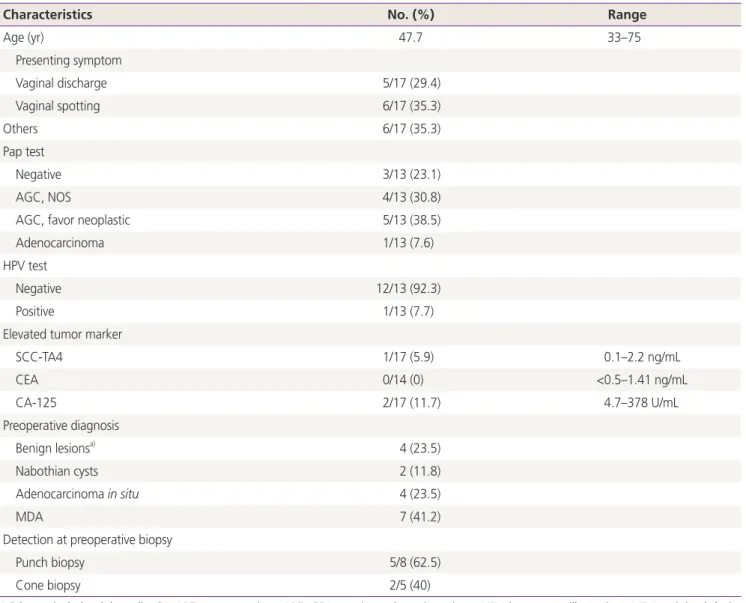
Table 1. Clinical characteristics of patients (n=17)
Characteristics No. (%) Range
Age (yr) 47.7 33–75
Presenting symptom
Vaginal discharge 5/17 (29.4)
Vaginal spotting 6/17 (35.3)
Others 6/17 (35.3)
Pap test
Negative 3/13 (23.1)
AGC, NOS 4/13 (30.8)
AGC, favor neoplastic 5/13 (38.5)
Adenocarcinoma 1/13 (7.6)
HPV test
Negative 12/13 (92.3)
Positive 1/13 (7.7)
Elevated tumor marker
SCC-TA4 1/17 (5.9) 0.1–2.2 ng/mL
CEA 0/14 (0) <0.5–1.41 ng/mL
CA-125 2/17 (11.7) 4.7–378 U/mL
Preoperative diagnosis
Benign lesionsa) 4 (23.5)
Nabothian cysts 2 (11.8)
Adenocarcinoma in situ 4 (23.5)
MDA 7 (41.2)
Detection at preoperative biopsy
Punch biopsy 5/8 (62.5)
Cone biopsy 2/5 (40)
AGC, atypical glandular cells; CA-125, cancer antigen 125; CEA, carcinoembryonic antigen; HPV, human papillomavirus; MDA, minimal devia- tion adenocarcinoma; NOS, not otherwise specified; Pap, Papanicolaou; SCC-TA4, squamous cell carcinoma tumor antigen 4.
a)Leiomyoma, adenomyosis, and hematometra.
Materials and methods
We retrospectively reviewed the medical charts of patients who were diagnosed with MDA (based on histopathological findings) between January 2005 and December 2015, at the Comprehensive Gynecologic Cancer Center of CHA Bundang Medical Center. We analyzed medical records and obtained information regarding clinical characteristics, surgical findings, and oncologic outcomes.
We used the 2014 World Health Organization (WHO) clas- sification for the histopathological classification of cervical adenocarcinoma [6]. The histopathological definition and characteristics of MDA are: 1) a well-differentiated mucinous adenocarcinoma in which most glands are indistinguish- able histologically from normal endocervical glands, 2) a le- sion showing cytologically bland glands of varying sizes and shapes, 3) a lesion showing increased mitotic activity, 4) a lesion with hyperplastic glands at the surface and, 5) lesions showing an increased number of glands deeper than the low- er level in normal endocervical glands. All patients diagnosed with MDA underwent examination by a gynecologic patholo- gist at our hospital. Staging of tumors was performed based on the criteria recommended by the International Federation for Obstetrics and Gynecology. Treatment was initiated with surgery with or without adjuvant therapy except in 3 patients who underwent neoadjuvant chemotherapy. Adjuvant therapy was classified into 3 types: exclusive chemotherapy, exclusive radiotherapy, and concurrent chemoradiation therapy (CCRT).
This study was approved by the Institutional Review Board of the CHA Bundang Medical Center (CHA IRB 2017-09-012).
Ethical approval was provided by the Ethics Committee.
The survival time for each patient was calculated from the date of diagnosis to the date of death with right-censoring on the date of the last follow-up among survivors. Cumula- tive survival probabilities of patients were estimated using the life table method (commonly referred to as the Kaplan–
Meier method). The log-rank test was used to compare the 2 survival curves. Multivariate analysis was performed using Cox regression analysis. Hazard ratios (HRs) with 95% con- fidence intervals (CIs) were reported. The Statistical Package for the Social Sciences (SPSS Inc., Chicago, IL, USA) ver. 16.0 was used for all statistical analyses. A P-value <0.05 was con- sidered statistically significant.
Results
We identified 17 patients for whom clinicopathological infor-
Table 2. Histopathological findings and treatment strategies used (n=17)
Characteristics No. (%)
FIGO stage
IB1 6 (35.3)
IB2 6 (35.3)
IIA 2 (11.8)
IIB 1 (5.9)
IIIB 2 (11.8)
Mean tumor size (cm) 4.01 (range: 1.8–8.0)
Neoadjuvant chemotherapya) 3
Operation 17
Simple hysterectomy±LND 10
Radical hysterectomy±LND 10
Primary 7
Secondaryb) 3
Pathology
MDA alone 14 (82.4)
Mixed typec) 3 (17.6)
LVSI positive 6
Lymph node dissection 9
Metastasis 2
No metastasis 7
Adjuvant therapy
None 4 (23.5)
Chemotherapya) alone 2 (11.8)
RT alone 1 (5.9)
CCRTd)±chemotherapy 10 (58.8)
STK11 mutation status
Test done 3
Negative 3
Positive 0
CCRT, concurrent chemoradiation therapy; FIGO, International Fed- eration for Obstetrics and Gynecology; LND, pelvic and/or para-aortic lymph node dissection; LVSI, lymphovascular space invasion; MDA, minimal deviation adenocarcinoma; RT, radiation therapy; STK11, serine/threonine kinase gene.
a)Cisplatin and etoposide combination chemotherapy; b)Radical parametrectomy after confirmation of MDA following simple hyster- ectomy; c)Mixed with mucinous adenocarcinoma; d)Weekly cisplatin administration.
mation was available. Clinical characteristics of these patients are summarized in Table 1. Their mean age was 47.7 years.
Chief complaints at the time of diagnosis were vaginal spot- ting (6/17, 35.3%) and vaginal discharge (5/17, 29.4%). The Pap test performed in 13 patients revealed negative findings in 3 (3/13, 23.1%) and abnormalities in 10 patients (10/13, 76.9%). Atypical glandular cells were observed in 9 of the 10 patients showing cytological abnormalities. The remaining patient showed an adenocarcinoma. HPV infection was de- tected in 1 patient (1/13, 7.7%). The Pap or HPV tests were not performed in 4 patients. Tumor markers were within the reference range in most patients except 3. Presumed diag- noses before performing a hysterectomy were benign lesions (4/17, 23.5%), nabothian cysts (2/17, 11.8%), adenocarci- noma in situ (4/17, 23.5%), and MDA (7/17, 41.2%). The biopsy-proven diagnostic rate of MDA before surgery was 41.2% (punch biopsy: 5/17, conization: 2/17).
Stage IB disease was observed in 12 (12/17, 70.6%), stage II in 3 (3/17, 17.7%), and stage III in 2 patients (2/17, 11.8%)
(Table 2). The mean tumor diameter was 4.01 cm. Three pa- tients diagnosed with MDA before undergoing the staging operation received 3 cycles of neoadjuvant chemotherapy using cisplatin and etoposide. Ten patients underwent simple hysterectomy. After the diagnosis of MDA was confirmed in incidentally diagnosed lesions following simple hysterectomy, subsequent staging operations including radical paramet- rectomy, bilateral salpingo-oophorectomy, and pelvic and/
or para-aortic lymph node dissection were performed in 3 patients. Radical hysterectomy was initially performed in 7 patients diagnosed with MDA. Fourteen patients (14/17, 82.4%) showed only MDA, whereas 3 (3/17, 17.6%) showed MDA and concomitant mucinous adenocarcinoma. Among the 9 patients who underwent lymph node dissection, lymph node metastasis was detected in 2. Lymphovascular space invasion (LVSI) was positive in 6 patients including 2 with lymph node metastasis. Thirteen patients (13/17, 76.5%) received adjuvant treatment after the initial surgery. Among those who received adjuvant therapy, 2, 1, and 10 patients underwent exclusive chemotherapy, exclusive radiotherapy, and CCRT with or without chemotherapy, respectively. Three patients underwent genetic testing for the STK11 germline mutation to detect PJS, and all patients showed negative findings.
At the time of the last follow-up, 11 patients (11/17, 64.7%) showed no evidence of disease, 2 (2/17, 11.8%) developed recurrence, and 4 (4/17, 23.5%) showed disease persistence. All patients showing recurrence or disease per-
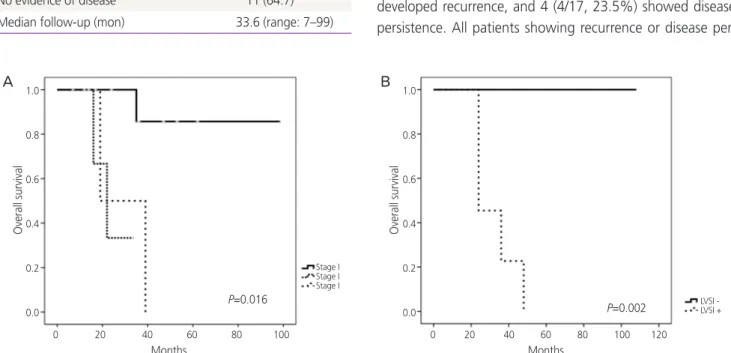
Fig. 1. (A) Kaplan-Meier curve showing the overall survival rate based on stages of minimal deviation adenocarcinoma (P=0.016). (B) Ka- plan-Meier curve showing the overall survival rate based on lymphovascular space invasion (P=0.002).
A B
Overall survival
Months
P=0.016
P=0.002
Stage I Stage I Stage I
LVSI - LVSI +
Months
0 20 40 60 80 100 120 0 20 40 60 80 100
1.0
0.8
0.6
0.4
0.2
0.0
1.0
0.8
0.6
0.4
0.2
0.0
Overall survival
Table 3. Oncological outcomes
Characteristics (n=17) No. (%)
Recurrence or persistence 6 (35.3)
Died of disease 5 (29.4)
Alive with disease 1 (5.9)
No evidence of disease 11 (64.7)
Median follow-up (mon) 33.6 (range: 7–99)
sistence died of the disease except 1 patient who is currently undergoing chemotherapy after recurrence (Table 3).
The median follow-up was 33.6 months (range, 7–99 months). Univariate analysis showed that advanced stage disease (P=0.016) and LVSI (P=0.002) were associated with poor overall survival (OS) rates (Fig. 1); however, other pa- rameters including age (P=0.069) and radicality of hysterec- tomy (P=0.217) were not significantly associated with OS.
Multivariate analysis showed that advanced stage disease was significantly associated with a poor OS rate (HR, 2.92;
95% CI, 1.097–7.746; P=0.032). However, no statistically significant differences in OS were observed with respect to age, type of hysterectomy performed, and LVSI (Table 4).
Discussion
Most cervical cancers are squamous cell carcinomas. Adeno- carcinomas represent 20–25% of all cervical carcinomas [7].
MDA is a rare subtype of cervical mucinous adenocarcinoma accounting for only 1–3% of cervical adenocarcinomas [8].
Adenoma malignum of the uterine cervix was first described in 1870 [1]. The term MDA was proposed by Silverberg and Hurt [9] in 1975 to indicate its resemblance to normal endo- cervical glands and the lack of cellular features of malignancy [10]. Recently, MDA has been reclassified by the WHO as a subcategory of gastric-type mucinous cervical adenocarci-
noma. This categorization is reserved only for the extremely well-differentiated cell types [6].
Based on the literature reviews and meta-analysis of 347 cases of MDA, the mean age at diagnosis is 45 years (range 20–78 years). The major clinical manifestations are profuse vaginal discharge (60.4%) and irregular vaginal bleeding (50.0%) [1]. In this study, the mean age of patients diag- nosed with MDA was 47.7 years. Most patients (64.7%) pre- sented with typical symptoms of vaginal discharge or bleed- ing (Table 1).
Pap and HPV tests serve as routine screening tests for cervi- cal cancer [2,11]. Colposcopically directed punch biopsy or cervical conization can be performed on suspicious cervical lesions. The Pap test used as a diagnostic tool for MDA has shown a limited detection rate (32.7%, 37/113). Literature reviews have shown that cervical biopsies performed in 185 patients demonstrated a detection rate of 50.7%, and cer- vical conization performed in 14 patients demonstrated a detection rate of 100% [1]. In the present study, although a direct comparison was difficult, the detection rates of MDA using cervical cytology, punch biopsy, and conization were 7.6% (1/13), 62.5% (5/8), and 40% (2/5), respectively (Table 1). Adenocarcinoma in situ was detected even after a secondary conization in 2 of 5 patients who underwent con- ization indicating that MDA is usually located deep within the endocervix and that it shows an endophytic and not an exophytic growth pattern, unlike cervical squamous cell
Table 4. Univariate and multivariate analysis of clinicopathological factors associated with overall survival rateRisk factors Univariate analysis
P-value
Multivariate analysis
HR 95% CI P-value
Age (yr) 0.069 0.053–1.938 0.215
≤40 1.00
>40 0.32
Stage 0.016 1.097–7.746 0.032
I 1.00
II & III 2.92
Hysterectomy 0.217 0.063–2.472 0.320
Radical hysterectomy 1.00
Simple hysterectomy 2.56
LVSI involvement 0.002 0.033–2,150,819.194 0.223
None 1.00
Yes 267.74
CI, confidence interval; HR, hazard ratio; LVSI, lymphovascular space invasion.