http://dx.doi.org/10.5468/ogs.2015.58.2.117 pISSN 2287-8572 · eISSN 2287-8580
Introduction
Women with lesser abnormal cervical cytological lesions identified in a Pap smear such as atypical squamous cells of undetermined significance (ASCUS) or low-grade squamous intraepithelial lesion (LSIL) have a small but significantly in- creased risk of developing cervical cancer compared to women with a normal finding on Pap. However, in contrast to the reproducible cytologic classification of LSIL, ASCUS is often an equivocal result and, for that reason, the most common cytologic abnormality, however, the least reproducible [1,2].
To improve the management of women with ASCUS cytology, many studies tried to demonstrate the cost-effectiveness of hu- man papillomavirus (HPV) testing for triage of ASCUS cytology
[3,4]. The proven cost-effectiveness of HPV testing in ASCUS triage led to the 2012 updated consensus guidelines for the
Impact of age on the false negative rate of human papillomavirus DNA test in patients with atypical squamous cells of undetermined significance
Kyu-Hee Won
1, Jae Yeon Lee
1, Hye-Yon Cho
2, Dong Hoon Suh
3, Jae Hong No
3, Yong-Beom Kim
3Department of Obstetrics and Gynecology, 1Seoul National University College of Medicine, Seoul; 2Hallym University Dongtan Sacred Heart Hospital, Hwasung; 3Seoul National University Bundang Hospital, Seongnam, Korea
Objective
Human papillomavirus (HPV) test was incorporated into the triage of lesser abnormal cervical cytologies: atypical squamous cells of undetermined significance (ASCUS) or low-grade squamous intraepithelial lesion (LSIL). This study aimed to evaluate the impact of age on the efficacy of HPV testing in patients with lesser abnormal cervical cytologies.
Methods
A total of 439 patients with ASCUS or LSIL were included. The association between age groups and the diagnostic performances of HPV test for high-grade cervical intraepithelial neoplasia (CIN2+) was evaluated.
Results
Median age was 44 years (range, 17 to 75 years). ASCUS was more frequently observed in older patients while LSIL was more common in younger patients (P=0.002). CIN2+ was found in 11.3% (32/284) of the ASCUS patients and 12.9% (20/155) of patients with LSIL. Older patients with ASCUS showed lower HPV infection rates (P=0.025), but not LSIL (P=0.114). However, the prevalence of CIN2+ was similar between the age groups with ASCUS or LSIL. In patients with ASCUS, the false negative rate of HPV test for CIN2+ was 6.2%. The false negative rate of the HPV test became higher with increasing of the age after the age of 50 (P=0.034).
Conclusion
Our findings suggest that false negative rate of the HPV test for CIN2+ in ASCUS patients older than 50 years might become higher with increasing of the age. Negative HPV results in patients of the age >50 years with ASCUS should be carefully interpreted.
Keywords: Age; Atypical squamous cells of the cervix; Human papillomavirus DNA tests; Uterine cervical dysplasia
Received: 2014.5.13. Revised: 2014.9.5. Accepted: 2014.10.3.
Corresponding author: Yong-Beom Kim
Department of Obstetrics and Gynecology, Seoul National University Bundang Hospital, 82 Gumi-ro 173beon-gil, Bundang- gu, Seongnam 463-707, Korea
Tel: +82-31-787-7253 Fax: +82-31-787-4054 E-mail: [email protected]
Articles published in Obstet Gynecol Sci are open-access, distributed under the terms of the Creative Commons Attribution Non-Commercial License (http://creativecommons.
org/licenses/by-nc/3.0/) which permits unrestricted non-commercial use, distribution, and reproduction in any medium, provided the original work is properly cited.
Copyright © 2015 Korean Society of Obstetrics and Gynecology
management of abnormal cervical cancer screening tests and cancer precursors [5]. According to the guidelines, colposcopy is indicated for all women with HPV-positive ASCUS regardless of the genotyping results, because the 5-year cumulative risk for cervical intraepithelial neoplasia (CIN) 2 or worse (CIN2+) among women testing HPV-positive ASCUS was similar to that of women with LSIL (18% vs. 16%) [6].
By contrast, HPV-negative ASCUS is recommended to be fol- lowed with co-testing at 3 years, because the risks of CIN2+
were similar between HPV-negative ASCUS and negative Pap alone. However, the similarity was found only for women un- der the age of 60 years, after which cancer risk increased for HPV-negative ASCUS versus negative Pap-alone results (aged 60 to 64 years, 0.26% vs. 0.035%, respectively; P=0.3) [6].
A recent epidemiologic study reported that age was a strong determinant of high-risk HPV infection in Korean women with a significant lower infection rate in older than in younger women [7]. There was considerable evidence for the suggested significant impact of age on HPV triage of ASCUS cytology for colposcopy referral [8]. As such, age could be another criterion for improving HPV triage of ASCUS. Nonetheless, there was no study that evaluates the age impact on the diagnostic per- formance of HPV test in lesser abnormal cytologies in Korean women. We, therefore, investigated the impact of age on the diagnostic performance of the HPV test in patients with AS- CUS/LSIL in Korean women.
Materials and methods
1. Patient and data collection
In our retrospective study, a total of 439 consecutive patients who had ASCUS or LSIL results on Pap smear and underwent colposcopic biopsy for the cytologic abnormalities at the Seoul National University Bundang Hospital between January 2010 and December 2011 were included. Women without cor- responding biopsy results were excluded. All the patients had the corresponding HPV DNA testing results, either by hybrid capture or by HPV genotyping, within 2 months before cervi- cal biopsy. Those who had undergone hysterectomy and had a past medical history of cervical cancer or CIN were excluded.
Women who were pregnant at the time of cervical cytology were also excluded. The study protocol was approved by the ethics committee of the Seoul National University Bundang Hospital. Clinicopathologic variables of the patients including age at the time of colposcopy, the results of abnormal cervical
cytologies, HPV DNA test, and punch biopsy were obtained from review of the electronic medical record system. The pa- tients were grouped into five according to the age: ≤30, 31 to 40, 41 to 50, 51 to 60, and >60 years.
2. Cytology and human papillomavirus testing
Cytological diagnoses were classified using the 2001 Bethesda System Nomenclature. Hybrid capture II HPV test (HC II; Di- gene Corporation, Gaithersburg, MD, USA) and GG HPV DNA genotyping chip kit (Goodgene, Seoul, Korea) were used for detecting high-risk HPV infection according to the physician’s preference. HC II testing was performed no later than 5 days after the collection of the specimens according to the manu- facturer’s instructions [9]. The specimens with relative light units/cutoff value ratios >1.0 were considered positive for one or more high-risk HPV genotypes including the following 13 genotypes: HPV genotypes 16, 18, 31, 33, 35, 39, 45, 51, 52, 56, 58, 59, and 68. Another method we used for detecting high-risk HPV infection was the GG HPV DNA genotyping chip kit (Goodgene). This method identifies 40 HPV types including 15 high-risk types (16, 18, 31, 33, 35, 39, 45, 51, 52, 56, 58, 59, 66, 68, and 69). According to the manufacturer’s instruc- tions, genomic DNA extraction, amplification, labeling and hybridization as well as analysis were performed.
3. Colposcopy
Colposcopy with biopsy was performed within 2 weeks after having obtained the above named cytology results. Ectocervi- cal biopsies of visible lesions after application of 3% acetic acid or 4 locations (3, 6, 9, and 12 o’clock direction), if no lesion was visible, were obtained. Endocervical curettage was also performed in women with no lesions. Biopsy specimens were reviewed by an experienced gynecologic pathologist and diag- nosed using standard criteria and the CIN terminology.
4. Statistical analysis
Chi-square test or Fisher’s exact test, when appropriate, were
used for comparing proportions and identifying any statistical
significance of the difference in the sensitivity and specificity of
HPV test between age groups. Test for trend by linear by linear
association was used for the analysis according to the five age
groups. Two-sided P<0.05 was considered statistically signifi-
cant. The SPSS ver. 12.0 (SPSS Inc., Chicago, IL, USA) was used
for data analysis.
Results
1. Patient characteristics
Patient characteristics are shown in Table 1. Median age was 44 years (17 to 75 years). ASCUS was found in 284 (64.7%) and LSIL was found in 155 (35.3%). High-risk HPV was posi- tive in 276 (62.9%) patients. CIN 1, 2, and 3 were diagnosed in 106 (24.1%), 29 (6.6%), and 18 (4.1%), respectively. High- risk HPV infection rate was increased as the severity of CIN lesions on punch biopsy results: 54.1% of patients with nega- tive punch biopsy result, 69.8% of CIN1, 93.1% of CIN2, and 100% of CIN3+. Five (1.1%) had a diagnosis of invasive carci- noma on punch biopsy.
2. Comparisons according to age
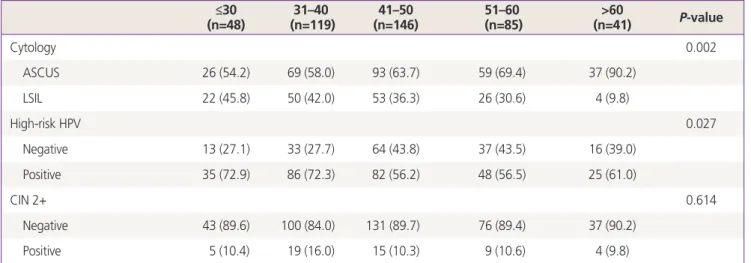
ASCUS was more frequently observed in older patients, while LSIL was more common in younger patients (P=0.002) (Table 2). High-risk HPV infection was more frequently observed in younger patients than older patients (P=0.027). Nevertheless, the proportion of CIN2+ was similar between the age groups (P=0.614). In two separate subgroup analyses of patients with ASCUS (Table 3) and LSIL (Table 4), the decreasing trend of high-risk HPV infection in older women was observed in the patients with ASCUS (P=0.025), but not in the patients with LSIL (P=0.114). The prevalence of CIN2+ lesions was not dif- ferent between the age groups not only in the patients with ASCUS (P=0.303) but also in the patients with LSIL (P=0.860).
3. Impact of age on the diagnostic performances of human papillomavirus DNA test
In patients with ASCUS, sensitivity, specificity, positive predic- tive value, negative predictive value, and accuracy of the HPV test for CIN2+ lesions were 93.8%, 38.5%, 16.2%, 98.0%, and 37.7%, respectively (Table 5). In patients with LSIL, the cor- responding values of HPV test for CIN2+ lesions were 100%, 47.4%, 22.0%, 100%, and 54.2%, respectively. After group- ing the patients with ASCUS into five age groups, the first three age groups (≤30, 31 to 40, 41 to 50 years) had a false negative rate 0%. After the age of 50 years, the increasing trend of the false negative rate in older women was observed (χ
2=4.511,
P=0.034). However, the false negative rates of the two old-est age groups were not significantly higher than that of the youngest age group (16.7%, 33.3%, and 100% for 51 to 60,
>60, and ≤30 years, respectively, P=0.999). By contrast, the sen- sitivity of 100% of HPV test for CIN2+ lesions in women with LSIL was not changed in every five age groups. The specificities of older age groups were not higher than that of age ≤30 years in women with ASCUS and LSIL (Table 5). Any increasing trend of specificity was not observed in older women with ASCUS (χ
2
=2.975, P=0.085) and LSIL (χ
2=2.997, P=0.083).
Discussion
In this study we evaluated the impact of age on the HPV triage in patients with lesser abnormal cervical cytologies. The more severe the CIN lesion was, the more frequently a high-risk HPV infection was observed. Despite the lower rate of high-risk HPV infection in older than in younger patients, there was no difference of CIN2+ lesions between the age groups, this trend
Table 1. Patient characteristics (n=439)Variable No (%) High-risk HPV
infection
Age (yr) 44 (17–75)
≤30 48 (10.9) 35 (72.9)
31–40 119 (27.1) 86 (72.3)
41–50 146 (33.3) 82 (56.2)
51–60 85 (19.4) 48 (56.5)
>60 41 (9.3) 25 (61.0)
Cervical cytology
ASCUS 284 (64.7) 185 (65.1)
LSIL 155 (35.3) 91 (58.7)
HPV DNA test
Negative 163 (37.1) -
Low-risk 20 (4.6) -
High-risk 276 (62.9) -
Other types 65 (14.8) -
Punch biopsy
Negative 281 (64.0) 152 (54.1)
CIN 1 106 (24.1) 74 (69.8)
CIN 2 29 (6.6) 27 (93.1)
CIN 3 18 (4.1) 18 (100)
Carcinoma 5 (1.1) 5 (100)
Values are presented as median (range) or n (%).
HPV, human papillomavirus; ASCUS, atypical squamous cells of un- determined significance; LSIL, low-grade squamous intraepithelial lesion; CIN, cervical intraepithelial neoplasia.
Table 2. Comparison of the patients according to the age groups (n=48)≤30 31–40
(n=119) 41–50
(n=146) 51–60
(n=85) >60
(n=41) P-value
Cytology 0.002
ASCUS 26 (54.2) 69 (58.0) 93 (63.7) 59 (69.4) 37 (90.2)
LSIL 22 (45.8) 50 (42.0) 53 (36.3) 26 (30.6) 4 (9.8)
High-risk HPV 0.027
Negative 13 (27.1) 33 (27.7) 64 (43.8) 37 (43.5) 16 (39.0)
Positive 35 (72.9) 86 (72.3) 82 (56.2) 48 (56.5) 25 (61.0)
CIN 2+ 0.614
Negative 43 (89.6) 100 (84.0) 131 (89.7) 76 (89.4) 37 (90.2)
Positive 5 (10.4) 19 (16.0) 15 (10.3) 9 (10.6) 4 (9.8)
Values are presented as n (%). The scale of age is year.
ASCUS, atypical squamous cells of undetermined significance; LSIL, low-grade squamous intraepithelial lesion; HPV, human papillomavirus;
CIN, cervical intraepithelial neoplasia.
Table 3. Comparison of the prevalence of high-risk HPV and CIN2+ lesion between age groups in patients with ASCUS (n=284) (n=26)≤30 31–40
(n=69) 41–50
(n=93) 51–60
(n=59) >60
(n=37) P-valuea)
High-risk HPV 0.025
Negative 6 (23.1) 16 (23.2) 38 (40.9) 25 (42.4) 14 (37.8)
Positive 20 (76.9) 53 (76.8) 55 (59.1) 34 (57.6) 23 (62.2)
CIN2+ 0.303
Negative 23 (88.5) 58 (84.1) 84 (90.3) 53 (89.8) 34 (91.9)
Positive 3 (11.5) 11 (15.9) 9 (9.7) 6 (10.2) 3 (8.1)
Values are presented as n (%). The scale of age is year.
HPV, human papillomavirus; CIN, cervical intraepithelial neoplasia; ASCUS, atypical squamous cells of undetermined significance.
a)Test for trend by linear by linear association.
Table 4. Comparison of the prevalence of high-risk HPV and CIN2+ lesion between age groups in patients with LSIL (n=155) (n=22)≤30 31–40
(n=50) 41–50
(n=53) 51–60
(n=26) >60
(n=4) P-valuea)
High-risk HPV 0.114
Negative 7 (31.8) 17 (34.0) 26 (49.1) 12 (46.2) 2 (50.0)
Positive 15 (68.2) 33 (66.0) 27 (50.9) 14 (53.8) 2 (50.0)
CIN2+ 0.860
Negative 20 (90.9) 42 (84.0) 47 (88.7) 23 (88.5) 3 (75.0)
Positive 2 (9.1) 8 (16.0) 6 (11.3) 3 (11.5) 1 (25.0)
Values are presented as n (%). The scale of age is year.
HPV, human papillomavirus; CIN, cervical intraepithelial neoplasia; LSIL, low-grade squamous intraepithelial lesion.
a)Test for trend by linear by linear association.
was observed in ASCUS, but not LSIL. In contrast to the consis- tent sensitivity of 100% of high-risk HPV test for CIN2+ lesions in every age group with LSIL, the sensitivity of 100% in young patients ≤30 years with ASCUS decreased to 66.7% in old pa- tients aged >60 years. In other words, the false negative rate of older patients >60 years with ASCUS was as high as 33.3%, compared to 0% in the youngest counterpart.
The problem of the HPV test as the preferred option for ASCUS triage is the poor specificity for CIN2+ lesions, which could lead to over-diagnosis of regressive CIN2+, subsequently excessive colposcopy referral, particularly in younger women [10]. There are consistent data of higher prevalence of high- risk HPV infection in younger women than the older counter- part. Many HPV infections in women under age 30 are recently acquired infections, most of which will naturally clear in a few years without progressing, even in case of CIN 2, thus HPV tri- age may be less efficient for those women [11]. Poor specificity of a positive HPV test for CIN2+ lesions in younger women in our study was also confirmed in a recently published popu- lation-based study from Norway, in which the specificity was
47%, 71%, and 82% for the age groups <34, 34 to 50, and
>50 years, respectively [12].
As the age advanced, however, the specificity increased whereas the sensitivity decreased. These findings were consis- tent with those of the study by Stoler et al. [13] reporting that the sensitivity of HPV test declined dramatically with increasing age, 93.3% in 21 to 29 years and 67.7% in 40 years or older, whereas specificity improved. They explained that the de- creased sensitivity was most likely owing to pathologic misclas- sification of non-CIN lesions as CIN2+ lesions in older women because of age-related mimics. Furthermore, they mentioned that increased numbers of a false negative HPV test results might occur like in our study [13]. The false negative rate of the HPV test in ASCUS/ LSIL has been reported as 3.7% to 18.2% [14-16]. Jastania et al [17]. reported the characteristics of false negative HC II testing. They stated that HPV DNA was present in the assessed samples, but the level of viral DNA was less than the amount necessary for the result to be considered positive. They also mentioned unsatisfactory cytologic sample for evaluation virtually devoid of cells as a possible reason be-
Table 5. Age impact on the diagnostic performance of HPV DNA test for CIN2+ lesionsSensitivity (%) Specificity (%) PPV (%) NPV (%) Accuracy (%)
ASCUS
High risk-HPV 93.8 38.5 16.2 98.0 37.7
≤30 (n=26) 100 26.1 15.0 100 34.6
31–40 (n=69) 100 27.6 20.8 100 39.1
41–50 (n=93) 100 45.2a) 16.4 100 50.5
51–60 (n=59) 83.3b) 45.3c) 14.7 96.0 49.2
>60 (n=37) 66.7b) 38.2d) 8.7 92.9 40.5
LSIL
High risk-HPV 100 47.4 22.0 100 54.2
≤30 (n=22) 100 35.0 13.3 100 40.9
31–40 (n=50) 100 40.5 24.2 100 50.0
41–50 (n=53) 100 55.3e) 22.2 100 60.4
51–60 (n=26) 100 52.2f) 21.4 100 57.7
>60 (n=4) 100 50.0g) 66.7 100 75.0
The scale of age is year.
HPV, human papillomavirus; CIN, cervical intraepithelial neoplasia; PPV, positive predictive value; NPV, negative predictive value; ASCUS, atypical squamous cells of undetermined significance; LSIL, low-grade squamous intraepithelial lesion.
P-values by test for trend by linear by linear association: a)0.098 (Fisher’s exact test); b)0.034 and by chi-square test compared with age ≤30, 0.999 (Fisher’s exact test); c)0.116; d)0.340; e)0.128; f)0.258; g)0.538 (Fisher’s exact test).