pISSN 2289-0203ㆍeISSN 2383-7101 https://doi.org/10.15747/jcn.2016.8.3.77
체외막형 산화기를 시행한 심장내과 중환자실 입원 환자의 경장영양 지원: 관찰 연구
김성혜1, 신윤진2, 라미용1, 조영연1, 양정훈3,4, 조양현3,5, 서지영3,6, 강보리2, 김양하2
1삼성서울병원 영양팀, 2이화여자대학교 식품영양학과, 성균관대학교 의과대학 3중환자의학과, 4순환기내과, 5흉부외과, 6호흡기내과
Enteral Nutrition Support in Coronary Care Unit Patients Receiving Extraocorporeal Membrane Oxygenation: An Observational Case Study
Sung Hye Kim1, Yoonjin Shin2, Mi Yong Rha1, Young Yun Cho1, Jeong Hoon Yang3,4, Yang-Hyun Cho3,5, Ji Young Seo3,6, Bori Kang2, Yangha Kim2
1Department of Dietetics, Samsung Medical Center, 2Department of Nutritional Science and Food Management, Ewha Womans University, 3Department of Critical Care Medicine, 4Division of Cardiology, Department of Medicine, 5Department of Thoracic and Cardiovascular Surgery, 6Division of Pulmonary and Critical Care Medicine, Department of Medicine, Samsung Medical Center, Sungkyunkwan University School of Medicine, Seoul, Korea
Purpose: Enteral feeding remains controversial in patients receiving extracorporeal membrane oxygenation (ECMO), particularly in those treated with a high-dose vasopressor. This study examined the safety and feasibility of enteral nutritional support for patients undergoing ECMO in a cardiac care unit (CCU).
Methods: Adult patients admitted to the CCU undergoing ECMO from January 2014 to May 2015 were included. Patients with
<48 hours of support, undergoing ECMO at another hospital, and inaccurate medical records were excluded.
Results: Among the 14 patients undergoing ECMO in the CCU, 2 patients were diagnosed with malnutrition and the others were in the normal state in the initial assessment. On the other hand, they had the malnutrition risk factors (anorexia, weight loss, fluid retention, and hypermetabolic state). Thirteen patients received enteral nutrition and 1 patient had possible oral intake.
The average initiation day of enteral nutrition was 2.0±1.6 days on ECMO. The mean duration of enteral nutrition was 5.2±4.9 days and the target goal was achieved within 3 days. There were no serious adverse effects for enteral nutrition but 3 patients had gastrointestinal problems (diarrhea and anorexia), and gastrointestinal bleeding occurred in 1 patient. In 1 case, enteral nutrition had to be stopped due to the prone position. Overall, 5 patients were cured, 3 patients recovered through heart transplantation, and 6 patients died.
Conclusion: Most CCU patients receiving ECMO were well nourished but had the malnutrition risk factors in progress. These results suggest that enteral feeding might be safe and feasible in patients treated with ECMO but there were minor side effects.
Key Words: Enteral nutrition, Extracorporeal membrane oxygenation, Malnutrition
Received Dec 13, 2016; Revised Dec 21, 2016; Accepted Dec 21, 2016 Correspondence to Yangha Kim
Department of Nutritional Science and Food Management, Ewha Womans University, 52 Ewhayeodae-gil, Seodaemun-gu, Seoul 03760, Korea
Tel: +82-2-3277-3101, Fax: +82-2-3277-4425, E-mail: [email protected] Conflict of interest: None.
This is an Open Access article distributed under the terms of the Creative Commons Attribution Non-Commercial License (http://creativecommons.org/licenses/by-nc/4.0) which permits unrestricted non-commercial use, distribution, and reproduction in any medium, provided the original work is properly cited.
서 론
중환자에게 적절한 영양지원은 환자의 치유와 회복에 중요한 영향을 미친다. 경장영양은 위 장관이 정상적으로 기능을 하고 있으나, 경구 섭취 시 흡인의 위험이 있거나 경구 섭취량이 요구 량에 미치지 못하는 경우에 우선적으로 고려되는 영양지원 방 법이다. 조기 경장영양 지원은 정맥영양과 비교하여 비용이 저
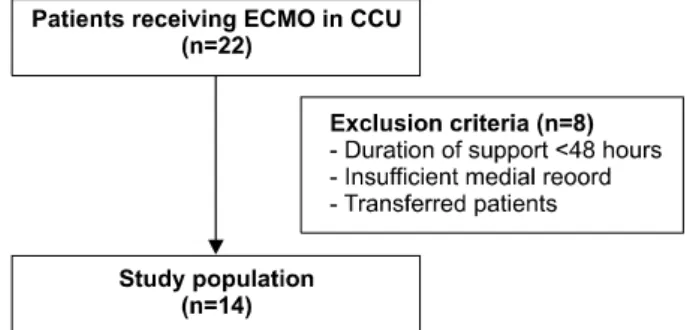
Fig. 1. Study participants. ECMO = extracorporeal membrane oxygenation; CCU = coronary care unit.
렴하고, 장점막을 사용함으로써 장 기능에 긍정적인 영향을 주 며, 감염성 합병증을 감소시키는 장점이 있어 중환자에서 적극 권장되고 있다.1-4 하지만 흡인으로 인한 저산소증이나 폐렴과 같은 합병증 등의 이유로 경장영양이 지연되거나 중단되어 환 자의 영양요구량을 충족시키지 못하는 경우가 빈번하다.
체외막형 산화기(extracorporeal membrane oxygenation, ECMO)는 심장 또는 폐 기능이 회복될 때까지 심폐 기능을 보 조하는 장치이다.5 최근 국내 이용사례가 증가되고 있으며 그로 인한 환자의 생존율 및 치료성적 향상이 보고되고 있다.6,7 ECMO 적용환자는 약물로 인한 소화기 문제와 치료적 금식으 로 인한 영양공급량의 부족이 나타날 수 있으며, 대사적 요구량 이 증가하면서 지속적인 이화작용과 함께 단백질 분해가 일어 난다.8,9 성공적 치료로 회복기에 들어서도 단백질 파괴는 지속 되는 것으로 알려져 있으며, 이 같은 대사적 손실은 중증도에 비 례한다. ECMO 적용환자가 퇴원 후에 일상 생활로 복귀하거나, 심폐이식 후에 생존이 가능할지까지 고려한다면 적극적인 영양 지원 계획이 필수적이다.10
ECMO 적용환자는 대개 인공호흡기(mechanical ventilator) 를 지니고 있고 고용량의 승압제 사용에 따른 혈역학적 불안정 상태가 자주 발생하므로 영양지원이 간과될 수 있다.10 소화기 문제가 동반되지 않는다면 경장영양이 우선시되고 있으나, ECMO 적용환자는 중환자가 대부분이기 때문에 무리한 경장 영양 지원은 장허혈을 초래하여 패혈증 및 다장기부전을 일으 킬 수 있다.11 또한, 승압제 사용으로 인한 장내로의 관류(splan- chnic perfusion) 또는 장누공(bowel perforation) 위험이 동 반되므로 경장영양 지원을 제한하기도 한다.12-14 하지만 최근 연구에서는 승압제의 종류와 사용량, 소화기 부적응 증상(잔여 물 증가, 복부통증, 복부팽만 등)을 자세히 관찰하면서 비위관 을 통한 경장영양을 시행하면 비교적 안전하다는 결과가 보고 되고 있다.15,16
따라서 본 연구에서는 심장내과 중환자실에 입원한 ECMO 적용환자들의 임상적 특성, 영양상태, 경장영양 지원 순응도 등 을 관찰하여 ECMO 적용환자의 경장영양 지원 안정성과 유용 성에 대한 기초자료로 활용하고자 하였다.
대상 및 방법
1. 연구 대상 및 기간
2014년 1월 1일부터 2015년 5월 31일까지 순환기내과 소속 으로 입원하여 심장내과 중환자실에서 ECMO를 시행 받은 14 명의 환자를 대상으로 하였다(Fig. 1). ECMO 적용기간이 48 시간 이내이거나, 타 병원에서 ECMO를 적용한 후 전원된 경
우, 관련 전자의무기록이 부정확한 경우는 제외하였다.
2. 연구 내용 및 방법
자료의 수집은 삼성서울병원 임상연구 윤리심의위원회의 승 인(IRB no. 2016-2715-033-011) 하에 시행되었으며, 연구대상 자의 전자의무기록을 후향적으로 검토하여 아래의 자료를 수집 하였다.
1) 임상적인 특성
대상자의 나이, 성별, 지속적 신대체 요법(continuous renal replacement therapy, CRRT) 여부, 인공호흡기 적용 여부, 고 용량 노르에피네프린 적용 여부, ECMO의 종류, 사용기간, 적 용 원인 등에 대해 조사하였다.
2) ECMO 삽입 당시 영양상태
키, 체중, 체질량지수(body mass index, BMI)를 조사하고 아 시아 태평양 기준에 의하여 비만을 분류하였다.17 혈중 생화학적 지표(hemoglobin [Hb], albumin, cholesterol, total lympho- cyte count [TLC], blood urea nitrogen [BUN], creatinine, white blood cell, absolute neutrophil count [ANC], C-re- active protein [CRP])를 조사하였으며, 삼성서울병원 영양검색 도구(Samsung Medical Center [SMC]-nutrition screening index)를 이용하여 영양불량위험도를 평가하였다(Table 1). 이 외 영양상태에 영향을 줄 수 있는 동반 증상 및 질환으로 식욕부 진, 입원 후 체중감소 여부, 체액저류(fluid retention, 입원 후 체 중증가 ≥2 kg),18 당뇨 진단 여부, 신장질환 진단 여부, 대사항진 상태(CRP 상승 ≥5 mg/dL)에19 대해 조사하였다.
3) 경장영양 지원 순응도
European Society for Clinical Nutrition and Metabolism (ESPEN)과 American Society for parenteral and enteral
Table 1. Nutrition screening index (Samsung Medical Center)
Nutrition screening index A (mild) B (moderate) C (severe)
TSF/MAMC 25∼5th 15∼5th <5th
%IBW 80∼89 70∼79 <70
%UBW 85∼90 75∼84 <75
Weight loss (%) <5%/mo
<10%/6 mo
>5%/mo
>10%/6 mo
>2%/wk
>20%/6 mo
Albumin (g/dL) 2.8∼3.2 2.1∼2.7 <2.1
Total lymphocyte (cells/mm3) 1,200∼1,500 800∼1,200 <800
Normal = less than one B; Moderate malnutrition = more than two B, or one C; Severe malnutrition = more than two C; TSF = triceps skinfold thickness; MAMC = mid-arm muscle circumference; IBW = ideal body weight; UBW= usual body weight.
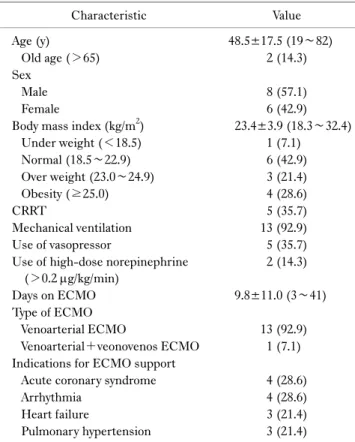
Table 2. Clinical characteristics (n=14)
Characteristic Value
Age (y) 48.5±17.5 (19∼82)
Old age (>65) 2 (14.3)
Sex
Male 8 (57.1)
Female 6 (42.9)
Body mass index (kg/m2) 23.4±3.9 (18.3∼32.4)
Under weight (<18.5) 1 (7.1)
Normal (18.5∼22.9) 6 (42.9)
Over weight (23.0∼24.9) 3 (21.4)
Obesity (≥25.0) 4 (28.6)
CRRT 5 (35.7)
Mechanical ventilation 13 (92.9)
Use of vasopressor 5 (35.7)
Use of high-dose norepinephrine (>0.2 g/kg/min)
2 (14.3)
Days on ECMO 9.8±11.0 (3∼41)
Type of ECMO
Venoarterial ECMO 13 (92.9)
Venoarterial+veonovenos ECMO 1 (7.1) Indications for ECMO support
Acute coronary syndrome 4 (28.6)
Arrhythmia 4 (28.6)
Heart failure 3 (21.4)
Pulmonary hypertension 3 (21.4)
Values are presented as mean±standard deviation (range) or number (%).
CRRT = continuous renal replacement therapy; ECMO = extra- corporeal membrane oxygenation.
Nutrition (ASPEN) 가이드라인20-22에 근거하여 시행되고 있 는 원내 중환자실 경장영양 지원 프로토콜을 적용하여 목표량은 20∼25 kcal/kg으로 산정하였고 24∼48시간 이내 지속적인 영 양공급을 시행하였다. ECMO 삽입 및 제거 시점에 경장영양 지원 여부를 조사하였으며, 경장영양 지원에 대한 순응도를 관 찰하기 위해 경장영양 공급 기간 및 공급량, 목표량에 대한 경장 영양 공급 비율, 경장영양에 대한 합병증, 재원기간 동안의 예후 를 조사하였다.
3. 통계학적 분석
수집된 자료는 IBM SPSS Statistics ver. 20.0 (IBM Co., Armonk, NY, USA)을 이용하여 분석하였다. 범주형 변수들은 빈도와 백분율로 나타내었고, 연속형 변수들은 평균±표준편차 로 요약하였다.
결 과
1. 임상적인 특성
대상자의 임상적 특성은 Table 2와 같았다. 평균 연령은 48.5±17.5세였으며, 남성은 8명(57.1%), 여성은 6명(42.9%) 이었다. CRRT는 5명(35.7%), 인공호흡기는 13명(92.9%)이 이용하고 있었으며, 고용량 노르에피네프린 사용은 2건 (14.3%)으로 나타났다. Venoarterial ECMO를 주로 사용하였 고(13명, 92.9%), venoarterial ECMO와 venovenous ECMO 를 병행하여 사용한 경우가 있었다(1명, 7.1%). 평균 ECMO 사용기간은 9.8±11.0일이었다. ECMO 삽입 적용 원인은 급성 관상동맥증후군 4명(28.6%), 부정맥 4명(28.6%), 심부전 3명 (21.4%), 폐고혈압 3명(21.4%)으로 나타났다.
2. 영양상태 평가 1) 체질량지수
ECMO 적용환자의 BMI는 평균 23.4±3.9 kg/m2이었다 (Table 2). 저체중은 1명(7.1%), 정상체중은 6명(42.9%), 과체 중은 3명(21.4%), 비만은 4명(28.6%)으로 나타났다.
Table 3. Biochemical data and malnutrition
Variable Value
Hb (g/dL) 11.8±2.5 (9.0∼16.7)
Albumin (g/dL) 3.5±0.6 (2.3∼4.5)
Cholesterol (mg/dL) 130.0±41.8 (45.0∼213.0) TLC (cells/mm3) 1,741.4±1,864.7 (190.0∼7,540.0)
BUN (mg/dL) 32.5±24.2 (5.9∼90.8)
Cr (mg/dL) 1.9±2.3 (0.4∼9.9)
WBC (L) 10,800.0±5,500.0 (4,120.0∼20,400.0) ANC (L) 7,400.0±4,500.0 (2,410.0∼18,970.0)
CRP (mg/dL) 3.9±5.7 (4.1∼20.4)
Moderate malnutritiona 2 (14.3)
Values are presented as mean±standard deviation (range) or number (%).
Hb = hemoglobin; TLC = total lymphocyte count; BUN = blood urea nitrogen; Cr = creatinine; WBC = white blood cell; ANC = absolute neutrophil count; CRP = C-reactive protein.
aMalnutrition was estimated by using Samsung Medical Center- nutrition screening index.
Table 5. Enteral nutrition support
Variable Value
Enteral nutrition
Yes 13 (92.9)
No 1 (7.1)
Initiation day of enteral nutrition 2.0±1.6
1 day on ECMO 6 (42.9)
2 day on ECMO 2 (14.3)
3 day on ECMO 2 (14.3)
4 day on ECMO 2 (14.3)
5 day on ECMO 1 (7.1)
Duration of enteral nutrition (day) 5.2±4.9 (0∼20) Complication of enteral nutrition
Good compliance 8 (57.1)
Anorexia 1 (7.1)
Diarrhea 2 (14.3)
Bleeding 1 (7.1)
Prone position 1 (7.1)
Post of enteral nutrition
Cure 5 (35.7)
Heart transplantation 3 (21.4)
Mortality 6 (42.9)
Values are presented as number (%) or mean±standard deviation (range).
ECMO = extracorporeal membrane oxygenation.
Table 4. Comorbid conditions
Variable Value
Anorexia 5 (35.7)
Weight loss 1 (7.1)
Fluid retention 4 (28.6)
Diabetes 4 (28.6)
Renal failure 7 (50.0)
Hypermetabolic state 4 (28.6)
Values are presented as number (%).
2) 생화학적 지수, 영양불량률
Hb는 11.8±2.5 g/dL, albumin은 3.5±0.6 g/dL로 정상범주 로 나타났다(Table 3). SMC-nutrition screening index를 사 용하여 평가한 결과, 심한 영양불량은 없었으며 중정도 영양불 량이 2명(14.3%) 관찰되었다. BUN은 32.5±24.2 mg/dL, CRP 는 3.9±5.7 mg/dL로 다소 높은 수치를 나타냈으며, ANC 7,400.0±4,500.0 L로 다소 낮은 수치를 나타냈다.
3. 동반 증상 및 질환
동반증상 및 질환을 조사한 결과(Table 4), 신장질환 7명 (50.0%), 과대사 상태(hypermetabolic state) 4명(28.6%), 식 욕부진 5명(35.7%), 체액저류 4명(28.6%), 당뇨 4명(28.6%), 체중감소 1명(7.1%) 순으로 나타났다.
4. 경장영양 지원 순응도 1) 경장영양 지원
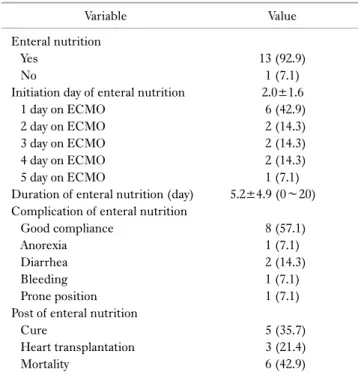
ECMO 적용환자 중 13명(92.9%)에게 경장영양이 지원되었
으며, 1명(7.1%)은 경구식이가 공급되었다(Table 5). 경장영 양 지원 시작시점은 ECMO 삽입 후 평균 2.0±1.6일에 시행되 었다. 경장영양 지원 기간은 약 5.2±4.9일이었다. 경장영양 시 행 후 3일에는 경장영양 공급량이 약 1,200 kcal를 초과하였으 며 목표량의 약 80% 수준에 도달하였다(Table 6).
2) 경장영양 지원 경과
경장영양 지원 후 설사 발생은 2명(14.3%), 식욕부진 1명 (7.1%), 소화기 출혈 1명(7.1%), 호흡기 문제(prone position 시행) 1명(7.1%)으로 나타났다(Table 5). 추후 증상 호전되어 치유된 경우는 5명(35.7%)으로 조사되었으며, 3명(21.4%)은 심장이식을 통해서 회복하였다. 사망한 환자는 6명(42.9%)이 었다.
고 찰
중환자들에게 있어 경장영양은 우선 시 권고되고 있으며 장 기능 유지, 스트레스 및 면역반응 조절, 질환의 중증도 개선에 장점을 가지고 있다.21 하지만 환자의 혈역학적 상태가 불안정 하거나 고용량의 승압제를 사용하게 되는 경우에는 경장영양을 진행하는 데 어려움이 따르며, venoarterial ECMO를 시행하게 되는 중증 심폐부전 상태에서는 초기 영양상태가 비교적 양호
한 환자들의 영양지원이 간과되기 쉬운 것이 현실이다. 따라서 본 연구에서는 ECMO 시행한 사례들을 고찰해보며 경장영양 의 안정성과 유용성에 대해 알아보고자 하였다.
본 연구대상자의 임상적 특성을 조사한 결과, 연령 분포가 다 양할 뿐만 아니라 Ridley 등10과(42세) Ferrie 등23의(44세) 연 구대상자와 비교하여 높은 연령을 나타내었다. ECMO 삽입 원 인은 부정맥, 급성 관상동맥증후군으로 주된 요인이었다. 대부 분 인공호흡기를 사용하고 있었으며 CRRT 및 고용량 승압제 적용 사례가 있는 것으로 보아 대다수의 환자가 장기부전을 동 반한 혈역학적 불안정한 상태임을 알 수 있었다.
대상자의 영양상태 분석한 결과, 대상자의 49.5%가 과체중 또는 비만이었고 영양불량 비율이 낮은 편이어서 경장영양 진 행 여부를 고민하게 되는 요인으로 생각되었다. 하지만 면역 수 치(ANC)의 저하, CRP의 상승과 같은 혈중 생화학 지표뿐만 아니라 식욕부진, 체액저류, 체중감소 등의 증상으로 미루어 볼 때 면역상태가 저하된 잠재적인 영양불량 상태로 짐작할 수 있 었다. Corkins 등24의 연구에서는 영양불량을 진단할 때 단순히 체위만 측정하는 것이 아니라 질병력(고혈압, 만성호흡기질환, 당뇨, 간질환, 소화기질환 등), 체액저류, 알코올, 약물, 소화기 문제 등을 고려하여 판정한다고 제언하고 있어 이를 뒷받침해 주었다. 이러한 조사 결과를 종합할 때, 본 연구대상자들은 초기 영양상태는 양호하지만 추후 영양불량 위험이 높을 것으로 예 상되므로 영양 공급이 필요하다고 판단되었다.
경장영양 지원 시점은 대다수 ECMO 삽입 후 평균 2.0±1.6 일째로 나타나 중환자실 입실 후 24∼48시간 이내 영양지원을 시행하고 있는 원내 중환자 경장영양 프로토콜이 적절하게 적 용되고 있음을 알 수 있었으며, ECMO 삽입 3일째에는 공급 목 표량의 80%까지 도달한 것으로 나타났다. 대상 환자의 절반 이 상이 양호한 순응도를 나타냈으며, 추후 치유되거나 심장이식 을 시행하는 예후를 보이기도 하였다. Ferrie 등23의 연구에 따 르면, venoarterial ECMO 적용환자에게 경장영양을 실시한 결 과, 평균 4일 후에 목표율에 도달하는 것으로 나타났으며 절반 이상의 환자가 부적응 증상 없이 양호한 순응도를 나타내었다.
심장외과계 중환자를 대상으로 한 선행연구에서는 ECMO 적 용환자에게 경장을 실시하여 목표량의 70%에 도달하는 데 1주 일이 소요되었으며 심각한 부작용은 나타나지 않았고 높은 생 존율(86%)을 보고하였다.25 따라서 ECMO 적용환자의 경장영 양은 대사적 안정성을 고려하여 진행된다면, 효율적인 영양 공 급 경로가 될 수 있을 것으로 생각된다.
현재 ECMO 적용환자들을 위한 경장영양 지원 지침으로 알 려져 있는 것은 없다. 하지만 혈역학적 상황과 약물 사용 등에 있어서 임상 양상이 매우 유사한 인공좌심실보조기구(ventri- Table 6. Energy delivery and target delivery rate Day 1Day 2Day 3Day 4Day 5Day 6Day 7Day 8Day 9Day 10 Case 1202 (14.4)200 (14.3) Case 2154 (11)765 (47.8)1,010 (63.1)548 (34.3)1,582 (98.9)1,477 (92.3)969 (60.6)1,065 (66.6)728 (45.5)1,369 (91.3) Case 340 (2.9)80 (5.3) Case 4266 (19)78 (6.5) Case 5141 (10.1)932 (66.6)1,372 (98)1,372 (98)464 (33.1) Case 6200 (14.3)710 (47.3)292 (19.5)955 (63.7)753 (50.2)808 (53.9) Case 773 (5.2)272 (18.1) Case 8340 (24.3)998 (66.5)1,672 (111.5)420 (28) Case 9273 (19.5)750 (46.9)1,080 (67.5)1,559 (97.4)1,438 (89.9)1,302 (81.4)1,590 (99.4)1,554 (97.1)1,252 (78.3) Case 10299 (21.4)398 (28.4) Case 1160 (4.3)821 (54.7)1,472 (98.1)1,533 (102.2)1,472 (98.1)1,464 (97.6)1,471 (98.1)378 (25.2) Case 12370 (26.4)1,191 (74.4)1,619 (101.2)1,180 (73.8)240 (15.0) Case 13450 (32.1)1,306 (93.3)1,349 (96.4)1,349 (96.4)1,400 (100)1,400 (100)1,400 (100) Mean (range)220.6 (40∼450)653.9 (78∼1,306)1,233.3 (292∼1,672)1,114.5 (420∼1,559)1,049.9 (240∼1,582)1,290.2 (808∼1,477)1,343.0 (969∼1,590)999.0 (378∼1,554)990.0 (728∼1,252)1,369 (1,369) Values are presented as energy delivery level, kcal (target delivery rate, %).
cular assist device) 사용 환자들을 대상으로 한 영양 평가 및 관리 방법을 참고할 수 있다.26 중환자실 입원 후 24∼48시간 이 내에 공급되는 초기 경장영양 지원은 소화기 순응도의 근접 모 니터링이 가능하며 혈역학적으로 안정된 환자이거나 약물사용 이 특정 용량 이하(epinephrine ≤5 g/min, norepinephrine
≤5 g/min, dopamin ≤10 g/min, vasopressin ≤0.04 units/min, milrinone ≤0.375 g/kg/min)인 경우에 권장하고 있다.
본 연구는 다음과 같은 한계를 갖는다. 영양 지원으로 인한 임 상적 경과는 환자의 상태에 큰 영향을 받는데, 본 연구대상자는 다양한 연령 분포와 질병 상태를 가지고 있기 때문에 독립적인 영양지원 효과가 반영되기 어려웠다. 또한, 전자의무기록에만 의존하는 후향적 연구로 기존에 시행한 검사 결과 외의 요인은 검토할 수 없었다. 이러한 한계점에도 불구하고, ECMO 적용 환자의 경장영양지원을 보고한 국내 사례가 거의 없는 상황에 서 ECMO를 적용한 심장내과 중환자실 환자를 대상으로 경장 영양 순응도를 조사한 연구라는 점에 의의가 있다.
결 론
심장내과 중환자실에서 ECMO 적용환자들에게 경장영양을 공급한 결과, 소화기 문제를 제외하고는 대다수 양호한 순응도 를 나타냈으며 추후 치유되거나 심장이식을 시행하는 예후를 보이기도 하였다. 영양 상태의 개선은 임상적 치료 효과 향상에 기여할 수 있으므로, ECMO 적용환자들의 적극적인 경장영양 지원을 위하여 순응도 향상을 모색하는 후속 연구가 필요할 것 으로 생각된다.
REFERENCES
1. Bower RH, Talamini MA, Sax HC, Hamilton F, Fischer JE.
Postoperative enteral vs parenteral nutrition. A randomized controlled trial. Arch Surg 1986;121(9):1040-5.
2. Twomey PL, Patching SC. Cost-effectiveness of nutritional support. JPEN J Parenter Enteral Nutr 1985;9(1):3-10.
3. Levine GM, Deren JJ, Steiger E, Zinno R. Role of oral intake in maintenance of gut mass and disaccharide activity. Gastroen- terology 1974;67(5):975-82.
4. Moore FA, Moore EE, Jones TN, McCroskey BL, Peterson VM.
TEN versus TPN following major abdominal trauma--reduced septic morbidity. J Trauma 1989;29(7):916-22; discussion 922-3.
5. Del Sorbo L, Cypel M, Fan E. Extracorporeal life support for adults with severe acute respiratory failure. Lancet Respir Med 2014;2(2):154-64.
6. Kim TH, Lim C, Park I, Kim DJ, Jung Y, Park KH. Prognosis in the patients with prolonged extracorporeal membrane oxy- genation. Korean J Thorac Cardiovasc Surg 2012;45(4):236-41.
7. Lee SJ, Chee HK, Hwang JJ, Kim JS, Lee SA, Kim JS. Application of veno-venoarterial extracorporeal membrane oxygenation in multitrauma patient with ARDS: a case report. Korean J Thorac Cardiovasc Surg 2010;43(1):104-7.
8. Singer P. Nutrition in intensive care medicine: beyond physiology. Basel:KARGER;2013.
9. Farías MM, Olivos C, Díaz R. Nutritional implications for the patient undergoing extracorporeal membrane oxygenation.
Nutr Hosp 2015;31(6):2346-51.
10. Ridley EJ, Davies AR, Robins EJ, Lukas G, Bailey MJ, Fraser JF.
Nutrition therapy in adult patients receiving extracorporeal membrane oxygenation: a prospective, multicentre, observational study. Crit Care Resusc 2015;17(3):183-9.
11. Alberda C, Gramlich L, Jones N, Jeejeebhoy K, Day AG, Dhaliwal R, et al. The relationship between nutritional intake and clinical outcomes in critically ill patients: results of an international multicenter observational study. Intensive Care Med 2009;35(10):1728-37.
12. Mentec H, Dupont H, Bocchetti M, Cani P, Ponche F, Bleichner G. Upper digestive intolerance during enteral nutrition in critically ill patients: frequency, risk factors, and complications.
Crit Care Med 2001;29(10):1955-61.
13. Kazamias P, Kotzampassi K, Koufogiannis D, Eleftheriadis E.
Influence of enteral nutrition-induced splanchnic hyperemia on the septic origin of splanchnic ischemia. World J Surg 1998;22(1):
6-11.
14. McClave SA, Chang WK. Feeding the hypotensive patient: does enteral feeding precipitate or protect against ischemic bowel?
Nutr Clin Pract 2003;18(4):279-84.
15. Mancl EE, Muzevich KM. Tolerability and safety of enteral nutrition in critically ill patients receiving intravenous vaso- pressor therapy. JPEN J Parenter Enteral Nutr 2013;37(5):
641-51.
16. Wells DL. Provision of enteral nutrition during vasopressor therapy for hemodynamic instability: an evidence-based review.
Nutr Clin Pract 2012;27(4):521-6.
17. World Health Organization. The Asia-Pacific perspective:
redefining obesity and its treatment. Sydney:Health Communi- cations Australia;2000.
18. Kalantar-Zadeh K, Regidor DL, Kovesdy CP, Van Wyck D, Bunnapradist S, Horwich TB, et al. Fluid retention is associated with cardiovascular mortality in patients undergoing long-term hemodialysis. Circulation 2009;119(5):671-9.
19. Desport JC, Preux PM, Magy L, Boirie Y, Vallat JM, Beaufrère B, et al. Factors correlated with hypermetabolism in patients with amyotrophic lateral sclerosis. Am J Clin Nutr 2001;74(3):328-34.
20. Kreymann KG, Berger MM, Deutz NE, Hiesmayr M, Jolliet P, Kazandjiev G, et al. ESPEN guidelines on enteral nutrition:
intensive care. Clin Nutr 2006;25(2):210-23.
21. McClave SA, Martindale RG, Vanek VW, McCarthy M, Roberts P, Taylor B, et al. Guidelines for the provision and assessment of nutrition support therapy in the adult critically ill patient:
Society of Critical Care Medicine (SCCM) and American Society for Parenteral and Enteral Nutrition (A.S.P.E.N.). JPEN J Parenter Enteral Nutr 2009;33(3):277-316.
22. Dhaliwal R, Cahill N, Lemieux M, Heyland DK. The Canadian critical care nutrition guidelines in 2013: an update on current recommendations and implementation strategies. Nutr Clin Pract 2014;29(1):29-43.
23. Ferrie S, Herkes R, Forrest P. Nutrition support during extra- corporeal membrane oxygenation (ECMO) in adults: a retros- pective audit of 86 patients. Intensive Care Med 2013;39(11):
1989-94.
24. Corkins MR, Guenter P, DiMaria-Ghalili RA, Jensen GL, Malone A, Miller S, et al. Malnutrition diagnoses in hospitalized patients: United States, 2010. JPEN J Parenter Enteral Nutr 2014;38(2):186-95.
25. Umezawa Makikado LD, Flordelís Lasierra JL, Pérez-Vela JL, Colino Gómez L, Torres Sánchez E, Maroto Rodríguez B, et al.
Early enteral nutrition in adults receiving venoarterial extra- corporeal membrane oxygenation: an observational case series.
JPEN J Parenter Enteral Nutr 2013;37(2):281-4.
26. Montgomery TD, Cohen AE, Garnick J, Spadafore J, Boldea E.
Nutrition assessment, care, and considerations of ventricular assist device patients. Nutr Clin Pract 2012;27(3):352-62.