논문 2011-48CI-6-4
CooRP: 모바일 Ad-hoc 무선 센서 네트워크에서 협력 라우팅 프로토콜
( CooRP: A Cooperative Routing Protocol in Mobile Ad-hoc Wireless Sensor Networks )
안 병 구*, 이 주 상**, 김 남 수****
( Beongku An, JooSang Lee, and Nam-Soo Kim )
요 약
본 논문에서는 레일리페이딩 환경의 모바일 Ad-hoc 무선 센서네트워크에서 네트워크 컨버젼스 및 전송 효율 서비스를 효 과적으로 지원하기 위한 협력 라우팅 프로토콜 (CooRP)을 제안한다. 제안된 CooRP의 주요한 특징 및 기여도는 다음과 같다.
첫째, 라우팅 경로들은 방향성 안내 라인 영역 내에서 노드들의 이동성 정보를 이용한 엔트로피 개념 기반 위에서 설정되며, 경로 설정을 위한 컨트롤 오버헤드를 줄일 수 있다. 둘째, 페킷 전송 효율을 증가시키기 위해서 설정된 라우팅 경로에 기반을 둔 향상된 SNR을 지원할 수 있는 협력 데이터 전송 전략이 사용된다. 셋째, 제안된 CooRP의 협력전송에 대한 이론적인 분석 이 outage probability를 가지고 이루어진다. 제안된 CooRP의 성능평가는 OPNET을 사용한 시뮬레이션과 이론적 분석을 통하 여 이루어진다. 성능평가를 통하여 제안된 프로토콜은 안정된 경로 설정 및 협력 전송을 통한 데이터 전송효율을 효과적으로 증가 시킬 수 있음을 알 수 있다.
Abstract
In this paper, In this paper, we propose a Cooperative Routing Protocol (CooRP) for supporting network convergence and transmission services efficiently in mobile ad-hoc wireless sensor networks with Rayleigh fading environments. The main contributions and features of this paper are as follows. First, the routing routes are decided on route stability based on entropy concepts using mobility of nodes within the direction guided line region to increase the operational lifetime of routes as well as reduce control overhead for route construction. Second, a cooperative data transmission strategy based on the constructed stable routing route is used to increase packet delivery ratio with advanced SNR. Third, a theoretical analysis for cooperative data transmission of the proposed CooRP with outage probability is presented. The performance evaluation of the proposed CooRP is performed via simulation using OPNET and analysis. The results of performance evaluation show that the proposed CooRP by using stable routing routes and cooperative transmission can increase packet delivery ratio efficiently.
Keywords: Mobile Ad-hoc Wireless Sensor Networks, Cooperative Routing and Transmission, Route Stability, Outage Probability
* 평생회원, 홍익대학교 컴퓨터정보통신공학과
(Dept. of Computer & Infor. Comm. Eng., Hongik University)
** 학생회원, 홍익대학교 대학원 전자전산공학과
(Dept. of Electronics & Computer Eng., Graduate School, Hongik University)
*** 평생회원, 청주대학교 정보통신공학과
(Dept. of Electronics Eng., Cheongju University)
※ 이 논문은 2011년도 정부(교육과학기술부)의 재원으로 한국연구재단의 기초연구사업 지원을 받아 수행된 것임 (2011-0025907).
접수일자: 2011년9월28일, 수정완료일: 2011년11월2일
Ⅰ. Introduction
How to both save transmission power and increase packet delivery ratio in mobile ad-hoc wireless sensor networks?[1~2] This problem is one of the most important challenging issues in mobile ad-hoc wireless sensor networks. Cooperative communication
[3] is one of the solvable approaches of this problem.
Since a transmission in the wireless channel is overheard by neighboring stations, these neighboring stations can process these signals and re-transmit them in order to facilitate better reception. The destination combines the signals received from the source and the helper, thus creating spatial diversity and robustness against channel variations due to fading. In cooperative communication, one of the feasible solutions is to take full advantage of idle nodes, namely relays, in the vicinity of the transmitting node to relay the original signal to its destination. This not only benefits from path-loss reduction but also enables nodes to use each other's antennas to obtain an effective form of spatial diversity without the need for physical antenna arrays. Additionally, a constraint on node size which requires each node to be equipped with single-antenna makes such a solution very appropriate in mobile ad-hoc wireless sensor networks scenario.
In this paper, we study and focus on cooperative routing and transmission in mobile ad-hoc wireless sensor networks. Especially, the cooperative routing architecture presented in this work uses a cooperative transmission technology which just utilizes the constructed stable routing route to enhance the performance of data transmission with both power and network resource usage efficiency. This paper consists of as follows. Section Ⅱ presents the proposed CooRP, and a theoretical analysis of the CooRP with outage probability is presented in section
Ⅲ. The performance evaluation of the CooRP is presented in section Ⅳ, and section V concludes this paper.
Ⅱ. The Proposed Cooperative Routing Protocol: CooRP
Fig. 1 describes the architecture of the proposed CooPR. Fig.1(a) present how to decide stable routing routes based on entropy concepts[4~5] using mobility of mobile nodes to increase the operational lifetime of routes and how to reduce control overhead and power for route construction within the direction guided line region while Fig.1(b) describes how to transmit data messages by using cooperative communication[3]
based on the constructed stable route to increase packet delivery ratio efficiently.
As we can see in Fig.1(a), the CooPR uses the
f ) (N1
N2
N3
) (NN
1 -
NN
2 -
NN
N4
(a) The construction of stable routes by using entropy concepts using mobility of nodes within the direction guided line region
Mobile node over the route at t+Δt Mobile node over the route at t
Mobile node in the given network at t Mobile node in the given network at t+Δt
Velocity vector (speed, direction)
S(Source) S (Source)
Mobile Ad-hoc Wireless Sensor Networks
Direction Guided Line
Cooperative Data transmission
f ) (N1
N2
N3
) (NN 1 -
NN
2 -
NN
N4
Gateway at t
Gateway at t+Δt D(Destination) [Gateway(Sink)]
D (Destination) [Gateway(Sink)]
(b) The cooperative data transmission based on the constructed stable routing route
그림 1. CooRP의 구조
Fig. 1. The architecture of CooRP.
entropy concepts[4] using node mobility information to construct the stable routing routes between a source
f ) (N1
N2
N3
) (NN
1 -
NN
2 -
NN
N4
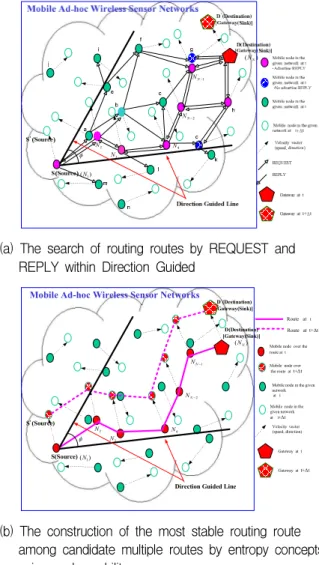
(a) The search of routing routes by REQUEST and REPLY within Direction Guided
Route at t Route at t+Δt
Mobile node over the route at t+Δt Mobile node over the route at t
Mobile node in the given network at t Mobile node in the given network at t+Δt
Velocity vector (speed, direction)
S(Source) S (Source)
Mobile Ad-hoc Wireless Sensor Networks
Direction Guided Line f
) (N1
N2
N3
) (NN
1 -
NN
2 -
NN
N4
Gateway at t
Gateway at t+Δt D(Destination)
[Gateway(Sink)]
D (Destination) [Gateway(Sink)]
(b) The construction of the most stable routing route among candidate multiple routes by entropy concepts using node mobility
f
) (N1
N2
N3
) (NN
1 -
NN
2 -
NN
N4
(c) Cooperative data transmission based on the constructed routing route
그림 2. CooRP의 동작과정 Fig. 2. The operations of CooRP.
node S() and a destination node D() within the direction guided line region, in an environment where multiple paths are available in a mobile ad-hoc wireless sensor networks. The basic concepts of the construction of stable routing routes is based on our previous works[4]. The CooRP uses a direction guided line(DGL) transmission strategy to reduce control overhead and to save power for routing route construction.
As we can see in Fig.1(b), the CooRP uses a cooperative data transmission strategy which can support both SNR efficiency and network resources (i.e., power, bandwidth) efficiency between a source node and a destination node is used to increase transmission efficiency with increased SNR. In our cooperative data transmission strategy based on the constructed stable routing route, all of nodes over the constructed routing route can work as data transmission nodes, source node and helper node together, for supporting cooperative data transmission efficiency. For example, in Fig.1(b) node just transmits data to node as source node while node
can also transmits data to node as helper node. Especially, since all nodes over the constructed routing route can work as relay nodes in the proposed cooperative data transmission, the relay selection is not required.
The operations of the proposed CooRP consist of six steps as follows.
Ÿ Step 1: The operation of source node S(), generation and advertisement of a REQUEST (see Fig.2(a))
Ÿ Step 2: The operation of a node that receives REQUEST with sequence number from the source node (see Fig.2(a))
Ÿ Step 3: The operation of destination node D() that receives a REQUEST (see Fig.2(a))
Ÿ Step 4: The operation of a node that receives a REPLY, calculation of route stability (see Fig.
2(a)). The route stability between the node(
) and the destination node(
) are calculated usingf N1
) (NN 1 -
NN
2 -
NN
N2
N3 N4
) (N2 S
) (N3 R
) (N4 D
그림 3. 제안된 CooRP의 데이터 전송전략
Fig. 3. Cooperative data transmission strategy of the proposed CooRP based on the selected routing route.
entropy concepts in our previous works[4].
Ÿ Step 5 : The operation of source node S() that receives a REPLY, selection of the best stable route and cooperative data transmission (see Fig.2(a), Fig.2(b) and Fig.2(c))
Ÿ Step 6: The operation of a node that receives data messages, cooperative data transmission (see Fig.2(c))
Ⅲ. The theoretical analysis of CooRP with outage probability
In this section, we present the theoretical analysis of the proposed CooRP with outage probability. We derives the outage probability, , for the proposed CooRP between a source node and a destination node
1. Data transmission strategy
Fig. 3 describes the cooperative data transmission strategy of the proposed CooRP.
For practical application, it is assumed that every node knows the location positions of itself and destination, so that the source node knows the direction towards destination. The basic concepts for cooperative data transmission of the proposed CooRP are as follow:
Ÿ At time slot, a source node() transmits a message to the node () and node() over the routing route simultaneously by using broadcasting nature of transmission in wireless network.
Ÿ The time slot, the node() transmits a decoded message to the node() and the
node() over the routing route simultaneously.
Ÿ The node() selects the signal which has the maximal SNR using the selection combining diversity from the received signals (i.e., one signal comes from the source node() and the other one comes from node(), then decodes the signal and at time slot the node() transmits the decoded signal to both the node ()and the node( ) over the routing route simultaneously.
Ÿ These processes are repeated until the transmitted message arrives at the final destination node (). We assume there is a network controller to coordinate the retransmissions from the relay nodes.
2. End-to-end (source to destination) outage probability
The received SNR at a receiver can be represented by
(1)
where is the transmit power of a transmitter, is the noise power, is the distance between a transmitter and a receiver, and is the path loss exponent. The is the transmit SNR, which is defined by
(2)
In rich scattering, the Rayleigh fading model is commonly used. Under this assumption, the received SNR is exponentially distributed. The outage probability between the transmitter and the receiver,, is defined that the received SNR is less than the defined threshold, and written by [6~7]
Pr ≺ exp
(3)
where is the threshold SNR.
The simple model of a cooperative diversity, which has single relay node(helper), is shown in Fig.3. In the small rectangular box of Fig.3, S(), R() and D() represent source node, relay node, and destination node respectively. The transmission from the source node(S) is occurred at first time slot.
Then, the signal arrives at the both of two intended receivers(R and D), the relay node regenerates and transmits the signal at a later time slot. The destination node will compare the two signals which are transmitted from both the source node and relay node separately, and selects the signal with higher instantaneous SNR as the decision signal by using the selection combining diversity.
As shown in the small rectangular box of Fig.3, in this cooperative diversity model there are two independent signals received separately at the destination site (D(
)). The one is the signal from the direct path (S-D) via the first transmission and the other one is from the relay path (S-R-D) via later transmission.The outage probability of the direct path,
, is given by[7]
(4)
where
denotes the outage probability between source and destination nodes, and is given by(3) in which dis the distance between the source node and the destination node.The outage probability of the relay path, , is given by
(5)
where
and
are the outage probability between the source and the relay nodes, and between the relay and the destination nodes respectively.Under the assumption that the received signals from each path (i.e. source-destination path and relay-destination path) are independent for simplicity,
the outage probability with the selection combining diversity can be given by [6~7]
(6)
Now, we can expand the analysis of the simple cooperative diversity model to an ad-hoc wireless sensor networks with N nodes in general, which is described in Fig.3. In this proposed CooRP, the outage probability,
, between the source node () and the destination node (
) is given by
≤ ≤ (7) where
(8)
≤ ≤
and where and are the outage probability and the probability that the message signal is transmitted successfully from the node I to the nodej, respectively.
Ⅳ. Performance Evaluation
1. Simulation Scenario and Framework
The performance evaluation of our protocol is accomplished via modeling and simulation using the Optimized Network Engineering Tool (OPNET). A mobile ad-hoc wireless sensor networks consisting of 50 nodes that are placed randomly within a rectangular region of 1 km x 1 km is modeled in the simulation. Each node is modeled as an infinite-buffer, store-and-forward queuing station, and is assumed to be aware of its position with the aid of a reliable position location system (i.e., GPS).The mobile nodes are assumed to have constant radio range of Z=250m to construct a routing route while the radio range is not used for cooperative data transmission over Rayleigh fading channel.
In this simulation, two different mobility models
are used. In the first mobility scenario, random mobility pattern is model. A mobile node picks a position within the simulation area randomly in each movement epoch, then move towards it with a speed in the range [0, max km/h] and direction range [0,2] respectively. The speed and direction are updated in dependently for each node every ∆ seconds (in our simulation ∆=5 second). The pause time at the end of each epoch is zero second.
In the second mobility scenario, a group mobility pattern[8] is modeled. Specifically, nodes are grouped into several groups, where we assume that nodes in the same group have similar mobility characteristics (speed and direction). The speed and direction of each group are selected randomly at the start point of the simulation within the speed range [0, max km/h]
and the direction range [0,2] and is assumed that the group holds these speed and direction for the duration of the simulation. Regarding the moving direction of the mobiles, at the beginning of the simulation a starting moving direction is selected randomly for each group (different groups have different initial directions). Initially, each group consists of 5 nodes.
If a mobile arrives at the boundary of the given network coverage area, the node reenters into network.
2. Performance Metrics
The performance metrics that we use in this paper for the evaluation purposes are the following:
Ÿ Packet delivery ratio (PDR): It is defined as the number of data packets delivered to a destination node over the number of data packets supposed to be delivered to a destination node.
Ÿ Outage probability (): The probability that the system model is in outage between a source node and a destination.
Ÿ Control overhead: It is defined as the average number of control signal packets related to the route creation process that are received by a
node per one route creation process(control overhead/route_setup/node).
Ÿ Delay: It is defined as the average latency time for route creation between a source node and a destination node (delay/route_setup).
3. Numerical Results
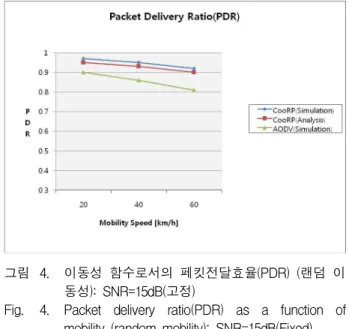
Fig.4 and Fig.8 illustrate the PDR (packet delivery ratio) of the CooRP protocol as a function of mobility speed when the value of SNR (SNR=15dB) is fixed for two mobility scenarios, random mobility and group mobility respectively. As we can see in these figures, the results of both simulation(PDR) and theoretical analysis(≈ ,) of CooRP are quite similar(i.e., similar with values and graph pattern) in highly dynamic situations. Especially, in the group mobility scenario the PDR of the CooRP presents more good result than the corresponding PDR of AODV[9]. The reason is that in our CooRP protocol the routing routes are created and selected on the basis of the entropy-based concepts using mobility and the data packets are transmitted by using cooperative communication with the increased SNR.
Fig.5 and Fig.9 present the PDR (packet delivery ratio) of the CooRP protocol as a function of SNR
그림 4. 이동성 함수로서의 페킷전달효율(PDR) (랜덤 이 동성): SNR=15dB(고정)
Fig. 4. Packet delivery ratio(PDR) as a function of mobility (random mobility): SNR=15dB(Fixed).
그림 5. SNR 함수로서의 페킷전달효율(PDR) (랜덤 이 동성): 이동성 속도=20km/h(고정)
Fig. 5. Packet delivery ratio(PDR) as a function of SNR (random mobility): Mobility speed=20km/h(Fixed).
그림 6. 이동성 함수로서의 컨트롤오버헤드(랜덤 이동 성): SNR=15dB(고정)
Fig. 6. Control overhead/route_setup/node as a function of mobility(random mobility): SNR=15 dB(Fixed).
when the value of m ax (max=20km/h) is fixed. As we can see in these figures, the results of both simulation (PDR) and theoretical analysis (≈ ) of CooRP are very similar(i.e.
similar with values and graph pattern). As we can see in these figures, the PDR of CooRP is increased when the SNR is increased while the PDR of CooRP is larger than that of AODV. The reason is that in our protocol the data packets are transmitted by cooperative communication with the increased SNR.
Fig.6 and Fig.10 show the control overhead associated with the route creation and maintenance as a function of mobility speed when the value of SNR (SNR=15 dB) is fixed. The control overhead includes all the control signals (packets) that need to be exchanged among the various nodes in order to
그림 7. 이동성 함수로서의 경로설정 지연시간 (랜덤 이동성): SNR=15dB(고정)
Fig. 7. Delay/route_setup as a function of mobility.
(random mobility): SNR=15 dB(Fixed)
그림 8. 이동성 함수로서의 페킷전달효율(PDR) (그룹 이동성): SNR=15dB(고정)
Fig. 8. Packet delivery ratio(PDR) as a function of mobility (group mobility): SNR=15 dB(Fixed).
create and maintain the routing routes. As we can see in Fig.6 and Fig.10, the control overhead remains relatively constant and low as the speed increases.
The reason is that the CooRP uses direction guided line(DGL) strategy for route creation and the updates for route creation are operated periodically. As we can see in Fig.6 and Fig.10, the control overhead for both CooRP is less than the corresponding control overhead of AODV. The reason is that the number of updates for route creation and maintenance for CooRP that uses both direction guided line(DGL) strategy and mobility information of node is less than those numbers of AODV.
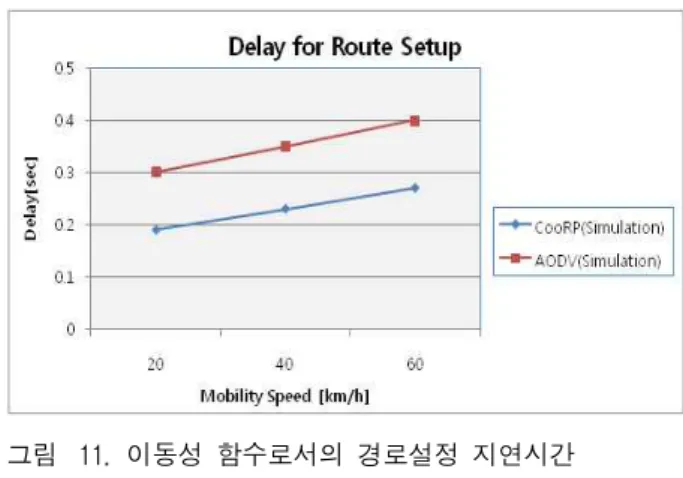
Fig.7 and Fig.11 describe the average delay (latency time) for route creation as a function of mobility speed when the value of SNR (SNR=15 dB)
그림 9. SNR 함수로서의 페킷전달효율(PDR)(그룹 이동 성): 이동속도=20km/h(고정)
Fig. 9. Packet delivery ratio(PDR) as a function of SNR (group mobility): Mobility speed=20 km/h(Fixed).
그림 10. 이동성 함수로서의 컨트롤오버헤더 (그룹이동성): SNR=15dB(고정)
Fig. 10. Control overhead/route_setup/node as a function of mobility(group mobility): SNR=15 dB(Fixed).
그림 11. 이동성 함수로서의 경로설정 지연시간 (그룹 이동성): SNR=15dB(고정)
Fig. 11. Delay/route_setup as a function of mobility.
(group mobility): SNR=15dB(Fixed)
is fixed. The delay includes all the latency times that need to be spent between a source node to a destination node for route creation. As we can see in Fig.7 and Fig.11, the delay for route creation remains
relatively constant and low as the speed increases because both CooRP and AODV use reactive concepts for route creation. However, the delay of CooRP is slightly less than the corresponding delay of AODV. The reason is that CooRP can create very stable routing routes by entropy-based concepts using node mobility. The average delay (latency time) for route creation may be reduced according to the decreased number of update control signals for route creation and maintenance by using direction guided line(DGL) strategy.
V. Conclusion
In this paper, we propose a Cooperative Routing Protocol, called CooRP, to support packet delivery ratio efficiently with advanced SNR, increased operational lifetime of routes as well as reduced control overhead for route construction for Rayleigh fading mobile ad-hoc wireless sensor networks.
Especially, we just consider a realistic approach based on mobile sensor nodes and mobile gateway while the conventional research for sensor networks focus on mainly fixed sensor nodes and fixed gateway. To support the stable routing routes with the increased lifetime, entropy concepts using mobility of nodes which are based on our previous works[5] are used while a direction guided strategy is applied for reducing control overhead for route construction. Since the cooperative data transmission strategy to increase packet delivery ratio efficiently with advanced SNR is based on the constructed stable routing route and all nodes over the routing route can work as relay nodes, the relay selection is not required. We have also presented a theoretical framework for cooperative data transmission based on the constructed stable routing route with outage probability in order to evaluate the performance of the design alternatives for algorithm and implementation used for CooRP. The performance evaluation of the proposed CooRP has demonstrated it’s efficiency in terms of packet delivery ratio, delay
for route construction, and control overhead for route construction, as a function of mobility and SNR respectively, and therefore indicates that the proposed CooRP can be used to support high message delivery accuracy with resource saving and advanced SNR in mobile ad-hoc wireless sensor networks. Especially, we use the approximated relationship results,
≈ , to compare the PDR for simulation and the outage probability , , of cooperative data transmission for theoretical analysis. In the simulation using OPNET, two mobility models, random mobility model and group mobility model, are presented to evaluate the performance of the CooRP efficiently according to the mobility of mobile nodes in mobile ad-hoc wireless sensor networks. The performance evaluation in section IV illustrates the proposed CooRP can enhance PDR efficiently with advanced SNR, increased operational lifetime of routes as well as reduced control overhead for route construction in mobile ad-hoc wireless sensor networks with Rayleigh fading environments.
참 고 문 헌
[1] Ian F. Akyildiz, Weilian Su, Yogesh Sankarasubramanian, and Erdal Cayici, “A Survey on Sensor Networks,” IEEE Communications Magazine, vol. 40, issue 8, pp.102-114, August 2002.
[2] Beongku An, Symeon Papavassiliou, “Supporting Multicasting in Mobile Ad-hoc Wireless Networks: Issues, Challenges and Current Protocols,” Wireless Communications and Mobile Computing (WCMC), vol. 2, issue 2, pp.115-130, March 2002.
[3] J. N. Laneman, D. Tse, and G. Wornell,
“Cooperative Diversity in Wireless Networks:
Efficient Protocols and Outage Behavior,” IEEE Trans. Inform. Theory, vol. 50, issue 12, pp.
3062–3080, December 2004.
[4] Beongku An, Symeon Pappavassiliou, “An Entropy-Based Model for Supporting and Evaluating Stability in Mobile Ad-hoc Wireless Networks,” IEEE Communications Letters, vol. 6, issue 8, pp.328-330, August 2002.
[5] Akira Shiozaki, “Edge Extraction Using Entropy
Operator,” Computer Vision, Graphics, and Image Processing 36, vol. 36 , issue 1, pp.1-9, November 1986.
[6] Sachin Abhyankar and Dharma P. Agrawal,
“Distributed Mobility-Aware Route Selection for Wireless Ad-hoc Networks,” Proc. of Performance, Computing and Communications Conference, pp.241-247, April 2002.
[7] M. Hasna, M.-S. Alouini, “End-to-end performance of transmission systems with relays over Rayleigh-fading channels,” IEEE Trans. on Wireless Communications, vol.2, no.6, pp.1126-1131, November 2003.
[8] Xiaoyan Hong, Mario Gerla, Guangyu Pei and Ching-Chuan Chiang, “A Group Mobility Model for Ad-Hoc Wireless networks,” Proc. of ACM/IEEE MSWiM'99, pp. 53-66, August 1999.
[9] C.E Perkins and E.M. Royer, “Ad-Hoc on demand distance Vector Routing,” Proc. of WMCSA’99, pp.90-100, February 1999.
저 자 소 개
안 병 구
(평생회원)1988년 경북대학교전자공학 (학사)
1996년 (미) olytechnic Univ.
Dept. of Electrical &
Computer Eng.(석사).
2002년 (미)New Jersey Institute of Technology (NJIT), Dept. of Electrical & Computer Eng.(박사)
1989년~1993년 포항산업과학기술연구(RIST), 선임연구원.
2003년~현재 홍익대학교 컴퓨터정보통신공학과 교수
2008년~현재 한국인터넷방송통신학회(IWIT)
2010년~현재 대한전자공학회 컴퓨터소사이티부회장
부회장
2005년~2010년 Marquis Who's Who in Science and Engineering
(세계과학기술인명사전) 등재,
2006년~2010년 Marquis Who's Who in the World(세계인명사전) 등재
<주관심분야 : Wireless Networks, Ad-hoc &
Sensor Networks, QoS Routing & Multicast Routing, Cooperative Communication, VLC, Bioinformatics, Cross-Layer Technology, Mobility Management, Location-Based Technology>
이 주 상
(학생회원)2006년 홍익대학교 컴퓨터정보 통신공학과(학사) 2008년 홍익대학교 대학원 전자
전산공학과(석사) 2008년 3월∼현재 홍익대학교
대학원 전자전산공학과 재학(박사과정)
<주관심분야 : Ad-hoc & Sensor Networks, Mobile Wireless Networks, Routing, Cooperative Communications, Multicast Routing Protocols, Cross-Layer>
김 남 수
(평생회원)1981년 광운대학교전자공학과 1983년 연세대학교전자공학과(학사)
(석사)
1991년 연세대학교전자공학과 1986년~1994년 ETRI(전자통신 연구소)(박사)
이동통신 연구단 무선기술 실장 역임 1991년~1991년 BNR(Bell Northern Research)
방문 연구원
2002년~2003년 NJIT(New Jersey Institute of Technology) 교환교수
1994년~현재 청주대학교 전자공학과 교수 2006년~2007년 청주대학교 학술정보처장 2010년~2010년 청주대학교 입학처장
<주관심분야 : Wireless mobile ad-hoc network, Cooperative diversity system, RF system design, Digital modulation, 무선 이동통신 채널, 이동통신 시스템 설계>
![Fig. 1 describes the architecture of the proposed CooPR. Fig.1(a) present how to decide stable routing routes based on entropy concepts [4~5] using mobility of mobile nodes to increase the operational lifetime of routes and how to reduce control overhead a](https://thumb-ap.123doks.com/thumbv2/123dokinfo/5104950.572694/2.892.470.785.522.870/describes-architecture-proposed-concepts-mobility-increase-operational-lifetime.webp)