• 검색 결과가 없습니다.

Characterization of an antioxidant peptide from katsuobushi (dried bonito) protein hydrolysates

N/A
N/A
Protected

Academic year: 2021

Share "Characterization of an antioxidant peptide from katsuobushi (dried bonito) protein hydrolysates"

Copied!
9
0
0

로드 중.... (전체 텍스트 보기)

전체 글

(1)

Introduction

Reactive oxygen species (ROS), in particular the superoxide anion (•O2

), hydroxyl radical (•OH), and hydrogen peroxide (H

2

O

2

), are unwanted metabolic byproducts of normal aerobic metabolism [1]. Lipid and fatty acid oxidation generates free radicals, which lead to the development of undesirable off-flavors, odors, and potentially toxic reaction products [2,3,4]. In addition, oxidative stress can modify DNA, proteins, small cellular molecules, and is thought to play a significant role in the occurrence of diseases including cancer, arteriosclerosis, cardiovascular diseases, diabetes mellitus, neurological disorders and Alzheimer's

disease [5,6]. However the body employs an array of antioxidant defenses that can scavenge for and convert ROS, such as free radicals, into harmless species. For example, the antioxidant defense system includes superoxide dismutase (SOD), catalase (CAT), glutathione peroxidase (GPx), glutathione reductase (GR), and tripeptide glutathione (GSH).

These enzymatic and non-enzymatic antioxidants work together to scavenge for and eliminate oxidative stress [7], and furthermore, a steady-state maintenance of the ROS:

antioxidant ratio is essential for avoiding this increase in oxidizing species [8]. Synthetic antioxidants such as butylated hydroxyanisole (BHA), butylated hydroxytoluene (BHT), tbutylhydroquinone (TBHQ), and propyl gallate have been

* Corresponding author

Phone: 82-33-640-2854 Fax: 82-33-640-2955 E-mail: [email protected]

This is an open-access journal distributed under the terms of the Creative Commons Attribution Non-Commercial License

(http://creativecommons.org/licenses/bync/3.0)

http://dx.doi.org/10.15433/ksmb.2015.7.1.019 ISSN 2383-5400 (Online)

Characterization of an antioxidant peptide from katsuobushi (dried bonito) protein hydrolysates

Jung Kwon Lee, Joong-Kyun Jeon, Hee-Guk Byun *

Department of Marine Biotechnology, Gangneung–Wonju National University, Gangneung 210–720, Republic of Korea

Abstract The objective of the current study was to evaluate the inhibitory and antioxidant activities of powdered katsuobushi (dried bonito) protein hydrolysates and their corresponding fractions. The powdered katsuobushi (dried bonito) hydrolysates were obtained by enzymatic hydrolysis using Alcalase, α-chymotrypsin, Neutrase, pepsin, papain, and trypsin. The antioxidant efficacy of the respective hydrolysates were evaluated using 2,2-diphenyl-1-picrylhydrazyl (DPPH), hydroxyl, superoxide, and alkyl radical-scavenging activities. Among the hydrolysates, the peptic-derived hydrolysate exhibited the highest antioxidant activity compared to other enzymatic hydrolysates. Therefore, the peptic-derived hydrolysate was further analyzed, and was found to contain an active peptide with an amino acid sequence identified as Pro-Met-Pro-Leu-Asn-Ser-Cys (756 Da). The purified peptides from powdered katsuobushi (dried bonito) had an EC

50

value of 105.82 μM, and exhibited an inhibitory effect against DNA oxidation induced by hydroxyl radicals. Taken together, these results suggests that powdered katsuobushi (dried bonito) could be used as a natural antioxidant in functional foods and prevent oxidation reactions in food processing.

Keywords : Antioxidant, DPPH radical scavenging, Peptide, Electron spin resonance spectrometry,

Powdered katsuobushi (dried bonito)

(2)

widely used to preserve food products by delaying the discoloration and deterioration caused by oxidation [9].

However, the use of these synthetic antioxidants has been limited in some countries due to potential health hazards [10].

Recently, enzymatic hydrolysis with proteases has garnered much attention in antioxidant research. Protein hydrolysates, which are the peptides resulting from enzymatic hydrolysis, affect health-related functions such as those in the antioxidant defense system [11]. As a result of research into this field, various antioxidant peptides produced through enzymatic hydrolysis have been isolated from marine organisms including the flounder fish (Paralichthys olivaceus) [12], Sphyrna lewini [13], blue mussel (Mytilus edulis) [14], marine Chlorella ellipsoidea [15], silver carp (Hypophthalmichthys molitrix) [16], sand eel [17], and rotifer [18]. These naturally-occurring marine organism-derived antioxidants are considered to be safer and have less adverse side effects compared to synthetic antioxidants.

Enzymatic hydrolysates exhibited several benefits when added to foods. These benefits included improved water-binding ability, myofibrillar protein heat stability, emulsifying stability, protein solubility, and the nutritional quality of foods. Moreover, enzymatic hydrolysis has become a valuable tool for modifying protein function [19]. Generally, the bioactive properties of peptides produced through enzymatic hydrolysis remain latent within the parent protein until released by hydrolysis. Most of the bioactive peptides are 2–20 amino acids long, and their primary amino acid sequences play a critical role in their bioactivity [20].

Katsuobushi (dried bonito) has a distinct umami flavor originating from the presence of glutamic and inosinic acids.

More specifically, the potent flavors come from of a mixture of components such as acids, phenols, pyridines, pyrazines, and thiazoles [21,22]. katsuobushi (dried bonito) is a traditional Japanese food additive [21], and is also used widely as a flavor enhancer. It is produced by a variety of processes including boiling, sun-drying, smoking, and in mold cultures.

However, no studies to date have reported on the presence of antioxidant peptides in powdered katsuobushi (dried bonito) hydrolysates. In the present study, we investigated the radical scavenging activity of enzymatically-prepared powdered katsuobushi (dried bonito) protein hydrolysates, and further isolated a potent antioxidant peptide. Moreover, we investigated the protective effect of the purified peptide against DNA oxidation induced by the hydroxyl radicals.

Materials and Methods

Materials

katsuobushi (dried bonito) was donated by Department of a seaport and traditional fish market of Jumunjin (Gangneung, Korea), and stored at ―80°C until used. Various commercial enzymes, such as α-chymotrypsin, papain, pepsin and trypsin were purchased from Sigma Chemical Co. (St. Louis, MO).

Alcalase and Neutrase were purchased from Novo Co. (Novo Nordisk, Bagsvaerd, Denmark). 1,1-diphenyl-2-picryl- hydrazyl (DPPH) was also purchased from Wako Chemical Co. All other reagents used in this study were reagent grade chemicals.

Analysis of amino acid compositions

Amino acids were analyzed using an automatic analyzer (Hitachi Model 835-50, Japan) with a C18column(5μm, 4.6

× 250 mm, Watchers, MA). The reaction was carried out at 38°C, with the detection wave length at 254 nm and a flow rate of 1.0 mL/min. All chemical analyses (fromeachtank) were carried out in triplicate.

Preparation of powdered katsuobushi (dried bonito) hydrolysates

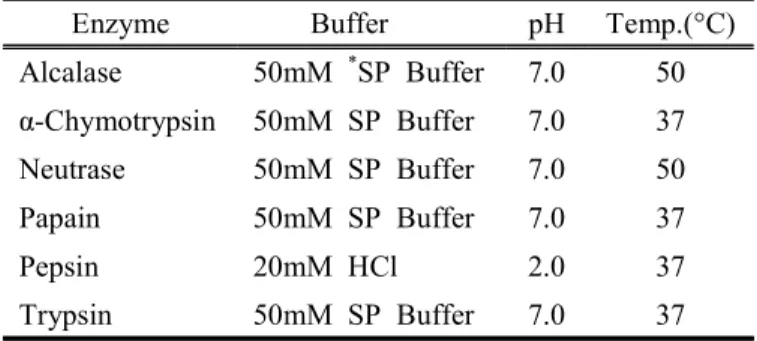
To prepare powdered katsuobushi (dried bonito) hydrolysates, enzymatic hydrolysis was performed using various enzymes (Alcalase, α-chymotrypsin, Neutrase, papain, pepsin, and trypsin) at their optimal conditions. The powdered katsuobushi (dried bonito) was hydrolyzed separately using various enzymes with a substrate to enzyme ratio of 1:100 for 6 hr, under optimum pH and temperature conditions (Table 1). After the reaction, reactant was conducted by glass filter and lyophilized hydrolysates were stored at −80°C until use.

Table 1. Optimal conditions of enzymatic hydrolysis for various enzymes.

Enzyme Buffer pH Temp.(°C)

Alcalase 50mM

*

SP Buffer 7.0 50

α-Chymotrypsin 50mM SP Buffer 7.0 37

Neutrase 50mM SP Buffer 7.0 50

Papain 50mM SP Buffer 7.0 37

Pepsin 20mM HCl 2.0 37

Trypsin 50mM SP Buffer 7.0 37

*
SP ; Sodium phosphate

(3)

Electron spin resonance (ESR) measurement DPPH radical Scavenging activity

DPPH radical scavenging activity was measured using the method described by Nanjo et al [23]. A 30 μL sample solution (or distilled water itself as control) was added to 30 μL of DPPH (60 μM) in methanol solution. After mixing vigorously for 10 s, the solution was then transferred into a 50 μL quartz capillary tube, and the scavenging activity of hydrolysate on DPPH radical was measured using a JES-FA200 ESR spectrometer (JEOL Ltd., Tokyo, Japan).

The spin adduct was measured on an ESR spectrometer exactly 2 min later. Spectrometer settings were: magnetic field, 336.5 ± 5 mT; power, 5mW; modulation frequency, 9.41 GHz; amplitude, 1ⅹ1000; modulation width, 0.8 mT;

sweep width, 10 mT; sweep time, 30 sec. DPPH radical scavenging ability was calculated following equation in which control and sample were relative peak height of radical signals with and without sample, respectively.

Radical scavenging activity (%) = (control-sample)/control×100%

Hydroxyl radical Scavenging activity

Hydroxyl radicals were generated by iron-catalyzed Haber.

Weiss reaction (Fenton driven Haber.Weiss reaction) and the generated hydroxyl radicals rapidly reacted with nitrone spin trap DMPO [24]. The resultant DMPO-OH adducts was detectable with an ESR spectrometer. The sample solution (15 μL) was mixed with DMPO (0.3 M, 15 μL), FeSO

4

(10 mM, 15 μL) and H

2

O

2

(10 mM, 15 μL) in a phosphate buffer solution (pH 7.4), and then transferred into a 50 μL quartz capillary tube. After 2.5 min, the ESR spectrum was recorded using an ESR spectrometer. Spectrometer settings were:

magnetic field, 336.5 ± 5 mT; power, 1 mW; modulation frequency, 9.41 GHz; amplitude, 1× 200; modulation width, 0.1 mT; sweep width, 10 mT; sweep time, 30 sec. Hydroxyl radical scavenging ability was calculated following equation in which control and sample were relative peak height of radical signals with and without sample, respectively.

Radical scavenging activity (%) = (control-sample)/control×100%

Superoxide radical scavenging activity

Superoxide radical anions were generated by UV irradiated

riboflavin/EDTA system [25]. The reaction mixture containing 0.3 mM riboflavin, 1.6 mM EDTA, 800 mM DMPO and indicated concentration of sample solution was irradiated for 1 min under UV lamp at 365 nm. The reaction mixture was transferred to 50 μL quartz capillary tube of the ESR spectrometer for measurement. Spectrometer settings were: magnetic field, 336.5 ± 5 mT; power, 10 mW;

modulation frequency, 9.41 GHz; amplitude, 1×1000;

modulation width, 0.1 mT; sweep width, 10 mT; sweep time, 30 sec. Superoxide radical scavenging ability was calculated following equation in which control and sample were relative peak height of radical signals with and without sample, respectively.

Radical scavenging activity (%) = (control-sample)/control×100%

Alkyl radical scavenging activity

Alkyl radicals were generated by AAPH [26]. The phosphate buffered solution (pH 7.4) reaction mixtures containing 40 mM AAPH, 40 mM 4-POBN. The sample solution (15 μL) was mixed with AAPH (15 μL), POBN (15 μL). And the mixture were incubated at 37℃ for 30 min.

The reaction mixture was transferred to 50 μL quartz capillary tube of the ESR spectrometer for measurement. Spectrometer settings were: magnetic field, 336.5 ± 5 mT; power, 10 mW;

modulation frequency, 9.41 GHz; amplitude, 1×1000;

modulation width, 0.2 mT; sweep width, 10 mT; sweep time, 30 sec. Alkyl radical scavenging ability was calculated following equation in which control and sample were relative peak height of radical signals with and without sample, respectively.

Radical scavenging activity (%) = (control-sample)/control×100%

Purification and identification of antioxidant peptides The hydrolysate obtained from powdered katsuobushi (dried bonito) was dissolved in distilled water and loaded onto a Sephadex G-25 gel filtration column (2.5 cm × 70 cm) which had been previously equilibrated with distilled water.

The column was then eluted with the distilled water at a flow

rate of 1.5 ml/min (fraction volume 7.5 mL), while separated

fractions showing DPPH radical scavenging activity were

pooled and lyophilized. DPPH radical scavenging activity

(4)

fraction was separated by reversed-phase HPLC on a Grom-sil 120 ODS-5 ST column (5 μm, 10 mm × 250 mm) using a linear gradient of acetonitrile (0–20 %, v/v, 40 min) containing 0.1% trifluoroacetic acid (TFA) at a flow rate of 0.5 mL/min.

Finally, the fraction with the DPPH radical scavenging activity was collected and lyophilized; this was followed by the identification of the amino acid sequence.

Determination of molecular weight and amino acid sequence

Molecular weight and amino acid sequence of purified peptide from powdered katsuobushi (dried bonito) protein were determined by Q-TOF mass spectrometry (Micromass, Altrincham, UK) coupled with electrospray ionization (ESI) source. The purified peptide dissolved in methanol/water (1:1, v/v) was infused into the ESI source and molecular mass was determined by doubly charged (M+2H)

2+

statein the mass spectrum. Following molecular mass determination, the peptide was automatically selected for fragmentation and sequence information was obtained by tandem MS analysis.

Protection potential of induced DNA damage by hydroxyl radical

To evaluate the protective effects of the hydrolysate against DNA damage caused by hydroxyl radicals, a reaction was induced by placing the following reagents in an Eppendorf tube: 5 μL of genomic DNA (RAW 264.7 cell line), 2 mM FeSO

4

, and various concentrations of the purified peptide. The mixture was then incubated at 37℃ for 30 min, followed by the addition of 4 μL of 10mM H

2

O

2

(29). Next, the mixture was subjected to 1% agarose gel electrophoresis, after which the DNA bands were stained with ethidium-bromide.

Statistical analysis

All experiments were performed in triplicate. All results were expressed as means ± standard errors of measurement.

Rusults and Discussion

Amino acid composition of powdered katsuobushi (dried bonito)

The amino acid composition of powdered katsuobushi (dried bonito) is shown in Table 2. The powdered katsuobushi (dried bonito) contained high proportions of alkaline amino

acids (histidine, arginine, lysine), hydrophobic amino acids (phenylalanine, valine, leucine, isoleucine, proline, alanine, glycine), and branched-chain amino acids (valine, isoleucine, leucine). The most abundant amino acids were Glu, Asp, Ala, Lys, and Leu, which accounted for 13.67%, 10.77%, 9.34%, 8.86%, and 8.31%, respectively (Table 2). Protein hydrolysates obtained after enzymatic hydrolysis are composed of free amino acids and short-chain peptides, and their amino acid profiles exhibit many advantages as nutraceuticals or functional foods. The amino acid composition of any food protein plays a significant role in various physiological activities in the human body and either directly or indirectly affects the maintenance of good health.

Amino acids are the building blocks essential for the synthesis of a wide variety of proteins including nutrients carriers, enzymes, and structural proteins.

Table 2. Amino acid contents of powdered katsuobushi (dried bonito)

Amino acids Content (%)

Asp 10.77

Thr 6.14

Ser 6.23

Glu 13.67

Gly 6.33

Ala 9.34

Val 5.00

Cys 0.32

Met 1.02

Ile 3.91

Leu 8.31

Tyr 2.37

Phe 3.37

Lys 8.86

His 5.36

Arg 4.81

Pro 0.81

Hypro 0.33

Antioxidant activity of hydrolysates

The powdered katsuobushi (dried bonito) protein

hydrolysates were prepared by enzymatic hydrolysis using the

following commercially available proteases: Alcalase,

α-chymotrypsin, Neutrase, papain, pepsin, and trypsin. The

extent of protein degradation within the hydrolysates was

estimated by evaluating the degree of hydrolysis (DH). This

analysis revealed that the DH of Alcalase, Neutrase,

(5)

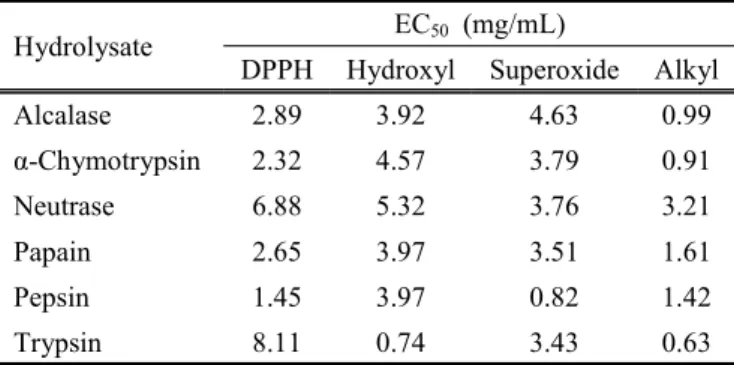
α-chymotrypsin, pepsin, trypsin, and papain were 86.1%, 77.8%, 68.1%, 63.6%, 38.2% and 69.8%, respectively (Table 3). The antioxidant activity of a substance can be quantified by evaluating its scavenging activities on free radicals in oxidative systems. Consequently, the protein katsuobushi (dried bonito) hydrolysates were evaluated for their free radical scavenging effects on DPPH, hydroxyl, superoxide, and alkyl radicals by using electron spin resonance technique.

As shown in Table 4, scavenging of DPPH radicals was more efficient than that of hydroxyl, superoxide and alkyl radicals.

Among the hydrolysates, the peptic–derived hydrolysate exhibited the highest antioxidant activity compared to the other enzymatic hydrolysates. The EC

50

(concentration of hydrolysate needed to scavenge 50% of radical activity) values of peptic hydrolysates on scavenging DPPH, hydroxyl, superoxide, and alkyl radicals were found to be 1.45, 0.74, 0.82, and 1.42 mg/mL, respectively. Recent advances in biotechnology have highlighted the ability of enzymes to produce novel food products, modified food composition, and improved waste processing [11]. Therefore, we purified peptic hydrolysates to identify the active antioxidant peptide.

Table 3. The yield of powdered katsuobushi (dried bonito) hydrolysates

Enzyme Yield (%)

Alcalase 86.1

α-Chymotrypsin 77.8

Neutrase 68.1

Papain 63.6

Pepsin 38.2

Trypsin 69.8

Table 4. The EC

50

values of enzymatic hydrolysates to scavenging DPPH, hydroxyl, superoxide and alkyl radicals.

Hydrolysate EC

50

(mg/mL)

DPPH Hydroxyl Superoxide Alkyl

Alcalase 2.89 3.92 4.63 0.99

α-Chymotrypsin 2.32 4.57 3.79 0.91

Neutrase 6.88 5.32 3.76 3.21

Papain 2.65 3.97 3.51 1.61

Pepsin 1.45 3.97 0.82 1.42

Trypsin 8.11 0.74 3.43 0.63

* Concentration of hydrolysate required to efficacy 50% of the respective radical ESR signal intensity.

Purification of the katsuobushi (dried bonito) antioxidant peptide

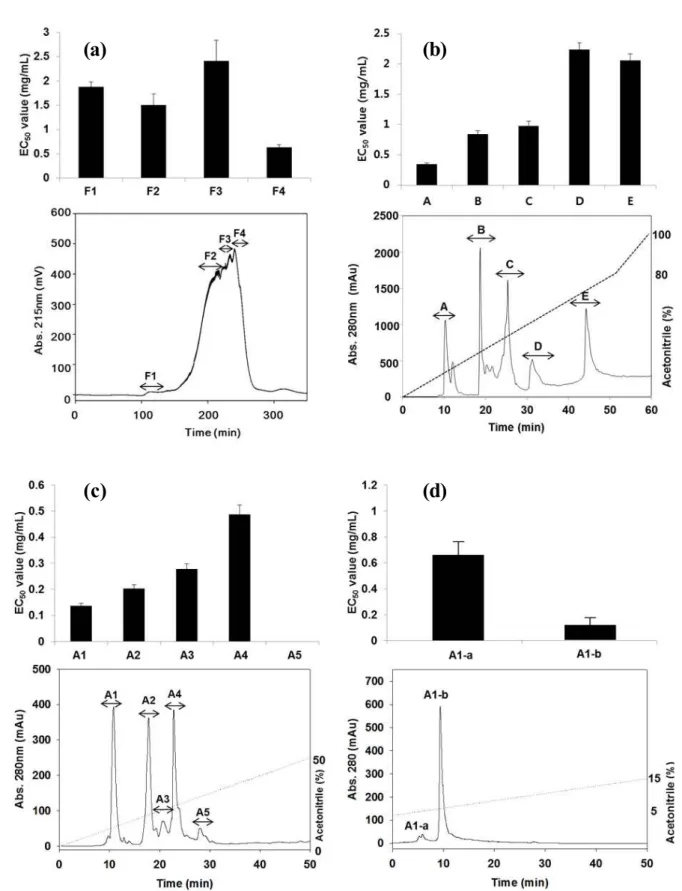
To identify the antioxidant peptides derived from the powdered katsuobushi (dried bonito) peptic-derived hydrolysates with the highest antioxidant activity, hydrolysates were separated by Sephadex G-25 column chromatography into four fractions (F1–F4) (Fig. 1(a) lower layer). Sephadex G-25 column chromatography separates according to molecular size, where the preliminary fractions contain larger peptides, and secondary fractions contain smaller peptides. According to a report by [27], most bioactive peptides are of small molecular size between 2 and 20 amino acids in length.

Therefore, secondary fractions were assumed to have the greatest potential of containing the bioactive peptides of interest. Accordingly, we found that fraction F4 possessed strong antioxidant activity. Specifically, the DPPH radical scavenging activity of F4 had the highest antioxidant activity with an EC

50

value of 0.64 mg/mL (Fig. 1(b) upper layer). F4 was further separated by an column and subsequently separated into five fractions (A–E) (Fig. 1(b) lower layer). Fraction A showed the highest DPPH radical scavenging activity with an EC

50

value of 0.35mg/mL. This active fraction identified through revers phase-HPLC (Fraction A) was further purified using the C

18

analytical column with a linear gradient of acetonitrile (0-30%, v/v, 50 min) at a flow rate of 1.0 mL/min. As shown in Fig.

1(c), the active peaks were analyzed, and the EC

50

values of A1 were 0.14 mg/mL. The same active fraction was further purified using the same column with a different linear gradient of acetonitrile (5-10 %, v/v, 50 min) at a lower flow rate (0.5 mL/min). As shown in Fig. 1(d), the active peaks of A1-b had EC

50

values of 80.1 μg/mL. The radical scavenging activities of purified peptide is shown Table 5.

Table 5. The EC

50

values of purified peptide to scavenging DPPH, hydroxyl, superoxide and alkyl radicals.

Hydrolysate

EC

50

(μg/mL)

DPPH Hydroxyl Superoxide Alkyl

Purified peptide 80.1 39.2 46.3 99.0

* Concentration of hydrolysate required to efficacy 50% of the

respective radical ESR signal intensity.

(6)

Figure 1. Separation scheme for the radical-scavenging peptide obtained from dried bonito hydrolysate. (A) Gel filtration chromatography on Sephadex G-25 column (2.5 × 70 cm). The column was eluted with distilled water and eluted at a flow rate of 1.5 mL/min. Protein elution was monitored at 215 nm. The fractions were collected and tested for DPPH radical scavenging activity as illustrated in the upper panel. (B) RP-HPLC on an ODS pre C18 column. The fractions with the desire peaks were pooled and tested for DPPH radical scavenging activity. (C,D) RP-HPLC on an analytical C18 column. The fractions with the desire peaks were pooled and tested for DPPH radical scavenging activity.

(a) (b)

(c) (d)

(7)

Characterization of the katsuobushi (dried bonito) antioxidant peptide

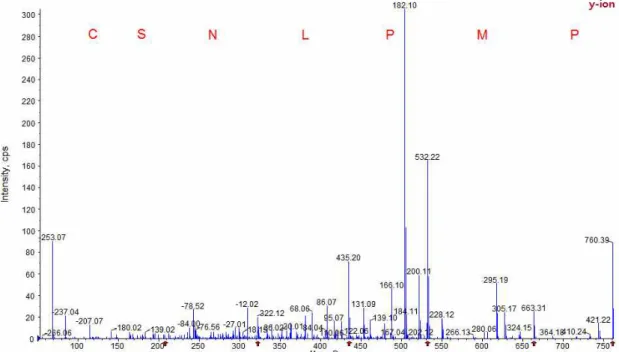
The purified A-1-b fraction was analyzed by ESI.MS for molecular mass determination and ESI.MS/MS for peptide characterization. The amino acid sequence of the bioactive purified peptide from this fraction was identified to be Pro-Met-Pro-Leu-Asn-Ser-Cys (M.W.: 756 Da), and the EC

50

value of this purified antioxidant peptide was 105.82μM (Fig. 2) [29]. Furthermore, we demonstrated that the purified DPPH radical scavenging peptide has a sequence similar reported, including the Tuna DPPH radical scavenging peptide (Pro-Met-Asp-Tyr-Met-Val-Thr, RSA = 85.2% at 100 μg/mL) [30] and sardinelle (Sardinella aurita) DPPH radical scavenging peptide (Pro-His-Tyr-Leu, RSA = Not data) [4]

It is also reported that antioxidant peptides possess some metal chelation and/or proton/electron donating activities, which could allow them to interact with free radicals and terminate their chain reactions or prevent their formation [31].

Therefore, the amino acid constituents and sequence are

critical for their antioxidant activity. Furthermore, it has been shown that hydrophobic amino acids in addition to one or more residues of histidine, proline, methionine, cysteine, tyrosine, tryptophan, and phenylalanine can enhance the activities of antioxidant peptides. [32,33]. Moreover, evidence suggests that functional peptides are dependent on amino acid sequence and structure [33]. Li et al. reported that the antioxidant activity of histidine-containing peptides was attributed to the proton-donating ability of the histidine imidazole group [28]. Specifically, histidine and proline participate in the antioxidant activity of designed peptides, among which Pro–His–His exhibited the greatest antioxidant activity [28]. Moreover, Dávalos et al. reported that among the amino acids, tyrosine, tryptophan, and methionine showed the highest antioxidant activity, followed by histidine, cysteine, and phenylalanine [32]. In agreement, the amino acid composition of the purified antioxidant peptide from powdered katsuobushi (dried bonito) consisted of proline, methionine and cysteine.

Figure 2. Identification of molecular mass and amino acid sequence of the purified peptides from powdered katsuobushi (dried bonito) peptic hydrolysate by HPLC. MS/MS experiments were performed on a Q-TOF tandem mass spectrometer equipped with a nano-ESI source.

Prevention of oxidation-induced DNA damage by a katsuobushi (dried bonito) peptide

As shown in Fig. 3, the purified katsuobushi (dried bonito) peptide had a protective effect against DNA oxidation induced by hydroxyl radicals, and this result was dose

dependent with increasing peptide concentrations ranging from 0.5 to 0.125 mg/mL. These results indicate this katsuobushi (dried bonito) peptide exerted adequate protective effects on radical-mediated DNA damage.

Furthermore, our results show that the katsuobushi (dried

(8)

bonito) purified peptide can prevent oxidative damage to DNA when exposed to OH radicals generated by Fe(II)/H

2

O

2

.Fe

2+

-catalyzed conversion of H

2

O

2

is a major route to the synthesis of OH radicals in physiologic systems.

OH radicals are highly reactive with all components of the DNA molecule, leading to damage of both purine and pyrimidine, and also the deoxyribose backbone [34]. DNA is also a sensitive bio-target for ROS-mediated oxidative damage [35], and DNA damage by ROS is known to initiate carcinogenesis, and affect the pathogenesis for neurodegenerative diseases such as Parkinson’s disease and Alzheimer’s disease.

Figure 3. Protective effect of purified powdered katsuobushi (dried bonito) extract on hydroxyl radicals induced oxidation of genomic DNA. Blank: untreated sample and H

2

O

2

, FeSO

4

, Control: distilled water instead of sample, Sample: Treated sample, H

2

O

2

and FeSO

4

(+ : treatment, - : not treatment).

Conclusion

In the current study, powdered katsuobushi (dried bonito) proteins were hydrolyzed with various enzymes, and the antioxidant activities of the resultant purified peptides were determined,. As a result, an antioxidant peptide with seven-amino acids (Pro-Met-Pro-Leu-Asn-Ser-Cys) from the peptic hydrolysate of powdered katsuobushi (dried bonito) protein was identified. This purified peptide exhibited an inhibitory effect against DNA oxidation induced by hydroxyl radicals. These results suggest that powdered katsuobushi (dried bonito) could be used to enhance the antioxidant effects of functional foods and prevent oxidation reactions in food processing.

Acknowledgement

This research was the project titled '(Marine bio-regional specialization leading technology development) Functional bi omaterial development of the East coastal marine bioresource ', funded by the Ministry of Oceans and Fisheries, Korea.

References

1. Castro, L. and Freeman, B.A. 2001. Reactive oxygen species in human health and disease. Nutrition 170, 161–5.

2. Lin, C.C. and Liang, J.H. 2002. Effect of antioxidants on the oxidative stability of chicken breast meat in a dispersion system. J. Food Science. 67, 530–533.

3. Gimenez, B., Aleman, A., Montero, P. and Gomez-Guillen, M.C. 2009. Antioxidant and functional properties of gelatin hydrolysates obtained from skin of sole and squid. Food Chem 114, 976–983.

4. Bougatef, A., Nedjar-Arroume, N., Manni, L., Ravallec, R., Barkia, A., Guillochon, D. and Nasri, M. 2010.

Purification and identification of novel antioxidant peptides from enzymatic hydrolysates of sardinelle (Sardinella aurita) by-products proteins. Food Chem. 118, 559–565.

5. Halliwell, B. 2002. Effect of diet on cancer development:

is oxidative DNA damage a biomarker. Free Radical Bio.

Med. 32, 968–974.

6. Stadtman, E.R. 2006. Protein oxidation and aging. Free Radical Res. 40, 1250–1258.

7. McCord, J.M. 1993. Human disease. free radicals, and the oxidant/antioxidant balance. Clin Biochem. 26, 351–357.

8. Somani, S.M. and Rybak, L.P. 1996. Comparative effects of exercise training on transcription of antioxidant enzyme and the activity in old rat heart. Ind. J. Physiol.

Pharmacol. 40, 205–212.

9. Wanita, A. and Lorenz, K. 1996. Antioxidant potential of 5-npentadecylresorcinol. J. Food. Process. Pres. 20, 410–429.

10. Becker, G.L. 1993. Preserving food and health:

Antioxidants make functional, nutritious preservatives.

Food Processing(Chicago). 12, 54–56.

11. Clemente, A. 2000. Enzymatic protein hydrolysates in human nutrition. Trends Food Sci. Technol. 11, 254–62.

12. Ko, J.Y., Lee, J.H., Samarakoon, K., Kim, J.S. and Jeon, Y.J. 2013. Purification and determination of two novel antioxidant peptides from flounder fish (Paralichthys olivaceus) using digestive proteases. Food Chem.

Toxicol. 52, 113–120.

(9)

13. Luo, H.Y., Wang, B., Li, Z.R., Chi, C.F., Zhang, Q.H. and He, G.Y. 2013. Preparation and evaluation of antioxidant peptide from papain hydrolysate of Sphyrna lewini muscle protein. LWT-Food Sci Technol. 51, 281–288.

14. Wang, B., Li, L., Chi, C. F., Ma, J. H., Luo, H. Y. and Xu, Y. F. 2013. Purification and characterisation of a novel antioxidant peptide derived from blue mussel (Mytilus edulis) protein hydrolysate. Food Chem. 138, 1713–1719.

15. Ko, S.C., Kim, D.K. and Jeon, Y.J. 2012. Protective effect of a novel antioxidative peptide purified from a marine Chlorella ellipsoidea protein against free radical-induced oxidative stress. Food Chem. Toxicol. 50, 2294–2302.

16. Zhong, S., Ma, C., Lin, Y. C. and Luo, Y. 2011.

Antioxidant properties of peptide fractions from silver carp (Hypophthalmichthys molitrix) processing by-product protein hydrolysates evaluated by electron spin resonance spectrometry. Food Chem. 126, 1636–1642.

17. Lee, W.S., Jeon, J.K. and Byun, H.G. 2011.

Characterization of a novel antioxidative peptide from the sand eel Hypoptychus dybowskii. Process Biochem. 46, 1207–1211.

18. Byun, H.G., Lee, J.K., Park, H.G., Jeon, J.K. and Kim, S.K.

2009. Antioxidant peptides isolated from the marine rotifer, Brachionus rotundiformis. Process Biochem. 44, 842–846.

19. Korhonen, M., Pihlanto-Leppala, A. and Tupasela, T.

1998. Impact of processing on bioactive proteins and peptides. Trends Food Sci. Tech. 9, 307–319.

20. Himaya, S.W.A., Ngo, D.H., Ryu, B.M. and Kim, S.K.

2012. An active peptide purified from gastrointestinal enzyme hydrolysate of Pacific cod skin gelatin attenuates angiotensin-1 converting enzyme (ACE) activity and cellular oxidative stress. Food Chem. 132, 1872–1882.

21. Yajima, M., Nakamura, H., Sakakibara, T., Yanai, K. and Hayashi. 1981. Volatile flavour components of dried bonito (katsuobushi). I. On basic, acidic and weak acidic fractions. Agr. Biol. Chem. 45, 2761–2768.

22. Yajima, M., Nakamura, H., Sakakibara, J., Ide, T., Yanai, K. and Hayashi. 1983. Volatile flavour components of dried bonito (katsuobushi). II. From neutral fraction. Agr.

Biol. Chem. 47, 1755–1760.

23. Nanjo, F., Goto, K., Seto, R., Suzuki, M., Sakai, M. and Hara, Y. 1996. Scavenging effects of tea catechins and their derivatives on 1,1,-diphenyl-2-picrylhydrazyl radical. Free Radic. Biol. Med. 21, 895–902.

2 4 . Rosen, G.M. and Rauckman, E.J. 1984. Spin trapping

of superoxide and hydroxyl radicals. Method Enzymol. 105, 198–209.

25. Guo, Q., Zhao, B., Shen, S., Hou, J., Hu, J. and Xin, W.. 1999. ESR study on the structure-antioxidant activity relationship of tea catechins and their epimers. Biochimica et Biophysica Acta (BBA)-General Subjects. 1427, 13–23.

26. Hiramoto, K., Johkoh, H., Sako, K.I. and Kikugawa, K.

1993. DNA breaking activity of the carbon-centered radical generated from 2,2-azobis (2-amidinopropane) hydrochloride (AAPH). Free Radic. Res. 19, 323–332.

27. Pihlanto, L. 2000. Bioactive peptides derived from bovine whey proteins: Opioid and ace-inhibitory. Trends Food. Sci. Tech. 11, 347–356.

28. Li, B., Chen, F., Wang, X., Ji, B. and Wu, Y. 2007.

Isolation and identification of antioxidative peptides from porcine collagen hydrolysate by consecutive chromatography and electrospray ionization–mass spectrometry. Food Chem. 102, 1135–43.

29. Hsu, K. (2010). Purification of antioxidative peptides prepared from enzymatic hydrolysates of tuna dark muscle by-product. Food Chem. 122, 42–48.

30. Je, J.Y., Qian, Z., Byun, H.G. and Kim, S.K. 2007.

Purification and characterization of an antioxidant peptide obtained from tuna backbone protein by enzymatic hydrolysis. Process Biochem. 42, 840–846.

31. Elias, R.J., Kellerby, S.S. and Decker, E.A. 2008.

Antioxidant activity of proteins and peptides. Crit. Rev.

Food Sci. Nutr. 48, 430-441.

32. Dávalos, A., Miguel, M., Bartolome, B. and López-Fandino, R. 2004. Antioxidant activity of peptides derived from egg white proteins by enzymatic hydrolysis.

J. Food Protect. 67, 1939–1944.

33. Murase, H., Nagao, A. and Terao, J. 1993. Antioxidant and emulsifying activity of N-(longchain-acyl) histidine and N-(long-chain-acyl) carnosine. J. Agric. Food Chem.

41, 1601–1604.

34. Ngo, D.N., Lee, S.H., Kim, M.M. and Kim, S.K. 2009.

Production of chitin oligosaccharides with different molecular weights and their antioxidant effect in RAW 264.7 cells. J Funct. Foods. 1, 188–198.

35. Martinez, G.R., Loureiro, A.P., Marques, S.A., Miyamoto,

S., Yamaguchi, L.F. and Onuki, J. 2003. Oxidative and

alkylating damage in DNA. Mutat. Res. 554, 115-127.

수치

Table  1.  Optimal  conditions  of  enzymatic  hydrolysis  for  various  enzymes.
Table  2.  Amino  acid  contents  of  powdered  katsuobushi  (dried  bonito)
Table  4.  The  EC 50  values  of  enzymatic  hydrolysates  to  scavenging  DPPH,  hydroxyl,  superoxide  and  alkyl  radicals.
Figure  1.  Separation  scheme  for  the  radical-scavenging  peptide  obtained  from  dried  bonito  hydrolysate
+3

참조

관련 문서

The 1,1-diphenyl-2-picrylhydrazyl (DPPH) free radical scavenging assay, the trolox equivalent antioxidant capacity (TEAC) assay, the superoxide radical scavenging (NBT) assay,

The antioxidant activities of the extracts from Buddleja officinalis were evaluated by DPPH radical, hydroxyl radical, hydrogen peroxide and intracellular ROS scavenging assay,

These results revealed that the Eastern eel hydrolysates exhibited strong radicals (DPPH, ABTS, superoxide, hydroxyl, and hydrogen peroxide) scavenging properties

water extract samples from Euonymus alatus leaf by measuring DPPH radical scavenging, total polyphenol content, hydroxyl radical scavenging, superoxide dismutase (SOD)-like

Although RC has lower activity for scavenging DPPH, superoxide, and hydroxyl radicals than does GT, its activity to inhibit peroxyl radical-lipid peroxidation was

Antioxidant activities were evaluated on the basis of DPPH radical scavenging activity, oxygen radical absorbance capacity (ORAC), cellular antioxidant capacity (CAC),

was measured by scavenging activity of 1,1-diphenyl-2-prcrylhydrazy (DPPH), hydroxyl radical (·OH), superoxide radical, and nitric oxide.. extract showed significant radical

To evaluate the anti-oxidative activities of GDE, we measured scavenging activities on DPPH radical, hydroxyl radical, hydrogen peroxide, superoxide anion, lipid