Vol. 19, No. 5, pp. 73-79, October 2015
Effect of Hydrogen Charging on the Mechanical Properties of 304 Stainless Steels
Sang-Pill Lee*†, Seung-Kuk Hwang**, Jin-Kyung Lee*, In-Soo Son*, and Dong-Su Bae***
(Received 30 July 2015, Revision received 05 October 2015, Accepted 05 October 2015)
Abstract: The effects of hydrogen charging on the mechanical properties of 304 stainless steels were investigated in conjunction with the detailed examinations of their fracture modes. The dependence of the absorbed impact energy and the surface hardness of the 304 stainless steels on the hydrogen charging time was characterized. The tensile properties of the 304 stainless steels by the variation of cross-head speed were also evaluated at the room temperature. The hydrogen charging was performed by an electrolysis method for all specimens of the 304 stainless steels. The mechanical properties of the 304 stainless steels exhibited the sensitivity of embrittlement due to a hydrogen charging. The correlation between mechanical properties and fracture surfaces was discussed.
Key Words:Hydrogen embrittlement, Hydrogen charging time, 304 stainless steel, Tensile property, Hardness Absorbed impact energy
*† Sang-Pill Lee(corresponding author) : Department of Mechanical Engineering, Dongeui University.
E-mail : [email protected], Tel : 051-890-1662
* Jin-Kyung Lee, In-Soo Son : Department of Mechanical Engineering, Dongeui University.
** Seung-Kuk Hwang : Department of Computer Aided Mechanical Design, Korea Polytechnic VII.
*** Dong-Su Bae : Department of Advanced Materials Engineering, Dongeui University.
1. Introduction
In the last decade, the alternative energy resources for non-renewable fossil fuel have been required for the conquest of serious environmental pollution and energy crisis. With the strong strategies for the decrease of CO2, the extensive research for the reduction of fossil fuels has been concentrated on various renewable energy resources such as wind power, tidal power, solar power and
fuel cell. Recently, the hydrogen is considered as an attractive energy candidate for high energy efficiency and zero-emission of greenhouse gases in the energy conversion industries.1-3) However, it is very difficult to deal with the hydrogen, because it is generally stored as pressurized gas, cryogenic liquid and solid fuel. Especially, the efficient storage technology for liquid hydrogen is regarded as a key issue to hydrogen economy, due to the chemical or physical interaction of hydrogen and structural material. The high performance component materials for the transportation of hydrogen is also required in the hydrogen related industries. One of promising candidate materials, the stainless steel is considered for a new approach in the storage device of liquid hydrogen.4-6) It was well known that the stainless steels possessed some favorable properties for various industrial applications such as high
temperature strength, excellent corrosion resistance and low oxidation. The stainless steel were extensively utilized as a principal energy material for the tube or piping structure in the nuclear power plant system, due to the excellent resistance to harsh environments. However, the relationship of material property and hydrogen must be obviously provided for the primary application of stainless steels to the hydrogen storage device. The hydrogen related phenomena in the corrosion atmosphere such as hydrogen embrittlement, hydrogen cracking or blistering are also important subject for the design reliability of hydrogen storage equipment, owing to the reduction of ductility. The gaseous hydrogen charging method for structural materials was entirely performed to investigate the mechanical properties under hydrogen environments.7-10)An electrolysis method by a driving force of electrochemical potential can be regarded as an effective way for the charging of high level hydrogen into the material surface, using a driving force of electrical potential.11-13) This technique for hydrogen research has good potentials in the most laboratories without the special high pressure facility. In order to extend the application of stainless steel into various hydrogen energy industries, the characterization of stainless steels by the hydrogen charging is essential for the design of stainless steel components.
Unfortunately, there are few research in the hydrogen charging properties of stainless steels for the manufacturing of hydrogen storage device.
The purpose of the present study is to investigate the hydrogen charging characteristics of the 304 stainless steels, based on the detailed examination of their mechanical properties and fractured surfaces.
Especially, the effect of hydrogen charging time on the impact energy and the hardness of the 304 stainless steels was examined. The tensile properties of hydrogen charged 304 stainless steels were also evaluated with the variation of cross-head speed.
2. Experimental procedures
The material used in the hydrogen charging experiment was 304 stainless steel with austenite microstructure. The specimens of the 304 stainless steels for tensile, impact and hardness tests were machined with the rolling direction of rolled plate, prior to the hydrogen charging. The hydrogen charging for the 304 stainless steels was carried out, using an electrolysis method. The test specimen of 304 stainless steels was attached at the cathode. The counter anode of platinum (Pt) was also mounted at the constant distance from the specimen. A constant potential between tensile specimen and Pt counter was applied for the hydrogen charging, using the Galvano/Potentiostat (Model: HA 151-A). The current density of 100 mA/cm2 was constantly maintained at the cathode during the hydrogen charging. The hydrogen was charged on the surface of all specimens under an electrolytic solution of 1N H2SO4 and As2O3. In other words, the atomic hydrogen, which isolated from H2SO4 at the cathode reaction due to the driving force of electric potential, is diffused into the surface of each specimen. The hydrogen charging times for all specimens of 304 stainless steels were 12 hour and 24 hour, respectively. The amount of charged hydrogen on each specimen of 304 stainless steels was measured by a specific hydrogen analyzer (Model: OH-900, ELTRA). A thermal conductivity detector with an excellent hydrogen detectability of about 0.1 ppm is mounted in this system. The cylindrical specimen with a diameter of 3.0 mm and a height of 6.0 mm was used for the measurement of hydrogen content.
Both tensile test and impact test were carried out to investigate the effect of hydrogen charging on the mechanical properties of the 304 stainless steels.
The hardness test was also performed to examine the surface strengthening of the 304 stainless steels
by the hydrogen charging. The mechanical tests were immediately performed for the prevention of hydrogen release from the surface of specimen, after cleaning the charged specimen with a distilled water. The tensile test specimen was machined, based on the criterion of ASTM G142. The diameter and the gauge length for center portion of tensile specimen were 6.0 mm and 28.6 mm, respectively. The tensile test of the 304 stainless steels was carried out at the room temperature.
Especially, the tensile properties of 304 stainless steels were investigated with the variation of cross-head speed under tensile loading, in order to examine the sensitivity of hydrogen charging. The cross-head speeds of tensile test were 0.12 mm/min, 0.5 mm/min, 1.0 mm/min and 5.0 mm/min, respectively. The impact properties of the 304 stainless steels by the variation of hydrogen charging times were also examined at the room temperature, using a Charpy impact tester. The standard specimen with the dimension of 10 mm x 10 mm x 55 mm was used for the impact test of the 304 stainless steels. The V shaped notch with the depth of 2 mm was machined on the test specimen. The average impact energy of the 304 stainless steels was measured, using five pieces of test samples. The Vickers hardness test for the 304 stainless steels was induced to examine the strengthening of material surface resulted from the hydrogen charging. The load of indenter and its holding time for the hardness test were 0.1 kg and 10 seconds, respectively. The Vickers hardness of the 304 stainless steels was determined as an average value of 10 points. Both fracture surfaces and failure shapes of tensile and impact specimens were observed to examine the fracture mode of the 304 stainless steels by the hydrogen charging, using a stereoscopic microscope and a scanning electron microscope.
3. Results and discussion
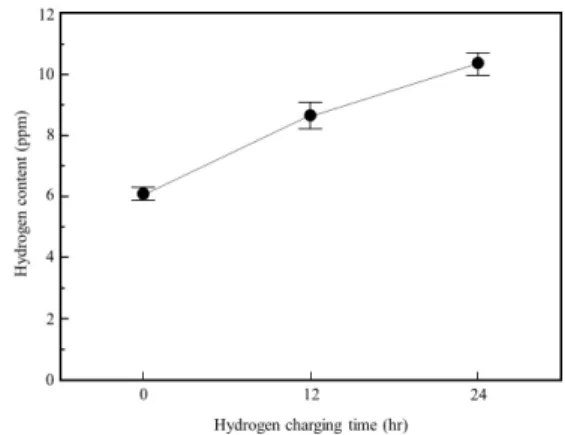
Fig. 1 shows the hydrogen content of the 304 stainless steels by the variation of hydrogen charging periods. The as-pressed sample of 304 stainless steel without a hydrogen charging possessed an average hydrogen content of about 6.0 ppm. The hydrogen content of the 304 stainless steels obviously increased with the increase of hydrogen charging times. The 304 stainless steel represented the increase amount of about 5.0 ppm during the hydrogen charging of 24 hours. In other words, the 304 stainless steels had a hydrogen content of about 11.0 ppm after the hydrogen charging of 24 hours.
Fig. 1 Effect of hydrogen charging periods on the hydrogen content of the 304 stainless steels
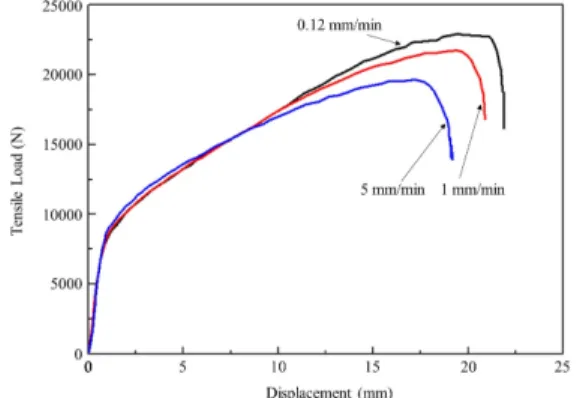
Fig. 2 displays the representative load- displacement curves of the 304 stainless steels obtained from different cross-head speeds of tensile loading. The hydrogen charging time for tensile test specimen was 12 hours. It was found that 304 stainless steels suffered from a hydrogen charging represented a similar fracture behavior, in spite of the variation of cross-head speeds in the tensile loading. However, the 304 stainless steels entirely showed a different behavior beyond the proportional limit, as the
cross-head speeds of tensile loading increased. In other words, the decrease of cross-head speeds led to the strengthening of tensile load and displacement in the hydrogen charged materials. This means that the tensile behavior of the 304 stainless steels by the hydrogen charging obviously displayed the dependence of cross-head speed.
Fig. 3 shows the effect of cross-head speeds on the ultimate tensile strength and the yield strength of the 304 stainless steels. The tensile test specimen was charged with the hydrogen during 12 hours.
The strength properties of 304 stainless steels were also measured using three pieces of tensile test specimens. It was found that the yield strength of the 304 stainless steels was not affected by the variation of cross-head speeds. The 304 stainless steels represented an average yield strength of about 350 MPa, even though the cross-head speed in the tensile loading increased. However, the ultimate tensile strength of 304 stainless steels tended to increase with the decrease of cross-head speed.
Especially, the 304 stainless steels represented an average ultimate tensile strength of about 780 MPa at the cross-head speed of 0.12 mm/min, which corresponded to about 1.2 times of that at the cross-head speed of 5.0 mm/min.
Fig. 2 Representative load-displacement curves of hydrogen charged 304 stainless steels depending on the variation of cross-head speeds in the tensile loading
Fig. 3 Effect of cross-head speeds on the ultimate tensile strength and the yield strength of the 304 stainless steels
Fig. 4 shows the effect of cross-head speeds on the elongation of the 304 stainless steels. The tensile test specimen was also charged with the hydrogen during 12 hours. It was found that the ductility of the 304 stainless steels was sensitive to the variation of cross-head speeds in the tensile loading. In other words, the fractured elongation of the 304 stainless steels obviously decreased with the increase of cross-head speed. Especially, the 304 stainless steels represented an average elongation of about 75 % at the cross-head speed of 0.12 mm/min.
Fig. 5 shows the effect of hydrogen charging
Fig. 4 Effect of cross-head speeds on the fractured elongation of the 304 stainless steels
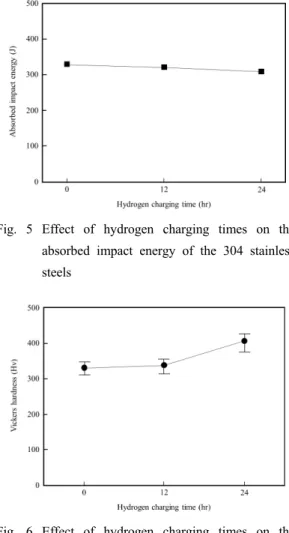
times on the absorbed impact energy of the 304 stainless steels. The absorbed impact energy of as-received samples without the hydrogen charging was also shown in this figure. It was found that the absorbed impact energy of the 304 stainless steels was obviously affected by the hydrogen charging on the material surface. An as-received sample of the 304 stainless steels represented an average absorbed impact energy of about 330 J. Such an absorbed impact energy tended to decrease with the increase of hydrogen charging times. Especially, the 304 stainless steels possessed an average absorbed impact energy of about 300 J at the hydrogen charging time of 24 hours. The reduction of impact energy is due to the hardening of material surface by the charging of hydrogen. In other words, the hydrogen charging on the surface of materials leads to the strengthening of embrittlement for the reduction of impact energy.
Fig. 6 shows the effect of hydrogen charging times on the Vickers hardness of the 304 stainless steels. The Vickers hardness of as-received samples without the hydrogen charging was also shown in this figure. The 304 stainless steels without the hydrogen charging represented an average hardness of about 330 Hv. The surface hardening of the 304 stainless steels was obviously affected by the variation of hydrogen charging times. In other words, the Vickers hardness of the 304 stainless steels greatly increased with the increase of hydrogen charging time. Especially, 304 stainless steels represented an average hardness of about 405 Hv at the hydrogen charging time of 24 hours, which corresponded to about 1.2 times of as-received sample without the hydrogen charging.
This is related to the surface hardening by the induction of hydrogen atoms. As shown in Fig. 1 and Fig. 6, the increase of charged hydrogen content for the 304 stainless steels leads to the strengthening of surface hardness. It can be also considered that the surface hardening deteriorates the absorbed impact energy of the 304 stainless steels, owing to the hydrogen embrittlement.
Fig. 5 Effect of hydrogen charging times on the absorbed impact energy of the 304 stainless steels
Fig. 6 Effect of hydrogen charging times on the Vickers hardness of the 304 stainless steels
Fig. 7 shows the representative fracture surface for impact test specimens of the 304 stainless steels without a hydrogen charging. It was found that the 304 stainless steels exhibited a plastic deformation like shear lip and a tearing portion in the stereoscopic microscope of fractured profile. As shown in Fig. 7(b), the ductile fracture morphology with large amount of wide and large-sized dimples was entirely existed at the center portion of fractured impact specimen. In addition, the 304 stainless steels displayed the typical cleavage fracture surface at the tearing portion of Fig. 7(c).
Especially, as shown in Fig. 7(a), the combination
of ductile fracture with amount of dimples and small cleavage facets was obviously observed at the edge portion of fractured specimen.
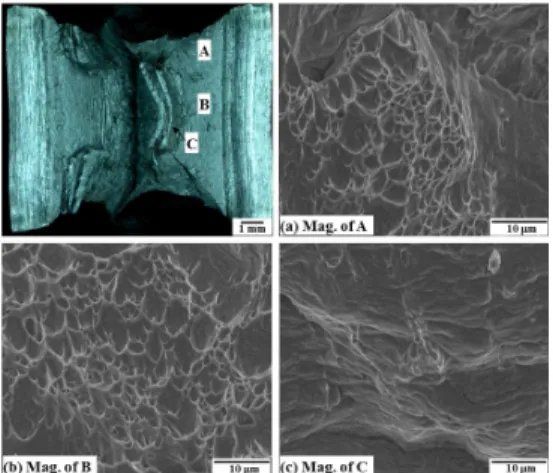
Fig. 8 shows the representative fracture surface for impact test specimens of hydrogen-charged 304 stainless steels. The hydrogen charging time for the 304 stainless steels was 24 hours. As shown in Fig.
7 and Fig. 8, the 304 stainless steels represented a similar fracture profile in the stereoscopic microscope photographs, in spite of a hydrogen charging. In other words, both large amount of plastic deformation and tearing portion were observed at the impact fracture surface of hydrogen-charged 304 stainless steels. However, as shown in Fig. 8(b), the evidence of cleavage fracture facet was observed at the center portion of fractured impact specimen, accompanying the reduction in the extent of dimples. Especially, the 304 stainless steels displayed a different fracture surface at the edge portion of fractured impact specimen in the case of hydrogen charging. It was found in Fig. 7(a) and Fig. 8(a) that the 304 stainless steels obviously exhibited a brittle fracture mode with the extreme reduction of ductile dimples, after the hydrogen charging. This is due to the
Fig. 7 Representative fracture surface for impact test specimens of the 304 stainless steels without a hydrogen charging
Fig. 8 Representative fracture surface for impact test specimens of hydrogen-charged 304 stainless steels
embrittlement of material surface by the induction of hydrogen atoms. (See Fig. 6) It can be also considered that the variation of fracture mode at the edge portion leads to the reduction of absorbed impact energy, owing to the surface hardening by the hydrogen charging.
4. Conclusions
1) The hydrogen content in the 304 stainless steels increased with the increase of hydrogen charging times. The 304 stainless steels possessed a hydrogen content of about 11.0 ppm, when the hydrogen charging time was 24 hours.
2) Hydrogen-charged 304 stainless steels exhibited an obvious sensitivity for the cross-head speed, even though a similar fracture behavior was observed in the tensile loading. However, the ultimate tensile strength of the 304 stainless steel and its elongation tended to increase with the decrease in the cross-head speed.
3) The hydrogen charging for the 304 stainless steel led to the hardening at the surface of the steel.
The hardness of the 304 stainless steel significantly increased with the increase of hydrogen charging time. The 304 stainless steels possessed an average
hardness of about 405 Hv after 24 hours of hydrogen charging.
4) The absorbed impact energy of the 304 stainless steel tended to decrease with the increase of hydrogen charging time, accompanying the cleavage fracture mode with a considerable reduction in the ductile dimples at the edge portion of fractured surfaces. These results are due to the hardening at the surface of the 304 stainless steel by the hydrogen charging process.
Acknowledgement
This work was supported by Dongeui University Grant (2015AA122).
References
1. D. H. Lee, 2012, “Toward the clean production of hydrogen: Competition among renewable energy sources and nuclear power”, International Journal of Hydrogen Energy, Vol. 37, pp.
15726-15735.
2. S. Dutta, 2014, “A review on production, storage of hydrogen and its utilization as an energy source”, Journal of Industrial and Engineering Chemistry, Vol. 20, pp. 1148-1156.
3. Z. Zhang and C. Hu, 2014, “System design and control strategy of the vehicles using hydrogen energy”, International Journal of Hydrogen Energy, Vol. 39, pp. 12973-12979.
4. J. Zheng, X. Liu, P. Xu, P. Liu, Y. Zhao and J.
Yang, 2012, “Development of high pressure gaseous hydrogen storage technologies”, International Journal of Hydrogen Energy, Vol.
37, pp. 1048-1057.
5. H. Barthelemy, 2012, “Hydrogen storage- industrial prospective”, International Journal of Hydrogen Energy, Vol. 37, pp. 17364-17372.
6. R. K. Ahluwalia, T. Q. Hua, J. K. Peng, S.
Lasher, K. Mckenney, J. Sinha and M. Gardiner, 2010, “Technical assessment of cryo-compressed
hydrogen storage tank systems for automotive applications”, Journal of Hydrogen Energy, Vol.
35, pp. 4171-4184.
7. M. Hoelzel, S. A. Danikin, H. Ehrenberg, D. M.
Toebbens, T. J. Udovic, H. Fuses and H. Wiph, 2004, “Effects of high-pressure hydrogen charging on the structure of austenitic stainless steels”, Materials Science and Engineering, Vol.
A384, pp. 255-261.
8. N. E. Nanninga, Y. S. Levy, E. S. Drexler, R.
T. Condon, A. E. Stevenson and A. J. Slifka, 2012, “Comparison of hydrogen embrittlement in three pipeline steels in high pressure gaseous hydrogen environments”,Corrosion Science, Vol.
59, pp. 1-9.
9. C. San Marchi, B. P. Somerday and S. L.
Robinson, 2007, “Permeability, solubility and diffusivity of hydrogen isotopes in stainless steels at high gas pressures”, Journal of Hydrogen Energy, Vol. 32, pp. 100-116.
10. Y. Mine and T. Kimoto, 2011, “Hydrogen uptake in austenitic stainless steels by exposure to gaseous hydrogen and its effect on tensile deformation”, Corrosion Science, Vol. 53, pp.
2619-2629.
11. S. Sugiyama, H. Ohkubo, M. Takenaka, K.
Ohsawa, M. I. Ansari, N. Tsukuda and E.
Kuramoto, 2000, “The effect of electrical hydrogen charging on the strength of 316 stainless steel”, Journal of Nuclear Materials, Vol. 283-287, pp. 863-867.
12. M. Au, 2007, “High temperature electrochemical charging of hydrogen and its application in hydrogen embrittlement research”, Materials Science and Engineering, Vol. A454-455, pp.
564-569.
13. J. Capelle, J. Dmytrakh and G. Pluvinage, 2010,
“Comparative assessment of electrochemical hydrogen absorption by pipeline steels with different strength”, Corrosion Science, Vol. 52, pp. 1554-1559.