• 검색 결과가 없습니다.

Ginsenoside Rg2 Inhibits Lipopolysaccharide-Induced Adhesion Molecule Expression in Human Umbilical Vein Endothelial Cell

N/A
N/A
Protected

Academic year: 2022

Share "Ginsenoside Rg2 Inhibits Lipopolysaccharide-Induced Adhesion Molecule Expression in Human Umbilical Vein Endothelial Cell"

Copied!
5
0
0

로드 중.... (전체 텍스트 보기)

전체 글

(1)

133 http://dx.doi.org/10.4196/kjpp.2013.17.2.133

ABBREVIATIONS: VCAM-1, vascular cell adhesion molecule 1;

ICAM-1, intercellular adhesion molecule 1; LPS, lipopolysaccharide;

HUVEC, human umbilical vein endothelial cell; NF-κB, nuclear factor kappa B; MAPK, mitogen-activated protein kinase; PI3- kinase, phosphatidylinositol 3-kinase; MEK/ERK, mitogen-activated protein kinase kinase/extracellular signal-regulated kinase; JNK, c-Jun N-terminal kinase; IκBα, IkappaBα.

Received January 2, 2013, Revised March 7, 2013, Accepted March 12, 2013

Corresponding to: Hee Yul Ahn, Department of Pharmacology, College of Medicine, Chungbuk National University, 52 Naesoodong- ro, Heungdeok-gu, Cheongju 361-763, Korea. (Tel) 82-43-261-2850, (Fax) 82-43-261-3178, (E-mail) [email protected]

This is an Open Access article distributed under the terms of the Creative Commons Attribution Non-Commercial License (http://

creativecommons.org/licenses/by-nc/3.0) which permits unrestricted non-commercial use, distribution, and reproduction in any medium, provided the original work is properly cited.

Ginsenoside Rg2 Inhibits Lipopolysaccharide-Induced Adhesion Molecule Expression in Human Umbilical Vein Endothelial Cell

Young-Suk Cho

1

, Chan Hyung Kim

1

, Tae-Sun Ha

2

, Sang Jin Lee

3

, and Hee Yul Ahn

1

Departments of

1

Pharmacology,

2

Pediatrics,

3

Physiology, College of Medicine, Chungbuk National University, Cheongju 361-763, Korea

Vascular cell adhesion molecule 1 (VCAM-1), intercellular adhesion molecule 1 (ICAM-1), P- and E-selectin play a pivotal role for initiation of atherosclerosis. Ginsenoside, a class of steroid glycosides, is abundant in Panax ginseng root, which has been used for prevention of illness in Korea. In this study, we investigated the mechanism(s) by which ginsenoside Rg2 may inhibit VCAM-1 and ICAM-1 expressions stimulated with lipopolysaccharide (LPS) in human umbilical vein endothelial cell (HUVEC). LPS increased VCAM-1 and ICAM-1 expression. Ginsenoside Rg2 prevented LPS-mediated increase of VCAM-1 and ICAM-1 expression. On the other hand, JSH, a nuclear factor kappa B (NF-κB) inhibitor, reduced both VCAM-1 and ICAM-1 expression stimulated with LPS. SB202190, inhibitor of p38 mitogen-activated protein kinase (p38 MAPK), and wortmannin, phosphatidylinositol 3-kinase (PI3-kinase) inhibitor, reduced LPS-mediated VCAM-1 but not ICAM-1 expression. PD98059, inhibitor of mitogen-activated protein kinase kinase/extracellular signal-regulated kinase (MEK/ERK) did not affect VCAM-1 and ICAM-1 expression stimulated with LPS. SP600125, inhibitor of c-Jun N-terminal kinase (JNK), reduced LPS-mediated ICAM-1 but not VCAM-1 expression. LPS reduced IkappaBα (Iκ Bα ) expression, in a time-dependent manner within 1 hr. Ginsenoside Rg2 prevented the decrease of Iκ Bα expression stimulated with LPS. Moreover, ginsenoside Rg2 reduced LPS-mediated THP-1 monocyte adhesion to HUVEC, in a concentration-dependent manner. These data provide a novel mechanism where the ginsenoside Rg2 may provide direct vascular benefits with inhibition of leukocyte adhesion into vascular wall thereby providing protection against vascular inflammatory disease.

Key Words: Endothelial cell, Ginsenoside Rg2, ICAM-1, VCAM-1

INTRODUCTION

Atherosclerosis is a chronic inflammatory disease of the vasculature. Activation of vascular endothelial cell is the initiating event of atherosclerosis. Pro-inflammatory cyto- kines such as tumor necrosis factor-alpha (TNFα) mediate vascular endothelial cell activation resulting in upregula- tion of adhesion molecules such as P- and E-selectin, inter- cellular adhesion molecule 1 (ICAM-1), vascular cell adhe- sion molecule 1 (VCAM-1). Cell adhesion molecules initiate leukocyte-endothelial cell contact and facilitate subsequent rolling, activation and transendothelial migration into vas- cular wall [1,2]. Recruited monocytes differentiate into mac- rophages which engulf lipoprotein particles through endo- cytosis and become foam cells in vascular intima, which is

a hallmark of the nascent of atherosclerotic plaque [1,2].

Expression of ICAM-1 has been observed in human athero- sclerotic plaques [3]. Epidemiological studies have demon- strated that increased vascular risk in individuals with ele- vated levels of cell adhesion molecules such as ICAM-1 and P-selectin [4]. Elevated soluble-ICAM levels demonstrated increase of vascular inflammation in atherosclerotic pa- tients [5]. Serum concentrations of VCAM-1 and ICAM-1 were significantly higher in patient groups with coronary artery disease (CAD) compared with the controls [6].

Moreover, significant correlations between ICAM-1 and VCAM-1 levels and maximal carotid artery intimal-medial thickness were found in type-2 diabetic patients [7].

Ginsenosides, found in the plant genus Panax, are tri-

terpene saponins. These can be classified into two groups

as follows: the protopanaxadiol group (Rb1, Rb2, Rc, Rd)

and the protopanaxatriol group (Rg1, Re, Rf, Rg2). Ginseno-

side Rb1 inhibited TNFα-induced VCAM-1 expression in

human endothelial cells [8]. Protopanaxadiol-type saponin

was the most potent saponin fraction against TNFα-induc-

(2)

molecules in vitro and in vivo [9]. Ginsenoside Rb1 acted as a weak phytoestrogen in MCF-7 human breast cancer cells [10]. On the other hand, ginsenoside Rg1 attenuated the oxidative stress in the liver of exercised rats [11].

Ginsenoside Rg2 protected memory impairment via an- ti-apoptosis in a rat model with vascular dementia [12].

Panax notoginseng reduced atherosclerotic lesions in ApoE-deficient mice and inhibited TNF-alpha-induced en- dothelial adhesion molecule expression and monocyte adhe- sion [13], and suppressd RAGE/MAPK signaling and nu- clear factor kappa B (NF-κB) activation in apolipopro- tein-E-deficient atherosclerosis-prone mice [14]. Therefore, ginsenoside may act as a potential molecule for prevention and treatment against vascular inflammation. However, the mechanism(s) of ginsenoside on decrement of vascular inflammation has not been fully investigated.

The aim of study was to investigate the mechanism(s) of ginsenoside Rg2 on lipopolysaccharide (LPS)-induced VCAM-1 and ICAM-1 expression in human umbilical vein endothelial cell (HUVEC).

METHODS Materials

Endothelial cell basal medium (EBM)-2 Bullet kit was obtained from Lonza (Walkersville, MD). RPMI 1640, fetal bovine serum (FBS), penicillin-streptomycin, phosphate buffer saline (PBS) and trypsin-EDTA were obtained from Invitrogen Corp (Carlsbad, CA). LPS was obtained from List Biological Laboratories, Inc. Gelatin, Calcein-AM, JSH, SB202190, PD98059, wortmannin, SP600125 and ginseno- side Rg2 were obtained from Sigma-Aldrich Corp (St. Louis, MO). Antibodies against VCAM-1, ICAM-1, IκBα, β-tu- bulin and horseradish peroxidase-conjugated goat anti- rabbit IgG were purchased from Santa Cruz Biotechnology, Inc (Santa Cruz, CA).

Cell culture

HUVEC was purchased from Lonza (Walkersville, MD) at passage 1 and maintained in EBM-2 Bullet kit with 10%

heat-inactivated FBS at 37

o

C in a humidified atmosphere of 5% CO

2

. In experiments, endothelial cells were used at passage 4∼9. Cells were plated at 90∼95% confluence and treated for 1 hr with 50μM of inhibitor or Rg2 (1∼50μM) prior to LPS (1μg/ml) stimulation for 8 hr. A group of cells treated only with dimethylsulfoxide (DMSO) were used as a solvent control. Human-derived THP-1 macrophage cell lines were obtained from the American Type Culture Collection (ATCC) (Manassas, VA). THP-1 cells were cul- tured in RPMI 1640, and supplemented with 2 mM L-gluta- mine, 100μg/ml streptomycin, 100 IU/ml penicillin and 10% FBS.

Western blot analysis

The endothelial cells were treated with Rg2 or inhibitor prior to LPS stimulation. After treatment, cells were wash- ed twice in PBS. Whole cell lysates were prepared with RIPA buffer containing the Protease Inhibitor Cocktail V (Calbiochem, Switzerland). Protein concentration was de- termined by using the Bio-Rad protein assay (Bio-Rad Lab,

resolved on 8% and 12% SDS-polyacrylamide gel. The pro- teins were electrophoretically transferred to an Immobi- lon-P membrane (Millipore, Bedford, MA) and the mem- branes were blocked with 5% nonfat dry milk in Tris-buf- fered saline containing 0.1% Tween-20 (TTBS) at room tem- perature 1 hr. The membrane was incubated for overnight with primary antibodies of anti-human ICAM-1, anti-hu- man VCAM-1 and IκBα. After three washes with TBS-T buffer, the membrane was then incubated for 1 hr with goat anti-rabbit IgG horseradish peroxidase. The levels of ICAM-1, VCAM-1 and IκBα proteins were determined by using an Enhanced Chemiluminescence Plus kit (Amer- sham Biosciences, Piscataway, NJ) and Fujifilm LAS-3000 system (Fujilfilm, Japan). Anti-human β-tubulin antibody was used for the loading control. Each image of Western blot was quantified with Multi Gauge Software Version 2.3 (Fujifilm, Japan).

Cell adhesion assay

HUVEC was grown in EBM-2 containing 10% FBS at a density of 2.0×10

5

cells/well on 24-well plates. Endothelial cells at 90∼95% confluence were treated with Rg2 (1, 20, 50μM) for 1 hr prior to 1μg/ml of LPS stimulation for 8 hr. THP-1 cells were labeled with Calcein-AM (5μM) in RPMI 1640 medium containing 10% FBS for 30 min. After extensive washing with PBS, the labeled THP-1 cells were seeded at a density of 5.0×10

5

cells/well onto endothelial cells which were treated with the Rg2 and/or LPS and, then, incubated for 1 hr at 37

o

C while gentle shaking. After incubation, non-adherent cells were removed by gentle washing two times with PBS. Photograph images were ob- tained at 485 nm excitation and 538 nm emission using a SPOT II digital camera-attached fluorescence microscope (Diagnostic Instrument, Livingston, Scotland).

Data analysis

The results are presented as means±SEM for each treat- ment group in each experiment. Data were tested by one-way ANOVA followed by Scheffe post-hoc test for multi- ple comparisons. Statistical software SPSS (Chicago, IL, USA) was used. p<0.05 was considered statistically significant.

RESULTS

Effect of ginsenoside Rg2 on LPS-induced VCAM-1 and ICAM-1 expression from endothelial cells

Treatment of endothelial cells with LPS (1μg/ml) in-

creased VCAM-1 and ICAM-1 expression. By 8 hr after LPS

treatment, maximal expression of VCAM-1 and ICAM-1

was attained. To determine whether LPS-stimulated

VCAM-1 and ICAM-1 expression is affected by ginsenoside

Rg2, endothelial cells were treated for 1 hr with ginsenoside

Rg2 (1∼100μmol/l) prior to LPS (1μg/ml) stimulation for

8 hr. Ginsenoside Rg2 inhibited VCAM-1 and ICAM-1 ex-

pression stimulated with LPS in a concentration-dependent

manner, significantly (Fig. 1).

(3)

Fig. 1. Effect of Rg2 on the protein expression levels of adhesion molecules in HUVEC stimulated with LPS. Endothelial cell was treated with 1, 10, 20, 50 and 100μmol/l of Rg2 for 1 hr prior to LPS (1μg/ml) stimulation for 8 hr. Cell extracts were resolved on 8% SDS-polyacrylamide gel and Western blot analysis with the respective primary antibody against VCAM-1 and ICAM-1. β- tubulin was used as an internal control. The bar graph represents the amount of VCAM-1 and ICAM-1 estimated by image scanning and is expressed in arbitrary units. Values are means±SEM of 3 independent experiments. Statistical significance assessed by one-way ANOVA followed by Scheffe post-hoc test for multiple comparisons (**p<0.01, ***p<0.001 vs LPS).

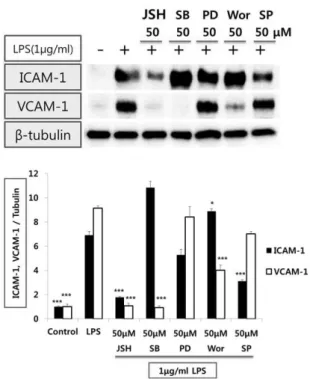
Fig. 2. Effect of inhibitors of signal transduction pathway on the protein expression levels of adhesion molecules in HUVEC stimulated with LPS. Endothelial cell was treated with 50μmol/l of JSH (NF-κB inhibitor), SB202190 (p38 MAPK inhibitor), PD98059 (MEK/ERK inhibitor), wortmannin (PI3-K inhibitor), and SP600125 (JNK inhibitor) for 1hr prior to LPS (1μg/ml) sti- mulation for 8 hr. Cell extracts were resolved on 8% SDS- polyacrylamide gel and Western blot analysis with the respective primary antibody against VCAM-1 and ICAM-1. β-tubulin was used as an internal control. The bar graph represents the amount of VCAM-1 and ICAM-1 estimated by image scanning and is expressed in arbitrary units. Values are means±SEM of 3 inde- pendent experiments. Statistical significance assessed by one-way ANOVA followed by Scheffe post-hoc test for multiple comparisons (*p<0.05, ***p< 0.001 vs LPS).

The signaling mechanism(s) by which LPS induces VCAM-1 and ICAM-1 expression from endothelial cells We first tested if VCAM-1 and ICAM-1 expression stimu- lated with LPS were mediated through the nuclear factor kappaB (NF-κB) pathway in HUVEC. LPS-induced VCAM-1 and ICAM-1 expression were prevented by JSH (50μmol/ l), inhibitor of NF-κB. Moreover, VCAM-1 but not ICAM-1 expression stimulated with LPS was decreased by SB 202190 (50μmol/l), an inhibitor of p38 mitogen-activated protein kinase (p38 MAPK) or wortmannin (50μmol/l), in- hibitor of phosphatidylinositol 3-kinase (PI3-kinase). How- ever, PD98059 (50μmol/l), inhibitor of mitogen-activated protein kinase kinase/extracellular signal-regulated kinase (MEK/ERK) did not affect VCAM-1 and ICAM-1 expression stimulated with LPS. SP600125 (50μmol/l), inhibitor of c-Jun N-terminal kinase (JNK), reduced LPS-mediated ICAM-1 but not VCAM-1 expression (Fig. 2).

Effect of ginsenoside Rg2 on I κ B α expression from endothelial cells

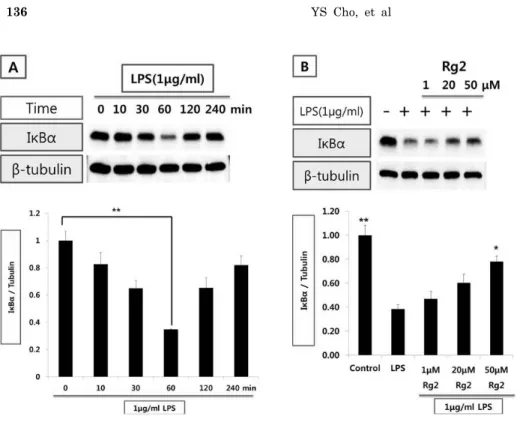
Treatment of endothelial cells with LPS (1μg/ml) de- creased IκBα expression. By 1 hr after LPS treatment, significant decrease of IκBα was attained (Fig. 3A). To

determine whether LPS-stimulated IκBα expression is af- fected by ginsenoside Rg2, endothelial cells were treated for 1 hr with ginsenoside Rg2 (1∼50μmol/l) prior to LPS (1μg/ml) stimulation for 1 hr. Ginsenoside Rg2 reversed the decrease of LPS-induced IκBα expression in a concen- tration- dependent manner, significantly (Fig. 3B).

Effect of ginsenoside Rg2 on THP-1 cell adhesion from endothelial cells

The adhesion of THP-1 cells to endothelial cells was measured using quantitative monolayer adhesion assay.

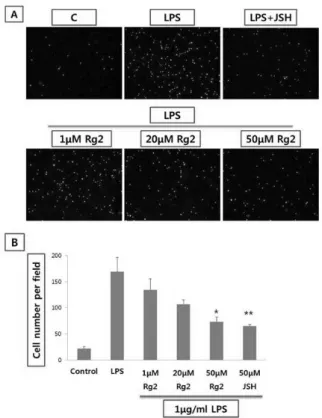
The adhesion of THP-1 cells onto endothelial cells were in- creased to five folds by LPS (1μg/ml) stimulation for 8 hrs.

Ginsenoside Rg2 (1∼50μmol/l) inhibited the adhesion of

THP-1 cells to endothelial cells stimulated with LPS, in a

concentration-dependent manner (Fig. 4). Moreover, JSH

(50μmol/l), inhibitor of NF-κB, attenuated the adhesion

of THP-1 cells to endothelial cells stimulated with LPS, sig-

nificantly (Fig. 4).

(4)

Fig. 3. Effect of Rg2 on IκBα ex- pression in HUVEC stimulated with LPS. (A) Time-course of IκBα ex- pression in HUVECs stimulated with LPS (1μg/ml). (B) Effect of Rg2 on time-course of IκBα expression in HUVEC stimulated with LPS.

Endothelial cell was treated with 1, 20, and 50μmol/l of Rg2 prior to LPS (1μg/ml) stimulation for 1 hr.

Cell extracts were resolved on 12%

SDS-polyacrylamide gel and Wes- tern blot analysis with the res- pective primary antibody against Iκ Bα. β-tubulin was used as an inter- nal control. The bar graph repre- sents the amount of IκBα esti- mated by image scanning and is expressed in arbitrary units. Values are means±SEM of 3 independent experiments. Statistical significance assessed by one-way ANOVA followed by Scheffe post-hoc test for multiple comparisons (A: **p<0.05 vs con- trol; B: *p<0.05, **p<0.01 vs LPS).

DISCUSSION

LPS, the prototypical endotoxin, promotes the secretion of pro-inflammatory cytokines in many cell types after bind- ing to CD14/TLR4/MD2 receptor [15]. In our study, stim- ulation with LPS to HUVEC increased VCAM-1 as well as ICAM-1 expression. The expression of adhesion molecules such as VCAM-1 and ICAM-1 is a pivotal early event for vascular inflammatory diseases [1,2]. Therefore, a natural molecule which inhibits the expression of VCAM-1 and ICAM-1 may be a potential candidate for prevention and treatment of vascular inflammatory diseases such as athe- rosclerosis with less toxicity.

Ginsenoside, a class of steroid glycosides, is abundant in Panax ginseng root, which has been used for health promo- tion in Korea for hundreds of years. Ginsenoside Rg2, proto- panaxatriol, inhibited VCAM-1 and ICAM-1 expression stimulated with LPS from HUVEC. The inhibition of VCAM-1 and ICAM-1 expression by ginsenoside Rg2 was in a concentration-dependent manner, significantly. Recent- ly, it was reported that ginsenoside Rg3 inhibited TNFα- induced expression of cell adhesion molecules in human en- dothelial cells [16]. In their study, activities of transcription factor, NF-kB and activator protein-1 (AP-1), were blocked by Rg3. Transcription factor, NF-κB, activity is essential for adhesion molecule expression. In our study, we show that JSH, an inhibitor of NF-κB, attenuated both VCAM-1 and ICAM-1 expression stimulated with LPS. Moreover, ginsenoside Rg2 prevented the decrease of IκB expression stimulated with LPS. IκB dissociation from RelA-p50 com- plex is crucial for NF-κB activity [17]. Therefore, ginseno- side Rg2 may act as a NF-κB inhibitor. Blockade of NF-κB activity could be beneficial in vascular inflammatory dis- ease such as atherosclerosis although questions remain.

On the other hand, SB202190, p38 MAPK inhibitor, and wortmannin, PI3-kinase inhibitor, decreased VCAM-1 but not ICAM-1 expression stimulated with LPS, respectively.

In contrast, inhibitor of p38 MAPK reduced the high glu-

cose-induced induction of ICAM-1 in endothelial cells [18].

Inhibition of PI3-kinase significantly reduced the express- ion of ICAM-1 stimulated with vascular endothelial growth factor in retinal endothelial cells [19]. Moreover, PD98059, inhibitor of MEK/ERK did not affect VCAM-1 and ICAM-1 expression stimulated with LPS. However, inhibitors of p38 MAPK (SB203580), and ERK (PD98059) could suppress TNFα-induced ICAM-1 expression, while only p38 MAPK and MEK/ERK inhibitors could suppress TNFα-induced VCAM-1 expression in human proximal tubular epithelial cells [20]. It appears that activation of p38 MAPK, PI3-kin- ase, and MEK/ERK on VCAM-1 and ICAM-1 induction de- pends on the used ligand and cell type in each experiment.

SP600125, inhibitor of JNK, decreased LPS-induced ICAM-1 but not VCAM-1 expression. JNK is the upstream regulator of transcription factor, activator protein-1 (AP-1) [21].

Therefore, it seems likely that ICAM-1 expression by LPS may be regulated by AP-1 as well as NF-κB. VCAM-1 ex- pression by LPS may be regulated primarily by NF-κB rather than AP-1 transcription factor.

The increase of THP-1 monocyte adhesion to endothelial cell by LPS supports the crucial role of VCAM-1 and ICAM-1 in early phase of atherogenesis. Ginsenoside Rg2 significantly reduced THP-1 monocyte adhesion to endothe- lial cell stimulated with LPS in a concentration-dependent manner. TNFα-induced THP-1 monocyte adhesion to HUVEC was attenuated by ginsenoside Rh1 [22]. Ginsenso- side Rg2 as well as Rh1 may be effective against early phase of vascular inflammation such as atherosclerosis. In vivo animal study will further strengthen the evidence for the vascular protective effects of ginsenoside Rg2.

In conclusion, the ginsenoside Rg2 may provide direct

vascular benefits with inhibition of leukocyte adhesion into

vascular wall thereby providing protection against vascular

inflammatory disease.

(5)

Fig. 4. Effect of Rg2 on THP-1 monocyte adhesion to LPS in HUVEC stimulated with LPS. (A) Endothelial cell was treated with 1, 20, and 50μmol/l of Rg2 prior to LPS (1μg/ml) stimulation for 8 hr. THP-1 cells were labeled with Calcein-AM (5μmol/l) for 30 min. The labeled THP-1 cells were seeded at a density of 5.0×10

5

cells/well onto endothelial cells treated with the Rg2 and/or LPS and then incubated for 1 hr. Microphotographs (four independent experiments) were obtained using fluorescence microscopy. Mag- nification ×100. (B) The bar graph represents the cell number of THP-1 monocyte. Values are means±SEM of 3 independent ex- periments. Statistical significance assessed by one-way ANOVA followed by Scheffe post-hoc test for multiple comparisons (*p

<0.05, **p<0.01 vs LPS).

ACKNOWLEDGEMENTS

This work was supported by the research grants of the Chungbuk National University in 2010. Authors are grate- ful to Dr. Sandra Davidge, Department of Obstetrics/

Gynecology, University of Alberta, Canada for critical read- ing of the manuscript.

REFERENCES

1. Kułdo JM, Ogawara KI, Werner N, Asgeirsdóttir SA, Kamps JA, Kok RJ, Molema G. Molecular pathways of endothelial cell activation for (targeted) pharmacological intervention of chro- nic inflammatory diseases. Curr Vasc Pharmacol. 2005;3:11-39.

2. Libby P. Inflammatory mechanisms: the molecular basis of inflammation and disease. Nutr Rev. 2007;65:S140-S146.

3. Poston RN, Haskard DO, Coucher JR, Gall NP, Johnson-Tidey RR. Expression of intercellular adhesion molecule-1 in athero- sclerotic plaques. Am J Pathol. 1992;140:665-673.

4. Mahmoudi M, Curzen N, Gallagher PJ. Atherogenesis: the role of inflammation and infection. Histopathology. 2007;50:535- 5. Schirmer SH, Fledderus JO, van der Laan AM, van der 546.

Pouw-Kraan TC, Moerland PD, Volger OL, Baggen JM, Böhm M, Piek JJ, Horrevoets AJ, van Royen N. Suppression of inflammatory signaling in monocytes from patients with coronary artery disease. J Mol Cell Cardiol. 2009;46:177-185.

6. Damnjanović G, Jelić M, Dindić B, Ilić S. Serum concentration of soluble adhesive molecules in patients with different forms of coronary artery disease. Vojnosanit Pregl. 2009;66:265-270.

7. Rubio-Guerra AF, Vargas-Robles H, Serrano AM, Lozano- Nuevo JJ, Escalante-Acosta BA. Correlation between the levels of circulating adhesion molecules and atherosclerosis in type-2 diabetic normotensive patients: circulating adhesion molecules and atherosclerosis. Cell Adh Migr. 2009;3:369-372.

8. Chai H, Wang Q, Huang L, Xie T, Fu Y. Ginsenoside Rb1 inhibits tumor necrosis factor-alpha-induced vascular cell adhesion molecule-1 expression in human endothelial cells.

Biol Pharm Bull. 2008;31:2050-2056.

9. Wang N, Wan JB, Chan SW, Deng YH, Yu N, Zhang QW, Wang YT, Lee SM. Comparative study on saponin fractions from Panax notoginseng inhibiting inflammation-induced endothe- lial adhesion molecule expression and monocyte adhesion. Chin Med. 2011;6:37.

10. Lee YJ, Jin YR, Lim WC, Park WK, Cho JY, Jang S, Lee SK.

Ginsenoside-Rb1 acts as a weak phytoestrogen in MCF-7 human breast cancer cells. Arch Pharm Res. 2003;26:58-63.

11. Korivi M, Hou CW, Huang CY, Lee SD, Hsu MF, Yu SH, Chen CY, Liu YY, Kuo CH. Ginsenoside-Rg1 protects the liver against exhaustive exercise-induced oxidative stress in rats.

Evid Based Complement Alternat Med. 2012;2012:932165.

12. Zhang G, Liu A, Zhou Y, San X, Jin T, Jin Y. Panax ginseng ginsenoside-Rg2 protects memory impairment via anti-apop- tosis in a rat model with vascular dementia. J Ethnopharmacol.

2008;115:441-448.

13. Wan JB, Lee SM, Wang JD, Wang N, He CW, Wang YT, Kang JX. Panax notoginseng reduces atherosclerotic lesions in ApoE- deficient mice and inhibits TNF-alpha-induced endothelial adhesion molecule expression and monocyte adhesion. J Agric Food Chem. 2009;57:6692-6697.

14. Dou L, Lu Y, Shen T, Huang X, Man Y, Wang S, Li J. Panax notogingseng saponins suppress RAGE/MAPK signaling and NF-kappaB activation in apolipoprotein-E-deficient athero- sclerosis-prone mice. Cell Physiol Biochem. 2012;29:875-882.

15. Rockel C, Hartung T. Systematic review of membrane com- ponents of gram-positive bacteria responsible as pyrogens for inducing human monocyte/macrophage cytokine release. Front Pharmacol. 2012;3:56.

16. Hien TT, Kim ND, Kim HS, Kang KW. Ginsenoside Rg3 inhibits tumor necrosis factor-alpha-induced expression of cell adhesion molecules in human endothelial cells. Pharmazie.

2010;65:699-701.

17. Monaco C, Paleolog E. Nuclear factor kappaB: a potential therapeutic target in atherosclerosis and thrombosis. Cardio- vasc Res. 2004;61:671-682.

18. Kim SW, Kim CE, Kim MH. Flavonoids inhibit high glucose- induced up-regulation of ICAM-1 via the p38 MAPK pathway in human vein endothelial cells. Biochem Biophys Res Com- mun. 2011;415:602-607.

19. Zhang XL, Wen L, Chen YJ, Zhu Y. Vascular endothelial growth factor up-regulates the expression of intracellular adhesion molecule-1 in retinal endothelial cells via reactive oxygen species, but not nitric oxide. Chin Med J (Engl).

2009;122:338-343.

20. Ho AW, Wong CK, Lam CW. Tumor necrosis factor-alpha up-regulates the expression of CCL2 and adhesion molecules of human proximal tubular epithelial cells through MAPK signaling pathways. Immunobiology. 2008;213:533-544.

21. Tang G, Minemoto Y, Dibling B, Purcell NH, Li Z, Karin M, Lin A. Inhibition of JNK activation through NF-kappaB target genes. Nature. 2001;414:313-317.

22. Lee ES, Choi JS, Kim MS, You HJ, Ji GE, Kang YH. Ginseno-

side metabolite compound K differentially antagonizing tumor

necrosis factor-α-induced monocyte-endothelial trafficking. Chem

Biol Interact. 2011;194:13-22.

수치

Fig. 1. Effect of Rg2 on the protein expression levels of adhesion  molecules in HUVEC stimulated with LPS
Fig. 3. Effect of Rg2 on IκBα ex- ex-pression in HUVEC stimulated with  LPS. (A) Time-course of IκBα  ex-pression in HUVECs stimulated  with LPS (1μg/ml)
Fig. 4. Effect of Rg2 on THP-1 monocyte adhesion to LPS in  HUVEC stimulated with LPS

참조

관련 문서