Korean J Radiol 7(3), September 2006
215
Occlusion of Traumatic Carotid
Cavernous Fistula by Incidentally Formed Thrombus During the Interventional
Procedure: A Case Report
In this report, we present a rare case of traumatic carotid cavernous fistula that was occluded during the interventional procedure by incidentally formed blood clot. Sudden occlusion of the fistula and the resolution process of the precarious blood clot can be clearly seen on the serial angiogram.
he direct type carotid cavernous fistula (CCF) is one of the major compli- cations that can occur after head trauma. It is indicated by a high-flow fistula between the carotid artery and the cavernous sinus. The sponta- neous occlusion of a symptomatic carotid cavernous fistula is not a common finding. In this case report, we present an incidental occlusion of a traumatic CCF by a thrombus that was formed during the interventional procedure. To our knowledge, this is the first report showing such a phenomenon.
CASE REPORT
A 42-year-old male patient presented with headache, right eyelid swelling and right eye redness that he had suffered with for one month. The patient had a history of a car accident with head injury five months ago. On physical examination, right eye
exophthalmos and chemosis was observed, and bruit was auscultated on the right eye ball.
A CT imaging study of the brain implied the existence of a right carotid-cavernous fistula; the scan revealed a prominent right superior ophthalmic vein (Fig. 1).
The patient was taken to an angiography suite for endovascular treatment of the suspected fistula. An initial angiogram of the right internal carotid artery (ICA) verified the rapid opacification of the cavernous sinus with drainage into the superior ophthalmic vein, the inferior petrosal sinus and the pterygoid plexus. The origin of the fistula was difficult to visualize despite the acquisition of multiple projection
angiograms. With performing an ipsilateral compression study of the ICA, the fistula was suspected to have originated from the proximal portion of the cavernous ICA (Fig. 2A). To verify the exact location of the fistula, an Exelsior 18 microcatheter (Boston Scientific, Fremont, CA) and a Transend microguide-wire (Boston Scientific, Fremont, CA) were used for the superselective angiogram and embolization.
However, it was difficult to advance the mirocatheter to the cavernous sinus through the small sized fistula, and there was remarkable resistance to moving the microguide- wire back and forth through the fistula. After several trial of catheterization and removal of the microcatheter, an angiogram was done. We found sudden occlusion of the fistula by a blood clot that was protruding into the lumen of the ICA (Fig. 2B). The Kum Whang, MD
1Myeong Sub Lee, MD
2Myung Soon Kim, MD
2Ji Yong Lee, MD
3Woocheol Kwon, MD
2Index terms : Carotid-Cavernous Sinus Fistula
Interventional procedures
Korean J Radiol 2006 ; 7 : 215-217 Received September 9, 2005; accepted after revision November 9, 2005.
Departments of 1Neurosurgery,
2Radiology, 3Neurology, Yonsei University Wonju College of Medicine, Kangwon-do 220-701, Korea
Address reprint requests to : Myeong Sub Lee, MD, Department of Radiology, Wonju College of Medicine, Yonsei University, Wonju Christian Hospital, 162 Ilsan-dong, Wonju, Kangwon-do 220-701, Korea Tel. (8233) 741-1467 Fax. (8233) 732-8281
e-mail: [email protected]
T
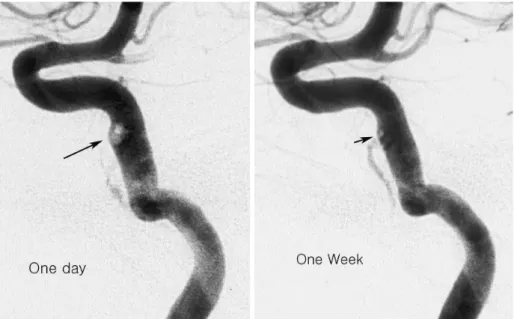
patient’s symptoms were immediately alleviated after angiography. We stopped the interventional procedure and conducted two serial follow-up angiograms at one day and one week after the interventional procedure to evaluate the precarious protruding blood clot and the state of the occluded fistula. Progressive resolution of the thrombus was shown on the serial angiogram (Fig. 3). A small residual fistulous channel was noted near the occluded fistula, but it showed stasis of the contrast dye and there was no connection to the other venous channels. Three
weeks after therapy, the patient’s symptoms had completely resolved.
DISCUSSION
Various endovascular approaches have been tried to correct high-flow post-traumatic CCF (1 3). Spontaneous closure of CCFs by thrombosis of the cavernous sinus is uncommon, and especially in the traumatic high flow type, although it has been previously described in some cases (4). Nishijima et al. reported one case of spontaneous occlusion of a traumatic CCF after orbital venography and also six other cases that had been observed on angiography (5). As a mechanism of spontaneous occlusion, they suggested that carotid angiography played an important role in most of these cases. They also suggested that stasis of the blood flow during venography may have caused the formation of a thrombosis inside of the cavernous sinus, which induced closure of the fistula.
In our case, fistula closure by the blood clot occurred during the angiogram and the microcatheter/ microgu- idewire navigating procedure. We think that some CCFs, especially small size fistulas, may be quite susceptible to being occluded by external forces such as carotid artery compression during angiogram procedures via the mechan- ical stimuli or the intimal trauma that occurs during interventional procedures, and this may cause thrombosis of the cavernous sinus. Our case may belong to this type of circumstance.
Whang et al.
216
Korean J Radiol 7(3), September 2006Fig. 2. Sudden occlusion of the fistula by an incidentally formed blood clot.
A. On the ipsilateral compression angiogram, a small fistula (arrow) and venous drainage into the ophthalmic vein and cavernous sinus are noted.
B. Occlusion of the fistula and protrusion of thrombus can be seen within the internal carotid artery lumen (arrow).
A B
Fig. 1. A 42-year-old male patient with post-traumatic carotid- cavernous fistula. Enhanced orbital CT shows enlargement of the right superior ophthalmic vein and proptosis.
One of our major concerns was the protruding blood clots formed at the fistula site because of the risk of vascular occlusion or an embolic event. However, there were no complications and situation resolved very well.
In conclusion, we present here a rare case of occlusion of a post-traumatic direct CCF. Traumatic CCFs, and
especially small size fistulas, can be occluded during interventional procedures by such external stimuli such as a catheter and wire movement. The blood clot that protruded into the vascular lumen was not harmful in this case, but careful observation and follow-up for embolic complications is implicated.
References
1. Debrun GM, Vinuela F, Fox AJ, Davis KR, Ahn HS. Indications for treatment and classification of 132 carotid-cavernous
fistulas. Neurosurgery 1988;22:285-289
2. Fabian TS, Woody JD, Ciraulo DL, Lett ED, Phlegar RF, Barker DE, et al. Posttraumatic carotid cavernous fistula: frequency analysis of signs, symptoms, and disability outcomes after angiographic embolization. J Trauma 1999;47:275-281 3. Guglielmi G, Vinuela F, Duckwiler G, Dion J, Stocker A. High-
flow, small-hole arteriovenous fistulas: treatment with electrodetachable coils. AJNR Am J Neuroradiol 1995;16:325- 328
4. Alkhani A, Willinsky R, TerBrugge K. Spontaneous resolution of bilateral traumatic carotid cavernous fistulas and develop- ment of trans-sellar intercarotid vascular communication: case report. Surg Neurol 1999;52:627-629
5. Nishijima M, Iwai R, Horie Y, Oka N, Takaku A. Spontaneous occlusion of traumatic carotid cavernous fistula after orbital venography. Surg Neurol 1985;23:489-492
Traumatic CC Fistula Occluded by Incidentally Formed Thrombus during Intervention
Korean J Radiol 7(3), September 2006
217
Fig. 3. On the serial follow-up angiograms done at one day and one week after the initial procedure, progres- sive resolution of the blood clot (arrow) is seen. A small remaining fistulous track (small arrow) is noted with delayed contrast stagnation.
A B