• 검색 결과가 없습니다.

Rasagiline Induced Drug Rash with Eosinophilia and Systemic Symptoms Syndrome: A Case Report

N/A
N/A
Protected

Academic year: 2021

Share "Rasagiline Induced Drug Rash with Eosinophilia and Systemic Symptoms Syndrome: A Case Report"

Copied!
3
0
0

로드 중.... (전체 텍스트 보기)

전체 글

(1)

pISSN: 1229-6538 eISSN: 2383-5699 Korean J Clin Geri 2020;21(2):117-119 https://doi.org/10.15656/kjcg.2020.21.2.117

CASE REPORT

Received August 19, 2020; revised September 29, 2020; accepted October 22, 2020.

Corresponding author: Chang Hyeong Kim, Department of Neurology, Munsung Hospital, 168 Seongdang-ro, Namgu, Daegu 42459, Korea.

E-mail: [email protected]

Copyright Ⓒ 2020 The Korean Academy of Clinical Geriatrics

This is an open access article distributed under the term s of the Creative Com m ons Attribution Non-Com m ercial License (http://creativecom m ons.org/licenses/by-nc/4.0) which perm its unrestricted non-com m ercial use, distribution, and reproduction in any m edium , provided the original work is properly cited.

Rasagiline Induced Drug Rash with Eosinophilia and Systemic Symptoms Syndrome: A Case Report

Chang Hyeong Kim

1

, Kyung Min Yi

2

1

Department of Neurology, Munsung Hospital, Daegu;

2

Department of Nursing, Suseong University, Daegu, Korea

Rasagiline alone or in combination with other medications is used to treat the symptoms of Parkinson's disease. Drug rash with eosinophilia and systemic symptoms (DRESS) syndrome is a severe idiosyncratic drug reaction with a long latency period.

A 75-year-old woman with Parkinson's disease developed DRESS syndrome after 15-day rasagiline therapy. To our knowledge, this is the first clinical case report that describes rasagiline induced DRESS syndrome.

Key Words: DRESS syndrome, Drug rash, Rasagiline

INTRODUCTION

Drug rash with eosinophilia and systemic symptoms (DRESS) syndrome is a rare, potentially life-threatening, drug-induced hypersensitivity reaction that includes skin eruption, hemato- logical abnormalities (eosinophilia, and atypical lymphocytosis), lymphadenopathy, and internal organ involvement (the liver, kidney, and lung) [1]. DRESS syndrome most commonly manifests 2–8 weeks after initiation of the offending medicine.

Patients routinely develop fever early on in the disease proc- ess, followed by the rashes. These may vary from a mild ex- anthem to extensive blistering and skin loss, but is more of- ten pruritic macular erythema that may be associated with papules, pustules or vesicles. Systemic involvement commonly manifests as lymphadenopathy, hepatitis, pericarditis, inter- stitial nephritis or pneumonitis [2]. Medications most com- monly associated with DRESS syndrome are anticonvulsants, antibiotics (particularly the beta-lactams class), and allopurinol.

Other medications known to cause DRESS syndrome include non-steroidal anti-inflammatory drugs, captopril, mood stabil- izers, and antiretroviral agents [3].

Rasagiline, a monoamine oxidase type B (MAO-B) inhibitor is currently used both for monotherapy and as an adjunct to levodopa and dopamine agonists in the management of Parkinson’s disease [4].

We report on the case of a DRESS syndrome following the initiation of rasagiline for treating Parkinson’s disease.

CASE REPORT

A 75-year-old woman presented with a 1-year history of

progressive parkinsonism, which manifested as bradykinesia,

bilateral hand tremor, and gait festination, among other such

features. She had no history of other disease. Also, she de-

nied the use of any current medication. We considered levo-

dopa treatment as first-line treatment of Parkinsonism. Notably,

(2)

118 Korean J Clin Geri 2020;21(2):117-119

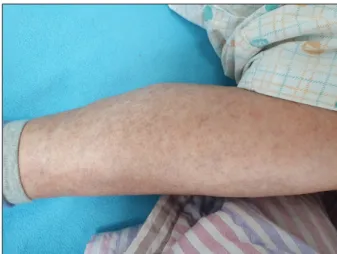
Figure 1. Rash on the left arm. Figure 2. Rash on the left leg.

levodopa is usually administered three or four times a day;

however, she wished to receive once-a-day dosing. Therefore, rasagiline was administered at a dose of 1 mg once daily.

Fifteen days after initiation of the drug, the patient developed a skin rash on her both arms and legs (Figures 1, 2) and er- ythematous maculopapular rashes throughout the body accom- panied by fever (38.1°C). Significant leukocytosis (21,000/mm

3

) with marked eosinophilia–eosinophils 50% of the total white blood cell count [10,520/mm

3

] was observed from the first day of appearance of the rash. Liver enzymes were elevated (serum glutamic oxaloacetic transaminase (SGOT) 110 IU, serum gluta- mic pyruvic transaminase (SGLT) 152 IU. The serum C-re- active protein (CRP) level was also elevated to 85 mg/L.

Physical examination showed multiple, enlarged, nontender cervical lymph nodes measuring approximately 2×2 cm in size. The serum hemoglobin, platelet count, blood urea nitro- gen (BUN), and creatinine (Cr) levels were normal. These clinical and laboratory findings were suggestive of DRESS syndrome. Steroid therapy was started methylprednisolone at a dose of 1 mg/kg. This treatment led to complete resolution of the rash, 11 days after cessation of the drug. The eosino- phil count and liver enzymes returned to normal 9 days after cessation of the drug while the steroid was tapered.

DISCUSSION

The pathogenesis of DRESS syndrome is not completely understood. Reactivation of the human herpes virus-6 (HHV-6)

following the administration of an offending drug is known to play a major role in the pathogenesis of this syndrome [5]. DRESS syndrome is characterized by fever, cutaneous eruption, internal organ involvement, and hematological ab- normalities that occur 2-8 weeks after the administration of the offending drug. The incidence of DRESS syndrome ranges from 1 in 1,000 to 1 in 10,000 exposures in patients ad- ministered the specific drug [6].

The diagnostic criteria for DRESS syndrome include the following [5]:

1. Maculopapular rash that develops 3 days after initiation of therapy with a limited number of drugs.

2. Persistent clinical findings despite drug withdrawal.

3. Fever ( >38℃).

4. Hepatic abnormalities.

5. Leukocyte abnormalities with detection of at least one of the following features: (i) leukocytosis (>11,000 cells/mm

3

), (ii) atypical lymphocytosis (5%), (iii) eosinophilia ( >1,500 eosi- nophils/mm

3

).

6. HHV-6 reactivation.

Our patient met four of the criteria for DRESS syndrome (maculopapular rash, hepatic and leukocytic abnormalities, and eosinophilia observed 15 days after rasagiline admin- istration).

We evaluated adverse drug reactions and causality assess-

ment scales using the World Health Organization Collaborating

Centre (WHO–UMC) for International Drug Monitoring,

the Uppsala Monitoring Centre criteria. We designated this

(3)

Chang Hyeong Kim, Kyung Min Yi: Rasagiline Induced DRESS Syndrome: A Case Report 119

case as a “probable” causality category [7].

An unrecognized offending drug (rasagiline) induced DRESS syndrome in this patient. It is important to be aware that ra- sagiline can cause of DRESS syndrome.

CONFLICTS OF INTEREST

No potential conflict of interest relevant to this article was reported.

REFERENCES

1. Bocquet H, Bagot M, Roujeau JC. Drug-induced pseudolym- phoma and drug hypersensitivity syndrome (Drug Rash with Eosinophilia and Systemic symptoms: DRESS). Semin Cutan Med Surg 1996;15:250-7.

2. Seth D, Kamat D, Montejo J. DRESS syndrome: a practical ap- proach for primary care practitioners. Clin Pediatr (Phila) 2008;

47:947-52.

3. Tas S, Simonart T. Management of drug rash with eosino- philia and systemic symptoms (DRESS syndrome): an update.

Dermatology 2003;206:353-6.

4. Hauser RA, Abler V, Eyal E, Eliaz RE. Efficacy of rasagiline in early Parkinson’s disease: a meta-analysis of data from the TEMPO and ADAGIO studies. Int J Neurosci 2016;126:942-6.

5. Criado PR, Criado RF, Avancini JM, Santi CG. Drug re- action with Eosinophilia and Systemic symptoms (DRESS) / Drug-induced Hypersensitivity syndrome (DIHS): a review of current concepts. An Bras Dermatol 2012;87:435-49.

6. Cacoub P, Musette P, Descamps V, Meyer O, Speirs C, Finzi L, et al. The DRESS syndrome: a literature review. Am J Med 2011;124:588-97.

7. Uppsala Monitoring Centre. The use of the WHO-UMC system for standardised case causality assessment [Internet]. Uppsala:

Uppsala Monitoring Centre; [cited 2013 Apr 10]. Available

from: http://www.who-umc.org/Graphics/24734.pdf.

수치

Figure 1. Rash on the left arm. Figure 2. Rash on the left leg.

참조

관련 문서

Drug-intoxicated patients were predominantly male, with the highest incidence of intoxication among patients above the seventh decade of age(21.5%) and the

We suggest that it will be helpful for diagnosis, treatment and prevention of adverse drug reaction through known causative drug and clinical

Therefore, in this paper, the solar array of HST is modeled as a simple model with beams and membranes, and the phenomenon of thermal induced vibration is verified and

To develop a prolonged ocular drug delivery system with less frequency dosing, nanoparticles covalently bonded with levofloxacin in contact lenses will be a

Results: In this research, in the group with fibromyalgia patients group, systemic lupus erythematosus patients group and without systemic autoimmune

Serum uric acid levels and risk for vascular disease in patients with metabolic syndrome... Prevalence if the metabolic syndrome in a Turkish

 Early advancements using chemical principles (Mass Transfer & Polymer Materials)..  Nasal sprays that deliver finely atomized amounts of a

A study on the characteristics of bacteria isolated from cultured flounder( Paralichthys olivaceus )showing disease symptoms in Jeju area of Korea.. Drug