ABSTRACT
Purpose: BRCA1/2 mutations are associated with risks of breast and ovarian cancer. In Korea, incidences of BRCA1/2 genetic testing and risk-reducing surgery (RRS) have increased with insurance coverage and the Angelina Jolie effect. The aim of this study was to identify trends in RRS performed in Korean women with the BRCA1/2 mutation.
Methods: We retrospectively reviewed the medical records of BRCA1/2 mutation carriers with (affected carriers) and without (unaffected carriers) breast cancer until August 2018 from 25 Korean Hereditary Breast Cancer (KOHBRA)-affiliated hospitals.
Results: The numbers of contralateral risk-reducing mastectomy (RRM) and risk-reducing bilateral salpingo-oophorectomy (RRBSO) in affected carriers have increased 5.8- and 3.6- fold, respectively, since 2013. The numbers of RRBSO in unaffected carriers has increased 8-fold since 2013. The number of institutions that perform RRS has increased gradually. The number of hospitals that perform contralateral RRM on affected carriers increased from 3 in 2012 to 11 in 2018, and that of those that perform RRBSO increased from 7 to 17. The number of hospitals that perform bilateral RRM on unaffected carriers increased from 1 in 2012 to 2 in 2018, and that of those that perform RRBSO increased from 1 to 8. However, the hospitals showed differences in the rates of RRM or RRBSO performed.
Conclusion: The incidence of RRS increased each year throughout the study period. However, in Korea, the rate of RRS procedures depended on the hospital.
Original Article
Sung Mi Jung 1,*, Jai Min Ryu 1,*, Hyung Seok Park 2, Ji Soo Park 3, Eunyoung Kang 4, Seeyoun Lee 5, Han-Byoel Lee 6, Hyun Jo Youn 7, Tae-Kyung Yoo 8 , Jisun Kim 9, Jeong Eon Lee 1, Sang Ah Han 10,
Dongwon Kim 11, Sung-Won Kim 11, Korean Hereditary Breast Cancer Study Group
1 Division of Breast Surgery, Department of Surgery, Samsung Medical Center, Sungkyunkwan University School of Medicine, Seoul, Korea
2Department of Surgery, Yonsei University College of Medicine, Seoul, Korea
3 Division of Medical Oncology, Department of Internal Medicine, Yonsei Cancer Center, Yonsei University College of Medicine, Seoul, Korea
4Department of Surgery, Seoul National University Bundang Hospital, Seongnam, Korea
5Department of Surgery, National Cancer Center, Goyang, Korea
6Department of Surgery, Seoul National University College of Medicine, Seoul, Korea
7 Division of Breast Thyroid Surgery, Department of Surgery, Jeonbuk National University Medical School, Jeonju, Korea
8 Division of Breast Surgery, Department of Surgery, Seoul St. Mary's Hospital, College of Medicine, The Catholic University of Korea, Seoul, Korea
9 Division of Breast Surgery, Department of Surgery, University of Ulsan College of Medicine, Asan Medical Center, Seoul, Korea
10Department of Surgery, School of Medicine, Kyung Hee University, Seoul, Korea
11Department of Surgery, Daerim St. Mary's Hospital, Seoul, Korea
Trends in Risk-Reducing Mastectomy and Risk-Reducing Salpingo-
Oophorectomy in Korean Carriers of the BRCA1/2 Mutation
Received: May 27, 2020 Accepted: Nov 24, 2020 Correspondence to Sung-Won Kim
Department of Surgery, Daerim St. Mary's Hospital, 657 Siheung-daero,
Yeongdeungpo-gu, Seoul 07442, Korea.
E-mail: [email protected]
*These authors contributed equally to this work.
© 2020 Korean Breast Cancer Society This is an Open Access article distributed under the terms of the Creative Commons Attribution Non-Commercial License (https://
creativecommons.org/licenses/by-nc/4.0/) which permits unrestricted non-commercial use, distribution, and reproduction in any medium, provided the original work is properly cited.
ORCID iDs Sung Mi Jung
https://orcid.org/0000-0003-2820-8797 Jai Min Ryu
https://orcid.org/0000-0001-5405-7385 Hyung Seok Park
https://orcid.org/0000-0001-5322-6036 Ji Soo Park
https://orcid.org/0000-0002-0023-7740 Eunyoung Kang
https://orcid.org/0000-0002-2591-1594 Seeyoun Lee
https://orcid.org/0000-0002-7576-1512 Han-Byoel Lee
https://orcid.org/0000-0003-0152-575X Hyun Jo Youn
https://orcid.org/0000-0002-2407-8537
Tae-Kyung Yoo
https://orcid.org/0000-0002-5790-353X Jisun Kim
https://orcid.org/0000-0002-4884-6107 Jeong Eon Lee
https://orcid.org/0000-0003-0037-2456 Sang Ah Han
https://orcid.org/0000-0001-6629-955X Dongwon Kim
https://orcid.org/0000-0003-0587-3575 Sung-Won Kim
https://orcid.org/0000-0001-5687-1380 Conflict of Interest
Lee HB is a member on the board of directors of, and has stock and ownership interests at DCGen, Co., Ltd., Seoul, South Korea, outside the current study. The other authors declare no conflict of interest.
Author Contributions
Conceptualization: Kim SW; Data curation:
Park HS, Park JS, Kang E, Lee S, Lee HB, Youn HJ, Yoo TK, Kim J, Lee JE, Han SA;
Investigation: Kim D; Writing - original draft:
Jung SM; Writing - review & editing: Ryu JM, Lee JE, Kim SW.
Keywords: Breast neoplasms; Genes, BRCA1; Genes, BRCA2; Prophylactic mastectomy;
Salpingo-oophorectomy
INTRODUCTION
The most common causative gene of hereditary breast cancer is BRCA1/2, with mutations in these genes accounting for almost 25% of families with a strong history of breast cancer [1].
The estimated lifetime risks are 56%–80% for breast cancer and 27%–45% for ovarian cancer in carriers of the BRCA1 mutation, and 45%–84% for breast cancer and 10%–20% for ovarian cancer in carriers of the BRCA2 mutation [2-4]. Results from the Korean Hereditary Breast Cancer (KOHBRA) study have helped improve clinicians' recognition of hereditary breast cancer, especially in Korea [5-7].
Carriers of the BRCA1/2 mutation are recommended to undergo annual breast magnetic resonance imaging for screening or receive risk-reducing management procedures such as chemoprevention or risk-reducing surgery (RRS). In Korea, RRS for breast and ovarian cancer prevention was not widely performed before 2012. However, the National Health Insurance initiated insurance coverage of BRCA1/2 genetic testing in May 2012. In addition, the actress Angelina Jolie—a carrier of the BRCA1 mutation—announced her decision to undergo a bilateral risk-reducing mastectomy (RRM) in May 2013. Following these events, more women took interest in BRCA1/2 mutations, and the frequency of RRS has increased over the past decade [8].
In a previous study, we reported the trends in RRS and BRCA1/2 genetic testing from 2010 to 2015 [9]. Insurance for risk-reducing bilateral salpingo-oophorectomy (RRBSO) has been available since December 2012. Subsequently, insurance coverage of RRM with or without breast reconstruction was initiated in October 2017. The aim of this study was to investigate trends in RRS for the prevention of breast and ovarian cancer in Korean carriers of the BRCA1/2 mutation until August 2018.
METHODS
Affected carriers were defined by BRCA1/2 mutation with breast cancer, and unaffected carriers were defined by BRCA1/2 mutation without breast cancer. Overall, 25 KOHBRA- affiliated hospitals agreed to participate in this study, with 18 hospitals subsequently providing data. The data were retrospectively collected from patients' medical records. In addition, the number of BRCA1/2 genetic tests performed by the Health Insurance Review and Assessment Service was investigated. The numbers of genetic testing for BRCA1/2 mutations and RRS were collected from January 2010 to August 2018.
The 25 KOHBRA-affiliated hospitals were Bunhongbit Hospital, Chonbuk National University Hospital, Daegu Catholic University Medical Center, Daejeon St. Mary's Hospita, Daerim Saint Mary's Hospital, Dankook University Hospital, Dongguk University Ilsan Hospital, Gangnam Severance Hospital, Gangwon National University Hospital, Inje University Ilsan Paik Hospital, Korea Cancer Center Hospital, Korea University Anam Hospital, Kwangju christian hospital, Kyunghee University Medical Center, Kyungpook National University Hospital, National Cancer Center, Samsung Medical Center, Seoul Asan Hospital, Seoul
National University Bundang Hospital, Seoul National University Hospital, Seoul St. Mary's Hospital, Severance Hospital, Soonchunhyang University Bucheon Hospital, Soonchunhyang University Cheonan Hospital, and Ulsan University Hospital.
Statistical analyses were performed using SPSS Statistics version 25 (IBM Corp., Armonk, USA). The χ2 test and Fisher's exact test were conducted to compare categorical variables between the 2 groups. The categorical variables are reported here as number (percentage).
The Wilcoxon signed rank test was used to analyze the difference in numbers of RRS
performed among BRCA1/2 mutation carriers before and after Angelina Jolie's announcement.
Statistical significance was defined as p < 0.05 in all tests.
This study followed the principles outlined in the Declaration of Helsinki and was approved by the Institutional Review Board of Samsung Medical Center (IRB file No. 2020-03-021-001).
The need for informed consent was waived because of the low risk posed by this investigation.
RESULTS
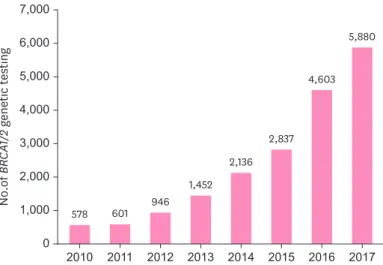
In Korea, BRCA1/2 genetic testing has rapidly increased 10-fold from 578 cases in 2010 to 5,880 cases in 2017 (Figure 1). Of 19,033 patients who underwent BRCA1/2 genetic testing, 1,752 (9.2%) carriers of the BRCA1/2 mutation were divided into two groups: 1238 affected carriers and 514 unaffected carriers (Table 1).
The numbers of RRM and RRBSO performed increased moderately during the period investigated. Among 1,238 affected carriers, contralateral RRM was performed in 122 (9.9%) patients, and RRBSO in 428 (34.6%) patients until August 2018. Among 514 unaffected
0
No.of BRCA1/2 genetic testing
2,000 4,000 5,000 6,000 7,000
2014 2013 2012 2011 3,000
1,000
2017 2016 2015 2010
2,136 1,452 601 946
5,880
4,603
2,837
578
Figure 1. Annual trends in BRCA1/2 genetic testing in South Korea.
Table 1. Number of RRS in BRCA1/2 mutation carrier until August 2018
Variables BRCA1/2 mutation carrier with
breast cancer BRCA1/2 mutation carrier without breast cancer
No. of BRCA1/2 mutation carrier 1,238 514
RRM 122 (9.9%) 6 (1.2%)
RRBSO 428 (34.6%) 61 (11.9%)
RRS = risk-reducing surgery; RRM = risk-reducing mastectomy; RRBSO = risk-reducing bilateral salpingo- oophorectomy.
carriers, bilateral RRM and RRBSO were performed in 6 (1.2%) and 61 (11.9%) patients, respectively, until August 2018 (Table 1). Contralateral RRM among affected carriers increased approximately 5.8-fold, from 5 cases in 2013 to 29 cases in 2017. RRBSO among affected carriers also increased approximately 3.6-fold, from 22 cases in 2013 to 79 cases in 2017. Among unaffected carriers, bilateral RRM increased by 1 case in 2017, and RRBSO increased 8-fold from 2 cases in 2013 to 16 cases in 2017 (Figure 2). There were significant differences in the rate of contralateral RRM in affected carriers and RRBSO in BRCA1/2 mutation carriers before and after Angelina Jolie's announcement (p < 0.05); however, there was no difference in the rate of bilateral RRM in unaffected carriers (Table 2).
The number of institutions that performed RRS increased gradually. The number of institutions performing contralateral RRM in affected carriers increased from 3 in 2012 to 11 in 2018, and that of those performing RRBSO increased from 7 to 17 in the same time frame.
The number of institutions that performed bilateral RRM in unaffected carriers increased from 1 in 2012 to 2 in 2018, and that of those performing RRBSO increased from 1 in 2012 to 8 in 2018.
Hospitals in Korea showed differences in the rates of RRM and RRBSO. Among affected carriers treated at different hospitals, the highest and lowest rates of contralateral RRM were 44.4% and 2.9%, respectively, while those of RRBSO were 100% and 12.7%, respectively (Figures 3 and 4). Among unaffected carriers, the highest and lowest rates of RRS were 11.1%
and 7.4% for bilateral RRM, and 80% and 2.0% for RRBSO, respectively (Figures 5 and 6).
However, there was no significant difference in the rate of RRM or RRBSO by level of care. Of the 18 hospitals that provided data, 4 hospitals were secondary and 14 were tertiary. Among affected carriers treated at secondary and tertiary hospitals, the rates of contralateral RRM were 11.8% and 9.8%, and the rates of RRBSO were 23.5% and 34.9%, respectively. Among unaffected carriers treated at secondary and tertiary hospitals, the rates of bilateral RRM were 0.0% and 1.2%, and the rates of RRBSO were 3.4% and 12.4%, respectively (Tables 3 and 4).
0
Surgery No.
A
40 80 100
2014 2013 60
20
2017 2016 2015 45 22
75 79 66
5 10
24 29 12
0
Surgery No.
B
10 20 25
2014 2013 15
5
2017 2016 2015 5 2
16 20
9
1 1 0 1
0 Bilateral risk-reducing
salpingo-oophorectomy Contralateral risk-reducing mastectomy
Bilateral risk-reducing salpingo-oophorectomy Bilateral risk-reducing mastectomy
Figure 2. Annual trends for risk-reducing surgery in (A) affected carriers and (B) unaffected carriers.
Table 2. The Angelina Jolie effect on trends for RRS in BRCA1/2 mutation carriers
Variables Before 2012 After 2013 p-value
Contralateral RRM affected carrier 11 (9.0%) 111 (91.0%) 0.003
Bilateral RRM unaffected carrier 3 (50.0%) 3 (50.0%) 1.000
RRBSO affected carrier 43 (10.0%) 385 (90.0%) <0.001
RRBSO unaffected carrier 4 (6.6%) 57 (93.4%) 0.007
RRS = risk-reducing surgery; RRM = risk-reducing mastectomy; RRBSO = risk-reducing bilateral salpingo- oophorectomy.
DISCUSSION
This study was conducted by collecting and analyzing data from multiple centers affiliated with the KOHBRA study that was conducted until May 2013. We retrospectively reviewed annual trends in BRCA1/2 genetic testing and RRS in KOHBRA-affiliated hospitals until August
0
%
10 30 40 50
20
H1 44.4
H2 22.6
H3 18.2
H4 15.7
H5 13.9
H6 11.8
H7 11.4
H8 7.3
H9 6.7
H10 4.8
H11 2.9
Figure 3. Rate of contralateral risk-reducing mastectomy in affected carriers by institution.
0
%
20 60 80 100
40
H17 100.0
H18 100.0
H10 67.5
H7 66.7
H15 60.0
H6 58.8
H4 52.8
H2 47.8
H9 46.7
H1 44.4
H12 34.3
H3 27.3
H5 26.9
H16 20.0
H13 16.1
H8 12.7
H11 12.7
Figure 4. Rate of risk-reducing bilateral salpingo-oophorectomy in affected carriers by institution.
0
%
2 6 8 12
4 10
H4 11.1
H2 7.4
Figure 5. Rate of bilateral risk-reducing mastectomy in unaffected carriers by institution.
2018. Our study showed that while the rates of BRCA1/2 genetic testing and RRS have increased rapidly, there are differences in the number of RRS performed among hospitals in Korea.
The prevalence of BRCA1/2 genetic testing and RRS have continued to increase because of the global rise in numbers of laboratories offering genetic testing, expanding insurance coverage, celebrity endorsement, and evidence for the clinical benefits of known mutational status [3,9].
In Korea, the KOHBRA study (2007–2013) established a large cohort of BRCA1/2 mutation carriers among Korean breast cancer patients [7], and has improved clinician awareness of the BRCA 1/2 mutation. In addition, insurance reimbursement for hereditary breast cancer has been enacted in Korea over the past 10 years. Korea is the only Asian country that offers national insurance to patients with breast cancer for BRCA1/2 genetic testing.
Moreover, the disclosure of Angelina Jolie's medical history was followed by increasing BRCA1/2 genetic testing and RRS in Korea. Jolie underwent RRM in May 2013 and RRBSO in March 2015, and these announcements helped create global awareness about BRCA1/2 genetic testing and RRS. We found that RRBSO in BRCA1/2 mutation carriers increased significantly after Jolie's announcement. Contralateral RRM in affected carriers also increased
significantly; however, there was no significant difference in bilateral RRM in unaffected carriers. Many studies have reported the international trends in BRCA1/2 genetic testing and RRM after Jolie's announcement. For instance, Desai and Jena [10] found that the rate of RRM remained unchanged after news coverage about Jolie's diagnosis, although BRCA1/2 genetic testing increased significantly. However, several other studies showed an increase
0
%
20 60 80
H1 H2 H10 H3 40
H5 H7 H4 H6
14.8 14.3 33.3 29.1
6.3 2.0 8.3 80.0
Figure 6. Rate of risk-reducing bilateral salpingo-oophorectomy in unaffected carriers by institution.
Table 3. Rate of RRS in affected carriers by level of care until August 2018
Variables Secondary Tertiary p-value
No. of BRCA1/2 mutation carrier 34 1,204
Contralateral RRM 4 (11.8%) 118 (9.8%) 0.768
RRBSO 8 (23.5%) 420 (34.9%) 0.170
RRS = risk-reducing surgery; RRM = risk-reducing mastectomy; RRBSO = risk-reducing bilateral salpingo- oophorectomy.
Table 4. Rate of RRS in unaffected carriers by level of care until August 2018
Variables Secondary Tertiary p-value
No. of BRCA1/2 mutation carrier 29 485
Bilateral RRM 0 (0.0%) 6 (1.2%) 1.000
RRBSO 1 (3.4%) 60 (12.4%) 0.234
RRS = risk-reducing surgery; RRM = risk-reducing mastectomy; RRBSO = risk-reducing bilateral salpingo- oophorectomy.
in bilateral RRM in an international database of BRCA1/2 mutation carriers who had recently undergone genetic testing [3,11]. The uptake of RRM by unaffected carriers varied greatly among countries [3,12]. Metcalfe et al. [3] reported an increase in RRM in 10 countries, with the highest uptake of bilateral RRM being in the United States (49.9%) and the lowest in Poland (4.5%). In Korea, the uptake of RRM was 1.2% in unaffected carriers and 9.9% in affected carriers until August 2018. By August 2018, BRCA1/2 mutation carriers were more likely to choose RRM than they had been in the preceding decade. The impact of insurance coverage and Angelina Jolie's news resulted in changes in thinking about RRS in Korea.
The increase in numbers of clinicians and hospitals that perform RRS has also affected its uptake, although there are differences in rates of RRS among hospitals in Korea. The lack of significant differences in rates of RRS between secondary and tertiary hospitals may be due to RRS being actively recommended in only a few hospitals, regardless their level of care. The difference in rates among hospitals may be attributed to differences in the clinician's choices, time for genetic testing results, genetic counseling, or multidisciplinary teams between hospitals. It will be necessary to improve the medical environment and clinicians' awareness, so that more clinicians and hospitals may consider the result of BRCA1/2 genetic testing more carefully, which may further affect decision-making for RRS.
Risk-reducing management of BRCA1/2 mutation carriers has occurred worldwide [13,14]. In carriers of the BRCA1/2 mutation, RRM lowers the risk of breast cancer by approximately 90%
[15,16]. RRBSO is associated with a 70% reduction in the risk of ovarian cancer in unaffected carriers and an 85% reduction in affected carriers [17]. RRBSO also lowers the risk of breast cancer by 37% in BRCA1 mutation carriers and by 64% in BRCA2 mutation carriers [17]. The current National Comprehensive Cancer Network guidelines recommend RRBSO for BRCA1 mutation carriers who are aged between 35 and 40 years and have completed childbearing [18]. Since the onset of ovarian cancer occurs an average of 8–10 years later in BRCA2 mutation carriers than in those with the BRCA1 mutation, RRBSO is recommended until the age of 40–45 years in the former [18]. In unaffected carriers, survival benefits are apparent for RRBSO, but not for RRM. However, Heemskerk-Gerritsen et al. [19] reported that RRM is associated with lower mortality than surveillance for carriers of the BRCA1 mutation [20,21].
Metcalfe et al. [22] showed that mortality risk was lower in patients with BRCA1/2 mutation who were treated for stage I or II breast cancer with bilateral mastectomy that those treated with unilateral mastectomy. Although RRS is recommended for carriers of the BRCA1/2 mutation, the procedure has adverse psychosocial and sexual effects because it removes normal breasts or ovaries. Moreover, sensory changes and skin necrosis may be caused by RRM, and RRBSO may have adverse effects on lipid profiles and may increase the risk of cardiovascular disease and osteoporosis. Because of the benefits and harms of RRS, clinicians should play a major role in the decision-making process of RRM or RRBSO for carriers of the BRCA1/2 mutation [13,23,24].
The results of BRCA1/2 genetic testing before surgery may help affected carriers decide whether to undergo contralateral RRM. Traditional Sanger sequencing analysis for BRCA1/2 mutation has a high cost and long turnaround time (TAT) due to the large size of the genes [25]. Next‐generation sequencing (NGS) allows simultaneous sequencing of multiple cancer susceptibility genes, and may be less expensive. NGS can also have a shorter TAT and higher accuracy than conventional methods [25,26], which can allow clinicians and patients to make decisions about RRS. In Korea, insurance coverage of NGS for BRCA1/2 genetic testing started in September 2017, and both BRCA1/2 genetic testing and RRS are likely to gradually increase in frequency. Further research is needed on this trend in Korea.
This study demonstrated an increasing incidence of BRCA1/2 genetic testing and RRS in consecutive years. However, differences in RRS rates depend on the hospital in Korea.
We need to provide enough information for patients to understand the results of genetic counseling so that they can make the optimal choice of treatment.
ACKNOWLEDGEMENTS
We thank all investigators of the KOrean Hereditary BReast cAncer (KOHBRA) study.
REFERENCES
1. Han SA, Kim SW, Kang E, Park SK, Ahn SH, Lee MH, et al. The prevalence of BRCA mutations among familial breast cancer patients in Korea: results of the Korean Hereditary Breast Cancer study. Fam Cancer 2013;12:75-81.
PUBMED | CROSSREF
2. Koo DH, Chung IY, Kang E, Han SA, Kim SW. Usage patterns of surveillance, chemoprevention and risk- reducing surgery in Korean BRCA mutation carriers: 5 years of experience at a single institution. J Breast Cancer 2011;14:S17-23.
CROSSREF
3. Metcalfe K, Eisen A, Senter L, Armel S, Bordeleau L, Meschino WS, et al. International trends in the uptake of cancer risk reduction strategies in women with a BRCA1 or BRCA2 mutation. Br J Cancer 2019;121:15-21.
PUBMED | CROSSREF
4. Kuchenbaecker KB, Hopper JL, Barnes DR, Phillips KA, Mooij TM, Roos-Blom MJ, et al. Risks of breast, ovarian, and contralateral breast cancer for BRCA1 and BRCA2 mutation carriers. JAMA 2017;317:2402-16.
PUBMED | CROSSREF
5. Han SA, Park SK, Ahn SH, Lee MH, Noh DY, Kim LS, et al. The Korean Hereditary Breast Cancer (KOHBRA) study: protocols and interim report. Clin Oncol (R Coll Radiol) 2011;23:434-41.
PUBMED | CROSSREF
6. Kang E, Kim SW. The Korean Hereditary Breast Cancer study: review and future perspectives. J Breast Cancer 2013;16:245-53.
PUBMED | CROSSREF
7. Kang E, Seong MW, Park SK, Lee JW, Lee J, Kim LS, et al. The prevalence and spectrum of BRCA1 and BRCA2 mutations in Korean population: recent update of the Korean Hereditary Breast Cancer (KOHBRA) study. Breast Cancer Res Treat 2015;151:157-68.
PUBMED | CROSSREF
8. Evans DG, Barwell J, Eccles DM, Collins A, Izatt L, Jacobs C, et al. The Angelina Jolie effect: how high celebrity profile can have a major impact on provision of cancer related services. Breast Cancer Res 2014;16:442.
PUBMED | CROSSREF
9. Lee J, Kim S, Kang E, Park S, Kim Z, Lee MH, et al. Influence of the Angelina Jolie announcement and insurance reimbursement on practice patterns for hereditary breast cancer. J Breast Cancer 2017;20:203-7.
PUBMED | CROSSREF
10. Desai S, Jena AB. Do celebrity endorsements matter? Observational study of BRCA gene testing and mastectomy rates after Angelina Jolie's New York Times editorial. BMJ 2016;355:i6357.
PUBMED
11. Evans DG, Wisely J, Clancy T, Lalloo F, Wilson M, Johnson R, et al. Longer term effects of the Angelina Jolie effect: increased risk-reducing mastectomy rates in BRCA carriers and other high-risk women. Breast Cancer Res 2015;17:143.
PUBMED | CROSSREF
12. Meijers-Heijboer EJ, Verhoog LC, Brekelmans CT, Seynaeve C, Tilanus-Linthorst MM, Wagner A, et al.
Presymptomatic DNA testing and prophylactic surgery in families with a BRCA1 or BRCA2 mutation.
Lancet 2000;355:2015-20.
PUBMED | CROSSREF
13. Kim SI, Lim MC, Lee DO, Kong SY, Seo SS, Kang S, et al. Uptake of risk-reducing salpingo-oophorectomy among female BRCA mutation carriers: experience at the National Cancer Center of Korea. J Cancer Res Clin Oncol 2016;142:333-40.
PUBMED | CROSSREF
14. Lee EG, Kang HJ, Lim MC, Park B, Park SJ, Jung SY, et al. Different patterns of risk reducing decisions in affected or unaffected BRCA pathogenic variant carriers. Cancer Res Treat 2019;51:280-8.
PUBMED | CROSSREF
15. Meijers-Heijboer H, van Geel B, van Putten WL, Henzen-Logmans SC, Seynaeve C, Menke-Pluymers MB, et al. Breast cancer after prophylactic bilateral mastectomy in women with a BRCA1 or BRCA2 mutation. N Engl J Med 2001;345:159-64.
PUBMED | CROSSREF
16. Rebbeck TR, Friebel T, Lynch HT, Neuhausen SL, van't Veer L, Garber JE, et al. Bilateral prophylactic mastectomy reduces breast cancer risk in BRCA1 and BRCA2 mutation carriers: the PROSE study group. J Clin Oncol 2004;22:1055-62.
PUBMED | CROSSREF
17. Domchek SM, Friebel TM, Singer CF, Evans DG, Lynch HT, Isaacs C, et al. Association of risk-reducing surgery in BRCA1 or BRCA2 mutation carriers with cancer risk and mortality. JAMA 2010;304:967-75.
PUBMED | CROSSREF
18. Daly MB, Pilarski R, Berry M, Buys SS, Farmer M, Friedman S, et al. NCCN guidelines insights: genetic/
familial high-risk assessment: breast and ovarian, version 2.2017. J Natl Compr Canc Netw 2017;15:9-20.
PUBMED | CROSSREF
19. Heemskerk-Gerritsen BAM, Jager A, Koppert LB, Obdeijn AI, Collée M, Meijers-Heijboer HEJ, et al.
Survival after bilateral risk-reducing mastectomy in healthy BRCA1 and BRCA2 mutation carriers. Breast Cancer Res Treat 2019;177:723-33.
PUBMED | CROSSREF
20. Ludwig KK, Neuner J, Butler A, Geurts JL, Kong AL. Risk reduction and survival benefit of prophylactic surgery in BRCA mutation carriers, a systematic review. Am J Surg 2016;212:660-9.
PUBMED | CROSSREF
21. Rebbeck TR, Kauff ND, Domchek SM. Meta-analysis of risk reduction estimates associated with risk- reducing salpingo-oophorectomy in BRCA1 or BRCA2 mutation carriers. J Natl Cancer Inst 2009;101:80-7.
PUBMED | CROSSREF
22. Metcalfe K, Gershman S, Ghadirian P, Lynch HT, Snyder C, Tung N, et al. Contralateral mastectomy and survival after breast cancer in carriers of BRCA1 and BRCA2 mutations: retrospective analysis. BMJ 2014;348:g226.
PUBMED | CROSSREF
23. Kauff ND, Satagopan JM, Robson ME, Scheuer L, Hensley M, Hudis CA, et al. Risk-reducing salpingo- oophorectomy in women with a BRCA1 or BRCA2 mutation. N Engl J Med 2002;346:1609-15.
PUBMED | CROSSREF
24. Glassey R, O'Connor M, Ives A, Saunders C, Hardcastle SJkConFab Investigators. Influences on decision-making for young women undergoing bilateral prophylactic mastectomy. Patient Educ Couns 2018;101:318-23.
PUBMED | CROSSREF
25. Nicolussi A, Belardinilli F, Mahdavian Y, Colicchia V, D'Inzeo S, Petroni M, et al. Next-generation sequencing of BRCA1 and BRCA2 genes for rapid detection of germline mutations in hereditary breast/
ovarian cancer. PeerJ 2019;7:e6661.
PUBMED | CROSSREF
26. Chan M, Ji SM, Yeo ZX, Gan L, Yap E, Yap YS, et al. Development of a next-generation sequencing method for BRCA mutation screening: a comparison between a high-throughput and a benchtop platform. J Mol Diagn 2012;14:602-12.
PUBMED | CROSSREF