• 검색 결과가 없습니다.

Influence of MWCNTs on Fracture Toughness of MWCNTs/Nickel-Pitch Fiber/Epoxy Composites

N/A
N/A
Protected

Academic year: 2021

Share "Influence of MWCNTs on Fracture Toughness of MWCNTs/Nickel-Pitch Fiber/Epoxy Composites"

Copied!
5
0
0

로드 중.... (전체 텍스트 보기)

전체 글

(1)

Special Issue Paper

Influence of MWCNTs on Fracture Toughness of MWCNTs/Nickel-Pitch Fiber/Epoxy Composites

Yoon-Ji Yim *, Soo-Jin Park*

ABSTRACT: The influence of MWCNTs on fracture toughness properties of MWCNTs/Nickel-Pitch Fibers/epoxy composites (MWCNTs/Ni-PFs/epoxy) was investigated according to MWCNTs content. Nickel-Pitch-based carbon fibers (Ni-PFs) were prepared by electroless nickel-plating. The surface properties of Ni-PFs were determined by scanning electron microscopy (SEM) and X-ray photoelectron spectrometry (XPS). The fracture toughness of MWCNTs/Ni-PFs/epoxy was assessed by critical stress intensity factor (K

IC

) and critical strain energy release rate (G

IC

). From the results, it was found that the fracture toughness properties of MWCNTs/Ni-PFs/epoxy were enhanced with increasing MWCNTs content, whereas the value decreased above 5 wt.%. MWCNTs content. This was probably considered that the MWCNTs entangled with each other in epoxy due to an excess of MWCNTs.

Key Words: Pitch Fibers, Multi-walled Carbon Nanotubes (MWCNTs), Electroless Nickel-plating, Epoxy Composites, Fracture Toughness

1. INTRODUCTION

These days, pitch-based carbon fibers (pitch fibers) have received considerable attention due to their advantages such as high carbon yield, low cost, and good graphitizability that are characteristic of pitches derived from coal tar or petroleum.

These excellent properties of pitch fibers are transferred to matrix through their interface. Accordingly most of pitch- based carbon fibers reinforced composite properties are con- trolled by interfacial adhesion between pitch fibers and matrix resins [1,2].

Carbon nanotubes (CNTs) are a typically nanofillers and were discovered as fullerene-related structures by Iijima at NEC laboratory of Tsukuba in 1991 [3]. Carbon nanotubes also have several excellent properties including electronic con- ductivity, thermal conductivity, corrosion resistance, high strength, Young's modulus and so on [4-6].

In this study, epoxy matrix was reinforced with Pitch fibers and multi walled carbon nanotubes (MWCNTs) to enhance the fracture toughness of the composites. In order to improve interfacial adhesive strength between fillers and matrix resins,

the filler surface is commonly modified by numerous surface treatments [7-9]. Therefore the pitch fibers and MWCNTs were electrolessly nickel-plated and acidic treated, respectively.

The objective of this study is to evaluate the influence of MWCNTs on the fracture toughness of MWCNTs/Ni-PFs/

epoxy composites. The pitch fiber surfaces were characterized by SEM and XPS to confirm the morphology of the fiber sur- faces and the elemental compositional changes. The critical stress intensity factor (K

IC

) and critical strain energy release rate (G

IC

) were investigated to determine the fracture tough- ness of the MWCNTs/Ni-PFs/epoxy composites according to MWCNTs contents.

2. EXPERIMENTAL

2.1 Specimen preparation

The epoxy resin used in this work was diglycidyl ether of bisphenol A (DGEBA, YD-128) which was supplied by the Kukdo Chem. Co., Korea. The curing agent used in this work was a modified cycloaliphatic amine curing agent (KH-819) supplied by the Kukdo Chem. Co., Korea. Pitch fibers (PFs)

Received 30 September 2015, received in revised form 28 December 2015, accepted 30 December 2015

* *

Department of Chemistry, Inha University

Department of Chemistry, Inha University, Corresponding author (E-mail: [email protected])

(2)

362 Yoon-Ji Yim, Soo-Jin Park

were supplied by GS Caltex Co., Korea. MWCNTs were used as a reinforcement material and were manufactured by the CVD process (purity: 95 wt.%, diameter: ~10 nm, length: 10–

20 μm) which was supplied by Nanosolution, Korea.

The schematic diagram of the electroless nickel-plating pro- cesses involved in the activation and metal deposition is illus- trated in Fig. 2(a). Before the electroless nickel-plating process, the PFs were pretreated in 5M HNO

3

for 30 min in order to increase interfacial adhesion between the nickel and the PFs.

They were sequentially activated in tin chloride (SnCl

2

) and palladium chloride (PdCl

2

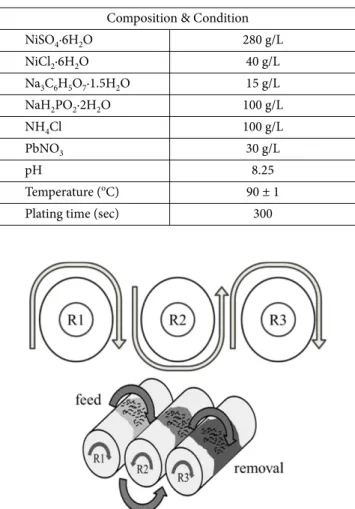
) solution for 30 min each. By acti- vating, Sn/Pd nucleates adhered to the surface of PFs, and these nucleates accelerated the metal plating during the elec- troless nickel-plating. Ni-PFs were obtained by dipping the PFs into the nickel bath for 300 s. The constituents of plating solutions and reaction conditions are listed in Table 1.

The MWCNTs were acid treated by following method before use. The acid treatments were based on a mixture of concentrated nitric (HNO

3

) and sulphuric acids (H

2

SO

4

) in a ratio of 1:3, respectively. In a typical experiment, a 1 g portion of as-received MWCNTs was added to 40 cm

3

of the acid mix-

ture in a round-bottomed flask, and refluxed for 30 min. On cooling, the mixture was washed with distilled water on a sin- tered glass filter until the washings showed no acidity.

The Ni-PFs (5 wt.%) and MWCNTs (1, 2, and 5 wt.%) were dispersed within the epoxy resin for 2 h using a 3-roll-mill at room temperature. The 3-roll-mill is a machine that uses shear force created by three horizontally positioned rolls rotating in opposite directions and different speeds relative to each other, in order to mix, refine, disperse, or homogenize viscous mate- rials fed into it (Fig. 1). The mixtures were then poured into a mold and cured at 100°C for 1 h and 130°C for 1 h.

2.2 Characterization

The morphologies of the Ni–PFs were measured by a scan- ning electron microscope (SEM, JSM-6701F, JEOL). Fourier transform infrared (FT-IR) spectra of as-received MWCNTs and acidic MWCNTs (A-MWCNTs) were recorded with a FT- IR spectrometer (Nicoleti S10, Thermo SCIENTIFIC, USA).

The surface properties of the Ni–PFs were characterized by X- ray photoelectron spectroscopy (XPS, K-alpha, Thermo Sci- entific). The XPS experiment was performed using a K

α

spec- trometer equipped with an AlK

α

X-ray source. The base pressure in the sample chamber was controlled in the range from 10

-8

to 10

-9

torr. The critical stress intensity factor (K

IC

) and critical strain energy release rate (G

IC

) were measured using a single-edge-notched (SEN) beam fracture toughness test in a three-point flexural test. The fracture toughness tests were conducted using a universal test machine (UTM, LR5K plus, Lloyd) in accordance with the ASTM D-5045-95. The span-to-depth ratio and crosshead speed were 4:1 and 1 mm/

min. The specimen dimensions were 50 mm × 10 mm × 5 mm.

The notches were cut using a diamond coating saw, approx- imately half the depth of the specimen. The fracture toughness values reported represent an average of the results for tests run on at least six specimens.

3. RESULTS AND DISCUSSION

The SEM images of as-received and Ni-PFs are shown in Fig. 2(b). The surface morphologies of as-received PFs are smooth and clean. On the other hand, the surfaces morphol- ogies of Ni-PFs shows that nickel particles were homoge- neously plated on the surfaces of Ni-PFs [10].

The FT-IR spectra and SEM image of MWCNTs are shown in Fig. 3. The FT-IR spectra of MWCNTs showed peaks with very low intensity at 3432 cm

-1

corresponding to O-H group.

In the case of A-MWCNTs, this band appeared with signifi- cantly higher intensity according to the degree of modifica- tion. This was attributed to the increased number of carboxylic acid groups generated at the surface of the MWCNTs after acidic treatments [11]. The acidic treatment strengthens the peak intensity because of increase in active groups on the MWCNTs. These active groups may help to change the polar- Table 1. Composition and Conditions of Electroless Ni Plating

Bath

Composition & Condition

NiSO

4

·6H

2

O 280 g/L

NiCl

2

·6H

2

O 40 g/L

Na

3

C

6

H

5

O

7

·1.5H

2

O 15 g/L

NaH

2

PO

2

·2H

2

O 100 g/L

NH

4

Cl 100 g/L

PbNO

3

30 g/L

pH 8.25

Temperature (

o

C) 90 ± 1

Plating time (sec) 300

Fig. 1. Schematic diagram of 3-roll-mill

(3)

ity and the functionality of the MWCNTs surfaces.

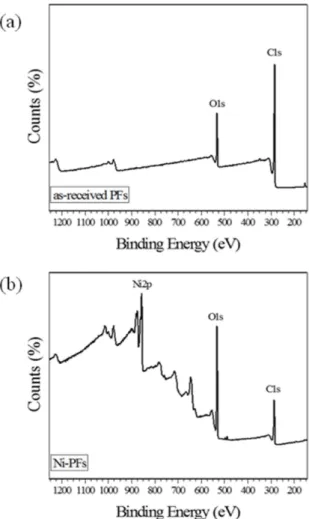
It is well known that XPS is a powerful analytical technique to confirm the chemical composition of materials. The XPS spectra and elemental compositions of as-received PFs and Ni- PFs are presented in Fig. 4 and Table 2, respectively. As a result, the spectrum of as-received PFs shows an intense C

1s

peak and a O

1s

peak at 284.6 and 532.8 eV, respectively. The O

1s

peak is probably due to intrinsic surface carboxyl groups.

By contrast, C

1s

, O

1s

, and Ni

2p

(B.E. = 857.6 eV) peaks are observed in XPS spectra of Ni-PFs. The O

1s

peak of Ni-PFs is probably because of PFs surfaces of NiO, C=O, O-C-O, –OH, and -C-O groups [12]. From the XPS results, it is found that

the surface composition of the PFs changed considerably after the electroless nickel plating. The carbon content of Ni-PFs decreased, whereas the oxygen and nickel contents of Ni-PFs increased compared with those of PFs. The O

1s

/C

1s

ratios of Ni-PFs are also increased compared to those of as-received PFs [13]. It is thought that the Ni-plating formed deposition of more active groups on the inactive carbon, thereby enhancing the surface functionality of Ni-PFs.

The understanding of fracture phenomenon was first pre- sented by Griffith [14]. It is generally accepted that the fracture toughness of filler-reinforced composites depend strongly on the level of adhesion between the filler and the matrix. The fracture toughness of MWCNTs/Ni-PFs/epoxy as a function of MWCNTs content was determined in terms of the critical stress intensity factor (K

IC

). The values of K

IC

were calculated by the following equations [15,16].

Fig. 2. (a) Schematic diagrams of the electroless Ni-plating pro- cesses involved in the activation and metal deposition;

(b) SEM images of as-received PFs and 300 Ni-PFs

Fig. 3. (a) FT-IR spectra of as-received MWCNTs and A-MWCNTs;

(b) SEM image of MWCNTs

Fig. 4. XPS spectra of (a) as-received PFs and (b) Ni-PFs

Table 2. Elemental compositions of as-received PFs and Ni-PFs

Samples C

1s

O

1

Ni

2p

O

1s

/C

1s

as-received PFs 80.1 16.5 - 0.2

Ni-PFs 41.0 44.4 12.6 1.0

(4)

364 Yoon-Ji Yim, Soo-Jin Park

(1) and

(2)

where P is the rupture force, L the span between the supports, and Y the geometrical factor; a, b and d are the specimen pre- crack length, width and thickness, respectively.

The values of G

IC

can be calculated from the results of the K

IC

. Using the Irwin relationship [17], the equation (3) accord- ing to stress and strain under the same conditions was used.

(3)

where υ is the Poisson’s ratio (υ ≈ 0.3), and E is the Young’s modulus (flexural modulus) obtained from flexural testing.

The Young’s modulus is the ratio of stress to strain in flexural deformation.

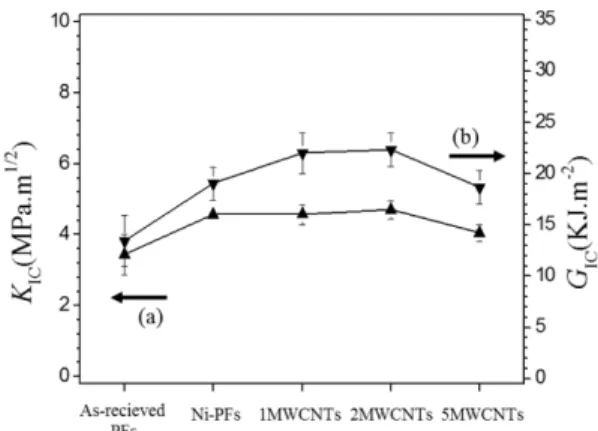
The influence of MWCNTs on fracture toughness of MWCNTs/Ni-PFs/epoxy can be seen in Fig. 5. Fig. 5(a) shows the values of K

IC

for MWCNTs/Ni-PFs/epoxy as a function of MWCNTs content. Firstly, K

IC

values of Ni-PFs/epoxy com- posites are higher than as-received PFs/epoxy composites.

This is due to the presence of the oxygen functional groups and the nickel alloy on the Ni-PFs surfaces in the composites, resulting in increasing the interfacial functional groups, as already shown in SEM and XPS. It is thought that oxygen functional groups and the Nickel alloy enhanced interfacial adhesion with the matrix resin, ultimately improving the resis- tance of the composites to cracks [18]. The K

IC

values were also increased according to increasing MWCNTs content. It is also thought that MWCNTs ultimately improved the resis- tance of the composites to cracks by interfering with moving of the polymer matrix. These results can probably be attributed to the enhanced interfacial bonding strength resulting from the increasing active group of MWCNTs as already shown in

FT-IR results. However, it is observed that the K

IC

values were decreased above 5MWCNTs. It seems that MWCNTs entan- gled with each other in the matrix due to an excess of MWCNTs [19].

Fig. 5(b) shows the values of G

IC

for the MWCNTs/Ni-PFs/

epoxy composites as a function of MWCNTs content. In com- mon with K

IC

results, G

IC

values of the MWCNTs/Ni-PFs/

epoxy have a maximum value at 2MWCNTs. It could be seen that the change of G

IC

is similar to that of K

IC

.

4. CONCLUSIONS

The effects of the concentration of MWCNTs (2~5 wt.%) on fracture toughness of MWCNTs/Ni-PFs/epoxy composites were investigated. Our experimental results suggested that mechanical properties were gradually increased according to increasing MWCNTs content. The addition of MWCNTs plays a significant role in the reinforcement of the Ni-PFs/

epoxy composites. Meanwhile, it is observed that fracture toughness were decreased above certain content. It seems that MWCNTs entangled with each other in the matrix due to an excess of MWCNTs.

ACKNOWLEDGEMENT

This research was financially supported by the “Carbon val- ley construction program” through the Ministry of Trade, Industry & Energy (MOTIE) and Korea Institute for Advance- ment of Technology (KIAT).

REFERENCES

1. Maikuma, H. and Kubomura, K., “Bearing Strength and Dam- age Progress for PAN-Based and Pitch-Based Carbon Fiber”, Composites Journal of Composite Materials, Vol. 27, 1993, pp. 1739-1761.

2. Chae, H.G., Newcomb, B., Gulgunje, P., Liu, Y., Gupta, K., Kamath, M., Lyons, K., Ghoshal, S., Pramanik, C., Giannuzzi, L., Şahin, K., Chasiotis, L., and Kumar, S., “High Strength and High Modulus Carbon Fibers”, Carbon, Vol. 93, 2015, pp. 81-87.

3. Iijima, S., “Helical Microtubules of Graphitic Carbon”, Nature, Vol 354, 1991, pp. 56-58.

4. Jakubinek, M., Ashrafi, B., Zhang, Y., Martinez-Rubi, Y., Kings- ton, C., Johnston, A., and Simard, B., “Single-walled Carbon Nanotube–epoxy Composites for Structural and Conductive Aerospace Adhesives”, Composites Part B: Engineering, Vol. 69, 2015, pp. 87-89.

5. Gallo, G. and Thostenson, E., “Electrical Characterization and Modeling of Carbon Nanotube and Carbon Fiber Self-sensing Composites for Enhanced Sensing of Microcracks”, Materials Today Communications, Vol. 3, 2015, pp. 17-26.

6. Singh, B.P., Saini, K., Choudhary, V., Teotia, S., Pande, S., Saini, P., and Mathur, R.B., “Effect of Length of Carbon Nanotubes on Electromagnetic Interference Shielding and Mechanical Prop- K

IC

P L

b d

3/2

--- Y

=

Y 3 a/d ( )

1/2

[ 1.99 – ( a/d ) 1 a/d ( – ) 2.15 3.93a/d ( – + 2.7a

2

/d

2

) ] 2 1 2a/d ( + ) 1 a/d ( – )

3/2

---

=

G

IC

K

IC2

--- 1 υ E ⋅ ( –

2

)

=

Fig. 5. Fracture toughness values of MWCNTs/Ni-PFs/epoxy as a

function of MWCNTs content; (a) K

IC

and (b) G

IC

(5)

erties of Their Reinforced Epoxy Composites”, Journal of Nanopar- ticle Research, Vol. 16, 2014, pp. 2161.

7. Lee, S.O., Choi, S.H, Kwon, S.H., Rhee, K.Y., and Park, S.J.,

“Modification of Surface Functionality of Multi-walled Carbon Nanotubes on Fracture Toughness of Basalt Fiber-reinforced Composites”, Composites Part B: Engineering, Vol. 79, 2015, pp.

47-52.

8. Park, S.J., Jang, Y.S., and Rhee, K.Y., “Interlaminar and Ductile Characteristics of Carbon Fibers-Reinforced Plastics Produced by Nanoscaled Electroless Nickel Plating on Carbon Fiber Sur- faces”, Journal of Colloid and Interface Science, Vol. 245, 2002, pp. 282-290.

9. Park, M., Kim, H.Y., Jin, F.L., Lee, S.Y., Choi, H.S., and Park, S.J., “Combined Effect of Corona Discharge and Enzymatic Treatment on the Mechanical and Surface Properties of Wool”, Journal of Industrial and Engineering Chemistry, Vol. 20, 2014, pp. 179-183.

10. Yim, Y.J., Rhee, K.Y., and Park, S.J., “Influence of Electroless Nickel-plating on Fracture Toughness of Pitch-based Carbon Fibre reinforced Composites”, Composites Part B: Engineering, Vol. 76, 2015, pp. 286-291.

11. Seo, M.K. and Park, S.J., “A Kinetic Study on the Thermal Deg- radation of Multi-Walled Carbon Nanotubes-Reinforced Poly (propylene) Composites”, Macromolecular Materials and Engi- neering, Vol. 289, 2004, pp. 368-374.

12. Choi, J.R., Lee, Y.S., and Park, S.J., “A Study on Thermal Con- ductivity and Electrical Conductivity of Electroless Ni-plated Multi-walled Carbon Nanotubes Reinforced Epoxy Matrix Composites”, Journal of Industrial and Engineering Chemistry,

Vol. 20, 2014, pp. 3421-3424.

13. Casella, I. and Contursi, M., “Pulsed Electrodeposition of Nickel/palladium Globular Particles from an Alkaline Gluco- nate Bath. An Electro Chemical, XPS and SEM Investigation”

Journal of Electroanalytical Chemistry, Vol. 692, 2013, pp. 80-86.

14. Griffith, A., “The Phenomena of Rupture and Flow in Solids”, Philosophical Transactions of the Royal Society A, Vol. 221, 1921, pp. 163-198.

15. Moon, C.H., Jung, G., Im, S.S., Nah, C., and Park, S.J., “Effect of Anodic Oxidation of H

2

SO

4

/HNO

3

Ratio for Improving Interfacial Adhesion between Carbon Fibers and Epoxy Matrix Resins”, Polymer (Korea), Vol. 37, 2013, pp. 61-65.

16. Yim, Y.J., Seo, M.K., Kim, H.Y., and Park, S.J., “Electromagnetic Interference Shielding Effectiveness and Mechanical Properties of MWCNT-reinforced Polypropylene Nanocomposites”, Poly- mer (Korea), Vol. 36, 2012, pp. 494-499.

17. Park, S.J., “Studies on Cure Behaviors, Dielectric Characteristics and Mechanical Properties of DGEBA/Poly(ethylene tere- phthalate) Blends”, Macromolecular Research, Vol. 17, 2009, pp.

585-590.

18. Dong, W., Liu, H.C., Park, S.J., and Jin, F.L., “Fracture Tough- ness Improvement of Epoxy Resins with Short Carbon Fibers”

Journal of Industrial and Engineering Chemistry, Vol. 20, 2014, pp. 1220-1222.

19. Lee, S.E., Cho, S., and Lee, Y.S., “Mechanical and Thermal Properties of MWCNT-reinforced Epoxy Nanocomposites by Vacuum Assisted Resin Transfer Molding”, Carbon Letters, Vol.

15, 2014, pp. 32-37.

수치

Fig. 1. Schematic diagram of 3-roll-mill
Fig. 2. (a) Schematic diagrams of the electroless Ni-plating pro- pro-cesses involved in the activation and metal deposition;
Fig. 5. Fracture toughness values of MWCNTs/Ni-PFs/epoxy as a function of MWCNTs content; (a)  K IC  and (b)  G IC

참조

관련 문서

Figure 8.1 A propane tank truck explosion due to fracture from initial cracks in

Summerscales, "An investigation into the effects of fabric architecture on the processing and properties of fibre reinforced composites produced by resin

Key Words: Femur, Subtrochanteric fracture, limited open reduction, Proximal femoral nail anti-rotation (PFNA)... 수술 방법 및

No.. ramus insufficiency fracture, B) Thorax and abdomen CT showing multiple spine compression fracture.. ramus insufficiency fracture, B) After 4 months of

Effects of vacuum, mold temperature and cooling rate on mechanical properties of press consolidated glass fiber/PET composite , Composites Part A: Applied Science

However, the short beam strength of the basalt fiber reinforced composites was higher than those of the glass fiber reinforced composites in the case of the Vacuum

– Short fiber or whisker reinforced composites (e.g. Continuous fiber or sheet reinforced MMCs)..

1n Kyongsang dialect , three distinctive pitch levels exist; low(L) , high (H) and extremely high(H i.e. accented high). tonal phrase )is predicta bl e by the pitch