Several modalities that have been used in Korean medicine have not undergone evaluation. The Korea Institute of Oriental Medicine (KIOM), a South Korean national research agency, launched the Korean medicine case Report (KORE) program in May 2019 to promote case reports, especially among clinicians.
The aim was to (1) introduce the KIOM-initiated KORE program, (2) report the results from the KORE program, and (3) present the challenges and limitation from the KORE program. We conducted a narrative review of the cases to which KORE was applied. A total of 16 proposals were reviewed since May 2019. Five proposals were rejected, and 7 case reports were included. Case reports for 3 therapies have been created under guidance. The KORE program makes it easier for Korean medicine doctors to initiate and complete case reports.
©2020 Korean Acupuncture & Moxibustion Medicine Society. This is an open access article under the CC BY- NC-ND license (http://creativecommons.org/licenses/by-nc-nd/4.0/).
Article history:
Submitted: August 03, 2020 Revised: October 20, 2020 Accepted: October 26, 2020 Keywords:
acupuncture, case report, Korean medicine
https://doi.org/10.13045/jar.2020.00248 pISSN 2586-288X eISSN 2586-2898
J Acupunct Res 2020;37(4):290-293
Short Communication
Introduction to Korea Institute of Oriental Medicine’s Korean Medicine Case Report Program
Sungha Kim*
Clinical Medicine Division, Korea Institute of Oriental Medicine, Daejeon, Korea
ABSTRACT
Journal of Acupuncture Research
Journal homepage: http://www.e-jar.org
Introduction
Practice-based evidence involves the use of treatment approaches that are derived from, and support holistic local cultural practices and traditions, which require clinical expertise and an accumulation of evidence during practice [1,2]. Korean medicine (KM) is a traditional system of medicine that has been performed over centuries. It comprises of clinical diagnostics, methods of utilizing medicinal resources available in nature, and therapeutic modalities such as acupuncture, moderate surgery, and other physical modalities. The traditional evidence base of KM consists of literature describing the clinical experience (YiAn) [3], which are equivalent to the doctor’s journal or case report. Korean medicine doctors (KMDs) record and read these case reports to improve medical care and acquire systematic knowledge of KM.
Case reports can identify deficiencies in current treatments, suggest appropriate changes, and provide insights into disease progression [4-6]. Case reports also allow for the observation of different outcomes that emerge from the detailed accounts of practitioners [6]. Thus, they are the most informative accounts of KM practice.
Baek et al [7] reported more than 67% of KMDs share their case reports with colleagues through study groups or private online
communities. Therefore, case reports can be considered to be the corner-stone of practice-based evidence in KM.
However, the current format of case reports which are shared in online communities has limitations in that they can only be shared with those that have access. There are no criteria to validate the quality of these case reports, most of which do not meet the expected standard. Therefore, validating and evaluating KM case reports is essential. Similarly, many complementary and alternative medicine (CAM) modalities that are already in use have not undergone evaluation. A few programs have assessed the value of various CAM modalities based on individual cases: the National Cancer Institute’s Best Case Series Program for cancer in the United States [8] and the National Research Center in CAM International Registry of Exceptional Courses of Disease in Norway [9]. In accordance with the current situation, the Korea Institute of Oriental Medicine (KIOM), a government research institute specializing in KM, implemented a case report project in 2005 to gather evidence in this field through active participation of local clinics [10]. Furthermore, KIOM launched the Korean medicine case report (KORE) program in May 2019 to promote case reports, especially among local KMDs. The objectives of this program are (1) to evaluate cases of patients whose conditions
* Corresponding author. Sungha Kim
Clinical Medicine Division, Korea Institute of Oriental Medicine, Yuseong-gu, Daejeon 34054, Korea E-mail: [email protected]
ORCID: Sungha Kim https://orcid.org/0000-0001-5542-3850
©2020 Korean Acupuncture & Moxibustion Medicine Society. This is an open access article under the CC BY-NC-ND license (http://creativecommons.org/licenses/by-nc-
nd/4.0/).
Sungha Kim / Korea Institute of Oriental Medicine 291
improved with KM, (2) to publish case reports in public access journals through collaboration with KMDs, and (3) to educate KMDs on the reporting of cases. This report was developed to (1) introduce the KIOM-initiated KORE program, (2) report the results from the KORE program, and (3) present the challenges and limitations of the KORE program.
Materials and Methods
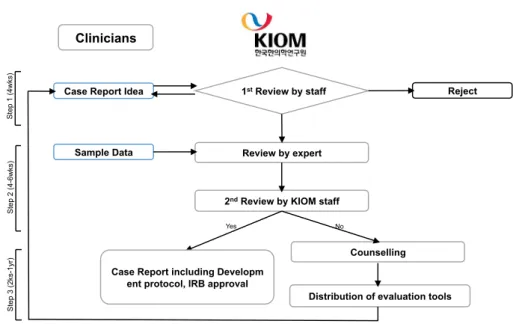
The general process for evaluating a valid case is outlined in Fig. 1, although this process may vary. Clinicians may send cases directly via e-mail ([email protected]) or through the website (https://oasis.kiom.re.kr/kore/). Each case was first evaluated by 3 to 7 personnel of the KORE team using a checklist, which consists of 10 KM researchers specialized in fields such as acupuncture, psychiatry, pediatrics, gynecology, and preventive and internal medicine.
The evaluation is based on the following 3 principles including the value of the case, quantification potential, and future orientation (Table 1). If the score on the checklist is above the cut-
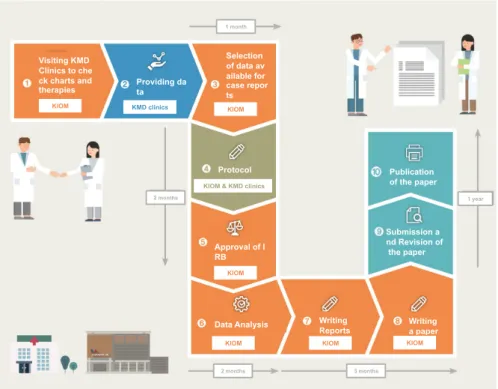
off (80), sample data and a 1-page overview are presented to the relevant experts to determine the possibility of conversion to an objective evaluation tool (e.g., photographs of the skin of patients with psoriasis can be converted to the psoriasis area severity index, through expert consultation). The final review is performed by the KORE team. If approved, the KORE team submits a case report protocol to the Institutional Review Board of the KIOM, and the case is published in related journals (Fig. 2). If not approved, the KORE team provides guidance or relevant evaluation tools to the KMD.
Results
A total of 16 proposals were reviewed since May 2019 (Table 2). Five proposals were rejected for the following reasons:
non-disclosure of the KM therapy used, diagnostic error, and insufficient evidence. Furthermore, only 1 patient showed improvement, apart from those with rare incurable diseases.
Although improvements were observed in the patients, they had not been assessed before and after treatment using objective
Fig. 1. Selection process conducted for the case report under the KORE program.
KORE, Korean medicine case report.
Case Report Idea
Review by expert
2
ndReview by KIOM staff
Step 1 (4wks)
Sample Data
Reject 1
stReview by staff
Case Report including Developm ent protocol, IRB approval
Distribution of evaluation tools
Step 2 (4-6wks)Step 3 (2ks-1yr)
Clinicians
Counselling
Yes No
Category Contents Score Total score
Value of case The disease is worth reporting. 20
100
The treatment is worth reporting. 20
Quantification potential The number of cases is appropriate for reporting. 15
It is possible to quantify the presented data. 15
Future orientation There is a possibility of developing new Korean Medicine treatment technology in the future. 15
It will help to build evidence of Korean Medicine treatment in the future. 15
Table 1. Checklist for the First Review of the Case Report Idea.
J Acupunct Res 2020;37(4):290-293 292
tools (i.e., the evidence the KMDs relied only was subjective to the patient). Since May 2019, 7 case reports were included for review following approval from the Institutional Review Board for publications. Case reports for 3 therapies were created under the KIOM staff guidance including therapies for impingement syndrome (ultrasonic guided acupuncture), chronic hepatitis B (herbal medicine), and rheumatoid arthritis (complex).
Discussion
Although most submitted proposals were rejected, the KIOM plans to continue with this program. One of the obstacles is a policy regarding KMD’s utilization of medical devices such as ultrasound,
Fig. 2. Case reports process.
Visiting KMD Clinics to che ck charts and therapies
KIOM
Providing da ta
KMD clinicsSelection of data av ailable for case repor ts
KIOMSubmission a nd Revision of the paper
KIOM & KMD clinicsApproval of I RB
KIOM
Data Analysis
KIOMWriting Reports
KIOM
Writing a paper
KIOMPublication of the paper
2 months
1 month
2 months 3 months
1 year