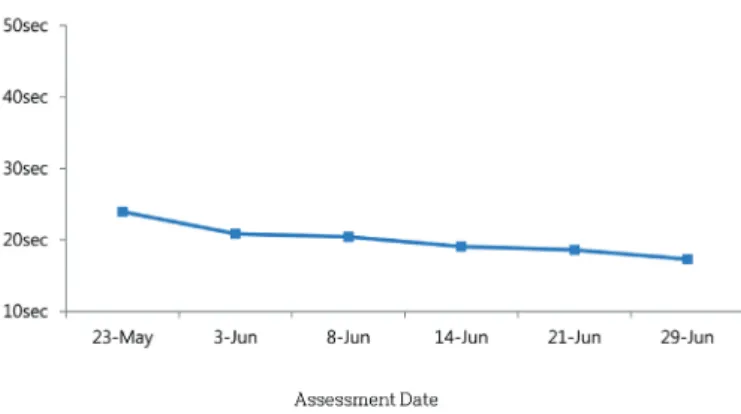
This case study examined the effect of Korean Medicine on a 72-year old male with a habitual history of smoking and drinking, and a family history of hypertension who had suffered an acute stroke. A couple of months later he complained of upper extremity weakness and was diagnosed with dysarthria. The patient received Korean Medicine treatment of acupuncture and herbal medicine for 39 days at the Samse Oriental Hospital, in conjunction with physiotherapy and Western medicine. Articulation accuracy, vowel accuracy, alternation and speed of reading sentences were evaluated every 7days. The results showed that the patient had improvement of articulation (10%) and vowel (37%) accuracy, alternation (12%) and speed of reading sentences (28%) suggesting that Korean Medicine treatment contributed to this progress.
©2018 Korean Acupuncture & Moxibustion Medicine Society. This is an open access article under the CC BY- NC-ND license (http://creativecommons.org/licenses/by-nc-nd/4.0/).
Article history:
Submitted: May 10, 2018 Revised: June 8, 2018 Accepted: July 4, 2018 Keywords:
dysarthria,
Korean traditional medicine, stroke
https://doi.org/10.13045/jar.2018.00115
pISSN 2586-288X eISSN 2586-2898
J Acupunct Res 2018;35(3):138-140
Case Report
A Case Report of a Stroke Patient with Dysarthria Treated with Korean Medicine
Ji Young Baek 1, *, Yeo Bin Park 1 , Ho-Joon Song 2 , Ji Won Baek 1 , Won Ho Kong 1 , Shin-Young Kim 1 , Chang-beom Ahn 1
1 Department of Acupuncture & Moxibustion Medicine, Samse Korean Medical Hospital, Busan, Korea
2 Department of Acupuncture & Moxibustion Medicine, MokdongDongshin Hospital of Korean Medicine, Seoul, Korea
ABSTRACT
Journal of Acupuncture Research
Journal homepage: http://www.e-jar.org
Introduction
Strokes are the 2
nd most common cause of death worldwide [1], and approximately 20%–30% of stroke survivors suffer dysarthria [2]. Dysarthria is associated with physiological function and self-identity, social and emotional confusion, and feelings of stigmatization [3]. Dysarthric speech is incoherent because of poor control of oral articulator muscles, particularly the tongue and lips, and poor respiratory control [4]. In the Western world, speech therapy is used to improve dysarthria. In Korea, there are few studies of treatment of dysarthria after a stroke. In this case study, the results of using Korean medicine to treat a patient suffering from dysarthria are reported. The patient was admitted to Samse Oriental hospital on April 8, 2017 and had treatment until discharge on July 1, 2017.
Case Report
A 72-year-old male, habitual smoker of 40 years and daily drinker, witha family history of hypertension on his father’s side,
was admitted to Samse Oriental Hospital (April 8, 2017) where blood tests and an MRI brain scan was performed. Clinical chemistry results were in the normal range but radiology showed acute infarction in the right basal ganglia region (Fig. 1). On the T2WI and Flair images, multiple small high signal intensities in both periventricular white matter were noted (Fig. 1). There was no evidence of the pathologic condition in the cerebral arteries, and he was diagnosed as having had an episode of acute stroke. On June 4, 2017, after waking up, the patient had a feeling of weakness in his left arm. He received treatment at the Samse Oriental Hospital until July 1, 2017.
Treatments
Acupuncture: A Korean medical doctor with3years clinical experience, performed acupuncture at 7acupoints:“Seven points of CVA”; Baekhoe (GV20), Gokbin (GB7), Gyeonjeong (GB21), Pungsi (GB31), Joksamni (ST36), Hyeonjong (GB39), Gokji (LI11). Disposable 0.20 mm × 30 mm-sized stainless-steel needles (Dongbang Acupuncture Inc., Korea) were used every morning
* Corresponding author.
Department of Acupuncture & Moxibustion Medicine, Samse Korean Medical Hospital, Busan, Korea E-mail: [email protected]
©2018 Korean Acupuncture & Moxibustion Medicine Society. This is an open access article under the CC BY-NC-ND license (http://creativecommons.org/licenses/by-nc- nd/4.0/).
Aug-016