Thermoelectric properties of La (1-x) M x CoO 3 (M=Sr, Ca;x=0, 0.1) ceramics for thermal sensors
Min-Gyu Kang * , Kwang-Hwan Cho, Chong-Yun Kang, Jin-Sang Kim, Sang-Sig Kim * , and Seok-Jin Yoon
†Abstract
We have investigated the effects of dopant on the thermoelectric properties that La
(1-x)M
xCoO
3(M=Sr, Ca;x=0, 0.1) bulk ceramics fabricated by the conventional solid state reaction method. The Seebeck coefficient of La
(1-x)M
xCoO
3(M=Sr, Ca;x=0, 0.1) bulk ceramics was measured at wide temperature range from 300 K to 673 K. The thermoelectric properties(Seebeck coefficient and electrical resistivity) depend strongly on the kinds of dopants. Sr and Ca dopant decrease the Seebeck coefficient. Density of sintered La
0.9Sr
0.1CoO
3ceramic at 1523 K was 7.12 g/cm
2and Seebeck coefficient was 35 µ V/K at 663 K. However, the electrical resistivity of the Sr doped sample was low and stable.
Key Words : wide range, thermal sensor, thermoelectric, dopant, seebeck
1. Introduction
Thermoelectric(TE) materials based on Seebeck effect have been usually used thermal sensor applica- tions, specially where the temperature difference is measured between two different points
[1]. In the past, metal based TE thermal sensors have been used for sur- face temperature measurements. However, metal based TE thermal sensors have low Seebeck coefficients(R- type=5 µ /K) which determine sensitivity of sensors
[2-5]. In this reason, recently alternate materials have been investigated for increasing thermal sensitivity, some of which are nitrides, borides, silicides and carbides. These materials possess more excellent electrical conductivity and Seebeck coefficients(TiC/TaC= − 16 µ /K at 1000 K) than metal based TE thermal sensors. Most of these materials however, exhibit poor oxidation resistance at high temperature. For instance, TiC and TaC thermocou- ple oxidize completely at temperature above 1200 K
[6]. Thus the important factors for the application of TE thermal sensors are large Seebeck coefficient(thermo- emf), chemical stability, phase stability and resistance to oxidation in the entire temperature range of operation.
The past studies for different application show that some of mixed oxide materials have good phase and chemical stability in oxidizing atmosphere.
Lanthanum cobalt oxide based materials are one of candidate of thermoelectric materials. They are mixed ionic and electronic conductor and have been widely investigated for oxide electrodes in various solid and liquid electrochemical devices, electrodes in memory devices and solid oxide fuel cells
[7-10]. It is also known that they have the large Seebeck coefficient at high tem- perature. In this work, we investigated the relative den- sity, electrical resistivity and Seebeck coefficient of LaCoO
3with Sr, Ca dopants at a La site.
2. Experimental
La
(1-x)M
xCoO
3(M=Sr, Ca;x=0, 0.1) samples were prepared by conventional solid state reaction method.
Stoichiometric mixture of Co
3O
4, La
2O
3, CaCO
3and SrCO
3powders were calcined at 1273 K for 12 h, milled with zirconia balls and pressed uniaxially into pellets. The sample were sintered at 1373 K, 1423 K, 1473 K and 1523 K for 12 h with slow cooling. For entire ohmic contact, silver paste was spreaded at the both side of samples and fired at 1173 K for 30 minutes.
X-ray diffraction data were collected on a PANalyti- cal X ’ Pert pro diffractometer using Cu K
aradiation. The
Thin Film Materials Research Center, KIST
*School of Electrical Engineering, Korea University
†
Corresponding author: [email protected]
(Received : April 6, 2009, Accepted : May 11, 2009,)
relative densities of ceramics were measured using the Archimedes ’ s method. To calculate Seebeck coefficients of samples, thermoelectric voltage and thermal gradient were measured from 323 to 673 K. Fig. 1 is the diagram of thermoelectric properties measuring system. Electri- cal resistivity was calculated with the resistance, length, and electrode area of samples.
3. Result
The XRD patterns of the crushed powder of La
(1-x)M
xCoO
3(M=Sr, Ca;x=0, 0.1) are shown in Fig. 2. It shown that all diffraction peaks can be indexed to the LaCoO
3phase without any secondary phase. It can be known that dopants were substituted entirely.
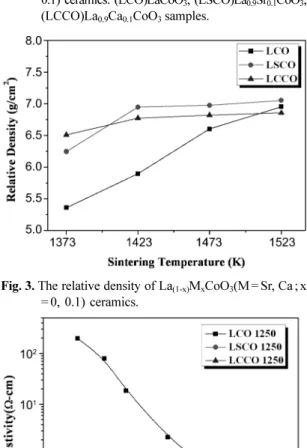
Fig. 3 shows the relative density of La
(1-x)M
xCoO
3(M=Sr, Ca;x=0, 0.1) according to the sintering tem- perature. Density of all samples are increased with increasing sintering temperature. The Ca and Sr-doped ceramics show a higher relative density than undoped samples. The relative density of La
0.9Sr
0.1CoO
3ceram- ics become ~95 % when sintered at 1523 K. It can be known that the sintering temperature of LaCoO
3can be decreased by the addition of Sr or Ca.
The temperature dependence of electrical resistivities of La
(1-x)M
xCoO
3(M=Sr, Ca;x=0, 0.1) ceramics are shown in Fig. 4. The specimens doped with Sr and Ca showed temperature independent electrical resistivity, indicating semiconductor behavior. Low electrical resis- tivity is an important factor for figure of merit of ther- moelectric materials, because it can generate large thermoelectric power
[11]. LSCO and LCCO have much lower resistivity than LCO, which could be attributed to the increase of carrier concentration by Ca and Sr-sub- stitution. The substitutions of Sr
2+and Ca
2+for La
3+introduce excess negative charges in the lattice, which
Fig. 1. Diagram of thermoelectric properties measuring system.
Fig. 2. XRD patterns of La
(1-x)M
xCoO
3(M=Sr, Ca;x=0, 0.1) ceramics. (LCO)LaCoO
3, (LSCO)La
0.9Sr
0.1CoO
3, (LCCO)La
0.9Ca
0.1CoO
3samples.
Fig. 3. The relative density of La
(1-x)M
xCoO
3(M=Sr, Ca;x
=0, 0.1) ceramics.
Fig. 4. Temperature dependence of electriccal resistivities
of La
(1-x)M
xCoO
3(M=Sr, Ca;x=0, 0.1) sintered at
1523 K.
are related to oxygen vacancies according to an equation;
(1) In this phenomena, the hole is generated for the lattice to keep electroneutrality condition. The electrical resis- tivity can be expressed as the reciprocal of electrical conductivity and then can be expressed hole concentra- tion and mobility related formula. conventionally elec- trical conductivity expressed as ;
(2) where µ p is the mobility of holes and E
ais the acti- vation energy with E
a= ∆ H m +( E
g/2), where, ∆ H m is the motional enthalpy of the holes. LaCoO 3 based materials are known that they are narrow band gap semiconduc- tor. In this case, the hall which generated from dopant could change narrower band gap. Consequently, we could explain that increasing amount of dopants can decrease electrical resistivities.
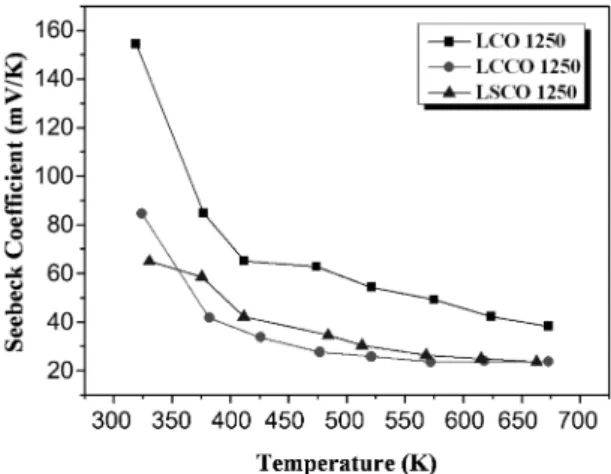
Fig. 5 shows temperature dependence of seebeck coefficient of La (1-x) M x CoO 3 (M=Sr, Ca;x=0, 0.1) ceramics. All samples exhibit temperature dependence seebeck coefficient. Especially the tempeature depend- ences of seebeck coefficients were small in LCCO and LSCO specimens. In this paper, we employed the fol- lowing modified Mott formula to explain the seebeck coefficient dependent on temperature and dopants;
(3) where n, µ ( ε ), k
B, c e are carrier concentration, energy correlated carrier mobility, Boltzmann constant and spe- cific heat with c
e=( π 2 k 2 B T/3 e ) ψ ( ε ), where, ψ ( ε ) is the density of state, respectively [12] . The formula(3) consists of two terms, the value of first term c e /n is an inverse of carrier concentration and second term is related with the carrier mobility. The Sr- and Ca- doped samples have higher carrier concentration than LCO. In the for- mula(3), magnitude of Seebeck coefficients are decreased with increasing carrier concentration which are generated by dopant and thermal energy. However decrement of Seebeck coefficients of all samples are similar at high temperature(>450 K). Amount of carri- ers that can be generated by thermal energy are satu- rated after this region and the carrier mobility which was one of effective factor have influence on Seebeck coef- ficient. We can explain this phenomena in the basic phys- ics. In the theory, carrier mobility was expressed as :
(4) where e , l p , m p are electron charge, mean free path of hole and hole mass, respectively. In this formula, mobility of holes depends on factor of T -1/2 and mean free path also depends on the temperature. Mean free path is deter- mined by the various collision mechanisms acting on the carriers as collisions of electrons with phonons, the ther- mally caused lattice vibrations, and collisions with impu- rities. At high temperatures, at which collision with phonons is the dominant factor, l p is inversely propor- tional to temperature that is l p ~T -1 so that we can express hall mobility as µ p ~T -3/2[13] . Consequently, we could know that the more temperature was increased, the more effect of carrier mobility is powerful.
4. Conclusion
We have synthesized thermoelectric ceramics La (1- x) M x CoO 3 (M=Sr, Ca;x=0, 0.1). The Seebeck coeffi- cient concluding thermal sensitivity was decerased by amount of dopants. However, we have obtained stable and low electrical resistivity at the Sr doped sample. In the result, Sr doped LaCoO 3 has large thermoelectric power and respect to be applicable for TE thermal sensor.
Acknowledgement
This research was supported by a grant from the Fun- damental R&D program for Core Technology of Mate- O
o↔ V
o··+ 2
e –+ 0.5 O
2σ pe µ
p~ T
1–– E
ak
BT
---
⎝ ⎠
⎛ ⎞
exp
=
S c ---- π n
e2