Results of Surgical Treatment on Benign Anal Diseases in Korean HIV-Positive Patients
Perianal diseases are the most common reasons for surgery in HIV-positive patients. This study aimed to evaluate the outcomes of these surgical procedures in Korean patients, focusing on wound healing and postoperative complications. Retrospective analysis was performed on 72 HIV-positive patients who underwent surgery by a single surgeon for benign anal disease between 1998 and 2011. Of these, 68.1% (49/72) of patients received surgery for condyloma acuminata, 19.4% (14/72) for anal fistulas, 6.9% (5/72) for hemorrhoids, and 5.6% (4/72) for perianal abscesses. Patients with condyloma acuminata received surgical excision with electrical coagulation, and all wounds healed completely within 3 months, though 16.3% (8/49) of these patients experienced recurrence. Twelve of the 49 patients (24.5%) who were treated for condyloma acuminata underwent simultaneous operations for concomitant anal fistulas (n = 6), hemorrhoids (n = 4), and perianal abscesses (n = 2). Overall, 3 postoperative complications developed following a total of 94 procedures, and there was no significant increase in complication rate for patients with a low CD4+ T-cell count ( < 200/μL) compared to those with a higher count. The results demonstrate favorable results following perianal surgery in HIV-positive Korean patients.
Keywords: HIV; Acquired Immunodeficiency Syndrome; Anal Operation; Condyloma Acuminata; Wound Healing
Heung-Kwon Oh,1 Sang-Hui Moon,2 Seungbum Ryoo,2 Eun Kyung Choe,2 and Kyu Joo Park2
1Department of Surgery, Seoul National University Bundang Hospital, Seongnam; 2Department of Surgery, Seoul National University College of Medicine, Seoul, Korea
Received: 8 June 2014 Accepted: 10 July 2014 Address for Correspondence:
Kyu Joo Park, MD
Department of Surgery, Seoul National University College of Medicine, 101 Daehak-ro, Jongno-gu, Seoul 110-744, Korea Tel: +82.2-2072-2901, Fax: +82.2-766-3975
E-mail: [email protected]
http://dx.doi.org/10.3346/jkms.2014.29.9.1260 • J Korean Med Sci 2014; 29: 1260-1265
INTRODUCTION
The incidence of acquired immunodeficiency syndrome (AIDS), first reported in 5 patients in June 1981, has increased annually, and it is estimated that as of 2012, 35 million people worldwide are living with the human immunodeficiency virus (HIV) (1).
This increased incidence has been documented in Korea, start- ing with the first case in 1985, up to 7,788 patients reported by the Korean Centers for Disease Control as of December 2012 (2). Although the reported prevalence of HIV/AIDS is below 0.1% in Korea compared to 0.6% in the United States and 0.3%
in Western Europe, the rapid rate of increase along with the population of undiagnosed patients indicates that the actual prevalence is higher (1, 2).
The most common cause for surgical intervention in HIV-pos- itive patients is anal disease, which can develop in 5.9%-34% of patients (3-6). However, domestic reports of actual surgical mana- gement for anal disease in HIV-positive patients in Korea are extremely rare, with currently no reports on surgical outcomes or postoperative follow-up (7). Therefore, the purpose of this study was to report the presentation, surgical management, wound healing process and rate of recurrence of benign anal disease in Korean HIV-positive patients.
MATERIALS AND METHODS Patients
Medical records from 72 consecutive HIV-positive patients who underwent surgery for benign anal disease from July 1998 to December 2011 at the Department of Surgery in Seoul National University Hospital were retrospectively evaluated. Cases with diagnoses confirmed by Western blot at the Korea National In- stitute of Health were eligible for evaluation, and only those per- formed by the same surgeon were selected to exclude variations due to surgical performance.
Surgical procedures
All surgical procedures followed universal precautions for pre- vention of transmission of HIV, hepatitis B virus, and other blood- borne pathogens (8). All medical personnel were required to wear a surgical cap, surgical mask, sterilized scrubs (either dou- ble or waterproof), double gloves, and footwear protection; sur- geons, scrub nurses and anesthesiologists were required to wear eye shields (Fig. 1). With the exception of 3 minor operations performed in the outpatient clinic, all operations were perform- ed in the operation room on a Saturday to avoid other elective surgery schedules.
ORIGINAL ARTICLE
Surgery
Oh H-K, et al. • Surgical Management of Anal Disease with HIV Infection
Statistical analysis
The current study evaluated the clinical characteristics of anal diseases in HIV-positive patients, their surgical management, wound healing, and recurrence by disease type. An additional comparative analysis of clinical characteristics and outcomes between HIV-positive patients and HIV-negative patients (n = 15) with condyloma acuminata was performed. Categorical vari- ables were analyzed using the chi-square test or Fisher’s exact test, as appropriate. Continuous variables were compared us- ing the Mann-Whitney test. P values of less than 0.05 were con- sidered to indicate a statistically significant difference. Analyses were conducted using SPSS version 18.0 for Windows (SPSS, Chicago, IL, USA).
Ethics statement
The study protocol was approved by the institutional review board of Seoul National University Hospital (IRB No. 1309-091- 522). The necessity for informed consent was waived by the board.
RESULTS
Clinical characteristics
A total of 94 operations was performed on 72 patients with HIV infection for concomitant benign anal disease during the obser- vation period. All but 1 of the patients were male with a mean age of 36 yr (range: 19-63 yr); 30 patients (41.7%) were in their thirties, 25 patients (34.7%) were in their twenties, and 17 pati- ents (23.6%) were in their forties. Of the 43 patients whose route of infection was confirmed, all were suspected to be from sexu- al transmission; 21 patients were heterosexual (including the one woman); 15 patients were homosexual, and 7 patients were bisexual.
The initial symptoms indicating surgical treatment included
perianal mass (31/72, 43.1%), anal pain (24/72, 33.3%), hemor- rhage (7/72, 9.7%), perianal discharge (7/72, 9.7%), and pruri- tus ani (3/72, 4.2%). The average duration from HIV infection to the development of anal symptoms was 24.8 months (range:
0-120 months), among which 25 patients (25/72, 34.7%) were newly diagnosed with HIV during preoperative evaluation for their anal symptoms.
Condyloma acuminata was the most common diagnosis (49/
72, 68.1%), including 12 patients (12/49, 24.5%) that also had other anal diseases. Fourteen patients (14/72, 19.4%) had anal fistulas, 5 patients (5/72, 6.9%) had hemorrhoids, and 4 patients (4/72, 5.6%) had perianal abscesses (Table 1). The average CD4+
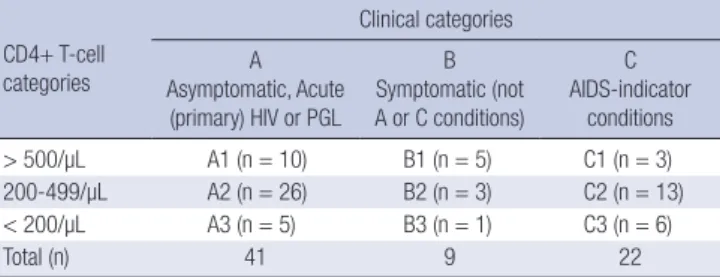
T-cell count was 403/μL (range: 18-1,333/μL), with 12 patients (11/72, 16.7%) showing counts below 200/μL. According to the Centers for Disease Control classification system for HIV infec- tion and the expanded AIDS surveillance case definition for adolescents and adults (9), 56.9% (41/72) of patients were as- ymptomatic HIV-positive patients, whereas 43.1% (31/72) were symptomatic AIDS patients (Table 2). The postoperative mean hospital stay was 1.25 days, and outpatient clinic follow-up was routinely performed.
Condyloma acuminata
All 49 patients with condyloma acuminata received surgical ex- cision with electric cauterization, among which 12 patients re- ceived appropriate simultaneous procedures for concomitant anal conditions such as anal fistula (n = 6), hemorrhoids (n = Table 1. Perianal diseases operated in HIV-positive patients
Disease No. %
Condyloma acuminatum without other disease with anal fistula with hemorrhoids with perianal abscess
49 37 6 4 2
68.1 - - - -
Anal fistula 14 19.4
Hemorrhoids 5 6.9
Perianal abscess 4 5.6
Total 72 100
HIV, human immunodeficiency virus.
Fig 1
Fig. 1. Standard precautions were used when performing surgery on a patient posi- tive for human immunodeficiency virus.
Table 2. Distribution of 72 HIV-positive patients, according to the 1993 revised Cen- ters for Disease Control classification for HIV infection and extended AIDS surveil- lance case definition for adolescents and adults
CD4+ T-cell categories
Clinical categories A
Asymptomatic, Acute (primary) HIV or PGL
B Symptomatic (not A or C conditions)
C AIDS-indicator
conditions
> 500/µL A1 (n = 10) B1 (n = 5) C1 (n = 3)
200-499/µL A2 (n = 26) B2 (n = 3) C2 (n = 13)
< 200/µL A3 (n = 5) B3 (n = 1) C3 (n = 6)
Total (n) 41 9 22
AIDS, acquired immunodeficiency syndrome; HIV, human immunodeficiency virus;
PGL, persistent generalized lymphadenopathy.
Oh H-K, et al. • Surgical Management of Anal Disease with HIV Infection
Table 3. Comparison of clinical characteristics between HIV-positive and HIV-negative patients with condyloma acuminata
Variables HIV-positive
(n = 49) HIV-negative*
(n = 15) P Age, yr (median [range]) 36.0 (19-55) 41.0 (20-79) 0.036
Male (No., [%]) 49 (100) 6 (40.0) 0.001
Concomitant anal disease (No., [%]) 12 (24.5) 6 (40.0) 0.326 Annular growth (No., [%]) 22 (44.9) 5 (33.3) 0.427 Pathology
Benign (No., [%])
Dysplasia/squamous cell carcinoma (No., [%])
46 (93.9) 3 (6.1)
11 (73.3) 4 (26.7)
0.047
Complications (No., [%]) 1 (2.0) 2 (13.3) 0.134
Time to wound healing, days (median [range]) 35 (12-96) 35 (15-60) 0.457
Recurrences (No., [%]) 8 (16.3) 3 (20.0) 0.701
*Six of these patients had a past medical history of organ (n = 3 kidney, n = 3 liver) transplantation.
Fig 2
A B
Fig 2
A
A BB
Fig. 2. Subtype of condyloma acuminata according to growth patterns. (A) Simple scattered type, and (B) Annular invasive type.
Fig 3
A B C
Fig 3
A B C
Fig 3
A
AB
B CC
Fig. 3. Condyloma acuminata. (A) Preoperative status, (B) Immediate postoperative status after excision with electrocauterization, and (C) Healing wound one month after operation.
4), or perianal abscesses (n = 2). Operative findings showed an- nular invasive growth along the anal verge in 22 cases, while the remainder showed simple scattered growth (Fig. 2). Except for 1 case of acute urinary retention, there were no significant post- operative complications, and all patients were discharged with- in 2 days. Wound healing was observed at the outpatient clinic throughout the follow-up period and completed in a mean of 35 days (range: 12-96 days), with no reports of significant com- plications (Fig. 3). Pathology reports showed 3 cases (3/49, 6.1%) of dysplasia, whereas the remaining cases were benign condy- loma. The median follow-up period was 46.9 months (range:
5.3-135 months), during which 16.3% (8/49) of patients experi- enced recurrence at a mean of 10.1 months (range: 1.3-25.2 months). The recurrence rate for annular type condyloma was significantly higher at 24.1% (7/22) compared to 3.7% (1/27) for simple type condyloma (P = 0.016). All recurrence cases were re-excised. Among the patients with recurrence, one patient with moderate to severe dysplasia on the initial pathologic re- port later presented with progression to squamous cell carcino- ma 23 months after the initial surgery.
Clinical characteristics of patients with condyloma acumina- ta were compared between those who were HIV-positive (n = 49) and those who were HIV-negative (n = 15) (Table 3). Surgi- cal outcomes including postoperative complications, time to
Oh H-K, et al. • Surgical Management of Anal Disease with HIV Infection
wound healing, and recurrence, were not different between these two groups.
Anal fistula
A total of 20 patients presented with anal fistulas, among which 6 had concomitant condyloma acuminata. Fistulotomy alone was performed on the 16 patients with intersphincteric type fis- tulas, and a seton drainage procedure was included in 2 of the 4 patients with transsphincteric type fistulas. All patients were discharged within 2 days without complications. Eighteen of these patients showed satisfactory wound healing within 19-82 days, whereas two patients showed delayed wound healing ei- ther after antiviral treatment for herpes simplex virus infection (with a low CD4+ T-cell count of 46/μL), or radiation therapy for a squamous cell carcinoma identified 23 months after the initial operation. The median follow up time was 27.2 months (range:
2.0-83.1 months), during which no recurrences were reported.
However, 1 patient with a transsphincteric fistula developed another fistula at a different location 14 months after the initial operation and thus underwent an additional fistulotomy.
Perianal abscess
Perianal abscesses were diagnosed in 6 patients, 2 of whom had concomitant condyloma acuminata. One of these patients de- veloped perianal sepsis following a hemorrhoidectomy at an- other institution. The CD4+ T-cell count in this patient was 18/
μL signifying remarkable immunodeficiency, though the pa- tient underwent an emergency drainage procedure and recov- ered without significant complications. The median follow up was 56.8 months (range: 27.9-144.2 months), during which 1 patient developed recurrence and required repeat drainage.
Hemorrhoids
Nine cases of hemorrhoids were reported, with 4 cases showing concomitant condyloma acuminata. Four cases were primary hemorrhoids, and 1 case was recurrent following an operation from another institution. Four patients were newly diagnosed with HIV during the preoperative evaluation. All patients were discharged after 2-4 days without complications, with a mean wound healing time of 30.1 days (range: 12-47 days). No recur- rences were reported during the median 35.6-month (range:
2.3-133.5 months) follow-ups.
Postoperative course
A total of 94 operations were performed on the 72 patients in- cluded in the study. Among these, 23.4% (22/94) were reopera- tions, and 3.2% (3/94) had complications including 1 case of acute urinary retention following excision of condyloma acum- inata, and delayed healing in 2 fistulotomy wounds. The patient with the herpes simplex virus infection was the only patient of 12 with CD4+ T-cell counts below 200/μL that developed com-
plications, corresponding to similar complication rates between the groups with low and high CD4+ T-cell counts. No operation- related mortality occurred during the study.
DISCUSSION
One third of HIV-positive patients develop anorectal pathology, and half of these require surgery (4). Previous studies have shown that hemorrhoids are the most common anal condition in non- HIV patients, whereas condyloma acuminata is the most com- mon in HIV-positive patients, followed by ulcers, malignancies, anal fistulas and perianal abscesses (5, 10). Consistent with these reports, the results of this study show that condyloma is the most common condition occurring in Korean HIV-positive patients.
However, in contrast to foreign reports, only one case with ulcer was observed in our study. A reason for this discrepancy may be that only cases that underwent surgery were included in our study. In addition, the results of this study show 16.7% of HIV- positive patients have combined anal conditions, which falls within the reported range of 16%-66% (10-12).
Wexner et al. (4) reported that 15% of HIV-positive patients present with anorectal symptoms prior to the diagnosis of AIDS.
Moreover, Barrett et al. (12) stated that as anal diseases may be the first presenting symptoms, patients presenting with multi- ple anal diseases should be approached with a higher level of suspicion for HIV infection. Indeed, more than a third of the cases in this study were newly diagnosed with HIV infection during their preoperative evaluation for anal diseases. This in- cidence is higher than reported for patients in the West, which may correspond with a lower reported HIV/AIDS prevalence and a lower level of suspicion and testing in the primary care settings in Korea. These results document the importance of routine serologic testing for HIV in the preoperative work-up of perianal diseases.
The presentation of condyloma acuminata, which results from an infection with the human papilloma virus, differs between HIV-positive and non-HIV patients. In HIV-positive patients, condyloma displays relatively rapid growth to a significantly larger size, frequently extends into the anal canal, shows fre- quent recurrence, and is associated with a high incidence of neoplastic transformation (5, 13). Therefore, pathologic confir- mation after surgical excision should be mandatory. Reports show that mild to moderate dysplasia occurs in 16.4% and se- vere dysplasia occurs in 19.4% of HIV-positive patients, and even benign condyloma has been known to progress to intraepithe- lial neoplasia and invasive carcinoma (10, 14). Manzione et al.
(15) reported a recurrence rate of 52.6% after treatment of con- dyloma, noting a higher incidence of recurrence in cases with severe dysplasia. There are few reports of invasive malignancy, likely because mortality due to AIDS occurs before carcinoma development. However, AIDS-related mortality has decreased
Oh H-K, et al. • Surgical Management of Anal Disease with HIV Infection
with the implementation of highly active antiretroviral therapy and the development of new medical therapies; concomitantly, cases of invasive malignancies have increased (5, 16). Three pa- tients in this study experienced dysplastic growth in condyloma acuminata. One patient showed moderate to severe dysplasia and eventually developed squamous cell carcinoma 23 months after the initial operation. Two patients with mild to moderate dysplasia received treatment 2 and 12 months before comple- tion of this study and are currently under close follow-up with- out recurrence.
One patient with an anal fistula showed delayed wound heal- ing with a persistent ulcerative lesion, and the tissue culture from the anal ulcer revealed herpes simplex virus infection. Although anal ulcers can be caused by HIV itself, several reports indicate that the herpes simplex virus is responsible for the majority of ulcers with HIV disease (3, 10, 13). Despite the difficulty of viral culture and the low prevalence of anal ulcers in Korea, we sug- gest that viral culture should be mandatory for HIV-positive pa- tients with anal ulcers and non-healing wounds.
Initial reports stated that only 12% of HIV-positive patients can expect full recovery from surgical treatment, with a third of these requiring more than 6 months for complete wound heal- ing (4). However, improvements in HIV treatment have lowered the risk of complications with wound healing, and some reports have shown successful wound healing in 94% of patients (5, 6).
The patient’s immunocompetency may be a pivotal factor for successful treatment, as CD4+ T-cells contribute to wound heal- ing by secreting cytokines such as transforming growth factor-β and interleukin-2 (17). A report by Lord (19) found that patients with CD4+ T-cell counts < 50/μL showed signs of delayed wound healing. However, studies by Safavi et al. (13) and Nadal et al.
(18) showed no association between wound healing and CD4+
T-cell count. Consistent with these studies, our results showed no significant increase in complication rate in patients with low CD4+ T-cell counts (< 200/μL).
Results of treatments for anal diseases vary across the litera- ture. Orkin et al. reported good results with only conservative treatment, yet also showed only a 26% cure rate, with up to 41%
of patients developing condyloma at another site (20). Barret et al. (12) reported complete cure in only 44% of patients after 13 weeks of follow-up, with a recurrences of condyloma in 52%, abscesses in 41%, and fistulas in 3%. Consten et al. (5) reported discrepancies in wound healing in relation to specific anal dis- eases; perianal abscesses, ulcers and malignancies showed dif- ficulty in wound healing, whereas hemorrhoids or polyps show- ed good recovery irrespective of HIV infection. The discrepan- cies in these results can be explained by the progression of HIV treatment or by differences in the patient populations.
In conclusion, with the increase of both HIV infection and anal disease requiring surgery, surgeons should understand the characteristics of anal diseases in HIV-positive patients. Safely
performed surgeries following standard precautions should be sufficient to eliminate concerns of transferring infection to med- ical staff. Despite concerns for the challenged immunity of HIV- positive patients, our study indicates that low CD4+ T-cell counts do not predict delayed wound healing or complications. As a result, HIV-positive patients receiving appropriate care at a prop- er time should expect low complications and sequelae.
ACKNOWLEDGMENTS
The authors are indebted to J. Patrick Barron, Professor Emeri- tus, Tokyo Medical University and Adjunct Professor, Seoul Na- tional University Bundang Hospital for his pro bono editing of this manuscript. The preliminary results of this study were pre- sented at the annual meeting of the Korean Society of Coloproc- tology, held from April 6-8 2012 in Seoul, Korea.
DISCLOSURE
The authors have no potential conflicts of interest to declare.
ORCID
Heung-Kwon Oh http://orcid.org/0000-0002-8066-2367 Sang-Hui Moon http://orcid.org/0000-0003-1102-8714 Seungbum Ryoo http://orcid.org/0000-0001-6407-0444 Eun Kyung Choe http://orcid.org/0000-0002-7222-1772 Kyu Joo Park http://orcid.org/0000-0002-9134-7426 REFERENCES
1. United Nations Programme on HIV/AIDS. UNAIDS report on the glob- al AIDS epidemic 2013. Available at http://www.unaids.org/en/data- analysis/knowyourepidemic [accessed on 15 May 2014].
2. Korea Centers for Disease Control and Prevention. Annual report on the notified HIV/AIDS in Korea. Available at http://aidsinfo.cdc.go.kr/
aidsinfo/user/jsp/ud/ud04_1ht01i.jsp [accessed on 15 May 2014].
3. Miles AJ, Mellor CH, Gazzard B, Allen-Mersh TG, Wastell C. Surgical management of anorectal disease in HIV-positive homosexuals. Br J Surg 1990; 77: 869-71.
4. Wexner SD, Smithy WB, Milsom JW, Dailey TH. The surgical manage- ment of anorectal diseases in AIDS and pre-AIDS patients. Dis Colon Rectum 1986; 29: 719-23.
5. Consten EC, Slors FJ, Noten HJ, Oosting H, Danner SA, van Lanschot JJ.
Anorectal surgery in human immunodeficiency virus-infected patients:
clinical outcome in relation to immune status. Dis Colon Rectum 1995;
38: 1169-75.
6. Burke EC, Orloff SL, Freise CE, Macho JR, Schecter WP. Wound healing after anorectal surgery in human immunodeficiency virus-infected pa- tients. Arch Surg 1991; 126: 1267-70.
7. Hwang DY, Lee JS, Yoon SG, Rhyou JH, Song SG, Lee JK. Benign anal diseases on patients with HIV disease. J Korean Soc Coloproctol 2003;
Oh H-K, et al. • Surgical Management of Anal Disease with HIV Infection
19: 1-5.
8. Centers for Disease Control (CDC). Update: universal precautions for prevention of transmission of human immunodeficiency virus, hepatitis B virus, and other bloodborne pathogens in health-care settings. MMWR Morb Mortal Wkly Rep 1988; 37: 377-82, 387-8.
9. From the Centers for Disease Control and Prevention. 1993 revised clas- sification system for HIV infection and expanded surveillance case defi- nition for AIDS among adolescents and adults. JAMA 1993; 269: 729-30.
10. Nadal SR, Manzione CR, Galvão VM, Salim VR, Speranzini MB. Perianal diseases in HIV-positive patients compared with a seronegative popula- tion. Dis Colon Rectum 1999; 42: 649-54.
11. Yuhan R, Orsay C, DelPino A, Pearl R, Pulvirenti J, Kay S, Abcarian H.
Anorectal disease in HIV-infected patients. Dis Colon Rectum 1998; 41:
1367-70.
12. Barrett WL, Callahan TD, Orkin BA. Perianal manifestations of human immunodeficiency virus infection: experience with 260 patients. Dis Co- lon Rectum 1998; 41: 606-11.
13. Safavi A, Gottesman L, Dailey TH. Anorectal surgery in the HIV+ patient:
update. Dis Colon Rectum 1991; 34: 299-304.
14. Anderson CA, Boller AM, Richardson CJ, Balcos EG, Zera RT. Anal con-
dyloma: a comparison between HIV positive and negative patients. Am Surg 2004; 70: 1014-8.
15. Manzione CR, Nadal SR, Calore EE. Postoperative follow-up of anal con- dylomata acuminata in HIV-positive patients. Dis Colon Rectum 2003;
46: 1358-65.
16. Diamond C, Taylor TH, Aboumrad T, Bringman D, Anton-Culver H. In- creased incidence of squamous cell anal cancer among men with AIDS in the era of highly active antiretroviral therapy. Sex Transm Dis 2005;
32: 314-20.
17. Wòjciak B, Crossan JF. The effects of T cells and their products on in vitro healing of epitenon cell microwounds. Immunology 1994; 83: 93-8.
18. Nadal SR, Manzione CR, Galvao VM, Salim VR, Speranzini MB. Heal- ing after anal fistulotomy: comparative study between HIV+ and HIV- patients. Dis Colon Rectum 1998; 41: 177-9.
19. Lord RV. Anorectal surgery in patients infected with human immunode- ficiency virus: factors associated with delayed wound healing. Ann Surg 1997; 226: 92-9.
20. Orkin BA, Smith LE. Perineal manifestations of HIV infection. Dis Colon Rectum 1992; 35: 310-4.