INTRODUCTION
Racial differences in health care outcomes among patients in the United States continue to be revealed in the literature [1-12].
It has been shown that minority patients have greater burdens
Racial Differences in Hospital Stays among Patients Undergoing Craniotomy for Tumour Resection
at a Single Academic Hospital
John P. Sheppard1, Carlito Lagman2, Prasanth Romiyo1, Thien Nguyen1, Daniel Azzam1, Yasmine Alkhalid1, Courtney Duong1, Isaac Yang1,2,3,4,5,6
Departments of 1Neurosurgery, 2Radiation Oncology, 3Head and Neck Surgery, and the 4Jonsson Comprehensive Cancer Center,
Ronald Reagan UCLA Medical Center of the David Geffen School of Medicine at the University of California, Los Angeles, Los Angeles, CA, USA Department of 5Neurosurgery and the 6Los Angeles Biomedical Research Institute (LA BioMed), Harbor-UCLA Medical Center, Torrance, CA, USA
Received December 12, 2018 Revised April 22, 2019 Accepted June 4, 2019 Correspondence Isaac Yang
Department of Neurosurgery, David Geffen School of Medicine at the University of California, Los Angeles (UCLA), 300 Stein Plaza, Suite 562, Los Angeles, CA 90095, USA Tel: +1-310-267-2621
Fax: +1-310-825-9384 E-mail: [email protected]
Background Racial differences in American patients undergoing brain tumour surgery remain poorly characterized within urban medical centres. Our objective was to assess racial differences in operative brain tumour patients at a single academic hospital in Los Angeles, California.
Methods We reviewed medical records of adult patients undergoing craniotomy for tumour re- section from March 2013 to January 2017 at UCLA Medical Centre. Patients were categorized as Asian, Hispanic, Black, or White. Racial cohorts were matched on demographic variables for compari- sons. Our primary outcome was post-operative length of stay (LOS). Secondary outcomes included hospital mortality and discharge disposition.
Results In this study, 462 patients identified as Asian (15.1%), Hispanic (8.7%), Black (3.9%), or White (72.3%). After cohort matching, non-White patients had elevated risk of prolonged LOS [odds ratio (OR)=2.62 (1.44, 4.76)]. No differences were observed in hospital mortality or non-routine dis- charge. Longer LOS was positively correlated with non-routine discharge [rpb (458)=0.41, p<0.001].
Black patients with government insurance had average LOS 2.84 days shorter than Black patients with private insurance (p=0.04). Among Hispanics, government insurance was associated with non- routine discharge [OR=4.93 (1.03, 24.00)].
Conclusion Racial differences manifested as extended LOS for non-White patients, with compa- rable rates of hospital mortality and non-routine discharge across races. Prolonged LOS loosely re- flected complicated clinical course with greater risk of adverse discharge disposition. Private insurance coverage predicted markedly lower risk of non-routine discharge for Hispanic patients, and LOS of three additional days among Black patients. Further research is needed to elucidate the basis of these differences.
Key Words Brain neoplasms; Craniotomy; Socioeconomic factors; Racial factors.
of morbidity and mortality compared to White patients even after controlling for differences in socioeconomic status, edu- cation, and treatment [6-8,13-23]. Some studies attribute the origin of these differences to increased comorbidities in minor- ity patients [24-28], while others describe decreased access to care, disparate health care networks, distrust in the medical es- tablishment, and doctor-centred biases as contributing to health care inequities [6,22,29-31].
Recent studies have focused on racial differences among Black patients diagnosed with brain tumours, but less work has
This is an Open Access article distributed under the terms of the Creative Commons Attribution Non-Commercial License (https://creativecommons.org/licenses/by-nc/4.0) which permits unrestricted non-commercial use, distribution, and reproduction in any medium, provided the original work is properly cited.
Copyright © 2019 The Korean Brain Tumor Society, The Korean Society for Neuro- Oncology, and The Korean Society for Pediatric Neuro-Oncology
been done with respect to other vulnerable populations. Asian and Hispanic people comprise a large subset of patients in many urban academic medical centres, yet have received less atten- tion [6,7]. Moreover, previous research investigating racial dif- ferences in brain tumour patients has relied heavily on the use of national databases and multicentre survey studies [5,7,8,22,23].
Although helpful, the clinical granularity of such studies is lim- ited. To our knowledge, the results of those studies have not been validated at the institutional level.
Here, we investigate outcomes of adult brain tumour patients who underwent craniotomy for tumour resection at a large ac- ademic medical centre in Los Angeles, California between March 2013 and January 2017. We chose hospital stay as our primary outcome measure. We also reviewed hospital mortali- ty, discharge disposition, and delivery of adjuvant therapies at our institution (chemotherapy and radiotherapy). We assessed racial differences in these clinical measures across all patients, and again after identifying racial sub-cohorts matched on de- mographic and socioeconomic variables. We hypothesized that racial differences exist at the institutional level among adult pa- tients undergoing brain tumour surgery, which may manifest as differences in length of stay (LOS) or rates of non-routine discharge.
MATERIALS AND METHODS
Study design and selection of patientsWe conducted a retrospective cross-sectional study that in- cluded adult patients (18 years or older) who underwent crani- otomy for brain tumour resection at a single academic medical centre in Los Angeles, California from March 2013 to January 2017. Patients were selected using International Classification of Diseases, 9th and 10th Revision and Current Procedural Terminology, version 4 codes. Informed consent was obtained from all individual participants included in the study. The study had prior approval from our institutional review board and ethics committee before data collection was initiated (IRB ap- proval number 17-000579).
Data collection
Medical records were reviewed to identify race and to eval- uate clinical variables of interest. Demographics (age, sex, race, Los Angeles County resident status, median income by zip code, and insurance status) and brain tumour pathologic diagnoses were also collected. We categorized patients into four major racial groups based on self-identification: Asian, Hispanic, Black, and White. Those patients whose race was reported as other, unknown, or those who refused to identify with a race were excluded. Median incomes were determined using the website https://www.incomebyzipcode.com. Insurance status
was defined as government (including Medicaid, Medicare, or Tricare for U.S. military veterans) or nongovernment (i.e., private insurance or self-pay).
Outcomes
The primary outcome was hospital length of stay (LOS). Sec- ondary outcome measures were hospital mortality, discharge disposition, and access to adjuvant therapies including chemo- therapy and radiotherapy. LOS was also dichotomized and analysed as a categorical dependent variable where a prolonged LOS was defined as LOS greater than 7 days. Hospital mortal- ity was defined as death occurring during hospitalization for brain tumour surgery. Discharge disposition was categorized as routine (to home) or non-routine (other than to home). Ac- cess to adjuvant therapies was determined through review of the medical records; only chemotherapy and/or radiotherapy for the brain tumour were considered.
Statistical analysis
We performed standard univariate analyses to compare out- comes of Asian, Hispanic, and Black patients to White patients.
We performed additional comparisons stratified by specific brain tumour pathologies (meningioma and glioblastoma) with- in each of the four racial groups. Group-wise differences in continuous measures were identified using two-sample t tests.
Variances were pooled between samples. However, if a viola- tion of equal sample variances was detected based on Folded F tests, Satterthwaite’s approximation for degrees of freedom was used to compute the p value. Statistical significance was determined a priori at an alpha level of 0.05.
Pearson (r) and point-biserial correlations (rpb) were per- formed to test for linear relationships between continuous/con- tinuous and continuous/dichotomous variable pairs, respec- tively. We used the Mantel-Haenszel method [32] to test for bivariate associations between binary outcomes. Group-wise differences in binary measures were also analysed using odds ratio (OR), with 95% confidence interval (CI) for contingency tables evaluated using Fisher’s exact tests. The above analyses were performed using SAS Studio (Cary, NC, USA).
Matched cohort analysis
We performed a secondary analysis with 1:1 matched co- horts, which matched Asian, Hispanic, and Black patients to White patients according to age, sex, Los Angeles County resident status, median income by zip code, and insurance status to isolate the effects of race on the outcomes of inter- est. This procedure was carried out through propensity score matching using the nearest neighbour approach [33] and was implemented using the “MatchIt” package in R (Univer- sity of Auckland, Auckland, New Zealand).
Analysis of Variance (ANOVA) confirmed a significant main effect of patient race on LOS [F(3,458)=4.04, p=0.007]. Com- paring specific racial groups, there was a higher average LOS in Asian compared to White patients, but the difference was not statistically significant (8.70 vs. 5.75 days, p=0.06). Asian pa- tients had a significantly increased risk of prolonged LOS (be- yond 7 hospital days). compared to White patients [OR 2.21, 95% CI (1.27–3.87)]. Hispanic patients stayed in the hospital on average longer than White patients (8.46 vs. 5.75 days, p<0.01).
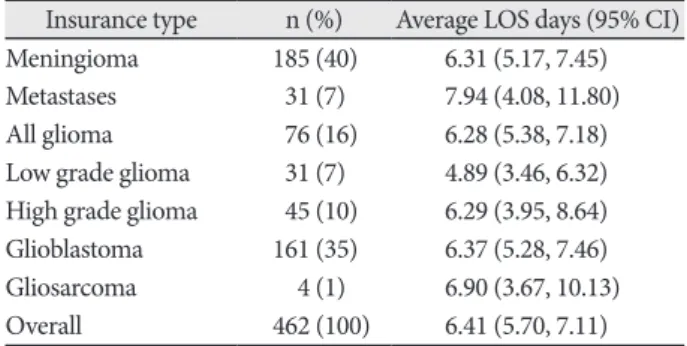
Table 2 and Fig. 3B compare LOS in patients stratified by brain tumor pathology. Overall, ANOVA demonstrated no main effect of brain tumor pathology on LOS [F(5,146)=0.496, p=0.78]. The longest LOS was observed following resection of intracranial metastases, with average LOS of 7.94 days (4.08, 11.80), while the shortest LOS of 4.89 days (3.46, 6.32) was ob- served following resection of low grade glioma. The most com- mon brain, meningioma and glioblastoma, together consisted of 75% of all cases, and had similar LOS of 6.31 (5.17, 7.45) and 6.37 (5.28, 7.46) days, respectively.
Comparison of LOS stratified by patients’ medical insurance status is provided in Fig. 3C and Table 3. ANOVA revealed no significant effect of insurance type (private, government, or no insurance) on LOS, although a trend was observed [F(2,203)=
2.56, p=0.078]. Average LOS for patients who had some form of billable health insurance for the inpatient stay was 6.39 (5.67, 7.11) days. Overall, patients with government insurance had the longest hospital stays on average [7.50 (6.20, 8.80) days], pa- tients with private insurance had intermediate LOS [5.81 (4.96, 6.66) days], and patients with no registered health insurance had the shortest LOS [4.92 (2.39, 7.44) days].
Next, we considered whether LOS was correlated with pa- tient’s age. Across all 462 patients in the cohort regardless of brain tumor pathology, we observed no significant correlation between age at surgery LOS [r(460)=0.05, p=0.28]. We also as- sessed for correlations between age and LOS stratified by each the specific type of tumor, but found no significant correlations
RESULTS
Study populationA total of 517 adult patients were eligible. Of those, 55 pa- tients who reported race as “other” or declined to identify with a race were excluded, leaving 462 patients who self-identified with a race and were included in the analysis. The study popu- lation included 70 patients who identified as Asian (15.1%), 40 Hispanic (8.7%), 18 Black (3.9%), and 334 White (72.3%). The racial breakdown of the overall cohort and the subset residing within Los Angeles County are depicted in Fig. 1, with com- parison provided to the population demographics of Los An- geles reported in the 2010 U. S. Census.
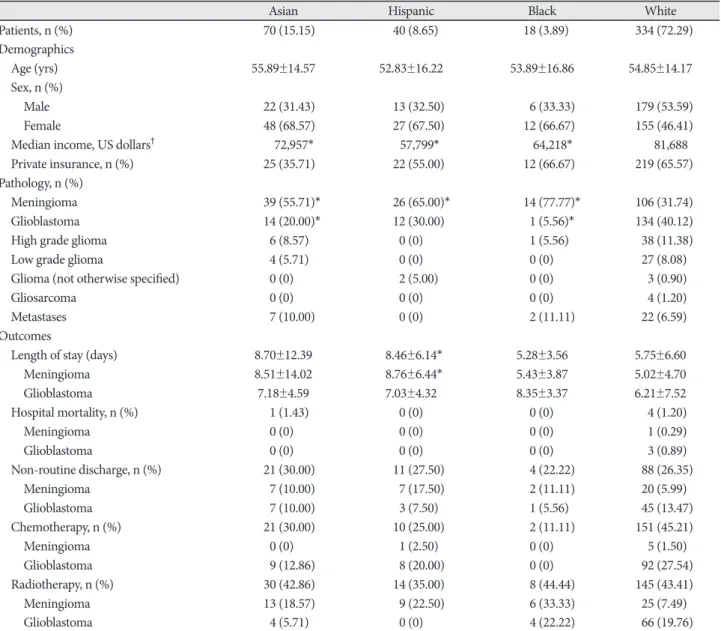
The mean age of patients was 54.8±14.5 years. Fifty-two per- cent of patients were female and 56% lived in Los Angeles Coun- ty at the time of surgery. Meningioma was more frequently di- agnosed in Asian, Hispanic, and Black patients (all p<0.001), whereas glioblastoma was less frequently diagnosed in Asian and Black patients when compared to White patients (all p=
0.002). The results of our unmatched analyses are summarized in Table 1. The proportions of brain tumor pathology observed for patients of each race is also depicted graphically in Fig. 2.
There were no significant differences in insurance status when we compared Asian, Hispanic, or Black patients to White pa- tients. However, Asian (p=0.02), Hispanic (p<0.001), and Black (p=0.01) patients lived in residential areas associated with lower median incomes when compared to White patients, on average.
Hospital length of stay
Across the entire cohort of 462 patients who identified as Asian, Hispanic, Black or White, the average LOS and 95% con- fidence interval was 6.41 (5.70, 7.11) days. Average LOS in pa- tients stratified by race is tabulated in Table 1 and presented graphically in Fig. 3A. Average LOS was 8.70 (5.80, 11.61) days in Asians, 8.46 (6.56, 10.36) days for Hispanics, 5.28 (3.64, 6.93) days for Blacks, and 5.74 (5.04, 6.45) days for Whites. A standard
Fig. 1. Racial composition of patients undergoing craniotomy for tumor resection. A: All craniotomy patients within our institutional study.
B: Craniotomy patients within our study residing in Los Angeles County at time of surgery. C: Racial demographics of Los Angeles Coun- ty reported in 2010 United States Census.
All craniotomy patients in cohort Los Angeles County population demographics (2010) Craniotomy patients residing in Los Angeles County
White non-Hispanic, 334, 72.3%
White non- Hispanic, 2,728,321, 28%
White non-Hispanic, 169, 66%
Asian or Pacific
Islander, 70, 15.1% Asian or Pacific
Islander, 48, 18%
Native American,
72,828, 1% Other, 98,734, 1%
Hispanic or Latino,
40, 8.7%
Hispanic or Latino, 4,687,889, 48%
Hispanic or Latino, 25, 10%
African- American,
18, 3.9% African-
American, 15, 6%
A B C
African- American, 856,874, 8%
Asian or Pacific Islander, 1,372,959,
14%
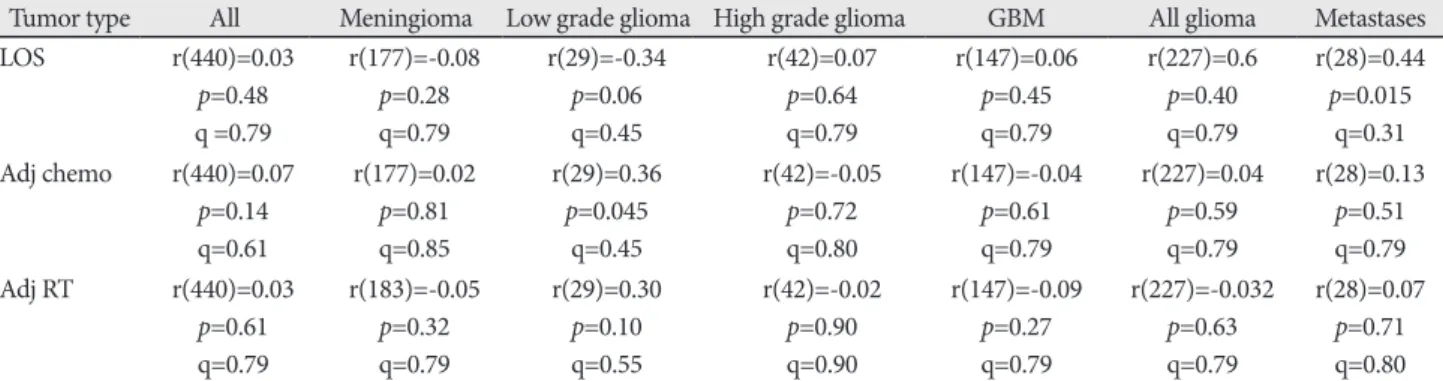
between age and LOS for any of the tumor pathologies in our cohort (Table 4). Additionally, we assessed for possible corre- lations between LOS and patients’ economic status, as approxi- mated based upon the median income of patients’ residential postal codes. There was no significant relationship between residential median income and LOS across patients [r(460)=
0.05, p=0.28]. We further assessed correlations between resi- dential median income and LOS within all tumor types with adequate sample size, and again found no significant correla- tions between LOS and residential median income (Table 5).
Longer average LOS in Hispanic patients relative to Whites was especially pronounced for patients diagnosed with menin- giomas (8.76 vs. 5.02 days, p=0.001). For Hispanic patients di- agnosed with a meningioma, higher median income was pos- Table 1. Summary of patients (unmatched cohort) (n=462)
Asian Hispanic Black White
Patients, n (%) 70 (15.15) 40 (8.65) 18 (3.89) 334 (72.29)
Demographics
Age (yrs) 55.89±14.57 52.83±16.22 53.89±16.86 54.85±14.17
Sex, n (%)
Male 22 (31.43) 13 (32.50) 6 (33.33) 179 (53.59)
Female 48 (68.57) 27 (67.50) 12 (66.67) 155 (46.41)
Median income, US dollars† 72,957* 57,799* 64,218* 81,688
Private insurance, n (%) 25 (35.71) 22 (55.00) 12 (66.67) 219 (65.57)
Pathology, n (%)
Meningioma 39 (55.71)* 26 (65.00)* 14 (77.77)* 106 (31.74)
Glioblastoma 14 (20.00)* 12 (30.00) 1 (5.56)* 134 (40.12)
High grade glioma 6 (8.57) 0 (0) 1 (5.56) 38 (11.38)
Low grade glioma 4 (5.71) 0 (0) 0 (0) 27 (8.08)
Glioma (not otherwise specified) 0 (0) 2 (5.00) 0 (0) 3 (0.90)
Gliosarcoma 0 (0) 0 (0) 0 (0) 4 (1.20)
Metastases 7 (10.00) 0 (0) 2 (11.11) 22 (6.59)
Outcomes
Length of stay (days) 8.70±12.39 8.46±6.14* 5.28±3.56 5.75±6.60
Meningioma 8.51±14.02 8.76±6.44* 5.43±3.87 5.02±4.70
Glioblastoma 7.18±4.59 7.03±4.32 8.35±3.37 6.21±7.52
Hospital mortality, n (%) 1 (1.43) 0 (0) 0 (0) 4 (1.20)
Meningioma 0 (0) 0 (0) 0 (0) 1 (0.29)
Glioblastoma 0 (0) 0 (0) 0 (0) 3 (0.89)
Non-routine discharge, n (%) 21 (30.00) 11 (27.50) 4 (22.22) 88 (26.35)
Meningioma 7 (10.00) 7 (17.50) 2 (11.11) 20 (5.99)
Glioblastoma 7 (10.00) 3 (7.50) 1 (5.56) 45 (13.47)
Chemotherapy, n (%) 21 (30.00) 10 (25.00) 2 (11.11) 151 (45.21)
Meningioma 0 (0) 1 (2.50) 0 (0) 5 (1.50)
Glioblastoma 9 (12.86) 8 (20.00) 0 (0) 92 (27.54)
Radiotherapy, n (%) 30 (42.86) 14 (35.00) 8 (44.44) 145 (43.41)
Meningioma 13 (18.57) 9 (22.50) 6 (33.33) 25 (7.49)
Glioblastoma 4 (5.71) 0 (0) 4 (22.22) 66 (19.76)
Values are presented as n (%) or mean±SD unless otherwise indicated. *p<0.05 for the comparisons of specific race versus White, †Mean of median incomes by zip code
Fig. 2. Relative frequencies of brain tumor pathologies by race in patients undergoing craniotomy for tumor resection at our institu- tion.
Asian Hispanic Black White
Meningioma Glioblastoma High grade glioma Low grade glioma Metastases Glioma NOS Gliosarcoma 100
80 60 40 20 0
%
or glioblastoma separately [OR 3.05, 95% CI (1.12-8.30)].
Secondary outcomes
Across all patients, residential median income was not cor- related with the probability of receiving adjuvant chemother- apy [r(440)=0.07, p=0.14] or adjuvant radiation therapy [r(440)=
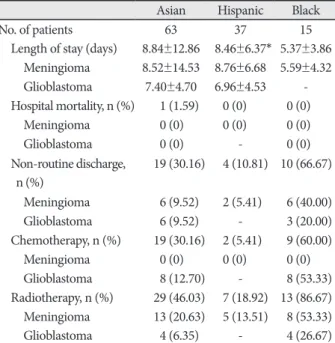
-0.02, p=0.61] within our health system, and no correlations between residential income and receipt of adjuvant therapy were observed when stratifying patients by tumor pathology (Table 5). There were no significant differences in hospital mor- tality or discharge disposition observed between races in ei- ther the unmatched (Table 5, 6) or matched (Table 7, 8) cohort analyses (see Methods for details of cohort matching). There were five cases of hospital mortality (1.1%) and 124 cases of non-routine discharge (26.8%). The most common types of non-routine discharge were to acute rehabilitation units (89 cases, 71.8%) or skilled nursing facilities (21 cases, 16.9%). For Hispanic patients, government insurance was associated with an increased risk of non-routine discharge [OR 4.93, 95% CI (1.03–24.00)]. For Black patients, higher median income was correlated with an increased risk of non-routine discharge (rpb=0.60, p=0.03).
For Hispanic patients diagnosed with glioblastoma, higher median income was positively associated with delivery of adju- vant radiotherapy at our institution (rpb=0.65, p=0.03). Among Hispanic patients diagnosed with glioblastoma, those treated with adjuvant radiotherapy at our institution had on average higher median incomes compared to patients not treated with adjuvant radiotherapy at our institution ($76,819 vs. $51,509, p=0.03). In the matched cohort analysis, Asian and non-White patients were less likely to receive chemotherapy at our institu- tion [OR 0.42, 95% CI (0.20–0.87) and OR 0.35, 95% CI (0.20–
0.60), respectively] compared to White patients. However, non- White patients were more likely to have diagnoses of benign tumors, while White patients had higher rates of high-grade itively associated with prolonged LOS (rpb=0.42, p=0.03). Black
patients with government insurance had post-operative hospi- tal stays 2.84±1.86 days shorter on average than Black patients with private insurance coverage (p=0.04).
After cohort matching, Asian patients still had an increased risk of prolonged LOS [OR 3.05, 95% CI (1.30–7.12)], and His- panic patients still stayed in the hospital 2.70±1.28 days longer than White patients (p=0.04). Collectively, non-White (Asian, Hispanic, and Black) patients had a higher risk of prolonged LOS whether pooling tumour types [OR 2.62, 95% CI (1.44–
4.76)] or examining meningioma [OR 4.35, 95% CI (1.19–15.88)]
Fig. 3. Comparisons of average hospital length of stay in patients undergoing craniotomy for tumor resection stratified by (A) patient race, (B) brain tumor pathology, and (C) type of medical insurance. Error bars indicate 95% confidence intervals.
Table 2. Average length of hospital stay stratified by brain tumor pathology
Insurance type n (%) Average LOS days (95% CI) Meningioma 185 (40) 6.31 (5.17, 7.45)
Metastases 31 (7) 7.94 (4.08, 11.80)
All glioma 76 (16) 6.28 (5.38, 7.18)
Low grade glioma 31 (7) 4.89 (3.46, 6.32) High grade glioma 45 (10) 6.29 (3.95, 8.64) Glioblastoma 161 (35) 6.37 (5.28, 7.46)
Gliosarcoma 4 (1) 6.90 (3.67, 10.13)
Overall 462 (100) 6.41 (5.70, 7.11)
n, number of patients; LOS, length of stay; CI, confidence interval
Table 3. Average length of hospital stay stratified by patient insur- ance status
Insurance type n (%) Average LOS days (95% CI) Any insurance 454 (98) 6.39 (5.67, 7.11)
Private 295 (64) 5.81 (4.96, 6.66)
Government 159 (34) 7.50 (6.20, 8.80)
No insurance 7 (2) 4.92 (2.39, 7.44)
Overall 462 (100) 6.41 (5.70, 7.11)
n, number of patients; LOS, length of stay; CI, confidence interval
A B C
Asian Hispanic Black White All Menin
gioma Metastases
All glioma Low g
rade glioma Glioblastoma
Gliosarcoma High grade glioma
Overall Any insurance
Private insurance 14
12 10 8 6 4 2 0
14 12 10 8 6 4 2 0
14 12 10 8 6 4 2 0
Length of hospital stay (days) Length of hospital stay (days) Length of hospital stay (days)
Government insurance No insurance
gliomas and glioblastomas conventionally treated with adju- vant therapies (Fig. 1, Table 1).
Relationship of length of stay to non-routine discharge
Across patients of all patients, longer LOS was positively cor- related with risk of a non-routine (i.e., non-home) discharge [rpb(458)=0.41, p<0.001]. Positive correlations between LOS and risk of non-routine discharge of similar magnitude were observed within Asian patients [rpb(68)=0.52, p<0.001], Black patients [rpb(16)=0.40, p=0.10], Hispanic patients [rpb(38)=
0.56, p<0.001], White patients [rpb(330)=0.37, p<0.001], and
all non-White patients [rpb(126)=0.41, p<0.001).
DISCUSSION
Recent work emphasizes delivery of equitable specialty care [5,34,35]. With few exceptions, these studies have examined trends in morbidity and mortality in national databases such as the Nationwide Inpatient Sample [8], National Surgical Qual- ity Improvement Program [7], and Surveillance, Epidemiology, and End Results registry [36]. Such analyses provide the advan- tage of large sample sizes generalizable to the American public.
However, they are limited by possible coding errors and mini- Table 4. Correlations between age and length of stay stratified by brain tumor pathology
Tumor type All Meningioma Low grade glioma High grade glioma GBM All glioma Metastases Age vs. LOS r(460)=0.05
p=0.28
r(183)=-0.001 p=0.99
r(29)=0.06 p=0.76
r(43)=0.20 p=0.20
r(159)=0.05 p=0.51
r(240)=0.09 p=0.15
r(29)=0.02 p=0.91 LOS, length of stay; GBM, glioblastoma; r, Pearson’s correlation; p, two-tailed significance level
Table 5. Correlations between median income and length of stay, probability of receiving adjuvant chemotherapy, and probability of receiv- ing adjuvant radiation therapy within our health system following surgical resection, stratified by type of brain tumor
Tumor type All Meningioma Low grade glioma High grade glioma GBM All glioma Metastases
LOS r(440)=0.03
p=0.48 q =0.79
r(177)=-0.08 p=0.28 q=0.79
r(29)=-0.34 p=0.06 q=0.45
r(42)=0.07 p=0.64 q=0.79
r(147)=0.06 p=0.45 q=0.79
r(227)=0.6 p=0.40 q=0.79
r(28)=0.44 p=0.015
q=0.31 Adj chemo r(440)=0.07
p=0.14 q=0.61
r(177)=0.02 p=0.81 q=0.85
r(29)=0.36 p=0.045
q=0.45
r(42)=-0.05 p=0.72 q=0.80
r(147)=-0.04 p=0.61 q=0.79
r(227)=0.04 p=0.59 q=0.79
r(28)=0.13 p=0.51 q=0.79 Adj RT r(440)=0.03
p=0.61 q=0.79
r(183)=-0.05 p=0.32 q=0.79
r(29)=0.30 p=0.10 q=0.55
r(42)=-0.02 p=0.90 q=0.90
r(147)=-0.09 p=0.27 q=0.79
r(227)=-0.032 p=0.63 q=0.79
r(28)=0.07 p=0.71 q=0.80 LOS, length of stay; Adj, adjuvant; chemo, chemotherapy; RT, radiation therapy; GBM, glioblastoma; r, Pearson’s correlation; p, two-tailed significance level; q, FDR-adjusted significance level
Table 6. Secondary clinical outcomes stratified by race (unmatched cohort analysis) Prolonged LOS (over 7 days)
[OR (95% CI)] Non–routine discharge
[OR (95% CI)] Chemotherapy
[OR (95% CI)] Radiotherapy [OR (95% CI)]
Race (Reference: White)
Asian 2.21 (1.27–3.87)* 1.19 (0.67–2.09) 0.52 (0.30–0.90)* 0.98 (0.58–1.65)
Meningioma 1.92 (0.81–4.55) 0.94 (0.36–2.44) – 1.62 (0.73–3.62)
Glioblastoma 2.39 (0.77–7.40) 1.93 (0.64–5.85) 0.82 (0.26–2.60) 0.41 (0.12–1.38)
Hispanic 3.99 (2.03–7.83)* 1.05 (0.50–2.19) 0.40 (0.19–0.85)* 0.70 (0.35–1.39)
Meningioma 4.89 (1.95–12.28)* 1.58 (0.59–4.28) 0.81 (0.09–7.23) 1.72 (0.68–4.32) Glioblastoma 3.19 (0.96–10.57) 0.64 (0.17–2.50) 0.91 (0.26–3.20) 0.52 (0.15–1.79)
Black 0.80 (0.22–2.83) 0.79 (0.25–2.47) 0.15 (0.03–0.67)* 1.04 (0.40–2.71)
Meningioma 0.82 (0.17–3.96) 0.72 (0.15–3.46) – 2.43 (0.77–7.67)
Glioblastoma – – – –
Non–White 2.39 (1.53–3.74)* 1.08 (0.69–1.71) 0.42 (0.27–0.66)* 0.89 (0.59–1.35)
Meningioma 2.40 (1.20–4.78)* 1.09 (0.52–2.27) 0.26 (0.03–2.26) 1.78 (0.94–3.38)
Glioblastoma 2.96 (1.26–6.94)* 1.33 (0.57–3.10) 0.78 (0.33–1.84) 0.43 (0.18–1.06)
*p<0.05. CI, confidence interval; OR, odds ratio
mal clinical granularity, which renders them unable to elucidate differences in care within a specific city, health system, or in- stitution.
Here, we identified racial differences in neurosurgical out- comes in adult patients who underwent craniotomy for brain tumour resection at a single academic hospital over four con- secutive years. Both Asian patients and non-White patients in general had increased risks of prolonged LOS compared to White patients. Additionally, Hispanic patients had longer av- erage LOS than White patients. Observed differences in LOS
persisted in a matched cohort analysis controlling for demo- graphic and socioeconomic variables, and were consistent with previous findings reported in the literature [8,22]. In the past decade, several national database studies of patients undergo- ing brain tumour resection have reported longer LOS in Black [7,8,22,23] and Hispanic patients [7] compared to White pa- tients. To our knowledge, however, ours is the first study to demonstrate such differences within patients treated at a single hospital.
Understanding the clinical significance of extended LOS is critical for interpreting racial differences in LOS among the operative patients in our study. One possibility is that pa- tients with better insurance coverage or access to care are kept in hospital longer to recover adequately for home dis- charge, whereas patients with poorer coverage are discharged sooner with greater risk of adverse discharge disposition. In this scenario, longer LOS would be expected to correlate with higher rates of routine discharge. An alternative hypothesis is that prolonged LOS could reflect a poorer clinical course stemming from higher comorbidity burden or more ad- vanced disease at presentation. This latter view is favoured by a majority of prior studies [6-8, 22,23].
Under the hypothesis that extended LOS reflects heightened co-morbidity burden and disease severity, longer LOS would correlate with greater risk of non-routine discharge, such as dis- charge to a skilled nursing facility or acute rehabilitation unit.
Conversely, patients with lower comorbidity burden or less ad- vanced disease would have faster recovery timer (i.e., shorter LOS) and higher rates of home discharge. Indeed, previous out- come studies of operative brain tumour patients have report- ed the combination of longer LOS and higher rates of adverse discharge in minority patients [8,23]. Our own correlation anal- Table 7. Clinical outcomes and rates of adjuvant therapy by race
and tumor pathology (matched cohort analysis)
Asian Hispanic Black
No. of patients 63 37 15
Length of stay (days) 8.84±12.86 8.46±6.37* 5.37±3.86 Meningioma 8.52±14.53 8.76±6.68 5.59±4.32
Glioblastoma 7.40±4.70 6.96±4.53 -
Hospital mortality, n (%) 1 (1.59) 0 (0) 0 (0)
Meningioma 0 (0) 0 (0) 0 (0)
Glioblastoma 0 (0) - 0 (0)
Non-routine discharge,
n (%) 19 (30.16) 4 (10.81) 10 (66.67) Meningioma 6 (9.52) 2 (5.41) 6 (40.00)
Glioblastoma 6 (9.52) - 3 (20.00)
Chemotherapy, n (%) 19 (30.16) 2 (5.41) 9 (60.00)
Meningioma 0 (0) 0 (0) 0 (0)
Glioblastoma 8 (12.70) - 8 (53.33)
Radiotherapy, n (%) 29 (46.03) 7 (18.92) 13 (86.67) Meningioma 13 (20.63) 5 (13.51) 8 (53.33)
Glioblastoma 4 (6.35) - 4 (26.67)
Values are presented as n (%) or mean±SD unless otherwise indi- cated. *p<0.05
Table 8. Secondary clinical outcomes stratified by race (matched cohort analysis) Length of stay (over 7 days)
[OR (95% CI)] Non-routine discharge
[OR (95% CI)] Chemotherapy
[OR (95% CI)] Radiotherapy [OR (95% CI)]
Race (Reference: White)
Asian 3.05 (1.30–7.12)* 1.38 (0.63–3.05) 0.42 (0.20–0.87)* 0.94 (0.47–1.89)
Meningioma 4.60 (0.91–23.25) 1.52 (0.34–6.75) – 1.87 (0.60–5.88)
Glioblastoma 1.89 (0.41–8.61) 1.10 (0.25–4.80) 0.11 (0.01–1.08) 0.35 (0.07–1.61)
Hispanic 2.56 (0.97–6.75) 0.88 (0.32–2.41) 0.67 (0.24–1.85) 0.64 (0.25–1.62)
Meningioma 3.67 (0.81–16.54) 0.83 (0.19–3.67) – 0.67 (0.17–2.59)
Glioblastoma 1.46 (0.26–8.05) 0.45 (0.08–2.67) 1.00 (0.15–6.53) 0.69 (0.12–3.78)
Black 1.63 (0.23–11.46) 0.73 (0.15–3.49) 0.62 (0.09–4.34) 5.69 (0.94–34.46)
Meningioma 1.11 (0.08–15.53) 1.11 (0.08–15.53) – –
Glioblastoma – – – –
Non-White 2.62 (1.44–4.76)* 1.04 (0.59–1.85) 0.35 (0.20–0.60)* 0.90 (0.53–1.51) Meningioma 4.35 (1.19–15.88)* 0.15 (0.37–3.56) 0.96 (0.90–1.04) 1.25 (0.49–3.16) Glioblastoma 3.05 (1.12–8.30)* 1.41 (0.53–3.74) 0.99 (0.37–2.64) 0.68 (0.25–1.83)
*p<0.05. CI, confidence interval; OR, odds ratio
ysis of LOS and discharge disposition was consistent with this framework: We observed weak yet consistently positive corre- lations (r=0.37–0.56) between LOS and non-routine discharge across patients of all racial demographics, with LOS explain- ing 17% of the overall variance in discharge disposition. This provides limited evidence that longer LOS in our patients was loosely correlated with adverse disposition (i.e., non-routine discharge), providing some context for which the observed ra- cial differences in LOS might be viewed. While generally in line with the view of prior studies [6-8,22,23], this interpretation only serves as a rough generalization and falls short of address- ing the full complexity of factors influencing LOS.
The lack of observed differences in LOS or non-routine dis- charge rates between Black and White patients in our study merits discussion. Prior studies of operative brain tumour pa- tients, in contrast, have reported significant differences affect- ing Black patients, including higher overall morbidity [7,24-26], greater symptom severity at diagnosis [37], and extended LOS after surgery [6-8]. Unfortunately, our limited sample size of only 18 African-American patients severely limited our ability to draw definitive conclusions regarding outcomes in this re- gard. As LOS is a function of many clinical variables, it is dif- ficult to interpret the potential meaning of our lack of observed differences. Nationwide data demonstrate greater severity of disease and increased comorbidity burden at surgery in Black patients. While these observations support higher expected rates of postoperative complications and longer LOS in Black patients [7], other factors could have simultaneously acted to shorten LOS. As yet one example, implicit racial biases affect- ing medical treatment of Black patients are described. These have been found to influence care decisions from pain manage- ment [38,39] to administration of necessary procedures [40].
Though speculative, it is conceivable that such implicit biases could also affect clinicians’ discharge decisions in a postopera- tive context. Whether such biases affect LOS in patients under- going brain tumour resection remains unknown and requires further investigation.
Other factors that may have influenced the observed out- come measures in a race-dependent manner relate to racial dif- ferences in patients’ decisions to seek or accept treatment. Such decisions could be related to difficulty accessing care, disparate health care networks and quality of care, distrust in the medi- cal establishment, or doctor-centred biases [6,22,29-31]. Addi- tionally, differences in cultural values or beliefs may have af- fected patients’ decisions regarding their care, and could have affected the duration for which patients wished to remain in hospital postoperatively [41,42]. It is unclear to what extent such factors influenced outcomes in our study, as we did not inves- tigate underlying circumstances of discharge (e.g., to what ex- tent patients dictated discharge times or whether patients left
against medical advice). The decision to leave hospital care could also reflect socioeconomic differences given the increased costs of extended LOS to the patient. This hypothesis seems plau- sible given that Black patients in our study who had access to private insurance remained in the hospital for nearly three more post-operative days than Black patients who had government insurance.
The racial differences highlighted in our study should be ad- dressed through a combination of patient education, clinician awareness of implicit bias, and preventative health care ini- tiatives that prioritize equitable access to quality health care.
To this end, more research is needed to ascertain the extent of racial differences in baseline morbidity among our cohort.
Identifying the specific comorbidities most associated with outcome differences among our patient population could help prioritize public health efforts within our institution’s health system and through collaborative efforts with outside providers. Further investigation should also consider how implicit bias among medical decision-makers may relate to LOS or treatment decisions. Finally, patient surveys could shed light on racial, cultural, or socioeconomic differences that affect patients’ trust in their healthcare providers or their goals of care.
Limitations
Several limitations affect the conclusions of our study.
First, our study is retrospective and limited by demographic information available in the medical record. Several other patient characteristics may have impacted outcomes but were not retrievable in retrospect. In particular, patient income data was based on the median income of patients’ residential zip codes, which is less accurate than patient-reported in- come. Median incomes by zip code for Black and Hispanic patients were $64,218 and $57,799 on average. Both numbers surpass the median household income of $55,909 for Los Angeles County. These numbers are likely higher than in- comes for the majority of Black and Hispanic patients receiv- ing care in Los Angeles County, and our surrogate income measures may have over-estimated the true incomes of the Black and Hispanic patients included in our study.
Second, our sample size was significantly limited for pa- tients of non-White racial backgrounds, especially for Black (n=18) and Hispanic (n=40) patients. This reduced our abili- ty to sub-stratify racial cohorts by clinical or demographic variables, and limited our statistical power. Third, we did not characterize comorbid status or disease severity at the time of surgery, both of which could have profound effects on pa- tient outcome and hospital LOS. Fourth, our data on rates of adjuvant therapy was limited to adjuvant treatments admin- istered at our institution. In many cases, adjuvant therapy is
provided at outside institutions closer to the patient’s home, and the likelihood of receiving adjuvant therapy at our insti- tution versus outside centres may have differed between rac- es. Thus, our data on adjuvant therapies must be interpreted with caution.
Finally, it is important to note that our single-institution study does not address the full range of racial differences ob- served for patients in our vicinity undergoing brain tumour surgery (i.e., Los Angeles County) [6-8]. Only 3.9% of the patients in our cohort were Black, despite Black persons comprising 9.8% of Los Angeles County. Similarly, 8.7% of our cohort identified as Hispanic even though Hispanics currently comprise 47% of the population of Los Angeles County. A comprehensive assessment of racial differences af- fecting brain tumour patients in our area would require de- tailed institutional data from other nearby hospitals serving Los Angeles county. Despite these limitations, our study is the first to describe racial differences in adult brain tumour patients treated at a single institution and adds to the grow- ing literature [5-8,22,23,31,35].
In conclusion, we conducted a single-institution study on racial differences for adult patients undergoing surgical re- section of brain tumours. There were no racial differences in rates of hospital mortality or non-routine discharge. Thus, we found no evidence of racial differences in short-term sur- vival or functional outcomes. However, we found a signifi- cant main effect of race on hospital LOS, and higher inci- dence of prolonged LOS in non-White relative to White patients. Asian and Hispanic patients stayed in the hospital longer than White and Black patients following surgery. Dif- ferences in LOS remained significant after matching cohorts on demographic and socioeconomic variables. Although there were no differences in non-routine discharge, we did observe a significant positive correlation between longer LOS and non-routine discharge across our cohort.
In contrast to race, other factors we considered likely to af- fect outcomes, including brain tumor pathology, age at sur- gery, insurance status, and estimated income, were not sig- nificantly associated with length of stay across patients.
However, access to private insurance notably affected out- comes for non-White patients. Hispanic patients lacking pri- vate insurance had nearly 5 times the odds of non-routine discharge as Hispanic patients with private insurance cover- age, and Black patients with government insurance remained in hospital for nearly 3 fewer post-operative days than Black patients with private insurance coverage. Moreover, Black and Hispanic patients were markedly underrepresented in our cohort relative to the demographic composition of Los Angeles County.
In Los Angeles as in the United States as a whole, healthcare
outcomes and access to quality care are disparate along socio- economic and racial lines. While racial background is a non- modifiable factor, investigating racial differences in surgical outcomes and understanding their root causes is, in our opin- ion, critical. In terms of its effect on length of hospital stay, race outweighed all other factors considered, including brain tumor pathology, age at surgery, insurance status, and esti- mated income. Racial differences in neurosurgical patients and their clinical outcomes should continue to be evaluated at the institutional level to better understand current challenges and barriers to care. Longer-term goals of this research are to further characterize racial disparities among neurosurgical patients, assess whether and how institutional or other sys- tems-level factors may contribute to such differences, and to provide insights into systems-level changes that might be im- plemented to address disparities and achieve the best possible neurosurgical outcomes for all our patients regardless of race.
Conflicts of Interest
The authors have no potential conflicts of interest.
Acknowledgments
Methma Udawatta, John P. Sheppard and Thien Nguyen are recipients of the David Geffen Medical Scholarship. Carlito Lagman and Prasanth Romiyo have received support from the Tina and Fred Segal Benign Brain Tumor and Skull Base Research Fellowship. Isaac Yang is supported by the UCLA Visionary Ball Fund Grant, Eli and Edythe Broad Center of Regen- erative Medicine and Stem Cell Research UCLA Scholars in Translational Medicine Program Award, Jason Dessel Memorial Seed Grant, UCLA Honberger Endowment Brain Tumor Research Seed Grant, and Stop Can- cer (US) Research Career Development Award.
REFERENCES
1. Nelson A. Unequal treatment: confronting racial and ethnic disparities in health care. J Natl Med Assoc 2002;94:666-8.
2. Institute of Medicine (US) Committee on Cancer Research Among Minorities and the Medically Underserved; Haynes MA, Smedley BD.
The unequal burden of cancer: an assessment of NIH research and programs for ethnic minorities and the medically underserved. Wash- ington, DC: National Academies Press; 1999.
3. Shavers VL, Brown ML. Racial and ethnic disparities in the receipt of cancer treatment. J Natl Cancer Inst 2002;94:334-57.
4. Geronimus AT, Bound J, Waidmann TA, Hillemeier MM, Burns PB.
Excess mortality among blacks and whites in the United States. N Engl J Med 1996;335:1552-8.
5. Curry WT Jr, Barker FG 2nd. Racial, ethnic and socioeconomic dis- parities in the treatment of brain tumors. J Neurooncol 2009;93:25-39.
6. Curry WT Jr, Carter BS, Barker FG 2nd. Racial, ethnic, and socioeco- nomic disparities in patient outcomes after craniotomy for tumor in adult patients in the United States, 1988-2004. Neurosurgery 2010;66:427-37;
discussion 437-8.
7. Dasenbrock HH, Liu KX, Devine CA, et al. Length of hospital stay af- ter craniotomy for tumor: a National Surgical Quality Improvement Program analysis. Neurosurg Focus 2015;39:E12.
8. Muhlestein WE, Akagi DS, Chotai S, Chambless LB. The impact of race on discharge disposition and length of hospitalization after crani- otomy for brain tumor. World Neurosurg 2017;104:24-38.
9. Zhang W, Lyman S, Boutin-Foster C, et al. Racial and ethnic disparities in utilization rate, hospital volume, and perioperative outcomes after
total knee arthroplasty. J Bone Joint Surg Am 2016;98:1243-52.
10. Damle RN, Flahive JM, Davids JS, Maykel JA, Sturrock PR, Alavi K.
Examination of racial disparities in the receipt of minimally invasive surgery among a national cohort of adult patients undergoing colorec- tal surgery. Dis Colon Rectum 2016;59:1055-62.
11. Taioli E, Wolf AS, Camacho-Rivera M, et al. Racial disparities in esoph- ageal cancer survival after surgery. J Surg Oncol 2016;113:659-64.
12. Lucas FL, Stukel TA, Morris AM, Siewers AE, Birkmeyer JD. Race and surgical mortality in the United States. Ann Surg 2006;243:281-6.
13. Ragland KE, Selvin S, Merrill DW. Black-white differences in stage- specific cancer survival: analysis of seven selected sites. Am J Epidemi- ol 1991;133:672-82.
14. Eley JW, Hill HA, Chen VW, et al. Racial differences in survival from breast cancer. Results of the National Cancer Institute Black/White Cancer Survival Study. JAMA 1994;272:947-54.
15. Yood MU, Johnson CC, Blount A, et al. Race and differences in breast cancer survival in a managed care population. J Natl Cancer Inst 1999;91:1487-91.
16. Optenberg SA, Thompson IM, Friedrichs P, Wojcik B, Stein CR, Kramer B. Race, treatment, and long-term survival from prostate cancer in an equal-access medical care delivery system. JAMA 1995;274:1599-605.
17. Davis FG, McCarthy BJ, Freels S, Kupelian V, Bondy ML. The condi- tional probability of survival of patients with primary malignant brain tumors: surveillance, epidemiology, and end results (SEER) data. Can- cer 1999;85:485-91.
18. Surawicz TS, Davis F, Freels S, Laws ER Jr, Menck HR. Brain tumor survival: results from the National Cancer Data Base. J Neurooncol 1998;40:151-60.
19. Davis FG, Freels S, Grutsch J, Barlas S, Brem S. Survival rates in pa- tients with primary malignant brain tumors stratified by patient age and tumor histological type: an analysis based on Surveillance, Epide- miology, and End Results (SEER) data, 1973-1991. J Neurosurg 1998;88:1-10.
20. Polednak AP, Flannery JT. Brain, other central nervous system, and eye cancer. Cancer 1995;75(1 Suppl):330-7.
21. Shin JY, Yoon JK, Diaz AZ. Racial disparities in anaplastic oligoden- droglioma: an analysis on 1643 patients. J Clin Neurosci 2017;37:34-9.
22. Mukherjee D, Patil CG, Todnem N, et al. Racial disparities in Medic- aid patients after brain tumor surgery. J Clin Neurosci 2013;20:57-61.
23. Nuño M, Mukherjee D, Elramsisy A, et al. Racial and gender disparities and the role of primary tumor type on inpatient outcomes following craniotomy for brain metastases. Ann Surg Oncol 2012;19:2657-63.
24. Bach PB, Schrag D, Brawley OW, Galaznik A, Yakren S, Begg CB. Surviv- al of blacks and whites after a cancer diagnosis. JAMA 2002;287:2106-13.
25. Hodgson DC, Fuchs CS, Ayanian JZ. Impact of patient and provider characteristics on the treatment and outcomes of colorectal cancer. J Natl Cancer Inst 2001;93:501-15.
26. West DW, Satariano WA, Ragland DR, Hiatt RA. Comorbidity and breast cancer survival: a comparison between black and white women.
Ann Epidemiol 1996;6:413-9.
27. Sutherland CM, Mather FJ. Long-term survival and prognostic factors in breast cancer patients with localized (no skin, muscle, or chest wall attachment) disease with and without positive lymph nodes. Cancer 1986;57:622-9.
28. Satariano WA, Ragland DR. The effect of comorbidity on 3-year sur- vival of women with primary breast cancer. Ann Intern Med 1994;120:104-10.
29. Masi CM, Gehlert S. Perceptions of breast cancer treatment among African-American women and men: implications for interventions. J Gen Intern Med 2009;24:408-14.
30. Haider AH, Sexton J, Sriram N, et al. Association of unconscious race and social class bias with vignette-based clinical assessments by medi- cal students. JAMA 2011;306:942-51.
31. Nooka AK, Behera M, Lonial S, Dixon MD, Ramalingam SS, Pentz RD. Access to Children's Oncology Group and Pediatric Brain Tumor Consortium phase 1 clinical trials: Racial/ethnic dissimilarities in par- ticipation. Cancer 2016;122:3207-14.
32. Mantel N, Haenszel W. Statistical aspects of the analysis of data from retrospective studies of disease. J Natl Cancer Inst 1959;22:719-48.
33. Ho D, Imai K, King G, Stuart E. Matching as nonparametric prepro- cessing for reducing model dependence in parametric causal infer- ence. Polit Anal 2007;15:199-326.
34. Mukherjee D, Zaidi HA, Kosztowski T, et al. Disparities in access to neuro-oncologic care in the United States. Arch Surg 2010;145:247-53.
35. Barnholtz-Sloan JS, Sloan AE, Schwartz AG. Racial differences in sur- vival after diagnosis with primary malignant brain tumor. Cancer 2003;98:603-9.
36. Claus EB, Black PM. Survival rates and patterns of care for patients di- agnosed with supratentorial low-grade gliomas: data from the SEER program, 1973-2001. Cancer 2006;106:1358-63.
37. Byers TE, Wolf HJ, Bauer KR, et al. The impact of socioeconomic sta- tus on survival after cancer in the United States: findings from the Na- tional Program of Cancer Registries Patterns of Care Study. Cancer 2008;113:582-91.
38. Singhal A, Tien YY, Hsia RY. Racial-ethnic disparities in opioid pre- scriptions at emergency department visits for conditions commonly associated with prescription drug abuse. PLoS One 2016;11:e0159224.
39. Hoffman KM, Trawalter S, Axt JR, Oliver MN. Racial bias in pain as- sessment and treatment recommendations, and false beliefs about bio- logical differences between blacks and whites. Proc Natl Acad Sci U S A 2016;113:4296-301.
40. Harris DR, Andrews R, Elixhauser A. Racial and gender differences in use of procedures for black and white hospitalized adults. Ethn Dis 1997;7:91-105.
41. Chaturvedi SK, Strohschein FJ, Saraf G, Loiselle CG. Communication in cancer care: psycho-social, interactional, and cultural issues. A gen- eral overview and the example of India. Front Psychol 2014;5:1332.
42. Tawk R, Dutton M. Racial differences in length of stay for patients who leave against medical advice from U.S. general hospitals. Int J En- viron Res Public Health 2016;13:95.
![Table 2 and Fig. 3B compare LOS in patients stratified by brain tumor pathology. Overall, ANOVA demonstrated no main effect of brain tumor pathology on LOS [F(5,146)=0.496, p=0.78]](https://thumb-ap.123doks.com/thumbv2/123dokinfo/5212925.121274/3.892.85.809.846.1037/table-compare-patients-stratified-pathology-overall-demonstrated-pathology.webp)