• 검색 결과가 없습니다.

Cone-Beam Computed Tomographic Assessment of Temporomandibular Joint Morphology in Patients with Temporomandibular Joint Disc Displacement and in Healthy Subjects: A Pilot Study JOMP

N/A
N/A
Protected

Academic year: 2021

Share "Cone-Beam Computed Tomographic Assessment of Temporomandibular Joint Morphology in Patients with Temporomandibular Joint Disc Displacement and in Healthy Subjects: A Pilot Study JOMP"

Copied!
7
0
0

로드 중.... (전체 텍스트 보기)

전체 글

(1)

pISSN 2288-9272 eISSN 2383-8493 J Oral Med Pain 2016;41(2):41-47 http://dx.doi.org/10.14476/jomp.2016.41.2.41

Cone-Beam Computed Tomographic Assessment of Temporomandibular Joint Morphology in Patients with Temporomandibular Joint Disc Displacement and in Healthy Subjects: A Pilot Study

Hang-Moon Choi

1

, Moon-Soo Park

2

1

Department of Oral and Maxillofacial Radiology, Research Institute of Oral Science, College of Dentistry, Gangneung-Wonju National University, Gangneung, Korea

2

Department of Oral Medicine and Diagnosis, Research Institute of Oral Science, College of Dentistry, Gangneung-Wonju National University, Gangneung, Korea

Received April 16, 2016 Revised June 7, 2016 Accepted June 7, 2016

Purpose: The purpose of this study was to analyze the size and morphology of mandibular condyle and mandibular fossa between temporomandibular joint (TMJ) disc displacement (DD) patients and healthy subjects using cone-beam computed tomography (CBCT).

Methods: Twenty healthy subjects and twenty TMJ DD patients participated in this study re- spectively. We made five measurements in mandibular condyle (medio-lateral dimension, an- tero-posterior dimension, condyle height, intercondylar distance and intercondylar angle) and two measurements in mandibular fossa (mandibular fossa depth and articular eminence angle) using CBCT image.

Results: There was no difference between two groups in medio-lateral dimension. In case of antero-posterior dimension, average of healthy controls was larger than that of TMJ DD pa- tients, but that was not significant statistically. There were no significant differences between two groups in condyle height. Comparing intercondylar distance and intercondylar angle be- tween two groups, there was no significant difference between two groups. In comparison of mandibular fossa depth and articular eminence angle, there was no significant difference be- tween two groups.

Conclusions: We couldn’t find any definite relationship between TMJ morphology and TMJ DD.

Key Words: Cone-beam computed tomography; Disc displacement; Morphology; Temporoman- dibular joint

Correspondence to:

Moon-Soo Park

Department of Oral Medicine and Diagnosis, Research Institute of Oral Science, College of Dentistry, Gangneung-Wonju National University, 7 Jukheon-gil, Gangneung 25457, Korea

Tel: +82-33-640-2466 Fax: +82-33-640-3113 E-mail: [email protected]

This study was supported by Scientific Research (SR1204) of Gangneung- Wonju National University Dental Hospital.

JOMP

Journal of Oral Medicine and Pain

Copyright

2016 Korean Academy of Orofacial Pain and Oral Medicine. All rights reserved.

CC

This is an open-access article distributed under the terms of the Creative Commons Attribution Non-Commercial License (http://creativecommons.org/licenses/by-nc/4.0/),

INTRODUCTION

The temporomandibular joint (TMJ) is one of the most important joints of the body which comprises the mandibu- lar condyle and the temporal bone.

1)

Temporomandibular disorder (TMD) is a symptom complex rather than a sin- gle condition, and it is thought to be caused by multiple factors.

2-4)

The successful diagnosis of TMD comes from the

comprehensive examination and the proper diagnostic.

Although the use of radiography for a diagnosis of TMD

has some limitations because of structural variation of TMJ,

the radiography plays an important role in the diagnos-

tic assessment of TMD.

5,6)

A variety of imaging modalities

have been used to evaluate the TMJ. Panoramic radiogra-

phy, conventional linear or complex motion tomography

and computed tomography (CT) are used to assess the osse-

ous components of the joints, whereas magnetic resonance

(2)

imaging (MRI) is used to assess the soft tissue components.

Traditionally used two-dimensional TMJ projections, such as the transcranial view, are of limited use nowadays. These projections suffer from significant superimposition of the overlying structures, which compromises their ability to de- tect pathological TMJ changes. Panoramic radiography is still useful in evaluating gross TMJ osseous pathology.

7,8)

CT has been a valuable aid in the evaluation of the TMJ.

This technique was found to be superior to hypocycloi- dal tomography.

9)

However, the high cost, access to equip- ment and the relatively high radiation dose have limited the widespread use of CT for TMJ evaluation. With the advent of cone-beam CT (CBCT), these barriers have been over- come. Today CBCT units are located in dental schools, den- tal radiographic laboratories and private practices, and have provided increased access to CT technology. Furthermore, the cost of imaging patients with CBCT units is generally lower than medical CT.

10,11)

CBCT has high dimensional ac- curacy in measuring facial structures including TMJ.

12,13)

As a clinician treating TMD patients, author has frequent- ly observed relatively small mandibular condyle in TMJ disc displacement (DD) patients. Therefore the relationship between TMJ DD and TMJ morphology has been a mat- ter of great concern to author. There were some researches on the size and morphology of TMJ, but most of them were based on autopsy or two-dimensional image and their sub- jects were non-Asian.

The aim of this study was to analyze the size and mor- phology of mandibular condyle and mandibular fossa (MF) in Korean healthy controls and TMJ DD patients using CBCT.

MATERIALS AND METHODS

1. Subjects

Twenty healthy subjects participated voluntarily in this study and twenty TMD patients had visited in the Depart- ment of Oral Medicine at Gangneung-Wonju National University Dental Hospital (Gangneung, Korea) from October 2013 to January 2016 were also included. The aver- age age of participants is displayed in Table 1. All subjects were examined clinically by a specialist. A comprehen- sive history and an informed consent were taken from all

subjects. This study protocol was approved by Gangneung- Wonju National University Dental Hospital Ethics Review Committee (IRB2012-25-4). TMD patients with the sign and symptom of TMJ DD such as noise, periodic lock and limi- tation of motion were Included in TMJ DD group. Subjects having muscle disorder and degenerative bony change in TMJ were excluded. Subjects with class II or class III maloc- clusion and missing permanent tooth were also excluded.

2. Methods

All CBCT scans were acquired at position of maximum dental intercuspation with an Alphard Vega unit (Asahi Roentgen, Kyoto, Japan) and set at 80 kV, 5-9 mA, 17 sec- onds scan time, and 0.3 mm voxel size. Scan data were re- positioned along Frankfort horizontal plane using bilateral porions and right orbitale and then three-dimensionally reconstucted by using of Xelis Dental software (Infinitt Healthcare, Seoul, Korea).

This study was designed to access the morphology of condylar head and MF which included condylar medio- lateral (ML) and antero-posterior (AP) dimension, condyle height, intercondylar (IC) distance and angle, MF depth, and articular eminence (AE) angle (Table 2).

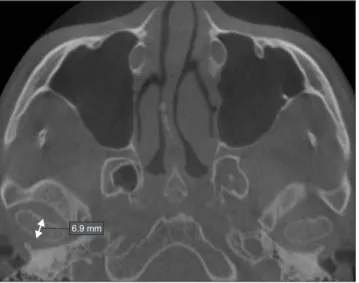
All measurements were performed by one oral and max- illofacial radiologist. For ML dimension, we use oblique coronal plane made by condylar axis and measure the hori- zontal distance between medial and lateral ends at the con- dylar head in the oblique coronal plane (Fig. 1). AP dimen- sion was measured at the axial image showed the longest ML condylar dimension (Fig. 2). For condyle height, we re- constructed an oblique sagittal plane image which showed apex of coronoid process and center of condylar head. We

Table 1. Demographic characteristics of the subjects (n=40)

Characteristic  Group

Healthy control Temporomandibular disorder Sex

Male 10 10

Female 10 10

Average age (y)

Male 36.4±9.3 23.0±5.6

Female 32.0±12.8 32.5±12.4

Values are presented as number of patients or mean±standard

deviation.

(3)

widened the thickness of image for showing condylar heads and ramus in the same image (Fig. 3). For IC distance, we reconstructed an oblique coronal image which showed right and left condylar lateral pole in the same image, and then measured horizontal distance between right and left lateral end of condyles (Fig. 4). For condylar axis angle, we used axial image which showed the longest ML condylar dimen- sion and measured the angle between the ML plane of the condylar head and the midsagittal plane (Fig. 5). IC angle was defined as sum of both condylar axis angles. MF depth and AE angle were measured at the oblique sagittal image bisecting condylar head (Fig. 6).

Table 2. Definitions of measurements

Measurement Definition

ML dimension Horizontal distance between medial and lateral ends at the condylar head in the coronal plane

AP dimension Linear distance between anterior and posterior ends of the condylar head at the bisecting line of ML dimension in axial plane

Condyle height Vertical distance between the most superior point of the MF and the most inferior point of the AE at the bisecting sagittal plane of condylar head

IC distance Horizontal distance between right and left lateral end of condyles in the coronal plane

IC angle Sum of right and left condylar axis angles (each angle is defined as angle between the ML plane of the condylar head and the midsagittal plane)

AE angle Angle between line formed by the most superior point of the MF and the most inferior point of the AE and horizontal plane at the bisecting sagittal plane of condylar head

MF depth Perpendicular linear distance between the most superior point of condyle and a line passing through the deepest point mandibular notch and perpendicular to tangent of posterior surface of ramus in sagittal plane

ML, medio-lateral; AP, antero-posterior; MF, mandibular fossa; AE, articular eminence; IC, intercondylar.

20.9 mm

Fig. 1. Oblique coronal image shows measurement of medio-lateral dimension.

6.9 mm

Fig. 2. Axial image shows measurement of antero-posterior dimension.

Fig. 3. Oblique sagittal image shows measurement of condyle height.

22.0 mm

(4)

3. Statistical Analysis

Independent t-test and Mann-Whitney U test were used to compare the mean values of ML dimension, AP dimen- sion, condyle height, IC distance, IC angle, MF depth and AE angle. p-values less than 0.05 were considered sta- tistically significant. All statistical analyses were per- formed with the IBM SPSS Statistics version 21.0 (IBM Co., Armonk, NY, USA).

RESULTS

We made five measurements in mandibular condyle (ML

dimension, AP dimension, condyle height, IC distance, and IC angle) and two measurements in MF (MF depth and AE angle) in each CBCT image.

Average ML dimension of healthy controls is 20.31 mm, and average ML dimension of TMD patients is 20.14 mm.

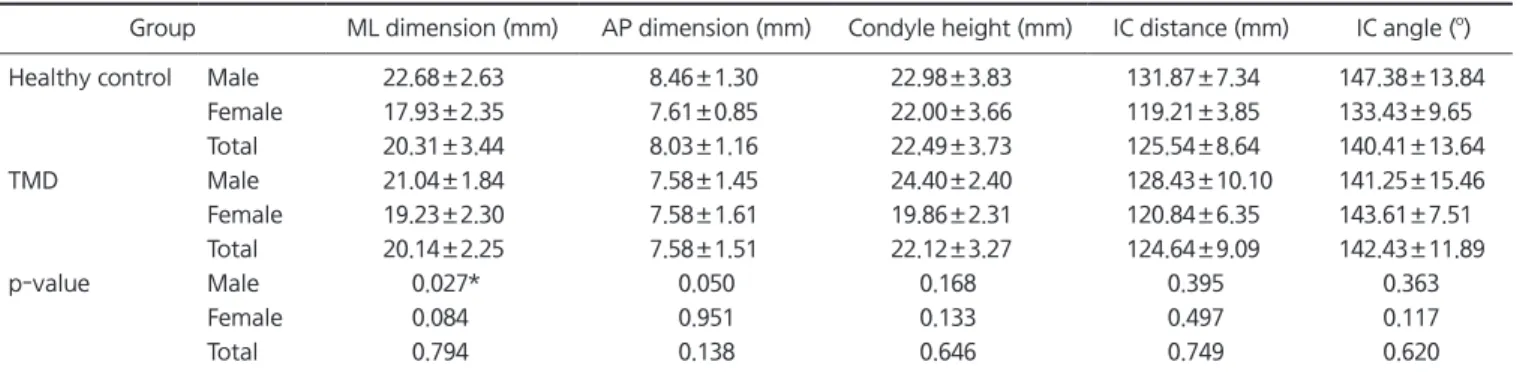
We couldn’t find any difference between two groups. But, comparing ML dimension in males, there was a significant difference in ML dimension (p<0.05). In case of AP dimen- sion, average AP dimension of healthy controls is 8.03 mm, and average AP dimension of TMD patients is 7.58 mm.

Average AP dimension of healthy controls was larger than that of TMD patients, but that was not significant statisti- cally. Comparing condyle height, IC distance and IC angle between healthy controls and TMD patients, there was no significant difference between two groups (Table 3).

Average MF depth of healthy controls is 7.08 mm, and average MF depth of TMD patients is 6.84 mm. And aver- age AE angle of healthy controls is 32.29

o

, and average AE angle of TMD patients is 32.74

o

. In comparison of MF depth and AE angle, there was no significant difference between two groups (Table 4).

DISCUSSION

CBCT, a recently developed imaging technology, is likely the modality of choice for assessing TMJ osseous

Fig. 4. Oblique coronal image shows measurement of intercondylar distance.

124.5 mm

Fig. 5. Axial image shows measurement of condylar axis angle.

68.2

Fig. 6. Oblique sagittal image shows measurement of mandibular fossa depth and articular eminence angle.

35.8

9.2 mm

(5)

morphology.

14)

CBCT in general has an acceptable accuracy for diagnosing osseous TMJ abnormalities with fairly high sensitivity, although small abnormalities might be missed.

However, there are differences between different CBCT scanners and imaging protocols. In most studies, high spec- ificity is reported. The diagnostic accuracy of CBCT seems to be comparable with CT for TMJ diagnostics.

15)

Mandibular condyle is located in the upper neck of the mandible and it has oval shape with long ML dimension and short AP dimension and they differ greatly in their shapes and dimensions. According to Solberg et al.,

16)

the average ML dimension is significantly greater in men (21.8 mm) than in women (18.7 mm). They reported that there is no significant difference between men (10.1 mm) and wom- en (9.1 mm) in AP dimension of the condyle. Raustia and Pyhtinen

17)

have reported that the average of AP dimension is 9.6 mm and the average of ML dimension is 19.6 mm.

It has been previously reported that the mean value of AP dimension of normal condyle was 7.9±1.3 mm on sagit- tal section and ML dimension was 21.2±2.2 mm on coronal section in Korean.

18)

In our study, the mean ML dimension in healthy con- trol was 20.31 mm and mean AP dimension was 8.03 mm. These data differ from the previous study based on Caucasian, but they are similar to another previous study based on Korean. It is thought that this condyle morpholo- gy with relatively large ML dimension and small AP dimen- sion in Korean may originate from anatomical difference between Caucasian and Asian. According to Solberg et al.,

16)

average IC distances between lateral poles are 121.0 mm in males and 115.6 mm in females. Our data were 131.87 mm in males and 119.21 mm in females, which were larger than the previous data by Solberg et al.

16)

The cranium and man- dible of Asian are usually wider than those of Caucasian, therefore this result also can be explained by the racial difference.

In comparing the mandibular condyle and MF between healthy controls and TMJ DD patients, we didn’t get a defi- nite conclusion. But it could be confirmed that average AP dimension of healthy controls was larger than that of TMJ DD patients (but not significant statistically). There was a considerable age gap between male healthy controls and male TMJ DD patients, but all subjects were young adults without degenerative bony change in TMJ. Therefore this age gap might not have a decisive effect on results.

It has been reported that the condylar shape and size vary based on anterior disk position in juvenile females with

Table 3. Comparison the dimensions of the condyle between healthy controls and TMD patients

Group ML dimension (mm) AP dimension (mm) Condyle height (mm) IC distance (mm) IC angle (

o

)

Healthy control Male 22.68±2.63 8.46±1.30 22.98±3.83 131.87±7.34 147.38±13.84

Female 17.93±2.35 7.61±0.85 22.00±3.66 119.21±3.85 133.43±9.65

Total 20.31±3.44 8.03±1.16 22.49±3.73 125.54±8.64 140.41±13.64

TMD Male 21.04±1.84 7.58±1.45 24.40±2.40 128.43±10.10 141.25±15.46

Female 19.23±2.30 7.58±1.61 19.86±2.31 120.84±6.35 143.61±7.51

Total 20.14±2.25 7.58±1.51 22.12±3.27 124.64±9.09 142.43±11.89

p-value Male 0.027* 0.050 0.168 0.395 0.363

Female 0.084 0.951 0.133 0.497 0.117

Total 0.794 0.138 0.646 0.749 0.620

TMD, temporomandibular disorder; ML, medio-lateral; AP, antero-posterior; IC, intercondylar.

Values are presented as mean±standard deviation.

*p<0.05, analyzed by t-test and level of significance between groups.

Table 4. Comparison the dimensions of the glenoid fossa between healthy controls and TMD patients

Group MF depth (mm) AE angle (

o

) Healthy control Male 7.52±1.34 35.62±5.02

Female 6.65±1.04 28.96±4.12

Total 7.08±1.27 32.29±5.65

TMD Male 7.37±1.15 35.42±4.44

Female 6.30±1.16 30.06±4.94

Total 6.84±1.26 32.74±5.37

p-value Male 0.706 0.897

Female 0.328 0.449

Total 0.383 0.714

TMD, temporomandibular disorder; MF, mandibular fossa; AE, articular eminence.

Values are presented as mean±standard deviation.

(6)

TMD.

19)

According to Kurita et al.,

20)

condyles in the joints with permanent disk displacement were smaller than those in joints without displacement in both dimensions. Lee et al.

18)

have reported that the average size of condyle with DD was smaller than that of condyle without DD in Korean.

The articulating surfaces of the joint are covered by a dense connective tissue that contains varying amounts of chondrocytes, proteoglycans, elastic fibers and oxytalan fi- bers and these soft tissues covering TMJ are known to have the ability to proliferate sufficiently to change the appear- ance of the joint, allowing the adaption to the different me- chanical stress. Therefore the decrease in condyle size in TMJ DD patients might be explained by the bony adapta- tion to the changed mechanical stress resulting from articu- lar disk displacement.

Shahidi et al.

21)

have reported that there is no apparent re- lationship between the AE inclination and the clinical dys- function index in patients with TMD. We also couldn’t find any significant relationship between MF morphology and TMD.

The present study did not represent a significant relation- ship between TMJ morphology and TMD. Because we have analyzed the limited sample size, the fact that the relation- ship between TMJ morphology and TMD was not signifi- cant in the present study does not prove absolute lack of any relationship. Now we are collecting more CBCT images from healthy subjects and TMD patients, therefore we are looking forward to get a definite conclusion through well- organized analysis based on sufficient samples in the near future.

CONFLICT OF INTEREST

No potential conflict of interest relevant to this article was reported.

REFERENCES

1. Wu CK, Hsu JT, Shen YW, Chen JH, Shen WC, Fuh LJ. As- sessments of inclinations of the mandibular fossa by com- puted tomography in an Asian population. Clin Oral Investig 2012;16:443-450.

2. Habets LL, Bezuur JN, Naeiji M, Hansson TL. The orthopantomo- gram, an aid in diagnosis of temporomandibular joint problems.

II. The vertical symmetry. J Oral Rehabil 1988;15:465-471.

3. Schiffman E, Ohrbach R, Truelove E, et al. Diagnostic criteria for temporomandibular disorders (DC/TMD) for clinical and research applications: recommendations of the international RDC/TMD consortium network and orofacial pain special interest group. J Oral Facial Pain Headache 2014;28:6-27.

4. Ahmad M, Schiffman EL. Temporomandibular joint disorders and orofacial pain. Dent Clin North Am 2016;60:105-124.

5. Mongini F. The importance of radiography in the diagnosis of TMJ dysfunctions. A comparative evaluation of transcranial ra- diographs and serial tomography. J Prosthet Dent 1981;45:186- 198.

6. Koh K, Ahn HK. Comparative study on the clinical and radio- graphic findings of temporomandibular joint dysfunction pa- tients. J Korean Acad Oral Maxillofac Radiol 1991;21:33-44.

7. Brooks SL, Brand JW, Gibbs SJ, et al. Imaging of the temporo- mandibular joint: a position paper of the American academy of oral and maxillofacial radiology. Oral Surg Oral Med Oral Pathol Oral Radiol Endod 1997;83:609-618.

8. Könönen M, Kilpinen E. Comparison of three radiographic meth- ods in screening of temporomandibular joint involvement in patients with psoriatic arthritis. Acta Odontol Scand 1990;48:271- 277.

9. Larheim TA, Kolbenstvedt A. Osseous temporomandibular joint abnormalities in rheumatic disease. Computed tomography versus hypocycloidal tomography. Acta Radiol 1990;31:383-387.

10. Ludlow JB, Davies-Ludlow LE, Brooks SL. Dosimetry of two ex- traoral direct digital imaging devices: NewTom cone beam CT and Orthophos Plus DS panoramic unit. Dentomaxillofac Radiol 2003;32:229-234.

11. Ludlow JB, Davies-Ludlow LE, Brooks SL, Howerton WB. Do- simetry of 3 CBCT devices for oral and maxillofacial radiology:

CB Mercuray, NewTom 3G and i-CAT. Dentomaxillofac Radiol 2006;35:219-226.

12. Kobayashi K, Shimoda S, Nakagawa Y, Yamamoto A. Accuracy in measurement of distance using limited cone-beam computerized tomography. Int J Oral Maxillofac Implants 2004;19:228-231.

13. Lascala CA, Panella J, Marques MM. Analysis of the accuracy of linear measurements obtained by cone beam computed tomogra- phy (CBCT-NewTom). Dentomaxillofac Radiol 2004;33:291-294.

14. Hilgers ML, Scarfe WC, Scheetz JP, Farman AG. Accuracy of linear temporomandibular joint measurements with cone beam computed tomography and digital cephalometric radiography.

Am J Orthod Dentofacial Orthop 2005;128:803-811.

15. Larheim TA, Abrahamsson AK, Kristensen M, Arvidsson LZ. Tem- poromandibular joint diagnostics using CBCT. Dentomaxillofac Radiol 2015;44:20140235.

16. Solberg WK, Hansson TL, Nordström B. The temporomandibular joint in young adults at autopsy: a morphologic classification and evaluation. J Oral Rehabil 1985;12:303-321.

17. Raustia AM, Pyhtinen J. Morphology of the condyles and man- dibular fossa as seen by computed tomography. J Prosthet Dent 1990;63:77-82.

18. Lee DH, Oh SH, Suh CH, Kim JB. A study on the size of TMD

patient’s condyle head. J Korean Assoc Oral Maxillofac Surg

(7)

2001;27:417-422.

19. Hasegawa H, Saitoh I, Nakakura-Ohshima K, et al. Condylar shape in relation to anterior disk displacement in juvenile fe- males. Cranio 2011;29:100-110.

20. Kurita H, Ohtsuka A, Kobayashi H, Kurashina K. Alteration of the horizontal mandibular condyle size associated with temporoman- dibular joint internal derangement in adult females. Dentomaxil-

lofac Radiol 2002;31:373-378.

21. Shahidi S, Vojdani M, Paknahad M. Correlation between articular

eminence steepness measured with cone-beam computed tomog-

raphy and clinical dysfunction index in patients with temporo-

mandibular joint dysfunction. Oral Surg Oral Med Oral Pathol

Oral Radiol 2013;116:91-97.

수치

Table 1. Demographic characteristics of the subjects (n=40)
Fig. 3. Oblique sagittal image shows measurement of condyle  height.
Fig. 6. Oblique sagittal image shows measurement of mandibular  fossa depth and articular eminence angle.
Table 3. Comparison the dimensions of the condyle between healthy controls and TMD patients

참조

관련 문서

Therefore, the aim of this study was to investigate the morphologic characteristics of the interalveolar foramen and to analyze according to sex and age using cone

The purpose of this study is to analyze the situations of violating the right to learn and violence in student-athletes from an ethnographic view and

The purpose of this study is to analyze the interest and self-confidence of middle school students in learning English grammar and to examine the

The purpose of this study is to analyze the relationship between dance performances, which is a part of social contribution activities of local governments,

Purpose: The aim of this study is to identify the relationship between knowledge and awareness of radiation department students and their intent in

Objective: The purpose of this study was to analyze recent trend in incidence of basal cell carcinoma and squamous cell carcinoma in patients from the Gwangju City

The purpose of this study was to analyze the impaction pattern of the impacted mandibular third molar and the relationship with the inferior alveolar nerve

The torque analysis was performed acting on the joint of robot by modeling the kinematics and dynamics of the robot.. Load torque of the joint