Neogene Uplift in the Korean Peninsula Linked to Small-scaled Mantle Convection at Singking Slab Edge
Jaeryul Shin* · Mike Sandiford**
소규모 맨틀 대류에 의한 한반도의 신제3기 이후 융기 운동
신재열*·Mike Sandiford**
Abstract : This study provides quantitative constraints on Neogene uplift in the Korean peninsula using onshore paleo-shoreline records and seismic data. The eastern margin of Northeast Asia including Korea sits in the back-arc system behind the Western Pacific Subduction Zone, a complex trench triple junction of the Philippine Sea, Pacific, and Eurasian (Amurian) plates. An analysis of seismic data in the subduction zone shows that the pattern of uplift in the peninsula mirrors the extent of deep seismicity in subducting Pacific plate beneath. Combined with previous tomographic studies it is proposed that uplift is partly driven by asthenospheric upwelling caused by a sinking slab during the Neogene. In addition, the SHmax orientations of E-W and N-S trends in the peninsula are consistent with the prevailing in-situ stress fields in the eastern Eurasian continent generated by various plate boundary forces. The uplift in Korea during the Late Neogene is attributed, in part, to lithospheric failure relating to faulting movements, thus providing a link between dynamic effects of mantle upwelling at sinking slab edge and lithospheric responses driven by plate boundary forces.
Key Words : epeirogenic uplift, the Western Pacific Subduction Zone, seismicity, asthenospheric upwelling, mantle convection, lithospheric failure
요약 :본 연구는 한반도의 신제3기 이후 융기 운동에 관한 발생 요인을 탐구하고자 육상의 고해수준 기록들과
북동 아시아 일대의 심발 지진 자료를 분석하였다. 지구조적으로 한반도를 포함한 북동 아시아의 동쪽 연변부 는 태평양 판, 필리핀해 판 그리고 유라시아 판이 함께 경계하는 복잡한 서태평양 섭입대의 후배호 지역에 위 치하고 있다. 서태평양 섭입대의 지진 자료 분석은 한반도의 융기 패턴이 서태평양 섭입판의 활동과 관련된 심 발 지진의 발생 범위를 잘 반영하고 있다. 지구과학 제 분야의 기존 연구 성과들을 종합적으로 고찰해 볼 때, 한반도를 비롯한 동북 아시아 동연변부 해안 지역을 따라 나타나는 대륙 융기 현상은 서태평양 섭입대의 맨틀 하강에 의해 발생하는 소규모의 맨틀 대류에 의해 진행되고 있는 것으로 판단되며, 융기 운동의 시작 시기는 마이오세(ca. 23 Ma) 이후의 시기로 판단 된다. 한편, 한반도 내에서 확인되는 동-서 그리고 북-남 방향의 최 대 압축 응력들은 판 경계 응력에 대응하는 현생 응력 체계와 잘 일치한다. 이는 판 경계 응력에 대응한 암석권 최상부의 지각 변형이 또한 최근 수 백 만년의 시간 내에서 한반도의 융기를 가속시키는 것으로 보여진다.
주요어 :조륙 운동, 서태평양 섭입대, 지진 활동성, 연약권 용승, 맨틀 대류, 암석권 지각 변형
* School of Earth Sciences, University of Melbourne, Victoria 3010, Australia, Ph.D candidate
** School of Earth Sciences, University of Melbourne, Victoria 3010, Australia
1. Introduction
The lithosphere is dynamically linked with the large scale motion in the convective mantle beneath. While the horizontal lithospheric movements are now well understood in a framework of plate tectonics, it is still a challenge to explain the vertical motions of the Earth’s surface, especially in intraplate regions. Such movements may arise from a variety of sources, such as upwelling upper mantle flows and lithospheric re- sponses to plate boundary forces.
The tectonic environment eastern margin of the northeastern Asia is a back-arc system in-board be- hind the Western Pacific Subduction Zone, a complex trench triple junction of the Philippine Sea, Pacific, and Eurasian (Amurian) plates (Figure 1). In this set-
ting, the Korean peninsula provides an important tectonic link between the ancient craton and the active subduction processes in a more proximal intraplate setting in terms of the geology and tectonic evolution of Northeast Asia from the Archean to the present (Chough and Sohn, 2010; Matsuda and Uyeda, 1971;
Taira et al., 1982).
Although the Korean peninsula has a complex long-lived tectonic history with its crustal architec- ture established in the Mesozoic, Cenozoic tectonic movements are highlighted by evidence for ongoing uplift. Evidence for the creation of topographic relief is preserved in the Quaternary marine terraces developed along all coasts of the peninsula and by active faults in the southeastern part of the peninsula. The coastal mountain belt along the eastern margin of the penin- sula also suggests an ongoing deformation during the
Figure 1. Northwest Pacific region with plate boundaries of Eurasian (EP), Okhotsk (OP), Western Pacific (WPP) and Philippine Sea (PSP) plates with plate motion velocities (Seno et al., 1993; Wei and Seno, 1998;
Zang et al., 2002). Grey circles are volcanoes, consistent with location of the subduction zone in the Western Pacific. KA: Kurile arc; JA: Japan arc; IBA: Izu-Bonin arc; RA: Ryukyu arc.
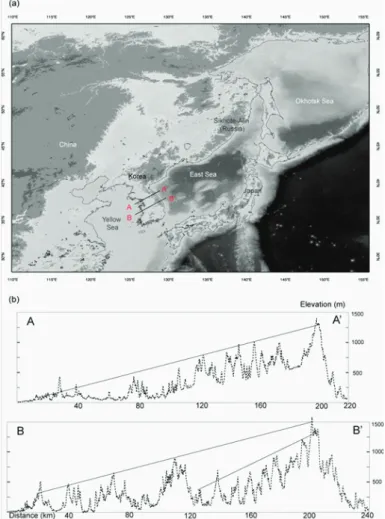
Cenozoic. Relief profiles (Figure 2) show a topographic asymmetry across the peninsula. West-facing slopes are much gentler than east-facing slopes implying an easterly tilting of the Korean peninsula accompany the peninsular wide uplift.
In this study, I will outline observations of active deformations related to the topographic evolution of the peninsula during the Neogene. Uplift rates during the Neogene are estimated using a variety of different techniques. These uplift rates provide insights into the
causative mechanisms. Focal earthquake mechanisms and hypocenter data underneath Northeast Asia have been analysed to investigate the relation between topo- graphic evolution and sub-lithospheric processes to- gether with insights from relevant fields such as seismic tomography, thermochronology and geochemistry.
In addition, the present-day tectonic regime related to dominantly fault-related crustal deformation is discussed in terms of lithospheric responses associated with the Neogene uplift.
Figure 2. (a) Topography map of Northeast Asia. Light grey for elevation >500 m, dark grey for elevation
>1500 m in Northeast Asia and Japan, derived from ETOPO2 data. The high-elevated uplifting areas in the eastern margin of Northeast Asia generally run parallel to the Japan and Kurile arcs. (b) Relief profiles of the
Korean peninsula crossing east to west, derived from ASTER GDEM data.
2. Tectonic setting of Northeast Asia
The Cenozoic tectonic evolution of Northeast Asia has been influenced by the westward subduction of the Philippine Sea and Pacific plates along its eastern margins and the India-Eurasia collision along the southern margins (Huang and Zhao, 2006; Liu et al., 2001; Northrup et al., 1995). This tectonic regime involving a northward push in the south and an east- ward pull in the east has produced a diverse range of geological structures from the Tibetan plateau and the surrounding range in the west to the continental rifts, marginal basins and volcanic arcs in the east (Li and Van der Hilst, 2010). The Earth surface deformation is likely to be connected with structural heterogeneity and geodynamical processes in the Earth interiors. For example, mantle upwelling induced by sinking slabs in the subduction zone has been invoked as a potential mechanism for widespread uplift, volcanism, and ex- tensional tectonics in East China and Korea (Liu et al., 2001; Tatsumi et al., 1990; Yin, 2000).
The Western Pacific Subduction Zone (WPSZ) is composed of the Eurasian, Amurian, Philippine Sea, Okhotsk, and Pacific plates. While the Amurian Plate was previously considered as a part of the Eurasian plate, many recent studies of regional tectonics and seismicity proposed that it constitutes an independent continental plate (Amurian Plate) covering Northeast China, the Korean peninsula, the East Sea and the southeastern part of Russia (Heki et al., 1999; Yin, 2010). The Pacific Plate currently converges to the northwest beneath the Kurile, Japan and Izu arcs at a rate of ~9.2 cm yr-1 (Seno et al., 1993). The Philippine Sea Plate is subducting northward and north-north- eastward beneath the Okhotsk and Amurian plates at a rate of 3.4 cm yr-1 (Zang et al., 2002). These small con- tinental micro-plates of the Amurian and Okhotsk are characterised by relatively slow northeastward motion
with a rate of 0.08 cm yr-1 and 0.24 cm yr-1, respectively (Wei and Seno, 1998)(Figure 1).
The East Sea is a marginal sea lying behind the Ja- pan Arc, comprised of three deep basins known as the Japan, Ulleung, and Yamato Basins. The ODP (Ocean Drilling Program) Legs 127 and 128 (Pisciotto et al., 1992; Tamaki et al., 1992) and a number of onshore studies (Jolivet et al., 1994; Otofuji, 1996; Tatsumi and Kimura, 1991) suggested that the initial opening commenced with fault-controlled crustal extension in the early Oligocene and the subsequent spreading continued until the middle Miocene. Interestingly, there was no significant volcanism during the initial rifting, but breakup and subsequent spreading are characterised by vigorous volcanism. Recently, Kim et al. (2007) interpreted marine seismic profiles in conjunction with swath bathymetric and magnetic data. The eastern Korean margin reveals structural ele- ments consisting of a seaward succession of rift basin, uplifted rift flank, and steep continental slope along its length. The Ulleung Basin differs from the Yamato and Japan basins containing thick mass flow sedimen- tary deposits attributable to active tectonic processes along the Korean peninsula margin (Kim et al., 2007).
Thus, the Korean margin and the basins along side provide important constraints on the evolution of the WPSZ realm.
3. Neotectonic records in the peninsula
1) Geomorphic features of the peninsula
The N-S trending Taebaek Range runs along the eastern margin of the Korean peninsula with maximal heights over 1500 m. The range is typically expressed by a geomorphically rugged, high relief uplands
system. The remnants of one or more peneplains are preserved at elevation of over 1200 m in and around the range (Yoon et al., 2007). The east flank of the range preserves flights of marine terraces displayed up to 160 m above present sea level. River terraces pre- served along incised streams have been interpreted as the result of regional uplift and climatic effects during the Quaternary (Son, 1996; Yoon et al., 2007). The uplifted belt in Korea extends north to the extreme southeastern Russia, running parallel to the eastern margins of the Northeast Asia.
2) Marine terraces and formation ages
Several flights of marine terraces have been recog- nised in the eastern and southern coast of the peninsu- la since the early 1970’s (Choi, 1993; Choi, 2004; Kim, 1973; Lee, 1987; Lee and Park, 2006; Oh, 1981; Shin, 2004; Yoon et al., 2003), but the sequence and cor- relation of paleo-shorelines is debated with different opinions. Recently, a number of geochronological data
have been reported from these terraces, providing new opportunity to test earlier works and establish a more reliable chronology for the Korean marine terraces.
In this section, the distributions and absolute ages of preserved terraces along the eastern and southern coast is summarised building on the works of Yoon et al.
(2003), Shin (2004), and Lee and Park (2006).
Sets of marine terraces are extraordinarily well pre- served along the eastern coast. Nine distinct terraces up to 160 m above present sea level (apsl) have been reported (Choi et al., 2003; Hwang et al., 2003; Shin, 2004; Yoon et al., 2003), and are referred as T-1 to T-9 from the youngest to oldest (Table 1).
Numerical ages obtained by amino acid racemiza- tion (AAR) and optically stimulated luminescence (OSL) techniques have been established from T-2 and T-3 terraces. Choi (1993) first reported an AAR age of 124 ka BP from deposits of T-3 terrace in the mid- eastern coast, suggesting a last interglacial age (MIS 5e). Recently, Choi et al. (2009) obtained a similar OSL age of 127 ka from paleo-beach sediments on T-3
Table 1. Distribution and geochronology of marine terraces in the eastern and southern coast.
Terrace Num.
Middle Eastern Coast1) Southeastern Coast 2) Southern Coast 3) Elevation
(m apsl) Shoreline
(m apsl) Formation age
(MIS stage) Elevation Shoreline Formation age Elevation Shoreline Formation age
T-1 5-6 5 5-6 5
T-2 5-12 10 MIS 5a 7-10 10 MIS 5a
(50-80ka)5)6)7) 9.5-13 10 MIS 5a (70.1±4.6 ka) 3)
T-3 12-25 25 MIS 5e
(124 ka) 4) 18-25 25 MIS 5e
(127±12 ka) 7) 18-22 22 MIS 5e
T-4 20-40 40 40-50 50 27-32 32
T-5 65-75 70 75-80 80
T-6 75-90 90 80-90 90
T-7 97-110 110 110-115 115
T-8 125-150 140 125-140 140
T-9 155-160 160
1) Yoon et al. (2003) 2) Shin (2004) 3) Lee and Park (2006) 4) Choi (1993) 5) Choi et al. (2003) 6) Choi (2004) 7) Choi et al. (2009)
terraces in the southeastern coast. Absolute ages for T-2 terraces are consistently in the range of 50-80 ka BP, indicating a MIS 5a stage (Choi, 2004; Choi, et al., 2003; Choi et al., 2009). T-1 terraces are understood to be formed corresponding to a postglacial relative high sea stand during the mid-Holocene.
The marine terraces along the southern coast are less well preserved and are poorly documented. The poor preservation may in part reflect its differing coastal aspect. The southern coast is characterised by indented coastline with gently deepened bathymetry in the continental shelf and by relatively high tidal range in excess of >4 m (Korea Hydrographic and Oceano- graphic Administration, http://www.khoa.go.kr/).
Such coastal environment produces relatively low wave energy conditions at the shoreline that minimise the potential for marine terrace formation.
Recently, Lee and Park (2006) reported three emerged marine terraces in the southern coast at 10 to 13 m apsl, 18 to 22 m apsl and 27 to 32 m apsl, respec- tively. These correspond in height to T-2, T-3 and T-4 terraces in the eastern coast (Table 1). The OSL age obtained from deposits of the lowest terrace (10-13 m apsl) is 70.1±4.6 ka BP, suggesting MIS 5a stage for the formative age. Based on the order of terrace sequence with pedologic properties, the formation age for the second terrace at 18-22 m apsl has been assigned as MIS 5e stage.
4. Inferred Quaternary uplift rates
Deduction of uplift rates from marine terraces re- quires an understanding of the Quaternary sea levels.
Past sea level changes over the past 300 ka have been interpreted from raised coral terraces (Antonioli et al., 2004; Dutton et al., 2009; Thompson and Goldstein, 2005), and from the marine oxygen isotope record
(Chappell and Shackleton, 1986; Dodge et al., 1983;
Siddall et al., 2003; Stirling et al., 1998;). The esti- mates of average global sea level at MIS 5e range from +6 m to +2 m higher than the present level (Hearty et al., 2007; Neumann and Moore, 1985). However, regional variations exist and the height of MIS 5e sea level around Korea is not well established.
Along the east coast, the age-altitude curve with the uplift rate derived from T-2 and T-3 is shown in Figure 3. According to the following equation,
paleo-shoreline = uplift rate × time - sea level at the time
the uplift rate in the eastern coast derived from T-3 terrace has been calculated as 168±16 m Myr-1 during the late Quaternary. References used are 125 ka for terrace age, 25 m altitude of the inner edge and 2-6 m paleo-sea level datum, respectively. The obtained OSL ages from T-2 deposits are in a range of 65-92 ka, implying that T-2 terraces were formed corresponding to MIS 5a period (Choi, 2004; Choi et al., 2003; Lee and Park, 2006). Proposed sea level at MIS 5a is di- verse from 20-25 m below (Shackleton, 1987), 13-18 m below (Richards et al., 1994), to as high as the present level (Ludwig et al., 1996). This diversity may result in part from regional differences in isostatic relaxation responses to melting of ice sheets (Kiden et al., 2002;
Lambeck et al., 1998). According to Ota and Omura (1992), sea level at MIS 5a (ca. 70-90 ka BP) in Japan was as high as the present level. Assuming that sea level around Korea at this time was similar to Japan, it yields an uplift rate of 126±16 m Myr-1 for T-2 terrace, which is largely consistent with the uplift rate derived from T-3 terrace.
The elevations of T-3 and T-4 terraces along the south coast are lower than the east coast by between 3 to 18 m (Lee and Park, 2006), implying a correspond- ing lowering in uplift. Calculation south coast uplift
rate for T-3 terrace is 144±16 m Myr-1.
5. Mantle structure underneath Northeast Asia
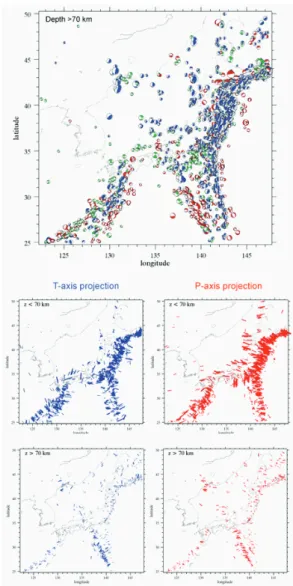
Earthquake hypocenter and focal plane solutions provide constraints on the spatial and stress distribu- tions in the slabs. In Figure 4, the shallow moment tensor solutions at <70 km depth along arcs and trenches of the Pacific and Philippine Sea plates fit well with the directions of the plate motions. In con- trast, the moment tensor solutions at >70 km depth give more complex nodal planes with the way that the volcanoes line up with the western edge of the Pacific slab as indicated by the deepest earthquakes (>300 km) (Figure 5). This limits of the deepest earthquakes is developed in the northwestward prolongation of the plate boundary between the Pacific and Philippine Sea plates, probably associated with the morphological ex- tent of the subducting slabs. In addition, The T-axises with the dominant NNW to NE orientation and P-
axises of the approximately E-W orientation at >70 km may indicate that the Philippine Sea Plate is subduct- Figure 3. Uplift rates during the late Quaternary,
estimated from T-2 and T-3 terraces.
Figure 4. Focal mechanism solutions at depth in Northwest Pacific and the East Sea from ANSS and CMT database. The shallow moment tensor solutions at <70 km depth fit well with the directions of the plate motions. In contrast, the moment tensor solutions at >70 km depth give more complex nodal planes, probably associated with subduction of the Philippine Sea Plate underlying the Pacific slab and morphological expression of the two subducting slabs. Red-: normal fault; blue-: thrust fault; green
ball: strike-slip fault.
ing underlying the Western Pacific slab which is thin and gently subducting through the upper mantle at the Japan arc, beneath the southwestern Japan and the East Sea (Miller and Kennett, 2006).
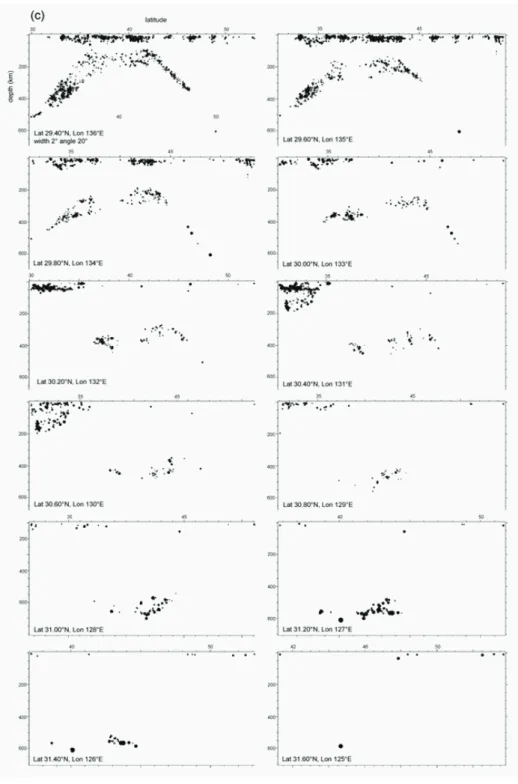
Seismicity with depth in the Korean peninsula shows that Cenozoic volcanoes are located above the
outermost rim of the subducting slab (Figure 5), sug- gesting a relation with subduction processes. These volcanoes that extend from Korea up into China, more or less rimming the deep subduction related earth- quakes, correspond to the actively uplifting area.
6. Discussion
1) Small-scaled mantle convection at sinking slab edge
In subduction zones, gravitational body forces aris- ing from variations in density distribution play an important role in driving and regulating the subduc- tion processes (Ringwood and Irifune, 1988; Zorin et al., 2006). A number of geophysical studies regarding subduction processes and their heterogeneity within the WPSZ proposed seismic discontinuities in the mantle transition zone at 660 km in depth and at the top of the lower mantle underneath the eastern China and Korea. The seismic discontinuities have been in- terpreted as a stagnant Pacific slab (Gao et al., 2010;
Li and Van der Hilst, 2010; Miller et al., 2005; Zhu et al., 2010)(Figure 6). Stagnate slabs in the mantle transition zone are commonly related to trench retreat and follow slab roll-back events (Becker et al., 1999;
Funiciello et al., 2003; Guillou-Frottier et al., 1995;
Zhong and Gurnis, 1997; Zhu et al., 2010). More re- cent tomographic studies show significant anomalies in the mantle transition zone adjacent to the stagnant slab (Ai et al., 2008; Xu et al., 2011). According to Ai et al. (2008), the transition zone beneath the northeast- ern China and the northern Yellow Sea is thinner than the global average. The elevated, thinned transition zone has been speculated to result from either small scale convection associated with the edge of the sink- ing slab or from small plumes generated from the lower Figure 5. (a) Seismicities with depth in Northwest
Pacific and the East Sea. The volcanoes (grey hexagon) line up with the western edge of the Pacific slab as indicated by the deepest earthquakes (>300 km depth) corresponding loosely to an actively uplifting area in the study area. Red-: 70-100 km; green-: 100-300 km; blue dot: >300 km depth. (b) Cross section with depth at 40°-44°N / 122°-148E. (c) Cross sections of slices with 2° width from 29.40°N / 136°E (top left)
to 31°40N / 126°E (bottom right). Note that each slide is rotated 20 degrees in a clockwise direction.
The seismic data are derived from ANSS and CMT database.
Figure 5. continued
mantle.
Choi et al. (2006) has determined isotopic composi- tions from the six Late Cenozoic intraplate centres of alkali basaltic volcanism in South Korea including the Baengnyeong Island in the Yellow Sea. The results show that the basalts have oceanic island basalt (OIB)- like trace element abundance with mantle-derived xenoliths of primarily spinel peridotite, suggesting it originates from melting in the asthenosphere, rather than from a deep seated plume. Additionally, there is no evidence yet for the existence of mantle plumes such as typical hotspot tracks with clear age progres-
sions or of unequivocal tomographic images delineat- ing distinct deep-seated thermal anomalies in South Korea (Choi et al., 2006).
Such evidence suggests that the surface uplift in the eastern margin of Northeast Asia is correlated to mantle upwelling convection induced by the sink- ing Pacific slab (Figure 7). The uplifted mountainous belt in Korea (Taebaek and Nangnim Range) ex- tends some ~2000 km north into Russia (the Central Sikhote-Alin) along the eastern continental margin of Northeast Asia. It is generally expected that lengths and amplitude of deformation of the Earth’s surface Figure 6. (a) Mantle discontinuities at 660 km depth beneath Northeast China and Korea. (b) and (c) Cross
sections of P-velocity tomogram with the 410- (green), 660- (red), and 720-km (yellow dashed line) depth discontinuities along two lines shown in (a) (Gao et al., 2010).
Figure 7. A skeptical model illustrating the Neogene uplift in Korean peninsula induced by a small-scaled mantle convection at the sinking Pacific slab edge.
correspond to the depth and volume of the source with its chemical properties. The long-wavelength uplift in order of 103 km in the Korean peninsula may reflect instabilities generated around the lip of the subduct- ing Pacific slab edge. This is well represented in the distribution of seismicity at depth with the sinking slab in the region. In addition, slab stagnation and its subsequent processes in the mantle transition zone are supposed to be related to the subducting slab morphol- ogy such as dip of the subducting plate and the con- vergence velocity. This is basically understood in terms of time to accrue critical amount of subducted mass for example, metastable olivine, in the lower portion of the subducting slab (Zorin et al., 2006). Hence, it is possible that the relatively thick and quickly subduct- ing slab with a gentle dip at the Japan arc (Miller and Kennett, 2006) plays the key role in slab stagnation and ensuing mantle dynamics in the northeastern Asia.
2) Timing of surface uplift induced by dynam- ic effects
According to Lim and Lee (2005), the cooling his- tory of the Upper Cretaceous granite (Palgongsan Granite) shows complex cooling rates: A rapid cooling rate of 33°C Myr-1 over ~700 °C to 300 °C between 90 and 70 Ma, 9 °C Myr-1 over 300 °C to 240 °C between 70 and 65 Ma, and 12 °C Myr-1 over 240 °C to 100
°C between 65 and 55 Ma. Rapid cooling rates over
~700 °C to 300 °C may depend largely on the thermal contrast between the intruding granitic magma and the surrounding country rocks. After reaching thermal equilibrium (300 °C to 240 °C), the cooling rate was decreased abruptly in late stage (240 °C to 100 °C). In addition, the cooling rates of the <100 °C temperature range were calculated to be ~1.5 °C Myr-1 by the apa- tite fission track ages and length data. The slowing of cooling rates of the Upper Cretaceous granites at the
surface temperature (<100 °C) plausibly suggest that it has been influenced by regional uplift and erosional processes after the rocks approached the surface in the time of the Oligocene or Miocene (Lim and Lee, 2005). The cooling histories of adjacent granites, Sin- dong Group and Taebaek Range in the central and eastern peninsula, also show a certain similarity with the result of Lim and Lee (2005) in the low tempera- ture range (Han, 2002; Lim et al., 2003), implying surface uplift has been occurring in a broad region in the peninsula. In addition, Min et al. (2008) proposed from apatite (U-Th)/He ages of the Jurassic granites (Taebaek Range) a pulse of rapid exhumation since 23 Ma, based on the contrastive elevation-independent ages below 500 m and above 700 m.
It seems that a significant tectonic reconfigura- tion occurred to the margins of the Pacific Plate in the boundary of Oligocene and Miocene. It has been pointed out that the Japanese arcs have been retreating oceanward since the Early Miocene (Fournier et al., 1994; Jolivet et al., 1994; Schellart et al., 2003), and notably the time of the Early Miocene has been also inferred as when the East Sea opening commenced (Jolivet et al., 1994; Lallemand and Jolivet, 1985). As such, there is a remarkable temporal match between the Pacific slabs retreat, the opening of the East Sea, and the initial timing of surface uplift in the eastern margin of Northeast Asia in the Early Miocene.
It is proposed conclusively that the uplift move- ment of the Earth’s surface in Northeast Asia has been induced by sinking of the stagnant Pacific slab in the mantle transition zone since the Early Miocene, in the meantime, the secondary processes linked to the sinking of the slab such as back-arc spreading led to the opening of the East Sea and the Neogene volca- nisms in the eastern margin of Northeast Asia. A slab in the upper mantle (100 km wide by 600 km deep), with a ~ 1% thermal density anomaly (0.5 Tm a), can be compensated by a surface deflection of order 1 km
(over a 600 km wide zone) (Sandiford et al., 2009). The uplifted ranges (Taebak and Nangnim) in the Korean peninsula are ~1500 m in height with a length of over 2000 km, that can be comparable to the scale of sur- face deflection associated with density anomaly in the upper mantle.
3) Lithospheric responses driven by plate boundary forces
Although the Korean peninsula remains largely aseismic compared with the surrounding high seismic areas such as North China, Philippines, and Japan, there has been hundreds of small earthquakes recorded annually and five magnitude >5.0 earthquakes record- ed in the past century in the peninsula. There are more than thirty Quaternary faults reported so far, they are mostly centred along the NNE trending Yangsan Fault
System and the NNW trending Ulsan Fault System in the southeastern peninsula (Figure 8). The Yangsan Fault System with a prominent dextral strike-slip ten- sor contains evidence of multiple deformation events throughout the past 45 Ma (Kyung, 2003), and the Ulsan Fault System may have been reactivated by E-W compressional or transpressional stresses during the Cenozoic, following formed by apparent N-S strike- slip motions during the Cretaceous (Kim et al., 2008).
The Quaternary faults in the southeastern penin- sula are NNW- to NNE-trending, high angle strike- slip-dominant-oblique-slip faults and NNW- to NE- trending, low angle reverse slip-dominant-oblique- slip faults (Park et al., 2007; Ree et al., 2003). The fault ages range from 0.16 Ma to 1.1 Ma (Cheong et al., 2003; Choi et al., 2007; Lee and Yang, 2007).
The Quaternary strike-slip faults are subsidiary to the Yangsan Fault Sytem, while the Quaternary dominant
Figure 8. (a) Tectonic map of the southeastern peninsula showing locations of Quaternary faults (yellow circles) and epicenters of earthquakes (white circles). Stress determination (top right) using slip vectors inferred from focal mechanism solutions represents the approximately E-W trending SHmax. Red lines are
Quaternary faults (Choi et al., 2007). (b) Quaternary fault at Suryeom in the southeastern coast, reversely crosscutting marine terrace sediments (T-4) with a NW trend (Shin, 2004).
(a)
(b)
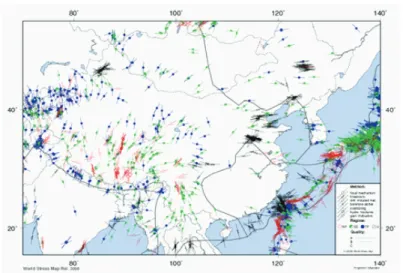
reverse-slip faults result from reactivation of the Ter- tiary normal faults formed during the opening of the East Sea (Ree et al., 2003). Furthermore, earthquake focal mechanism solution data in South Korea (Park et al., 2007) suggest a dominant NE-SW orientation with a oblique strike-slip regime. Together with the results of fault slip analysis, the maximum horizontal stress orientation (SHmax) in the peninsula is the NW-SE to E-W trend (Kim et al., 1996; Kyung et al., 2001; Park et al., 2007). In most plates the maximum horizontal stress orientation parallels the direction of absolute plate motion and it is thus inferred that the forces that drive and resist plate motion are responsible for the present-day stress field (Zoback, 1992). The in-situ stress field in the peninsula fits well with the approximate E–W trending SHmax of the Amurian Plate (Figure 9). Tectonic processes in Northeast Asia are characterised by the fragmentation of the Eurasian Plate into smaller micro-plates, for example, the Amu- rian Plate as a consequence of the collision between the Indo-Australia and Eurasia plates (Heki et al., 1999; Yin, 2010; Zonenshain and Savostin 1981). The
present-day stress orientation in the peninsula is con- sistent with the nature of plate forcing stemming from the convergence between the Indo-Australian and Eurasian plates.
Interestingly, the NNW-SSE to N-S trending com- pression is also dominant in the present-day stress tensors in the peninsula (Choi et al., 2007; Park et al., 2007). This orientation is obviously distinct from the SHmax of the Amurian Plate, but subparallel to the SHmax in southwestern Japan, suggesting that it has been influenced by the northwestward motion of the Philippine Sea Plate (Itoh et al., 2002; Miyazaki and Heki, 2001). In any case, the SHmax orientations in the Korean peninsula are consistent with the inferred in-situ stress field generated by plate boundary forces.
Many fault events in the southeastern peninsula are centred in the middle to the late Quaternary (Table 2), hence it is likely that the Quaternary faultings driven by plate boundary forces has accelerated the uplift in the peninsula since the middle Quaternary. One possible explanation for the cause intensifying fault movements is a build-up in stress state under the influ-
Figure 9. In-situ tectonic stress field in Northeast Asia displaying the maximum horizontal compressive stress (SHmax)(Heidbach et al., 2008). A radial pattern of the SHmax orientations primarily diverge from the Tibet
plateau related to the collision between Indo-Australian and Eurasian plate.
ence of the far-field tectonic processes. The Quaternary faults have been reactivated (Choi et al., 2002; Kee et al., 2007), although the precise time intervals are yet poorly defined.
7. Conclusion
Seismicities with depth in and around the peninsula show that the Cenozoic volcanoes are located above the outermost rim of the subducting slab, suggesting a relation between the Cenozoic volcanic activities and the subduction processes of the Pacific Plate. The vol- canoes that extend from Korea up into China more or less rimming the deep subduction related earthquakes correspond loosely to an actively uplifting area and
seem to include one of the most explosive volcanoes in the historic record. Consequently, the pattern of uplift mirrors the extent of deep seismicity in subducting Pa- cific plate beneath, proposed that uplift is partly driven by asthenospheric upwelling caused by a sinking slab.
The edges of the subducting Pacific slabs are currently stagnated in the mantle transition zone along the east- ern margin of Northeast Asia beneath. Although the peninsula remains largely aseismic compared with the surrounding high seismic areas such as North China, Philippines, and Japan, there has been hundreds of small earthquakes recorded annually and more than thirty Quaternary faults has been reported. The active fault events are mostly centred in the time of the mid- dle-late Quaternary, that has accelerated uplift in the peninsula since the middle Quaternary. It is, in part, attributed to lithospheric failure derived by distant Table 2. Slip vector and age data Quaternary faults in the southern peninsula, modified after Choi et al. (2007).
Slip vector is denoted by the dip direction, dip of fault and vectorial pitch. Vectorial pitch lies around 0° for sinstral fault, around ±180° for dextral fault, around +90° for normal fault and around -90° for reverse fault.
Locations are mapped in Figure 8.a.
Fault name Slip vector (° ) Age (ka)* Reference
Wangsan 146/45, -49 510±210-520±140 Choi et al. (2002a)
Gwaereung 110/45, -142 240±20-370±20 Chwae et al. (1998)
Malbang 020/40, -57
039/44, -63 106±30-500±70 Choi et al. (2002b)
Eupchon 105/40, -80
105/32, -112 530±120-2010±110 Choi et al. (2002a) Kee et al. (2007)
Suryeom 105-45, E-W 280±20-770±100 Ryoo et al.(2000)
Yugye 117/45, -120 520±50-800±30 Chwae et al. (1998)
Bangok 315/85, -25 640±60 Chwae et al. (1998)
Beokgye 101/85, 172 400±20-870±70 Chwae et al. (1998)
Sangcheon 105/85, -125
115/80, -155 340±30-850±240 Chwae et al. (1998)
Gacheon 1 117/80, -90 1000±260-1160±110 Choi et al. (2002a)
Gacheon 2 127/80, -160 750±90 Choi et al. (2002a)
Joil 100/90, -160 800±100-830±190 Chwae et al. (1998)
*ESR ages
plate boundary forces. The prevailing present-day E–
W and N-S SHmax orientations in the peninsula are consistent with the nature of plate forcing stemming from the convergence between the Indo-Australian and Eurasian plates and the northwestward motion of the Philippine Sea Plate.
References
Ai, Y., Zheng, T., Xu, W., and Li, Q., 2008, Small scale hot upwelling near the North Yellow Sea of east- ern China, Geophysical Research Letters, 35 (L20305), doi:10.1029/2008GL035269.
Antonioli, F., Bard, E., Potter, E.M., Sergio, S., and Im- prota, S., 2004, 215-ka History of sea-level oscil- lations from marine and continental layers in Argentarola Cave speleothems (Italy), Global and Planetary Change, 43, 57-78.
Becker, T.W., Faccenna, C., O’Connell, R.J., and Giardini, D., 1999, The development of slabs in the upper mantle: insights from numerical and laboratory experiments, Journal of Geophysical Research, 104(15), 207-215.
Chappell, J., and Shackleton, N.J., 1986, Oxygen isotopes and sea level, Nature, 324, 137-140.
Cheong, C.S., Hong, D.G., Lee, K.S., Kim, J.W., Choi, J.H., Murray, A.S., Chwae, U., Im, C.B., Chang, C.J., and Chang, H.W., 2003, Determination of slip rate by optical dating of fluvial deposits from the Wangsan fault, SE Korea, Quaternary Science Review, 22, 1207-1211.
Choi, S.G., 1993, The Last Interglacial sea levels estimated from the morphostratigraphic comparison of the Late Pleistocene fluvial terraces in the eastern coast of Korea, Korean Journal of Quaternary Re- search, 7(1), 1-26 (In Korean with English Abstr.).
Choi, S.J., 2004, Marine terrace of Daebo-Guryongpo- Gampo, SE Korea (II), Korean Journal of Eco- nomic and Environmental Geology, 37, 245-253
(In Korean with English Abstr.).
Choi, S.G., Jang, H., and Kim, J.Y., 2003, Research note:
New classification of the higher marine terraces in Eupcheon coast, Southeastern coast of Korean peninsula, Journal of the Korean Geomorpho- logical Association, 10(1), 89-94 (In Korean with English Abstr.).
Choi, J.H., Kim, J.W., Murray, A.S., Hong, D.G., Chang, H.W., and Cheong, C.S., 2009, OSL dating of marine terrace sediments on the southestern coast of Korea with implications for Quaternary tecton- ics, Quaternary International, 199, 3-14.
Choi, P.Y., Lee, H.K., and Chwae, U., 2007, Tectonic
‘aggression and retreat’ in the Quaternary tecton- ics of southern Korea, Journal of the Geological Society of Korea, 43(4), 415-425 (In Korean with English Abstr.).
Choi, S.H., Mukasa, S.B., Kwon, S.T., and Andronikov, A.V., 2006, Sr, Nd, Pb and Hf isotopic composi- tions of late Cenozoic alkali basalts in South Ko- rea: Evidence for mixing between the two domi- nant asthenospheric mantle domains beneath East Asia, Chemical Geology, 232, 134-151.
Choi, J.H., Murray, A.S., Jain, M., Cheong, C.S., and Chang, H.W., 2003, Luminescence dating of well- sorted marine terrace sediments on the southeast- ern coast of Korea, Quaternary Science Reviews, 22, 407-421.
Choi, P.Y., Ryoo, C.R., Kwon, S.K., Chwae, U., Hwang, J.H., Lee, S.R., and Lee, B.J., 2002, Fault tectonic analysis of the Pohang-Ulsan area, SE Korea: Im- plications for active tectonics, Journal of the Geo- logical Society of Korea, 38(1), 33-50 (In Korean with English Abstr.).
Chough, S.K., and Sohn, Y.K., 2010, Tectonic and sedi- mentary evolution of a Cretaceous continental arc-backarc system in the Korean peninsula: New view, Earth-Sciences Reviews, 101, 225-149.
Dodge, R.E., Fairbanks, R.G., Benniger, L.K., and Maur- rasse, F., 1983, Pleistocene Sea Levels from Raised Coral Reefs of Haiti, Science, 219, 4591-1423.
Dutton, A., Bard, E., Antonioli, F., Esat, T.M., Lambeck,
K., and McCulloch, M.T., 2009, Phasing and am- plitude of sea-level and climate change during the penultimate interglacial, Nature Geoscience, 2, 355-359.
Fournier, M., Jolivet, L., Huchon, P., Sergeyev, K.F., and Oscorbin, L.S., 1994, Neogene strike-slip faulting in Sakhalin and the Japan Sea opening, Journal of Geophysical Research, 99, 2701-2726.
Funiciello, F., Morra, G., Regenauer-Lieb, K., and Giar- dini, D., 2003, Dynamics of retreating slabs: 1.
Insights from two-dimensional numerical experi- ments, Journal of Geophysical Research, 108(B4), 2206, doi:10.1029/2001JB000898.
Gao,Y., Suetsugub, D., Fukaob, Y., Obayashib, M., Shia, Y., and Liuc, R., 2010, Seismic discontinuities in the mantle transition zone and at the top of the lower mantle beneath eastern China and Korea:
Influence of the stagnant Pacific slab, Physics of the Earth and Planetary Interiors, 183, 288-195.
Guillou-Frottier, L., Buttles, J., and Olson, P.A., 1995, Laboratory experiments on the structure of sub- ducted oceanic lithosphere, Earth and Planetary Science Letters, 133, 19-34.
Han, J.W., 2002, Uplift history of the Taebaeksan Range in the Daegwallyeong area using fission track analysis, MS thesis, Seoul National Unversity, Seoul (In Korean with English Abstr.).
Hearty, P.J., Hollin, J.T., Neumann, C., O’Leary, M.J., and McCulloch, M., 2007, Global sea-level fluc- tuations during the Last Interglaciation (MIS 5e), Quaternary Science Reviews, 26, 2090-2112.
Heidbach, O., Tingay, M., Barth, A., Reinecker, J., Kurfeß, D., and Müller, B., 2008, The world stress map database release 2008, doi:10.1594/GFZ.
WSM.Rel2008.
Heki, K., Miyazaki, S., Takahashi, H., Kasahara, M., Kimata, F., Miura, S., Vasilenko, N.F., Ivashchen- ko, A., and An, K., 1999, The Amurian Plate motion and current plate kinematics in eastern Asia, Journal of Geophysical Research, 104(B12), 29147-29155.
Huang, H.L., and Zhao, D.P., 2006, High-resolution
mantle tomography of China and surrounding regions, Journal of Geophysical Research, 11, doi:10.1029/2005JB004066.
Hwang S.I., Yoon, S.O., and Park, H.S., 2003, The geo- morphological development of coastal terraces at Jigyeong-Ri, the areal boundary between Gyeongju- and Ulsan city on the southeast coast of Korea, Journal of Korean Geography Society, 38(4), 490-504 (In Korean with English Abstr.).
Itoh, Y., Tsutsumi, H., Yamamoto, H., and Arato, H., 2002, Active right-lateral strike-slip fault zone along the southern margin of the Japan Sea, Tec- tonophysics, 351, 301-314.
Jolivet, L., Tamaki, K., and Fournier, M., 1994, Japan Sea, opening history and mechanism: a synthesis, Jour- nal of Geophysical Research, 99, 22237-22259.
Kee, W.S., Kim, B.C., Hwang, J.H., Song, K.Y., and Kim, Y.H., 2007, Structural characteristics of Quater- nary reverse faulting on the Eupcheon Fault, SE Korea, Journal of the Geological Society of Korea, 43(3), 311-333 (In Korean with English Abstr.).
Kiden, P., Denys, L., and Johnston, P., 2002, Late Qua- ternary sea-level change and isostatic and tectonic land movements along the Belgian-Dutch North Sea coast: geological data and model results, Jour- nal of Quaternary Science, 17, 535-546.
Kim, H.K., Choi, B.H., Yun, H.S., and Kim, K.O., 2008, Marine geoid around Korean Peninsula, Journal of Korean Society of Coastal and Ocean Engi- neers, 20(6), 621-629.
Kim, K.Y., Kim, D.H., and Lee, S.Y., 2008, Near-surface geophysical studies in the Ulsan Fault Zone of Ko- rea. Exploration Geophysics, 39, 78-84; Butsuri- Tansa, 61, 78-84; Mulli-Tamsa, 11, 78-84.
Kim, S.K., Kim, M.S., and Suh, K.W., 1996, Source mech- anism of the Southern Yellow Sea earthquake by waveform inversion, Journal of the Korean Earth Sciences Society, 17(4), 326-329 (In Korean with English Abstr.).
Kim, H.J., Lee, G.H., Jou, H.T., Cho, H.M., Yoo, H.S., Park, G.T., and Kim, J.S., 2007, Evolution of the eastern margin of Korea: Constraints on the open-
ing of the East Sea (Japan Sea), Tectonophysics, 436, 37-55.
Kim, S.W., 1973, A study on the terraces along the South- eastern coast (Bangeogin–Pohang) of the Korean peninsula, The Journal of Geological Society of Korea, 9, 89-121 (In Korean).
Kyung, J.B., 2003, Paleoseismology of the Yangsan Fault, southeastern part of the Korean Peninsula, Annals of Geophysics, 46(5), 983-996.
Kyung, J.B., Cheong, T.W., Lee, J.G., Lee, D.K., and Lee, E.A., 2001, Analysis of fault plane solution and stress field using the micro-earthquakes in the central region of south Korea, Journal of the Korean Earth Science Society, 22(4), 292-300 (In Korean with English Abstr.).
Lallemand, S., and Jolivet, L., 1985, Japan Sea: a pull-apart basin? Earth and Planet Science Letters, 76, 375- 389.
Lambeck, K., Smither, C., and Johnston, P., 1998, Sea- level change, glacial rebound and mantle viscosity for northern Europe, Geophysical Journal Inter- national, 134, 102-144.
Lee, D.Y., 1987, Stratigraphical research of the Quaternary deposits in the Korean peninsula, The Korean Journal of Quaternary Research, 1, 3-20 (In Korean).
Lee, G.R., and Park, C.S., 2006, Properties of deposits and geomorphic formative ages on marine terraces in Gwangyang Bay, South sea of Korea, Korea, Jour- nal of Korean Geography Society, 41, 346-360 (In Korean with English Abstr.).
Lee, H.K., and Yang, J.S., 2007, ESR dating of the Eup- chon fault, South Korea, Quaternary Geochronol- ogy, 2, 392-397.
Li, C., and Van der Hilst, R.D., 2010, Structure of the upper mantle and transition zone beneath Southeast Asia from traveltime tomography, Journal of Geophysical Research, 115(B07308), doi:10.1029/2009JB006882.
Lim, H.S., and Lee, Y.I., 2005, Cooling history of the Up- per Cretaceous Palgongsan Granite, Gyeongsang Basin, SE Korea and its tectonic implication for
uplift on the active continental margin, Tectono- physics, 403, 151-165.
Lim, H.S., Lee, Y.I., and Min, K.D., 2003, Thermal histo- ry of the Cretaceous Sindong Group, Gyeongsang Basin, Korea based on fission track analysis, Basin Research, 15, 139-152.
Liu, J.Q., Han, J.T., and Fyfe, W.S., 2001, Cenozoic episodic volcanism and continental rifting in northeast China and possible link to Japan Sea de- velopment as revealed from K–Ar geochronology, Tectonophysics, 339(3-4), 385-401.
Ludwig, K.R., Nuhs, D.R., Simmions, K.R., Halley, R.B., and Shinn, E.A., 1996, Sea-level records at ~80 ka from tectonically stable platforms: Florida and Bermuda, Geology, 24, 211-214.
Matsuda, T., and Uyeda, S., 1971, On the Pacific-type orogeny and its model - extension of the paired belts concept and possible origin of marginal seas, Tectonophysics, 11, 5-27.
Miller, M.S., Gorbatov, A., and Kennett, B.L.N., 2005, Heterogeneity within the subducting Pacific slab beneath the Izu–Bonin–Mariana arc: Evidence from tomography using 3D ray tracing inversion techniques, Earth and Planetary Science Letters, 235, 331-342.
Miller, M.S., and Kennett, B.L.N, 2006, Evolution of mantle structure beneath the northwest Pacific:
Evidence from seismic tomography and paleogeo- graphic reconstructions, Tectonics, 25(TC4002), doi:10.1029/2005TC001909.
Min, K.K., Cho, M., and Reiners, P.W., 2008, Exhuma- tion history of the Taebaek mountain Range in Korean peninsula: Implications for Miocene tec- tonic evolution of East Asia, American Geophysi- cal Union 89, 53, Suppl., Abstract T53B- 1922.
Miyazaki, S., and Heki, K., 2001, Crustal velocity field of Southwest Japan: subduction and arc-arc colli- sion, Journal of Geophysical Research, 106, 4305- 4326.
Neumann, A.C., and Macintyre, I.G., 1985, Reef response to sea level rise: keep-up, catch-up or give-up, Proceedings of the Fifth International Coral Reef
Congress, 3, 105-110.
Northrup, C.J., Royden, L.H., and Burchfiel, B.C., 1995, Motion of the Pacific plate relative to Eurasia and its potential relation to Cenozoic extension along the eastern margin of Eurasia, Geology, 23(8), 719-722.
Oh, G.H., 1981, Marine terraces and their tectonic defor- mation on the coast of the southeastern part of Korean peninsula, Bulletin of the Department of Geography, University of Tokyo, 13, 1-61 (In Japanese).
Ota, Y., and Omura, O., 1992, Contrasting styles and rates of tectonic uplift of coral reef terraces in Ryukyu and Daito Islands, southwestern Japan, Quater- nary International, 15/16, 17-29.
Otofuji, Y., 1996, Large tectonic movement of the Japan Arc in late Cenozoic times inferred from paleo- magnetism: review and synthesis, Island Arc, 5, 229-249.
Park. J.C., Kim, W., Chung, T.W., Baag, C.E., and Ree, J.H., 2007, Focal mechanisms of recent earth- quakes in the Southern Korean Peninsula, Geo- physical Journal International, 169, 1103-1114.
Pisciotto, K.A., Ingle, J.C., Jr., von Breymann, M.T., Barron, J., et al., 1992, Proc. ODP, Sci. Results, 127/128 (Pt. 1): College Station, TX (Ocean Drilling Program), doi:10.2973/odp.proc.
sr.127128-1.1992.
Ree, J.H., Lee, Y.J., Rhodes, E.J., Park, Y., Kwon, S.T., Chwae, U., Jeon, J.S., and Lee, B., 2003, Quater- nary reactivation of Tertiary faults in the south- eastern Korean Peninsula: age constrint by opti- cally stimulated luminescence dating, The Island Arc, 12, 1-12.
Richards, D.A., Smart, P.L., and Edwards, R.L., 1994, Maximum sea levels for the last glacial period from U-series ages of submerged speleothems, Na- ture, 367, 357-360.
Ringwood, A.E., and Irifune, T., 1988, Nature of the 650- km seismic discontinuity: implications for mantle dynamics and dirrerentiation, Nature, 331, 131- 136.
Sandiford, M., Quigley, M., Broekert, P.DE., and Jakica, S., 2009, Tectonic framework for the Cenozoic cratonic basins of Australia, Australian Journal of Earth Sciecnes, 56(S5-S18).
Schellart, W.P., Jessell, M.W., and Lister, G.S., 2003, Asymmetric deformation in the backarc region of the Kuril arc, northwest Pacific: New insights from analogue modeling, Tectonics, 22(5), 1047, doi:10.1029/2002TC001473.
Seno, T., Stein, S., and Gripp, A.E., 1993, A model for the motion of the Philippine Sea plate consistent with NUVEL-1 and geological data, Journal of Geo- physical Research, 98, 17941-17948.
Shackleton, N.J., 1987, Oxygen isopotes, ice volume and sea level, Quaternary Science Reviews, 6, 183-190.
Shin, J.R., 2004, The geomorphic development of Suryum- Yupchon-Bongil area on the southeastern coast of Gyeongju City-with priority given to coastal ter- race and active fault, MS thesis, Kyungpook Na- tional University, Daegu (In Korean with English Abstr.).
Siddall, M., Rohling, E.J., Almogi-Labin, A., Hemleben, Ch., Meischner, D., Schmelzer, L., and Smeed, D.A., 2003, Sea-level fluctuations during the last glacial cycle, Nature, 423, 853-858.
Son, M.W., 1996, River terraces and movement type of Taebaek mountain range, Journal of the Korean Geomorphological Association, 3(1), 45-53 (In Korean with English Abstr.).
Stirling, C.H., Esat, T.M., Lambeck, K., and McCulloch, M.T., 1998, Timing and duration of the Last Interglacial: evidence for a restricted interval of widespread coral reef growth, Earth and Planetary Science Letters, 160, 745-762.
Taira, A., Okada, H., Whitaker, J.H.McD., and Smith, A.J., 1982, The Shimanto Belt of Japan: Creta- ceous to lower Miocene active margin sedimenta- tion. in: Leggett, K.D. (Eds.), Trench-Forearc Geology, Geological Society of London, Special Publication, 10, 5-26.
Tamaki, K., Suyehiro, K., Allan, J., McWilliams, M., et al., 1992. Proc. ODP, Sci. Results, 127/128 (Pt. 2):
College Station, TX (Ocean Drilling Program), doi: 10.2973/odp.proc.sr.127128-.1992.
Tatsumi, Y., and Kimura, N., 1991, Backarc extension ver- sus continental breakup: petrological aspects for active rifting, Tectonophysics, 197, 127-137.
Tatsumi, Y., Maruyama, S., and Nohda, S., 1990, Mecha- nism of back‐arc opening in the Japan Sea: Role of asthenospheric injection, Tectonophysics, 181, 299–306, doi:10.1016/0040-1951(90)90023-2.
Thompson, W.G., and Goldstein, S.L., 2005, Open-system coral ages reveal persistent suborbital sea-level cycles, Science, 308, 401-404.
Wei, D., and Seno, T., 1998, Determination of the Amu- rian plate motion, in Mantle Dynamics and Plate Interactions in East Asia, Geodynamics Series, 27, Flower M.E.J. et al. (Eds), AGU, Washington, D.C., pp. 337-346.
Xu, W., Zheng, T.Y., and Zhao, L., 2011, Mantle dynamics of the reactivating North China Craton: Con- straints from the topographies of the 410-km and 660-km discontinuities, Science China Series D-Earth Sciences, 54(6), 881-887, doi: 10.1007/
s11430-010-4163-0.
Yin, A., 2000, Mode of Cenozoic east‐west extension in Tibet suggesting a common originof rifts in Asia during the Indo‐Asian collision, Journal of Geophysical Research, 105(B9), 21745-21760, doi:10.1029/2000JB900168.
Yin, A., 2010, Cenozoic tectonic evolution of Asia: A pre- liminary synthesis, Tectonophysics, 488, 293-325.
Yoon, S.O., Hwang, S.I., and Ban, H.K., 2003, Geo- morphic development of marine terraces at Jeongdongjin-Daejin area on the East coast, Cen- tral part of Korean Peninsula, Journal of Korean Geography Society, 38, 156-172 (in Korean with English Abstr.).
Yoon, S.O., Hwang, S.I., and Lee, G.R., 2007, Geo- mor ph ic e volut ion of f luv i a l ter r a c e s at
Yeongdong×Yeongseo Streams in Gangwon Province, Korea, Journal of Korean Geography Society, 42(3), 388-404 (in Korean with English Abstr.).
Zang, S.X., Chen, Q.Y., Ning, J.Y., Shen, Z.K., and Liu, Y.G., 2002, Motion of the Philippine Sea plate consistent with the NUVEL-1A model, Geophysi- cal Journal Internatinal, 150, 809-819.
Zhong, S., and Gurnis, M., 1997, Dynamic interaction between tectonic plates, subducting slabs and the mantle, Earth Interact, 1, 1-18.
Zhu, G., Shi, Y., and Tackley, P., 2010, Subduction of the Western Pacific Plate underneath Northeast China: Implications of numerical studies, Physics of the Earth and Planetary Interiors, 178, 92-99.
Zoback, M.D., 1992, First- and second-order patterns of stress in the lithosphere: the worldstress map project, Journal of Geophysical Research, 97(B8), 11703-11728.
Zonenshain, L.P., and Savostin, L.A., 1981, Geodynamics of the Baikal rift zone and plate tectonics of Asia, Tectonophysics, 76, 1-45.
Zorin, Yu.A., Turutanov, E.Kh., Kozhevnikov, V.M., Rasskazov, S.V., and Ivanov, A.V., 2006, Cenozoic upper mantle plumes in East Siberia and Central Mongolia and subduction of the Pacific Plate, Doklady Earth Sciences, 409(1), 723-723.
교신: 신재열, 멜버른 대학교 지구과학과(호주)(전화 010- 2762-9642, 이메일: [email protected])
Correspondence: Jaeryul Shin, School of Earth Sciences University of Melbourne Victoria, Australia (e-mail:
[email protected], phone: 010-2762-9642)
Recieved May 7, 2012 Revised June 4, 2012 Accepted June 6, 2012