Effects of Cervical Stabilization Exercise in patients with Cervical Artificial Disc Replacement
Purpose: This study was to identify the effect of cervical stabilization exercise on pain and structure in patients with cervical artificial disc replacement.
Methods: Forty-four individuals with cervical artificial disc replacement volunteered to participate from FEB 2012 to MAR 2013 in this study. They were allocated to either Experimental Group (EG) or Control Group (CG), with 22 subjects in each group. Subjects from the EG performed cervical stabilization exercise program and subjects from the CG performed isometric exercise program.
Assessment tools were made with the Visual Analogue Scale (VAS), Neck Disability Index (NDI), and Cervical Lordosis Angle (CLA).
Results: In this study, in within-group and between-group comparison, the EG and CG showed significant differences in all parameters(p<0.05). But EG showed more improvement than CG at all parameters.
Conclusion: These findings suggest that cervical stabilization exercise may be favorably used to improve VAS, NDI and CLA in patients with cervical artificial disc replacement. Further studies with larger sample and long-term follow-up period need to generalize the results of this study.
Key Words:Cervical artificial disc replacement, Cervical stabilization exercise, VAS, NDI, CLA Dae Hun Kim1, Myeong-Kyun Jeong2
1Department of Physical Therapy, School of Medical and Public Health, Kyungdong university , 2Department of Physical Therapy, Hong Ik Hospital
The Journal of Korean Society of Physical Therapy Original articles
Ⅰ. Introduction
Conservative treatments such as drugs and physical therapy are primarily performed for cervical disc disease and can alleviate its symptoms in many cases; however, surgical treatments are required when conservative treatments are ineffective.1 There are two surgical approaches related to cervical disc disease, namely anterior and posterior. Either approach can be taken depending on whether patient symptoms occur due to neuromuscular compression, spinal cord compression and soft or hard disc herniation; whether the parts of the disc herniation are central or posterolateral;
and the number of invasion segments, presence or absence
Copylight ⓒ 2013 The Korea Society of Physical Therapy
This is an Open Access article distribute under the terms of the Creative Commons Attribution Non-commercial License (Http:// creativecommons.org/license/by-nc/3.0.) which permits unrestricted non-commercial use, distribution,and reproduction in any medium, provided the original work is properly cited.
Received Nov 11, 2013 Revised Dec 8, 2013 Accepted Dec 9, 2013
Corresponding author Myeong-Kyun Jeong, [email protected]
of spinal stenosis and severity of cervical curvature.2-5 Of them, cervical artificial disc replacement is performed on a lesion localized within a single segment or two adjacent segments in the presence of continuing severe neuromuscular pain due to soft disc herniation despite intensive conservative therapy for more than 6 weeks. It has the advantage of fast recovery as compared to other surgical methods. However, there is a lack of postoperative studies investigating postoperative wear of the equipment, sagittal alignment, effects on the adjacent segments and voluntary union due to functional impairments.6 The cervical spine, which has the largest range of motion of all spinal sections, has relatively reduced mechanical stability.7 Therefore, of a variety of exercises to improve such spinal instability, stabilization exercise trains several structures consisting of spinal sections to maintain the neutral zone protected from micro-damages that result in wear and tear due to the force and load exerted by individual routine activities; additionally, it is an integrated exercise that improves flexibility,
coordination, endurance and muscular strength, thereby reconditioning the spinal stability muscles.8 Studies associated with cervical stabilization exercise reported that it was very effective for reducing chronic cervical pain and providing functional facilitation9 as well as an increase in activities near the core of the cervical spine so that it improves the patient’s ability to maintain a cervical standing posture and sound neutral posture in the treatment and management of patients with chronic cervical pain.10 However, other studies have examined stabilization exercises for chronic cervical pain and lumbar vertebrae,9,11-16 but sufficient studies relevant to cervical artificial disc replacement have not yet been performed. Against this backdrop, the objective of this study was to investigate the presence or absence of pain and structural alignment of the cervical vertebrae through cervical stabilization exercises after cervical artificial disc replacement.
II. Methods
1. Subjects
Of the 44 patients who were diagnosed with cervical disc disease by neurologists at G Hospital in Gyeong-gi Province and received cervical artificial disc replacement, 22 who performed cervical stabilization exercises (the experimental group, EG) and 22 patients who performed cervical isometric exercises (the control group, CG) participated in this study.
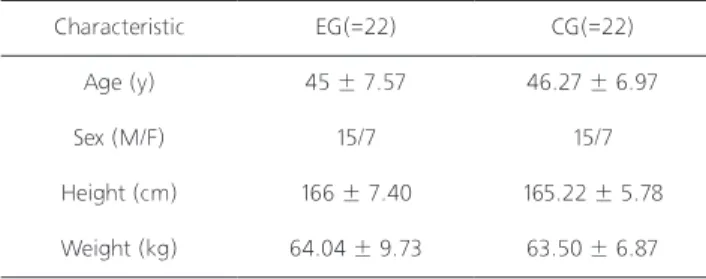
The study participants did not have cervical fractures or other surgical histories associated with the cervical vertebrae. Subjects who did not understand the survey contents were excluded from this study. Those subjects who listened carefully to the explanation of the study contents and agreed to participate were selected. The characteristics of the study participants are outlined in (Table 1).
2. Methods
In this study, Visual Analogue Scale(VAS), Korean Neck Disability Index (NDI), and Cervical Lordosis Angle (CLA) were measured in both groups 10 days after the cervical artificial disc replacement, while the exercise programs were performed 3 times a week for 8 weeks in 40 min sessions,
after which the measurement was performed in the same manner as before the exercise.17 In accordance with exercise programs prepared for the two groups, respectively, the experimental and control groups performed cervical stabilization and cervical isometric exercises, respectively.
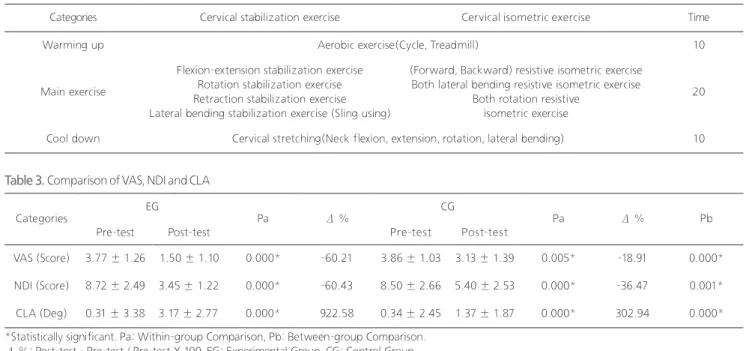
The cervical stabilization exercise was implemented by using the sling system suggested by Kwon et al18, while the cervical isometric exercise consisted of exercises for the neck and shoulder that are generally recommended by physical therapists for cervical pain management.19 The exercise programs are shown in (Table 2). For assessment, cervical pain, cervical functional disability and CLA were measured by using the VAS,16 NDI,20 and cervical radiographs (Dong Kang ACC-630R, Seoul, Korea), respectively; the measurements were made based on the method suggested
Characteristic EG(=22) CG(=22)
Age (y) 45 ± 7.57 46.27 ± 6.97
Sex (M/F) 15/7 15/7
Height (cm) 166 ± 7.40 165.22 ± 5.78
Weight (kg) 64.04 ± 9.73 63.50 ± 6.87
Table 1. Characteristics of study subjects
Values are presented as mean±standard deviation.
EG=Experimental Group, CG=Control Group.
Figure1. Cervical Lordosis Angle.
less.7 In particular, imbalances between muscles induce severe fatigue in the cervical flexors;22 when this pain continues, an individual’s posture, balance and control abilities are decreased, and proprioceptive receptors, vestibular organs and the visual postural control system in the body are changed, thereby causing functional impairment of the kinesthetic sense.23 Consequently, of the various related therapeutic approaches, exercise treatments are important.24 In particular, cervical stabilization exercise is reported to be effective in the treatment and management of patients with cervical pain.10 Therefore, this study aimed to elucidate the effects of cervical stabilization exercise on pain and structural recovery in patients after cervical artificial disc replacement.
Both groups in the current study manifested significant improvements in the cervical pain index and cervical disability index after an 8-week postoperative exercise intervention. In particular, the stabilization exercise group showed a 3×reduction in the cervical pain index -41.3% and a 2×improved cervical disability index -23.96% than the isometric exercise group.
In a study on cervical pain index, Oh et al25 reported that isometric and flexible exercises both effectively increased by Jochumsen (Figure 1).21 The data were analyzed by using
SPSS 18.0. The physical characteristics of the groups with respect to the exercise program are expressed as mean and standard deviation. Levene’s test was used to assess the equality of variances in the two groups, and Levene’s statistic was not significant (p>0.05), assuming equal variances between groups. Paired t-test was employed to confirm the differences before and after the exercise within groups. To compare differences in variances between both groups, an independent t-test was performed. Statistical significance was set at α= 0.05.
III. Results
The results of the stabilization exercise after cervical artificial disc replacement are shown in (Table 3). Both groups manifested significant outcomes between and within the groups (p<0.05).
IV. Discussion
The cervical spine has the largest range of motion of all spinal areas, although its mechanical stability is relatively
Categories Cervical stabilization exercise Cervical isometric exercise Time
Warming up Aerobic exercise(Cycle, Treadmill) 10
Main exercise
Flexion-extension stabilization exercise Rotation stabilization exercise Retraction stabilization exercise Lateral bending stabilization exercise (Sling using)
(Forward, Backward) resistive isometric exercise Both lateral bending resistive isometric exercise
Both rotation resistive isometric exercise
20
Cool down Cervical stretching(Neck flexion, extension, rotation, lateral bending) 10
Categories EG
Pa Δ % CG
Pa Δ % Pb
Pre-test Post-test Pre-test Post-test
VAS (Score) 3.77 ± 1.26 1.50 ± 1.10 0.000* -60.21 3.86 ± 1.03 3.13 ± 1.39 0.005* -18.91 0.000*
NDI (Score) 8.72 ± 2.49 3.45 ± 1.22 0.000* -60.43 8.50 ± 2.66 5.40 ± 2.53 0.000* -36.47 0.001*
CLA (Deg) 0.31 ± 3.38 3.17 ± 2.77 0.000* 922.58 0.34 ± 2.45 1.37 ± 1.87 0.000* 302.94 0.000*
Table 2. Exercise programs
Table 3. Comparison of VAS, NDI and CLA
*Statistically significant. Pa: Within-group Comparison, Pb: Between-group Comparison.
Δ %: Post-test - Pre-test / Pre-test X 100. EG: Experimental Group, CG: Control Group.
VAS(Visual Analogue Scale), NDI(Neck Disability Index), CLA(Cervical Lordosis Angle).
was provided by controlling the instability and abnormal movement of the cervical inter-body through an increase of muscular endurance in cervical stabilization instead of muscle strength, which is in agreement with the results of this study.
The limitations of this study are as follows. First, of the various available stabilization exercise programs, only exercise localized to the cervical vertebrae was performed to focus on patients after cervical artificial disc replacement surgery. Second, no comparative analysis was performed by using more objective assessment tools. Third, the number of subjects was small; therefore, further studies with a sufficient number of subjects are necessary to confirm the relationships among all the involved factors.
In conclusion, after an 8 week postoperative exercise intervention in patients with cervical artificial disc replacement, patients in both the stabilization exercise and the isometric exercise groups showed significant improvements. In particular, the stabilization exercise group demonstrated better cervical pain outcomes, disability index and structural relationships. However, further long- term studies with various exercise programs and objective assessments are needed to confirm our findings.
References
1. Murphy DR, Hurwitz EL, Gregory A, et al. A nonsurgical approach to the management of patients with cervical radiculopathy: a prospective observational cohort study. J Mani- pulative Phys Ther. 2006;29(4):279-87.
2. Bohlman HH, Emery SE, Goodfellow DB, et al. Robinson anterior cervical diskectomy and arthrodesis for cervical radiculopathy. Long-term follow-up of one hundred and twenty-two patients. J Bone Joint Surg Am. 1993;75(9):1298- 307.
3. Smith GW, Robinson RA. The treatment of certain cervical- spine disorders by anterior removal of the intervertebral disc and interbody fusion. J Bone Joint Surg Am. 1958;40(3):607-24.
4. Zdeblick TA, Bohlman HH. Cervical kyphosis and myelopathy.
Treatment by anterior corpectomy and strut-grafting. J Bone Joint Surg Am. 1989;71(2):170-82.
5. Benini A, KrayenbÜhl H, BrÜderl R. Anterior cervical discectomy without fusion Microsurgical technique. Acta Neurochir(Wien). 1982;61(1-3):105-10.
muscular strength and decreased pain in patients with cervical pain. O’Leary et al26 also reported that the neck flexion coordination exercise and that muscle endurance exercises such as the cervical flexion exercise effectively provided local pain relief.
Moreover, the findings of this study are in agreement with those of a study by Dusunceli et al27 that classified 55 patients with chronic cervical pain into three groups and followed them for 1 year; the results revealed that the pain index and cervical disability index after the cervical stabilization exercise showed functional improvements compared to the groups with conservative treatment and the groups with conservative treatment and isometric and muscular strength exercise programs. Such results are believed to be due to the fact that the postoperative stabilization exercise showed decreased cervical pain and cervical disability index caused by reinforced control abilities of the near core of the cervical vertebrae instead of simple isometric muscle strength exercises. Another study mentioned that changes in skeletal alignment generally appear to be lengthened or shortened muscles, imbalances in intensity of the antagonist and agonist utilization, or defects of the skeletal system that facilitate such muscular changes.28 In addition, Grimmer and Trott29 reported that weakened cervical flexor was associated with an increase in CLA. Furthermore, Jull30 reported that such muscular strength and endurance were weak in patients with cervical pain. Thus, the roles of the deep flexor have been considered important for cervical posture control and stability maintenance in recent years,31 and the association regarding the integrative action of the muscular system is highlighted in the maintenance of stability and proper function.32 In this study, both groups showed significantly improved outcomes in the recovery of cervical structure after the surgery and the stabilization exercise group manifested a 3×more improved CLA 619.64% than the isometric exercise group.
Evans et al33 reported an increased range of motion when gradual muscle exercises and stretching motions were applied, while Falla et al9 mentioned that a 6 week neck flexion exercise intervention could maintain cervical neutral posture. Moreover, Hur34 suggested that stability
6. Jeon TS, Chang H, Choi BW. Current concept on the operative treatment for degenerative cervical disc disease. J Korean Med Assoc, 2011;54(9):941-50.
7. Bogduk N, Mercer S. Biomechanics of the cervical spine. I:
Normal kinematics. Clin Biomech. 2000;15(9):633-48.
8. Kim SY. Lumbo-pelvic stabilization approach for lower back dysfunction. J Korean Acad Ortho Manu Phys Ther. 1998;4(1):7- 20.
9. Falla DL, Jull GA, Russell T, et al. Effect of neck exercise on sitting postural in patients with chronic neck pain. Phys Ther.
2007;87(4):408-17.
10. Jull G, Falla D, Treleaven J, et al. “Cervical flexor muscle retraining physiological mechanism of efficacy”. 2nd international conference on movement dysfunction, Scotland, 2005.
11. Chae YW, Lee HM. The effect of craniocervical exercise on tension-type headache. J Korean Soc Phys Ther. 2009;21(4):9-16.
12. You YY, Kim HS. Comparing the effects on elderly women of bearing weights and lumbar stabilization using lumbar muscle exercises group vs. Individual sessions with a physical therapist.
J Korean Soc Phys Ther. 2010;22(5):17-23.
13. Kim SY. Changes in cross-sectional area of lumbar muscle in patients with chronic back pain. J Korean Soc Phys Ther.
2010;22(5):39-47.
14. Kim JH, Park SK, Kang JI, Yang DJ. Effects of lumbar stability exercise program on trunk, lower extremity of muscle activity and balance in soccer player. J Korean Soc Phys Ther 2010;22(5):25-31.
15. Seo JK, Kim SY. The Relationship between Hip Abductor Muscle Strength and Lumbar Instability in Patients with Chronic Low Back Pain. . J Korean Soc Phys Ther. 2011;23(4):15-21
16. Kang SS, Goo GO. The Effects of Yoga Low Back Pain Exercise and Lumbar Extensor Muscle Endurance Exercise on Chronic Low Back Pain Patients. . J Korean Soc Phys Ther.
2012;24(2):107-12.
17. Kim DH, Cho HY, Kim CK. Effect of visual feedback training on lumbago and lumbar stabilization muscle strength of chronic back pain patient. J Korean Society Sport Leisure Studies, 2011;43(1):781-89.
18. Kwon JH, Cho MJ, Park MC, et al. Cervical stabilization exercise using the Sling system. J Korean Acad Ortho Manu Phys Ther.
2002;8(2):57-71.
19. Physical therapy center specialist Korea. Disease exercise program for physical therapists. Jeong Dam Publishing Company; 2001.
20. Kim TH, Kim JH, Gong WT. Rasch analysis to neck disability
index with neck pain subjects. J Korean Soc Phys Ther.
2009;21(3):1-8.
21. Jochumsen OH. The curve of the cervical spine. ACA J Chiro, 1970, 49.
22. Falla DL, Jull GA, Dall’Alba P, et al. An electromyographic analysis of the deep cervical flexor muscles in performance of craniocervical flexion. Phys Ther. 2003;83(10):899-906.
23. Sjolander P, Michaelson P, Jaric S, et al. Sensorimotor disturbances in chronic neck pain-range of motion, peak velocity, smoothness of movement, and repositioning acuity.
Manu Ther. 2008;12(2):122-31.
24. Bekkering GE, Engers AJ, Wensing M, et al. Development of an implementation strategy for physiotherapy guidelines on low back pain. Aust J Phys ther, 2003;49(3):208-16
25. Oh DW, Shim JH, Lee GW et al. The Effect of Active Neck Muscle Training in the Treatment of Chronic Neck Pain. J Korean Soc Phys Ther. 2004;16(4):168-78.
26. O’Leary S, Falla D, Hodges PW, et al. Specific therapeutic exercise of the neck induces local hypoalgesia. J Pain.
2007;8(11):832-39.
27. Dusunceli Y, Ozturk C, Atamaz F, et al. Efficacy of neck stabilization exercises for pain: a randomized cotrolled study. J Rehabil Med. 2009;41(8):625-31.
28. Youn JH, Sung DJ. The influence of mckenzie approach on head-shoulder posture of the patients with chronic neck pain.
The research institute of physical education and sports science.
1998;17(1):79-90.
29. Grimmer K, Trott P. The association between cervical excursion angles and cervical short flexor muscle endurance. Aust J Phys ther. 1998;44(3):201-07.
30. Jull D. Deep cervical neck flexor dysfunction in whiplash. J Muscuo pain, 2000;8(1-2):143-54.
31. Bonyd-Clark LC, Briggs CA, Galea MP. Muscle spindle distribution, morphology and density in longus colli and multifidus muscle of the cervical spine. Spine. 2002;27(7):694- 701.
32. Comerford MJ, Mottram SL. Functional stability re-training:
principles and strategies for managing mechanical dysfunction.
Man Ther. 2001;6(1):3-14.
33. Evans R, Bronfort G, Nelson B, et al. Two-year follow-up of a randomized clinical trial of spinal manipulation and two types of exercise for patients with chronic neck pain. Spine, 2002;27(21):
2383-89.
34. Hur JG. The Impact of Static Strength and Static Endurance of the Neck Deep Flexor on Chronic Neck Pain. J Korean Spor Resear, 2005;16(5):215-25.