• 검색 결과가 없습니다.

Vesicoureteral Reflux

N/A
N/A
Protected

Academic year: 2021

Share "Vesicoureteral Reflux"

Copied!
4
0
0

로드 중.... (전체 텍스트 보기)

전체 글

(1)

62

Case Report

ISSN 2465-8243(Print) / ISSN: 2465-8510(Online) http://dx.doi.org/10.14777/uti.2016.11.2.62 Urogenit Tract Infect 2016;11(2):62-65

Recurrent Urinary Tract Infection by Bladder Stone Resulting from Subureteral Injection Polydimethylsiloxane (Macroplastique ® ) for Treatment of

Vesicoureteral Reflux

Jae Young Choi, Hyun Tae Kim

1

, Young Hwii Ko, Young Hwan Lee

2

, Phil Hyun Song

Department of Urology, Yeungnam University College of Medicine, Daegu,

1

Department of Urology, Kyungpook National University School of Medicine, Daegu,

2

Department of Pediatircs, Yeungnam University College of Medicine, Daegu, Korea

While endoscopic subureteral injection of bulking agents has become a first-line therapy for the treatment of vesicoureteral reflux (VUR), mainly due to its high success rates with minimal complications, polydimethylsiloxane (PDS) adminis- tration can be associated with bladder calcification in a minority of patients. A 10-year-old girl with prior history of subureteral administration of PDS as a treatment modality for bilateral VUR six years ago showed recurrent lower urinary tract symptoms, including dysuria, frequency, and urgency, for the past 6 months.

She was admitted to our institution for right pyelonephritis with hydronephrosis.

Radiologic examination had revealed two yellowish impacted stones attached to the previous site of PDS administration without recurrence of VUR. The stones were completely removed by cystolitholapaxy. This study suggests that such a late- complication should be considered in patients with recurrent urinary tract infection or lower urinary tract symptom despite complete disappearance of VUR by prior subureteral administration therapy.

Keywords: Vesico-ureteral reflux; Subureteral injection; Urinary bladder calculi

Copyright 2016, Korean Association of Urogenital Tract Infection and Inflammation. All rights reserved.

This is an open access article distributed under the terms of the Creative Commons Attribution Non-Commercial License (http://creativecommons.org/licenses/by-nc/4.0) which permits unrestricted non-commercial use, distribution, and reproduction in any medium, provided the original work is properly cited.

Received: 28 February, 2016 Revised: 27 March, 2016 Accepted: 28 March, 2016

Correspondence to: Phil Hyun Song http://orcid.org/0000-0002-3801-258X Department of Urology, Yeungnam University College of Medicine, 170 Hyeonchung-ro, Nam-gu, Daegu 42415, Korea

Tel: +82-53-620-3693, Fax: +82-53-627-5535 E-mail: [email protected]

Owing to its ease of use and effectiveness, endoscopic administration of subureteral bulking agents has become a popular technique for the treatment of vesicoureteral reflux (VUR). In a published series, good cure rates (range, 70-92%) were reported after the administration of polydimethylsiloxane (PDS), which is commercially available as Macroplastique (Uroplasty BV, Geleen, the Netherlands), an implantation for treatment of VUR [1-3]. Postoperatively, complications were limited to obstructed ureters (1%), erosions (0.6%), and occurrence of contralateral VUR (2.1%), requiring no further surgical treatment [1]. However, despite such a low rate of complications, long-term follow-ups should not be disregarded. We report a case of pyelonephritis with

recurrent urinary tract infection caused by bladder stones as a result of PDS administration to initially treat bilateral VUR 6 years ago. Moreover, we provide a literature review with respect to the late-complications from PDS admi- nistration. This study was approved by the Institutional Review Board of the Yeungnam University Hospital (YUMC 2015-01-030).

CASE REPORT

A 10-year-old female patient was referred to our urologic

department from a local pediatric clinic for right flank pain,

nausea, and fever two weeks ago prior to her visitation.

(2)

Jae Young Choi, et al. Bladder Stone after Subureteral Injection for VUR 63

Urogenit Tract Infect Vol. 11, No. 2, August 2016 Fig. 2. About 2 cm sized yellowish impacted stone was observed at the site

of previous polydimethylsiloxane administration on cystoscopic findings.

Fig. 1. (A) Ultrasonography revealed a moderate degree hydronephrosis on right kidney. (B) On bladder imaging, 2.0 cm and 1.3 cm sized calcifications were identified around the trigonal area.

Fig. 3. After cystolitholapaxy, the right ureteral orifice was identified as having a normal shape. The color of urine jetting through the right ureteral orifice was clear.

From her detailed history, she had recurrent lower urinary tract symptoms, including dysuria, frequency, and urgency for the past 6 months, which was partially relieved from empirical antibiotics for 3 days. The patient, according to her past medical history, had undergone subureteral administration of PDS to treat bilateral VUR (right, grade 2; left, grade 3) six years ago.

Based on clinical symptoms, as well as leukocytosis as suggested by serum examination, and pyuria by mid-stream urinalysis, pyelonephritis was suspected; parenteral susceptible antibiotics were administered immediately. To evaluate the cause of pyelonephritis, abdominal ultra- sonography was performed. We identified a moderate degree of hydronephrosis on the right kidney (Fig. 1A),

and two bladder stones (2.0 cm and 1.3 cm) near the right trigonal area of the bladder (Fig. 1B). Her symptoms and pyuria on follow-up urinalysis had completed resolved in seven days. Voiding cystourethrography was then performed, which revealed an absence of VUR on both sides.

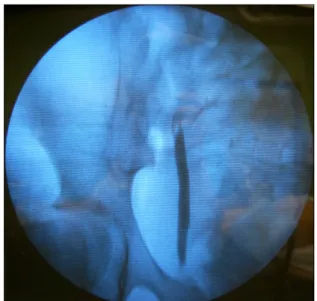
Thus, under the diagnosis of distal ureteral obstruction induced by bladder stone, cystolitholapaxy and right retrograde pyelography (RGP) were planned under general anesthesia. On cystoscopic findings, two yellowish impacted stones attached to the previous site of PDS administration, just below the right ureteral orifice, were observed (Fig.

2). Following complete stone removal using cystolitholapaxy,

RGP was performed to evaluate other potential causes of

(3)

64 Jae Young Choi, et al. Bladder Stone after Subureteral Injection for VUR

Urogenit Tract Infect Vol. 11, No. 2, August 2016

Fig. 4. After complete stone removal using cystolitholapaxy, retrograde pyelography was performed to evaluate other cause of ureteral obstruction, showing absence of a filling defect.

ureteral obstruction (Fig. 3). It showed an absence of a filling defect, thus confirming that the initial right hydro- nephrosis was caused not by a recurrence of VUR, but by the presence of bladder stones (Fig. 4). During a 12-month postoperative period, with a 3-month interval, no abnormal findings were observed on ultrasonography and urinalysis, and the patient experienced no lower urinary tract symptoms.

DISCUSSION

Endoscopic treatment of VUR is based on the principle of creating a solid support behind the intravesical ureter and elongating the intramural length of the ureter [4]. Several studies have reported that endoscopic treatment is effective and safe as a first-line therapy for the treatment of VUR;

however, an ideal agent has not yet been identified [3,5].

PDS, a nonbiodegradable substance, is a popular bulking agent, and is used extensively in medical applications [4].

It is reabsorbed and exchanged with a reactive transudate containing fibroblasts, which then facilitate its encapsulation [6]. Other previous studies have reported success rates ranging from 70% to 92% by endoscopic administration using PDS, and a recent meta-analysis reported a success rate of 76.6% [1-3]. In addition, long-term follow-up studies have demonstrated that the long-term success rate of PDS is much greater than that of other agents [5,7,8]. Markedly low rates of complications after endoscopic administration

of bulking agents have been reported. Rates of erosions and occurrence of contralateral VUR as postoperative complications have been reported in 0.6% and 2.1%, respectively [1]. In particular, the occurrence of ureteral obstruction was reported in less than 1% of injected ureters using PDS [1,9].

As a postoperative complication of endoscopic treatment, bladder calcification due to PDS exposure from bladder mucosal necrosis or erosion was also rare; however, the risk of bladder calcification increases after endoscopic treatment due to increased pressure and diminished perfusion of the overlying mucosa. Conversely, animal studies have reported formation of a well-encapsulated foreign body reaction at the administration site, composed of giant cells, fibroblasts, and collagen, with no substantial risk of migration [10]. Therefore, due to the risk of bladder mucosal necrosis, long-term follow-ups are required for patients who were administered PDS.

As demonstrated in this report, although rare, bladder stones at the site of previous PDS administration can be a possible complication. Given the growing popularity of PDS as a treatment for VUR, it is important for physicians to recognize this late-complication after an endoscopic administration of bulking agent, especially for patients with recurrent urinary tract infection or lower urinary tract symptom.

CONFLICT OF INTEREST

No potential conflict of interest relevant to this article was reported.

REFERENCES

1. van Capelle JW, de Haan T, El Sayed W, Azmy A. The long-term outcome of the endoscopic subureteric implantation of polydimethylsiloxane for treating vesico-ureteric reflux in children: a retrospective analysis of the first 195 consecutive patients in two European centres. BJU Int 2004;94:1348-51.

2. Aboutaleb H, Bolduc S, Upadhyay J, Farhat W, Bagli DJ, Khoury AE. Subureteral polydimethylsiloxane injection versus extra- vesical reimplantation for primary low grade vesicoureteral reflux in children: a comparative study. J Urol 2003;169:313-6.

3. Elder JS, Diaz M, Caldamone AA, Cendron M, Greenfield S,

Hurwitz R, et al. Endoscopic therapy for vesicoureteral reflux: a

meta-analysis. I. Reflux resolution and urinary tract infection. J

Urol 2006;175:716-22.

(4)

Jae Young Choi, et al. Bladder Stone after Subureteral Injection for VUR 65

Urogenit Tract Infect Vol. 11, No. 2, August 2016 4. Bae YD, Park MG, Oh MM, Moon DG. Endoscopic subureteral

injection for the treatment of vesicoureteral reflux in children:

Polydimethylsiloxane (Macroplastique

) versus Dextranomer/

Hyaluronic Acid Copolymer (Deflux

). Korean J Urol 2010;

51:128-31.

5. Capozza N, Caione P. Dextranomer/hyaluronic acid copolymer implantation for vesico-ureteral reflux: a randomized com- parison with antibiotic prophylaxis. J Pediatr 2002;140:230-4.

6. Solomon LZ, Birch BR, Cooper AJ, Davies CL, Holmes SA.

Nonhomologous bioinjectable materials in urology: ‘size matters’? BJU Int 2000;85:641-5.

7. Lakgren G, Wahlin N, Skoldenberg E, Stenberg A. Long-term

followup of children treated with dextranomer/hyaluronic acid copolymer for vesicoureteral reflux. J Urol 2001;166:1887-92.

8. Puri P, Chertin B, Velayudham M, Dass L, Colhoun E. Treatment of vesicoureteral reflux by endoscopic injection of dextra- nomer/hyaluronic acid copolymer: preliminary results. J Urol 2003;170:1541-4.

9. Al-Hunayan AA, Kehinde EO, Elsalam MA, Al-Mukhtar RS.

Outcome of endoscopic treatment for vesicoureteral reflux in children using polydimethylsiloxane. J Urol 2002;168:2181-3.

10. Smith DP, Kaplan WE, Oyasu R. Evaluation of polydimethyl-

siloxane as an alternative in the endoscopic treatment of

vesicoureteral reflux. J Urol 1994;152:1221-4.

수치

Fig. 1. (A) Ultrasonography revealed a moderate degree hydronephrosis on right kidney
Fig. 4. After complete stone removal using cystolitholapaxy, retrograde pyelography was performed to evaluate other cause of ureteral  obstruction, showing absence of a filling defect.

참조

관련 문서

Endoscopic spine surgery has become a practical, minimally invasive technique for decompression in patients with spinal disc herniation or stenosis.. However,

Although the coastal area of Jeju has already been developed, it has high pressure and demands for development continually increasing due to the increase

Therefore, this study aims to identify the relations between gastroesophageal reflux disease and body mass index, and waist measurement as indexes of obesity.. For the

Subjects with a smoking period of 1 to 3 years had a high smoking cessation success rate (p=0.024), and the lower the average daily smoking amount, the higher the

The former preferred Chilunjeolgu (a quatrain with seven words to a line) as a poetry style while the latter preferred Ounyulsi (a Chinese poetry style

success rates of dental implants placed at the time of or after alveolar ridge augmentation with an autogenous mandibular bone graft and titanium mesh: a 3-to

Separation of oil, gas, and water.. Multi Stage Separator Stabilization Column. Without Reflux 1) It is preferred

In the present study, the behavior of Mg sheet with strain rates will be observed and the effect of microstructure, texture and PB treatment on high rate tensile