High-temperature Oxidation of Nano-multilayered AlTiSiN Thin Films deposited on WC-based carbides
Yeon Sang Hwang and Dong Bok Lee†
School of Advanced Materials Science and Engineering, Sungkyunkwan University, Suwon, 440-746, Korea (Received April 09, 2013; Revised June 18, 2013; Accepted June 20, 2013)
Nano-multilayered, crystalline AlTiSiN thin films were deposited on WC-TiC-Co substrates by the cathodic arc plasma deposition. The deposited film consisted of wurtzite-type AlN, NaCl-type TiN, and tetragonal Ti2N phases. Their oxidation characteristics were studied at 800 and 900°C for up to 20 h in air. The WC-TiC-Co oxidized fast with large weight gains. By contrast, the AlTiSiN film displayed superior oxidation resistance, due mainly to formation of the α-Al2O3-rich surface oxide layer, below which an (Al2O3, TiO2, SiO2)-intermixed scale existed. Their oxidation progressed primarily by the outward diffusion of nitrogen, combined with the inward transport of oxygen that gradually reacted with Al, Ti, and Si in the film.
Keywords : AlTiSiN thin films, WC carbides, oxidation, Al2O3 oxide
†Corresponding author: [email protected]
1. Introduction
To improve the performance and service life of cut- ting tools or die molds, there have been deep interests in developing new coating materials which have good mechanical, thermal and chemical properties. Presently, hard titanium nitride (TiN) films, having high hardness, corrosion-resistance and decorative color, have been successfully applied on the surfaces of mechanical components to increase the lifetime, durability and per- formance in abrasive and corrosive environments.
However, they oxidize rapidly above 550oC owing to the formation of a TiO2 layer.1) Hence, the (Ti,Al)N films were developed as alternatives by partially sub- stituting Al for Ti in TiN.2-5) They had excellent me- chanical properties such as high hardness and good wear resistance, and started to react with hot air at 700-750oC.6) The enhanced oxidation resistance of (Ti, Al)N was attributed to the formation of an extremely thin outermost amorphous Al2O3 film. Below this pro- tective film, another thin layer of TiO2 formed on the remnant (Ti, Al)N film.7) These results obtained from the early stage of oxidation were confirmed by Ichimura and Kawana2) and Rebouta et al.8)
In order to further improve the mechanical properties and oxidation resistance, (Ti,Al,Si)N films were developed.9-15) The substitutional replacement of Al
atoms in the (Ti,Al) sites resulted in a structure refine- ment,13) increased hardness, mechanical properties,16-19) and oxidation resistance.9-11,13) (Ti,Al,Si)N films have been deposited by magnetron sputtering9,10) and catho- dic arc deposition.11-19) Depending on the deposition methods and deposition parameters such as targets, em- ployed gases, substrates, temperatures, and pressures, diverse (Ti,Al,Si)N film compositions (Ti- or Al-rich Ti1-xAlxSiyN with various x and y values) and structures (e.g., nanocrystalline, amorphous, TiAlN phases, hcp- AlN, fcc-AlN, fcc-TiN, Si3N4 phases) were obtained.
Since the films were frequently exposed to oxidative atmospheres at high temperatures during service as wear- and corrosion-resistant ones, their oxidation char- acteristics are of great importance for practical applications. Therefore, the thermal stability of (Ti,Al,Si) N films was previously studied.9-15,20) In particular, (Ti,Al,Si)N films displayed better oxidation resistance,
9-11,13)
mechanical properties, and higher hardness16-19) than (Ti,Al)N films. In order to study the thermal stability, (Ti,Al,Si)N films in the form of a homogenous sin- gle-layer or nanocomposites were heated in air,9,11,12,15,20)
low vacuum,10,14) or nitrogen.13) The substrates used were steel,9,10) Si,11,12,15) or WC-Co.13,14) The heating were per- formed in the temperature range of 700-1100oC for the period of 15 min-168 h, depending on investigators.
Under these oxidation conditions, the formed oxides con- sisted primarily of the (TiO2,Al2O3,SiO2)-mixed layer,9) an outer Al2O3 layer plus an inner (TiO2,Al2O3,SiO2)-mixed
layer,10) an outer Al2O3 layer plus an inner TiO2-rich lay- er,11) an Al2O3 layer,12) an outer Al2O3 layer plus an inner (TiO2,Al2O3)-mixed layer,13) and an outer TiO2 layer plus an inner Al2O3 layer.20) Likewise, the high-temperature ox- idation of the Ti, Al and Si in the (Ti,Al,Si)N films gen- erally resulted in the formation of complex oxides of TiO2, Al2O3 and SiO2 on the surface, respectively, which limited the diffusion of oxygen into the films.
However, more oxidation tests are needed for poten- tial application of the (Ti,Al,Si)N film. In this study, multilayered AlTiSiN films consisting of TiN nano- layers and AlSiN nanolayers were deposited using Ti and AlSi cathodes on the WC-TiC-Co substrate by the cathodic arc plasma deposition (CAPD). Nano-multi- layered films are of increasing interest for their superior mechanical and lubrication properties in advanced tri- bological applications. WC-based carbides, consisting of hard WC particles bound by the Co binder phase, have been used as cutting tools, rock drill tips and other wear resistant components for decades. The addition of TiC in WC–Co enhances hardness and wear resistance. In this study, the oxidation behavior of nano-multilayered AlTiSiN thin films was examined at 800 and 900oC in air. This study aims to study the oxidation kinetics, oxidation mechanism and micro- structure of nano-multilayered AlTiSiN thin films. The oxidation mechanism of (Ti,Al,Si)N films under vari- ous conditions still needs to be understood further, be- cause the oxidation behavior of the films depends sensi- tively on the deposition method and deposition parame- ters, which affect their crystallinity, composition, stoi- chiometry, thickness, surface roughness, grain size and orientation.
2. Experimental
AlTiSiN films were deposited on WC-20wt.%TiC -10wt.%Co sintered carbides with a size of 10x10x5 mm3 by CAPD using pure Ti and 88 at.%Al-12 at.%Si cathodes. Detailed deposition parameters are described elsewhere.20) Prior to deposition, a titanium interlayer was deposited with a thickness of approximately 500 nm to enhance film adhesion. The films were deposited to a thickness of about 6 μm at a nitrogen pressure of 0.4 Pa, a temperature of 250 oC, a bias voltage of -100 V, a Ti cathode arc current of 55 A, and a Al-Si cathode arc current of 35 A. The substrate holder was rotated with a speed of 4.55 rpm during deposition.
Nano-multilayered films were attained by rotating the substrate between two opposed cathodes of Ti and Al-Si. The average film composition was 26.6Al-10.7
Ti-3.3Si-59.4N (at.%) according to the electron probe microanalysis (EPMA).
The AlTiSiN films were oxidized at 800 and 900oC for up to 20 h in 1 atm of air. Using a thermogravimetric analyzer, weight gains were measured continuously as a function of time during oxidation. Following oxida- tion, the films were inspected by EPMA, a field-emis- sion scanning electron microscope (FE-SEM), an X-ray diffractometer (XRD) with Cu-Kα radiation, an Auger electron spectrometer (AES), and a transmission elec- tron microscope (TEM operated at 200 keV) equipped with an energy dispersive spectrometer (EDS with 5 nm spot size).
3. Results and discussion
Fig. 1. shows FE-SEM/EPMA/TEM/XRD results of the prepared AlTiSiN film. The smooth film surface consisted of numerous small, round, nanometer-size grains (Fig. 1(a)). The film exhibited brittle fracture (Fig. 1(b)). It was thin, dense, and adherent to the sub- strate (Fig. 1(c)). The corresponding EPMA line pro- files differentiated the AlTiSiN film, the Ti-interlayer, and the WC-TiC-Co carbides (Fig. 1(d)). The TEM cross-sectional image of the film revealed a nano-multi- layered structure (Fig. 1(e)). Here, white layers were AlSiN (width = 8 nm), which originated from the 88 at.%Al-12 at.%Si cathode, and dark layers were Ti-N (width = 3 nm), originating from the Ti cathode. The unequal thickness of these alternating nano-multilayers may be related with the different deposition yield, sol- ubility and mobility of Al, Ti, and Si. In Fig. 1(f), the substrate patterns of α–WC and the TiC additive were strong, owing to the thinness of the as-deposited film that consisted primarily of wurtzite-type AlN, NaCl-type TiN, and tetragonal Ti2N. The intensity of these phases were weak and broad because the film was nanocrystalline and multilayered.
The isothermal oxidation kinetics of WC-TiC-Co substrate and the as-deposited AlTiSiN film are shown in Fig. 2. The uncoated substrate oxidized fast with large weight gains at 800 and 900oC due mainly to the formation of the non-protective CoWO4. It is known that tungsten-containing oxides are invariably highly volatile at high temperatures, eventually resulting in complete volatilization.22) The substrate oxidized para- bolically, indicating that a diffusion process controlled the oxidation reaction. By contrast, weight gains of the AlTiSiN film were almost nil at 800 and 900oC. The AlTiSiN film dramatically improved the oxidation re- sistance of WC-TiC-Co substrate.
Fig. 1. AlTiSiN film deposited on the WC-TiC-Co substrate. (a) FE-SEM top view of the film, (b) FE-SEM image of the fracture surface of the film, (c) cross-sectional EPMA image, (d) line profiles of (c), (e) bright-field (BF) TEM image of the film, (f) XRD pattern.
Fig. 2. Weight change vs. oxidation time curves of WC-TiC-Co substrate and AlTiSiN film at 800 and 900oC in air.
Fig. 3. AES depth profiles of the AlTiSiN film after oxidation at 800oC for 15 min in air. The penetration rate is 18 nm/min for the reference SiO2.
Fig. 3. shows AES depth profiles of the oxidized AlTiSiN film, which was performed in order to under- stand the oxidation mechanism. Since a thin Pt film was sputter-deposited on top of the AlTiSiN film prior to oxidation, the maximum concentration point of the inert Pt marker corresponded to the original sample surface. It is seen that nitrogen diffused outwardly to escape from the surface probably as N2 gas, while oxy- gen diffused inwardly to react with Al, Ti, and Si, as TiN/AlN nano-multilayer5) and TiAlSiN films10,11) did during oxidation. Although most of the scale formed by the inwardly transported oxygen, the outermost scale formed by the outward diffusion of Al, Ti and Si. This is consistent with the following facts. α-Al2O3 grows primarily by the inward diffusion of oxygen along the grain boundaries, although there is some outward
growth as well.22) TiO2 forms by either inwardly diffus- ing oxygen ions or outwardly transported Ti ions. The tendency of Si to diffuse outward was the weakest, be- cause silicon ions were relatively immobile owing to the high bonding energy of Si4+-O-2 (465 kJ mol-1),23) and also due to the low concentration gradient of Si whose amount was the smallest in the film. It is noted that the standard free energies of formation of oxides per mole of O2 (ΔGf
O
), for example at 800oC are as follows: α-Al2O3 = -891 (kJ), SiO2 = -716 (kJ) and TiO = -878 (kJ).24) TiO is the precursor of the thermo- dynamically stable TiO2. Initially, Al, Si and Ti oxi dized competitively according to their concentration due to their highly negative ΔGf
O
values. Hence, an Al2O3-rich scale formed on the surface. Since α-Al2O3
grows very slowly on account of its highly stoichio- metric structure, and the fcc-AlN is largely covalently bonded,25) the oxidation of Al occurred quite slowly.
Hence, the AlTiSiN film displayed superior oxidation resistance.
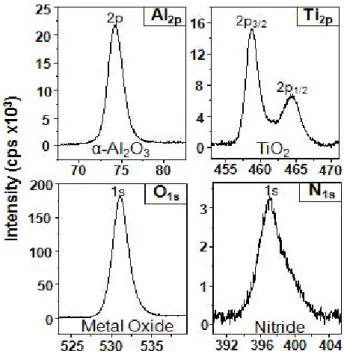
Fig. 4. shows the XPS spectra of the oxidized AlTiSiN film. The composition of the surface oxide scale was 33Al-5.5Ti-59.1O-2.4N (at.%), implying the formation of (Al,Ti)2(O,N)3, viz. Al2O3 incorporated with a small amount of Ti and nitrogen. No Si was detected owing to the relative immobility of Si4+ ions and the small amount of Si in the as-deposited film.
Since Al was the more mobile, abundant in the film,
Fig. 4. XPS spectra of Al2p, Ti2p, O1s, and N1s taken from the outermost surface of the AlTiSiN film that was oxidized at 800oC for 20 h.
and an active element, a protective Al2O3–rich surface scale formed. On the other hand, the Al2p peak was centered at 74.3 eV, which matched with the binding
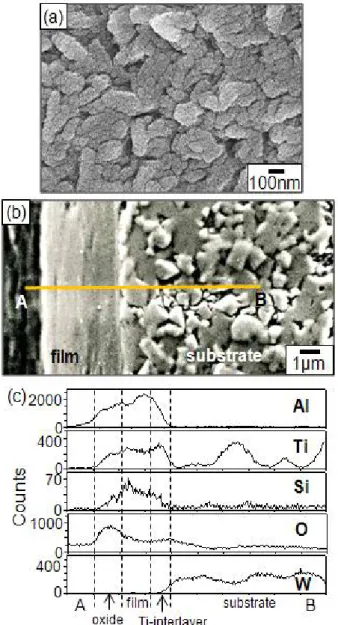
Fig. 5. AlTiSiN film after oxidation at 800oC for 20 h. (a) FE-SEM top view, (b) EPMA cross-sectional image, (c) line profiles along A-B shown on (b), (d) XRD pattern.
Fig. 6. AlTiSiN film after oxidation at 900oC for 10 h. (a) FE-SEM top view, (b) EPMA cross-sectional image, (c) line profiles across A and B of (b).
energy of Al2O3. The Ti2p3/2 spectrum showed a compo- nent at 458.8 eV, implying the formation of TiO2. The O1s spectrum shows a binding energy component at 531.3 eV associated with oxygen in metal oxides. In contrast with the strong O1s spectrum, the N1s spectrum (Eb =398.4 eV) was weak owing to the liberation of nitrogen. The release of nitrogen from the film may deter the formation of dense, continuous protective scales.
Fig. 5. shows the SEM/EPMA/XRD results of the AlTiSiN film after oxidation at 800oC for 20 h. The surface scale consisted of numerous, tiny oxide crystal- lites originating from the formation of slowly growing
oxides (Fig. 5(a)). The EPMA results shown in Figs.
5(b) and (c) revealed the oxide scale that formed on the AlTiSiN film, below which the Ti-interlayer and the WC-TiC-Co substrate existed. The highly pro- tective Al2O3-rich scale was dense and about 2 μ m-thick. The nitrogen line profile shown in Fig. 5(c) indicated the release of nitrogen around the oxide scale.
Fig. 5(d) shows the (α–WC, TiC)-substrate and the as-deposited film that consisted primarily of wurt- zite-type AlN, NaCl-type TiN, and tetragonal Ti2N. The strong substrate peaks and the weak α-Al2O3 peak in- dicated that oxidation progressed to a small extent.
Fig. 6. shows the SEM/EPMA results of the AlTiSiN film after oxidation at 900oC for 10 h. The surface ox- ide grains grew to a round shape, but they were still sub-micrometer in size (Fig. 6(a)). The EPMA results shown in Figs. 6(b) and (c) revealed about 3 μm-thick Al2O3-rich oxide scale, the AlTiSiN film, the Ti-inter- layer, and the WC-TiC-Co substrate. The film had a good oxidation resistance at 900oC.
4. Conclusions
The oxidation behavior of AlTiSiN nano-multi- layered thin films deposited on a WC-TiC-Co substrate was investigated at 800 and 900oC in air. The film which was composed of wurtzite-type AlN, NaCl-type TiN, and tetragonal Ti2N phases displayed excellent ox- idation resistance. Since Al had a high affinity for oxy- gen and its amount was the largest in the film, an α -Al2O3–rich surface scale formed, which was respon- sible for the excellent oxidation resistance. Below the α-Al2O3–rich surface scale, a thin (Al2O3, TiO2, SiO2)-intermixed scale formed by the inwardly diffus- ing oxygen. Si was relatively immobile. During oxida- tion, oxygen from the atmosphere diffused inwardly, whereas nitrogen diffused outwardly.
Acknowledgments
This research was supported by Basic Science Research Program through the National Research Foundation of Korea (NRF) funded by the Korean Ministry of Education, Science and Technology (2010-0023002).
References
1. I. Milošev, H. H. Strehblow and B. Navinšek, Thin Solid Films, 303, 246 (1997).
2. H. Ichimura and A. Kawana, J. Mater. Res., 8, 1093 (1993).
3. S. H. Yao, Y. L. Su, W. H. Kao and T. H. Liu, Tribol.
Int., 39, 332 (2006).
4. D. G. Kim, T. Y. Seong and Y. J. Baik, Thin Solid Films, 397, 203 (2001).
5. Y. H. Jeong, D. M. Kwang, C. H. Chung, W. G. Kim and H. C. Choe, Corros. Sci. Tech., 10, 212 (2011).
6. W. D. Münz, J. Vac. Sci. Technol., A4, 2695 (1986).
7. D. McIntyre, J. E. Greene, G. Hakansson, J. E. Sundgren and W. D. Münz, J. Appl. Phys., 67, 1542 (1990).
8. L. Rebouta, F. Vaz, M. Andritschky and M. F. Da Silva, Surf. Coat. Technol., 70, 76 (1995).
9. F. Vaz, L. Rebouta, M. Andritschky, M. F. Da Silva and J. C. Soares, Surf. Coat. Technol., 98, 912 (1998).
10. A. Vennemann, H. R. Stock, J. Kohlscheen, S. Rambadt and G. Erkens, Surf. Coat. Technol., 408, 174 (2003).
11. M. Pfeiler, J. Zechner, M. Penoy, C. Michotte, C. Mitterer and M. Kathrein, Surf. Coat. Technol., 203, 3104 (2009).
12. Y. Y. Chang and S. M. Yang, Thin Solid Films, 518, s34 (2010).
13. M. Parlinska-Wojtan, A. Karimi, O. Coddet, T. Cselle and M. Morstein, Surf. Coat. Technol., 344, 188 (2004).
14. A. Flink, J.M. Andersson, B. Alling, R. Daniel, J. Sjölén, L. Karlsson and L. Hultman, Thin Solid Films, 517, 714 (2008).
15. N. Fukumoto, H. Ezura and T. Suzuki, Surf. Coat.
Technol., 204, 902 (2009).
16. Y. Tanaka, N. Ichimiya, Y. Onishi and Y. Yamada, Surf. Coat. Technol., 215, 146 (2001).
17. O. Durand-Drouhin, A. E. Santana, A. Karimi, V. H.
Derflinger and A. Schütze, Surf. Coat. Technol., 260, 163 (2003).
18. P. J. Martin, A. Bendavid, J. M. Cairney and M. Hoffman, Surf. Coat. Technol., 200, 2228 (2005).
19. S. Q. Wang, L. Chen, B. Yang, K. K. Chang, Y. Du, J. Li and T. Gang, Int. J. Refract. Met. Hard Mater., 28, 593 (2010).
20. Y. Y. Chang, J. Nanosci. Nanotechno., 10, 4762 (2010).
21. S. K. Kim, P. V. Vinh, J. H. Kim and T. Ngoc, Surf.
Coat. Technol., 200, 1391 (2005).
22. N. Birks, G. H. Meier and F. S. Pettit, Introduction to the High-Temperature of Metals, 2nd ed, Cambridge University Press, England (2006).
23. P. Kofstad, Oxid. Met., 44, 3 (1995).
24. I. Barin, Thermochemical Data of Pure Substances, VCH, Weinhein, Germany (1989).
25. H. Holleck, J. Vac. Sci. Technol., A4, 2661 (1986).