301 Korean Chem. Eng. Res., 57(2), 301-304 (2019)
https://doi.org/10.9713/kcer.2019.57.2.301 PISSN 0304-128X, EISSN 2233-9558
단 신
Lipid Extraction from Spirulina platensis using Microwave for Biodiesel Production
Ummu Kalsum**, Heri Septya Kusuma*,†, Achmad Roesyadi* and Mahfud Mahfud*,†
*Department of Chemical Engineering, Faculty of Industrial Technology, Institut Teknologi Sepuluh Nopember, Surabaya, 60111, Indonesia
**Department of Chemical Engineering, Universitas Muslim Indonesia, Makassar, Indonesia (Received 23 August 2017; Received in revised form 25 November 2018; accepted 21 December 2018)
Abstract − Microwave was designed for lipid extraction from green algae (Spirulina platensis). Microalgae–solvent (various solvents) were extracted and heated using microwave at 600 W for around 40 min. The maximum yield obtained within this period was 12.530% of lipid compared to just 1.293% for Soxhlet extraction. Lipid analysis revealed that those with higher essential fatty acid content consist of saturated fatty acid (SAFA) and polyunsaturated fatty acid (PUFA) which could be used for biodiesel production.
Key words: Spirulina platensis, Lipid extraction, Microwave, Mixed solvent, Soxhlet extraction
1. Introduction
In the field of renewable energy, the development of biofuel pro- duction, particularly biodiesel production by using microalgae, has received great attention. A microalga is one of the non-edible plants which are referred to as the third generation feedstock because they do not compete for land like other terrestrial plants [1]. It is easy to cultivate and easily grows on non-arable land, saline water and even in contaminated water. It contains oil (TAG) of around 1~75% of its dry weight depending on the species [2]
and it’s also able to produce ten-times more oil than other plants [2,3]. This plant is considered to be one of the most promising alternatives sources of biodiesel [3].
The biodiesel production process, which puts microalgae to use, is made up of several steps: cultivation, harvesting, lipid extraction and transesterification reaction. Among these, lipid extraction is regarded as the greatest obstacle in biodiesel production because of its cost and low extraction rate [2]. The methods of extracting lipids from microalgae can be divided into mechanical and chemical. These two groups also contain several methods, such as press, Soxhlet extraction, ultrasonic-assisted extraction and ionic liquid extraction [4]. How- ever, these methods are ineffective and very slow. For instance, sol- vent based extraction takes a relatively long period of time and depends merely on the solvent used. Moreover, the chemical solvents used in performing it are toxic, inflammable and have bad effects on the environment together with people’s health. Solvent extraction is a costly process which requires a large amount of solvent and extra energy for recovering the solvent from the lipids after extraction [5].
Therefore, the extraction of lipids from intracellular locations should
be efficient in the usage of time and energy to ensure the quick pro- duction of microalgae oil.
In this study, the use of Soxhlet extraction and microwave for extracting lipids was evaluated, and microwave-assisted extraction (MAE) was developed as an alternative method to minimize the requirements for solvents and time. Due to its ability to penetrate materials and excite molecules homogeneously, MAE is superior in minimizing the requirements for solvents and time.
2. Materials and Methods
2-1. Materials
Dried Spirulina platensis powder was obtained from BBAP Taka- lar in Indonesia. Methanol andn-hexane were of analitycal grade and obtained from Chemical supplier Brataco Chem in East Java, Indo- nesia.
2-2. Soxhlet extraction
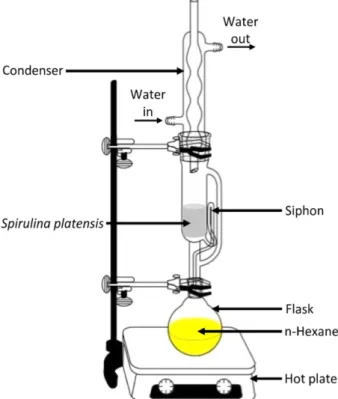
Microalgae lipids were extracted into a Soxhlet apparatus using heating mantel as a heating source. Ten grams of dry algae were kept over a Whatman filter paper and placed in a Soxhlet apparatus. The oil in the algae was extracted over 14 h using 100 mL hexane as the solvent. After the solvent was vaporized, the weight of the microal- gae lipids was determined and used to calculate the maximum recovery of yield. The schematic representation of extraction using Soxhlet apparatus is shown in Fig. 1.
2-3. Microwave-assisted lipid extraction
The extraction process was conducted using microwave Elex- tolux EMM2007X with minimum power of 800 W. The equipment used was designed as shown in Fig. 2. The microwave was used for lipid extraction because this heating method is more beneficial than the conventional one. The lipid extraction was in a 500 mL flat bot- tom flask with equipped reflux condenser and stirrer. Ten grams of
†To whom correspondence should be addressed.
E-mail: [email protected], [email protected] This is an Open-Access article distributed under the terms of the Creative Com- mons Attribution Non-Commercial License (http://creativecommons.org/licenses/by- nc/3.0) which permits unrestricted non-commercial use, distribution, and reproduc- tion in any medium, provided the original work is properly cited.
302 Ummu Kalsum, Heri Septya Kusuma, Achmad Roesyadi and Mahfud Mahfud
Korean Chem. Eng. Res., Vol. 57, No. 2, April, 2019
dried Spirulina platensis powder was loaded into the flask with sol- vent and heated with different extraction times while stirring. An extraction study was conducted using varying solvents and extraction times. The solvents used were methanol and n-hexane, which were modified using ratio 1:2, 1:1 and 1:0 (v/v).
The effects of using varying extraction times and solvents on the yield of microalgae lipid were investigated. After extraction, the mixture of biomass with solvent was filtered to separate filtrate and residue. Lipid from Spirulina platensis was obtained after the remain- ing solvents were distilled and evaporated.
3. Results and Discussion
3-1. The comparison of lipid extraction using Soxhlet extraction and microwave-assisted extraction methods
Table 2 shows the yield of lipid extracted from Spirulina platensis biomass using Soxhlet extraction and microwave-assisted extraction methods. The yield of lipids is presented as the total amount of extracted lipid per dry mass of microalgae.
Microwave-assisted extraction (MAE) produced better results than Soxhlet extraction. The yield of lipid extraction was 12.530%
per dry mass of algae produced by extraction using a mixture of methanol-hexane solvent (1:2) at 600 W of microwave power for a period of 40 min, whereas the yield by Soxhlet method was just 1.293%.
While using microwave irradiation, energy transfer into materials takes place rapidly through ionic conduction and interfacial polarisa- tion mechanism. Ranjan et al. (2010) [6] reported that oil extraction using microwave involves 1) Diffusion by lipid through cell walls into the solvent due to selectivity and solubility; and 2) Cell wall destruction with the contents being released into the solvent. Energy is transferred by the microwave into the material through dipolar polarization, ionic conduction and interfacial polarization, which brings about heating localization in materials and accelerates the reaction [7].
Extraction through microwave is generally based on mass trans- fer, properties of solvent and solute, the selectivity of solvents and the level of convection in the medium [8]. It is also determined by the dielectric constant and the dielectric properties of the solvent used.
The result obtained agrees with that of a related research from Bala- subramanian et al. (2011) [8], which revealed that microwave assisted extraction yielded higher lipids in comparison to extraction using Soxhlet method. Lee et al. (2010) [9] also reported better lipid extraction from Scenedesmus sp with 1:1 (v/v) chloroform-methanol by micro- wave for 5 min.
The yield obtained while using Soxhlet method for the extraction and n-hexane as the solvent was just 1.293%. In this method, non- polar solvents disrupt hydrophobic components by interacting with the neutral lipids in microalgae [4]. The yield obtained while using this method was lower when compared to the one gotten from the microwave assisted extraction because this method only relies on the ability of the solvents to penetrate the cell structure and attract oil stored in the cell matrix.
Lipid extraction of microalgae is highly dependent on the nature of solute and solvent, selectivity of solvent and the level convection of the medium. The major mechanism in Soxhlet extraction is diffu- Fig. 1. Schematic representation for extraction of lipid from Spiru-
lina platensis using Soxhlet.
Fig. 2. Schematic representation for extraction of lipid from Spirulina platensis using microwave.
Table 1. Yield of lipid extracted from Spirulina platensis by two different methods
Extraction methods Time Yield (%)
Soxhlet 14 h 1.293
Microwave 40 min 12.530
Lipid Extraction from Spirulina platensis using Microwave for Biodiesel Production 303
Korean Chem. Eng. Res., Vol. 57, No. 2, April, 2019 sion, and it does not involve mechanical application to the biomass.
Ultimately, this is a slow process which results in low yield and shows no improvement in yield, even when a polar solvent is used [10].
In the extraction processes using microwave, the use of solvent mixture modification (n-hexane/methanol) resulted in higher yield than the other extraction process. It is a non-polar solvent that is highly soluble to oils; thus, it is able to solve and attract oil content from the matrix cells of microalgae. It is also able to increase the absorption of energy, while methanol as the polar solvent allows microalgae to absorb more microwave energy; thus the rate of mass transfer and disruption of cells rises during microwave extraction. The extract- able yield obtained from microalgae while using the mixing solvent was noticeably higher than the yield obtained with hexane.
The result of using microwave in the extraction process (MAE) is strongly influenced by the microwave power used and the length of the extraction time [11-13]. Fig. 3 shows the yield of lipids extracted while using different solvents. In this study, the highest yield was obtained at 600 W over a period of 40 min using a modification of methanol and hexane solvent 1:2. The use of solvent modification n- hexane/methanol for the extraction of microalgae lipids while using microwave produced a higher yield than other extraction processes.
N-hexane as a non-polar solvent is highly soluble to oils; therefore, it is able to solve and attract oil content from the matrix cells of microalgae. It is also a medium which has the ability to increase the absorption of energy, while methanol is the polar solvent which allows microalgae to absorb more microwave energy; thus, the rate of mass transfer and disruption of cells rises during extraction with micro- wave. The lipid yield from microalgae using the mixing solvent was noticeably higher than the yield obtained with hexane.
The extraction process was conducted using high microwave power to obtain optimum yield of microalgae lipid. Microwave power acts as a driving force in the extraction process and brings about a heat- ing localization to ease the disruption of the matrix cell of microal- gae, thus making it easier to diffuse solutes out and dissolve in the solvent. However, the increase of microwave power increases the tem- perature and causes the yield of lipids to be constant or to decrease.
3-2. Fatty acid component of lipid from Spirulina platensis Microalgae lipids can be grouped into neutral and polar lipids.
Neutral lipids consist of triglyceride, hydrocarbon, fatty acid and ste- rol, whereas polar lipids are made up of phospholipid, glycolipid and Fig. 3. Yield of lipid from extraction of Spirulina platensis using micro-
wave at any time (process condition: mass of dried Spirulina platensis of 10 g and microwave power of 600 W).
Fig. 4. Chromatogram of lipid from Spirulina platensis.
304 Ummu Kalsum, Heri Septya Kusuma, Achmad Roesyadi and Mahfud Mahfud
Korean Chem. Eng. Res., Vol. 57, No. 2, April, 2019
carotenoid. Triglyceride (TAGs) is the highest component in microal- gae cells and it can be reached 80% from the total fat. It is often used as the main raw material in the production of biodiesel.
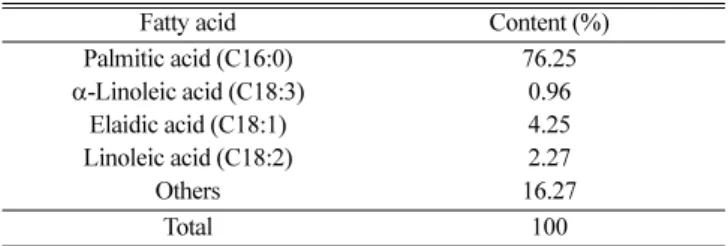
GC-MS analysis of fatty acid composition revealed that the fatty acid components of Spirulina platensis varied from C16-C18. The fatty acid composition of Spirulina platensis displayed the potential for biodiesel production.
From the composition of Spirulina platensis in Fig. 4 and Table 2, it can be seen that the fatty acid component consists of saturated fatty acid (SAFA) and polyunsaturated fatty acid (PUFAs). The fatty acid component of SAFAs contains palmitic acid with a percentage of around 76.25%, whereas the percentage of PUFAs contained in Spir- ulina platensis lipid was just 7.43%. The fatty acid component of PUFAs consists of a-linoleic acid, elaidic acid and linoleic acid.
4. Conclusions
Microwave assisted extraction was developed for the extraction of lipids from microalgae. This method has many advantages when compared to control, resulting in increased extraction yields. More than 12% lipid was extracted in 40 min in comparison to 1.293%
extracted in 14 h using Soxhlet extraction. The profile of microalgae lipid shows more saturated fatty acids which have the largest quanti- ties in the fatty acid component of microalgae that can potentially be developed for algal biodiesel production.
Acknowledgments
This research was partially supported by the Indonesian Ministry of Research, Technology and Education through Applied Research
University Grant. The authors are thankful to BBAP Takalar for pro- viding dried Spirulina platensis.
References
1. Kaushik, G., “Applied Environmental Biotechnology: Present Scenario and Future Trends,” Springer India, 2015.
2. Chisti, Y., “Biodiesel from Microalgae,” Biotechnol. Adv., 25, 294-306(2007).
3. Sheehan, J., Dunahay, T., Benemann, J. and Roessler, P., “Bio- diesel from Algae,” National Renewable Energy Laboratory, Colo- rado, 1998.
4. Mubarak, M., Shaija, A. and Suchithra, T. V., “A Review on Extraction of Lipid from Microalgae for Biodiesel Production,”
Algal Res., 7, 117-123(2015).
5. Iqbal, J. and Theegala, C., “Microwave Assisted Lipid Extraction from Microalgae Using Biodiesel as co-solvent,” Algal Res., 2, 34-42(2013).
6. Ranjan, A., Patil, C. and Moholkar, V. S., “Mechanistic Assess- ment of Microalgal Lipid Extraction,” Ind. Eng. Chem. Res., 49, 2979-2985(2010).
7. Bernardes, M. A. D. S., “Biofuel Production,” IntechOpen, Lon- don United Kingdom, 2011
8. Balasubramanian, S., Allen, J. D., Kanitkar, A. and Boldor, D.,
“Oil Extraction from Scenedesmus Obliquus Using a Continuous Microwave System–design, Optimization, and Quality Charac- terization,” Bioresour. Technol., 102, 3396-3403(2011).
9. Lee, J.-Y., Yoo, C., Jun, S.-Y., Ahn, C.-Y. and Oh, H.-M., “Com- parison of Several Methods for Effective Lipid Extraction from Microalgae,” Bioresour. Technol., 101(1), S75-S77, 2010.
10. Araujo, G. S., Matos, J. B. L, Fernandes, J. O., Cartaxo, S. J. M., Goncalves, L. R. B., Fernandes, F. A. N. and Farias, W. R. L.,
“Extraction of Lipid from Microalgae by Ultrasound Applica- tion,” Ultrason. Sonochem. 20, 95-98, 2013.
11. Kusuma, H. S., Altway, A. and Mahfud, M., “Alternative to Conventional Extraction of Vetiver oil: Microwave Hydrodistil- lation of Essential oil from Vetiver Roots (Vetiveria zizanioi- des),” IOP Conf. Ser.: Earth Environ. Sci., 101, 012015(2017).
12. Kusuma, H. S., Altway, A. and Mahfud, M., “Solvent-free Micro- wave Extraction of Essential oil from Dried Patchouli (Pogostemon cablin Benth) Leaves,” J. Ind. Eng. Chem., 58, 343-348(2018).
13. Ismanto, A. W., Kusuma, H. S. and Mahfud, M., “Solvent-free Microwave Extraction of Essential Oil from Melaleuca Leuca- dendra L.,” MATEC Web Conf., 156, 03007(2018).
Table 2. Fatty acid contents and composition of lipids from Spirulina platensis
Fatty acid Content (%)
Palmitic acid (C16:0) α-Linoleic acid (C18:3)
Elaidic acid (C18:1) Linoleic acid (C18:2)
Others
76.25 0.96 4.25 2.27 16.27 Total 100