A SHEAR BOND STRENGTH OF RESIN CEMENTS BONDED TO PRESSABLE PORCELAIN WITH
VARIOUS SURFACE TREATMENTS
Jong-Yeop Lee, D.D.S., Ph.Da., Eui-Bin Im, D.M.D.b
aChairman, Department of Dentistry, Kangbuk Samsung Hospital, Sungkyunkwan University School of Medicine
bDepartment of Dentistry, Kangbuk Samsung Hospital Sungkyunkwan University School of Medicine
Statement of problem. Resin cements are widely used in adhesive dentistry specially on all ceramic restorations. It is needed to find out adequate bonding strength between different porce- lain surface treatments, commercially available porcelains, and different resin cement systems.
Purpose.The purpose of this study was to evaluate shear bond strength of resin cements bonded to porcelains in three different modalities; 5 different porcelain surface treatments, 3 different resin cement systems and 3 different commercially available pressable porcelains.
Material and Method.This study consisted of 3 parts. Part I examined the effect of five different surface treatments on the pressable porcelain. Fifty discs (5 mm in diameter and 3 mm in height) of Authentic porcelain were randomly divided into 5 groups (n = 10). The specimens were sand- ed with 320 grit SiC paper followed by 600 grit SiC paper. The specimens were treated as follow:
Group 1-Sandblasting (aluminum oxide) only, Group 2 - sandblasting/silane, Group 3 - sandblasting/acid etching/silane, Group 4 - acid etching only, Group 5 - acid etching/silane. Part II examined the shear bond strength of 3 different resin cement systems (Duolink, Variolink II, Rely X ARC) on acid etch- ing/silane treated Authentic pressable porcelain. Part 3 examined the shear bond strength of Duolink resin cement on 3 different pressable porcelains (Authentic, Empress I, Finesse). All cemented spec- imens were stored in distilled water for 2 hours and tested with Ultradent shear bond strength test jig under Universal Instron machine until fracture. An analysis of variance(ANOVA) test was used to evaluate differences in shear bond strength.
Result. The shear bond strength test resulted in the following: (1) Acid etched porcelains record- ed greater shear bond strength values to the sandblasted porcelains. (2) Silane treated porcelains record- ed greater shear bond strength values to non-silane treated porcelains. (3) There was no significant difference between sandblasting/acid etching/silane treated and acid etching/silane treated porcelains. However those values were much higher than other three groups. (4) The shear bond strength with Variolink II was lower than the value of Duolink or Rely X ARC. (5) The shear bond strength of Finesse was lower than the value of Authentic or Empress I.
Key Words
Pressable ceramic, Porcelain surface treatment, Resin cement system
J Korean Acad Prosthodont : Volume 41, Number 3, 2003
※ This work was supported by Bisco, Inc(USA).
D
ental porcelains are widely used for their bio- compatibilities and good aesthetic result in mod- ern dentistry. The properties and characteristics of dental ceramics are being modified and de- veloped to produce better esthetic and strong ceramics. Pressable ceramic with lost-wax tech- nique is one of the approaches to produce better fitting and esthetic dental prosthesis. It is very crit- ical to form a strong bond between organic den- tal resins and dental porcelains to achieve suc- cessful restorations. Since Horn1(1983) proposed etch- ing porcelain laminate veneer restoration with ei- ther hydrofluoric acid or Stripit solution, there exist a lot of studies with different approaches to find better bonding between porcelain to resin cement.Stangle el al2revealed that porcelain etching sig- nificantly increased bond strength, and Chen et al3established that 120 seconds hydrofluoric acid produced the highest bond strength. Millet et al4(1995) showed that sandblasting increase the bond strength of first molar bands. Calamia and Simonsen5reported that etched porcelain sur- face is more important than silane treatment.
Rochette6first advocate the use of silane as a coupling agent. Lacy et al7showed that silane treat- ment increased almost 5 times higher bond strength than that of acid etched porcelain surface.
Barghi8also recommended that combination of acid etching and silane treatment would increase the bond strength.
Ever since Buonocore9advocated the use of etching the tooth, etching the tooth surface became a standard procedure in the adhesive dentistry. The adhesive in dentistry is still being developed and modified. With the discovery of wet bonding technique by Kanca10, the strength of dentin bonding is greatly enhanced. The sixth generation adhesive, which is All-in-One bottle sys- tem (etching, prime and adhesive agents in one bottle), is now on the market to reduce clinical time without loosing bonding strength. However,
fifth generation adhesive (primer and adhesive in one bottle) was used in this study because its use and strength is well known at present.
There exist numerous numbers of studies which shows different bond strength of porcelains bonded to resin cement, but most of works were done on feldspatic porcelains. This study was to evaluate (1) the shear bond strength of different surface treated pressable leucite enforced porce- lain [Authentic, Ceramay], (2) the shear bond strength of three commercially available resin cement systems (Rely X ARC, Duolink, Variolink II ) on Authentic porcelain, (3) shear bond strength of resin cement (Duolink) on three different pressable porcelains (Authentic, Empress I, Finesse).
MATERIAL AND METHOD
Three different commercially available leucite reinforced pressable porcelains, Authentic [Ceramay, Sturttgart, Germany], Empress I [Ivoclar, Schaan, Liechtenstein], Finesse [Dentsply, Milford, USA] were used.
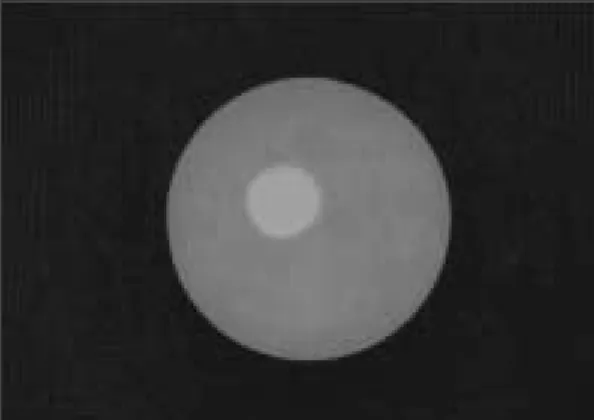
For different porcelain surface treatment test, 10 samples of Authentic disc were fabricated for each five groups. The wax patterns of disc (5 mm in diameter by 3 mm in height) were fabricated from a plastic mold. The wax patterns were invested and pressed into porcelain discs accord- ing to manufacture’s instructions. The discs were embedded in PMMA cold acrylic in the shape of a cylinder, 25 mm in diameter by 25 mm in height (Fig. 1). The specimens were then grounded on an orthodontic grinder to expose a clean surface of the porcelain. The specimens were subsequently treated with 320 grit SiC paper followed by 600 grit SiC paper. The specimens were then ultrasonically cleaned in distilled water. The samples were divided into 5 groups of 10 each, and the flat surface was used for the shear bond test.
Part I. The porcelain surface was treated as follow:
1. Group 1; specimen were sandblasted with 50- micron aluminum oxide [Dentaurum, Germany]
at 60 psi then ultrasonically cleaned for 3 min- utes in distilled water.
2. Group 2; specimens were sandblasted as group 1 then silanated with Bisco porcelain primer (silane).
3. Group 3; specimens were sandblasted as group 1 then acid etched with Bisco porcelain echant (hydrofluoric acid 9 %) for 2 minutes. The spec- imens were then ultrasonically cleaned for 3 minutes in distilled water. The specimens were silanated with Bisco porcelain primer (silane).
4. Group 4; specimens were acid etched with Bisco porcelain echant (hydrofluoric acid 9 %) for 2 minutes. The specimens were then ultra- sonically cleaned for 3 minutes in distilled water.
5. Group 5; specimens were acid etched as group 4 then silanated with Bisco porcelain primer (silane).
All specimens for part I were luted with One-Step [Bisco, Schaumburg, USA] adhesive with Duolink [Bisco, Schaumburg, USA] resin cement.
Part II. Different porcelains to Duolink resin cement.
Ten of each Empress I, Authentic and Finesse discs were fabricated as mentioned above. All specimens were acid etched and silanated as group 5 of part I.
Part III. Different resin cements to authentic porcelain disc.
Ten of Authentic porcelain disks were cement- ed with three different resin cement systems: 1.
Variolink II (resin cement), Excite (adhesive), Monobond S (porcelain silane) [Ivoclar, Schaan, Liechtenstein]. 2. Rely X ARC (resin cement, A1 shade), Single bond (adhesive), Porcelain Primer (porcelain silane), [3M, St. Paul, USA]. 3.
Duolink (resin cement), One step (adhesive), Porcelain primer (porcelain silane) [Bisco, Shaumburg. USA] were used.
Luting Procedure
For part I: two layers of One-Step adhesive were applies with a disposable brush on the porcelain samples which were embedded in the PMMA, then gentle air was applied to remove any excess. VIP [Bisco, Schaumburg, USA] curing light at 500 mV/cm2was used to cure the adhe- sive for 10 seconds. For group 2, 3 and 5, porce- lain silane (Porcelain Primer, Bisco) was applied for 20 seconds and then gentle air was applied before bonding.
For part II: two layers of One-Step adhesive were applies with a disposable brush on the three different porcelain types samples, which were embedded in the PMMA, then gentle air was applied to remove any excess. VIP curing light at 500 mV/cm2was used to cure the adhesive for 10 seconds.
For part III:
Variolink II (Ivoclar) resin cement system:
Monobond S (silane) was applied on the sample for 20 seconds, and then gentle air was applied.
Two layers of Excite (adhesive) was applies and excess was removed with gentle air. There was no light curing at this adhesive stage following manufacture’s instructions.
Rely X ARC (3M) resin cement system: porce- lain primer (silane) was applied on the sample for 20 seconds, and then gentle air was applied.
Two layers of Single Bond were applied with a dis- posable brush, and then gentle air was applies to remove excess adhesive. There was no light cur- ing at this adhesive stage following manufac- ture’s instructions.
All samples were mounted and secured in the Ultradent shear bond test sample holder (Fig.
2A, 2B). Equal amount of base and catalyst of resin cement were mixed on the paper tab, the resin
cement were stored in the gun type cement dis- penser, Centrix. The resin cement was filled in the
Ultradent plastic hole, and a small portion of light cur- ing composite resin,Biscore (Bisco, Schaumburg, USA) was placed on the top of the cement to gently push the resin cement. The total height of resin cement rod was less than 3 mm in height and 2.39 mm in diameter. All cement were light cured for 40 seconds from the top. The samples were disas- sembled from Ultradent sample holder then light cured for extra 20 seconds for complete polymer- ization. All specimens were immersed in the distilled water at 37℃ for 2 hours, and then tested to failure an Instron machine.
Ultradent shear bond test blade with semi-cir- cular shape (Fig. 3) was used at a headspeed of 0.5 mm / min (Fig. 4).
Fig. 1.Porcelain disc embedded in PMMA
(A) (B)
Fig. 2. A. Ultradent test assemble B. Top view of Ultradent test
Fig. 3.Ultradent shear bond test blade with semi-circular shape
Fig. 4.Sample assemble under shear bond test with Instron
RESULT
The mean and standard deviation were calculated for each group. An analysis of variance (ANOVA) test was used throughout to evaluate differences in shear bond strength of the cement to the different surface treatment. Significance at 95 % was chosen as representative of the result. Multiple compari- son (Tukey) was used to compare each group.
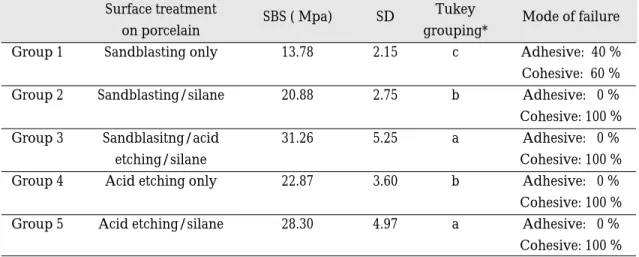
The result of the shear bond test of part I is sum- marized in table Ⅰ. Group 3 (sandblasted/hydro- fluoric acid etching /silane) showed the highest shear bond strength value, and group 1 (sand-
blasting only) showed the lowest. Group 2 and 5 showed higher bonding strength than that of group 1 and 4. There was no statistical difference between group 3 and 5. Most of the fracture was cohesive fracture (Fig. 6) in the porcelain except that group 1 showed 40 % of adhesive failure.
For different porcelain test, Authentic and Empress I showed higher values compared to Finesse (Table Ⅱ). Most (90 %) of the fracture took place in the porcelain (porcelain cohesive fracture).
For different resin cement test, Duolink and Rely X ARC showed higher shear bond strength values to Variolink II (Table Ⅲ).
Table Ⅰ. Shear bond strength of different surface treatment on Authentic porcelain with Duolink resin system(P<0.05)
Surface treatment
SBS ( Mpa) SD Tukey
Mode of failure
on porcelain grouping*
Group 1 Sandblasting only 13.78 2.15 c Adhesive: 40 %
Cohesive: 60 %
Group 2 Sandblasting/silane 20.88 2.75 b Adhesive: 0 %
Cohesive: 100 %
Group 3 Sandblasitng/acid 31.26 5.25 a Adhesive: 0 %
etching/silane Cohesive: 100 %
Group 4 Acid etching only 22.87 3.60 b Adhesive: 0 %
Cohesive: 100 %
Group 5 Acid etching/silane 28.30 4.97 a Adhesive: 0 %
Cohesive: 100 %
� : Different letters designate significantly different groups.
Table Ⅲ. Shear bond strength of different resin cement systems on Authentic porcelain disc(P<0.05)
Cement Adhesive
SBS SD Tukey Mode of ( Mpa) grouping* failure Doulink One- 28.30 4.97 a Adhesive: 0 %
Step Cohesive: 100 %
Rely X Single 27.81 4.38 a Adhesive: 0 %
ARC Bond Cohesive: 100 %
Variolink Excite 21.56 3.41 b Adhesive: 10 %
II Cohesive: 90 %
� : Different letters designate significantly different groups.
Table Ⅱ. Shear bond strength of different porce- lains with Duolink resin system(P<0.05)
Porcelain SBS SD Tukey Mode of (Mpa) grouping* failure Authentic 28.30 4.97 a Adhesive: 0 %
Cohesive: 100 % Empress I 28.67 5.07 a Adhesive: 0 %
Cohesive: 100 % Finesse 20.87 4.30 b Adhesive: 10 % Cohesive: 90 %
� : Different letters designate significantly different groups.
DISCUSSION
The polymerized resin provides considerable retention and simultaneously protects the porce- lain from cracking and fracturing under tensile stresses. Etching the porcelain surface with hydro- fluoric acid produces the microscopic surface roughness that provides retention when com- bined with a flowable resin capable of polymer- izing. The SEM view showed differences between untreated porcelain, sandblasted porcelain, and hydrofluoric acid etched porcelain (Fig. 5-A, B, C).
Ozcan et al11found out that sandblasting created very fine roughness and thus increased bonding surface area, but the bonding strength was insuf-
ficient. However the sandblasting increased bonding strength significantly when it was used on In-Ceram which cannot be etched12 with hydrofluoric acid. The use of silane for bonding ceramic was first suggested by Rochette6, and its use is now a standard procedure. Aida et al13revealed that silane enhances the formation of siloxane bonds and facilitates the adhesion of composite resin and porcelain. The reaction between methoxysilane of the silane agent and the OH group of porcelain surface that forms silox- ane bonds is initiated and accelerated by acid cat- alyst. Lacy et al7also stated that silane coupling agent with acid etching of porcelain surfaces may increase a bond strength stronger than a
A:untreated B:sandblasted
C: acid etched
Fig. 5.Porcelain surfaces A: untreated, B: sandblasted, C: acid etched
Fig. 6.Fracture site -porcelain cohesive failure
cohesive strength of the porcelain. In this exper- iment, group 3 and 5 which are the combina- tion of acid etching and silane treatment showed higher shear bond strength values due to both mechanical (hydrofluoric acid) and chemical (silane) bonding.
In the comparison of three different resin cement systems, Variolink resin cement showed the lower bond strength than others. The low pH of Excite adhesive used with Variolink II may cause the interference with the 3。amine group in the resin cement to lower the bonding capability.
The shear bond strength of resin cement bond- ed to Finesse porcelain showed lower bond strength than that of others. This may due to dif- ferent etched surface patterns and its low cohesive strength compared to other two porcelains.
The bond strength values in this study in gen- eral were higher than that of other investiga- tors5,14. The reason is that the area of bonding site used in this experiment was 0.04448 cm2, which is smaller than other investigators bonding site areas. Pecola15et al also compared shear bond strength of resin bonded to teeth with both tapered knife edge and restricted Ultradent test- ing device and concluded that restricted ultradent testing devices produced higher shear bond strength. The force to break divided by bonding area calculates shear bond strength value. If the bonding sites were smaller, then the bonding value would be higher. Hara16studied the effect of crosshead speed on shear bond strength and concluded that the slower the crosshead speed, the lower the shear bond strength. It was difficult to set absolute shear bond strength of resin cement bonded to porcelain to determine adequate bond- ing strengths. All bonding tests done in this study seemed to exceed the bond strength of resin cement from polymerization shrinkage.
However, further studies are still needed.
CONCLUSION
The conclusion that can be drawn from this study is as follow:
1. Shear bond strength of hydrofluoric acid etch- ing on leucite enforced pressable ceramic was higher than that of sandblasted surface.
2. Silane treated porcelain surface produced higher bond strength than that of non-silane treated porcelain.
3. There was no significant difference between sandblasting/acid etching/silane treated and acid etching/silane treated porcelains. However those values were much higher than other three groups.
4. Shear bond strength of Variolink II resin cement was lower than that of Duolink or Rely X ARC.
5. Shear bond strength of Finesse porcelain was lower than that of Authentic or Empress I.
REFERENCES
1. Horn, H.R., Porcelain laminate veneers bonded to etched enamel. Dental Clinics of North America 1983;27:671.
2. Stangel, I., Nathanson. D., Hsu, C.S., Shear strength of the composite bond to etched porcelain. J Dent Rest 1987;66:1460~5.
3. Chen, J. H., Matsumura, H., Atsuta, M., Effect of etching period on the bond strength pf a com- posite resin to a machinable porcelain. J Dentistry 1998;28:53~58.
4. Millet, D.T., McCube, J.F.,Bennett, T.G., Carter, N.E., Gordan, P.H., The effect of sandblasting on the retention of first molar orthodontic bands ce- mented with glass ionomer cement. British J of Orthodontics 1995;22:161.
5. Calamia, J.R., Simonsen, R. J., Effect of coupling agent on bond strength of etched porcelain. J Dent Rest 1984;63:179.
6. Lacy, A.M., Laluz, J., Watanabe, L.G., Dellinges, M., Effect of porcelain surface treatment on the bond to composite. J Prosthet Dent 1988;60:288~91.
7. Rochette, A.L., A ceramic bonded by etched enam- el and resin for fractured incisors. J Prosthet Dent 1975;33(3):287~293.
8. Barghi, N., To silnate or not to silanate: making a clinical decision. Compendium 2000;21:660~664.
9. Buonocore, M.G., A simple method of increas-
ing the adhesion of acrylic filling material to enamel surface, J Dent Res 1955;34:849-853.
10. Kanca, J.III., Improving bond strength through acid etching of dentin and bonding to wet dentin surface. JADA 1992;123:35-42.
11. Ozcan, M., Pfeiffer, P., Nergiz, I., A brief history and current status of metal and ceramic surface con- ditioning concepts for resin bonding in dentistry.
Quintessence International 1988;29:713~723.
12. Neikes, M.J., Kern, M., Strab, J.R., Tensile bond strength of two silicoating(silicate/silanization) sys- tems on the Al2O3In-Ceram. J Dent Rest 1992;71:533.
13. Aida, M., Hayakawa, T., Mizukawa, K., Adhesion of composite to porcelain with various surface conditions. J Prosthet Dent 1995;73:464.
14. Shahverdi. S., Canay. E., Bilge. A., Effect of different surface treatment methods on the bond strength of
composite resin to porcelain. J of Oral Rehabil 1998:25;699~705
15. Pecola, N., Yaman, Peter., Dennison, Joseph., Herrero. Alberto., Comparison of shear bond strength relative to two testing device. J Prosthet Dent 2002;88:511~515
16. Hara A.T., Pimenta, L.A., Rodrigues, L.A., Influence of cross-head speed on resin -dentin shear bond strength. Dent Meter 2001;14:319-323.
Reprint request to:
DR.JONG-YEOPLEE
DEPARTMENT OF DENTISTRY KANGBUKSAMSUNG HOSPITAL SUNGKYUNKWANUNIVERSITYSCHOOL OFMEDICINE 108, PYUNG-DONG,JONGRO-GUSEOUL,KOREA110-746 [email protected]