https://doi.org/10.9713/kcer.2017.55.6.785 PISSN 0304-128X, EISSN 2233-9558
Recovery of Zinc in Spent Pickling Solution with Oxalic Acid
Kyung-Ran Lee*, Jeongsook Kim and Jeong-Gook Jang†
Division of Energy and Bio Engineering, Dongseo University, 47, Jurye-ro, Sasang-gu, Busan, 47011, Korea
*Department of Environmental Engineering, Pukyong National University, 45, Yongso-ro, Nam-gu, Busan, 48513, Korea (Received 19 June 2017; Received in revised form 16 July 2017; accepted 18 July 2017)
Abstract − To collect zinc, Fe and Zn in spent pickling solution were extracted by using TBP (tributyl phosphate), and Zn was recovered from extracted solution to zinc oxalate particles by oxalic acid solution. The reusability of TBP sol- vent was also tested. The distribution coefficient of Zn was not affected by the concentration of Fe in spent pickling solution, almost constant with the values of 7.12~9.31 when extracted by TBP solvent. It was found that the extraction capacity of TBP solvent for Zn is higher than that for Fe. The extraction efficiency of Zn was higher than 95%, while most of Fe was left in aqueous phase. After the recovery, the used TBP solvent could be repeatedly reused for the extraction of Zn up to eight times. XRD analysis showed that zinc oxalate (ZnC2O4 2H2O) was formed from the reac- tion of Zn-TBP and oxalic acid. From the results of SEM analysis, the formation of zinc oxalate particle was strongly affected by the concentration of oxalic acid. In summary, Zn in spent pickling solution was successfully separated and recovered with TBP solvent and oxalic acid solution, respectively.
Key words: Spent pickling solution, Reuse of TBP solvent, Extraction, Zn recovery, Oxalic acid
1. Introduction
Metallic coating is a principal technique used to improve the cor- rosion resistance of various types of steel. Zinc layers are commonly used to protect steel goods from corrosion. The process of zinc depo- sition consists of the following steps: (i) degreasing with a hot alka- line solution, (ii) rinsing with water, (iii) pickling with 20% HCl solution, and (iv) rinsing and fluxing with zinc and ammonium chlo- rides and hot-dip coating with molten zinc at temperatures of about 450oC, In the pickling step, hydrochloric acid is consumed during the process, and several types of effluents can be generated by the mixture of the various washing waters and the saturated solutions which are substituted regularly. These solutions normally contain hydrochloric acid, oils, processing additives and metals of high con- centrations. In the pickling effluents from the zinc-plating processing, zinc (Zn) and iron (Fe, mainly Fe2+) are dissolved in hydrochloric acid as forms of metal-chloride complexes that might be recovered [1,2].
The metallic components in a spent pickling solution are pre- sented in a dissolved or solid state. Metals in a solid state are easily removed from the solution by gravitational sedimentation or filtra- tion. But ionic species should be separated by neutralization and pre- cipitation using chemicals such as lime or soda [3-6]. The resulting sludge is dewatered, stabilized, and incinerated or finally disposed in landfill. In this conventional treatment method, however, valuable
components in the waste are not recovered for reuse. In addition, it becomes increasingly difficult to secure enough landfill space [7].
Various types of separation technologies have been proposed to recover metals from the spent solution. They are referred to as sol- vent extraction [8,9], membrane distillation [10,11], selective precip- itation [12], anion exchange and membrane electroextraction [6], and microbial oxidation followed by liquid-liquid extraction and sol- vothermal synthesis of ferrites [13].
For the recovery of valuable metals from waste, which is to sepa- rate, purify and concentrate the metals from its mixed solution, the solvent extraction process is attractive because of its efficient, versa- tile, and flexible application to concentrations and species of metals in wastes, compared with other processes [14].
In non-ferrous metal industries, the solvent extraction process has been applied to the separation of nickel and cobalt solutions, and the extraction of copper, platinum group and rare earths metals [9,15].
Extensive studies have been recently carried out on the extraction and separation of zinc from pickling solutions using various solvents because the concentration of Zn in pickling solution is relatively high; thus, their recovery is very important from both environmental and economical aspects [8,9,16,17]. These studies were conducted to select adequate solvent for extraction of Zn and Fe from pickling solution with various solvent such as ALMIN 336 (tertiary amines), D2EHPA (di-2(-ethylhexyl) phosphoric acid), CYANEX 272 (bis(2,4,4- trimethylpentyl) monothiophosphinic acid), CYANEX 302 (bis(2,4,4- trimethylpentyl) dithiophosphinic acid) and TBP (tributyl phosphate) [1,8,9,18,19].
However, most of these studies rarely considered the reusability of solvent and recovery of Zn from extracted solution, but only focused on the extraction efficiency of Zn and Fe for a specific solvent. For
†To whom correspondence should be addressed.
E-mail: [email protected]
‡This article is dedicated to Prof. Jea Keun Lee on the occasion of his retire- ment from Pukyong National University.
This is an Open-Access article distributed under the terms of the Creative Com- mons Attribution Non-Commercial License (http://creativecommons.org/licenses/by- nc/3.0) which permits unrestricted non-commercial use, distribution, and reproduc- tion in any medium, provided the original work is properly cited.
the field application of the solvent extraction method, solvent reus- ability and recovery of valuable metals must be considered.
In this study, therefore, TBP was selected as an adequate solvent because its solubility for water and loss of solvent are lower than those of other solvents in the Zn extraction process [19]. The extraction efficiency of Zn in spent pickling solution and the recovery effi- ciency of Zn from extracted solution were investigated by using TBP solvent and oxalic acid solution, respectively. To investigate the reus- ability of TBP solvent, the extraction efficiency of Zn in pickling solution was also investigated according to the number of repeated extraction with used TBP solvent.
2. Materials and methods
2-1. Materials
Spent pickling solution was generally produced from Zn-plating process, and thus experimental solution was prepared artificially to control the Zn and Fe concentrations. Zn powder (Kanto chemical Co., Inc.) and reduced iron (JUNSEI, extra pure) were dissolved in 6 M HCl solution. TBP (tributyl phosphate, JUNSEI, special grade) was used as an organic solvent, and oxalic acid (H2C2O4·2H2O, JUN- SEI, extra pure) was used to recover Zn from extracted solution.
2-2. Methods
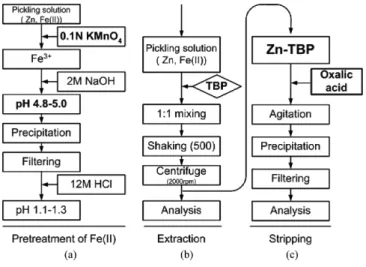
Fig. 1 is the flow diagram of the pretreatment, extraction and strip- ping procedures of Zn in spent pickling solution. To investigate the effect of Fe pretreatment, Fe2+ present in spent pickling solution was oxidized to Fe3+ by oxidizing agent (0.1N of KMnO4). And the solu- tion was hydrolyzed in conditions of pH 4.8~5.0 controlled by 2 M of NaOH solution. The precipitated Fe in the solution was filtered and the filtrate was controlled around pH 1.2 as shown in Fig. 1(a).
The extraction procedure of Zn and Fe is presented in Fig. 1(b). As shown in Fig. 1(b), 200 ml of TBP solvent was mixed with the same volume of pickling solution. The mixed solution was agitated suffi- ciently and separated by a centrifugal separator (2000 rpm, 10 min) into organic (TBP solvent) and aqueous (pickling solution) phases.
Recovery procedure of Zn from extracted solution in organic phase is presented in Fig. 1(c). To extract reversely Zn in organic phase, a small amount of oxalic acid was injected into Zn-loaded organic solution (TBP solvent). Particulate matters were formed and precipi- tated by the reaction of Zn-loaded TBP solvent and oxalic acid, and those were filtered, dried and analyzed by X-ray diffraction analyzer (X'Pert Philips) and SEM (HITACHI S-2400). After filtration of par- ticulate matters, the filtrate was recycled into the extraction process without new supply of TBP to assess the reusability of TBP solvent.
The concentrations of Zn and Fe were analyzed by atomic absorp- tion spectroscopy (AAS) in the sampled solutions from the pretreat- ment, extraction and stripping processes.
The bonding force between TBP solvent and water is very weak, as low as about 4.5 kcal/mol. The solubility of TBP for water is about 1.5×10⁻³ M (0.041%) in room temperature and decreases with tem- perature increase. The reason is that the dissociation degree of TBP is decreased with increase of temperature. Therefore, volume correc- tion was carried out because the volume of TBP solvent was changed in extraction procedure.
3. Results and discussion
3-1. Effect of Fe component in pickling solution
According to Hwang et al. [20], the extraction efficiency of Zn is strongly affected by the presence of Fe when spent pickling solution containing Zn and Fe is separated by liquid membrane method. In this case, Fe ion plays an inhibition role in the separation of Zn ion because of its similar extraction characteristics.
To investigate the effect of Fe concentration on the extraction characteristics of Zn, therefore, Fe concentrations were controlled by 20 mg/L and 200 mg/L with constant Zn concentration (800 mg/L) in spent pickling solution. Effect of Fe2+ concentration on the extraction rate of Zn into the TBP solvent was then investigated when spent pickling solution was pretreated or not.
The extraction efficiency of metal component in spent pickling solution can be determined by the assessment of distribution coeffi- cient (k) of each metal component. The concentrations and distribu- tion coefficients of Zn and Fe with the pretreatment of Fe2+ were analyzed and calculated, respectively. The distribution coefficient of metal component was defined as the ratio of the metal concentration in the organic solvent (Co) to that in aqueous solvent (Ca). The distri- bution coefficients are listed in Table 1. As shown in Table 1, the dis- tribution coefficient of Zn was not nearly affected by the pretreatment of Fe2+, and the values were in the range of 7.12~9.31. But the distribu- tion coefficient of Fe was lower than that of Zn, and the range was below 0.34.
In extracting pickling solution by TBP, metals participated in extraction reaction were ion forms of metal chlorides. Thus, the extraction rate was remarkably affected by the concentration of chlorine ion, and that was proportionally determined by the formation rate of complex compound reacted with chlorine anion [21].
Fig. 1. Flow diagram of experiments.
Therefore, it was found that the distribution coefficient of Zn was not considerably affected by the concentration of Fe. The reason is that pH of pickling solution was maintained at much lower level than that of the oxidation range of Fe2+. If pH condition had been main- tained at above 4, extraction characteristics of Zn would have been considerably decreased by the concentration of Fe3+ because most of Fe2+ in pickling solution would have been oxidized to Fe3+. Although Fe2+ existed in pickling solution, the extraction efficiency of Zn was not affected because extraction experiments were carried out around pH 1.2.
Also, the extraction efficiency of Zn was not seriously affected by the concentration of Fe in pickling solution, due to the differences of formation energies of complex compounds which can be formed by chlorine ions of Zn and Fe.
3-2. Effect of extraction number
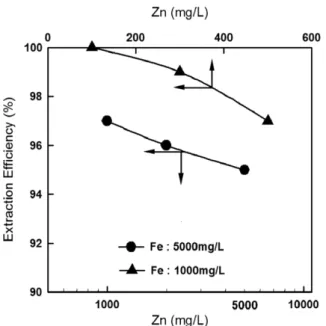
Generally, repeated extraction could be conducted to enhance the overall extraction efficiency. Therefore, repeated extraction test with- out new supply of solvent was carried out to investigate the effect of the number of repeated extractions on the extraction efficiency of Zn and remaining efficiency of Fe in pickling solution. In this test, Fe concentrations were 1000 mg/L and 5000 mg/L, and the pH of pick- ling solution was controlled at about 1. The extraction efficiency of
Zn was measured according to the concentration of Zn (100~5000 mg/L) in pickling solution, and the results are profiled in Fig. 2. As shown, the extraction efficiency of Zn in 1000 mg/L of Fe was higher than that in 5000 mg/L of Fe. And the extraction efficiency of Zn was higher than 95%, and that was slightly decreased with increase of Zn. It was attributed to the fact that the distribution coefficient of Zn for TBP was increased with decrease of Zn concentration. And it was suggested that the extraction performance of TBP for Zn was very high in pickling solution.
Fig. 3 shows the remaining efficiency of Fe in pickling solution with regard to iterative extractions using TBP solvent. The iterative extraction was carried out ten times using new organic solvent (TBP).
As mentioned, the distribution coefficient of Fe in TBP solvent was remarkably lower than that of Zn. The remaining efficiency was decreased with increase of extraction number. In the first extraction, the remaining efficiency of Fe in pickling solution was about 92~95%, and that was slightly decreased to around 85% until eight times extraction. But when the extraction number exceeded eight times, the efficiency was remarkably deceased to the range of 61~70%. The reason is that the bonding energy of Fe with chlorine ion in pickling solution is significantly higher than that of Zn. Therefore, Zn was preferentially extracted while Fe remained in pickling solution.
It was estimated that the extraction of Fe progressed after the extraction of Zn was almost accomplished and the concentration of Zn was sufficiently lowered. To enhance the utilization rate of extraction Table 1. Effect of Fe concentration and pretreatment on the distribution coefficients of Zn and Fe in TBP solution
Zn
(mg/L) Pretreatment Fe (mg/L) Distribution coefficient
Total Fe2+ kZn*(-) kFe*(-)
800 800 800 800
No Yes No Yes
20 20 200 200
15.94 0.05 164.26
4.00
7.23 7.12 9.31 7.15
0.11 0.34 0.25 0.25
*kZn, kFe (=Co/Ca); distribution coefficients of Zn and Fe, respectively
Fig. 2. Extraction efficiency of Zn according to concentrations of Zn and Fe in pickling solution.
Fig. 3. Remaining efficiency of Fe in pickling solution with extraction number.
solvent, therefore, iterative extraction was found to be suitable to selective extraction of Zn and Fe in pickling solution until 8 times.
3-3. Recovery of Zn in organic phase
It has been reported that there are many ways for production pro- cesses of ZnO powder [20]. The precipitation stripping method in these processes is very excellent. The reason is that metals or com- pounds are able to be produced directly by reducing agent or chemi- cal precipitant after extracting metal ions into organic phase. The stripping process is not separately conducted because the precipita- tion and stripping reactions of metal ions occurred simultaneously.
To extract reversely Zn in organic phase (TBP), therefore, backward extraction was carried out by oxalic acid, and their reaction equa- tions are as follow:
Extraction
Zn2+ + n(TBP) → n(TBP)−Zn (1)
Stripping
Zn- n(TBP) + 2H+ → Zn2+ + n(TBP) (2)
Precipitation
Zn2+ + C2O42- → Zn C2O4 (3)
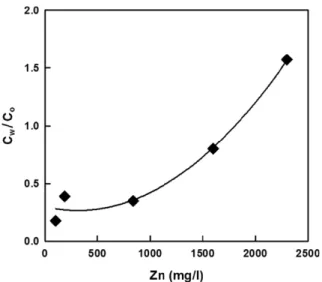
Fig. 4 shows the result of backward extraction with oxalic acid. Cw and Co are defined as the concentrations of Zn in water phase (oxalic acid) and organic phase (TBP), respectively. As shown in Fig. 4, the concentration ratio of Cw to Co increased exponentially with increase of Zn concentration in TBP. This might be due to the production of zinc oxalate through the reaction of oxalic acid added and Zn in TBP.
By adding the oxalic acid into the stirred TBP solvent, emulsion of oxalic acid was formed, and Zn2+ in TBP solvent which is organic phase was stripped in through the ion exchange with H+ in oxalic acid which is aqueous phase. Finally, stripped Zn2+ was precipitated as a form of zinc oxalate according to the reaction of Equation (3).
XRD analysis was carried out to verify the compound of precipi-
tated material according to the concentrations of oxalic acid for backward extraction. Fig. 5 shows the X-Ray diffraction patterns of precipitated materials from Zn-loaded TBP solution by backward extraction. The peaks mean the precipitated zinc oxalate (ZnC2O4·2H2O) with the concentration of oxalic acid. As shown in Fig. 5, the precipi- tated powder was pure state of zinc.
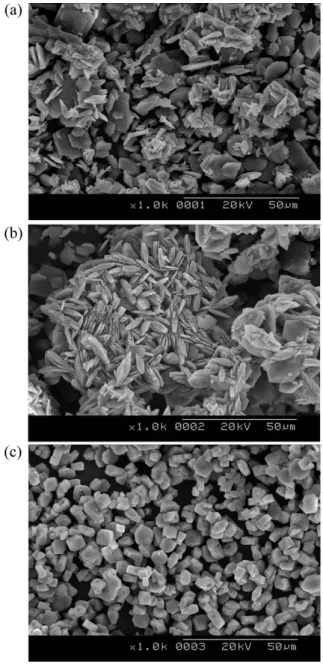
For the purpose of Zn recovery, Zn component in TBP was inversely extracted by oxalic acid and zinc oxalate (ZnC2O4·2H2O) was precipitated as powder. Fig. 6 shows the results of SEM analysis for ZnC2O4·2H2O, which was precipitated by the reaction of oxalic acid and Zn-TBP. As shown in Fig. 6, crystal forms of oxalate parti- cles remarkably varied with regard to the concentration of oxalic acid.
The form of zinc oxalate particle obtained in 0.1 M of oxalic acid was very irregular and flat type particles. When 0.5 M of oxalic acid was added, the shape of particles was similar to the result of 0.1 M of oxalic acid, but their size was slightly decreased. The SEM analysis result of ZnC2O4·2H2O particle, which was formed by the reaction of 1.0 M oxalic acid and Zn-TBP, significantly differed from the pre- vious two results. Most of the particles were very regular and had tet- rahedral shapes. From these results, it was found that the concentration of oxalic acid is a very important parameter for Zn recovery. From the remarkable effect of oxalic acid concentration on the formation of homogenized fine particles of zinc oxalate, it is expected that the recovery rate of fine powder of ZnO will be increased with increase of oxalic acid concentration.
Fig. 4. Ratio of Cw/Co according to various concentration of Zn in TBP by stripping of oxalic acid.
Fig. 5. X-Ray diffraction pattern of zinc oxalate precipitated from Zn-loaded TBP solution.
4. Conclusions
Extraction characteristics of Zn, and the remaining efficiency of Fe in pickling solution were investigated by TBP solvent extraction method. Zn in Zn-loaded TBP solvent was also extracted inversely with oxalic acid.
(1) At the conditions of 800 mg/L of Zn in pickling solution, it was estimated that the distribution coefficients of Zn were about 7.12~9.31 by TBP solvent extraction, and these distribution coefficients were not affected by Fe concentration in pickling solution.
(2) The extraction efficiency of Zn in pickling solution was over 95% with TBP solvent used, and the extraction performance of TBP was very excellent for Zn in pickling solution. The remaining effi- ciency of Fe in pickling solution was remarkably higher than that of
Zn when TBP was used as extracting solution.
(3) It was estimated that the extraction of Fe progressed after extraction of Zn was nearly accomplished and the concentration of Zn was sufficiently lowered. In iterative extraction, therefore, it was found that extraction more than eight times was not suitable for selective extraction of Zn and Fe in pickling solution.
(4) Zn in TBP solvent was reversely extracted by oxalic acid for the purpose of Zn recovery. The Zn concentration ratio of Cw to Co increased exponentially with increase of Zn concentration in TBP solvent.
(5) From the result of XRD analysis, it was confirmed that the pre- cipitated products in the reaction of Zn-TBP and oxalic acid were ZnC2O4·2H2O which can be precursor of ZnO. And that the concen- tration of oxalic acid was very important parameter for the forma- tion of zinc oxalate from the result of SEM analysis.
In summary, Zn in spent pickling solution was successfully sepa- rated and recovered by TBP solvent and oxalic acid, respectively.
References
1. Laso, J., García, V., Bringas, E., Urtiaga, A. M. and Ortiz, I.,
“Selective Recovery of Zinc over Iron from Spent Pickling Wastes by Different Membrane-based Solvent Extraction Process Configurations,” Industrial & engineering chemistry research, 54(12), 3218-3224(2015).
2. Silva, J. E., Paiva, A. P., Soares, D., Labrincha, A. and Castro, F., “Solvent Extraction Applied to the Recovery of Heavy Metals from Galvanic Sludge,” Journal of hazardous materials, 120(1/3), 113-118(2005).
3. Bolto, B. A. and Pawlowski, L., “Reclamation of Wastewater Constituents by Ion Exchange,” Effluent Water Treatment Journal, 23(6), 233-239(1983).
4. Kang, C. D., Sim, S. J. and Kim, W. S., “Continuous Removal of Copper from Wastewater by the Process Consisting of Ferric/
Limestone Coagulation, Polymer Flocculation, and Lamellar Sedimen- tation,” J. Ind. Eng. Chem. Seoul, Korea, 8(4), 328-333(2002).
5. Argiropoulos, G., Cattrall, R. W., Hamilton, I. C., Kolev, S. D. and Paimin, R., “The Study of a Membrane for Extracting Gold(III) from Hydrochloric Acid Solutions,” Journal of Membrane Sci- ence, 138(2), 279-285(1998).
6. Csicsovszki, G., Kékesi, T. and Török, T. I., “Selective Recovery of Zn and Fe from Spent Pickling Solutions by the Combination of Anion Exchange and Membrane Electrowinning Techniques,”
Hydrometallurgy, 77(1/2), 19-28(2005).
7. Lee, K. S. and Lee, I. K., “Recovery of Acids and Metals from a Spent Pickling Liquor through Ion Exchange and Cementation,” J.
Ind. Eng. Chem., 10(2), 196-200(2004).
8. El Dessouky, S. I., El-Nadi, Y. A., Ahmed, I. M., Saad, E. A. and Daoud, J. A., “Solvent Extraction Separation of Zn(II), Fe(II), Fe(III) and Cd(II) using Tributylphosphate and CYANEX 921 in Kerosene from Chloride Medium,” Chem. Eng. Process., 47(2), 177-183(2008).
9. Jha, M. K., Kumar, V. and Singh, R. J., “Solvent Extraction of Zinc from Chloride Solutions,” Sol. Extr. and Ion Exch., 20(3), 389-405(2002).
Fig. 6. SEM of oxalate particles precipitated from TBP solution (a) 0.1 M, (b) 0.5 M, (c) 1.0 M of oxalic acids.
10. Tomaszewska, M., Gryta, M. and Morawski, A. W., “Recovery of Hydrochloric Acid from Metal Pickling Solutions by Membrane Distillation,” Sep. Purif. Technol., 22/23, 591-600(2001).
11. Ju, C. S., Cheon, J. K. and Ha, H. D., “Separation of Zinc Ion from Aqueous Solutions by Liquid Membrane Permeator with Two Micro- porous Films,” Korean Chem. Eng. Res., 38(1), 13-19(2000).
12. Jandova, J., Maixner, J. and Grygar, T., “Reprocessing of Zinc Galvanic Waste Sludge by Selective Precipitation,” Journal Ceram- ics-Silikáty, 46(2), 52-55 (2002).
13. Konishi, V., Nomura, T. and Mizoe, K., “A New Synthesis Route from Spent Sulfuric Acid Pickling Solution to Ferrite Nanopar- ticles,” Hydrometallurgy, 74(1-2), 57-65(2004).
14. Swain, B., “Separation of Cobalt and Lithium from Lithium-ion Battery Industry Watse by Solvent Extraction and Supported Liquid Membrane: a Comparative Study,” Ph. D. Thesis, Chungnam National University, Korea, 1-237(2007).
15. Mahmoud, M. H. H. and Barakat, M. A., “Utilization of Spent Copper-pickle Liquor for Recovery of Metal Values,” Renewable Energy and Environment Protection Technology, 651-662(2001).
16. Regel-Rosocka, M. and Szymanowski, J., “Iron(II) Transfer to
the Organic Phase During Zinc(II) Extraction from Spent Pick- ling Solutions with Tributyl Phosphate,” Sol. Extr. and Ion Exch., 23(3), 411-424(2005).
17. Grzeszczyk, A. and Regel-Rosocka, M., “Extraction of Zinc(II), Iron(II) and Iron(III) from Chloride Media with Dibutylbutyl- phosphonate,” Hydrometallurgy, 86(1-2), 72-79(2007).
18. Andersson, S. O. S. and Reinhardt, H., Handbook of Solvent Extraction, edited by Teh C. Lo, M. H. I. Baird and C. Hanson, New York: John Wiley, c(1983).
19. Regel-Rosocka, M., Sastre, A. M. and Szymanowski, J., “Recovery of Zn(II) from HCl Spent Picklng Solution by Solvent Extraction,”
Environ. Sci. Technol., 35, 630-635(2001).
20. Hwang, J. S., Oh, C. H. and Lee, C. T., “Leaching of Valuable Metal and Separation of Zn Component from the Solid Waste EAF Dust,” J. Korean Solid Waste Engineering Society, 13, 96- 107(1996).
21. Ahn, J. W. K. and Park, H., “Extraction of Iron(III) from a Syn- thetics Leaching Solution of Mangnese Nodules by TBP,” Journal of Korean Institute of Mineral and Energy Resources Engineers, 35, 588-594(1998).