137 http://dx.doi.org/10.9713/kcer.2015.53.2.137
PISSN 0304-128X, EISSN 2233-9558
The Separation and Recovery of Nickel and Lithium from the Sulfate Leach Liquor of Spent Lithium Ion Batteries using PC-88A
Viet Tu Nguyen*,**, Jae-chun Lee*,**,†, Jinki Jeong**, Byung-Su Kim** and B. D. Pandey***
*Korea University of Science and Technology (UST), Resources Recycling, 217 Gajeong-ro, Yuseong-gu, Daejeon 305-350, Korea
**Korea Institute of Geoscience and Mineral Resources (KIGAM), Mineral Resources Research Division, 124 Gwahak-ro Yuseong-gu, Daejeon 305-350, Korea
***CSIR - National Metallurgical Laboratory (NML), Metal Extraction & Forming Division, Jamshedpur 831007, India (Received 5 July 2014; Received in revised form 30 August 2014; accepted 4 September 2014)
Abstract − The present paper deals with the extractive separation and selective recovery of nickel and lithium from the sulfate leachate of cathode scrap generated during the manufacture of LIBs. The conditions for extraction, scrubbing and stripping of nickel from lithium were optimized with an aqueous feed containing 2.54 kg·m-3 Ni and 4.82 kg·m-3 Li using PC-88A. Over 99.6% nickel was extracted with 0.15 kmol·m-3 PC-88A in two counter-current stages at O/A=1 and pH=6.5. Effective scrubbing Li from loaded organic was systematically studied with a dilute Na2CO3 solution (0.10 kmol·m-3). The McCabe-Thiele diagram suggests two counter-current scrubbing stages are required at O/A=2/3 to yield lithium-scrubbing efficiency of 99.6%. The proposed process showed advantages of simplicity, and high purity (99.9%) nickel sulfate recovery along with lithium to ensure the complete recycling of the waste from LIBs manufacturing process.
Key words: Lithium Ion Batteries, Cathode Scrap, High-purity Nickel, Recycling, Solvent Extraction
1. Introduction
Lithium ion batteries (LIBs) are extensively used in electric vehi- cles and portable electronic equipment (personal computers, video cameras and mobile phones, etc) because of several advantages over Ni-Cd rechargeable batteries, such as high performance with respect to electrochemical properties, safety, and environmental friendliness [1-3]. The widespread and rapidly increasing production and con- sumption of LIBs, as well as the development of consumer electronics and hybrid and electric vehicles, has led to an increased generation of battery scrap [4,5]. Although spent LIBs are generally not classified as hazardous waste, their inappropriate disposal may cause environ- mental problems due to the presence/generation of toxic substances from the inflammable and toxic elements/compounds.Therefore, recy- cling of spent LIBs through recovery of valuable metals contained in the cathode active material has become increasingly important to sustain the economic production and meet environmental regulations.
The recycling of valuable metals from spent LIBs mainly involves mechanical processing, thermal treatment and chemical processing, particularly acid or alkaline leaching, precipitation, separation and electrochemical recovery [6-10]. Because of the demand for high purity metals in the recycling of spent LIBs, more attention has been focused on solvent extraction, which can meet the economic and per-
formance requirements to replace conventional separation processes, particularly precipitation methods. So far, various hydrometallurgi- cal processes that use solvent extraction have been reported in the lit- erature for the recovery of metal values from the spent LIBs [11-13].
Most of the processes reported have mainly focused on optimizing conditions for the separation and recovery of cobalt, because it is rel- atively an expensive metal compared to the other constituents. How- ever, few studies have been published that incorporate complete process options to recover nickel and lithium as the refined products from such materials. Pranolo et al. [14]proposed a conceptual pro- cess flow-sheet for recovering cobalt, nickel and lithium from a syn- thetic solution of composition very similar to that of the leachate of spent LIBs. A mixed extraction system containing 7% (v) Ionquest 801 and 2% (v) Acorga M5640 (5-nonylsalicylaldoxime) in kero- sene was used in the first solvent extraction circuit to completely remove impurities (Fe3+, Al3+, Cu2+) in three counter-current stages at an A/O ratio of 2/1 and equilibrium pH of 4.0. In the second solvent extraction circuit, cobalt was separated from nickel and lithium using 15% (v/v) Cyanex 272 in kerosene at an equilibrium pH of 5.5-6.0.
Finally lithium and nickel were separated using Dowex IX resin.
More recently, Ahn et al. [15] studied solvent extraction for the sepa- ration and recovery of Ni and Li from the leaching solution of active cathode materials of Li-ion batteries using PC-88A. More than 99.4%
of Ni and 28.7% of Li were extracted in eq. pH 8.5 by 25% PC-88A.
Ni and Li from the loaded organic phases can be stripped by sulfuric acid. The only drawback is that nickel and lithium cannot be effec- tively purified and recovered as separate products.
The recycling of nickel-and lithium-based cathode materials in LIBs calls for paying adequate attention because of several compel-
†To whom correspondence should be addressed.
E-mail: [email protected]
‡This article is dedicated to Prof. Kyun Young Park on the occasion of his retirement from Kongju National University.
This is an Open-Access article distributed under the terms of the Creative Com- mons Attribution Non-Commercial License (http://creativecommons.org/licenses/by- nc/3.0) which permits unrestricted non-commercial use, distribution, and reproduc- tion in any medium, provided the original work is properly cited.
investigated to determine the optimum conditions for recovering highly pure nickel salt. The metal impurities in the loaded organic were scrubbed using sodium carbonate solution, which is critical to obtain- ing a high purity nickel product during the stripping stage. To the best of our knowledge such a detailed study on scrubbing has not been reported so far. Factors that affect the scrubbing efficiency of lith- ium, such as the scrub solution concentration, temperature, and num- ber of stages were also investigated. Finally, the nickel in the loaded organic solution was stripped with diluted sulfuric acid. A process flow-sheet is proposed based on the obtained data that has some advantages, such as simplicity and the efficient recovery of high purity metals from the sulfate leach liquor of the cathode scrap generated in the manufacturing process of LIBs.
2. Experimental
2-1. Reagents and apparatus
The final leach liquor of the cathode scrap (pH 2.03), which con- tained 2.54 kg·m-3 nickel and 4.82 kg·m-3 lithium, was used for the solvent extraction experiments after being initially treated with KMnO4 to remove Mn, followed by D2EHPA to remove Al and Fe.
The detailed pretreatment for cathodic materials has been described elsewhere [3,17].
A commercial extractant, PC-88A, was procured from Daihachi Chemicals, Japan and used without further purification. The extra pure kerosene oil was supplied by Junsei Chemical Co., Japan (bp 453-543 K) and used as the diluent. The desired concentration of the organic phase was prepared by diluting PC-88A in kerosene. All other chemicals used were of analytical grade (Junsei Chemicals Co.
Ltd). An atomic absorption spectrophotometer (Perkin Elmer model AAnalyst-400) and a pH meter (Orion 3-Star) were used to determine the metal concentrations and acidity of the solutions, respectively.
2-2. Procedure
Suitable volumes of aqueous and organic phases were equilibrated in a separatory funnel by mechanical shaking for 600 seconds. The pH of the aqueous phase was adjusted by adding 1.0 kmol·m-3 NaOH
varied from 1/5 to 5/1. All experiments were at room temperature (298 ± 1 K) unless stated otherwise. The percentage extraction (%E) and separation factor (β) were calculated using Eqs. (1) and (2):
(1)
(2)
in which the distribution ratio (D) is defined as a ratio of metal concentration in organic phase to that in aqueous phase; Vaq and Vorg are the volumes of aqueous and organic phases, respectively.
The scrubbing experiments were carried out by mixing a pure Na2CO3 solution with the organic phase previously loaded using the procedure described for the extraction experiments. External pH con- trol was not required during the scrubbing. For the stripping studies, different concentrations of acid solutions (HCl, H2SO4, and HNO3) were prepared from the analytical grade reagent.
3. Results and Discussion
3-1. Solvent extraction of nickel and lithium 3-1-1. Effect of equilibrium pH
The competitive extraction of nickel and lithium was studied over the equilibrium pH range of 4.0-7.5 from the same aqueous feed using 0.15 kmol·m-3 PC-88A. The results are plotted in Fig. 1a as the extraction percentage vs. equilibrium pH. The extraction efficiency of nickel was found to increase remarkably from 4.10 to 95.9% with an increase in the equilibrium pH to 7.5, while the extraction of lithium increased from 1.67 to 22.4% over the pH range investigated.
The separation factor, βNi/Li,rapidly increased from 3.74 to 79.9 as the equilibrium pH increased from 5.0 to 7.5, suggesting a good sep- aration of nickel from lithium. The pH above 7.5 is not desirable due to the precipitation of nickel hydroxide and high viscosity of the organic phase leading tothe formation of a third phase [18].
3-1-2. Effect of the extractant concentration
The effect of the extractant concentration on the extraction of
E% D 100×
D+(Vaq/Vorg) ---
=
β DNi DLi
--- [ ]Niorg/ Ni[ ]aq
[ ]Li org/ Li[ ]aq
---
= =
nickel and lithium was separately studied over the range of 0.075- 0.45 kmol·m-3 PC-88A at two equilibrium pH values of 6.0 and 6.5.
Data were plotted on the assumption that the acidic form of the extract- ant existed in the dimerized form (H2A2) in the organic phase.
The extraction percentage of nickel and lithium correlated well with the extractant concentration irrespective of the pH (Fig. 1b). In addition, the extraction of nickel was apparently more favorable than that of lithium. The separation factor for nickel over lithium (βNi/Li) increased almost two-fold from 25.4 to 53.5 at the same extractant concentration (0.15 kmol·m-3) when the equilibrium pH was raised from 6.0 to 6.5. This increase indicates that a better separation of nickel from lithium could be achieved with 0.15 kmol·m-3 PC-88A at an equilibrium pH of 6.5. However, lithium co-extracted into the organic phase may need to be scrubbed in the subsequent experi- ments.
3-1-3. Effect of temperature
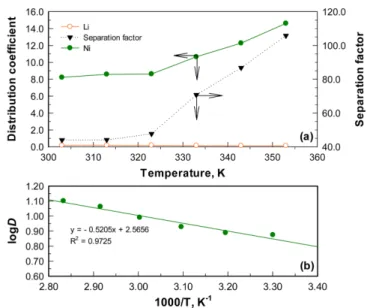
A set of experiments was performed to study the effect of tempera- ture on the extraction of nickel and lithium in a jacketed reactor, which was connected to a temperature controlled water bath (± 0.2oC) and a circulation pump to flow water. Temperature was varied between 298 and 353 K, while other parameters were fixed at 0.15 kmol·m-3 PC-88A, O/A=1 and equilibrium pH of 6.5. The temperature did not significantly affect the equilibrium pH, which remained almost con- stant at 6.5 ± 0.1. Fig. 2a clearly indicates correlation of temperature with nickel extraction efficiency; however, lithium extraction remains unaffected with the change in temperature. The separation factors for nickel over lithium were 44.1 and 105.8 at the respective tempera- tures of 298 and 353 K.
The plot of log D vs. 1000/T (K-1) is presented in Fig. 2b. The value of the enthalpy change (ΔH°) for nickel extraction can be obtained from the van’t Hoff equation:
or (3)
where R is the gas constant, and C is an integration constant which is assumed to be constant at a particular temperature under the experimental conditions [17,19].
The slope of the straight line (Fig. 2b) equals -ΔH°/2.303R in Eq. (3) and can be used to calculate the change in enthalpy, ΔH°. In this study, the value of ΔH° was estimated to be 9.97 kJ·mol-1. The positive ΔH° values suggest that the Ni extraction reaction was endothermic.
3-1-4. Extraction isotherm and simulation of counter-current extraction
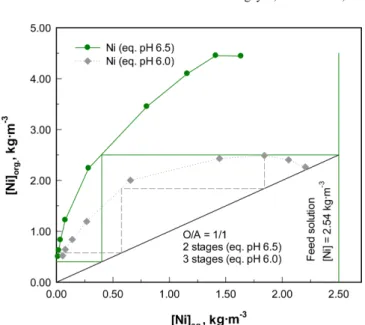
The nickel extraction isotherms were determined by varying the O/A phase ratio (1/5 to 5/1) at equilibrium pH values of 6.0 and 6.5 using 0.15 kmol·m-3 PC-88A. The McCabe-Thiele diagram presented in Fig. 3 shows that three theoretical extraction stages are needed to extract nickel at an equilibrium pH of 6.0 and O/A ratio of 1, whereas two stages are required at pH 6.5. This finding is attributed to the bet- ter distribution of Ni(II) in the organic phase at the higher equilib- rium pH, which reduces the number of stages required for extraction.
To confirm the McCabe-Thiele prediction, a two-stage counter- current simulation study was undertaken using 0.15 kmol·m-3 PC-88A at an O/A=1 and equilibrium pH of 6.5. The equilibrium concentra- tions of the related metals in the aqueous and organic phase after each extraction stage are shown in Fig. 4. The final raffinate (R2-i) con- taining 0.01 kg·m-3 Ni corresponds to a 99.6% extraction of nickel
∂(logD)
∂ 1/T( )
--- –ΔHo 2.303R ---
= log D –ΔHo
2.303RT --- C+
= Fig. 1. (a) Effect of equilibrium pH on the extraction and separation
factor of Ni and Li. Organic phase: 0.15 kmol·m-3 PC-88A;
Aqueous phase: 2.54 kg·m-3 Ni and 4.82 kg·m-3 Li; eq. pH=4.0- 7.5; O/A=1; t=600 s; T=298 K. (b) Effect of PC-88A concentration on the extraction of Ni and Li. Organic phase: 0.075-0.45 kmol·m-3 PC-88A; Aqueous phase: 2.54 kg·m-3 Ni and 4.82 kg·m-3 Li;
eq. pH=6.0 and 6.5; O/A=1; t=600 s; T=298 K.
Fig. 2. (a) Effect of temperature on separation factor and distribution coefficient of Ni and Li; (b) Plot of log D vs. 1000/Tfor Ni. Organic phase: 0.15 kmol·m-3 PC-88A; Aqueous phase: 2.54 kg·m-3 Ni and 4.82 kg·m-3 Li; eq. pH=6.5; O/A=1; t=600 s; T=298- 353 K.
with a low co-extraction of lithium (6.84%). The purity of nickel in the organic phase was 88.5%, which could practically be improved by increasing the number of extraction stages and/or providing scrubbing stages. An analysis of the loaded organic (LO1-i) containing 2.53 kg·m-3 Ni and 0.334 kg·m-3 Li shows the mass balance of these metals during the extraction stage.
3-2. Scrubbing of lithium from the loaded organic 3-2-1. Effect of scrub solution concentration
The loaded organic phase (2.53 kg·m-3 Ni; 0.334 kg·m-3 Li) obtained from the extraction stage was used for lithium scrubbing to generate a high purity nickel stream using Na2CO3 and NaOH solutions. The scrubbing efficiency as a function of the concentration of scrub solu- tions at a phase ratio of 1 is presented in Fig. 5. Increasing the con- centration of Na2CO3 and NaOH over the investigated range (0.01- 0.20 kmol·m-3) increased the scrubbing efficiency of lithium from 25.0% to 93.4% and from 23.0% to 77.3%, respectively. The scrub- bing of lithium could be maximized and remained constant when the
concentration of the alkali was further increased from 0.15 to 0.20 kmol·m-3. However, the scrubbing efficiency of lithium decreased due to the formation of a third phase when the concentrations of Na2- CO3 and NaOH were increased further.
Sodium carbonate yielded a better lithium scrubbing performance than sodium hydroxide. This difference can be attributed to the higher pH of the final scrub raffinate when NaOH was used as compared to Na2CO3; the final pH was 8.7 and 8.0 when 0.10 kmol·m-3 NaOH and Na2CO3 solutions were used, respectively. This indicates that the scrubbing of lithium at higher pH values is not favorable because of problems related to phase disengagement and the partial precipita- tion of nickel in the aqueous phase. Therefore, a 0.10 kmol·m-3 Na2- CO3 solution was considered to be the suitable reagent concentration for scrubbing and was used in subsequent experiments.
3-2-2. Effect of temperature on scrubbing of lithium
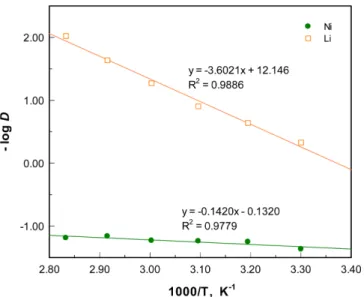
The effect of varying the temperature (298-353 K) on the scrub- bing of lithium from the loaded organic solution using 0.10 kmol·m-3 Na2CO3 was also investigated. The change in the distribution coeffi- cient as a function of the temperature for the scrubbing process is expressed by Eq. (3). As shown in Fig. 6, a plot of -log D against 1000/T results in a straight line from which ΔH° can be calculated. The positive value of ΔH°=29.9 kJ·mol-1 indicates that the lithium scrubbing pro- cess was endothermic.
3-2-3. Scrubbing isotherm-McCabe Thiele diagram
A McCabe-Thiele diagram was constructed for scrubbing lithium with 0.10 kmol·m-3 Na2CO3 solution to determine the number of stages required at a chosen phase ratio (Fig. 7). For the isotherm, O/A phase ratios were varied (1/5 to 5/1) by contacting the same metal loaded organic (2.53 kg·m-3 Ni; 0.334 kg·m-3 Li) with the scrub solution.
Fig. 3. McCabe-Thiele diagram for nickel extraction. Organic phase:
0.15 kmol·m-3 PC-88A; Aqueous phase: 2.54 kg·m-3 Ni and 4.82 kg·m-3 Li; eq. pH=6.0 and 6.5; O/A=1/5 to 5/1; t=600 s;
T=298 K.
Fig. 4. Two-stage counter-current simulation study for extraction of Ni and Li. Organic phase: 0.15 kmol·m-3 PC-88A; Aqueous phase: 2.54 kg·m-3 Ni and 4.82 kg·m-3 Li; eq. pH=6.5; O/
A=1; t=600 s; T=298 K.
Fig. 5. Effect of the scrub solution concentration on lithium scrubbing from loaded organic using different bases. Loaded organic:
2.53 kg·m-3 Ni and 0.334 kg·m-3 Li; Aqueous phase: 0.01- 0.20 kmol·m-3 Na2CO3 or NaOH; O/A=1; t=600 s; T=298 K.
The scrubbing efficiency of lithium increased rapidly from 17.4 to 99.5% as the O/A ratio decreased from 5/1 to 1/5. Generally, a higher O/A ratio is more favorable to decrease the amount of the scrub solu- tion, but the scrubbing at a high O/A ratio (organic/scrub solution) resulted in a poor phase separation. In fact, the phase disengagement time was found to exceed 48 h at O/A ratio of >5/1, after which the phase separation remained incomplete. Thus, the optimal O/A ratio for lithium scrubbing was considered lower than 5/1.
The McCabe-Thiele plot predicted two counter-current stages for the complete scrubbing of lithium at an O/A phase ratio of 2/3. The lithium scrubbing efficiency was predicted to be 91.0% and 99.6% in the first and second stage, respectively. A scrubbed organic solution containing less than 3.12 g·m-3 lithium was obtained in a two-stage
counter-current simulation, signifying almost quantitative scrubbing of Li as impurity.
3-3. Stripping of nickel from the loaded organic
The stripping of nickel from the scrubbed organic phase (PC-88A) containing 2.41 kg·m-3 Ni and 3.12 g·m-3 Li was investigated using various stripping agents, such as H2SO4, HCl, and HNO3, over a con- centration range of 0.02-0.3 kmol·m-3 and unit phase ratio (O/A).
The results (Fig. 8) indicate that the stripping efficiency was directly related to the acid concentration. The stripping of nickel was maxi- mized at acid concentration exceeding 0.20 kmol·m-3, which was found to be sufficient for the quantitative stripping of nickel in a single stage. In addition, H2SO4 can be considered to be an effective acid for nickel stripping and may be preferred because of reduced pollution effects compared to other acids. Nevertheless, HCl was more effec- tive than H2SO4 and HNO3 was the least effective acid. A solution of 0.20 kmol·m-3 sulfuric acid was chosen for nickel stripping in further studies.
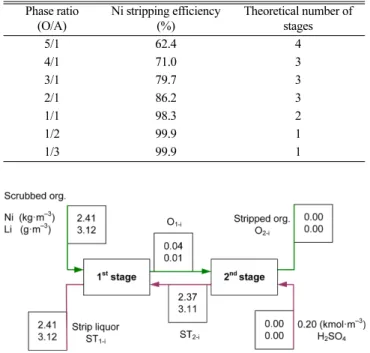
Stripping at higher O/A ratio can enrich nickel concentration in the strip solution. Therefore, the effect of different O/A phase ratios on the nickel stripping efficiency was investigated to optimize the conditions (see Table 1). High O/A ratios up to 5/1 resulted in a sharp decrease in the stripping efficiency from 99.9 to 62.4%. However, the number of required stripping stages increased when a higher O/A ratio was used.
By McCabe-Thiele plot the number of theoretical counter-current stages was determined for stripping loaded nickel in PC-88A with 0.20 kmol·m-3 H2SO4. The results given in Table 1 suggest the need for two stages to quantitatively strip nickel at an O/A ratio of 1/1.
Therefore, two-stage counter-current nickel stripping studies were performed by using 0.20 kmol·m-3 H2SO4 at O/A ratio of 1 to confirm the data predicted in the isotherm. The concentrations of metals in Fig. 6. Effect of temperature on lithium scrubbing from loaded organic.
Loaded organic: 2.53 kg·m-3 Ni and 0.334 kg·m-3 Li; Aqueous phase: 0.10 kmol·m-3 Na2CO3; O/A=1; t=600 s; T=298-353 K.
Fig. 7. McCabe-Thiele diagram for lithium scrubbing from the loaded organic. Loaded organic: 2.53 kg·m-3 Ni and 0.334 kg·m-3 Li; Aqueous phase: 0.10 kmol·m-3 Na2CO3; O/A=1/5 to 5/1;
t=600 s; T=298 K.
Fig. 8. Effect of acid concentration on stripping of nickel from loaded organic using different mineral acids. Loaded organic: 2.41 kg·m-3 Ni and 3.12 g·m-3 Li; Aqueous phase: 0.02-0.30 kmol·m-3 H2SO4, HCl, and HNO3; O/A=1; t=600 s; T=298 K.
F ↓ + (4) The temperature for the reaction was maintained at 373 K to mini- mize solubility loss because the solubility of Li2CO3 decreases from 1.52 to 0.71 g/100 g H2O when the temperature increases from 298 to 373 K [20].
A trace amount of nickel that remained in the mother liquor was also co-precipitated along with the lithium. Therefore, the lithium car- bonate was filtered and washed with hot water to remove the impurity.
The analytical results showed that 92.0% of the lithium was recov- Li2SO4+Na2CO3 Li2CO3 Na2SO4
Fig. 9. Two-stage counter-current simulation study for the stripping of nickel from loaded organic. Loaded organic: 2.41 kg·m-3 Ni and 3.12 g·m-3 Li; Aqueous phase: 0.20 kmol·m-3 H2SO4; O/
A=1; t=600 s; T=298 K.
Fig. 10. Flow-sheet of the process for the recovery of nickel and lithium from sulfate leach liquor of the cathode scrap generated in the manufac- turing process of Li-ion batteries.
ered as a precipitate, and the content of nickel in final product was less than 0.05%. After recovering of the two metals, the waste solu- tion can be further neutralized before discharging the effluent to the environment.
3-5. Flow-sheet for the recovery of metals from waste LIBs A flow-sheet of the process for the recovery of nickel and lithium from the sulfate leach liquor of cathode scrap generated from the manufacturing process of LIBs was developed (Fig. 10) based on the above data. The key advantage of the proposed flow-sheet is that the process is simple and selective for metal separation to meet the demand for high-purity nickel production.
4. Conclusions
The following conclusions are drawn based on the above studies:
(1) 99.9% pure nickel in solution can be recovered by the solvent extraction using PC-88A from the sulfate leach liquor of cathode scrap generated in the manufacturing process of LIBs.
(2) The nickel and lithium extraction efficiency and separation factor depend on the extractant concentration and the equilibrium pH of the aqueous phase. An extractant concentration of 0.15 kmol·m-3 PC-88A was found suitable for the selective extraction of nickel.
(3) The simulation study validated the prediction of McCabe- Thiele plot showing the requirements of two counter-current stages for extraction of nickel with 0.15 kmol·m-3 PC-88A at an equilibrium pH of 6.5 and O/A phase ratio of 1/1. Almost quantitative extraction of nickel was achieved under this condition.
(4) The loaded organic phase containing 2.53 kg·m-3 Ni and 0.334 g·m-3 Li was successfully purified by scrubbing with sodium carbonate solution (0.10 kmol·m-3) with complete scrubbing of lithium at O/A of 2/3 in two counter-current stages. The scrub raffinate can be reused in subsequent experiments for lithium precipitation, which would reduce the cost of operation.
The stripping of nickel from the loaded organic with 0.20 kmol·m-3 H2SO4 resulted in a stripping efficiency that exceeded 99.9% in a two-stage counter-current process at an O/A ratio of 1.
The proposed process flow-sheet is simple and has the advantage of recovering highly pure nickel and lithium salts from the sulfate leach liquor of cathode scrap produced in the manufacturing process of LIBs.
Acknowledgment
This work was supported by the basic research program of the Korea Institute of Geoscience and Mineral Resources (KIGAM).
Viet Tu Nguyen, would like to express his warmest thanks to KIGAM for awarding a research fellowship during the course of this investi- gation.
References
1. Granata, G., Moscardini, E., Pagnanelli, F., Trabucco, F. and Toro, L., “Product Recovery from Li-ion Battery Wastes Coming from An Industrial Pre-treatment Plant: Lab Scale Tests and Process Simulations,” J. Power Sources, 206, 393-401(2012).
2. Zou, H., Gratz, E., Apelian, D. and Wang, Y., “A Novel Method to Recycle Mixed Cathode Materials for Lithium Ion Batteries,”
Green Chem., 15, 1183-1191(2013).
3. Nguyen, V. T., Lee, J.-C., Jeong, J., Kim, B. S. and Pandey, B.
D., “Selective Recovery of Cobalt, Nickel and Lithium From Sulfate Leachate of Cathode Scrap of Li-ion Batteries Using Liquid-liquid Extraction,” Met. Mater. Int., 20(2), 357-365(2014).
4. Georgi-Maschler, T., Friedrich, B., Weyhe, R., Heegn, H. and Rutz, M., “Development of a Recycling Process for Li-ion Batteries,”
J. Power Sources, 207, 173-182(2012).
5. Chagnes, A. and Pospiech, B., “A Brief Review on Hydromet- allurgical Technologies for Recycling Spent Lithium-ion Batter- ies,” J. Chem. Technol. Biotechnol., 88, 1191-1199(2013).
6. Xu, J., Thomas, H. R., Francis, R. W., Lum, K. R., Wang, J. and Liang, B., “A Review of Pro-cesses and Technologies for the Recy- cling of Lithium-ion Secondary Batteries,” J. Power Sources, 177, 512-527(2008).
7. Ferreira, D. A., Prados, L. M. Z., Majuste, D., Mansur, M. B.,
“Hydrometallurgical Sepa-ration of Aluminium, Cobalt, Copper and Lithium from Spent Li-ion Batteries,” J. Power Sources, 187(1), 238-246(2009).
8. Sakultung, S., Pruksathorn, K. and Hunsom, M., “Simultaneous Recovery of Valuable Metals from Spent Mobile Phone Battery by An Acid Leaching Process,” Korean J. Chem. Eng., 24(2), 272-277(2007).
9. Harvianto, G. R., Jeong, S. G. and Ju, C. S., “The Effect of Dom- inant Ions on Solvent Extraction of Lithium Ion from Aqueous Solution,” Korean J. Chem. Eng., 31(5), 828-833(2014).
10. Lee, J. K., Jeong, S. G., Koo, S. J., Kim, S. Y. and Ju, C. S., “Sol- vent Extraction of Lithium Ion in Aqueous Solution Using TTA and TOPO,” Korean Chem. Eng. Res., 51(1), 53-57(2013).
11. Zhang, P., Yokoyama, T., Itabashi, O., Suzuki, T., Inoue, K., “Hydro- metallurgical Process for Recovery of Metal Values from Spent Lithium-ion Secondary Batteries,” Hydrometallurgy, 47, 259-271 (1998).
12. Swain, B., Jeong, J., Lee J.-C., Lee, G. H. and Sohn, J. S., “Hydro- metallurgical Process for Recovery of Cobalt from Waste Cathodic Active Material Generated During Manufacturing of Lithium Ion Batteries,” J. Power Sources, 167, 536-544(2007).
13. Kang, J., Senanayake, G., Sohn, J. S. and Shin, S. M., “Recovery of Cobalt Sulfate from Spent Lithium Ion Batteries by Reductive Leaching and Solvent Extraction with Cyanex 272,” Hydromet- allurgy, 100, 168-171(2010).
14. Pranolo, Y., Zhang, W. and Cheng, C. Y., “Recovery of Metals From Spent Lithium-ion Battery with Mixed Solvent Extractant System,” Hydrometallurgy, 102, 37-42(2010).
15. Ahn, J. W., Ahn, H. J., Son, S. H., Lee, K. W., “Solvent Extraction of Ni and Li from Sulfate Leach Liquor of the Cathode Active Materials of Spent Li-ion Batteries by PC-88A,” J. Korean Inst.
of Resources Recycling, 21(6), 58-64(2012).
16. U.S. Geological Survey, Mineral commodity summaries 2012: U.S.