294 http://dx.doi.org/10.9713/kcer.2014.52.3.294
PISSN 0304-128X, EISSN 2233-9558
Entropy Generation Analysis for Various Cross-sectional Ducts in Fully Developed Laminar Convection with Constant Wall Heat Flux
Haghgooyan, M. S.†,* and Aghanajafi, C.**
*Department of Mechanical Engineering, Islamic Azad University-South branch, Tehran, Iran
**Department of Mechanical Engineering, K.N. Toosi University of Technology, Tehran, Iran (Received 7 December 2013; Received in revised form 3 March 2014; accepted 19 March 2014)
Abstract − This study focuses on analysis and comparison of entropy generation in various cross-sectional ducts along with fully developed laminar flow and constant uniform wall heat flux. The obtained results were compared in ducts with circular, semicircular, and rectangular with semicircular ends, equilateral triangular, and square and sym- metrical hexagonal cross–sectional areas. These results were separately studied for aspect ratio of different rectan- gular shapes. Characteristics of fluid were considered at average temperature between outlet and inlet ducts. Results showed that factors such as Reynolds number, cross section, hydraulic diameter, heat flux and aspect ratio were effec- tive on entropy generation, and these effects are more evident than heat flux and occur more in high heat fluxes. Con- sidering the performed comparisons, it seems that semicircular and circular cross section generates less entropy than other cross sections.
Key words: Entropy Generation, Variety, Cross-sectional, Laminar, Flow, Heat Flux
1. Introduction
Analysis of heat transfer and entropy generation and also study of the second law of thermodynamics in terms of irreversibility in heat transfer processes give us an important and broad view for selecting dimensions and shapes of all kinds of heat exchanger. Exergy analy- sis is important and effective for selecting a duct for all engineering applications. Different factors play a role in entropy generation and irreversibility of a heat transfer in duct such as type of cross section of the duct, fluid friction, type of fluid flow, dimensions of duct and heat flux. The use of all kinds of fin and metal foams around duct can be effective on the phenomenon of heat transfer.
Bejan [1] conducted many studies on irreversibility and entropy generation in heat exchangers. He obtained good results on minimi- zation of entropy generation in viscose fluids and in dimensional level of duct. Ahmet and Sahin [2] found that high Reynolds number would lead to friction irreversibility in all kinds of circular, triangu- lar and sinus ducts and other ducts. The most optimal cross section of the duct for passage of fluid in laminar flow with constant tempera- ture of the duct wall and turbulent flow with constant wall heat flux is spherical. Ou and Cheng [3] conducted research on the effect of viscosity on heat transfer of pipe flow with uniform wall temperature.
Nug and Mukherjee [4] studied optimization of the second law of thermodynamics for transferring convection heat through a duct
along with constant heat flux boundary. Heat transfer and pressure drop in different shapes of ducts was also studied by Shah and Lon- don [5]. Oztop [6] studied entropy generation in semicircular and rectangular with semicircular ends duct. These studies have been conducted in two states of constant wall temperature and constant heat flux in wall. Flahat [7] studied the second law of thermodynam- ics in annular sector and circular segment ducts in fully developed laminar flow and constant heat flux boundary. He found that when Reynolds number increased, entropy generation would drop and when heat flux in wall of the duct increased in a constant Reynolds number, the entropy generation would decrease. He looked at the effect of segment angle and heat flux and found that a circular seg- ment duct was more optimal than a circular duct. Jaukowski and Todda [8] studied optimization of entropy generation in internal flows by comparing shapes of cross section of the duct. They noticed that circular cross section led to minimum entropy generation. Som- pop and Jarangthamm [9] studied analysis of the entropy generation in fully developed laminar flow in a hexagonal duct along with con- stant heat flux in wall. They compared the obtained results with a rectangular duct, and showed that the characteristics of a fluid had considerable effect on entropy generation; and when aspect ratio increased, the dimensionless entropy generation became small. The reason is that heat transfer rate is reduced with increase of aspect ratio in a constant heat flux. Vandadi and Aghanajafi [10] considered entropy generation analysis for micro scale forced convection in thermal entrance region. In this study the effect of Knudsen number and Brinkman number on the entropy generation rate and Bejan number in different axial location is presented. Aghanajafi and Man- sourizadeh [11] studied velocity and thermal boundary layer and
†To whom correspondence should be addressed.
E-mail: [email protected]
This is an Open-Access article distributed under the terms of the Creative Com- mons Attribution Non-Commercial License (http://creativecommons.org/licenses/by- nc/3.0) which permits unrestricted non-commercial use, distribution, and reproduc- tion in any medium, provided the original work is properly cited.
entropy generation near the periodically oscillating flat plate.They found computational fluid dynamics to solve the problem of vibrat- ing plate in order to fine velocity, temperature and entropy distribu- tion of each particle of fluid. Langeroudi and Aghanajafi [12,13]
strove for important thermal contact (enhanced-heat transfer) and reduced pump power loss in order to improve the thermodynamic efficiency of the heat exchanger. Good heat exchanger design means, ultimately, efficient thermodynamic performance, that is, the least generation of entropy or least destruction of useful work in an engi- neering system is directly proportional to the rate of entropy generation.
Satapathy [14] optimized the geometry of a coiled heat exchanger tube using the minimization of entropy generation method. The author pointed out that the optimum value of diameter ratio decreased with increasing Dean or Reynolds number. Hong and Bergles [15] obtained the thermal entry length solutions for semicircular duct for both con- stant heat flux and constant temperature boundary conditions for Newtonian fluid. Haddad et al. [16] investigated the entropy genera- tion in a laminar forced convection in the entrance region of a con- centric annulus using various thermal boundary conditions.
All of the studies investigated the subject and parameter which are effective in analysis of the entropy generation, but a question is raised here: what kind of cross section with what dimensions of duct are better for passage of fluid along with fully developed laminar flow and constant heat flux in wall of duct?
In summary, there is no comprehensive study in this field and gen- eral study of parameters effective on the entropy generation of differ- ent cross sections. In addition, there are contradictions in the mentioned studies in selection of the best shape of cross section of duct for transferring heat and the entropy generation in engineering applica- tions which are mentioned later.
We investigated and compared all cross sections of ducts and effect of aspect ratio in rectangle, Reynolds numbers and heat fluxes by reviewing more than twenty different papers in this field and comparing circular, equilateral triangular, symmetrical hexagonal, square, semicircular and rectangular with semicircular ends sections with each other.
2. Entropy Generation Analysis
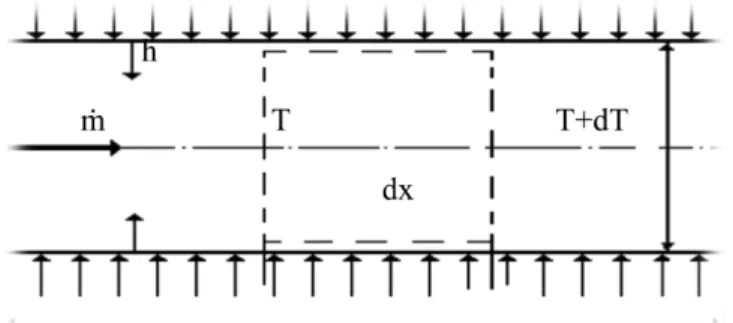
In this section, entropy generation is studied and formulated. All formulas of entropy generation result from general relation of energy balance in which characteristics of fluid along duct are considered equal. Control volume exposed to constant heat flux for all ducts is shown in Fig. 1, where ṁ is mass flow rate.
Energy balance for dx length of control volume is as follows:
(1) where h and P are heat transfer coefficient and diameter of the sections. Cp is fluid specific heat and ΔT = (Tw-T) is difference between fluid temperature and temperature of duct wall. A dis- placement and integration in Equation (1) yields Equation (2):
(2)
Equation (2) can be rewritten with dimensionless Stanton number St=h/ρucp where ρ is fluid density and u is its average velocity.
(3)
The expression Dh in Equation (3) indicates hydraulic diameter of duct.
The entropy generation for this control volume is equal to:
where ds for an incompressible fluid, is as follows:
(5)
By substituting Equation (5) in Equation (4) and also using Equa- tion (3) therein, after integration, we have:
(6)
The expression “pressure gradient “in Equation (6) can be men- tioned as follows:
(7)
where f is friction factor.
At the end, by substituting Equation (7) in Equation (6) and sim- plification, we have:
(8)
where Nu = hDh/k is Nusselt number.
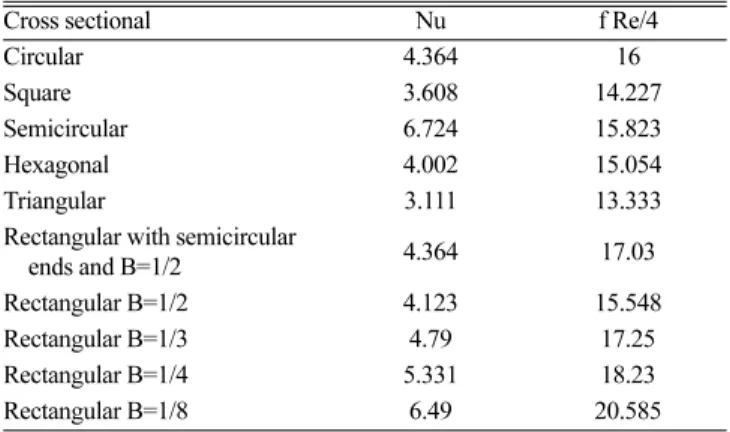
The expression of Nusselt number and number of fRe has been empirically studied by Shah and London [5] and results for different shapes are found in Table 1 where Re = ρuDh/μ is Reynolds number.
The expression μ is fluid viscosity.
dQ·
q··Pdx hPdxΔT m·cpdT
= = =
Tx Ti q··P m· cp ---x +
=
Tx Ti 4StΔT Dh ---x +
=
ds·gen m· ds dQ· T+ΔT --- –
=
ds cP dT/T dP ρT--- –
=
ds·gen
---dx m· cpdT dx--- ΔT
T T( +ΔT) --- m·
ρT--- dP ---dx
⎝– ⎠
⎛ ⎞
+
=
dP dx--- – fρU2
2Dh ---
=
S·
gen m· cp
Ti q··Dh KNucp
---
⎝ + ⎠
⎛ ⎞To
Ti Ti q··Dh KNucp
--- q··PL m· cp ---
+ +
⎝ ⎠
⎛ ⎞
---
ln fm· U2L
2Dh ---
To Ti --- ln To–Ti ---
⎝ ⎠
⎜ ⎟
⎜ ⎟
⎜ ⎟
⎛ ⎞
+
=
Fig. 1. Internal flow with constant heat flux.
The expression “entropy generation” can be defined dimension- less for comparison which is as follows:
(9)
The dimensionless total entropy generation based on the flow stream heat capacity rate (ṁ/cp) is defined as:
(10)
In this equation η1 and η2 are:
(11) (12) In these equations some parameters can be made dimensionless as follows:
(13)
(14)
(15)
In Fig. 2, all of the studied cross sections along with necessary parameters are shown.
For fully developed flow and fully wet section, hydraulic diame- ter is obtained as follows:
(16)
β = b/a (17) This is summarized for different shapes in Table 2.
3. Results and Discussion
This section compares dimensionless entropy generation through different ducts with circular, semicircular, square, symmetrical hex- agonal, equilateral triangle and rectangular with semicircular ends with aspect ratio of ½.
The passing fluid is in a water duct and its flow has been considered as fully developed laminar. To reach laminar flow, we have assumed hydraulic diameter and mass flow such that the Reynolds number is between 0<Re<3000. All of the analyzed ducts are exposed to differ- ent fluxes of 1000, 2500, 2000, 1500 and 3000 W/m2. All character- istics used for water fluid are considered constant and equal along the duct and these characteristics of fluid are at average temperature between outlet and inlet of the fluid. These characteristics are observed in Table 3. Average temperature has been obtained such that we first inserted Cp for water at inlet temperature in calculation and calcu- lated average temperature after obtaining outlet temperature and put- ting new Cp based on it. We performed this work in some stages until changes of outlet temperature could be lower than 1%. Other hypothe- ses of the duct are found in Table 3.
Comparisons of dimensionless entropy generation with Reynolds number and cross section have been made for all sections with equal
Ψ S·
GEN
Q· /To–Ti ---
=
Ψ (Re+τη1) 1 τ( + ) Re+τRe τη+ 1
( )
---
ln η2Re2 Re+τη1
---Re
⎝ ⎠
⎛ ⎞
ln +
=
η1=4Nu λ/Pr η2=μ3f Re/8ρ2Dh3q
St h
ρUCp
--- Nu RePr---
= =
τ Tw–T To ---
=
λ L
Dh ---
=
Dh 4Ac ---P
= Table 1. Values of fRe and Nu for constant heat flux boundary conditions
in various cross sections
Cross sectional Nu f Re/4
Circular 4.364 16
Square 3.608 14.227
Semicircular 6.724 15.823
Hexagonal 4.002 15.054
Triangular 3.111 13.333
Rectangular with semicircular
ends and B=1/2 4.364 17.03
Rectangular B=1/2 4.123 15.548
Rectangular B=1/3 4.79 17.25
Rectangular B=1/4 5.331 18.23
Rectangular B=1/8 6.49 20.585
Fig. 2. Cross-sectionals of (a) semicircular, (b) circle, (c) rectangular, (d) rectangular with semicircular ends, (e) equilateral triangular, (f) sym- metrical hexagonal.
Table 2. Definition of hydraulic diameter in various cross-sections
Circular A
Triangular √3/3a
Semicircular Пd/2+П
Rectangular (β/β+1)ˣ2a
Rectangular with semicircular ends β=1/2 (4+П/2+П)ˣa
Hexagonal √3ˣa
Table 3. Parameter values used in the analysis
L 10 m
Ti 298 k
ṁ 0.05 m3/s
Cp 4182 J/Kg·k
μ 9.93*10−4
Fig. 3. Comparing dimensionless entropy with Reynolds in different fluxes. (a) 1000, (b) 1500, (c) 2000, (d) 2500, (e) 3000 W/m2.
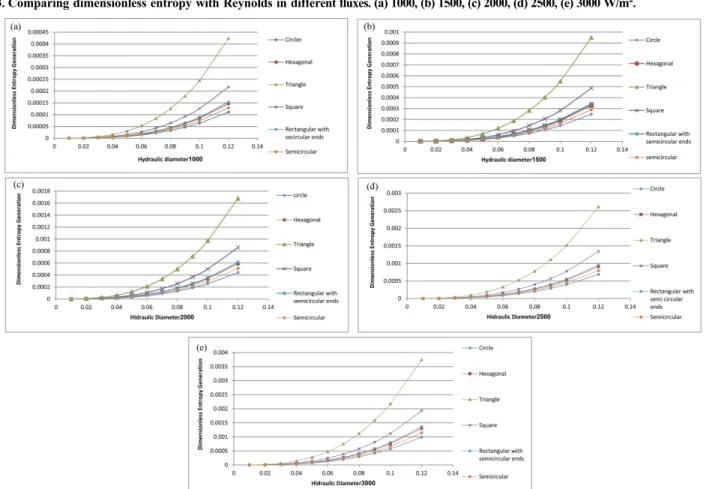
Fig. 4. Comparing dimensionless entropy generation with hydraulic diameter in different fluxes. (a) 1000, (b) 1500, (c) 2000, d), 2500, (e) 3000.
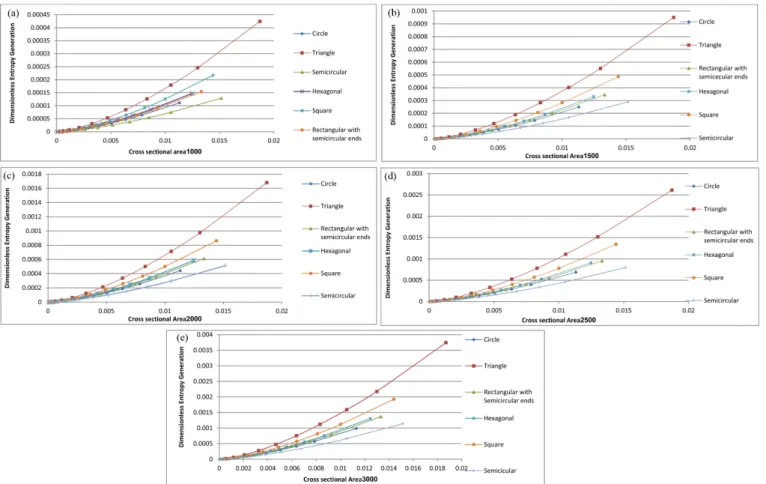
Fig. 5. Comparing dimensionless entropy generation with cross section in different heat fluxes. (a) 1000, (b) 1500, (c) 2000, d), 2500, (e) 3000.
Fig. 6. Comparing dimensionless entropy generation with Reynolds for rectangular aspect ratio in different heat fluxes. (a) 1000, (b) 1500, (c) 2000, (d) 2500, (e) 3000.
hydraulic diameter. As many various hydraulic diameters have been assumed, then the hydraulic diameters are shared between all cross- sectionals. Based on this calculation, the hydraulic diameter was first assumed for each cross section and then Reynolds number was cal- culated using it. These comparisons were made for different shapes in variables such as Reynolds number, hydraulic diameter and cross section. Results of calculation in different Reynolds number for vari- ous heat flux are mentioned in Figs. 3(a~d) and (e).
As observed above, increase of Reynolds reduces entropy genera- tion so that the highest slope of the diagram relating to Reynolds is between 0 and 1000.
Considering the shown diagrams, it is specified that increase of heat flux decreases descending trend of dimensionless entropy gen- eration and also increases dimensionless entropy generation. Results show that the lowest dimensionless entropy generation is related to a semicircle in a given Reynolds number and the highest dimension- less entropy generation is also related to square and equilateral triangle.
Results of calculation in different hydraulic diameters and exposed to different constant heat fluxes are found in Figs. 4(a~d) and (e).
These comparisons were made for different cross sections. Results show that the lowest dimensionless entropy generation relates to cir- cular and semicircular and these changes are more evident in higher heat fluxes. After circular, the lowest dimensionless entropy genera- tion relates to symmetrical hexagonal, rectangular with semicircular
ends, square and triangular shapes. It seems that the reason is high friction between wall and fluid, and increase of hydraulic diameter as well as cross section of the duct expands the lateral area of the duct.
As a result, the contact surface between fluid and wall of duct increases, which is the reason for increase of dimensionless entropy genera- tion. As observed above, an increase of heat flux enhances ascend- ing trend of dimensionless entropy generation in a given hydraulic diameter and for different cross sectional areas, and this increase is higher for triangle and square. To show dimensional effect of cross section, a comparison was made between different heat fluxes for cir- cular, semicircular, triangular, symmetrical hexagonal and rectangular with semicircular ends cross sections and dimensionless entropy generation.
Results for comparing cross section and dimensionless entropy generation are shown for 1000, 1500, 2000, 2500 and 3000 w/m2 heat fluxes in Figs. 5(a~e), respectively.
Results for cross sectional area are similar to results obtained by comparison with hydraulic diameter. With increase of heat flux, inlet and outlet temperature difference of fluid increases, which is the rea- son for increase of dimensionless entropy generation. Fig. 4-3 shows that increase of dimensions of cross sectional area enhances dimen- sionless entropy generation, and the highest increase relates to trian- gular shape and the lowest increase relates to semicircle. Studies show that hexagonal and circular cross sectional areas are regarded
Fig. 7. Comparing dimensionless entropy generation with hydraulic diameter for rectangular aspect ratio in different heat fluxes. (a) 1000, (b) 1500, (c) 2000, (d) 2500, (e) 3000.
as the cross sectional areas which have the lowest entropy genera- tion after semicircle. To study the effect of aspect ratio, comparison of dimensionless entropy generation with rectangular aspect ratio was used. In Figs. 6(a~e), dimensionless entropy generation has been compared with Reynolds number in heat fluxes of 1000, 1500, 2000, 2500 and 3000 w/m2, respectively. Results for aspect ratio of 1, 1/2, 1/3, 1/4 and 1/8 of rectangle were compared with each other.
It is observed that the lowest entropy generation relates to aspect ratio of 1, 1/2, 1/3, 1/4 and 1/8 and these changes occur more in high heat fluxes. In addition, with increase of heat flux the slope of the diagram will be sharp, which indicates important effect of heat flux.
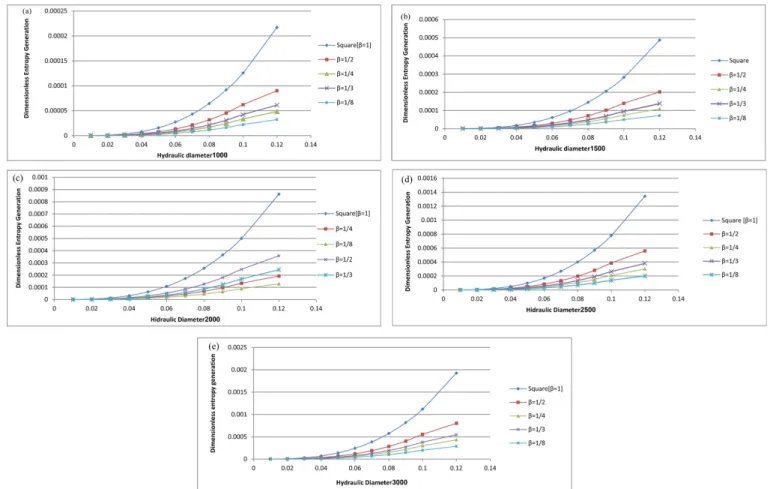
In Figs. 7(a~e), dimensionless entropy generation was studied in different hydraulic diameter for different aspect ratio of rectangle.
The obtained results are shown for heat fluxes of 1000, 1500, 2000, 2500 and 3000 w/m2, respectively. As observed above, increase of hydraulic diameter enhances dimensionless entropy generation which is also caused by high heat flux. The highest dimensionless entropy generation relates to square, and the lowest entropy relates to aspect ratio of 1/8. Results show that decrease of aspect ratio reduces dimen- sionless entropy generation in a constant hydraulic diameter.
Finally, a comparison was made between dimensionless entropy
generation and heat flux in two hydraulic diameters to show the effect of heat flux. The obtained results for hydraulic diameter of 0.05 are shown in Fig. 8(a), and for hydraulic diameter of 0.1 in Fig. 8(b).
Results show that in a constant heat flux, the highest dimension- less entropy generation relates to triangle and the lowest dimension- less entropy generation relates to circle. By increase of heat flux in a constant hydraulic diameter, dimensionless entropy generation increases, which is in line with the results obtained in the above figures.
4. Conclusions
We studied the dimensionless entropy generation in ducts with cir- cular, equilateral triangular, symmetrical hexagonal, square, semicir- cular and rectangular with semicircular ends sections and aspect ratio of ½ along with fully developed laminar flow and under constant heat flux in wall of the duct. Results show that:
By increasing of the heat flux, the entropy generation increases in all shapes, and this increase for triangle is higher than that for other shapes and the lowest increase is observed in circular shape.
By increasing of the cross-sectional area and hydraulic diameter, entropy generation will increase and the lowest increase relates to cir- Fig. 8. Comparing dimensionless entropy generation with heat flux in different cross sections for (a) Dh=.05, (b) Dh=.1.
cle and semicircle. By increase of Reynolds number from 0 to 3000, entropy generation considerably decreases. At low Reynolds numbers, the entropy generation descending trend is higher, and also the lowest entropy generation relates to a semicircle in a given Reynolds number.
In a constant hydraulic diameter for different rectangle aspect ratio, with increases of the aspect ratio, the entropy generation will increase.
At a constant Reynolds number, the aspect ratio of 1/3 has the lowest entropy generation, which becomes more evident at high heat fluxes.
Considering the performed comparisons, it seems that semicircular and circular cross sectional areas has the lowest entropy generation compared with other cross-sectional areas.
Nomenclatures a,b : duct sides [m]
cp : specific heat [J/kg K]
Dh : hydraulic diameter, m f friction factor or Darcy friction factor h : heat transfer coefficient [W/m2 K]
k : thermal conductivity [W/m K]
L : duct length [m]
ṁ : mass flow rate [kg/s]
Nu : Nusselt number P : pressure [Pa]
p : perimeter [m]
q̇" : heat flux [W/m2] : heat rate [W]
Re : Reynolds number S : specific entropy [J/kg.K]
: entropy rate [W/K]
St : Stanton number T : fluid temperature [K]
U : fluid velocity [m/s]
Greek Letters
dT : wall-bulk fluid temperature difference [Tw-T]
ψ : dimensionless entropy generation
ρ : fluid density [kg/m3] μ : absolute viscosity [kg/m·s]
β : aspect ratio Subscripts
gen : generation i : inlet o : outlet w : wall
References
1. Bejan, A., Int. J. Heat Transfer, 99, 374-380(1977).
2. Sahin, A. Z., Int. J. Heat Mass Transfer, 42, 1-11(2005).
3. Ou, J. W. and Cheng, K. C., Am Soc Mech Eng Pap, 74, HT- 50(1974).
4. Nag, P. K. and Mukherjee, P., Int. J. Heat Mass Transfer, 30, 401-405(1987).
5. Shah, R. K. and London, A. L., Laminar Flow Forced Convection in Ducts, Academic Press (1978).
6. Ozotop, H. F., Int. J. Heat and Mass Transfer, 32, 266-274(2005).
7. Falahat, A. R., Int. J. Elixir Mech. Eng., 42, 6135-6138(2012).
8. Jankowski, T. D., Int. J. Heat and Mass Transfer, 52, 3439-3445 (2009).
9. Jarungthammachote, S. P., Int. J. Energy, 35, 5374-5379(2010).
10. Vandadi, V. and Aghanajafi, C., Journal of Mechanics, 28(1), March(2012).
11. Aghanajafi, C. and Mansourizadeh, M., J. Fusion Energy, 26, 299-305(2007).
12. Langeroudi, H. G. and Aghanajafi, C., J. Fusion Energy, 25, No.
¾(2006).
13. Langeroudi, H. G. and Aghanajafi, C. J. Fusion Energy, 25, No.
¾(2006).
14. Satapathy, A. K., J Energy, 34, 1122e6(2009).
15. Hong, S. W. and Bergles, A. E., Int. J. Heat Mass Transfer, 19, 123(1976).
16. Haddad, O. M., Alkam, M. K. and Khasawneh, M. T., Int. J.
Energy, 29, 35-55(2004).
Q·
S·