Corrosion Characteristics of Welding Zones Welded with 1.25Cr-0.5 Mo Filler Metal to Forged Steel for Piston Crown Material
Jae-Hyun Jeong1, Sung-Yul Lee2, Myeong-Hoon Lee3, Tae-Sil Baek4 and Kyung-Man Moon2,†
1Dept. of Mechanical & Energy Systems Engineering ,Korea Maritime University, Dong Sam-Dong,Yong Do-ku, Busan, Korea
2Dept. of Marine Equipment Engineering, Korea Maritime University, Dong Sam-Dong,Yong Do-ku, Busan, Korea
3Dept. of Marine System Engineering, Korea Maritime University, Dong Sam-Dong,Yong Do-ku, Busan, Korea
4Dept. of Steel Industry, Pohang College, 60 Sindukro Hughaeup Bukgu, Pohang City, Gyeong Buk, Korea (Received February 08, 2015; Revised April 30, 2015; Accepted April 30, 2015)
A heavy oil of low quality has been mainly used in the diesel engine of the merchant ship as the oil price has been significantly jumped for several years. Thus, a combustion chamber of the engine has been often exposed to severely corrosive environment more and more because temperature of the exhaust gas of the combustion chamber has been getting higher and higher with increasing of using the heavy oil of low quality. As a result, wear and corrosion of the engine parts such as exhaust valve, piston crown and cylinder head surrounded with combustion chamber are more serious compared to the other parts of the engine. Therefore, an optimum repair welding for these engine parts is very important to prolong their lifetime in a economical point of view. In this study, 1.25Cr-0.5Mo filler metal was welded with SMAW method in the forged steel which would be generally used with piston crown material. And the corrosion properties of weld metal, heat affected and base metal zones were investigated using electrochemical methods such as measurement of corrosion potential, anodic polarization curves, cyclic voltammogram and impedance etc. in 35% H2SO4 solution. The weld metal and base metal zones exhibited the highest and lowest values of hardness respectively. And, the corrosion resistance of the heat affected and weld metal zones was also increased than that of the base metal zone. Furthermore, it appeared that the corrosive products with red color and local corrosion like as a pitting corrosion were more frequently observed on the surface of the base metal zone compared to the heat affected and weld metal zones. Consequently, it is suggested that the mechanical and corrosion characteristics of the piston crown can be predominantly improved by repair welding method using the 1.25Cr-0.5Mo electrode.
Keywords : forged steel, 1.25Cr-0.5Mo filler metal, SMAW, weld metal zone, electrochemical method, corrosion resistance, piston crown
†Corresponding author: [email protected]
1. Introduction
In recent years, the heavy oil of low quality that has a high viscosity as well as high impurities have mostly been used in the diesel engine of the merchant marine ships because the oil price has been significantly jumped for several years. As a result, vanadium and sulfide involved in the heavy oil has also easily caused either a high and low temperature corrosion1) or wear of the engine parts such as exhaust valve, piston crown and cylinder head surrounded with combustion chamber. Thus, the damaged engine parts caused by corrosion and wear mentioned above are recovered with repair welding, and these engine parts surrounded with combustion chamber
can be used again through repair welding, which is an economic way to extend their lifetimes. Furthermore, when the ship is newly constructed, the upper part of the piston crown would be also deposited with weld metal zone by repair welding method with some types of filler metals in order to inhibit its wear and corrosion.
There are numerous types of welding methods, that is, there is not only repair welding but also general welding to manufacture steel structures, and also numerous papers associated with mechanical properties2-9) and corrosion5-10) of welding zones has been reported. However, there is little reported that evaluation of mechanical and corrosion properties on the welding zones of upper part of piston crown was investigated using electrochemical method.
Therefore, in this study, repair welding with 1.25Cr-0.5 Mo filler metal was performed on the forged steel which
Table 1. Chemical composition (wt%) and mechanical properties of forged steel for piston crown material
C Si Mn P S Cr Mo Ni Y.S
(Mpa) T.s (Mpa)
E.L (%) 0.13 0.25 0.64 0.007 0.002 0.95 0.40 0.06 525 662 22.8
Table 2. Chemical composition (wt%) and mechanical properties of 1.25Cr-0.5 Mo filler metal
C Si Mn P S Cr Mo Ni Ni+Ta Fe Y.S
(Mpa) T.s (Mpa)
E.L (%) 0.7 0.72 0.51 0.012 0.004 1.26 0.51 . . bal 550 640 25
Fig. 1. Photographs of the test specimen sample with base met- al(BM), heat affected zone(HAZ) and weld metal(WM).
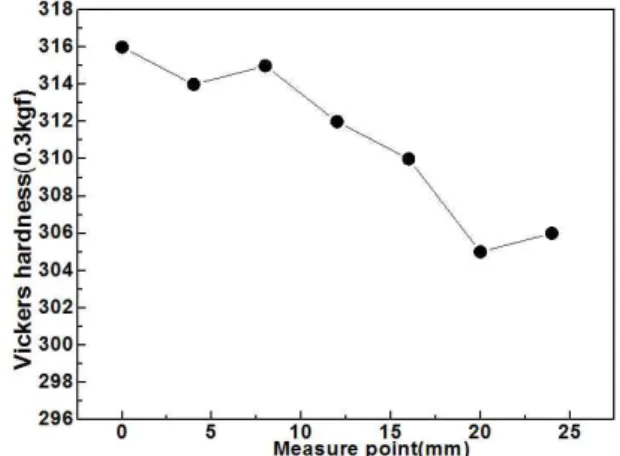
Fig. 2. Variation of the hardness of welding zones with distance from center area (0 mm) of weld metal zone to base metal zone (24 mm).
would be generally used with piston crown material. And the corrosion properties of weld metal, heat affected and base metal zones were investigated using electrochemical methods in 35% H2SO4 solution. Consequently, the results of this study may serve as a good available reference data set for successful information on the mechanical and corrosion characteristics indicating in each welding zone when the upper part of the piston crown is deposited by repair welding with 1.25cr-0.5 Mo filler metal.
2. EXPERIMENTAL PROCEDURE
The base metal used for the repair welding was a heat resistance steel with Cr-Mo low alloy which is being generally used with piston crown material. And The base metal specimen was prepared with a size such as a thickness of 50mm, a width of 260mm, and a length of 410mm. The hole with diameter of 20 mm, depth of 3.5 mm was artificially made in its center area, and its hole was deposited with repair welding using AC shielded metal arc welding (AC SMAW) method by 1.25Cr-0.5 Mo filler metal. The welding was performed from the AC 1st layer to the 5th layer. Table 1 and Table 2 show chemical composition of the base metal and 1.25Cr- 0.5Mo filler metal, respectively. The test specimen was again manufactured with a size such as a thickness of 10mm, a width of 20mm, and a length of 70mm by the lathe process. Fig. 1 shows a photograph of the test specimen and a schematic diagram with welding area.
The welding surface of the test specimens was polished with sand paper from No.200 to No.2000, and degreased with acetone, and insulated with epoxy coating except for an area of 1 cm2 (0.25 cm2 for heat affected zone) for the electrochemical test. The polarization curves were measured via the CMS105 program ( Gamry Co.UK ) in 35% H2SO4 solution with a flowing condition of 3cm/s
that was calculated by particle image velocimetery, and measurement condition was as follows, that is, scanning speed is 1mV/s, counter electrode is a Pt wire and, reference electrode is a saturated calomel electrode (SCE).
The surface morphology of the corrode surface was observed with an SEM microscope (Model: SV35, Sometech, Com, Ltd). Vickers hardness was measured three times in interval of 4 mm from center area of the weld metal zone to base metal zone, and obtained their average values.
3. RESULT AND DISCUSSION
Fig. 2 shows variation of hardness of welding zones with distance from center area of weld metal zone to base metal zone. The hardness of weld metal zone comparatively exhibited a higher value than that of the base metal zone.
The chemical composition of weld metal zone is considered
Fig. 3. Variation of corrosion potentials in each welding zone in 35% H2SO4 solution.
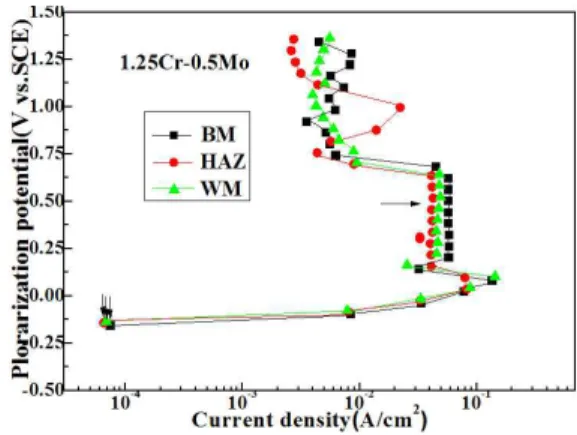
Fig. 4. Comparison of anodic polarization curves of each welding zone in 35% H2SO4 solution.
Fig. 5. Comparison of corrosion current densities in each welding zone.
Fig. 6. Comparison of impedances in each welding zone in 35%
H2SO4 solution.
to be mainly consisted of the chemical composition of the filler metal. Therefore, as shown in Table 1 and Table 2, it is thought that the weld metal zone represented a higher value of hardness compared to the base metal zone due to larger amount of Cr and Mo in weld metal zone than that of the base metal.
Fig. 3 shows variation of corrosion potentials of each welding zone. The weld metal and base metal zones exhibited the noblest and lowest corrosion potentials respectively. And the heat affected zone indicated a medium value. As shown in Table 1and Table 2, it is considered that the weld metal zone having larger amount of Cr and Mo compared to the base metal exhibited a nobler corrosion potential than the base metal zone.
Therefore, it is assumed that corrosion resistance of the weld metal zone is to be qualitatively better than that of the base metal zone.
Fig. 4 shows anodic polarization curves of each welding zone. As shown in Fig. 4, the passivity current density indicating with horizontal arrow showed slightly the biggest value in the base metal zone compared to the weld metal and heat affected zones. Moreover, it is suggested that the current density indicating as vertical arrow can
be approximately assumed as a corrosion current density11). Thus, Fig. 5 shows comparison of corrosion current density of each welding zone obtained by vertical arrows of Fig.
4. The base metal zone indicated more or less a higher value of corrosion current density than those of the heat affected and weld metal zones as shown in Fig. 5 As a result, it is expected that the weld metal and heat affected zones exhibited higher hardness as well as better corrosion resistance than the base metal zone due to larger amount of Cr and Mo beneficial to high hardness and good corrosion resistance.
Fig. 6 shows variation of impedances in each welding zone measured in 35 % H2SO4 solution. The value of impedance at 0.01Hz was the lowest value in the base metal zone, and the heat affected zone exhibited the highest value, moreover, the weld metal zone followed the heat affected zone.
As a result, these results of Fig. 5 and Fig. 6 were slightly in good agreement with each other, for instance, the corrosion resistance of the heat affected and weld metal zones increased with increasing the impedance.
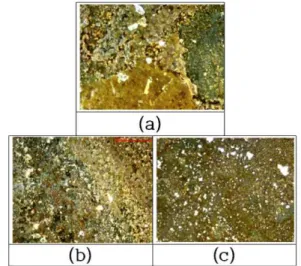
Fig. 7. Morphologies of corroded surfaces in each welding zone after measurement of anodic polarization curves,(a):BM, (b):HAZ, (c):WM, (x200).
Fig. 8. Morphologies of microstructures of each welding zone (a):BM, (b):HAZ, (c):WM, (x200).
Fig. 7 shows morphologies of the corroded surfaces for each welding zone after measurement of anodic polarization curves. It appeared that the corrosive products with red color were considerably covered on the surface of the base metal zone, and local corrosion pattern like as a pitting corrosion was also observed in the base metal zone. The corrosion products were also considerably observed on the surface of the base metal zone compared to the heat affected and weld metal zones.
Fig. 8 shows microstructures of the welding zones. The microstructure of the pearlite with black color was considerably observed in the base metal zone, and ferrite phase with white color also appeared more or less with crystal pattern. However, the amount of ferrite phase with
white color was significantly increased in the heat affected zone and the weld metal zones.
By the way, from the results of Fig. 1, the weld metal zone showed a higher hardness than that of the base metal zone. Thus, it is considered that the hardness increased with increasing the amount of ferrite phase. As a result, the larger amount of ferrite phase, the higher hardness, and the nobler corrosion potential, the corrosion resistance was increasingly increased. Therefore, it is considered that there was a somewhat good relationship between polarization characteristics and their mechanical properties.
4. CONCLUSION
When the repair welding by using the 1.25Cr-0.5 Mo filler metal was carried out on the forged steel that would be generally used with piston crown material, the mechanical and corrosion properties for each welding zone was investigated using electrochemical method. The weld metal and base metal zones exhibited the highest and lowest values of hardness respectively. Moreover, the corrosion current densities of the heat affected and weld metal zones also showed smaller values than the base metal zone. The microstructure of the pearlite with black color was considerably observed in the base metal zone, and the microstructure of ferrite with white color was significantly observed in the heat affected zone and the weld metal zone. As a result, it is expected that the weld metal and heat affected zones exhibited higher hardness as well as better corrosion resistance than the base metal zone because larger amount of Cr and Mo beneficial to high hardness and good corrosion resistance were in weld metal and heat affected zone than the base metal zone.
Consequently, it is suggested that the mechanical and corrosion characteristics of the piston crown can be considerably improved by repair welding using the 1.25Cr- 0.5Mo electrode.
References
1. S. K. Jang and J. I. Jeon, J. of Kor. Soc. of Mar. Eng., 30, 30 (2006).
2. J. D. Kim, B. L. Kil and C. J. Lee, J. of Kor. Soc. of Mar. Eng., 5, 629 (2006).
3. J. D. Kim, S. J. Yoo and J. S. Kim, J. of Kor. Soc. of Mar. Eng., 30, 623 (2006).
4. P. D. Bilmes, C. L. Liorente, Saire Huaman, L. M. Gassa and C. A. Gervasi, Corros. Sci., 48, 3261 (2006).
5. Y. H. Lee, Y. H. Kim and H. Kim, Corros. Sci. Tech., 2, 219 (2003).
6. I. H. Lo, M. C. Lee, K. Y. Lim, W. Ho, G. C. Y. Yang and W. T. Tsai, Corros. Sci. Tech., 31, 361 (2002).
7. K. M. Moon, M. H. Lee, K. J. Kim, J. G. Kim and S.
J. Kim, Corros. Sci. Tech., 2, 283 (2003).
8. V. S. Raja, S. K. Vershney, R. Raman and S. D. Kulkarni, Corros. Sci. 40, 1609 (1998).
9. L. W. Tsay, W. L. Lin, S. W. Chenct and G. S. Leu, Corros. Sci., 39, 1165 (1997).
10. P. D. Bilmes, C. L. Liorente, Saire Huaman, L. M. Gassa and C. A. Gervasi, Corros. Sci., 48, 3261 (2006).
11. K. M. Moon, J. P. Won, D. H. Park, S. Y. Lee, J. A.
Jeong, M. H. Lee, and T. S. Baek, Corros. Sci. Tech., 13, 20 (2014).