Original Article / 원저
Efficacy of Herbal Medicines for the Treatment of Seborrheic Dermatitis : Systematic Review
Jeong-Yoon Kim 1) ․ Young-Woo Jang 1) ․ Hye-Gyeong Kim 1) ․ Seung-Hwan Lim 2)*
1,2)
Dept. of Ophthalmology, Otolaryngology & Dermatology, Daejun Jaseng Hospital of Korean Medicine
지루성 피부염의 한약 치료 효과에 대한 체계적 문헌고찰
김정윤1)․ 장영우1)․ 김혜경1)․ 임승환2)*
1)대전자생한방병원 한방안이비인후피부과 (수련의)
2)대전자생한방병원 한방안이비인후피부과 (원장)
Abstract
목적 : 체계적 문헌고찰을 통하여 지루피부염에 한약복용의 효과와 연구의 질을 평가하기 위함.
방법 : OASIS, NDSL, EMBASE, Pubmed, Cochrane Library, CINAHL, CNKI, WANFANG, CiNii, J-STAGE를 이용 하여 검색하였다. 검색은 2018년 6월 21일에 시행되었으며 P는 지루성 피부염, I는 한약 복용으로 진행하였다. 두 명의 연구 자가 독립적으로 연구를 평가하고 선정하였으며, 의견이 다를 경우 제 3자가 개입하여 다수결로 결정하였다.
결과 : 중복 검색을 제외하고 총 952개의 연구가 검색되었으며 제목과 초록을 검토한 결과 897개의 연구가 제외되었다.
나머지 55개 연구의 전문을 검토한 결과 4개의 RCT연구가 최종 선정되었다. 선정된 연구는 발행연도, 대상, 중재법, 평가방 법, 효과, 부작용, RoB를 통해 평가하였다. 한약 복용을 한 치료군에서 대조군에 비해 유의하게 호전을 보였으며 중대한 부 작용은 없었다.
결론 : 지루성 피부염에 있어 한약 복용은 효과적이며 안전성이 있는 하나의 치료법이다. 향후 다양하고 체계적인 RCT의 시행이 요구된다.
Key words : seborrheic dermatitis; herbal medicine; Korean medicine; intake; systematic review
ⓒ 2018 the Society of Korean Medicine Ophthalmology & Otolaryngology & Dermatology
This is an Open Access journal distributed under the terms of the Creative Commons Attribution Non-Commercial License
(http://creativecommons.org/license/by-nc/3.0/) which permits unrestricted non-commercial use, distribution, and reproduction in
any medium, provided the original work is properly cited.
한방안이비인후피부과학회지 제31권 제3호(2018년 8월)
68
Ⅰ.Introduction
Seborrheic dermatitis is an eczematous dermatitis that occurs in areas of sebaceous glands are prominent. It is characterized by the redness and scales on the skin. It affects areas of the scalp, eyebrows, sternum, axillae, breast, umbilicus, groin, and wrinkles of buttocks and has repeat episodes.
Incidence is 1-3% of the total population and 3-10% of the general adult population.
Infants aged 3-4 months and men aged 40-70 are frequently affected, and is associated with oily skin. It is common in patients with neurological disorders, neuroleptic medication, endocrine disorders which cause obesity, alcoholics, and AIDS patients
1). Recently, patients are increasing regardless of gender and age, due to stress and the change of lifestyles such as having instant meal and meat
2).
The cause is unclear and there are various hypotheses such as sebaceous hypersecretion, malassezia yeast, abnormal metabolism of neurotransmitters(L-dopa), epidermal hyperplasia, AIDS, seasonal effects, food and drug disorders, and lifestyle, etc
1).
In general, the treatment of seborrheic dermatitis uses anti-inflammatory and antifungal agents as a topical treatment, and fluconazoles focusing on Malessesia yeasts are also used. If seborrheic dermatitis spreads to the entire body or does not respond to topical
treatment, oral therapy is used and there is an antifungal agent such as ketoconazole.
However, due to side effects of medication and the chronicization of seborrheic dermatitis, alternative methods such as mud treatment are being sought due to the difficulties in using external or oral solutions
7). Therefore, developing more effective and safe treatments than current methods for seborrheic dermatitis is needed. In the traditional Korean medicine literature, seborrheic dermatitis is referred to
“baekseolpung(白屑風)”, “myeonyupung(面遊風)”,
“yugupung(紐口風)”. Which occurs in the cephalic area is called “baekseolpung(白屑風)”, occurs in the face is “myeonyupung(面遊風)”, and that occurs in the chest is called
“yugupung(紐口風)”
3).
As the prevalence of seborrheic dermatitis increase, research is actively underway in Korean medicine. Many studies using various herbal remedies for seborrheic dermatitis have been reported, including the treatment of pharmacoacupuncture and applying herbal medicine extract. However, the number of patients used in the study is small and most of the studies were case reports. Therefore, there is lack of enough organized evidence to confirm the validity of herbal medicine for seborrheic dermatitis. These clinical studies should be validated and justified in evidence-based medicine. As a part of the evidence-based medicine, systematic review of the effects of acupuncture and herbal medicine in various diseases is being conducted in Korean medicine
20-23).
Corresponding author : Seung-hwan Lim, Munjeong-ro 48beon-gil, Seo-gu, Daejeon, Republic of Korea.
Tel: +82-42-610-0464, E-mail: [email protected]
• Recieved 2018/7/5 • Revised 2018/7/30 • Accepted 2018/8/6
This study investigated the use of herbal medicine as an alternative treatment for seborrheic dermatitis by extensively reviewing related literatures. The purpose of this study is to evaluate the safety and efficacy of taking herbal medicine as seborrheic dermatitis treatment and to provide database for the further study including establishing clinical practise guidelines. Furthermore, this study is written in English in order to identify the global trends and provide reliable baseline data that so can be widely used in the field of alternative medicine worldwide in the future.
Ⅱ. Objectives and Methods
1. Objectives
From the start of search engine support to June 20, 2018, clinical research papers on herbal medicine intake to seborrheic dermatitis were reviewed.
2. Methods
The electronic databases that were surveyed for this review were:
Korean – OASIS (Oriental medicine Advanced Searching Integrated System, http://oasis.kiom.
re.kr), NDSL (National Digital Science Links, http://scholar.ndsl.kr)
English - EMBASE (Excerpta Medica Database, ttp://www.embase.com), PubMed (http://www.ncbi.nlm.nih.gov/pubmed/), Cochrane library (http://www.cochranelibrary.com), CINAHL (Cumulative Index to Nursing and Allied Health Literature, http:// search.
ebscohost.com/login.asp?profile=ehost&default db=rzh)
Chinese – CNKI (China National Knowledge Infrastructure, http://acad.cnki.net/kns/default.htm), WANFANG (http://www.wanfangdata.com.cn/) Japanese - CiNii articles (http://ci.nii.ac.jp/), J-STAGE (Japan Science and Technology information Aggreator, Electronic, https://
www.jstage.jst.go.jp/).
The search terms P (patient) AND I (intervention) were used. Korean search terms were ‘지루 피부염’, ‘지루성 피부염’, english search terms were ‘seborrheic dermatitis’ for P, and ‘herbal’, ‘traditional’, ‘medicine’ for I.
Chinese search terms used previous english terms as well as ‘脂溢性皮炎’ for P, and ‘中药’
for I. Also, japanese search terms used previous english terms and used ‘脂漏性皮膚炎’
for P, ‘漢方薬’ for I. After the search, the literature was organized.
3. Selection and Exclusion Criteria
The selection criteria:
1) A study of patients with seborrheic dermatitis
2) A randomized controlled trials(RCTs) using herbal medicine intake
3) A study involving outcome variables to determine whether seborrheic dermatitis improved
The exclusion criteria:
1) Combined treatment which cannot identify the efficacy of herbal medicine intake 2) A study except RCTs, such as nonrandomized
controlled trials(non-RCTs), case control
한방안이비인후피부과학회지 제31권 제3호(2018년 8월)
70
study(CCT), single group trial, case report, in vivo, in vitro, literature review, letters 3) A study that did not include outcome
variables to determine whether seborrheic dermatitis improved
4. Study selection and data extraction
The study selection was undertaken by two review authors (KJY, JYW). The first selection was made after screening the title and abstract of articles found in the search, and after screening the full text, the second selection was done. The entire process was performed independently. The study was selected through the agreement between the two researchers, when the researchers failed to reach agreement, the third party intervened and decided by majority.
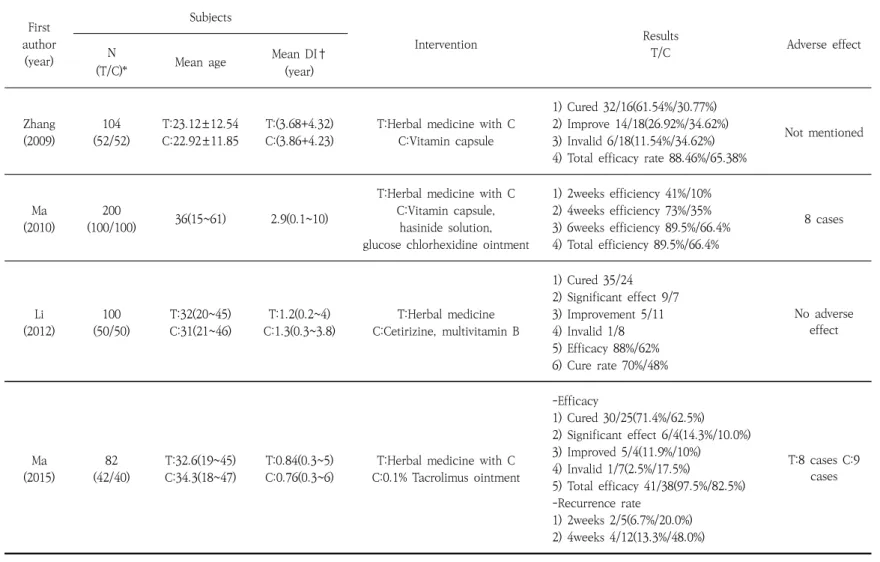
Data extraction was done by summarizing the year of publication, subject, treatment intervention procedure, evaluation method, treatment effect and side effect report.
5. Risk of bias assessment
A bias is a systematic error, or deviation from the truth, in results or inferences.
Different biases can lead to underestimation or overestimation of the true intervention effect.
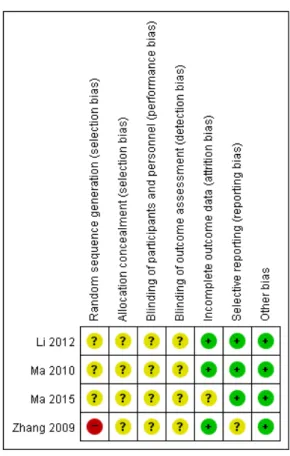
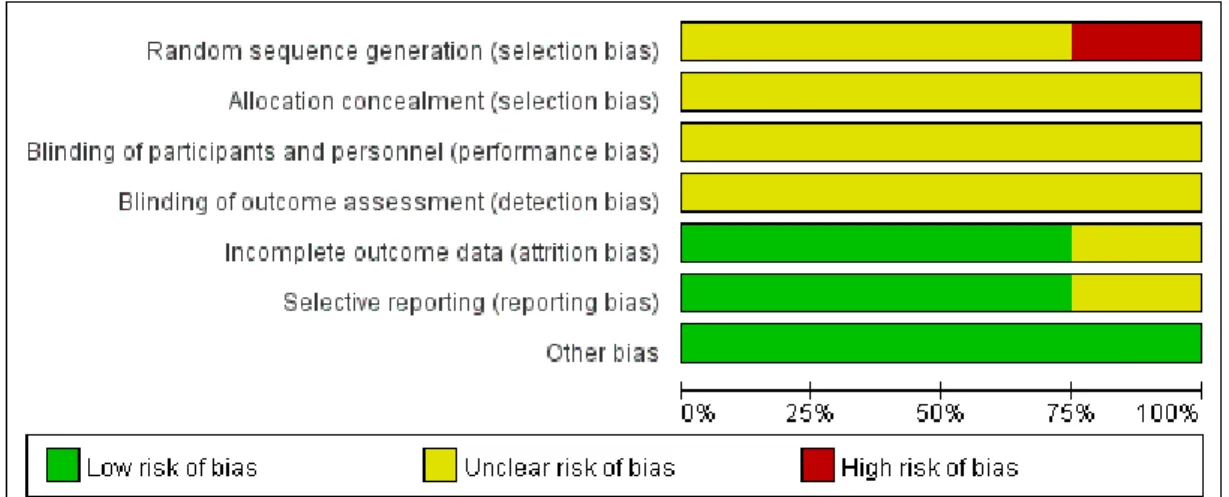
Risk of bias was evaluated by the risk of bias (RoB) tool which was developed by the Cochrane group. The types of bias in the RCTs are selection bias, performance bias, detection bias, attrition bias and reporting bias.
The RoB tool uses seven areas of random sequence generation, allocation concealment,
blinding of participants and personnel, blinding of outcome assessment, incomplete outcome data, selective reporting, and other bias. Depending on the study, the risk is determined as “high risk of bias”, “low risk of bias”, “unclear risk of bias” for each questions
15).
Results were combined using Review Manager(RevMan) 5.3.
Ⅲ. Results
1. Search results
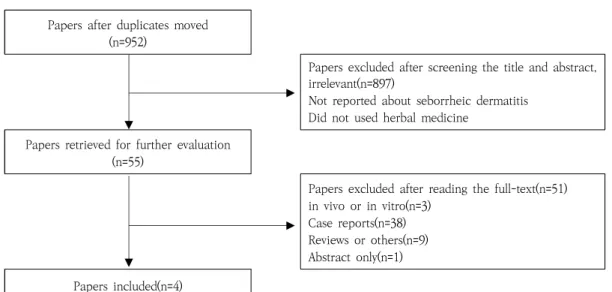
Search results were OASIS 15, NDSL 79, EMBASE 256, Pubmed 553, Cochrane Library 6, CINAHL 7, CNKI 70, WANFANG 116, CiNii 13, and J-STAGE 5. A total of 952 studies were found, excluding duplicates.
After screening the title and the abstract, the
studies which did not deal with seborrehic
dermatitis or used intervention other than
herbal medicine were excluded. Even if herbal
medicine was used as intervention, it was
excluded when it is unclear to identify the
effects of herbal medicine solely from
combined treatments. And the papers that did
not focus on comparing the efficacy of taking
herbal medicine, case reports, laboratory
papers which did not cover the human body,
and papers that only provided abstracts were
excluded, only RCTs were included. Therefore,
4 papers that meet the criteria were finally
selected(Fig. 1).