J Korean Med Ophthalmol Otolaryngol Dermatol 2019;32(1):74-82 pISSN 1738-6640 eISSN 2234-4020
http://www.ood.or.kr http://dx.doi.org/10.6114/jkood.2019.32.1.074
Original Article / 원저
한방안이비인후피부과학회지에 게재된 알레르기 비염과 관련된 임상 논문에 대한 고찰
강정인1․ 이동효2
우석대학교 한의과대학 안이비인후피부과학 교실 (1수련의, 2교수)
The Review on the Allergic Rhinitis Related Articles Published in the Journal of Korean Medicine Ophthalmology, Otolaryngology & Dermatology
Jeong-In Kang ․ Dong-Hyo Lee
Department of Ophthalmology, Otolaryngology & Dermatology, College of Korean medicine, Woo-Suk University
Abstract
Objective : The purpose of this study is to analyze the trends of allergic rhinitis related articles that have been published in the Journal of Korean Medicine Ophthalmology, Otolaryngology & Dermatology(JKOOD).
Method : We studied 32 articles of allergic rhinitis published in JKOOD from 1988 to 2018. 24 articles are classified into two categories; treatment-related article and diagnosis–related article which include pattern identification. And we reviewed the other 8 articles briefly in discussion.
Results : 16 treatment articles are classified into two categories; 13 case reports and 3 retrospective observation studies. In case reports, the studies are classified into three categories; 3 acupuncture group, 3 herbal medicine group or 7 herbal medicine with other parallel treatments group.
Conclusions : Further studies are needed on allergic rhinitis including treatment, alternative medicine and methods of evaluation in order to develop a level of evidence.
Key words : Allergic rhinitis; JKOOD; Review
ⓒ 2019 the Society of Korean Medicine Ophthalmology & Otolaryngology & Dermatology
This is an Open Access journal distributed under the terms of the Creative Commons Attribution Non-Commercial License (http://creativecommons.org/license/by-nc/3.0/) which permits unrestricted non-commercial use, distribution, and reproduction in any medium, provided the original work is properly cited.
Ⅰ. 서 론
알레르기 비염은 특징적인 알레르기 항원에 대한 IgE가 매개하는 면역반응으로 비점막의 염증을 일으 켜 코막힘, 콧물, 재채기, 가려움 등의 증상을 유발한 다1). 또한 지속적인 증상들로 피로, 수면장애 및 업무 장애, 집중력 감소 등의 불편함을 초래하여 삶의 질의 저하를 가져온다2,3).
2017년 기준 진료 인원이 6,892,302명(3위)에 이 르고 유병률이 지속적으로 증가 추세를 보이고 있으 며4,5), 이에 따른 치료비용 및 사회적 부담의 증가를 고려할 때 안전하면서 경제적이고 효과적인 치료에 대한 모색이 필요하다.
알레르기 비염의 일차 치료 약물로 항히스타민제와 국소 비충혈제거제 등이 사용되는데 항히스타민제의 경우 재채기, 콧물 및 가려움증에는 효과적이지만 코 막힘에는 효과가 불확실하며, 국소용 점막수축제의 경 우 장기간 사용 시 오히려 비점막 부종, 약물성 비염 의 원인이 될 수 있다6). 만성화되는 경과를 밟는 알레 르기 비염의 질환 특성상 한의학에 대한 치료 수요가 지속적으로 늘어가고 있는 추세이다7).
이에 본 연구에서는 한방안이비인후피부과학회지에 게재된 알레르기 비염 관련 임상 논문에 대한 분석 및 고찰을 통하여 알레르기 비염 연구 경향 및 현황을 파 악하고 향후 알레르기 비염의 한의학적 치료에 대한 연구의 방향을 모색하고자 하였다.
Ⅱ. 연구방법
1. 논문검색
연구 대상은 대한한방안이비인후피부과학회지
1988년 창간호부터 2018년 31권 4호까지 개재된 논 문을 대상으로 ‘알레르기 비염’, ‘알레르기성 비염’
‘Allergic rhinitis’의 키워드로 검색한 62편의 논문 중 실험 논문 30편을 제외한 총 32편의 논문을 대상 으로 하였다.
2. 연구방법
전체 32편의 논문을 대상으로 치료 영역, 변증을 포함한 진단 영역 등 2가지 항목으로 분류하였으며, 총 24편의 논문이 포함되었다. 각 항목에 대해서는 다 음과 같이 다시 세분화하여 기술하였다.
치료 영역은 증례보고(case report)와 후향적인 관 찰연구로 구분하였고, 증례보고는 다시 치료법을 중심 으로 한약 치료, 침 치료, 한약과 기타 치료의 병행으 로 나누어 분석하였다. 증례보고는 한명 이상의 환자 에서 이루어진 관찰로 집단으로 모으거나 분석되지 않고 개별적으로 언급된 것을 의미한다8).
변증을 포함한 진단 영역은 어떤 평가도구를 가지 고 연구하였는지에 따라 KiFDA-변증기준, 비내시경 평가척도, Heart Rate Variability(HRV), Multiple Allergosorbent Test system Chemiluminescent Assay(MAST CLA) 검사 관련 연구로 구분하였다.
이상의 분류에 포함되지 않는 8편은 최신 지견 또 는 진료 현황 조사 등이었으며, 고찰에서 간단히 소개 하기로 한다.
Ⅲ. 결 과
1. 분류 및 경향
알레르기 비염과 관련된 논문 62편에서 실험 논문 30편을 제외한 나머지 32편의 논문 중 치료 영역 논 문이 16편, 변증을 포함한 진단 영역 논문이 8편, 이 상의 분류에 포함되지 않는 논문이 8편으로 치료 영 역 논문이 가장 많은 것으로 나타났다.
Corresponding author : Dong-Hyo Lee, Department of Opthalmology, Otolaryngology and Dermatology, College of Oreiental Medicine, Woo-Suk University, 46, Eoeun-ro, Wansan-gu, Jeonju-si, Jeollabuk-do, 54987, Republic of Korea.
(Tel : 063-220-8611, E-mail : [email protected])
• Received 2019/1/14 • Revised 2019/1/23 • Accepted 2019/1/30
2. 치료 영역 항목
본 학회지에 게재된 치료 영역 논문은 총 16편으로 그 중 증례보고가 13편으로 주를 이루었고, 외래경과 기록지를 통한 후향적인 관찰연구가 3편이었다.
1) 증례보고
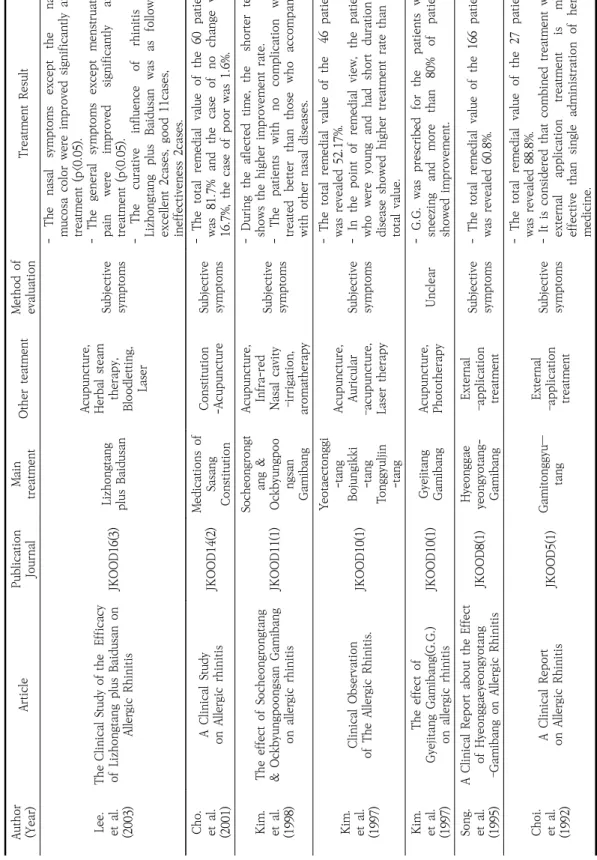
총 13편의 논문 중 침 치료만을 단독 시행한 경우 는 3편, 한약 치료를 단독 시행한 경우는 3편, 한약과 기타치료를 병행한 경우가 7편이었다(Table 1).
침 치료를 시행한 3편의 논문 중 2편은 이침 치료 를 시행한 논문이며, 나머지 1편은 체질침을 사용하였 다. 이침 치료 관련 논문 2편은 보건소에서 실시한 사 업에 참여한 학생들을 대상으로 穴位는 M101(肺), M13(副腎), M16(內鼻), M22(內分泌), M33(額), M55(神門)을 선정하여 총 4주간 주당 2회 시술을 하 여 효과를 평가하였다. 체질침 치료 관련 논문 1편은 알레르기 비염을 주소로 내원한 환자 중 금음체질로 판정된 환자 3명을 대상으로 증상에 따라 기본방, 부 계염증부방, 살균방을 주 2회씩 약 5주에 걸쳐 치료하 였다.
한약 치료를 시행한 3편의 논문 중 1편은 알레르기 비염 환자 77명을 대상으로 BOM 健脾消炎湯을 단독 투여 혹은 변증에 따라 平胃散, 補中益氣湯, 六味地黃 湯, 防風通聖散, 小靑龍湯 등과 합방하여 1개월간 투여 하였고, 다른 1편은 한방병원에 내원한 알레르기 비염 환자 22명을 대상으로 加味通竅湯을 1일 2포씩 총 4 주 동안 투여하였다. 나머지 1편은 알레르기 비염으로 진단 받은 환자 50명을 대상으로 補中益氣湯加味方을 투여하였고 투여기간은 환자마다 차이가 있었다.
한약과 기타 치료를 병행한 논문에서 사용한 한약 은 理中湯 合 敗毒散, 體質方, 小靑龍湯 合 玉屛風散 加 味方, 麗澤通氣湯, 桂枝湯加味方, 荊芥連翹湯加味, 加味 通竅湯 등으로 상이했으며 기타 치료로는 침 치료, 이 침, 광선치료, 향기요법, 하비갑개 사혈 등이 병행된 것으로 나타났다.
평가 방법은 Total Nasal Symptom Score(TNSS)
와 Total Non Nasal Symptom Score(TNNSS)를 사용한 논문이 1편, Severity Scoring Systems of Rhinitis(SSSR)을 사용한 논문이 2편, Visual Analogue Scale(VAS)를 사용한 논문이 1편 있었고, 그 외에는 자체적으로 개발한 증상별 4-5단계 척도를 사용하였다. 증상 평가와 함께 삶의 질 평가를 시행한 논문은 총 3편이었는데 그 중 2편은 각각 Rhinoconjuctivitis quality of life questionnaires (RQLQ)와 Quality of Life Questionnaire for Korean Rhinitisian(QLQKR)을 사용하였고, 나머지 1편은 표준화된 삶의 질 평가도구를 사용하지 않고 SSSR 척도를 활용하였다.
2) 후향적 관찰연구
3편의 논문은 알레르기 비염으로 병원에 내원하였 던 환자들의 외래경과기록지를 통한 임상 고찰에 대 한 것으로 성별과 연령, 내원시기, 치료방법, 치료기 간 및 치료 횟수, 과거력 등을 조사 및 분석하여 단순 빈도 분석 비교를 한 논문이었다9-11).
3. 변증 포함 진단 영역 항목
변증 포함 진단 영역 논문은 총 8편으로 KiFDA-변 증기준 관련 연구가 3편, 비내시경 평가지표 관련 연 구가 3편이었고, 그 외에 HRV 관련 연구가 1편, MAST CLA 검사 관련 연구가 1편이었다.
KiFDA-변증기준은 2008년 고 등12)이 한약과 생약 에 대한 알레르기 비염의 임상시험을 위하여 개발한 변증 평가도구로, 김 등13)에서는 변증도구의 개정 및 실용화를 위해 2012년 학술대회 등록 회원들을 대상 으로 알레르기 비염 변증 평가 문항들에 대한 변증 항 목별 응답 일치도와 변증 시 중요하게 고려되는 증상 영역 등에 대한 설문조사를 시행하였고, 이 등14)에서 는 알레르기 비염 환자 35명을 대상으로 환자 본인이 스스로 기입한 진단 평가지와 한방안이비인후피부과 전문의 1인이 환자를 직접 대면하여 평가한 변증진단 결과와의 일치도를 살펴보았다. 이후 KiFDA-변증기
Table 1. Characteristics of the Clinical Studies Author (Year)ArticlePublication JournalMain treatmentOther teatmentMethod of evaluationTreatment Result Hwang-bo. et al. (2011) Clinical Study on the Effects of Auricular Acupuncture Treatment in Allergic Rhinitis PatientsJKOOD24(1)Auricular acupuncture-TNSS, TNNSS, RQLQ
- Among items ofTNSS,nasalcongestion․ sneezing were significantly improved and total TNSSscores weresignificantly improved(p<0.05). - There was nosignificantdifference on TNNSS. - Among items of RQLQ, nasal & eye problem․ nasal symptom were significantly improved. Hwang-bo. et al. (2010)
Clinical Study on the Effects of Auricular Acupuncture Treatment in Allergic Rhinitis PatientsJKOOD23(3)Auricular acupuncture-SSSR, QLQKR
- SSSR Scores were significantly improved but there wasnosignificant difference on each items. -Among items of QLQKR, itching, worry about changeof environment, rolelimitation – physicalwere significantly improved and total QLQKR scores were significantly improved. Kim. et al. (2009)
3 Cases of the effect of 8 Constitution Acupuncture on Allergic RhinitisJKOOD22(2)8 Constitution –Acupuncture-VAS
- After taking8 Constitution-Acupuncture sessions,the symptoms of allergicrhinitis were improved. VAS was decreased 10 to 1(case1), 10 to 0(case2), 10 to 3(case3). Kim. et al. (2009)
The Clinical Study on the Effects of BOM Gunbisoyeom-tang (Jianbixiaoyan-tang) Gamibang for Allergic Rhinitis JKOOD22(1)BOM Gunbisoyeom —tang-SSSR, QOL
- BOM Gunbisoyeom-tang Gamibang improved significantlyall nasal symptoms,some non-nasal symptoms except chronic cough and ear symptoms and quality of life. Cho. et al. (2007)
Efficacy Evaluation of Gamitonggue-tang by Acoustic Rhinometry in Patients with Allergic Rhinitis JKOOD20(3)Gamitonggue— tang-Acoustic -Rhinometry, VAS
- After treatment(2, 4 weeks) the calculated flowresistance ofnasalcavity,totalnasal volume and nasal minimum cross – sectional showed no significant changes (p>0.05). - Symptomscore ofnasalobstructionshowed significant changes (p<0.05). Jung. et al. (2006)
The Analysis of 50 Patients with Allergic Rhinitis Administerd by Bojungikgitang-nGamibangJKOOD19(2)Bojungikgitang –Gamibang-Subjective symptoms - The shorterdurationofdisease andhigh dosage were the main factors which improved the symptoms of allergic rhinitis effectively. -The total remedial value ofthe 50patients wasrevealed74%(Excellent24%, Good32%, Slight 18%, None 26%).
Table 1. 계속 Author (Year)ArticlePublication JournalMain treatmentOther teatmentMethod of evaluationTreatment Result Lee. et al. (2003) The Clinical Study of the Efficacy of Lizhongtang plus Baidusan on Allergic Rhinitis JKOOD16(3)Lizhongtang plus Baidusan Acupuncture, Herbal steam therapy, Bloodletting, Laser
Subjective symptoms
- The nasalsymptoms except the nasal mucosa color were improved significantly after treatment (p<0.05). - The generalsymptoms except menstruation pain were improved significantly after treatment (p<0.05). - The curative influence ofrhinitisby LizhongtangplusBaidusan was asfollows; excellent 2cases, good 11cases, ineffectiveness 2cases. Cho. et al. (2001)
A Clinical Study on Allergic rhinitisJKOOD14(2)Medications of Sasang Constitution Constitution -AcupunctureSubjective symptoms
- The totalremedialvalueof the 60 patients was81.7%and the case of nochange was 16.7%, the case of poor was 1.6%. Kim. et al. (1998)
The effect of Socheongrongtang & Ockbyungpoongsan Gamibang on allergic rhinitisJKOOD11(1) Socheongrongt ang & Ockbyungpoo ngsan Gamibang Acupuncture, Infra-red Nasal cavity –irrigation, aromatherapy
Subjective symptoms
-During the aflected time, the shorter term shows the higher improvement rate. - The patientswithnocomplication were treated better than those who accompanied with other nasal diseases. Kim. et al. (1997)
Clinical Observation of The Allergic Rhinitis.JKOOD10(1) Yeotaectonggi -tang Bojungikki -tang Tonggyuljin -tang
Acupuncture, Auricular –acupuncture, Laser therapy Subjective symptoms
-The total remedial value ofthe 46patients was revealed 52.17%. -In the point ofremedial view, the patients who were young and had short duration of disease showed higher treatment rate than the total value. Kim. et al. (1997)
The effect of Gyejitang Gamibang(G.G.) on allergic rhinitisJKOOD10(1)Gyejitang GamibangAcupuncture, PhototherapyUnclear-G.G. was prescribed for the patients with sneezing andmore than 80%ofpatients showed improvement. Song. et al. (1995)
A Clinical Report about the Effect of Hyeonggaeyeongyotang –Gamibang on Allergic RhinitisJKOOD8(1)Hyeonggae yeongyotang- Gamibang External –application treatment
Subjective symptoms- The total remedialvalueofthe 166 patients was revealed 60.8%. Choi. et al. (1992)
A Clinical Report on Allergic RhinitisJKOOD5(1)Gamitonggyu— tang External –application treatment
Subjective symptoms
- -
The totalremedialvalueof the 27 patients was revealed 88.8%. It is considered that combined treatment with external application treatment is more effective thansingle administrationofherbal medicine.
준의 개정안에 대해 김 등7)이 보고한 논문이 1편이었 다.
비내시경 평가지표 관련 논문 3편은 2013년 윤 등
15)이 개발한 비내시경을 활용한 평가 척도를 이용한 연구였다. 김 등16)의 연구는 후향적 차트 리뷰를 통해 선정한 20개 증례의 비내시경 사진을 동일기관에 소 속된 평가자 4인과 타 기관에 소속된 평가자 4명이 각각 평가하게 하여 관찰자간, 관찰자내 신뢰도를 조 사한 예비 연구였다. 이 등17)은 알레르기 비염 환자 32명을 대상으로 한방안이비인후피부과 전문의 1인 이 비내시경 평가척도를 이용하여 평가한 결과와 Allergic Rhinitis and its Impact on Asthma (ARIA)의 분류기준 및 TNSS를 평가한 결과의 상관성 을 분석하였다. 안 등18)은 알레르기 비염 환자 32명을 대상으로 한방안이비인후피부과 전문의 1인이 평가한 비내시경 평가척도와 환자 스스로 작성한 한열변증설 문지를 통해 평가된 한열변증과의 상관성을 분석하였 다.
그 외에 HRV 관련 연구에서는 알레르기 비염 환자 32명을 대상으로 한방안이비인후피부과 전문의 1인 이 환자와의 직접적인 면담을 통하여 변증한 결과와 환자마다 HRV를 시행하여 변증군별 자율신경계 특성 의 차이가 있는지를 연구하였으나 각각의 특성을 반 영하는 지표에 유의한 차이가 없음을 확인하였으며, MAST CLA 관련 연구에서는 알레르기 비염 환자 35 명을 대상으로 피부반응검사와 MAST CLA 검사를 시 행한 후 그 결과를 비교하여 MAST CLA 검사의 진단 적 유용성을 확인하였다.
Ⅳ. 고찰 및 결론
알레르기 비염의 유병률 증가와 그에 따른 치료비 용의 지속적 증가 추세로 인하여 보다 안전하고 경제 적이며 효과적인 알레르기 비염 치료에 대한 요구가 늘어나고 있다.
이에 알레르기 비염의 한의 치료에 관하여 기존에
진행되어 온 임상 연구들에 대한 분석 및 고찰을 통하 여 향후 알레르기 비염의 한의 임상 연구 방향을 모색 하고자 하였다.
대한한방안이비인후피부과학회지 1988년 창간호부 터 2018년 31권 4호까지 개재된 알레르기 비염 관련 논문 62편 중 실험 논문 30편을 제외한 32편의 논문 을 치료영역 항목 16편, 변증 포함 진단영역 항목 8 편으로 나누었으며, 이상의 분류에 포함되지 않는 논 문이 8편이었다.
치료 영역 항목에서는 증례보고가 13편으로 가장 많았고 후향적 관찰연구가 3편이었다. 증례보고는 사 용된 치료법에 따라 침 치료, 한약 치료, 한약과 기타 치료를 병행한 항목으로 나누어 분석하였다. 침 치료 나 한약 치료의 경우 각각의 연구마다 사용된 처방이 상이해 특정한 빈용 처방을 파악할 수는 없었다. 그 외에 기타 동반된 치료로는 광선치료, 향기요법, 하비 갑개 사혈 등이 병행된 것으로 나타났다. 증례보고에 서 사용한 평가척도들을 살펴보면 표준화된 평가방법 들이 개발되어 있음에도 불구하고 임상적으로 소양증, 재채기, 비루 및 비폐색 등 증상의 유무에 근거를 두 고 환자가 느끼는 주관적 증상 정도에 따라 4-5단계 로 점수화하여 자체적으로 평가기준을 개발하여 이용 한 것이 대부분이었다. 이는 각 연구 결과간의 비교에 있어서 결과 해석이 제한적일 수밖에 없다고 판단된 다. 또한 증상의 평가에 있어 음향비강통기도검사를 활용한 연구도 있었으나 유의한 결과를 얻지는 못했 다.
변증 포함 진단 영역 항목 중 MAST CLA 검사와 HRV관련 논문 2편을 제외한 6편의 논문은 알레르기 비염의 객관적인 진단을 위한 평가도구 및 변증 설문 지의 개발에 대한 것이었다. 해당 연구들을 통해 객관 적인 평가지표 개발을 위해 노력해온 일련의 과정을 살펴볼 수 있었으나 평가도구가 한의 임상에 적용되 기 위해서는 추가적인 조사와 분석이 필요할 것으로 사료된다.
이상의 분류에 포함되지 않는 8편의 논문을 살펴보
면, 알레르기 비염의 현황에 관한 논문이 2편, 최신 지견 중심으로 알레르기 비염의 유병률 등 역학적인 정보와 병태생리, 진단 및 치료법 등을 정리한 논문이 2편, 알레르기 비염 환자의 삶의 질을 분석한 논문이 1편, 알레르기 비염의 기타 치료에 관한 연구 경향 분 석 논문이 3편이었다. 알레르기 비염의 현황에 관한 논문은 임상 한의사들을 대상으로 설문조사를 수행하 여 얻은 정보를 통해 치료현황 등에 대해 분석한 연구
19) 1편과 알레르기 비염으로 내원한 환자를 대상으로 전자의무기록에서 추출한 자료를 사용해 분석한 연구
20) 1편이었다. 알레르기 비염 환자의 삶의 질에 대한 논문은 알레르기 비염 환자 46명을 대상으로 조 등21) 이 고안한 QLQKR을 사용하여 평가하였고 대다수가 비 증상 외에도 전신 증상, 눈 증상을 호소하고 알레 르기 비염으로 인해 일상생활, 수면, 활동력, 감정 상 태에 불편함을 느끼는 것으로 나타났다22). 그 외의 논 문 3편은 모두 고찰 논문으로 알레르기 비염의 대체 의학적 치료에 관한 최근 논문경향 분석23) 1편, 알레 르기 비염의 비강 내 광치료에 관한 논문 경향 분석 1 편, 알레르기 비염의 침 치료에 대한 경제성 평가 연 구 경향 분석이 1편이었다. 이상의 3편의 논문에서는 한의 임상 영역에서의 다양한 치료 수단의 알레르기 비염 증상 및 삶의 질 개선 가능성을 확인할 수 있었 다.
출판년도에 따른 경향을 살펴보았을 때 증례보고가 주를 이루다가 점차 줄어드는 추세이며, 최근 알레르 기 비염의 한의 치료에 관한 연구 경향 분석 논문이 게재되고 있음을 확인할 수 있었다.
알레르기 비염의 한의 치료에 대한 수요가 증가함 에 따라 한의 임상 영역에서의 관련 논문이 보고되고 있으나 아직까지 국내에서 보고되는 임상 논문은 부 족한 것으로 보인다. 알레르기 비염의 한의학적 치료 에 대한 포괄적인 동향을 살펴보기 위해서는 한방안 이비인후피부과학회지에 발표된 논문 이외에 보다 많 은 문헌에 대한 조사 및 분석이 필요할 것으로 생각된 다. 또한 알레르기 비염 한의 치료의 올바른 임상적
적용을 위하여 지속적인 임상 연구 수행 및 보고를 통 한 근거창출이 필요하다.
Ⅴ. 감사의 글
본 연구는 한국보건산업진흥원을 통해 보건복지부
「한의약선도기술개발사업」의 재정 지원을 받아 수행 된 연구임(HB16C0009).
Ⅵ. Acknowledgments
This study was supported by the Traditional Korean Medicine R&D program funded by the Ministry of Health & Welfare through the Korea Health Industry Development Institute(HB16C0009).
ORCID
Jeong-In Kang
(https://orcid.org/0000-0002-1132-8365)
Dong-Hyo Lee
(https://orcid.org/0000-0002-4503-9270)
References
1. Kim JE, Baek JH. Research of Pattern Identification and Outcome Measurement in Allergic Rhinitis. The Journal of Pediatrics of Korean Medicine. 2016;
30(1):32-9.
2. Lee DH. A Review of Economic Evaluations in Acupuncture for Allergic Rhinitis. J Korean Med Ophthalmol Otolaryngol and
Dermatol. 2016;29(2):1-11.
3. Lee HS, Park EO. Development and Evaluation of Allergic Rhinitis-Specific Quality of Life (ARSQOL) Scale for Adults.
Journal of Korean Academy of Nursing.
2016;46(5):675-86.
4. Korea National Health Insurance Service and Korea Health Insurance Review and Assessment Services. National Health Insurance Statistical Annual Report. 2017.
5. Jeung CW, Jo HG, Kim HH, Song MY.
Current Update on Allergic Rhinitis for Korean Medicine Management. J Korean Med Ophthalmol Otolaryngol and Dermatol. 2016;29(4):95-113.
6. Van Cauwenberge P, Bachert C, Passalacqua G, Bousquet J, Canonica G, Durham S, et al. Consensus statement* on the treatment of allergic rhinitis. Allergy.
2000;55(2):116-34.
7. Kim MH, Yun YH, Ahn JH, Ko SG, Choi IH. Developing Pattern Identification Questionnaire of Allergic Rhinitis. J Korean Med Ophthalmol Otolaryngol and Dermatol. 2017;30(2):112-125.
8. Son MS, Song GJ, Jang SJ, Lee HS. Analysis of Articles Published of The Korean Society of Emergency Medicine. 1997;
(1):24-30.
9. Shin SH, Kim JH, Kim MB, Ko WS, Yoon HJ. A Clinical Study of 580 Cases on Hypersensitive Rhinitis including Allergic Rhinitis. J Korean Med Ophthalmol Otolaryngol and Dermatol. 2007;20(1):
218-27.
10. Choi IH. A Clinical Study of Hypersensitive
rhinitis including Allergic rhinitis. J Korean Med Ophthalmol Otolaryngol and Dermatol. 2002;15(2):169-82.
11. Chun SC, Lee SG, Jee SY. A clinical report about the effect of Tonguetangmi on Allergic Rhinitis. J Korean Med Ophthalmol Otolaryngol and Dermatol. 2002;15(2):
145-55.
12. Ko SK, Shin YC, Kwon DY, Lee JY, Park BJ, Choi IH, et al. The Research on evaluation endpoint development for clinical trial of herbal medicinal products about atopic dermatitis and allergic rhinitis. Korean Food and Drug Administration report. 2008.
13. Kim NK, Lee DH, Choi IH, Ko SG. An expert survey for developing pattern diagnosis instrument of persistent allergic rhinitis. J Korean Med Ophthalmol Otolaryngol and Dermatol. 2013;26(2):1-9.
14. Lee KJ, Kim HT, Jang BH, Choi IH, Ko SG.
Assessment of Concordance Rate in Pattern Analysis between Pattern Diagnosis of KiFDA on Allergic Rhinitis in 2008 and Doctor of Korean Medicine. J Korean Med Ophthalmol Otolaryngol and Dermatol.
2014;27(1):91-8.
15. Yun YH, Park JS, Kim KS, Kim NK, Kim KJ, Kim HT et al. A Study on the Development of Guideline for Assessing Anterior Nasal Cavity Using Nasal Endoscopy on Allergic Rhinitis Patients.
Kor J Oriental Preventive Medical Society.
2013;17(1):199-207.
16. Kim KS, Yun YH, Park JS, Kim NK, Kim KJ, Kim HT, et al. Inter- and Intra-rater
Reliability of Pattern Identification Using Nasal Endoscopy for Allergic Rhinitis. J Korean Med Ophthalmol Otolaryngol and Dermatol. 2013;26(2):10-8.
17. Lee KJ, Yun YH, Kim KS, Jang SB, Choi IH, Ko SG. A Study on Correlation between ARIA, TNSS and Nasal Endoscopy as Instruments of Evaluation for Allergic Rhinitis. J Korean Med Ophthalmol Otolaryngol and Dermatol. 2015;28(1):
109-18.
18. Ahn JH, Kim MH, Yun YH, Choi IH.
Relationship between Nasal Endoscopy Index for Pattern Identification and Cold-heat Pattern Identification in Allergic Rhinitis Patients. J Korean Med Ophthalmol Otolaryngol and Dermatol.
2015;28(4):1-11.
19. Kim YE, Jeong UM, Lee DH. A survey on treatment trend for allergic rhinitis in Korean medicine clinic. J Korean Med Ophthalmol Otolaryngol Dermatol. 2017;
30:75-96.
20. Jang BH, Choi IH, Kim KS, Kim HT, Kim KJ, Kim M-H, et al. Current status of allergic rhinitis patients in Korean Medicine hospitals-exploratory study based on electronic medical records of 3 hospitals. J Korean Med Ophthalmol Otolaryngol and Dermatol. 2014;27(1):
117-29.
21. Park KH, Cho JS, Lee KH, Shin SY, Moon JH, Cha CI. Rhinoconjunctivitis Quality of Life Questionnaire (RQLQ) as an Evaluator of Perennial Allergic Rhinitis Patients–The First Report. Korean Journal of
Otorhinolaryngology –Head and Neck Surgery. 2002;45(3):254-62.
22. Lee JG, Cho WJ, Hwang SY, Jee SY. The Quality of Life in Patients with Allergic Rhinitis Who Visit Daegu Oriental Hospital of Daegu Haany University. J Korean Med Ophthalmol Otolaryngol and Dermatol.
2007;20(3):191-203.
23. Kim JH, Shin SH, Kim MB, Ko WS, Yoon HJ. Systemic review: The study on alternative medicine for allergic rhinitis in Entrez Pubmed. J Korean Med Ophthalmol Otolaryngol and Dermatol. 2007;20(1):
239-49.