INTRODUCTION
The Child Welfare Act of South Korea defines the term
“child abuse” as “doing harm to a child’s health or welfare or committing physical, mental, or sexual violence, or cruel acts that are likely to impede normal growth of a child by adults including the child’s protector, and abandoning or neglect- ing a child by his/her protector.” According to this definition, the law categorizes child abuse into physical abuse, sexual abuse, emotional abuse, and neglect. “Physical abuse” is any act of physical violence committed by an adult against a child through which physical injury is caused or may be caused.
“Sexual abuse” is any act of a sexual nature either causing a child to feel sexually ashamed, such as sexual harassment and sexual violence, or forcing or enticing a child to engage in
any type of sexual activity. “Emotional abuse” is any act com- mitted by a caregiver that may cause injury to mental health and development, including direct abuse (e.g., habitual yell- ing or ignoring, verbal aggression, and negative gestures or words) and indirect mental injury inflicted on a child by wit- nessing physical and verbal domestic violence. “Neglect” is any act of abandoning a child under one’s protection with- out caring for basic needs including nutrition, clothing, and housing as well as appropriate rearing and healthcare. Child abuse is a serious social problem because abused children can be severely injured or even killed by the act of abuse, and are at a high risk for suicide in early adulthood [1,2].
Child abuse is known to have lingering effects, such as clini- cal symptoms including sleep disorder, anxiety, depressive disorder, and posttraumatic stress disorder, disruptive and aggressive behaviors [3,4], and impaired ability to form in- terpersonal relationships including peer and teacher attach- ment and later intimate relations [5-7].
This is an Open Access article distributed under the terms of the Creative Commons Attribution Non-Commercial License (https://creativecommons.org/licenses/by-nc/4.0) which permits unrestricted non-commercial use, distribution, and reproduction in any medium, provided the original work is properly cited.
Perception of Child Abuse and Child Disciplinary Practice among Adults Abused as Children:
Comparison to General Population
Ka Young Moon
1, So Young Irene Lee
1, A Reum Lee
1, Ka Yeong An
1, Kyung Soo Jung
2, Kyoung-Il Paek
2, Hyun Ah Kang
3, Ji Young Kang
3, and Shun Ah Chung
31
Department of Psychiatry, Soonchunhyang University Bucheon Hospital, Bucheon, Korea
2
Division of law, College of Law, Sookmyung Women’s University, Seoul, Korea
3
Division of Child Welfare & Studies, College of Human Ecology, Sookmyung Women’s University, Seoul, Korea
Objectives: The aim of this study was to compare differences in perception and knowledge of child abuse and child disciplinary prac- tices according to the history of child abuse victimization.
Methods: A questionnaire survey on child abuse was conducted with 491 adults raising children. We compared the perception and knowledge of child abuse and child disciplinary practices between two groups of adults with and without a history of childhood abuse victimization.
Results: The group with a history of childhood abuse had lower levels of knowledge of child abuse (F=6.990, p<0.01) and engaged in more negative disciplinary practices (F=5.974, p<0.05) than those without. However, no differences in the perception of child abuse were observed between the two groups.
Conclusion: The results suggest that adults with a history of childhood abuse have lower levels of knowledge of child abuse and use more negative disciplinary practices in raising their children. This highlights the need to administer not only educational but also more direct hands-on interventions to vulnerable parents in order to foster healthy parenting and disciplinary practices.
Key Words: Child abuse; Discipline; Perception; Knowledge.
Received: October 31, 2018 / Revision: November 20, 2018 / Accepted: January 3, 2019
Address for correspondence: So Young Irene Lee, Department of Psychiatry, Soonchunhyang University Bucheon Hospital, 170 Jomaru-ro, Bucheon 14584, Korea
Tel: +82-32-621-5063, Fax: +82-32-621-6909, E-mail: [email protected]
As examined above, not only does exposure to child abuse cause short-term problems to children but can have endur- ing repercussions into adolescence and adulthood. These repercussions can be exacerbated when abused children be- come parents. The social learning theory terms this phenom- enon “intergenerational transmission,” suggesting that abused children observe and learn their parents’ behavior and have a greater tendency to maltreat their own children [8]. This also reflects the phenomenon that the characteristics of inter- actions between children and their caregivers are internal- ized by children and carried on into adulthood, eventually influencing their relationships with their own children [9].
Given these theories and research results, parents whose caregivers exposed them to aggressive, violent discipline and rejection in their childhood are more likely to discipline their own children in the same negative way [10]. In this re- gard, a previous study demonstrated that parents with abu- sive childhood experiences are more likely to use harsh dis- cipline toward their own children [11]. However, except for this paper, research on the association between childhood exposure to abuse and parental child disciplinary practices has hardly been undertaken in South Korea. Therefore, the present study aims to identify the relationship between childhood exposure to abuse and parental child disciplin- ary practices.
Most South Korean studies related to child abuse have re- volved around determining the levels of knowledge and per- ception of child abuse and child abuse report intention among those legally obligated to report child abuse, such as kinder- garten and primary school teachers [12,13] and child wel- fare service and healthcare workers [14]. However, research on the awareness of child abuse among the general popula- tion or parents has been limited to investigating the level of parents’ knowledge and perception of child abuse [15]. Ac- cording to “Child Abuse & Neglect,” the 2016 report by the National Child Protection Agency, parents accounted for the largest proportion of child abuse offenders with 80.5%
[16]. This highlights the importance of research on parental perceptions of child abuse, especially the difference in the level of perception between parents with a history of child- hood abuse and those without, given the possibility of inter- generational transmission of experience of parenting prac- tices. According to a study on the levels of perception of child abuse among kindergarten teachers, the higher the percep- tion, the less likely they were to commit an act of child abuse [17]. From this, it follows that the level of perception of child abuse may be considered a potential protective factor against child-abusive behavior. Drawing on this assumption, this study aims to determine whether there are differences in the levels of knowledge and perception of child abuse between
parents with a history of childhood abuse and those without.
To sum up, not only can parents who were victims of child- hood abuse suffer from the lingering effects of victimization but their abusive childhood experiences can also adversely affect their relationships with their own children. However, there is a lack of research on such relationships in South Ko- rea. The aim of this study is, therefore, twofold: first, inves- tigating the possibility of the intergenerational transmission of child abuse by comparing the child disciplinary practices of parents with and without a history of childhood abuse;
second, comparing the levels of knowledge and perception of child abuse between these two groups.
METHODS
Participants
For the recruitment of survey participants, we used the data collected in the “Survey of Bucheon Citizens’ Percep- tion of Child Abuse” conducted with 1000 adults aged 20 to 65 who visited a public institution within Bucheon City in October and November 2015. For analysis purposes, we used the data of 491 visitors who had children (125 men, 366 wom- en). The survey data were collected by face-to-face interviews using a questionnaire. Prior to conducting the survey, survey- ors explained the purpose of the study, survey content and method, and the process of personal information collection and handling to the potential participants and received writ- ten informed consent. Surveyors were selected from among undergraduate students from mental health-related programs with mental health-related survey experience, and standard- ization training was provided to ensure interrater reliability.
The survey interviews were conducted at Bucheon City Mental Health Center in 2015 after approval by the Institu- tional Review Board of Soonchunhyang University Hospital Bucheon (IRB Number: 201510011).
Assessment scales
Demographic and clinical characteristics
Demographic variables were age, sex, marital status, edu-
cational level, economic status, religious affiliation, and pres-
ence/absence of school-aged children. Variables related to
clinical characteristics were alcohol use, psychiatric illness,
history of psychiatric treatment, and history of hospitaliza-
tion. As for psychiatric illness, the participants were asked
whether they had suffered or were suffering from any of the
following conditions: depressive disorder, anxiety disorder,
bipolar disorder, schizophrenia, adjustment disorder, so-
matoform disorder, sleep disorder, personality disorder, de-
mentia, organic mental disorders, mental retardation, and
developmental disabilities. It was also checked whether they had undergone psychiatric treatment and hospitalization.
History of childhood abuse
The participants were asked if they had experienced physi- cal, sexual, or emotional abuse or neglect from their caregiv- ers or significant adults. To assess the history of childhood abuse, we used a four-item subscale, one for each type of abuse, to be answered with either “yes” (1) or “no” (2).
Knowledge of child abuse
For measurement of the level of knowledge of child abuse, we prepared a 12-item assessment scale by partially modify- ing the items related to the perception of child abuse used in Hong and Lee [15] and those related to the knowledge of child abuse used in Kim [12]. The items covered contents related to the names and phone numbers of the institutions providing help to abused children, legal protection provided for informants, and characteristics of child abuse. The par- ticipants were supposed to answer each item with either
“yes” (1) or “no” (2). To calculate the score of knowledge of child abuse, each correct answer received 1 point and each incorrect answer 0 points. The sum of 12 points was divided by 12; that is, the closer the mean score to 1, the higher the lev- el of knowledge of child abuse.
Perception of child abuse
For measurement of the level of perception of child abuse, we used the 29-item assessment scale developed by Hong and Lee [15]. The 29 items are grouped into four subscales:
physical abuse, emotional abuse, sexual abuse, and neglect, with each item rated on a five-point Likert scale (1=definitely no, 5=definitely yes). For analysis, the mean scores of all items were calculated, and the closer the means to 5, the high- er the level of perception of child abuse.
Child disciplinary practices
For a quantitative analysis of participants’ child disciplin- ary practices, we derived the relevant items from the ques- tionnaire used in the original Ontario Child Health Study (OCHS) [18]. The first OCHS was conducted in 1983 to pro- spectively follow a large cohort of children and adolescents, assessing their physical health, psychiatric conditions, and developmental course. We translated and used questions from the seven-item parental disciplinary style subscale for when a child misbehaves: 1) explaining to the child, 2) sending the child to his/her room, 3) beating the child by hand, 4) beat- ing the child with a rod or other objects, 5) banning the child from doing something that he/she likes, 6) grabbing and shak- ing the child, and 7) punishing the child. Each item was rat-
ed on a four-point Likert scale ranging from 1 (never) to 4 (always). The closer the score is to 4, the higher the frequen- cy of the method used for child discipline. Item 1, which is a positive disciplinary method, was reverse scored, and the closer the mean score to 4, the higher the frequency of resort- ing to negative parental disciplinary practices.
Statistical analysis
Descriptive statistics were used to present the basic demo- graphic characteristics of the participants. Data were ana- lyzed using the t-test and chi-square test to compare the de- mographic and clinical characteristics between the two groups. In order to investigate the association between the levels of knowledge and perception of child abuse and the negative parental discipline of childhood in both groups, we conducted a correlation analysis for each group. Further- more, an analysis of covariance was performed to determine the intergroup differences in the level of perception and knowledge of child abuse and child discipline, using the de- mographic and clinical characteristics that showed signifi- cant intergroup differences as control variables. Statistical analysis was performed using SPSS 18.0 for Windows (SPSS Inc., Chicago, IL, USA).
RESULTS
Demographic characteristics (Table 1)
Sixty-eight out of 491 participants (13.8%) answered affir- matively to the question on whether they had been victims of one or more types of childhood abuse, and the rest (n=423, 86.2%) answered negatively. Among the demographic char- acteristics, marital status demonstrated a significant inter- group difference (χ
2=10.78, p<0.05): the group with a history of childhood abuse had a higher percentage of separation or divorce. No statistically significant intergroup differences were observed in other demographic variables.
Clinical characteristics (Table 2)
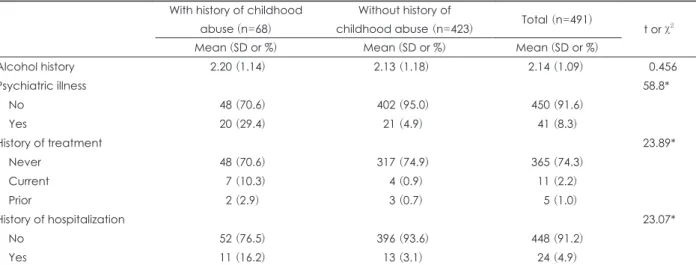
There were significant intergroup differences with regard to psychiatric illness (χ
2=58.8, p<0.001), with a significantly higher proportion of the group with than without a history of childhood abuse reporting the presence of psychiatric dis- orders (29.4% vs. 4.9%). This was most evident in the case of depressive disorder (χ
2=38.55, p<0.001), sleep disorder (χ
2= 12.39, p<0.001), and undiagnosed mental problems (χ
2=9.02, p<0.01). Accordingly, higher proportions of the group with than without a history of childhood abuse reported current and past history of mental illness-related treatment (10.3%
vs. 0.9%, and 2.9% vs. 0.7%, respectively) and psychiatric hos-
pitalization (16.2% vs. 3.1%), with statistical significance
Table 1. Demographic characteristics of subjects
With history of childhood abuse (n=68)
Without history of
childhood abuse (n=423) Total (n=491)
t or χ
2Mean (SD or %) Mean (SD or %) Mean (SD or %)
Age (years) 48.69 (8.67) 48.42 (8.55) 48.46 (8.55) 0.242
Sex 0.256
Male 19 (27.9) 106 (25.1) 125 (25.5)
Female 49 (72.1) 317 (74.9) 366 (74.5)
Marriage 10.78*
Married, cohabitation 59 (86.8) 388 (91.7) 447 (91.0)
Separation, divorce 8 (11.8) 16 (3.8) 24 (4.9)
Bereavement 0 (0) 11 (2.6) 11 (2.2)
Education 4.95
<6 years 3 (4.4) 5 (1.2) 8 (1.6)
<9 years 4 (5.9) 19 (4.5) 23 (4.7)
<12 years 29 (42.6) 216 (51.1) 245 (49.9)
Over 12 years 31 (45.6) 182 (43.0) 213 (43.4)
Economic status 4.36
Low 5 (7.4) 24 (5.7) 29 (5.9)
Medium low 17 (25.0) 76 (18.0) 93 (18.9)
Medium 35 (51.5) 257 (60.8) 292 (59.5)
Medium high 11 (16.2) 55 (13.0) 66 (13.4)
High 0 (0) 8 (1.9) 8 (1.6)
Religions 9.17
No religions 14 (20.6) 161 (38.1) 175 (35.6)
Christianity 28 (41.2) 123 (29.1) 151 (30.8)
Buddhism 9 (13.2) 60 (14.2) 69 (14.1)
Catholic 15 (22.1) 70 (16.5) 85 (17.3)
Others 2 (2.9) 8 (1.9) 10 (2.0)
School-aged children
Yes 34 (50.0) 188 (44.4) 222 (45.2) 0.745
No 33 (48.5) 229 (54.1) 262 (53.4)
Independent t-test for comparison of mean age and chi-square test for sex, marriage, education, economic status, religions, school-aged children. *p<0.05. SD: standard deviation
Table 2. Comparison of clinical characteristics between groups With history of childhood
abuse (n=68)
Without history of
childhood abuse (n=423) Total (n=491)
t or χ
2Mean (SD or %) Mean (SD or %) Mean (SD or %)
Alcohol history 2.20 (1.14) 2.13 (1.18) 2.14 (1.09) 0.456
Psychiatric illness 58.8*
No 48 (70.6) 402 (95.0) 450 (91.6)
Yes 20 (29.4) 21 (4.9) 41 (8.3)
History of treatment 23.89*
Never 48 (70.6) 317 (74.9) 365 (74.3)
Current 7 (10.3) 4 (0.9) 11 (2.2)
Prior 2 (2.9) 3 (0.7) 5 (1.0)
History of hospitalization 23.07*
No 52 (76.5) 396 (93.6) 448 (91.2)
Yes 11 (16.2) 13 (3.1) 24 (4.9)
Independent t-test for comparison of alcohol history and chi-square test for psychiatric illness, history of treatment, history of hos-
pitalization. *p<0.001. SD: standard deviation
(χ
2=23.89, p<0.001 and χ
2=23.07, p<0.001, respectively).
Correlations between Levels of Knowledge and Perception of Child Abuse and Negative Child Disciplinary Practices (Table 3)
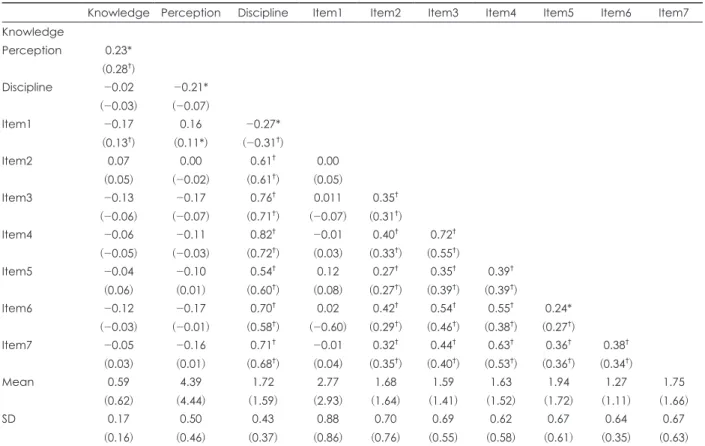
We computed a correlation matrix by calculating the cor- relation coefficients between all possible pairs of the vari- ables used for analysis (level of knowledge, level of percep- tion, child discipline, and seven items of child disciplinary practices) for both groups. The results demonstrated a posi- tive correlation between knowledge and perception in the group without a history of childhood abuse (r=0.270, p<0.01),
but no significant correlation in the group with a history of childhood abuse. The correlation coefficients of the knowl- edge/perception and discipline variable pairs were not sta- tistically significant in both groups. In other words, no sig- nificant correlations were observed between the levels of perception and knowledge of child abuse and negative child disciplinary practices.
Differences in Levels of Knowledge and Perception of Child Abuse Depending on the Experience of Childhood Abuse (Table 4)
Intergroup differences in the levels of knowledge and per-
Table 4. ANCOVA for comparison of perception and knowledge level about child abuse between groups With history of childhood abuse (n=68) Without history of childhood abuse (n=423)
F p
Mean (SE) Mean (SE)
Knowledge level 0.57 (0.20) 0.62 (0.08) 6.990* 0.009
Perception of abuse 4.41 (0.06) 4.46 (0.23) 0.873 0.351
Physical abuse 4.51 (0.55) 4.53 (0.22) 0.060 0.806
Emotional abuse 4.29 (0.70) 4.43 (0.28) 3.331 0.069
Sexual abuse 4.69 (0.48) 4.73 (0.19) 0.024 0.877
Neglect 4.20 (0.81) 4.21 (0.32) 0.646 0.422
ANCOVA, adjusted by marriage, psychiatric illness, history of treatment, history of hospitalization. *p<0.01. ANCOVA: analysis of co- variance, SE: standard error
Table 3. Correlation of perception level, knowledge level and discipline
Knowledge Perception Discipline Item1 Item2 Item3 Item4 Item5 Item6 Item7 Knowledge
Perception 0.23*
(0.28
†) Discipline -0.02 (-0.03)
-0.21*
(-0.07)
Item1 -0.17
(0.13
†)
0.16 (0.11*)
-0.27*
(-0.31
†)
Item2 0.07
(0.05)
0.00 (-0.02)
0.61
†(0.61
†)
0.00 (0.05)
Item3 -0.13
(-0.06)
-0.17 (-0.07)
0.76
†(0.71
†)
0.011 (-0.07)
0.35
†(0.31
†)
Item4 -0.06
(-0.05)
-0.11 (-0.03)
0.82
†(0.72
†)
-0.01 (0.03)
0.40
†(0.33
†)
0.72
†(0.55
†)
Item5 -0.04
(0.06)
-0.10 (0.01)
0.54
†(0.60
†)
0.12 (0.08)
0.27
†(0.27
†)
0.35
†(0.39
†)
0.39
†(0.39
†)
Item6 -0.12
(-0.03)
-0.17 (-0.01)
0.70
†(0.58
†)
0.02 (-0.60)
0.42
†(0.29
†)
0.54
†(0.46
†)
0.55
†(0.38
†)
0.24*
(0.27
†)
Item7 -0.05
(0.03)
-0.16 (0.01)
0.71
†(0.68
†)
-0.01 (0.04)
0.32
†(0.35
†)
0.44
†(0.40
†)
0.63
†(0.53
†)
0.36
†(0.36
†)
0.38
†(0.34
†)
Mean 0.59
(0.62)
4.39 (4.44)
1.72 (1.59)
2.77 (2.93)
1.68 (1.64)
1.59 (1.41)
1.63 (1.52)
1.94 (1.72)
1.27 (1.11)
1.75 (1.66)
SD 0.17
(0.16)
0.50 (0.46)
0.43 (0.37)
0.88 (0.86)
0.70 (0.76)
0.69 (0.55)
0.62 (0.58)
0.67 (0.61)
0.64 (0.35)
0.67 (0.63) Item 1: positive discipline, Item2-7: negative discipline. Parenthesis: the group without history of childhood abuse. *p<0.05,
†p<
0.01. SD: standard deviation
ception of child abuse were analyzed, with the variables that had shown significant intergroup difference (marital status, psychiatric illness, and history of treatment and hospitaliza- tion) controlled for. As a result, a significant intergroup dif- ference was found in the level of knowledge (F=6.990, p<0.01), but not in the level of perception of child abuse.
Differences in Child Disciplinary Practices Depending on the Experience of Childhood Abuse (Table 5)
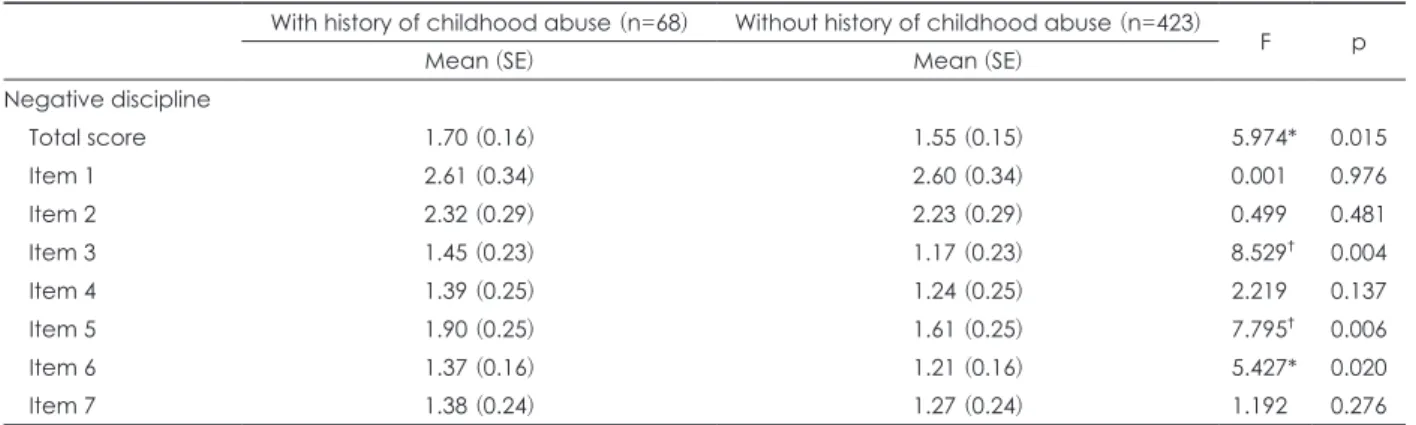
Intergroup differences in child disciplinary practices were analyzed, with the variables that had shown significant in- tergroup difference (marital status, psychiatric illness, histo- ry of treatment and hospitalization, and level of knowledge) controlled for. As a result, a significant intergroup difference was found in the total score of negative discipline (F=5.974, p<0.05). Broken down to individual items of child disciplin- ary practices, significant intergroup differences were found in three items: beating the child by hand, banning the child from doing something that he/she likes, and grabbing and shaking the child (F=8.529, p<0.01, F=7.795, p<0.01, and F=
5.427, p<0.05, respectively). No significant intergroup dif- ferences were found in the remaining four items: explaining to the child, sending the child to his/her room, beating the child with a rod or other objects, and punishing the child.
DISCUSSION
This study investigated differences in the levels of knowl- edge and perception of child abuse and child disciplinary practices between parents with a history of childhood abuse and those without. Given that the greatest proportion of child abuse is inflicted by parents and in light of the well-known phenomenon of intergenerational transmission [8], there is a need to examine the related aspects in parents with a his- tory of childhood abuse and to adopt preventive approaches.
This study focused on understanding the differences in dis-
ciplinary practices and knowledge and perception of child abuse between parents with a history of childhood abuse and those without in order to present a theoretical basis and ra- tionale for such preventive approaches. In this section, impor- tant results are summarized and their impacts are discussed.
First, comparisons of demographic and clinical charac- teristics between parents with a history of childhood abuse and those without revealed that the former had a higher prevalence of psychiatric illness, and a significantly higher proportion had undergone treatment and hospitalization for psychiatric conditions. Specifically, significant intergroup differences were observed in sleep disorder and depressive disorder, which is consistent with previous research suggest- ing that adults exposed to childhood abuse are more likely to exhibit long-term emotional instability [19]. In marital sta- tus, parents with a history of childhood abuse showed signifi- cantly higher percentages of separation and divorce, which can be interpreted in the same vein as the results of previous studies that childhood exposure to abuse works as a factor hampering the formation and maintenance of stable and intimate relationships in adulthood [20,21].
Second, whereas the level of knowledge of child abuse was positively correlated with the level of perception of child abuse in the group without a history of childhood abuse, no significant correlation was observed between these variables in the group with a history of childhood abuse. In this study, the level of perception of child abuse was measured as a variable for simply ascertaining whether a given situation is a case of child abuse or not, whereas the focus of the mea- surement of the level of knowledge was on determining wheth- er the participants had practical knowledge of how to re- spond to child abuse, such as reporting a case and relevant legal aspects. These results suggest the presence of a potential fac- tor hampering the effort to acquire the knowledge neces- sary for responding to a perceived case of child abuse in the case of the group with a history of childhood abuse, unlike
Table 5. ANCOVA for comparison of discipline between groups
With history of childhood abuse (n=68) Without history of childhood abuse (n=423)
F p
Mean (SE) Mean (SE)
Negative discipline
Total score 1.70 (0.16) 1.55 (0.15) 5.974* 0.015
Item 1 2.61 (0.34) 2.60 (0.34) 0.001 0.976
Item 2 2.32 (0.29) 2.23 (0.29) 0.499 0.481
Item 3 1.45 (0.23) 1.17 (0.23) 8.529
†0.004
Item 4 1.39 (0.25) 1.24 (0.25) 2.219 0.137
Item 5 1.90 (0.25) 1.61 (0.25) 7.795
†0.006
Item 6 1.37 (0.16) 1.21 (0.16) 5.427* 0.020
Item 7 1.38 (0.24) 1.27 (0.24) 1.192 0.276
ANCOVA, adjusted by marriage, psychiatric illness, history of treatment, history of hospitalization, knowledge level. *p<0.05,
†