Journal of Bacteriology and Virology 2014. Vol. 44, No. 4 p.311 – 316 http://dx.doi.org/10.4167/jbv.2014.44.4.311
Panonychus citri Can Induce T-helper Type 2 Immune Responses via the Release of Thymic Stromal Lymphopoietin and IL-4
Jaechun Lee, Seong-Chul Hong, Young-Bae Chung, Hye-Sook Lee and Keun Hwa Lee* The Environmental Health Center (Atopic Dermatitis and Allergic Rhinitis), Jeju National University School of
Medicine, Jeju, Korea
Panonychus citri damages the leaves of citrus trees, causing defoliation, and induces T-helper type 2 (TH2) immune responses (occupational asthma) via a hitherto unknown mechanism. This is a particular problem on Jeju Island, which is located to the south of the Korean peninsula. In this study, we show for the first time how P. citri induces TH2 immunity.
Exposure to P. citri induces the production of thymic stromal lymphopoietin (TSLP) by either basophils or CD4+ T cells (it is not certain which), which results in the production of interleukin 4 (IL-4). IL-4 promotes the production of immunoglobulin E (IgE), which ultimately contributes to the process of allergic inflammation. Therefore, TSLP plays an important role in the P. citri-induced TH2 immune response.
Key Words: P. citri, Occupational asthma, TSLP, IgE, IL-4.
INTRODUCTION
Under certain circumstances, the T-helper type 2 (TH2) immune response can have deleterious effects, resulting in significant tissue injury or serious disease. One of these inappropriate and damaging immune responses is the IgE-mediated (type I) hypersensitivity reaction (allergic inflammation), which is induced by allergens (1).
Metazoan parasites and simple protein allergens induce a TH2 immune response (allergic inflammation) (2~4). The citrus red mite, Panonychus citri, has been reported to damage the leaves of citrus trees, in some cases causing defoliation, on Jeju Island, which is located to the south of the Korean peninsula (5). In addition, Kim et al. have
reported cases of P. citri-induced occupational asthma (IgE-mediated broncho-constriction) (5). The mechanism underlying this allergen-induced TH2 immune response has not yet been studied.
Thymic stromal lymphopoietin (TSLP) is an interleukin (IL)-17-like cytokine that is involved in lymphocyte devel- opment (2, 6); it is also linked to the recruitment of TH2 cells and allergic inflammation (2, 3, 6). Epithelial cells such as keratinocytes or basophils produce TSLP during the development of allergic disease, and TSLP leads to TH2 cell recruitment, and ultimately allergic inflammation (2, 6, 7).
In this study, we show for the first time how P. citri can induce a TH2 immune response. Exposure to P. citri causes the production of TSLP by either basophils or CD4+ T cells (it is uncertain which), which in turn results in the pro-
311
Received: September 12, 2014/ Revised: October 7, 2014/ Accepted: October 10, 2014
*Corresponding author: Keun Hwa Lee, Ph.D. Department of Microbiology and Immunology, Jeju National University School of Medicine Jeju, 690-756, South Korea.
Phone: +82-64-754-8111, Fax: +82-64-705-2687, e-mail: yomust7@ jejunu.ac.kr
**This research was supported by the 2014 scientific promotion program funded by Jeju National University.
○CCThis is an Open Access article distributed under the terms of the Creative Commons Attribution Non-Commercial License (http://creativecommons.org/license/by-nc/3.0/).
Original Article
duction of IL-4. IL-4 stimulates the production of IgE, which ultimately contributes to the TH2 immune response (allergic inflammation) (2, 8). Thus, TSLP plays an important role in the P. citri-induced TH2 immune response.
MATERIALS AND METHODS P. citri extract
P. citri were collected from the remains of naturally infected citrus orchards and homogenized in a Teflon pestle homogenizer with sterile phosphate-buffered saline (10 mM, pH 7.4). The homogenate was centrifuged at 15,000 rpm for 40 min. The resulting supernatant was filtered using a sterile membrane filter (0.2 μm, Microfiltration System, CA, USA). The filtered supernatants were used as a crude extract of P. citri and frozen at -70℃ until used.
Human peripheral blood mononuclear cell stimulation Fresh human peripheral blood mononuclear cells (PBMCs) were isolated from healthy human blood speci- mens using density gradient centrifugation with Ficoll- Paque PLUS (GE Healthcare Bio-Sciences AB, 17-1440-02) and cultured (1 × 10⁶/well) in 24-well plates at 37℃ in 5% CO2 and in the presence or absence of P. citri extract (50 μg/well) in complete RPMI medium 1640. P. citri- stimulated PBMCs were harvested for evaluation of Tslp and Il-4 gene expression by real-time PCR. Supernatants were collected and tested for the presence of TSLP, IL-4, and IgE (9).
Human CD4+ T-cell stimulation
PBMCs were isolated from healthy human blood by density gradient centrifugation with Ficoll-Paque PLUS (GE Healthcare Bio-Sciences AB, 17-1440-02). CD4+ T cells were isolated from PBMCs using the Human CD4 subset Column Kit (R&D Systems, Minneapolis, MN, USA). Purified CD4+ T cells (1 × 10⁶/well) were cultured in complete RPMI medium 1640 in 24-well plates at 37℃
in 5% CO2 in the presence or absence of P. citri extract (50 μg/well) and with irradiated PBMCs as a source of antigen- presenting cells (APCs; 1 × 10⁶/well). Stimulated CD4+ T
cells were harvested for Tslp and Il-4 gene expression analysis by real-time PCR (9).
TSLP-specific antibody blocking experiment The role of TSLP was assessed by culturing PBMCs (1
× 106 cells/well) in the presence of P. citri extract (50 μg/well) and an anti-human-TSLP antibody (1 μg/well;
R&D Systems, Inc., Minneapolis, MN, USA). This mono- clonal antibody can neutralize the bioactivity of TSLP in vitro. Cells were harvested for analysis of Tslp and Il-4 gene expression by real-time PCR, and supernatants were collected and tested for the presence of TSLP, IL-4, and IgE.
Tslp and Il-4 gene expression as assessed by real-time PCR
Quantitative real-time RT-PCR was performed on a Bio- Rad system. Hypoxanthine-guanine phosphoribosyltrans- ferase was used as a reference for sample normalization (Superarray Bioscience, Frederick, MD, USA). Total RNAs were prepared from PBMCs and CD4+ T cells using an RNeasy Plus Mini Kit (QIAGEN, Cat. No. 74134), and cDNA was produced using a Reaction Ready First Strand cDNA Synthesis Kit (Superarray Bioscience). Tslp and Il-4 mRNA were quantified using a real-time PCR system utilizing RT2 primers (Superarray Bioscience). The relative quantitative real-time PCR data were calculated based on the 2-ΔΔCt method (10).
TSLP, IL-4, and total IgE detection by ELISA Supernatants were collected and tested for the presence of TSLP, IL-4, and total IgE. Quantitation of these cyto- kines was performed with the aid of a DuoSet ELISA Development System (R&D Systems, Inc.).
RESULTS
P. citri can induce the production of IgE and TSLP TSLP plays a role in protease allergen-induced TH2 inflammatory responses. Der p1 is a house dust mite allergen that is known to induce the TH2 immune response (11). P.
citri (citrus red mite) infects, among others, tangerine trees on Jeju Island South Korea, and is also a known allergen that can induce TH2 immune responses (5). However, the mechanism underlying the P. citri-induced TH2 inflammatory responses are not yet known. Sokol et al. showed that the protease allergen causes the release of TSLP-induced IgE
from basophils (2).
We studied the production of TSLP in P. citri-induced TH2 inflammatory responses. First, we assessed IgE, which is released in response to the activation of allergen-specific TH2 cells by B cells (1). The P. citri extract significantly affected the total IgE concentration, with levels increasing
A
B C
E D
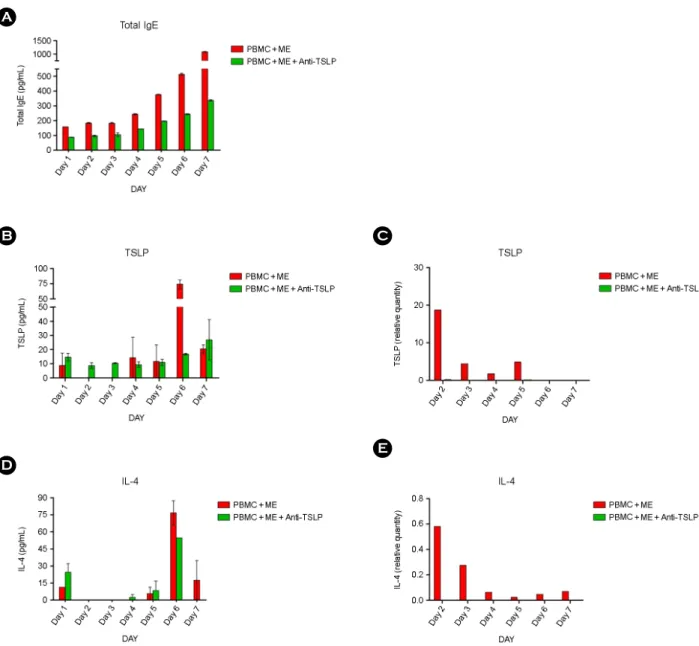
Figure 1. P. citri induces IgE secretion via the production of TSLP, and IL-4. IgE concentrations measured by ELISA (A). PBMCs were cultured with P. citri extract (50 μg/well). The role of TSLP in IgE secretion was assessed by culturing PBMCs with P. citri extract (50 μg/well) and anti-human-TSLP antibody (1 μg/well). TSLP production (B) and Tslp gene expression (C) were measured by ELISA and real-time PCR, respectively. IL-4 production (D) and Il4 gene expression (E) were measured by ELISA and real-time PCR, respectively.
ELISA, Enzyme-linked immunosorbent assay; PBMCs, human peripheral blood mononuclear cells; ME, P. citri extracts; Anti-TSLP:
anti-human TSLP antibody.
exponentially from day 2 to day 7 of culture. In addition, production of IgE by P. citri-extract-stimulated PBMCs reached a maximum after 7 days of culture (Fig. 1A).
TSLP secretion by PBMCs was also dramatically in- creased following 6 days of culture with P. citri extract (Fig.
1B). The mRNA relative expression of Tslp were also noticeable from day 2 to day 5, as shown in Fig. 1C. The expression of Tslp increased from day 2 to day 3 when human CD4+ T cells were cultured with P. citri extract and irradiated PBMCs as a source of APCs (Fig. 2A).
P. citri-induced-TSLP can induce the production of IL-4
IL-4 plays a critical role in priming naïve CD4+ T cells to become TH2 cells (12, 13), and contributes to isotype switching between IgG1 and IgE, and is thus an important factor associated with allergy and asthma (1).
To evaluate the production or expression of TSLP and IL-4, and Tslp and Il4, respectively, we determined the concentrations of TSLP and IL-4, and gene expressions of Tslp, Il-4 in PBMCs stimulated with P. citri extract and human CD4+ T cells and in irradiated PBMCs stimulated with P. citri extract. Concentrations of IL-4 reached a maximum on day 6 of culture when PBMCs were incubated with P. citri (Fig. 1D). The relative mRNA relative expression of Il-4 in human CD4+ T cells and irradiated PBMCs incubated with P. citri extract after Tslp gene
expression increased from day 4 to day 5, and then decreased from day 6 to day 7 (Fig. 2B). This suggests that P. citri-induced-TSLP causes the production of IL-4 in P.
citri-mediated-TH2 allergic disease.
The role of TSLP in P. citri-mediated IgE secretion and IL4 production
To investigate the role of TSLP in total IgE secretion and IL-4 production, we incubated P. citri extract-stimulated PBMCs with anti-human-TSLP antibody. We found that incubation with the anti-TSLP antibody significantly reduced total IgE secretion from day 1 to day 7 (Fig. 1A); IL-4 production was also reduced (Fig. 1D), and no Il-4 mRNA was detected (Fig. 1E). Thus, P. citri-induced TSLP plays an important role in IgE and IL-4 production.
DISCUSSION
P. citri infects citrus trees and is known to be a potent allergen associated with occupational allergy in humans (5).
However, the mechanism underlying the P. citri-mediated TH2 immune response is still not yet completely understood.
In this study, we reveal the mechanism underlying P.
citri-induced IgE production, and show that PBMCs respond to stimulation with P. citri extract by releasing IgE, TSLP, and IL-4.
We found that Tslp and Il4 are expressed by CD4+ T Figure 2. TSLP and IL-4 were produced by human CD4+T cells following stimulation with P. citri extract. Real-time PCR analysis of Tslp (A) and Il4 (B) gene expression in human CD4+ T cells that had been incubated with P. citri extract (50 μg/well). Irradiated PBMCs were used as a source of APCs and purified CD4+ T cells. IrPBMC, Irradiated human peripheral blood mononuclear cells; ME, P. citri extracts.
A B
cells in response to P. citri extract and that the secretion of IgE and IL-4 is greatly reduced when PBMCs are incubated with a monoclonal antibody raised against human TSLP.
Neutralization of TSLP resulted in inhibition of P. citri- induced IgE secretion, which suggests that production of this cytokine in response to P. citri is critical in the TH2 immune response.
Many studies have shown that basophils-derived TSLP and IL-4 has been linked to TH2 differentiation (2, 6, 8, 13~15). Sokol et al. showed that TSLP is produced by basophils and plays an important role in the initiation of TH2 differentiation (2), and Seder et al. showed that basophils can produce large amounts of IL-4 (16). However, Omori et al. showed that TSLP can directly prime TH2 differentiation without APCs, and TSLP-treated naïve CD4+ T cells are potentially capable of producing IL-4 (8).
Our results did not reveal the source of the produced IL-4, which could be either basophils or CD4+ T cells.
However, we suggest that both TSLP and IL-4 can drive the TH2 immune response in two ways: through the activation of B cells or by activating naïve CD4+ T cells via basophils (Fig. 1B, 1C, 1D, 1E, 2A, and 2B). Further study is required regarding the source of the IL-4 released following in P.
citri-induced IgE production (i.e., basophils, CD4+ T cells, or both).
In summary, we show that P. citri is capable of directly driving the TH2 immune response through the production of TSLP and IL-4, and for the first time show that the production of TSLP in response to P. citri plays a critical role in occupational asthma (i.e., IgE-mediated broncho- constriction).
REFERENCES
1) Kindt TJ, Goldsby RA, Osborne RA. Kuby Immu- nology 6th edition. Freeman, 2007;pp 307:384-5.
2)Sokol CL, Barton GM, Farr AG, Medzhitov R. A mechanism for the initiation of allergen-induced T helper type 2 responses. Nat Immunol 2008;9:310-8.
3) Min B, Paul WE. Basophils: in the spotlight at last. Nat Immunol 2008;9:223-5.
4) Finkelman FD, Urban JF Jr. Cytokines: making the right choice. Parasitol Today 1992;8:311-4.
5) Kim YK, Son JW, Kim HY, Park HS, Lee MH, Cho SH, et al. New occupational allergen in citrus farmers:
citrus red mite (Panonychus citri). Ann Allergy Asthma Immunol 1999;82:223-8.
6) Liu YJ. Thymic stromal lymphopoietin: master switch for allergic inflammation. J Exp Med 2006;203:269 -73.
7) Liu YJ, Soumelis V, Watanabe N, Ito T, Wang YH, Malefyt Rde W, et al. TSLP: an epithelial cell cytokine that regulates T cell differentiation by conditioning dendritic cell maturation. Annu Rev Immunol 2007;25:
193-219.
8) Omori M, Ziegler S. Induction of IL-4 expression in CD4(+) T cells by thymic stromal lymphopoietin. J Immunol 2007;178:1396-404.
9) Hong J, Li N, Zhang X, Zheng B, Zhang JZ. Induction of CD4+CD25+regulatory T cells by copolymer-I through activation of transcription factor Foxp3. Proc Natl Acad Sci U S A 2005;102:6449-54.
10) Livak KH, Schmittgen TD. Analysis of relative gene expression data using real-time quantitative PCR and the 2-ΔΔCt method. Methods 2001;25:402-8.
11) Ghaemmaghami AM, Gough L, Sewell HF, Shakib F.
The proteolytic activity of the major dust mite allergen Derp 1 conditions dendritic cells to produce less interleukin-12: allergen-induced Th2 bias determined at the dendritic cell level. Clin Exp Allergy 2002;32:
1468-75.
12) Le Gros G, Ben-Sasson SZ, Seder R, Finkelman FD, Paul WE. Generation of interleukin 4 (IL-4)-producing cells in vivo and in vitro: IL-2 and IL-4 are required for in vitro generation of IL-4-producing cells. J Exp Med 1990;172:921-9.
13) Swain SL, Weinberg AD, English M, Huston G. IL-4 directs the development of Th2-like helper effectors. J Immunol 1990;145:3796-806.
14) Soumelis V, Reche PA, Kanzler H, Yuan W, Edward G, Homey B, et al. Human epithelial cells trigger dendritic cell mediated allergic inflammation by producing TSLP.
Nat Immunol 2002;3:673-80.
15) Gilliet M, Soumelis V, Watanabe N, Hanabuchi S,
Antonenko S, de Waal-Malefyt R, et al. Human dendritic cells activated by TSLP and CD40L induce proallergic cytotoxic T cells. J Exp Med 2003;197:1059 -63.
16) Seder RA, Paul WE, Dvorak AM, Sharkis SJ, Kagey-
Sobotka A, Niv Y, et al. Mouse splenic and bone marrow cell populations that express high-affinity Fc epsilon receptors and produce interleukin 4 are highly enriched in basophils. Proc Natl Acad Sci U S A 1991;
88:2835-9.