CASE REPORT
Copyright © 2011, the Korean Surgical Society J Korean Surg Soc 2011;81:S43-46
http://dx.doi.org/10.4174/jkss.2011.81.Suppl1.S43
JKSS
Journal of the Korean Surgical Society pISSN 2233-7903ㆍeISSN 2093-0488
Received May 6, 2011, Revised July 28, 2011, Accepted August 9, 2011 Correspondence to: Kwang Ho Kim
Department of Surgery, Ewha Womans University School of Medicine, 911-1 Mok-dong, Yangcheon-gu, Seoul 158-710, Korea Tel: +82-2-2650-0513, Fax: +82-2-2644-7984, E-mail: [email protected]
cc Journal of the Korean Surgical Society is an Open Access Journal. All articles are distributed under the terms of the Creative Commons Attribution Non-Commercial License (http://creativecommons.org/licenses/by-nc/3.0/) which permits unrestricted non-commercial use, distribution, and reproduction in any medium, provided the original work is properly cited.
Metastasis to the breast from colonic adenocarcinoma
Kyoung Tae Noh, Boyoung Oh, Sun Hee Sung
1, Ryung-Ah Lee, Soon Sup Chung, Byung In Moon, Kwang Ho Kim
Departments of Surgery and 1Pathology, Ewha Womans University School of Medicine, Seoul, Korea
A 63-year-old woman was referred to a breast surgeon with a breast mass discovered incidentally during follow-up study af- ter colon cancer surgery. Invasive adenocarcinoma was revealed on core needle biopsy. Wide excision of the breast including the tumor was performed. On standard histological examination the tumor showed features of moderately differentiated adenocarcinoma. The immunohistochemistry study revealed positive results for cytokeratin (CK)20 and CDX2, but negative for CK7. These are typical characteristics for colon cancer. Considering her history of subtotal colectomy for sigmoid colon cancer, it is presumable that the mass in the breast was of colonic origin, and it was an extremely rare case of metastasis to the breast from primary colorectal neoplasm. Although the instance is rare, clinicians should keep the possibility of breast meta- stasis from colorectal cancer in mind for early and correct diagnosis.
Key Words: Breast, Neoplasm metastasis, Colon cancer
INTRODUCTION
Metastases to the breast from extramammary malig- nancies are rare and account for 0.43% of all breast malig- nancies [1]. Lymphoma, melanoma, sarcoma, lung carci- noma and ovarian tumor are common extramammary pri- mary malignancies that metastasize to the breast [1-3].
Cases of metastasis from primary colorectal neoplasm to the breast is extremely rare. In searching MEDLINE and EMBASE including non-English literature, and hand- searching the references, only 22 cases were identified. We describe the features of metastatic breast cancer from ad- enocarcinoma of the colon in a 63-year-old woman.
CASE REPORT
A 63-year-old woman was referred to a breast surgeon due to a mass with suspicious metastatic axillary lymph node discovered incidentally on positron emission tomog- raphy-computed tomography for follow-up study after colon cancer surgery without other metastatic lesion (Fig.
1). Four years ago, she underwent a subtotal colectomy for stage T3N1M0 sigmoid colon cancer with colonic ob- struction and subsequent chemotherapy with 5-fluorour- acil and leucovorine. Two years after the operation, a 2.8 cm sized solitary metastatic lung nodule on the right mid- dle lobe was identified on chest computed tomography for follow-up study for which she underwent pulmonary wedge resection, followed by chemotherapy with ox-
Kyoung Tae Noh, et al.
S44 thesurgery.or.kr
Fig. 1. Mild hyper- metabolic lesion was seen in lower inner qua- drant of right breast (ar- row) and focal hyper- metabolic lymph node was seen in right axil- lary area (arrow head).
Fig. 2. 1.7 cm sized irregular, whitish-gray, firm mass was iden- tified in lower inner portion of right breast, 3.5 cm apart from nip- ple.
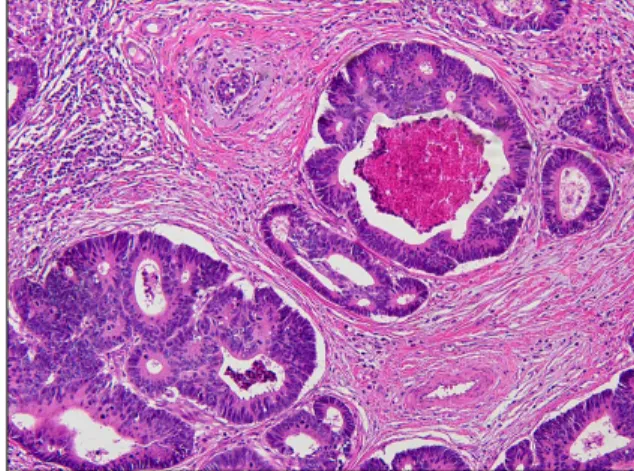
Fig. 3. Cuboidal to columnar tumor cells with eosinophilic cytoplasm and pseudostratification were seen on hematoxylin- eosin stain (×100).
aliplatin and 5-fluorouracil.
Physical examination revealed a 2 cm sized firm nodule in the lower inner quadrant of the right breast without evi- dence of axillary or supraclavicular lymphadenopathy.
The contralateral breast and axilla were normal.
The mass was not identified on mammography, but ul- trasonography showed 1.1 cm sized mass in the lower in- ner quadrant of the right breast without enlarged lymph node in the ipsilateral axilla. Sonography guided core nee- dle biopsy of the breast mass revealed invasive adeno- carcinoma. Serum tumor markers were all in normal rang- es (carcinoembryonic antigen 4.2 ng/mL, carbohydrate an- tigen 15-3 6.2 U/mL). Subsequent magnetic resonance imaging showed 1.8 cm sized ill-defined irregular shaped enhancing mass in the lower inner quadrant of the right breast and enlarged lymph node at the ipsilateral axilla compatible with a nodule suspicious for metastasis. Breast specific gamma imaging using 99mTc-MIBI showed a lesion with increased uptake in the lower inner portion of the right breast with no lesion uptake in the axilla.
Wide excision of the tumor and sentinel lymph node bi- opsy was performed (Fig. 2).
On histopathological examination, the tumor cells in
the breast mass were cuboidal to columnar with eosino- philic cytoplasm and pseudostratification, compatible with the features of adenocarcinoma of colorectal origin (Fig. 3). The harvested sentinel lymph node did not con- tain tumor cells.
Immunohistochemical study revealed the following re- sults: tumor cells were strongly positive for CDX2, cyto- keratin (CK)20 and negative for CK7, thyroid tran-
Metastasis to the breast from colonic adenocarcinoma
thesurgery.or.kr S45
Fig. 4. Immunohistoche- mistry showed neopla- stic cells were positive for CDX2 immunostai- ning (A, ×200) and cyto- keratin 20 immunostain- ing (B, ×200).
scription factor-1, estrogen receptor, progesterone re- ceptor, c-erbB2 (Fig. 4). These findings are consistent with metastatic adenocarcinoma of the colon or rectum.
Currently, she is receiving systemic chemotherapy with irinotecan and 5-fluorouracil.
DISCUSSION
Primary breast cancer is one of the most common malig- nancies and leading cause of death from malignant dis- ease in women. A malignant mass in the breast can easily be misinterpreted as breast cancer and inappropriate sur- gical intervention could be carried out. Although there are few instances of breast metastasis from colorectal malig- nancy, correct diagnosis is crucial to avoid unnecessary surgical intervention.
Generally, metastases to the breast from extramammary malignancies are characterized by rapidly growing, mo- bile masses that are easily palpable but do not cause over- lying skin or nipple retraction, or bloody nipple discharge [4,5]. Core biopsy allows histological assessment of the tis- sue, helping in identifying the origin of the carcinoma. On the histologic finding, the periductal and perilobular loca- tion of the tumor with the absence of in situ ductal carcino- ma in the surrounding breast specimen favor a metastasis [4,5]. Immunohistochemistry enables a more confident differentiation between a primary breast adenocarcinoma and a colorectal adenocarcinoma metastasis to the breast.
For our patient, diagnosis was finally reached after im- munohistochemistry finding. The majority of colorectal carcinomas are usually CK7-negative and CK20-positive,
while the majority of primary breast carcinomas is CK7-positive and CK20-negative [6]. And the positive im- munostaining for CDX2 is a highly sensitive and specific marker of colorectal carcinoma [7]. Our case showed these findings as well; tumor cells were positive for CDX2, CK20 and negative for CK7. Recently, some authors have sug- gested that the expression of CK20 can be identified in pri- mary breast cancer in contrast to the conventional im- munohistochemistry results. So, clinicians and patholo- gists should examine multiple immunohistochemistry markers and combine them as an approach for final diag- nosis [8].
According to recent reports, the management of meta- static breast mass from colorectal adenocarcinoma should be diagnostic and palliative. Barthelmes et al. [9] advo- cated that surgical excision should be avoided in the view of short life expectancy and risk of seeding to the skin.
Fernández de Bobadilla et al. [10] suggested that exci- sional biopsy was usually appropriate and provided ad- equate local control. If the diagnosis for the breast mass is unclear, unnecessary intervention, for example mastec- tomy or lymph node dissection of axilla, can be per- formed. Therefore, when breast mass is identified in- cidentally on radiologic study during follow-up after op- eration for colorectal carcinoma, clinicians should keep the possibility of breast metastasis from colorectal ad- enocarcinoma in mind. Additionally, periodical examina- tion of the breast after colorectal cancer surgery may be helpful to detect the metastasis early.
Kyoung Tae Noh, et al.
S46 thesurgery.or.kr
CONFLICTS OF INTEREST
No potential conflict of interest relevant to this article was reported.
REFERENCES
1. Georgiannos SN, Chin J, Goode AW, Sheaff M. Secondary neoplasms of the breast: a survey of the 20th Century.
Cancer 2001;92:2259-66.
2. Williams SA, Ehlers RA 2nd, Hunt KK, Yi M, Kuerer HM, Singletary SE, et al. Metastases to the breast from non- breast solid neoplasms: presentation and determinants of survival. Cancer 2007;110:731-7.
3. Vizcaíno I, Torregrosa A, Higueras V, Morote V, Cremades A, Torres V, et al. Metastasis to the breast from extra- mammary malignancies: a report of four cases and a re- view of literature. Eur Radiol 2001;11:1659-65.
4. Vergier B, Trojani M, de Mascarel I, Coindre JM, Le Treut
A. Metastases to the breast: differential diagnosis from pri- mary breast carcinoma. J Surg Oncol 1991;48:112-6.
5. Hajdu SI, Urban JA. Cancers metastatic to the breast.
Cancer 1972;29:1691-6.
6. Kende AI, Carr NJ, Sobin LH. Expression of cytokeratins 7 and 20 in carcinomas of the gastrointestinal tract. Histo- pathology 2003;42:137-40.
7. Werling RW, Yaziji H, Bacchi CE, Gown AM. CDX2, a high- ly sensitive and specific marker of adenocarcinomas of in- testinal origin: an immunohistochemical survey of 476 pri- mary and metastatic carcinomas. Am J Surg Pathol 2003;
27:303-10.
8. Wang SM, Huang DM, Li B, Ruan JD. Association of CK20 expression with the progression, metastasis and prognosis of breast cancer. Xi Bao Yu Fen Zi Mian Yi Xue Za Zhi 2009;25:706-7.
9. Barthelmes L, Simpson JS, Douglas-Jones AG, Sweetland HM. Metastasis of primary colon cancer to the breast-leave well alone. Breast Care 2010;5:23-5.
10. Fernández de Bobadilla L, García Villanueva A, Collado M, de Juan A, Rojo R, Pérez J, et al. Breast metastasis of pri- mary colon cancer. Rev Esp Enferm Dig 2004;96:415-9.