A trichilemmal carcinoma is a rare, cutaneous adnexal neoplasm which can occur on sun-exposed areas of the body. It is the malignant counterpart of trichilemmoma (1). It is however considered to be a low-grade malignant carcinoma due to its rare incidence of recurrence or metastasis (2).
There have been many reported cases of trichilemmal carcinoma with pathologic findings (1-6); however, to the best of our knowledge, the MR findings of trichilem- mal carcinoma have not previously been reported. In this case report, we will describe the MR findings of a trichilemmal carcinoma.
Case Report
A 79-year-old female was referred to our hospital with
a ten-month history of a large protruding mass in the right posterolateral aspect of her neck. Upon physical examination, the mass was noted to be fixed and hard.
The dimensions of the soft tissue mass were approxi- mately 7×11×7 cm. The patient did not complaint and no tenderness was experienced. Also, the patient had no neurologic symptoms. Discharge was noted from the central portion of the mass and the initial clinical im- pression was identified as dermatofibrosarcoma protu- berans.
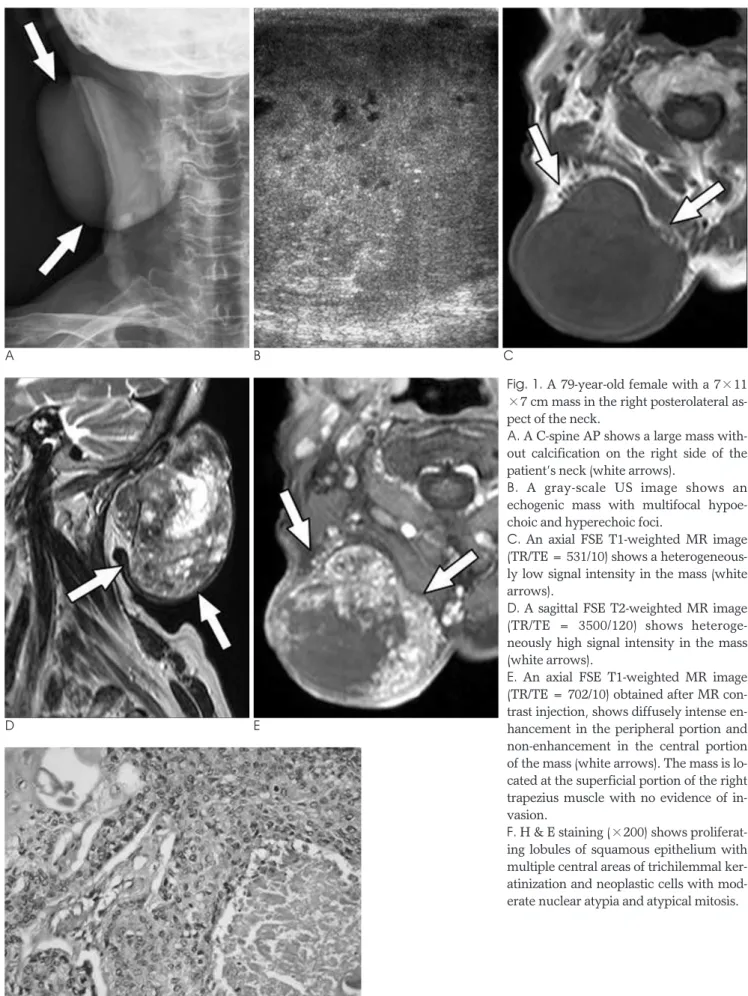
On a plain radiography, the soft tissue mass revealed no calcification (Fig. 1A). An ultrasonography was per- formed using a multi-frequency (5- to 12-MHz) linear-ar- ray transducer attached to an iU-22 scanner (Philips Medical Systems). Gray-scale imaging showed an echogenic mass with multifocal hypoechoic and hypere- choic foci (Fig. 1B). Color Doppler imaging revealed a vascular signal in the peripheral portion of the mass (not shown).
MR imaging was performed using a 1.5-T MR system (ACHIEVA, Philips Medical Systems, Netherlands). The mass lesion showed heterogeneously low signal intensi- ty on fast spin echo (FSE) T1-weighted images (Fig. 1C), and heterogeneously high signal intensity on FSE T2- weighted images in relation to the signal intensity of the
J Korean Soc Radiol 2009;61:87-90
─ 87 ─
MR Findings of Trichilemmal Carcinoma:
A Case Report
1Jong Chang Jang, M.D., Byeong Seong Kang, M.D., Jae-Hee Suh, M.D.2, Jae-Ryong Cha, M.D.3, Jae Cheol Hwang, M.D., Young Cheol Weon, M.D., Shang Hun Shin, M.D.
1Department of Radiology, University of Ulsan College of Medicine, Ulsan University Hospital, Ulsan, Korea
2Department of Pathology, University of Ulsan College of Medicine, Ulsan University Hospital, Ulsan, Korea
3Department of Orthopaedic Surgery, University of Ulsan College of Medicine, Ulsan University Hospital, Ulsan, Korea
Received February 20, 2009 ; Accepted May 3, 2009
Address reprint requests to : Byeong Seong Kang, M.D., Department of Radiology, University of Ulsan College of Medicine, Ulsan University Hospital, 290-3 Jeonha-dong, Dong-gu, Ulsan 682-714, Korea.
Tel. 82-52-250-8235 Fax. 82-52-252-5160 E-mail: [email protected]
A trichilemmal carcinoma is a rare superficial tumor occurring on the sun-exposed regions of older individuals. We examined a 79-year-old female with a large mass locat- ed in the right posterolateral aspect of the patient’s neck. The MR images showed a central cystic portion with intense peripheral enhancement. The histopathologic ex- amination of the resected specimen revealed a trichilemmal carcinoma. Here, we re- port the MR findings of the trichilemmal carcinoma in this patient.
Index words :Carcinoma Skin appendage
Magnetic resonance (MR)
Jong Chang Jang, et al: MR Findings of Trichilemmal Carcinoma
─ 88 ─ F
Fig. 1. A 79-year-old female with a 7×11
×7 cm mass in the right posterolateral as- pect of the neck.
A. A C-spine AP shows a large mass with- out calcification on the right side of the patient’s neck (white arrows).
B. A gray-scale US image shows an echogenic mass with multifocal hypoe- choic and hyperechoic foci.
C. An axial FSE T1-weighted MR image (TR/TE = 531/10) shows a heterogeneous- ly low signal intensity in the mass (white arrows).
D. A sagittal FSE T2-weighted MR image (TR/TE = 3500/120) shows heteroge- neously high signal intensity in the mass (white arrows).
E. An axial FSE T1-weighted MR image (TR/TE = 702/10) obtained after MR con- trast injection, shows diffusely intense en- hancement in the peripheral portion and non-enhancement in the central portion of the mass (white arrows). The mass is lo- cated at the superficial portion of the right trapezius muscle with no evidence of in- vasion.
F. H & E staining (×200) shows proliferat- ing lobules of squamous epithelium with multiple central areas of trichilemmal ker- atinization and neoplastic cells with mod- erate nuclear atypia and atypical mitosis.
D E
A B C
adjacent muscles (Fig. 1D). Prominent enhancement was observed in the peripheral portion of the mass, whereas non-enhancement was observed in the central portion of the mass following the intravenous injection of MR contrast material (0.5 mmol/ml gadodiamide, Omniscan, GE) (Fig. 1E). No evidence of adjacent mus- cular invasion was noted. The radiologic impression was a soft tissue sarcoma, such as dermatofibrosarcoma protruberans or malignant fibrous histiocytoma (MFH).
An excisional biopsy was performed on the mass, which was easily and completely removed from the pa- tient’s neck. No evidence of invasion to the right trapez- ius muscle was noted. In addition, no tumor cells were observed at the resected margin on the frozen section.
Upon histopathologic examination, the specimen had fluid with debris and showed proliferating lobules of squamous epithelium with multiple central areas of trichilemmal keratinization and neoplastic cells with moderate nuclear atypia and atypical mitosis. These findings were consistent with the diagnosis of trichilem- mal carcinoma (Fig. 1F).
A 12-month follow-up examination found that the pa- tient has had no signs of lesion recurrence and has re- mained healthy.
Discussion
A trichilemmal carcinoma usually occurs as a solitary, indolent lesion on the sun-exposed areas of older indi- viduals (1). The location of the lesion is most commonly confined to the scalp, face, neck, trunk, or upper ex- tremities. There has been no gender predilection noted with this neoplasm (1). Trichilemmal carcinoma is the malignant counterpart of trichilemmoma and is distinct from the proliferating trichilemmal tumor which has a different origin (2).
A trichilemmal carcinoma usually presents as a mass, ranging from a flesh-colored telangiectatic plaque or papule, to a hyperkeratotic or ulcerated crater (2, 3). The tumor is very indolent, and the incidence of metastasis is extremely rare (4).
The pathogenesis of a trichilemmal carcinoma re- mains unclear, although the lesion distribution tends to suggest that sunlight plays an important role in the de- velopment of this tumor. However, a trichilemmal car- cinoma has also been reported to occur on burn scars (5). Moreover, high-dose radiation therapy as well as nu- merous X-rays obtained for diagnostic purposes, has al- so been associated with this type of carcinoma (6).
Histologically, a trichilemmal carcinoma is mainly an intraepithelial tumor or is most commonly associated with an invasive component, which may involve the epidermis up to the subcutaneous fat. In general, this le- sion appears in continuity with the epidermis and/or fol- licular epithelium (4). Unlike its benign counterpart, a trichilemmal carcinoma exhibits cytological atypia with a high mitotic index, which is indicative of an aggressive malignancy (1).
To the best of our knowledge, the MR imaging find- ings of a trichilemmal carcinoma have not been previ- ously reported. Our case shows that a trichilemmal car- cinoma can appear on MR imaging as a solid mass with cystic components. Signal intensities of the solid compo- nent of the tumor on MR images show slight hyperin- tensity on FSE T1- and T2-weighted images and substan- tial enhancement after contrast administration. Signal intensities of the cystic components show hypointensity on T1-weighted images and prominent hyperintensity on T2-weighted images. These findings are similar to the malignant transformation of a proliferating trichilemmal tumor (7) or of a dermatofibrosarcoma protuberans (8).
Unfortunately, there are no characteristic MR imaging findings for the differential diagnosis of these soft tissue masses. However, a dermatofibrosarcoma protuberans differs from a trichilemmal carcinoma in terms of the most commonly involved site and the most frequently affected patient age group (8). In addition, malignant skin tumors such as squamous cell carcinomas show rel- atively ill-defined margins (9), whereas a clear cell squa- mous cell carcinoma lacks trichilemmal keratinization, lobular growth, and adnexal extension (10).
To our knowledge, this is the first case report of MR imaging findings of a trichilemmal carcinoma. Although a trichilemmal carcinoma is a rare disease, it may be in- cluded in the differential diagnosis of a large and super- ficially located soft tissue mass with heterogeneous en- hancement on MR imaging in older patients.
Acknowledgments
We thank Bonnie Hami, Department of Radiology, University Hospitals of Cleveland, for her editorial assis- tance in the preparation of this manuscript.
References
1. Reis JP, Tellechea O, Cunha MF, Baptista AP. Trichilemmal carci- noma: a review of eight cases. J Cutan Pathol 1993;20:44-49 2. Headington JT. Tumors of the hair follicle: a review. Am J Pathol
1976;85:479-514 J Korean Soc Radiol 2009;61:87-90
─ 89 ─
3. Swanson PE, Marrogi AJ, Williams DJ, Cherwitz DL, Wick MR.
Trichilemmal carcinoma: clinicopathologic study of 10 cases. J Cutan Pathol 1992;19:100-109
4. Nemetz MA, da Cunha RM, Reeck P, Neto WC, S. Moreira MT, S.
Coelho M. Trichilemmal carcinoma: a case study. Rev Bras Otorrniolaringol 2004;70:832-835
5. Ko T, Tada H, Hatoko M, Muramatsu T, Shirai T. Trichilemmal carcinoma developing in a burn scar: a report of two cases. J Dermatol 1996;23:463-468
6. Chan KO, Lim IJ, Baladas HG, Tan WT. Multiple tumour presen- tation of trichilemmal carcinoma. Br J Plast Surg 1999;52:665-667 7. Kim HJ, Kim TS, Lee KH, Kim YM, Suh CH. Proliferating
trichilemmal tumors: CT and MR imaging findings in two cases, on with malignant transformation. AJNR Am J Neuroradiol 2001;22:180-183
8. Torreggiani WC, Al-Ismail K, Munk PL, Nicolaou S, O’Connell JX, Knowling MA. Dermatofibrosarcoma protuberans: MR imaging features. AJR Am J Roentgenol 2002;178:989-993
9. Chiang KH, Chou AS, Hsu YH, Lee SK, Lee CC, Yen PS, et al.
Marjolin’s ulcer: MR appearance. AJR Am J Roentgenol 2006;186:
819-820
10. Dalton SR, LeBoit PE. Squamous cell carcinoma with clear cells:
how often is there evidence of tricholemmal differentiation? Am J Dermatopathol 2008;30:333-339
Jong Chang Jang, et al: MR Findings of Trichilemmal Carcinoma
─ 90 ─
대한영상의학회지 2009;61:87-90
외모근초암의 자기공명영상 소견: 증례 보고1
1울산대학교 의과대학 울산대학교병원 영상의학과
2울산대학교 의과대학 울산대학교병원 병리과
3울산대학교 의과대학 울산대학교병원 정형외과
장종창∙강병성∙서재희2∙차재룡3∙황재철∙원영철∙신상훈
외모근초암은, 나이가 많은 사람에게서 햇빛에 노출되는 곳에 발생하는 드문 표재성 종양이다. 저자들은, 우측 후 경부의 종괴를 주소로 내원한 79세 여자 환자를 검사하였다. 자기공명영상 소견에서 중심부는 낭성성분을 동반하였 으며 이 주변부는 강한 조영증강을 보였다. 종괴는 조직병리학 검사에서 외모근초암으로 확진되었다. 저자들은 외모 근초암의 자기공명영상 소견에 대해 보고하고자 한다.