Printed in the Republic of Korea DOI 10.5012/jkcs.2010.54.6.731
요약. 5-Aryl-3-(β-D-glucopyranosylthio)-1,2,4-triazole 화합물들을 합성하였으며, 합성한 화합물들에 대한 항균활성시험을 수행하였다.
주제어: S-glycosides, 1,2,4-Triazole, Glycosylation, 항균활성
ABSTRACT. Several new 5-aryl-3-(β-D-glucopyranosylthio)-1,2,4-triazoles have been synthesized. The structures of these new compounds were confirmed by 1H NMR, 13C NMR and elemental analyses.The antibacterial activities of the compounds were also evaluated.
Keywords: S-glycosides, 1,2,4-Triazole, Glycosylation, Antibacterial activities
1,2,4-Triazole기를 가지고 있는 S-glycoside들의 합성 및 항균활성시험
Shu-jun Chao, Ming-jiang Geng, and Ying-ling Wang*
Department of Chemistry, Xinxiang Medical University, Xinxiang, 453003, P. R. China (접수 2010. 5. 4; 수정 2010. 6. 13; 게재확정 2010. 6. 24)
Synthesis and Antibacterial Activities of New S-glycosides Bearing 1,2,4-Triazole
Shu-jun Chao, Ming-jiang Geng, and Ying-ling Wang*
Department of Chemistry, Xinxiang Medical University, Xinxiang, 453003, P. R. China. *E-mail: [email protected] (Received May 4, 2010; Revised June 13, 2010; Accepted June 24, 2010)
INTRODUCTION
1,2,4-Triazoles are very important organic compounds with wide-ranging biological activities. These compounds are reported to possess significant antiviral,1 antibacterial,2 antifungal,3 antiasthmatic,4 antidepressant5 and anti-inflam- matory6-7activities.
Glycosides have extensively existed in the animals and plants and taken on an important biological function.8 Many active ingredients in natural drugs and Chinese traditional drugs belong to glycosides. Significant antibacterial and anti- caner activities of glycosides have attracted many workers to attempt to improve the biological activity of these com- pounds by the glycosylation in order to increase their solu- bility in water and guidance quality.9-11
Since the recognized biological properties of ribavirin,12 1-β-D-ribofuranosyl-1,2,4-triazole-3-caroboxamide, the syn- thesis of N-glycosides and C-glycosides as well as their acyclic analogues possessing a 1,2,4-triazole moiety has attracted many workers13-14 in this field to try to enhance the biological activity of these compounds. During past decades, a great deal of modified N-glycosides,15-16 C-glyco- sides17-19 and S-glycosides have been emphasized,20-21 but only a few S-glycosides bearing 1,2,4-triazole have been reported.21 In view of this, we turned our attention to the
synthesis of novel S-glycosides possessing 1,2,4-triazole from 3-aryl-5-mercapto-1,2,4-triazole and tetra-O-acetyl- α-D-glucopyanosyl bromide. The antibacterial activities were also evaluated.
RESULTS AND DISCUSSIONS
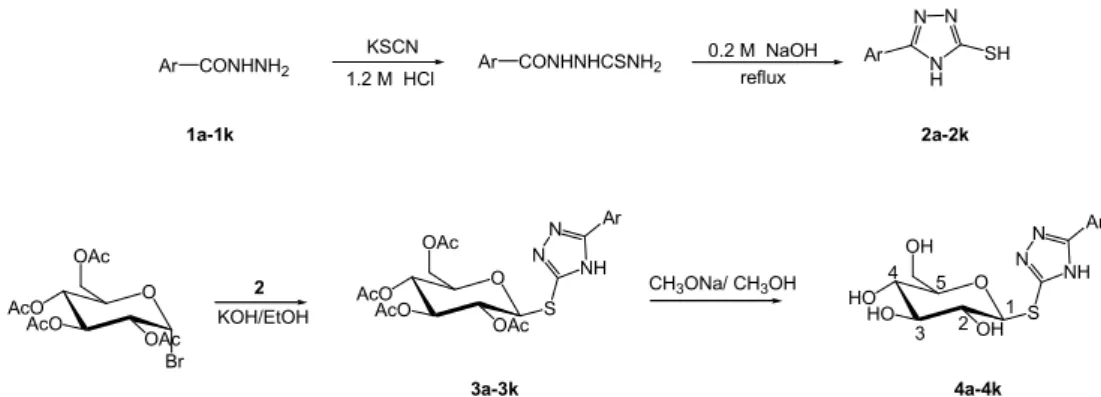
The synthetic route for the target compounds is outlined in Scheme 1. 3-Aryl-5-mercapto-1,2,4-triazoles (2a~2k) were prepared via the reaction of acylhydrazines with potassium thiocyanate in the presence of 1.2 M hydrochloric acid and subsequent intramolecular dehydration of the precipitate arylthiosemicarbazides in 8% sodium hydroxide solution.
The final recrystallization from 95% ethanol affords pure 2a~2k.22 5-Aryl-3-(2,3,4,6-tetra-O-acetyl-β-D-glucopyrano- sylthio)-1,2,4-triazole (3a~3k) were obtained by the direct glycosylation of (2a~2k) with tetra-O-acetyl-α-D-gluco- pyanosyl bromide in ethanol in the presence of potassium hydroxide. The deacetylation of 3a~3k using sodium metho- xide in methanol gave the corresponding 5-aryl-3-(β-D- glucopyranosylthio)-1,2,4-triazoles (4a~4k) in good yields.
The structure assignments of 3a~3k and 4a~4k were bas- ed on 1H NMR, 13C NMR and elemental analyses. In 1H NMR spectrum of 3a~3k, four singlets in the region of δ 1.96- 2.13 were attributed to four acetyl groups. Seven protons of
KSCN 0.2 M NaOH
1.2 M HCl reflux
1a-1k 2a-2k
AcO O AcO
Br OAc OAc
AcO O
AcO OAc
OAc
S NH N N
Ar
KOH/EtOH
3a-3k
2 CH3ONa/ CH3OH O
HOHO
OH OH
S NH N N
Ar
4a-4k
Ar CONHNH2 Ar CONHNHCSNH2 Ar N
H N N
SH
2 1 3
4 5
Scheme 1. Ar=Ph(a), o-CH3Ph(b), p-CH3Ph(c), o-ClPh(d), p-ClPh(e), m-ClPh(f), o-BrPh(g), p-BrPh(h), o-OHPh(i), o-OMePh(j), p-OMePh(k)
Table 1. Antibacterial activity of compounds 4a-4k
Compound 4a 4b 4c 4d 4e 4f 4g 4h 4i 4j 4k
E.coli ‐ ‐ + ‐ + + ‐ + ++ ‐ ‐
Streptococcus ‐ + ‐ + ++ + ‐ + ++ ‐ ‐
B.subtilis + ‐ ‐ ‐ ‐ ‐ ‐ ‐ +++ ‐ ‐
S.aureus ‐ + + ‐ + ‐ + + ++ ‐ ‐
Zone diameter of growth inhibition: < 10 mm (-), 10 - 13 mm (+), 14 - 17 mm (++) and 18 - 21 mm (+++). Diameter of the cup = 8 mm.
the sugar moiety exhibited the multiplets at δ 3.76-5.52.
The aryl groups were found in the region of δ 6.91-8.28.
While in the 1H NMR spectrum of 4a~4k, the disappearance of four sharp singlets around δ 2.00 could be mainly due to successful deacetylation of 3a~3k. Seven protons of the sugar moiety exhibited the multiplets at δ 3.15-4.84. Only β-anomer was obtained as judged by a doublet at δ 4.70- 4.84 ( JH1,H2 = 8.7-9.9 Hz) of the anomeric proton (H-1) in the sugar moiety.
Antibacterial Activity
Compounds 4a~4k were screened for their antibacterial activity against Escherichia coli, Streptococcus, Bacillus subtilis, and Staphylococus aureu employing the cup-plate method at the concentration of 200 µg/mL in nutrient agar media. The zone of the growth inhibition of bacteria, pro- duced by diffusion of the compounds from the cup into the surrounding medium, was measured after 24 h. The results are listed in Table 1. The antibacterial activity showed that most of the compounds were active against microorgani- sms. It is worthwhile to notice that compound 4i showed a good inhibitory effect to these bacteria, but 4j~4k do not express antibacterial activity.
The investigation on the sructure-activity relationship shows that hydroxy group enhances the antibacterial action of the title compounds. Further investigation on the biological activity of these compounds is in progress.
EXPERIMENTAL SECTION
The melting points were taken on an X-4 microscopic melting point apparatus and are uncorrected. All the 1H NMR and 13C NMR spectra were recorded at room temperature on a Varian Mercury-300 MHz spectrometer with TMS as internal standard. Elemental analysis was performed on an Elementar Vario EL apparatus. All reagents of analytical grade were used without purification. 3-Aryl-5-mercapto- 1,2,4-triazole (2a-2k) were synthesized according to the li- terature.21
General procedure for preparation of 5-aryl-3-(2,3,4,6- tetra-O-acetyl-β-D-glucopyranosylthio)-1,2,4-triazole (3a~3k)
3-Aryl-5-mercapto-1,2,4-triazole (2a~2k) (1 mmol) was dissolved in the solution of KOH (1 mmol) in ethanol (10 mL).
The mixture was stirred at room temperature for 30 min.
Compound of tetra-O-acetyl-α-D-glucopyanosyl bromide (1 mmol, 0.41 g) was then added to the solution, which was stirred at room temperature for 12 h. The mixture was fil- tered and washed with water. The crude product was puri- fied by flash column chromatography on silica gel with petro- leum ether/ethyl acetate as eluent.
5-Phenyl-3-(2,3,4,6-tetra-O-acetyl-β-D-glucopyrano- sylthio)-1,2,4-triazole (3a): Yield: 49%. mp 149 - 151 oC;
[α]D -43o (c 1, CH2Cl2); 1H NMR (CDCl3): δ 1.96 (s, 3 H, CH3C=O), 1.97 (s, 3 H, CH3C=O), 1.98 (s, 3 H, CH3C=O) 2.00 (s, 3 H, CH3C=O), 3.76-3.82 (m, 1 H, Glc-H-5), 4.14- 4.16 (m, 2 H, Glc-H-6), 5.04-5.14 (m, 2 H, Glc-H-2, H-4), 5.23-5.29 (m, 2 H, Glc-H-1, H-3), 7.36-7.39 (m, 3 H, ArH), 7.94-7.98 (m, 2 H, ArH); 13C NMR (CDCl3): δ 20.39, 61.75, 67.96, 69.89, 73.52, 75.95, 83.27, 126.30, 128.15, 128.71, 130.07, 169.33, 169.53, 169.99, 170.90; Anal. Calcd. for C22H25N3O9S: C, 52.06; H, 4.97; N, 8.28; Found: C, 52.21;
H, 4.94; N, 8.16.
5-o-Methylphenyl-3-(2,3,4,6-tetra-O-acetyl-β-D-glu- copyranosylthio)-1,2,4-triazole (3b): Yield: 53%; mp 100 - 102 oC; [α]D -31o (c 1, CH2Cl2); 1H NMR (CDCl3): δ 1.98 (s, 3 H, CH3C=O), 1.99 (s, 3 H, CH3C=O), 2.00 (s, 3 H, CH3C=
O), 2.02 (s, 3 H, CH3C=O), 2.53 (s, 3 H, ArCH3), 3.78-3.82 (m, 1 H, Glc-H-5), 4.17-4.21 (m, 2 H, Glc-H-6), 5.06-5.19 (m, 2 H, Glc-H-2, H-4), 5.24-5.32 (m, 2 H, Glc-H-1, H-3), 7.19-7.30 (m, 3 H, ArH), 7.65-7.67 (m, 1 H, ArH); 13C NMR (CDCl3): δ 20.45, 21.03, 29.56, 61.84, 68.03, 69.84, 73.66, 76.04, 83.27, 125.95, 129.03, 129.86, 131.28, 137.05, 169.39, 169.51, 170.08, 170.83; Anal. Calcd. for C23H27N3O9S: C, 52.97; H, 5.22; N, 8.06; Found: C, 53.04; H, 5.61; N, 8.21.
5-p-Methylphenyl-3-(2,3,4,6-tetra-O-acetyl-β-D-glu- copyranosylthio)-1,2,4-triazole (3c): Yield: 33%; mp 150 - 152 oC; [α]D -46o (c 1, CH2Cl2); 1H NMR (CDCl3): δ 1.98 (s, 3 H, CH3C=O), 1.99 (s, 3 H, CH3C=O), 2.00 (s, 3 H, CH3C=O), 2.01 (s, 3 H, CH3C=O), 2.35 (s, 3 H, ArCH3), 3.78-3.81 (m, 1 H, Glc-H-5), 4.15-4.18 (m, 2 H, Glc-H-6), 5.06-5.15 (m, 2 H, Glc-H-2, H-4), 5.24-5.27 (m, 2 H, Glc- H-1, H-3), 7.20 (d, 2 H, J = 8.1 Hz, ArH), 7.85 (d, 2 H, J = 8.1 Hz, ArH); 13C NMR (CDCl3): δ 20.43, 21.29, 61.78, 68.01, 69.93, 73.58, 75.98, 83.37, 129.46, 136.30, 140.39, 169.36, 169.57, 170.05, 170.92; Anal. Calcd. for C23H27N3- O9S: C, 52.97; H, 5.22; N, 8.06; Found: C, 52.70; H, 5.21;
N, 8.09.
5-o-Chlorophenyl-3-(2,3,4,6-tetra-O-acetyl-β-D-glu- copyranosylthio)-1,2,4-triazole (3d): Yield: 34%; mp 133 - 135 oC; [α]D -19o (c 1, CH2Cl2); 1H NMR (CDCl3): δ 2.01 (s, 3 H, CH3C=O), 2.02 (s, 3 H, CH3C=O), 2.03 (s, 3 H, CH3C=O), 2.05 (s, 3 H, CH3C=O), 3.79-3.85 (m, 1 H, Glc- H-5), 4.18-4.23 (m, 2 H, Glc-H-6), 5.14-5.23 (m, 2 H, Glc- H-2, H-4), 5.31 (t, 1 H, JH2,H3 = 9.3 Hz, Glc-H-3), 5.38 (d, 1 H, JH1,H2 = 10.5 Hz, Glc-H-1), 7.38-7.41 (m, 2 H, ArH), 7.47-7.49 (m, 1 H, ArH), 8.14-8.18 (m, 1 H, ArH); 13C NMR (CDCl3): δ 20.51, 61.45, 67.61, 69.58, 73.44, 76.47, 83.18, 122.47, 127.16, 130.97, 131.26, 132.94, 161.36, 164.69,
169.31, 169.42, 169.94, 170.55; Anal. Calcd. for C22H24- ClN3O9S: C, 48.76; H, 4.46; N, 7.75; Found: C, 48.44; H, 4.57; N, 7.78.
5-p-Chlorophenyl-3-(2,3,4,6-tetra-O-acetyl-β-D-glu- copyranosylthio)-1,2,4-triazole (3e): Yield: 53%; mp 86 - 88 oC; [α]D -55o (c 1, CH2Cl2); 1H NMR (CDCl3): δ 1.99 (s, 3 H, CH3C=O), 2.01 (s, 3 H, CH3C=O), 2.04 (s, 3 H, CH3C=O), 2.05 (s, 3 H, CH3C=O), 3.80 (ddd, JH4,H5 = 9.9 Hz, Glc-H-5), 4.17 (dd, JH5,H6’ = 4.5 Hz, Glc-H-6’), 4.24 (dd, 1 H, JH5,H6 = 2.4 Hz, JH6,H6’ = 12.3 Hz, Glc-H-6), 5.05-5.16 (m, 3 H, Glc-H-2, H-3, H-4), 5.24-5.30 (m, 1 H, Glc-H-1), 7.37 (d, 2 H, J = 8.4 Hz, ArH), 7.95 (d, 2 H, J = 8.4 Hz, ArH); 13C NMR (CDCl3): δ 20.46, 20.66, 61.78, 67.96, 69.95, 73.40, 76.21, 83.12, 127.68, 128.96, 135.84, 169.38, 169.57, 170.03, 171.05; Anal. Calcd. for C22H24ClN3O9S:
C, 48.76; H, 4.46; N, 7.75; Found: C, 48.59; H, 4.39; N, 7.71.
5-m-Chlorophenyl-3-(2,3,4,6-tetra-O-acetyl-β-D-glu- copyranosylthio)-1,2,4-triazole (3f): Yield: 31%; mp 138 - 140 oC; [α]D -54o (c 1, CH2Cl2); 1H NMR (CDCl3): δ 2.01 (s, 3 H, CH3C=O), 2.04 (s, 3 H, CH3C=O), 2.08 (s, 3 H, CH3C=O), 2.13 (s, 3 H, CH3C=O), 3.82 (ddd, JH4,H5 = 9.9 Hz, Glc-H-5), 4.16 (dd, JH5,H6’ = 5.1 Hz, Glc-H-6’), 4.34 (dd, 1 H, JH5,H6 = 2.4 Hz, JH6,H6’ = 12.3 Hz, Glc-H-6), 5.04-5.14 (m, 3 H, Glc-H-2, H-3, H-4), 5.25-5.32 (m, 1 H, Glc-H-1), 7.35-7.39 (m, 2 H, ArH), 7.92-7.99 (m, 1 H, ArH), 8.07 (s, 1 H, ArH); 13C NMR (CDCl3): δ 20.51, 20.75, 61.78, 67.93, 69.93, 73.28, 76.30, 82.94, 124.42, 126.48, 129.74, 129.98, 131.38, 134.71, 169.38, 169.57, 170.02, 171.16; Anal. Calcd.
for C22H24ClN3O9S: C, 48.76; H, 4.46; N, 7.75; Found: C, 48.94; H, 4.47; N, 7.73.
5-o-Bromophenyl-3-(2,3,4,6-tetra-O-acetyl-β-D-glu- copyranosylthio)-1,2,4-triazole (3g): Yield: 71%; mp 132 - 134 oC; [α]D -18o (c 1, CH2Cl2; 1H NMR (CDCl3): δ 1.99 (s, 3 H, CH3C=O), 2.01 (s, 3 H, CH3C=O), 2.02 (s, 3 H, CH3C=O), 2.04 (s, 3 H, CH3C=O), 3.82 (ddd, JH4,H5 = 9.9 Hz, Glc-H-5), 4.14 (dd, JH5,H6’ = 2.4 Hz, Glc-H-6’), 4.22 (dd, 1 H, JH5,H6 = 5.1 Hz, JH6,H6’ = 12.3 Hz, Glc-H-6), 5.11 (d, 1 H, JH2,H3 = 9.9 Hz, Glc-H-2), 5.17 (t, 1 H, JH4,H5 = 9.9 Hz, Glc- H-4), 5.29 (d, 1 H, JH3,H4 = 9.6 Hz,Glc-H-3), 5.36 (d, 1 H, JH1,H2 = 9.9 Hz,Glc-H-1), 7.28 (t, 1 H, J = 7.8 Hz, ArH), 7.40 (t, 1 H, J = 7.8 Hz, ArH), 7.65 (d, 1 H, J = 7.8 Hz, ArH), 7.98 (d, 1 H, J = 7.8 Hz, ArH); 13C NMR (CDCl3): δ 20.51, 61.87, 68.06, 69.87, 73.69, 76.08, 83.37, 120.75, 127.74, 131.35, 131.86, 133.89, 169.34, 169.45, 170.06, 170.76; Anal. Calcd. for C22H24BrN3O9S: C, 45.06; H, 4.13;
N, 7.17; Found: C, 44.97; H, 4.16; N, 7.40.
5-p-Bromophenyl-3-(2,3,4,6-tetra-O-acetyl-β-D-glu- copyranosylthio)-1,2,4-triazole (3h): Yield: 55%; mp 159 - 161 oC; [α]D -48o (c 1, CH2Cl2); 1H NMR (CDCl3): δ 2.01 (s, 3 H, CH3C=O), 2.03 (s, 3 H, CH3C=O), 2.07 (s, 3 H, CH3C=O), 2.10 (s, 3 H, CH3C=O), 3.80 (ddd, JH4,H5 = 9.9 Hz, Glc-H-5), 4.17 (dd, JH5,H6’ = 5.1 Hz, Glc-H-6’), 4.30 (dd, 1 H, JH5,H6 = 2.4 Hz, JH6,H6’ = 12.3 Hz, Glc-H-6), 5.06- 5.14 (m, 3 H, Glc-H-2, H-3, H-4), 5.25-5.28 (m, 1 H, Glc- H-1), 7.55 (d, 2 H, J = 8.1 Hz, ArH), 7.92 (d, 2 H, J = 8.4 Hz, ArH); 13C NMR (CDCl3): δ 20.51, 20.75, 61.77, 67.93, 69.92, 73.32, 76.25, 83.00, 127.92, 131.92, 169.39, 169.60, 170.06, 171.16; Anal. Calcd. for C22H24BrN3O9S: C, 45.06; H, 4.13; N, 7.17; Found: C, 45.10; H, 3.94; N, 7.08.
5-o-Hydroxyphenyl-3-(2,3,4,6-tetra-O-acetyl-β-D-glu- copyranosylthio)-1,2,4-triazole (3i): Yield: 50%; mp 178 - 180 oC; [α]D -49o (c 1, CH2Cl2); 1H NMR (CDCl3): δ 1.99 (s, 3 H, CH3C=O), 2.02 (s, 3 H, CH3C=O), 2.04 (s, 3 H, CH3C=O), 2.06 (s, 3 H, CH3C=O), 3.82-3.85 (m, 1 H, Glc- H-5), 4.20-4.23 (m, 2 H, Glc-H-6), 5.07-5.17 (m, 3 H, Glc- H-2, H-3, H-4), 5.27-5.30 (m, 1 H, Glc-H-1), 6.91 (t, 1 H, J = 7.5 Hz, ArH), 7.01 (d, 1 H, J = 7.5 Hz, ArH), 7.31 (t, 1 H, J = 7.8 Hz, ArH), 7.82 (d, 1 H, J = 7.8 Hz, ArH), 10.71 (s, 1 H, Ar-OH); 13C NMR (CDCl3): δ 20.45, 20.54, 61.81, 67.92, 69.80, 73.54, 76.22, 83.11, 117.53, 119.63, 125.95, 132.15, 156.65, 169.44, 169.70, 170.11, 177.22.); Anal.
Calcd. for C22H25N3O10S: C, 50.47; H, 4.81; N, 8.03. Found:
C, 50.40; H, 4.96; N, 8.09.
5-o-Methoxyphenyl-3-(2,3,4,6-tetra-O-acetyl-β-D-glu- copyranosylthio)-1,2,4-triazole (3j): Yield: 34%; mp 157 - 158 oC; [α]D -31o (c 1, CH2Cl2); 1H NMR (CDCl3): δ 1.98 (s, 3 H, CH3C=O), 2.00 (s, 3 H, CH3C=O), 2.02 (s, 3 H, CH3C=O), 2.04 (s, 3 H, CH3C=O), 3.83 (ddd, JH4,H5 = 9.9 Hz, Glc-H-5), 4.04 (s, 3 H, Ar-OCH3), 4.10 (dd, JH5,H6’ = 1.8 Hz, Glc-H-6’), 4.25 (dd, 1 H, JH5,H6 = 4.5 Hz, JH6,H6’ = 12.3 Hz, Glc-H-6), 5.12-5.52 (m, 3 H, Glc-H-2, H-3, H-4), 5.50 (d, 1 H, JH1,H2 = 10.5 Hz,Glc-H-1), 7.05 (d, 1 H, J = 8.1 Hz, ArH), 7.11 (t, 1 H, J = 7.8 Hz, ArH), 7.44 (t, 1 H, J = 7.8 Hz, ArH), 8.28 (d, 1 H, J = 7.5 Hz, ArH); 13C NMR (CDCl3): δ 20.57, 56.00, 61.87, 68.07, 69.84, 73.93, 75.96, 83.67, 111.18, 114.66, 121.52, 129.52, 131.90, 153.82, 156.71, 156.87, 169.38, 169.45, 170.15, 170.67; Anal. Calcd. for C23H27N3- O10S: C, 51.39; H, 5.06; N, 7.82; Found: C, 51.24; H, 4.99;
N, 7.91.
5-p-Methoxyphenyl-3-(2,3,4,6-tetra-O-acetyl-β-D-glu-
copyranosylthio)-1,2,4-triazole (3k): Yield: 70%; mp 172 - 174 oC; [α]D -23o (c 1, CH2Cl2); 1H NMR (CDCl3): δ 2.01 (s, 3 H, CH3C=O), 2.02 (s, 3 H, CH3C=O), 2.05 (s, 3 H, CH3C=O), 2.09 (s, 3 H, CH3C=O), 3.72-3.79 (m, 1 H, Glc- H-5), 3.83 (s, 3 H, ArOCH3), 4.15-4.25 (m, 2 H, Glc-H-6), 5.07-5.19 (m, 2 H, Glc-H-2, H-4), 5.25-5.31 (m, 2 H, Glc- H-1, H-3), 6.94 (d, 2 H, J = 8.1 Hz, ArH), 7.93 (d, 2 H, J = 8.1 Hz, ArH); 13C NMR (CDCl3): δ 20.53, 20.68, 55.30, 61.78, 68.00, 69.92, 73.55, 76.07, 83.29, 114.17, 127.92, 161.10, 169.41, 169.62, 170.09, 171.02; Anal. Calcd. for C23H27N3O10S: C, 51.39; H, 5.06; N, 7.82; Found: C, 51.11;
H, 5.00; N, 7.76.
General procedure for preparation of 5-aryl-3-(β-D-gluco- pyranosylthio)-1,2,4-triazole (4a~4k)
The compound (3a~3k) (0.2 mmol) was added to NaOMe (5 M)-MeOH (3 mL) and then stirred at room temperature for 1 ~ 2 h. The solution was concentrated and the crude pro- duct was purified by flash column chromatography on silica gel.
5-Phenyl-3-(β-D-glucopyranosylthio)-1,2,4-triazole (4a): Yield: 93%; [α]D +27o (c 1, MeOH); 1H NMR (D2O):
δ 3.29-3.36 (m, 3 H, Glc-H-2, H-3, H-5), 3.49 (t, 1 H, JH4,H5
= 8.7 Hz, Glc-H-4), 3.61 (dd, 1 H, JH5,H6’ = 5.1 Hz, Glc-H-6’), 3.78 (dd, 1 H, JH5,H6 = 1.8 Hz, JH6,H6’ = 12.3 Hz, Glc-H-6), 4.77 (d, 1 H, JH1, H2 = 9.9 Hz, Glc-H-1), 7.31-7.43 (m, 3 H, ArH), 7.88 (d, 2 H, J = 7.8 Hz, ArH); 13C NMR (D2O): δ 49.00, 60.95, 69.54, 72.35, 77.37, 80.14, 86.85, 125.82, 129.06, 131.47, 153.72, 164.22; Anal. Calcd. for C14H17- N3O5S: C, 49.55; H, 5.05; N, 12.38; Found: C, 49.39; H, 4.93; N, 12.18.
5-o-Methylphenyl-3-(β-D-glucopyranosylthio)-1,2,4- triazole (4b): Yield: 85%; [α]D -5o (c 0.5, MeOH); 1H NMR (D2O): δ 2.33 (s, 1 H, ArCH3), 3.30-3.41 (m, 3 H, Glc-H-2, H-3, H-5), 3.52 (t, 1 H, JH4,H5 = 9.0 Hz, Glc-H-4), 3.65 (dd, 1 H, JH5,H6’ = 5.1 Hz, Glc-H-6’), 3.83 (dd, 1 H, JH5,H6 = 1.5 Hz, JH6,H6’ = 12.6 Hz, Glc-H-6), 4.81 (d, 1 H, JH1, H2 = 9.9 Hz, Glc-H-1), 7.13-7.21 (m, 3 H, ArH), 7.48 (d, 1 H, J = 6.9 Hz, ArH); 13C NMR (D2O): δ 22.46, 63.55, 72.12, 74.87, 79.86, 82.73, 89.34, 128.45, 131.47, 132.12, 133.27, 134.77, 139.82, 155.42, 167.38; Anal. Calcd. for C15H19N3O5S: C, 50.98; H, 5.42; N, 11.89; Found: C, 50.81; H, 5.70; N, 12.12.
5-p-Methylphenyl-3-(β-D-glucopyranosylthio)-1,2,4- triazole (4c): Yield: 89%; [α]D -90o (c 1, MeOH); 1H NMR (D2O): δ 2.17 (s, 1 H, ArCH3), 3.24-3.35 (m, 3 H, Glc-H-2, H-3, H-5), 3.44 (t, 1 H, JH4,H5 = 8.4 Hz, Glc-H-4), 3.57 (dd,
1 H, JH5,H6’ = 8.1 Hz, Glc-H-6’), 3.75 (d, 1 H, JH6,H6’ = 12.0 Hz, Glc-H-6), 4.72 (d, 1 H, JH1, H2 = 9.9 Hz, Glc-H-1), 7.14 (d, 2 H, J = 8.1 Hz, ArH), 7.71 (d, 2 H, J = 8.1 Hz, ArH); 13C NMR (D2O): δ 20.44, 60.95, 69.58, 72.14, 77.47, 80.14, 86.95, 125.74, 128.55, 129.56, 139.16, 153.55, 164.22; Anal. Calcd.
for C15H19N3O5S: C, 50.98; H, 5.42; N, 11.89; Found: C, 51.22; H, 5.63; N, 12.15.
5-o-Chlorophenyl-3-(β-D-glucopyranosylthio)-1,2,4- triazole (4d): Yield: 88%; [α]D +8o (c 1, MeOH); 1H NMR (D2O): δ 3.26-3.35 (m, 3 H, Glc-H-2, H-3, H-5), 3.47 (t, 1 H, JH4,H5 = 9.0 Hz, Glc-H-4), 3.59 (dd, 1 H, JH5,H6’ = 5.4 Hz, Glc-H-6’), 3.77 (dd, 1 H, JH5,H6 = 1.8 Hz, JH6,H6’ = 12.6 Hz, Glc-H-6), 4.75 (d, 1 H, JH1, H2 = 9.9 Hz, Glc-H-1), 7.29-7.32 (m, 2 H, ArH), 7.44-7.61 (m, 2 H, ArH); 13C NMR (D2O): δ 32.31, 60.88, 69.74, 72.20, 77.28, 80.11, 86.69, 127.06, 130.08, 131.16, 153.05, 162.59; Anal. Calcd. for C14H16- ClN3O5S: C, 44.98; H, 4.31; N, 11.24; Found: C, 44.72; H, 4.59; N, 10.95.
5-p-Chlorophenyl-3-(β-D-glucopyranosylthio)-1,2,4- triazole (4e): Yield: 90%; [α]D +7o (c 1, MeOH); 1H NMR (D2O): δ 3.31-3.44 (m, 3 H, Glc-H-2, H-3, H-5), 3.53 (t, 1 H, JH4,H5 = 9.0 Hz, Glc-H-4), 3.67 (dd, 1 H, JH5,H6’ = 2.4 Hz, Glc-H-6’), 3.84 (d, 1 H, JH6,H6’ = 12.6 Hz, Glc-H-6), 4.83 (d, 1 H, JH1, H2 = 9.0 Hz, Glc-H-1), 7.49 (d, 2 H, J = 8.1 Hz, ArH), 7.88 (d, 2 H, J = 8.1 Hz, ArH); 13C NMR (D2O): δ 60.94, 69.53, 72.31, 77.33, 80.11, 86.88, 127.06, 128.83, 129.96, 133.71, 153.62, 163.23; Anal. Calcd. for C14H16- ClN3O5S: C, 44.98; H, 4.31; N, 11.24; Found: C, 44.84; H, 4.53; N, 11.50.
5-m-Chlorophenyl-3-(β-D-glucopyranosylthio)-1,2,4- triazole (4f): Yield: 89%; [α]D +3o (c 1, MeOH); 1H NMR (D2O): δ 3.27-3.41 (m, 3 H, Glc-H-2, H-3, H-5), 3.49 (t, 1 H, JH4,H5 = 8.1 Hz, Glc-H-4), 3.61 (dd, 1 H, JH5,H6’ = 5.1 Hz, Glc-H-6’), 3.79 (dd, 1 H, JH5,H6 = 1.2 Hz, JH6,H6’ = 12.3 Hz, Glc-H-6), 4.75 (d, 1 H, JH1, H2 = 9.9 Hz, Glc-H-1), 7.18-7.27 (m, 2 H, ArH), 7.67 (d, 1 H, J = 7.5 Hz, ArH), 7.73 (s, 1 H, ArH); 13C NMR (D2O): δ 30.27, 60.84, 69.38, 72.15, 77.10, 80.02, 86.67, 123.91, 125.41, 128.42, 130.34, 133.03, 134.08, 153.65, 162.80; Anal. Calcd. for C14H16ClN3O5S: C, 44.98;
H, 4.31; N, 11.24; Found: C, 44.66; H, 4.22; N, 11.19.
5-o-Bromophenyl-3-(β-D-glucopyranosylthio)-1,2,4- triazole (4g): Yield: 90%; [α]D +8o (c 0.5, MeOH); 1H NMR (D2O): δ 3.25-3.39 (m, 3 H, Glc-H-2, H-3, H-5), 3.45 (t, 1 H, JH4,H5 = 8.1 Hz, Glc-H-4), 3.60 (dd, 1 H, JH5,H6’ = 5.1 Hz, Glc-H-6’), 3.77 (dd, 1 H, JH5,H6 = 1.8 Hz, JH6,H6’ = 12.3 Hz,
Glc-H-6), 4.76 (d, 1 H, JH1, H2 = 9.9 Hz, Glc-H-1), 7.26 (t, 1 H, J = 7.5 Hz, ArH), 7.34-7.44 (m, 2 H, ArH), 7.65 (d, 1 H, J = 7.5 Hz, ArH); 13C NMR (D2O): δ 60.95, 69.62, 72.37, 77.57, 80.24, 86.85, 122.19, 127.58, 130.49, 131.03, 133.13, 133.62, 153.07, 163.87; Anal. Calcd. for C14H16BrN3O5S: C, 40.20; H, 3.86; N, 10.05; Found: C, 40.02; H, 3.70; N, 10.19.
5-p-Bromophenyl-3-(β-D-glucopyranosylthio)-1,2,4- triazole (4h): Yield: 95%; [α]D +3o (c 1, MeOH); 1H NMR (D2O): δ 3.27-3.42 (m, 3 H, Glc-H-2, H-3, H-5), 3.49 (t, 1 H, JH4,H5 = 9.0 Hz, Glc-H-4), 3.62 (dd, 1 H, JH5,H6’ = 5.4 Hz, Glc-H-6’), 3.79 (dd, 1 H, JH5,H6 = 1.8 Hz, JH6,H6’ = 12.3 Hz, Glc-H-6), 4.77 (d, 1 H, JH1, H2 = 9.9 Hz, Glc-H-1), 7.46 (d, 2 H, J = 8.4 Hz, ArH), 7.67 (d, 2 H, J = 8.4 Hz, ArH); 13C NMR (D2O): δ 60.88, 69.42, 72.22, 77.19,80.05, 86.75, 122.10, 127.36, 130.35, 131.85, 153.75, 163.38; Anal. Calcd.
for C14H16BrN3O5S: C, 40.20; H, 3.86; N, 10.05; Found: C, 45.87; H, 4.05; N, 10.25.
5-o-Hydroxyphenyl-3-(β-D-glucopyranosylthio)-1,2,4- triazole (4i): Yield: 85%; [α]D -10o (c 0.6, MeOH); 1H NMR (D2O): δ 3.15-3.30 (m, 3 H, Glc-H-2, H-3, H-5), 3.36 (t, 1 H, JH4,H5 = 8.4 Hz, Glc-H-4), 3.51 (dd, 1 H, JH5,H6’ = 5.1 Hz, Glc-H-6’), 3.67 (d, 1 H, JH6,H6’ = 12.3 Hz, Glc-H-6), 4.84 (d, 1 H, JH1, H2 = 9.9 Hz, Glc-H-1), 6.63-6.72 (m, 2 H, ArH), 7.08 (t, 1 H, J = 7.5 Hz, ArH), 7.52 (d, 1 H, J = 7.5 Hz, ArH);
13C NMR (D2O): δ 60.83, 69.36, 72.09, 77.21, 80.14, 86.47, 117.55, 118.28, 127.62, 130.60, 152.94, 159.69, 162.80;
Anal. Calcd. for C14H17N3O6S: C, 47.32; H, 4.82; N, 11.82;
Found: C, 47.41; H, 4.64; N, 11.98.
5-o-Methoxyphenyl-3-(β-D-glucopyranosylthio)-1,2,4- triazole (4j): Yield: 87%; [α]D +9o (c 0.5, MeOH); 1H NMR (D2O): δ 3.25-3.37 (m, 3 H, Glc-H-2, H-3, H-5), 3.47 (t, 1 H, JH4,H5 = 8.7 Hz, Glc-H-4), 3.61 (dd, 1 H, JH5,H6’ = 5.1 Hz, Glc-H-6’), 3.78 (d, 1 H, JH6,H6’ = 12.3 Hz, Glc-H-6), 3.76 (s, 3 H, ArOCH3), 4.76 (d, 1 H, JH1, H2 = 9.9 Hz, Glc-H-1), 7.02 (t, 1 H, J = 7.5 Hz, ArH), 7.10 (d, 1 H, J = 8.7 Hz, ArH), 7.39 (t, 1 H, J = 8.7 Hz, ArH), 7.82 (d, 1 H, J = 7.8 Hz, ArH); 13C NMR (D2O): δ 56.08, 62.60, 71.12, 73.77, 79.24, 82.06, 87.89, 112.62, 121.22, 121.69, 131.10, 131.79, 154.26, 158.58, 159.10; Anal. Calcd. for C15H19N3O6S: C, 48.77; H, 5.18; N, 11.38; Found: C, 48.53; H, 5.34; N, 11.49.
5-p-Methoxyphenyl-3-(β-D-glucopyranosylthio)-1,2,4- triazole (4k): Yield: 89%; [α]D -37o (c 1, MeOH); 1H NMR (D2O): δ 3.24-3.35 (m, 3 H, Glc-H-2, H-3, H-5), 3.44 (t, 1 H, JH4,H5 = 8.7 Hz, Glc-H-4), 3.56 (m, 1 H, Glc-H-6’), 3.60 (s, 1 H, ArOCH3), 3.74 (d, 1 H, JH6,H6’ = 12.3 Hz, Glc-H-6),
4.70 (d, 1 H, JH1, H2 = 9.6 Hz, Glc-H-1), 6.82 (d, 2 H, J = 8.1 Hz, ArH), 7.71 (d, 2 H, J = 8.4 Hz, ArH); 13C NMR (D2O):
δ 55.30, 60.83, 69.39, 72.19, 77.16, 80.00, 86.73, 114.22, 124.51, 127.19, 153.22, 159.11, 163.93; Anal. Calcd. for C15H19N3O6S: C, 48.77; H, 5.18; N, 11.38; Found: C, 48.44;
H, 5.36; N, 11.20.
Acknowledgments. We are gratefully acknowledged the financial support by Nature Science Foundation of the Edu- cation Department of Henan Province (2008A610007) and Xinxiang Medical University (No. 04GXLP03).
REFERENCES
1. Randhavane, P. V.; Narwade, S. K.; Sagi, G.; Karale, B. K. In- dian. J. Chem. 2010, 49B, 89.
2. Turan-Zitouni, G.; Kaplancýklý, Z. A.; Yýldýz, M. T.; Che- vallet, P.; Kaya, D. Eur. J. Med .Chem. 2005, 40, 607.
3. Lebouvier, N.; Giraud, F.; Corbin, T.; Na, Y. M.; Baut, G. L.;
Marchand, P.; Borgne, M. L. Tetrahedron. Lett. 2006, 47, 6479.
4. Naito, Y.; Akahoshi, F.; Takeda, S.; Okada, T.; Kajii, M.; Nishi- mura, H.; Sugiura, M.; Fukaya, C.; Kagitani, Y. J. Med. Chem.
1996, 39, 3019.
5. Kane, J. M.; Dudley, M. W.; Sorensen, S. M.; Miller, F. P. J.
Med. Chem. 1988, 31, 1253.
6. Mullican, M. D.; Wilson, M. W.; Connor, D. T.; Kostlan, C.
R.; Schrier, D. J.; Dyer, R. D. J. Med. Chem. 1993, 36, 1090.
7. Schenone, S.; Bruno, O.; Ranise, A.; Bondavalli, F.; Filippeli,
W.; Rossi, E.; Falcone, G. Il Farmaco. 1998, 53, 590.
8. Liu, M. G.; Fu, S. L. Journal of Hubei Three Gorges Univer- sity 2000, 22, 50.
9. Pellissier, H. Tetrahedron 2005, 61, 2947.
10. Xiang, J. N.; Chen, C. Y.; Jiang, L. H.; Zhou, H. X.; Yin, K.;
Deng, X. Q.; Chen, J.; He, X. X.; Wang, K. M. Chem. J. Chinese University 2007, 28, 1497.
11. Hu, X.; Yu, S. Y.; Cao, S. W.; Ruan, Z. Chemical Research and Application 2007, 19, 465.
12. Witkowski, J. T.; Robins, R. K.; Sidwell, R. W.; Simon, L. N.
J. Med. Chem. 1972, 15, 1150.
13. Györgydeák, Z.; Holzer, W.; Thiem, J. Carbohydr. Res. 1997, 302, 229.
14. Awad, L. F.; El Ashry, E. S. H. Carbohydr. Res. 1998, 312, 9.
15. Al-Masoudi, N. A.; Al-Soud, Y. A. Tetrahedron. Lett. 2002, 43, 4021.
16. Chen, X. M.; Li, Z. J.; Ren, Z. X .; Huang, Z. T. Carbohydr.
Res. 1999, 315, 262.
17. Sanghvi, Y. S.; Hanna, N. B.; Larson, S. B.; Fujitaki, J. M.;
Willis, R. C.; Smith, R. A.; Robins, R. K.; Revankar, G. R. J.
Med. Chem. 1988, 31, 330.
18. Al-Masoudi, N. A.; Al-Soud, Y. A.; Lagoja, I. M. Carbohydr.
Res. 1999, 318, 67.
19. Nasr, A. Z. J. Chin. Chem. Soc. 2005, 52, 519.
20. Leon-Ruaud, P.; Allainmat, M.; Plusquellec, D. Tetrahedron.
Lett. 1991, 32, 1557.
21. Ioana, S.; Vasile, B.; Micrea, N.; Nicolae, D.; Eugen, S. Revista de Chimie. 2005, 56, 1249.
22. Wang, Z. Y.; Shi, H. J.; Shi, X. H. Chin. J. Org. Chem. 1997, 17, 271.