Journal of the Korean Chemical Society
2005, Vol. 49, No. 3
Printed in the Republic of Korea
-321-
단 신
[C5(CH3)5]2TiCl2를 촉매로 한 LiAlH4에 의한 Alkene 및 Alkyne의 수소화 알루미늄 첨가반응
이형수*·이갑용
대구가톨릭대학교화학과
(2004. 6. 14 접수)
Hydroalumination of Alkenes and Alkynes with LiAlH
4Catalyzed by [C
5(CH
3)
5]
2TiCl
2Hyung Soo Lee* and Gab Yong Lee
Department of Chemistry, Catholic University of Daegu, Gyeongsan, Gyeongbuk 712-702, Korea (Received June 14, 2004)
주제어: 수소화알루미늄첨가반응, 촉매, [C5(CH3)5]2TiCl2, 위치선택성 Keywords: Hydroalumination, Catalyst, [C5(CH3)5]2TiCl2, Regioselectivity
INTRODUCTION
The titanium compounds have been widely used as reagents or catalysts for organic synthesis.1,2 A variety of Ti(III) and Ti(IV) compounds were reduced by various kinds of reducing agents to pro- duce the complexes containing titanium in lower oxidation states.3,4 The hydroalumination of olefins catalyzed by titanium or zirconium compounds has been developed as a convenient route to a variety of alkylaluminum compounds, however most of these reactions require long reaction time or elevated temperature.4,5 In particular, TiCl4, ZrCl4, and UCl4
are effective catalysts for the addition of lithium aluminum hydride or alane to olefinic double bonds to afford the corresponding organoaluminate or organoalane, respectively. These reactions are not only restricted to terminal olefins, but internal ole- fins react with LiAlH4.6 It was recently reported that ZrCl4-catalyzed hydrostannation of alkynes with Bu3SnH enables to produce the trans hydrostanna- tion product with high regio- and stereoselectivi- ties,7 and that the allylstannation of alkynes proceeds in the presence of catalytic amounts of ZrCl4 or
EtAlCl3 in the trans addition manner.8 We have directed our attention to the selective reactions of unsaturated hydrocarbons by using titanium and zirconium compounds.9-11 In this paper, we describe a rapid and convenient procedure for the regioselec- tive hydroalumination of alkenes with LiAlH4 in the presence of [C5(CH3)5]2TiCl2, and an efficiency of the reaction was evaluated by converting the alk- enes to the alkylaluminates under mild conditions.
The catalytic hydroalumination of terminal alkynes to alkenes is also described together with reaction of the internal alkynes.
EXPERIMENTAL SECTION
All glassware used was predried in an oven, assembled hot and cooled with a stream of argon in glove box. All reactions were carried out under argon atmosphere. All solvents were distilled and stored over an appropriate drying agent. [C5(CH3)5]2TiCl2, and LiAlH4 purchased from Strem Co. were used with- out further purification. All alkenes and alkynes were purified before use. 1H NMR spectra were recorded in CDCl3 on Varian Gemini-200 spec-
Journal of the Korean Chemical Society
322 이형수·이갑용
trometer with tetramethylsilane as an internal stan- dard. Infrared spectra were measured in a KBr pellet by a Matterson Genesis II FT-IR spectropho- tometer. GC analyses were carried out by a Young- lin GC-600D gas chromatograph equipped with HP-5 (Hewlett Packard, 0.32 mm, 30 m) or BP-5 (SGE, 0.32 mm, 60 m) capillary columns. Mass spectra were obtained by using a Shimadzu GC/MS QP-5000.
Typical procedure for hydroalumination. The mixture of [C5(CH3)5]2TiCl2 (0.098 g, 0.25 mmol), LiAlH4 (0.201 g, 5.30 mmol), and THF (15 mL) was placed in a vessel under argon. After stirring for 1 h, and allylbenzene (1.205 g, 10.2 mmol) was slowly introduced to the mixture at 0oC. The com- plete reaction was confirmed by GC, and the mix- ture was treated with dilute hydrochloric acid (10 mL) and extracted with n-pentane. The organic layer was dried over sodium sulfate, and the solvent was evaporated under reduced pressure. The residue was purified by column chromatography on alu- mina with n-pentane as an eluent, and n-pentane was removed to yield the propylbenzene (0.930 g, 76%). 1H NMR (CDCl3): δ 7.12~7.27 (m, 5H, C6H5), 2.55 (t, 2H, CH2), 1.65 (m, 2H, CH2), 0.92 (t, 3H, CH3). IR (cm−1): 3026, 2870, 1608, 1475, 1375, 753, 697.Preparation of (2-bromoethyl)benzene. To a solu- tion of LiAlH4 (0.417 g, 11.0 mmol) and [C5(CH3)5]2- TiCl2 (0.197 g, 0.51 mmol) in THF (20 mL) was added styrene (2.093 g, 20.1 mmol). The reaction mixture was stirred at 0oC for 3 h. Bromine (7.724 g, 48.3 mmol) in diethyl ether (40 mL) was added dropwise at 0oC. After completion of bromine addi- tion, the reaction mixture was allowed to remain 0.5 h at room temperature. Then the mixture was washed with 10% sodium thiosulfate solution, and satu- rated sodium chloride solution. The organic layer was dried over magnesium sulfate, and the solvent was removed under reduced pressure. The residue was purified by column chromatography on silica gel (n-hexane). The product was obtained (3.20 g, 86%). 1H NMR: δ 7.17~7.31 (m, 5H C6H5), 3.54 (t, 2H, CH2), 3.14 (t, 2H, CH2). IR (cm−1): 3062, 3028, 2964, 1602, 1453, 1262, 749, 698. Mass m/e 184
(M+), 186 (M++2).
Hydroalumination of diphenylethyne. The mixture of [C5(CH3)5]2TiCl2 (0.104 g, 0.27 mmol), LiAlH4 (0.201 g, 5.30 mmol), and THF (10 mL) was stirred for 1 h. Diphenylethyne (1.853 g, 10.4 mmol) in diethyl ether (10 mL) was added drop- wise at 0oC to the mixture, and stirred at 0oC for 5 h. The reaction mixture was treated with dilute hydrochloric acid (10 mL), and extracted with n- pentane. The organic layer was dried over sodium sulfate and filtered through a short alumina column (n-pentane) to eliminate inorganic salts. Removal of the solvents left a residue of oil and solid phase (1.80 g). GC analysis of the above residue indi- cated that the mixture contained cis-1,2-diphe- nylethene (62%), diphenylethyne (38%), and trans- 1,2-diphenylethene (trace). cis-1,2-Diphenylethene (oil): 1H NMR (CDCl3): δ 7.11~7.26 (m, 10H, C6H5), 6.59 (s, 2H, =CH-Ph). IR (cm−1): 3057, 1600, 1493, 1447, 992, 908.
The products are known and were characterized by comparison with authentic samples using GC and spectral data.
RESULTS AND DISCUSSION
The hydroalumination was examined with reagent systems consisting of various amounts of LiAlH4, 1-octene, and [C5(CH3)5]2TiCl2 in THF.11 In the same method, the reaction of 1-hexene with LiAlH4
in the presence of catalytic amounts of [C5(CH3)5]2TiCl2
in THF proceeded in a excellent yield under the reaction conditions outlined in Table 1. The reactiv- ity of Cp2TiCl2 and [C5(CH3)5]TiCl3 was compared with that of [C5(CH3)5]2TiCl2 in the hydroalumina- tion of 1-octene and styrene with LiAlH4, respec- tively. When using Cp2TiCl2 and [C5(CH3)5]TiCl3 as the catalyst, the reactions proceeded in a lower yields and a lower regioselectivity under the same conditions, and require long time (up to 24 h) or elevated temperature (65oC). The hydroalumina- tion of the representative alkenes with LiAlH4 was carried out in the presence of catalytic amounts of [C5(CH3)5]2TiCl2 in THF at 0oC. Table 1 shows the results of bromination (entries 1~5) and hydrolysis
[C5(CH3)5]2TiCl2를 촉매로 한 LiAlH4에 의한 Alkene 및 Alkyne의 수소화 알루미늄 첨가반응 323
2005, Vol. 49, No. 3
(entries 6~8) of alkylhydroaluminated products of alkenes. As shown there, the reaction of terminal monosubstituted alkenes such as 1-hexene, 1-octene, styrene, and 3-phenyl-1-propene occurred at 0oC in excellent yields (entries 1, 2, 5, and 7). Terminal monosubstituted alkenes have been hydroalumi- nated quantitatively without affecting aliphatic and aromatic functionalities. 1-Bromohexane, 1-bromooc- tane, and (2-bromoethyl)benzene obtained by bro- mination of alkylhydroaluminated products of alkenes showed a selectivity in excellent yields (entries 1, 2, and 5). The bromination results indicate that the reaction proceeds specifically to place the alumi- num at the terminal carbon atom. This reagent sys- tem was also applied to the reaction of disubstituted alkenes, such as 2-octene, 2-methyl-1-propene, trans- 1,2-diphenylethene, and 2-phenyl-2-propene, but reactions of these alkenes were hardly occurred at 0oC even after 5 h (entries 3, 4, 6, and 8). The reac-
tion permits the regioselective addition of LiAlH4 to the terminal monosubstituted double bond of alk- enes.
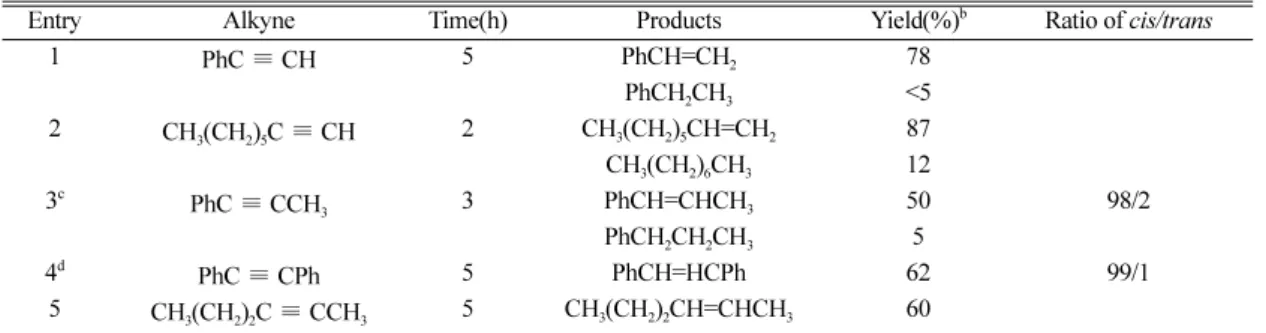
The hydroalumination of 1-octyne was carried out at 0oC, treatment of the reaction mixture with hydrochloric acid gave 1-octene (87%) and n-octane (12%). Similarly, several other alkynes were con- verted to the corresponding alkenes, the results are shown in Table 2. The primary products of these reactions are lithium alkenylhydroaluminates which upon protonolysis afford the corresponding alk- enes. In the reaction of terminal alkynes, the forma- tion of alkanes such as ethylbenzene and n-octane was also observed, the result suggests that small amounts of dialuminates may be produced during the reaction (entries 1 and 3).10 Moreover, in the reaction of diphenylethyne, the formation of cis- diphenylethene predominated in the initial stage, but the trans-diphenylethene was gradually increased
Table 1. The hydroalumination of alkenesa
Entry Alkene Time (h) Product Yield (%)b
1 CH3(CH2)3CH=CH2 3 CH3(CH2)4CH2Br 98
2 CH3(CH2)5CH=CH2 3 CH3(CH2)6CH2Br 99(87)
3 CH3(CH2)4CH=CHCH3 5 CH3(CH2)5CH(Br)CH3 trace
4 CH3(CH2)2C(CH3)=CH2 5 CH3(CH2)2CH(CH3)CH2Br trace
5 PhCH=CH2 3 PhCH2CH2Br 99(86)
6 trans-PhCH=CHPh 5 PhCH2CH2Ph trace
7 PhCH2CH=CH2 5 PhCH2CH2CH3 93(76)
8 PhC(CH3)=CH2 5 PhCH(CH3)2 3
a[C5(CH3)5]2TiCl2 : LiAlH4 : alkene = 1:10:20, 0oC.
bGC yields, isolated yields in parenthesis.
Table 2. The hydroalumination of alkynesa
Entry Alkyne Time(h) Products Yield(%)b Ratio of cis/trans
1 PhC≡CH 5 PhCH=CH2 78
PhCH2CH3 <5
2 CH3(CH2)5C≡CH 2 CH3(CH2)5CH=CH2 87
CH3(CH2)6CH3 12
3c PhC≡CCH3 3 PhCH=CHCH3 50 98/2
PhCH2CH2CH3 5
4d PhC≡CPh 5 PhCH=HCPh 62 99/1
5 CH3(CH2)2C≡CCH3 5 CH3(CH2)2CH=CHCH3 60
a[C5(CH3)5]2TiCl2 : LiAlH4 : alkyne = 1:10:20, 0oC.
bGC yields. c,dAfter isolation, a ratio of cis/trans was determined by GC.
Journal of the Korean Chemical Society
324 이형수·이갑용
during the reaction at 65oC for 5 h (trans/cis=18/82).
The selectivity in the above hydroalumination of alkynes is higher than that in the reaction catalyzed by Cp2TiCl2.10
In summary, the above results indicate that termi- nal monosubstituted alkenes can be hydroalumi- nated with LiAlH4 in the presence of catalytic amounts of the [C5(CH3)5]2TiCl2 under mild condi- tions. This reaction is rapid, and gives higher regi- oselectivity in excellent yields, and involves anti- Markovnikov addition. The reaction of alkynes affords preferentially monoaluminated products. In the case of internal alkynes, the formation of cis-alkenes predominates in the initial stage.
REFERENCES
1. (a) Wailes, P. C.; Coutts, R. S. P.; Weigold, H. Orga- nometallic Chemisrty of Titanium, Zirconium, and Hafnium; Academic Press: New York, 1974. (b) Reetz, M. T.
Organotitanium Reagents in Organic Synthesis; Spring Verlag: Berlin, 1986.
2. Collman, J. P.; Hegedus, L. S.; Norton, J. R.; Finke, R.
G. In Principles and Applications of Organotransition Metal Chemistry; University Science Book: C.A. 1987.
3. (a) Eisch, J. J. In Comprehensive Organometallic Chemistry;Wilkinson, G.; Stone G.; Abel, E. Ed.; Per- gamon Press: Oxford, 1982; Vol. 1, pp. 555-682. (b) Crabtree, R. H.: In The Organometallic Chemistry of the Transition Metals;Wiley-Interscience: New York, 1988; pp. 335-370. (c) Asao, N. Yamamoto, Y. Bull. Chem. Soc. Jpn. 2000, 73, 1071 and references cited therein. (d) Yun, S. S.; Lee, J.; Lee, S. K. Bull. Korean
Chem. Soc. 2001, 22, 623. (e) Yamasaki, S.; Kanai, M.;
Shibasaki, M. J. Am. Chem. Soc. 2001, 123, 1256.
4. Eisch, J. J. In Comprehensive Organic Synthesis; Trost, B. M.; Fleming, I. Ed.; Pergamon Press: Oxford, 1991;
Vol. 8.
5. (a) Sato, F.; Sato, S.; Sato, M. J. Organometal. Chem.
1976, 122, C25. (b) Isagawa, K.; Tatsumi, K.; Otsuji, Y.
Chem. Lett.1976, 1145. (c) Sato, F.; Sato, S.; Sato, M.
J. Organometal. Chem. 1976, 122, C25.(d) Sato, F.;
Sato, S.; Sato, M. J. Organometal. Chem. 1977, 131, C26. (e) Isagawa, K.; Tatsumi, K.; Otsuji, Y. Chem.
Lett.1977, 1117. (f) Sato, F.; Tomuro, Y.; Ishikawa, H.;
Sato, M. Chem. Lett. 1980, 99.
6. (a) Sato, F.; Sato, S.; Kodama, H.; Sato, M. J. Orga- nometal. Chem. 1977, 142, 71. (b) Le Marechal, J-F.;
Ephritikhine, M.; Folcher, G. J. Organometal. Chem.
1986, 309, C1.
7. (a) Asao, N.; Liu, J.; Sudoh, T.; Yamamoto, Y. J. Chem.
Soc., Chem. Commun. 1995, 2405. (b) Asao, N.; Liu, J.; Sudoh, T.; Yamamoto, Y. J. Org. Chem. 1996, 61, 4568.
8. (a)Asao, N.; Matsukawa, Y.; Yamamoto, Y. J. Chem.
Soc., Chem. Commun.1996, 1513. (b) Matsukawa, Y.;
Asao, N.; Yamamoto, Y. Tetrahedron, 1999, 55, 3779.
9. (a) Lee, H. S.; Isagawa, K.; Otsuji, Y. Chem. Lett.1984, 363. (b) Lee, H. S.; Isagawa, K.; Toyoda, H.; Otsuji, Y.
Chem. Lett.1984, 673. (c) Lee, H, S. J. KoreanChem. Soc. 1988, 32, 79.
10. (a) Lee, H. S. Bull. Korean Chem. Soc.1987, 8, 484.
(b) Lee, H. S.; Kim, I. H. J. Korean Chem. Soc. 1993, 37, 689.
11. (a) Lee, H. S.; Lee, H. Y. Bull. Korean Chem. Soc.
2000, 21, 451. (b) Lee, H. S.; Kim, C. J. J. Korean Chem. Soc.2003, 47, 297.