Immunogenicity and Safety of Trivalent Inactivated Influenza Vaccine: A Randomized, Double-Blind, Multi-Center, Phase 3 Clinical Trial in a Vaccine-Limited Country
Influenza vaccines are the primary method for controlling influenza and its complications.
This study was conducted as a phase 3, randomized, double-blind, controlled, multi- center trial at seven university hospitals to evaluate the immunogenicity and safety of an inactivated, split, trivalent influenza vaccine (GC501, Green Cross Corporation, Yongin, Korea), which was newly manufactured in Korea in 2008. Between September 21 and 26, a total of 329 healthy subjects were recruited for the immunogenicity analysis, while 976 subjects were enrolled for the safety analysis. The GC501 vaccine met both FDA and EMEA criteria with ≥ 80% of subjects achieving post-vaccination titers ≥ 40 for all three subtypes, even in the elderly. The vaccine was well tolerated with only mild systemic and local adverse events. In summary, GC501 showed excellent immunogenicity and a good safety profile in both young adults and the elderly. The licensure of GC501 might be an important basis in preparation for the future influenza pandemic.
Key Words: Influenza Vaccines; Influenza, Human; Vaccines, Inactivated Joon Young Song1, Hee Jin Cheong1,
Heung Jeong Woo2, Seong-Heon Wie3, Jin-Soo Lee4, Moon-Hyun Chung4, Yang Ree Kim5, Sook In Jung6, Kyung-Hwa Park6, Tae Hyong Kim7, Soo-Taek Uh8, and Woo Joo Kim1 Division of Infectious Diseases, Department of Internal Medicine, 1Korea University College of Medicine, Seoul; 2Hallym University College of Medicine, Chuncheon; 3The Catholic University of Korea, School of Medicne, St. Vincent’s Hospital, Suwon; 4Inha University College of Medicine, Incheon; 5The Catholic University of Korea, School of Medicne, Uijeongbu St. Mary’s Hospital, Uijeongbu; 6Chonnam National University Medical School, Gwangju; 7Divisions of Infectious Diseases and 8Respiratory and Allergy Medicine, Department of Internal Medicine, SoonChunHyang University Hospital, Seoul, Korea
Received: 25 August 2010 Accepted: 6 December 2010 Address for Correspondence:
Woo Joo Kim, MD
Division of Infectious Diseases, Department of Internal Medicine, Korea University Guro Hospital, Korea University College of Medicine, 97 Gurodong-gil, Guro-gu, Seoul 152-703, Korea Tel: +82.2-2626-3051, Fax: +82.2-2626-1105 E-mail: [email protected]
Funding statement: Green Cross Corporation funded this research.
DOI: 10.3346/jkms.2011.26.2.191 • J Korean Med Sci 2011; 26: 191-195 Infectious Diseases, Microbiology & Parasitology
INTRODUCTION
Influenza and its complications have a large social impact in- cluding increased demands on the healthcare system and pa- tient disability and mortality. Annually, the World Health Orga- nization (WHO) estimates that there are 3-5 million cases of se- vere influenza illness, resulting in 250,000-500,000 deaths in in- dustrialized countries (1). In the Republic of Korea (ROK), the Korean Influenza Surveillance Scheme (KISS) has been opera- tional in public health centers and private clinics since the year 2000, and about 20% of the general population is presumed to get the flu every year (2, 3). In addition to its social impact, in- fluenza also has a significant economic impact, including lost or reduced productivity in the work place, work and school ab- senteeism, and increased healthcare costs.
Influenza vaccines are the primary method for controlling influenza and its complications. In the ROK, the influenza vac- cine coverage rate in the general population is 34.3%, while the coverage rate in the priority group is 61.3%; higher than the rates of other countries (4). Despite the high vaccination rate in the ROK, all influenza vaccines prior to 2008 were imported from global vaccine manufacturers. In 2008, the Green Cross Corpo- ration of the ROK started to produce an influenza vaccine. Here- in, a multi-center, randomized trial of inactivated trivalent in- fluenza vaccine was conducted for the purposes of licensure.
MATERIALS AND METHODS Study design
This study was conducted as a randomized, double-blind, con-
trolled, multi-center, phase 3 trial at seven university hospitals in the ROK to evaluate the immunogenicity and safety of an in- activated, split, trivalent influenza vaccine (GC501, Green Cross Corporation) newly manufactured in Korea in 2008 (Clinical trial number-KCT0000034). Immunogenicity of the GC501 was com- pared to that of the control vaccine (Fluarix®, GlaxoSmithKline Biologicals, Rixensart, Belgium). Subjects (healthy adults aged
≥ 18 yr) were excluded for the following reasons: allergy to eggs, history of Guillain-Barre syndrome, immunodeficiency or receipt of immunosuppressive therapy, active neoplastic diseases, and previous influenza vaccination within six months prior to the study. Subjects who met the entry criteria for the study were strat- ified into two age groups (18-59 and ≥ 60 yr) and randomized to receive either the study vaccine or the control vaccine.
After a baseline blood sample was collected, the vaccine was administered as a single intramuscular injection into the deltoid muscle, and subjects were observed for 30 min. At day 21 after vaccination, a second blood sample was obtained.
Vaccines
The study vaccine (GC501) was a trivalent, inactivated split vac- cine loaded into pre-filled syringes containing 15 µg of hemag- glutinin and was produced in embryonated chicken eggs by the Green Cross Corporation (Yongin, ROK) according to the guide- lines of the WHO. The control vaccine was a 0.5 mL commercial trivalent, inactivated split vaccine (Fluarix®) in pre-filled syringes containing 15 µg of hemagglutinin. The vaccines were each com- posed of the following influenza strains: A/Brisbane/59/2007 IVR-148 (H1N1), A/Uruguay/716/2007 NYMC X-175C (H3N2), and B/Brisbane/3/2007.
Immunogenicity assessment
Serum samples were assessed for hemagglutination-inhibition (HI) antibodies to each hemagglutinin of the H1N1, H3N2 and B strains contained in the vaccine using a standard assay with use of chicken erythrocytes at the Korea University Guro Hospi- tal (5). HI antibody titers that were below the detection limit (i.e.,
< 1:10) were assigned a value of 1:5, and all other titers over 1:5,120 were assigned a value of 1:5,120.
The three co-primary immunogenicity end points after vac- cination were the proportion of subjects with antibody titers of 1:40 or more on HI assays (seroprotection rate), the proportion of subjects with either seroconversion or a four-fold or more in- crease in antibody titer (seroconversion rate), and geometric mean titer ratio (GMTR) (i.e., the ratio of the geometric mean titer after vaccination to the geometric mean titer before vacci- nation) (6). Serologic response, as measured by HI antibody ti- ters, was assessed using the criteria set by both the United States Food and Drug Administration (FDA) and the Committee for Proprietary Medicinal Products (CPMP) of the European Agen- cy for the Evaluation of Medicinal Products (EMEA). According
to the FDA criteria, the lower bound of the two-sided 95% con- fidence interval (CI) of seroprotection should meet or exceed 70% in adults aged < 65 yr (60% in adults ≥ 65 yr), and the lower bound of the two-sided 95% CI of seroconversion should meet or exceed 40% in adults aged < 65 yr (30% in adults ≥ 65 yr) (7).
In order to confirm protective immunogenicity based on the EMEA criteria, one of the following criteria must be met: sero- protection rates > 70% for subjects aged 18-60 yr and > 60% for subjects over 60 yr, seroconversion rates > 40% for subjects aged 18-60 yr and > 30% for subjects over 60 yr, or GMT ratios > 2.5 for subjects aged 18-60 yr and > 2.0 for subjects over 60 yr (6).
Safety assessment
At first visit, enrolled subjects were given a digital thermometer and a diary card containing of a list of solicited adverse events and their grades. On the immunization day (day 0), subjects were observed at the study site for a period of 30 min after vaccination to detect any immediate adverse reactions. For the next 7 days, subjects were educated to record the severity of solicited local adverse events and solicited systemic adverse events, axillary temperature and concomitant medications in the diary card.
Subjects used a standard scale to grade adverse events (8).
Solicited local adverse events were pain, tenderness, redness and swelling, and solicited systemic adverse events were fever, headache, malaise, shivering, fatigue, sweating, myalgia and arthralgia. We collected unsolicited reports during the study.
Serious adverse events were reported within 24 hr. Any adverse events were possibly considered to be related to the vaccine for up to six months after vaccination.
Statistical analysis
The sample size was chosen to meet the immunogenicity end- points based on the data of the Fluarix® trial (9). All statistics were generated using SPSS 11.5. The Student t-test (Mann Whit- ney U-test for less than 30 samples) was used to compare HI ti- ters between the two groups. HI titers obtained before and after vaccination were compared using the Wilcoxon test (two-tailed), and categorical variables were analyzed using the chi-square test. Results were considered statistically significant if the P val- ue was less than 0.05.
Ethics statement
The study was conducted in accordance with the Declaration of Helsinki and the standards of Good Clinical Practice by the In- ternational Conference on Harmonization. The protocol and consent forms were approved by the institutional review board of each participating study site. Informed written consent was obtained from all participants following a detailed explanation of schedules and study contents.
RESULTS Study subjects
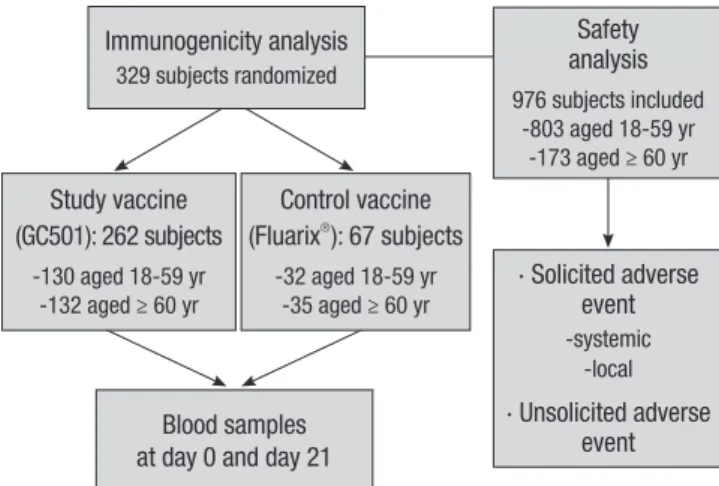
Between September 21 and 26, 2008, a total of 329 healthy sub- jects were recruited for the analysis of immunogenicity, while 976 subjects were enrolled for the safety analysis (Fig. 1). Three
hundred and nineteen subjects were randomized to receive ei- ther the study vaccine (GC501, 130 subjects aged 18-59 yr and 132 subjects aged ≥ 60 yr) or the control vaccine (Fluarix®, 32 subjects aged 18-59 yr and 35 subjects aged ≥ 60 yr). The demo- graphic and baseline characteristics of the two vaccine groups were well matched, as shown in Table 1. All 976 subjects in the safety analysis received the study vaccine.
Immunogenicity
Pre-vaccination GMTs were similar between the GC501 and con- trol vaccine groups in both subjects aged 18-59 yr and in sub- jects aged ≥ 60 yr (Table 2). Table 2 presents the immunogenicity data on the seroprotection, seroconversion and GMTR of 329 subjects by intent-to-treat (ITT) analysis. For each strain of the three subtypes, the seroprotection rates, seroconversion rates and GMTRs were comparable between the GC501 and control vaccine groups, irrespective of age (P > 0.05). The GC501 vaccine met both the FDA and EMEA criteria. In terms of the GC501 vac- cine, seroprotection rates were 88.5% for A/H1N1, 80.0% for A/
H3N2 and 94.6% for B in subjects aged 18-59 yr and were 81.8%
for A/H1N1, 81.1% for A/H3N2 and 82.6% for B in subjects aged Fig. 1. Flowchart of subjects through the study.
Blood samples at day 0 and day 21
· Solicited adverse event -systemic
-local
· Unsolicited adverse event Immunogenicity analysis
329 subjects randomized
Safety analysis 976 subjects included
-803 aged 18-59 yr -173 aged ≥ 60 yr Study vaccine
(GC501): 262 subjects -130 aged 18-59 yr
-132 aged ≥ 60 yr
Control vaccine (Fluarix®): 67 subjects
-32 aged 18-59 yr -35 aged ≥ 60 yr
Table 1. Demographic characteristics of the study subjects
Subjects aged 18-59 yr Subjects aged ≥ 60 yr
GC501 (n = 130) Control (n = 32) P value GC501 (n = 132) Control (n = 35) P value
Sex (male), No. (%) 52 (40.0%) 11 (34.4%) 0.559 50 (37.9%) 13 (37.1%) 0.936
Age, mean ± SD (yr) 34.3 ± 9.8 36.8 ± 10.7 0.200 65.2 ± 4.7 66.3 ± 5.3 0.267
BMI, mean ± SD 22.8 ± 3.3 23.8 ± 3.5 0.917 24.7 ± 2.9 24.4 ± 2.6 0.236
Smoking, No. (%) 29 (22.3%) 2 (6.3%) 0.018 8 (6.1%) 4 (11.4%) 0.528
Alcohol, No. (%) 56 (43.1%) 12 (37.5%) 0.751 29 (22.0%) 4 (11.4%) 0.244
BMI, body mass index.
Table 2. Immune responses after immunization with trivalent inactivated influenza vaccines, as measured using a hemagglutination-inhibition (HI) assay: GC501 versus control vaccine (Fluarix®)
Immunogenicity Subjects aged 18-59 yr Subjects aged ≥ 60 yr
GC501 Control P value GC501 Control P value
H1N1 Seroprotection Seroconversion GMTR GMT (day 0) GMT (day 21)
88.5 (81.4-93.2) 66.2 (57.3-74.1) 10.1 (7.5-13.5) 15.4 (12.4-18.9) 155.0 (120.8-197.5)
87.5 (70.1-95.9) 71.9 (53.0-85.6) 13.5 (7.0-26.0) 18.0 (10.6-30.5) 241.5 (139.6-420.3)
0.88 0.54 0.41 0.54 0.13
81.8 (74.0-87.8) 53.0 (44.2-61.7) 5.1 (4.1-6.4) 16.1 (13.1-19.8) 81.9 (66.8-101.3)
74.3 (56.4-86.9) 37.1 (22.0-55.1) 3.5 (2.4-5.3) 17.4 (11.7-26.1) 61.2 (41.1-90.4)
0.32 0.10 0.15 0.74 0.21 H3N2
Seroprotection Seroconversion GMTR GMT (day 0) GMT (day 21)
80.0 (71.9-86.3) 73.1 (64.5-80.3) 11.1 (8.3-15.0)
8.1 (6.9-9.5) 90.4 (67.1-120.8)
75.0 (56.3-87.9) 75.0 (56.3-87.9) 13.2 (8.1-21.5) 7.7 (5.8-10.2) 101.5 (60.8-169.5)
0.53 0.83 0.61 0.77 0.73
81.1 (73.1-87.2) 66.7 (57.9-74.5) 8.8 (6.8-11.3) 13.0 (10.6-16.2) 113.7 (88.5-145.1)
80.0 (62.5-90.9) 68.6 (50.6-82.6) 8.2 (5.2-13.2) 12.2 (8.8-17.0) 100.5 (61.5-164.1)
0.89 0.83 0.83 0.78 0.66 B
Seroprotection Seroconversion GMTR GMT (day 0) GMT (day 21)
94.6 (88.8-97.6) 53.1 (44.2-61.8) 4.0 (3.2-5.2) 34.7 (27.1-44.7) 140.4 (116.5-167.7)
100 (NA) 68.8 (49.9-83.3)
6.7 (4.1-11.2) 24.8 (15.8-38.9) 167.1 (123.8-226.2)
0.18 0.11 0.07 0.23 0.39
82.6 (74.8-88.4) 50.0 (41.2-58.8) 4.8 (3.9-6.0) 18.2 (14.7-22.5) 87.5 (70.6-108.1)
85.7 (69.0-94.6) 42.9 (26.8-60.5) 4.0 (2.7-6.0) 24.4 (15.9-37.1) 97.5 (67.5-140.9)
0.66 0.45 0.44 0.22 0.64 Geometric mean ratios are the ratios of the antibody levels at day 21 and at day 0. Seroconversion was defined as a pre-vaccination antibody titer of 1:10 or less and a post- vaccination titer of 1:40 or more.
≥ 60 yr. Likewise, seroconversion rates were 66.2% for A/H1N1, 73.1% for A/H3N2 and 53.1% for B in subjects aged 18-59 yr and were 53.0% for A/H1N1, 66.7% for A/H3N2 and 50.0% for B in subjects aged ≥ 60 yr. GMTRs ranged between 4.0 and 16.1 and were lower with regard to subtype B compared to those of A/
H1N1 and A/H3N2.
Safety
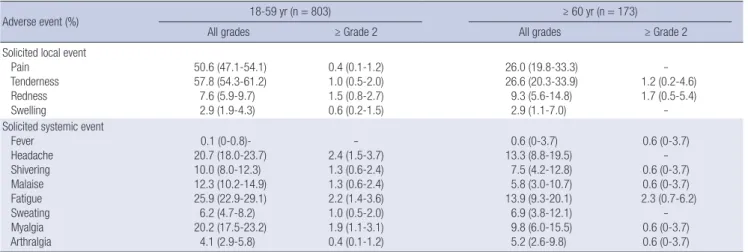
Solicited local and systemic adverse events reported within sev- en days of vaccination are shown in Table 3. Following the vac- cination, 595 (61.0%) of the 976 subjects reported solicited local adverse events, while 388 subjects (39.8%) reported solicited systemic adverse events. Overall, solicited adverse events were less common in the elderly group aged ≥ 60 yr (82 among 173 subjects, 47.4%) compared to those of the subjects aged 18-59 yr (587 among 803 subjects, 73.1%). The most common local ad- verse events were pain (451, 46.2%) and tenderness (510, 52.3%), while the most frequent systemic event was fatigue (232, 23.8%), followed by headache (189, 19.4%) and myalgia (179, 18.3%).
Most subjects reported systemic adverse events as grade 1 (no- ticeable but did not interfere with daily activity) that resolved within three days. High-grade systemic adverse events (≥ grade 2) were observed in 6.9% of subjects: fatigue (22, 2.3%), head- ache (19, 1.9%), myalgia (16, 1.6%), malaise (11, 1.1%) and shiv- ering (11, 1.1%).
During the 21 days after vaccination, unsolicited adverse events were reported by 86 (8.8%) of the 976 subjects. Of these, respiratory system disorder (31, 3.2%) was the most common, and 32 (3.3%) of the events were considered to be related to vac- cination. On the other hand, two severe adverse events of atel- ectasis and convulsion were reported. Atelectasis was not con- sidered to be related to vaccination, while the episode of con-
vulsion was possibly related. All subjects with unsolicited ad- verse events recovered without sequelae, and no death was re- ported.
DISCUSSION
This study showed that the immunogenicity of the new influen- za vaccine (GC501) is largely comparable with that of the com- mercial trivalent, inactivated split vaccine (Fluarix®, GlaxoSmith- Kline Biologicals, Rixensart, Belgium), which was well tolerated.
Up until the early 21st century, about 85% of the world’s sup- ply of influenza vaccine had been produced by nine vaccine companies located in nine different countries: France, Germa- ny, Italy, the Netherlands, Switzerland, the United Kingdom, the United States, Canada, and Australia (10). In the situation of large influenza epidemic, any country would be confronted with vac- cine shortage. Concerning vaccine shortage, some Asian coun- tries had tried to have their own manufacturing system. Japan already has four national influenza vaccine manufacturers, and China recently achieved licensure of an influenza vaccine. The GC501 vaccine in this study is the first Korean influenza vaccine which is expected to contribute to lowering the risk of vaccine shortages in the many vaccine-limited countries.
For the licensure of a new influenza vaccine, the FDA and EMEA provide definite criteria that must be achieved (6, 7). In the present study, GC501 met the FDA requirements with con- sistent rates of seroprotection (lower bound of the two-sided 95% CI ≥ 70%) and seroconversion (lower bound of the two-sid- ed 95% CI ≥ 40%) for all three subtypes, irrespective of age. As for the EMEA criteria, GC501 exceeded the requirements with
≥ 80% of subjects achieving post-vaccination titers ≥ 40 for all three subtypes, even in the elderly.
Table 3. Solicited local and systemic adverse events within seven days after GC501 vaccination
Adverse event (%) 18-59 yr (n = 803) ≥ 60 yr (n = 173)
All grades ≥ Grade 2 All grades ≥ Grade 2
Solicited local event Pain
Tenderness Redness Swelling
50.6 (47.1-54.1) 57.8 (54.3-61.2) 7.6 (5.9-9.7) 2.9 (1.9-4.3)
0.4 (0.1-1.2) 1.0 (0.5-2.0) 1.5 (0.8-2.7) 0.6 (0.2-1.5)
26.0 (19.8-33.3) 26.6 (20.3-33.9) 9.3 (5.6-14.8)
2.9 (1.1-7.0)
- 1.2 (0.2-4.6) 1.7 (0.5-5.4)
- Solicited systemic event
Fever Headache Shivering Malaise Fatigue Sweating Myalgia Arthralgia
0.1 (0-0.8)- 20.7 (18.0-23.7)
10.0 (8.0-12.3) 12.3 (10.2-14.9) 25.9 (22.9-29.1) 6.2 (4.7-8.2) 20.2 (17.5-23.2)
4.1 (2.9-5.8)
- 2.4 (1.5-3.7) 1.3 (0.6-2.4) 1.3 (0.6-2.4) 2.2 (1.4-3.6) 1.0 (0.5-2.0) 1.9 (1.1-3.1) 0.4 (0.1-1.2)
0.6 (0-3.7) 13.3 (8.8-19.5) 7.5 (4.2-12.8) 5.8 (3.0-10.7) 13.9 (9.3-20.1) 6.9 (3.8-12.1) 9.8 (6.0-15.5) 5.2 (2.6-9.8)
0.6 (0-3.7) - 0.6 (0-3.7) 0.6 (0-3.7) 2.3 (0.7-6.2)
- 0.6 (0-3.7) 0.6 (0-3.7)
*Data are presented as proportion (95% confidence interval) of participants who reported having a solicited local or systemic adverse event. Pain was grade 0 (absent), grade 1 (does not interfere with activity), grade 2 (repeated use of non-narcotic pain reliever > 24 hr or interferes with activity), grade 3 (any use of narcotic pain reliever or prevents daily activity), or grade 4 (emergency room visit or hospitalization). Tenderness was grade 0 (absent), grade 1 (mild discomfort to touch), grade 2 (discomfort with movement), grade 3 (significant discomfort at rest), or grade 4 (emergency room visit or hospitalization). Other adverse events were grade 1 (does not interfere with activity), grade 2 (interferes with activity), grade 3 (prevents daily activity), or grade 4 (emergency room visit or hospitalization).
In general, local reactions after inactivated influenza vaccina- tion are known to be relatively frequent (10%-65%) (11). Consis- tent with previous reports, GC501 showed mild local reactions in 61.0% of subjects. Though the frequency of systemic adverse reactions to GC501 (39.8%) was higher than those in previous reports (15% in average) (10), most adverse reactions were grade 1 and were resolved spontaneously within a few days. One epi- sode of convulsion was reported by a vaccine recipient (0.1%) and was considered to be possibly vaccine-related. However, the subject recovered without sequelae, and the episode was not recurrent.
In summary, GC501 showed excellent immunogenicity and a good safety profile in both young adults and the elderly. The licensure of GC501 might be an important basis in preparation for the future influenza pandemic.
REFERENCES
1. Wilschut JC, McElhaney J, Palache B. Influenza. 2nd ed. Philadelphia, PA: Elsevier Ltd 2006; 117-32.
2. Park SC, Choeng HJ, Sohn JW, Choi SJ, Eom JS, Woo HJ, Chun BC, Kim WJ. Efficacy of influenza vaccination among chronic ill patients: retro- spective case control study. Infect Chemother 2004; 36: 207-12.
3. Lee JS, Shin KC, Na BK, Lee JY, Kang C, Kim JH, Park O, Jeong EK, Lee JK, Kwon JW, Park SC, Kim WJ. Influenza surveillance in Korea: estab- lishment and first results of an epidemiological and virological surveil- lance scheme. Epidemiol Infect 2007; 135: 1117-23.
4. Kee SY, Lee JS, Cheong HJ, Chun BC, Song JY, Choi WS, Jo YM, Seo YB, Kim WJ. Influenza vaccine coverage rates and perceptions on vaccina- tion in South Korea. J Infect 2007; 55: 273-81.
5. Song JY, Cheong HJ, Hwang IS, Choi WS, Jo YM, Park DW, Cho GJ, Hwang TG, Kim WJ. Long-term immunogenicity of influenza vaccine among the elderly: Risk factors for poor immune response and persistence. Vaccine 2010; 28: 3929-35.
6. European Committee for Proprietary Medicinal Products. Note for guid- ance on harmonisation of requirements for influenza vaccines (CPMP/
BWP/214/96). London, UK: The Europen Agency for the Evaluation of Medicinal Products; c1997 Available at http://www.ema.europa.eu/
pdfs/human/bwp/021496en.pdf [accessed on 17 Aug 2010].
7. U.S. Department of Health and Human Services, Food and Drug Admin- istration, Center for Biologics Evaluation and Research. Guidance for industry: clinical data needed to support the licensure of trivalent inacti- vated influenza vaccines; c2006 Available at http://www.fda.gov/down- loads/BiologicsBloodVaccines/GuidanceComplianceRegulatoryInfor- mation/Guidances/Vaccines/ucm091985.pdf [accessed on 17 Aug 2010].
8. U.S. Department of Health and Human Services FDA, Center for Bio- logics Evaluation and Research. Guidance for Industry: Toxicity Grading Scale for Healthy Adult and Adolescent Volunteers Enrolled in Preven- tive Vaccine Clinical Trials. 2007. Available at http://www.fda.gov/Bio- logicsBloodVaccines/GuidanceComplianceRe [accessed on 17 Aug 2010].
9. El Sahly HM, Keitel WA. Clinical data on Fluarix: an inactivated split seasonal influenza vaccine. Expert Rev Vaccines 2008; 7: 713-9.
10. Fedson DS. Pandemic influenza and the global vaccine supply. Clin In- fect Dis 2003; 36: 1552-61.
11. Cheong HJ. Safety of influenza vaccine. J Korean Med Assoc 2007; 50:
267-73.
AUTHOR SUMMARY
Immunogenicity and Safety of Trivalent Inactivated Influenza Vaccine: A Randomized, Double-Blind, Multi-Center, Phase 3 Clinical Trial in a Vaccine- Limited Country
Joon Young Song, Hee Jin Cheong, Heung Jeong Woo, Seong-Heon Wie, Jin-Soo Lee, Moon-Hyun Chung, Yang Ree Kim, Sook In Jung, Kyung-Hwa Park, Tae Hyong Kim, Soo-Taek Uh, and Woo Joo Kim
This study is a phase 3, randomized, double-blind, controlled, multi-center trial to evaluate the immunogenicity and safety of an inactivated, split, trivalent influenza vaccine (GC501, Green Cross Corporation), which was newly manufactured in Korea in 2008.
During study periods, a total of 329 healthy subjects were recruited for the immunogenicity analysis, while 976 subjects were enrolled for the safety analysis. The GC501 vaccine met both FDA and EMEA criteria with ≥ 80% of subjects achieving post- vaccination titers ≥ 40 for all three subtypes, even in the elderly. The vaccine was well tolerated with only mild adverse events. In summary, GC501 showed excellent immunogenicity and a good safety profile in both young adults and the elderly. The licensure of GC501 might be an important basis in preparation for the future influenza pandemic.