447
©The Korean Society of Food Science and Technology
10가지 식용식물 추출물의 가바, 글루탐산 함량,
아세틸콜린에스테라제 억제 및 라디컬 소거능 비교
정연섭
1·박성진
1·김지은
1·양선아
2·박정현
2·김정현
3·지광환
3·이삼빈
1,2·이인선
1,*
1계명대학교 식품가공학과, 2계명대학교 전통미생물자원개발및산업화연구센터, 3금오공과대학교 응용화학과
A Comparative Study of GABA, Glutamate Contents, Acetylcholinesterase
Inhibition and Antiradical Activity of the Methanolic
Extracts from 10 Edible Plants
Yeon-Seop Jung1, Sung-Jin Park1, Ji-Eun Kim1, Seun-Ah Yang2, Jung-Hyun Park2, Jung-Hyun Kim3, Kwang-Hwan Jhee3, Sam-Pin Lee1,2, and In-Seon Lee1*
1
Department of Food Science and Technology, Keimyung University
2
The Center for Traditional Microorganism Resources, Keimyung University
3
Department of Applied Chemistry, Kumoh National Institute of Technology
Abstract In order to investigate the efficacies for cognitive function of edible plants, we measured the inhibitory effects of acetylcholinesterase(AChE) activity, radical scavenging activities, and the contents of GABA and glutamate in the plant extracts. Among the plant extracts, Schizandra chinensis contained the highest GABA 14.8 mg/g and the extracts of Cnidium officinale and Polygonum multiflorum also had a relatively high GABA. On the other hand, plant extracts except, Acorus gramineus, showed similar glutamate contents. S. chinensis, Hovenia dulcis, Thuja orientalis, and Eleutherococcus senticosus exhibited high inhibition against AChE activities at about 18-33% at 1 mg/mL. In addition, strong radical scavenging activities were also detected in those extracts which showed high AChE inhibition. Taken together, H. dulcis, T. orientalis, E. senticosus, and S. chinensis could be effective resources for enhancing cognitive function. Further, it was suggested that the AChE inhibitory activities of plant extracts might be related to antioxidative activity.
Keywords: edible plants extract, AChE, radical scavenging activity, GABA, glutamic acid
서
론
현대인에게 기억력은 급변하는 생활에서 그 중요성이 증대되 고 있으며, 사회적으로 학습량이 많은 청소년에서부터 노년에 이 르기까지 주요 관심 대상이 되고 있다. 이러한 기억력의 저하는 사회적으로 문제가 되고 있으며(1), 학습과 기억력 감퇴증상이 일 차적으로 나타나는 치매 질환은 65세 이상인 사람들의 약 10%, 80세 이상의 노인들에서는 약 50% 이상이 발병하는 것으로 추 정되고 있다. 또한 이러한 현상은 노인인구가 빠르게 증가함에 따라 더 급속하게 증가할 것으로 예상되고 있다(2,3). 치매에는 퇴행성 변화에 의한 Alzheimer’s disease(AD)와 뇌경색 등으로 유 발되는 뇌혈관성 치매 그리고 중독성 치매 등이 있다. 65세 이 상의 치매환자 중 AD가 50-60%를 차지하고 있으며, 여성이 남 성보다 발병 빈도가 2-3배 높은 것으로 보고되고 있다(4). 치매 질환의 일차적인 증상인 기억력과 인지기능의 감퇴현상 은 콜린성 신경계와 밀접한 관계가 있는 것으로 알려져 있으며, 보고에 따르면 postsynapse에 있는 muscarinic 수용체의 길항제인 scopolamine은 presynapse에서 유리되는 신경전달물질인 acetylcho-line과 muscarinic수용체의 결합을 저해하여 정보전달을 일시적으 로 차단함으로써, 학습과 기억력저하를 일으키게 되므로 acetyl-choline은 학습과 기억 증진효과를 검증하고자 하는 기억력 감퇴 동물모델에 통상적으로 이용되고 있다(5,6). 최근 치매 등으로 인해 저하된 인지기능 및 학습기능을 개선시 키고 향상시키는 다양한 치료전략을 수립하고 효과적인 물질을 찾 고자 하는 노력이 시도되고 있으며 현재까지 개발된 기억력 개선 약물들은 acetylcholine 합성전구체, 수용체 활성제, acetylcholinest-erase inhibitor 등이 있으나 효과가 일시적이고 미약하며 심각한 부 작용 및 독성 때문에 아직 사용에 논란의 여지가 많다(7-9). 한편 γ-aminobutyric acid(GABA)는 자연계에 분포하는 비단백 질 아미노산의 일종으로 4개의 탄소로 구성되어 있으며, 물에 매우 잘 녹는 물질이다(10,11). GABA는 L-glutamic acid로부터 glutamate decarboxylase의 촉매작용에 의해 생성되며, 주로 동물의 경우, 중 추신경계의 억제성 신경전달물질로서(12) 뇌의 혈류를 활발하게 하고 산소 공급량을 증가시켜 뇌세포의 대사기능을 촉진시키며 (13) 혈압강하와 알코올 대사를 증진시키는 것으로 알려져 있다 *Corresponding author: In-Seon Lee, Department of Food Scienceand Technology, Keimyung University, Daegu 704-701, Korea Tel: 82-53-580-5538
Fax: 82-53-580-5538 E-mail: [email protected]
Received April 18, 2012; revised May 25, 2012; accepted July 5, 2012
(14). 또한, GABA의 농도가 급격히 감소하거나 함량이 줄어들 때에는 발작이나 경련 등이 발생하며 이러한 현상이 지속될 시, 간질이나 치매 등 신경에 관계된 신경성 질환을 일으킬 수 있는 것으로 보고되고 있다(15). 전술한 바와 같이 여러 가지 작용기전에 따라 acetylcholine성 신경세포의 기능을 강화시켜줄 수 있는 acetylcholine성 약물들이 속속 개발되고 있으며 현재 시판되고 있는 tacrine(Cognex), doni-pezil(Aricept), rivastigmine(Excelon), galantamine(Reminil) 등 치매 치료제들의 약리작용기전을 살펴보면 모두 acetylcholinesterase 저 해 효과를 약효의 근간으로 삼고 있다. 이와 같이 치매치료제 개 발과정에 있어서 전 세계적으로 acetylcholinesterase(AChE)가 가 장 많이 약리작용점으로 채택되고 있는 연구 추세이며(16), GABA 의 경우 배아미, 녹차 및 뽕잎 등에 다소 함유되어 있으나, 약리 작용을 발휘하기에는 함량이 매우 낮다(17). 이에 본 연구에서는 뇌기능 향상을 위하여 민간에서 널리 사용되는 10가지 생약 추 출물(당귀: Angelica gigas, 원지: Polygala tenuifolia, 천궁: Cnid-ium officinale, 하수오: Polygonum multiflorum, 백복신: Poria cocos, 오미자: Schizandra chinensis, 측백엽: Thuja orientalis, 가 시오가피: Eleutherococcus senticosus, 석창포: Acorus gramineus, 헛개나무: Hovenia dulcis)을 대상으로 하여 AChE의 저해효과와 GABA 함량 및 항산화 효과 등의 생리 활성의 상관 관계를 살 펴봄으로써 민간에서 사용하는 생약 추출물의 효능을 입증하고 자 하였다.
재료 및 방법
식물재료본 실험에 사용된 당귀(Angelica gigas), 원지(Polygala tenuifo-lia), 천궁(Cnidium officinale), 하수오(Polygonum multiflorum), 백 복신(Poria cocos), 오미자(Schizandra chinensis), 측백엽(Thuja ori-entalis), 가시오가피(Eleutherococcus senticosus), 석창포(Acorus gramineus), 헛개나무(Hovenia dulcis)는 대구시 약령시장에서 건 조 상태의 것을 구입하여 사용하였다.
시료제조
본 실험에 사용된 생약시료는 불순물을 제거를 위하여 수세한 후 건조하여 사용하였고, 무게의 10배량(w/v)의 methanol(Mallinck-rodt Baker Inc., Philipsburg, MT, USA)을 가하여 24시간 동안 정 치하여 총 3회 반복 추출하였다. 추출액은 여과지(Whatman No. 3, Whatman Internatinal Ltd., Maidstone, England)로 여과한 다음 rotary evaporator(UT-1000, EYELA, Tokyo, Japan)로 55o
C에서 농축한 후 동결 건조하여 MeOH 추출물로 사용하였다.
γ-Aminobutyric acid(GABA) 함량측정
GABA 정량분석은 Zhang과 Bown의 방법(18)을 96 well plate 에 맞게 수정하여 실시하였다. Eppendorf tube에 시료 0.1 g과 methanol 400µL를 넣고 잘 섞은 다음 60-70o
C로 예열된 water bath에서 약 30분간 완전히 건조시켰다. 여기에 70 mM LaCl3
1 mL을 가하여 잘 섞고 13,000×g에서 5분간 원심분리한 후에 상 등액 700 µL과 0.1 M KOH 160 µL를 eppendorf tube에 첨가한 다음 3-5분간 교반하고 다시 13,000×g에서 5분간 원심분리한 후 상등액을 희석하여 GABA함량 측정에 이용하였다. GABA함량은 GABase를 이용하는 효소 방법을 사용하였고 생성되는 NADPH 의 양을 ELISA reader(Molecular Deivce Co., Sunnyvale, CA, USA)를 이용하여 340 nm에서 측정하였다.
L-Glutamate 함량 측정
0.1 M NaOH를 이용하여 pH를 4로 맞춘 생약 추출물 10 µL에 acetone에 녹인 1% FDAA(Marfey’s Reagent, 1-fluoro-2-4-dinitro-phenyl-5-L-alanine amide) 20µL와 1 M NaHCO3 4µL를 첨가한
혼합물을 40o
C에서 1시간 동안 반응시켰다. 그리고 실온에서 5분 동안 방치한 후, 1 M HCl 4 µL를 첨가하여 FDAA 반응을 종결 시킨 후 진공농축기(BioTron Inc., Gangneung, Korea)를 사용하여 건조시켰다. 생성된 FDAA-amino acid 유도체를 methanol 200 µL 에 용해시킨 후, 0.22 µM의 membrane filter로 여과하여 HPLC (Shimadzu Prominence LC20A, Shimadzu Co., Kyoto, Japan) 시 료로 사용하였다(19). Column은 YMC사의 C18(150×4.6 mm I.D.,
4µM)를 사용하였고 온도와 flow rate는 각각 40oC과 1 mL/min로
하였으며, 340 nm에서 분석하였다. Buffer A는 0.05 M triethy-lamine phosphate (pH 3)를 함유한 3차 증류수이며, Buffer B는 100% acetonitrile을 사용하였다. 2가지 용매를 이용하여 Table 1 과 같은 gradient 조성으로 추출물들을 분석하였다. L-Glutamate의 함량분석은 표준품인 L-glutamate(Sigma, Chemical Co., St. Louis, MO, USA)를 위와 동일한 방법으로 반응시킨 후, HPLC 분석을 통한 검량선을 작성하여 계산하였다.
AChE 저해 효과
저해 활성 측정은 Ellman법(20)과 Jason법(21)을 변형하여 수행 하였다. AChE(Sigma, Chemical Co.)효소는 일정량씩 분주하여 80o
C 이하에서 보관하였으며, 최종 농도는 0.22 unit의 농도로 사 용하였다. 또한 기질은 0.2 M의 sodium phosphate buffer(pH 8.0) 에 녹인 15 mM의 acetylcholine iodide를 사용하였으며, 발색 시약 인 0.01 M 5,5-dithio-bis(2-nitrobenzoic acid) (DTNB)은 0.2 M의 sodium phosphate buffer(pH 7.0)에 녹여 제조하였다. 효소 반응은 다음과 같이 전개하였다. 25 µL의 시료와 25 µL AChE 효소(0.22 U)를 가한 뒤 37o
C에서 15분간 preincubation을 하고, 125 µL의 DTNB 용액과 기질 25 µL를 가해 반응 시킨 후 ELISA reader (Molecular Deivce Co.)를 이용하여 412 nm에서 흡광도를 측정하 였다. 이때 대조물질로는 eserine hemisulfate salt을 이용하였으며 결과는 control군에 대한 %로 표시하였다.
Inhibition (%)=[1−(S−S0/C−C0)]×100
S: tested samples (enzyme, sample solution with assay buffer, DTNB, substrate)
S0: tested samples at zero time
C: control after 60 min of incubation (enzyme, assay buffer, Table 1. HPLC conditions for L-glutamate analysis
Column YMC C18 Column
Mobile phase Buffer A: 0.05 M Triethylamine phosphate, pH 3.0
Buffer B: 100% Acetonitrile Total Flow 1.0 mL/min
Wavelength (nm) 340 Column Temperature 40οC Gradient time table Run time (min) 40 Post time (min) 20
Time (min) 00 20 25 40
A solvent (%) 83 30 83 83
DTNB, substrate) C0: control at zero time
DPPH radical 소거 활성
시료의 free radical 소거 활성은 Blois(22)의 방법을 변형하여 stable radical인 2,2'-Diphenyl-β-picrylhydrazyl(DPPH, Sigma Chemi-cal Co.)에 대한 환원력을 측정한 것으로 99% methanol에 각 시 료를 녹여 농도별로 희석한 희석액 160 µL와 메탄올에 녹인 0.15 mM DPPH 용액 40 µL를 가하여 실온에 30분 방치한 후 517 nm에서 흡광도를 측정하였다. 각 시료 추출물의 유리라디칼 소거활성은 시료를 첨가하지 않은 대조구의 흡광도를 1/2로 감소 시키는데 필요한 시료의 농도인 RC50 값으로 나타내었다. 이때
활성비교를 위하여 합성항산화제인 butylated hydroxyl ani-sole(BHA)를 사용하였다.
ABTS radical 소거 활성
ABTS radical을 이용한 항산화력 측정은 ABTS cation deco-lourisation assay방법(23)에 의하여 실시하였다. 7 mM 2,2'-azino-bis(3-ethylbenzthiazoline-6-sulfonic acid) (ABTS, Sigma Chemical Co.)와 2.45 mM potassium persulfate를 최종 농도로 혼합하여 실 온인 암소에서 24시간 동안 방치하여 ABTS+•를 형성시킨 후 96
well에 734 nm에서 흡광도 값이 0.70(±0.02)이 되게 phosphate buffered saline(PBS, pH 4)로 희석하였다. 희석된 ABTS용액 180µL에 sample 20 µL를 가하여 잘 혼합하고 정확히 1분 동안 방치한 후 흡광도를 측정하였다. 각 시료 추출물과 단일 물질의 유리 라디칼 소거 활성은 시료를 첨가하지 않은 대조구의 흡광 도를 1/2로 감소시키는데 필요한 시료의 농도를 RC50값으로 나 타내었다. 통계처리 실험결과의 통계분석은 SAS program을 이용한 일원분산분석 법을 실시하여 Duncan’s multiple range test에 의해 시료간의 유 의적 차이(p<0.05)를 검정하였다.
결과 및 고찰
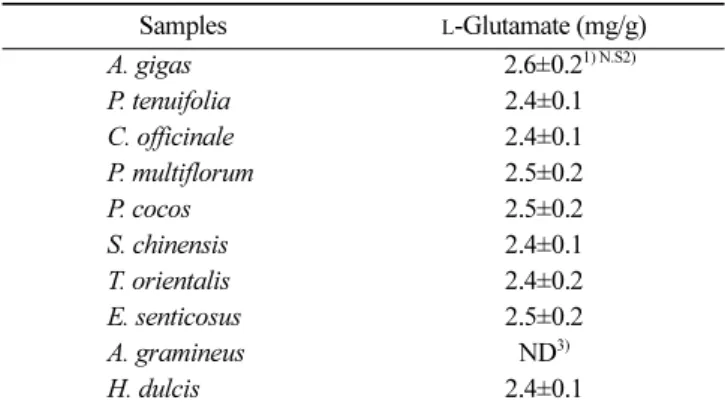
γ-Aminobutyric acid(GABA) 함량 측정 비단백질 아미노산인 GABA는 뇌나 척추에 존재하는 신경전 달 물질로 혈류를 개선하며 뇌의 산소공급을 증가시켜 뇌의 대 사촉진 및 뇌 기억을 증진시키는 뇌의 영양제로 알려져 있다(24-26). 본 연구에서는 당귀 등 생약재 10종의 MeOH 추출물을 대 상 시료로 하여 γ-ABAT와 SSADH 두 효소로 이루어진 GABase 효소를 이용하여 GABA함량을 측정하였으며 그 결과는 Table 2 에 나타내었다. 본 연구에 사용된 10종의 생약 추출물 중 천궁, 하수오, 측백엽, 석창포 추출물에서 각각 3.1±0.1, 5.4±0.2, 1.6±0.2, 1.0±0.2 mg/g의 높은 GABA함량을 나타내었으며, 또한 원지, 백 복신, 가시오가피, 헛개나무 추출물에서도 각각 0.7±0.1, 0.2±0.1, 0.9±0.1, 0.9±0.1 mg/g의 GABA 함량이 측정되었다. 이는 뽕잎이 0.6 mg/g, 오디 0.7 mg/g, 누에가루 0.1 mg/g, 백강잠 0.4 mg/g 및 상백피 1.7 mg/g으로 측정된(27) 것에 비하여 GABA함량이 높은 것으로 나타났다. 오미자 추출물에서는 14.8±0.7 mg/g의 가장 높 은 GABA 함량이 측정되었는데 오미자에는 shizandrin이라는 물 질이 함유되어 있으며 이 물질이 GABA 생합성 경로에서 GABA 분해효소의 활성을 조절하는 것으로 알려져 있어 다른 생약시료 들에 비해 높은 GABA함량을 나타내는 것으로 생각된다(28). 본 실험에서는 당귀를 제외한 9종의 생약 추출물에서 높은 GABA 함량을 확인할 수 있었다. AChE 저해 효과 체내의 신경전달물질 중 대표적인 신경전달물질인 acetylcholine 은 acetyl CoA와 choline이 choline acetyltraseferase(ChAT) 효소의 작용을 받아 합성되며 이것은 다시 AChE 효소의 작용으로 acetate 와 choline으로 분해된다. 따라서 체내의 신경전달이 원활하게 이 루어지려면 acetylcholine에 영향을 미치는 ChAT와 AChE 효소의 활성이 매우 중요하다(29). 본 실험에서는 10가지 식용식물 추출물을 이용하여 전기뱀장 어로부터 추출 정제된 AChE 활성 저해효과를 acetylthiocholine iodide을 기질로 사용하여 검색하였다. 우선 각각 1 mg/mL의 농 도로 희석한 각 생약재 추출물을 검체로 하여 각각의 효소저해 효과를 검색하고, 그 결과를 Fig. 1에 나타내었다. 그 중 오미자, 헛개나무, 측백엽, 가시오가피 추출물 1 mg/mL에서 각각 33.0, 26.6, 20.7, 17.8%로 비교적 높은 억제활성을 나타냈으며, 당귀, 원지, 천궁 백복신, 석창포 추출물에서는 약 6-10%의 억제활성을 나타냈다. 한편 AChE 저해 효과가 보고되어있는 황련의 황련 메 탄올 추출물은 대조구로 사용하였으며 0.1 mg/mL에서 60%의 억 제활성을 확인할 수 있었다(data not shown). 이는 Kim 등(16)이 발표한 내용과 유사한 것으로 대부분의 생약 추출물들이 약한 효 소 저해활성을 보였으며 황련의 경우 3 µg/mL의 농도에서도 50% 이상 저해하는 강력한 활성을 보여주었다. 본 실험에서도 하수오 추출물을 제외한 9가지 생약추출물에서 AChE 저해활성을 확인 할 수 있었다. L-Glutamate 함량 측정L-Glutamate는 glutamate decarboxylase의 촉매작용에 의해 GABA로 전환 가능하므로, 10가지 생약 추출물에서 GABA의 전 구체인, L-glutamate의 함량을 분석했다. 10가지 생약재의 메탄올 추출물에 함유된 아미노산의 아미노그룹(-NH2)과 FDAA의 불소 (F) 이온이 치환반응을 일으켜 형성된 FDAA-아미노산 유도체를 시료로 사용하였다. 이 방법은 HPLC를 이용하여 아미노산의 chiral 형태인 D-form과 L-form을 비극성 컬럼을 이용해서 분리할 수 있 다는 장점이 있으며(19) 본 실험의 결과는 Table 3에 나타내었다. 10가지의 생약재 추출물 중 석창포를 제외한 9가지 추출물의 L -Table 2. Contents of γ-aminobutyric acid (GABA) in methanol extracts of edible plants
Samples GABA contents (mg/g)
A. gigas ND1) P. tenuifolia 00.7±0.12)ef C. officinale 3.1±0.1c P. multiflorum 5.4±0.2 b P. cocos 0.2±0.1 f S. chinensis 14.8±0.7 a0 T. orientalis 1.6±0.2 d E. senticosus 0.9±0.1 e A. gramineus 01.0±0.2 de H. dulcis 0.9±0.1 e 1)ND: not determined
2)Data represent mean±SD of three independent experiments. Values
with different superscripts are significantly different between groups at p<0.05 by Duncan’s multiple comparison tests.
glutamate 함량은 최저 2.4±0.1 mg/g에서 최대 2.6±0.2 mg/g로 검 출되어 시료간 함량의 차이가 크지 않았다. 이렇게 일정한 L -glutamate의 함량이 검출된 것은 L-glutamate로부터 glutamate decarboxylase의 효소 작용에 의하여 체내에서 GABA로 전환 가 능성을 시사한다. 또한 10종류의 생약재 전체에서 D-glutamate는 검출되지 않았다. DPPH radical 소거 활성 노인성 치매의 경우 신경세포의 사멸에 의한 것으로, 활성산소 의 산화적 스트레스에 의하여 뇌조직에서 지질과산화의 증가, 단 백질과 DNA 산화의 증가 및 신경세포 사멸 등에 의하여 유발 된다고 보고 있다(30,31). 따라서 본 실험에서 10가지 식물 추출 물의 라디컬 소거활성을 측정하였다. DPPH는 짙은 자색을 띄는 비교적 안정한 free radical로서 항산화제, 방향족 아민류 등에 의 해 환원되어 색이 탈색되는데 이것은 다양한 천연소재로부터 항 산화 물질을 검색하는데 많이 이용되고 있다(32). 본 실험에서는 10가지 식물 추출물과 합성 항산화제인 BHA의 항산화 효과를 DPPH의 소거활성을 측정하여 비교하였으며 그 결과는 Table 4 에 나타내었다. 대부분의 추출물들이 다소 낮은 DPPH radical 소 거능을 나타냈지만 헛개나무, 측백엽, 가시오가피, 그리고 오미자 추출물의 RC50값이 각각 13.8±4.3, 17.6±0.5, 45.6±0.9, 48.5±0.5 µg/mL로 나타났으며, 특히 헛개와 측백엽 추출물의 경우 합성 항 산화제인 BHA(15.1±2.0 µg/mL)과 유사한 활성으로 강력한 DPPH 라디컬 소거능을 보이는 것으로 나타났다. ABTS radical 소거 활성
ABTS와 potassium persulfate를 암소에 방치하면 ABTS 라디컬 이 생성되는데 추출물의 항산화력에 의해 ABTS 라디컬 특유의 색인 청록색이 탈색된다. 이와 같이 ABTS 라디컬 탈색반응은 반 응이 1분 안에 종료 되므로 단시간에 측정할 수 있고, 소수성과 친수성 모두에 적용 가능하다(33). 본 실험에서는 10가지 식물 추출물과 비타민E 유사체인 Trolox 를 이용하여 ABTS 라디컬 소거능을 비교하였으며, 그 결과는 Table 4에 나타내었다. ABTS 라디컬 소거활성에서도 DPPH 라 디컬 소거 활성과 유사한 경향으로 나타났으며 오미자 추출물의 경우 RC50 값이 55.8±0.6 µg/mL로 측정되었고, 측백엽, 가시오가 피 추출물의 RC50값 또한 각각 20.3±1.0, 32.8±1.3 µg/mL로 높은 항산화 활성을 나타내었다. 특히 헛개나무 추출물의 경우 50 µg/ mL의 농도에서도 약 93%의 저해율을 나타냈으며 RC50 값이 15.3±1.3 µg/mL로 나타나, 이는 합성 항산화제인 Trolox(RC50: 32.7±0.6 µM)보다 뛰어난 효과로 아주 강력한 항산화 활성을 가 지는 것이라 할 수 있다. 항산화 효과를 측정하는 라디컬 소거능 측정 결과, AChE 억 제활성이 높았던 오미자, 헛개나무, 측백엽 및 가시오가피 추출 물은 강한 항산화 효과를 갖는 것을 확인할 수 있었다. 반면, 가 장 낮은 AChE 억제활성을 나타낸 하수오 추출물은 특히 ABTS 라디컬에 대해 낮은 소거능(RC50=178.0±2.5 µg/mL)을 나타내어, 항산화능과 AChE 억제활성과의 상관관계를 시사한다.
요
약
본 실험에서는 식용 가능한 10종 식물의 인지기능 개선 관련 효능을 검토하기 위하여 추출물의 AChE 억제활성과 DPPH, ABTS 라디컬 소거활성을 비교하였으며, GABA 및 글루탐산의 함량을 측정하였다. 그 결과, GABA 함량은 오미자 추출물에서 14.8 mg/g 으로 가장 높게 나타났으며, 천궁과 하수오 추출물에서도 각각 Fig. 1. Inhibitory effects against acetylcholinesterase of methanolextracts (1 mg/mL) from 10 edible plants. Data represent mean± standard deviation (SD) of three independent experiments. Values with different superscripts are significantly different (p<0.05).
Table 3. L-Glutamate contents of methanol extracts from edible plants Samples L-Glutamate (mg/g) A. gigas 00002.6±0.21) N.S2) P. tenuifolia 2.4±0.1 C. officinale 2.4±0.1 P. multiflorum 2.5±0.2 P. cocos 2.5±0.2 S. chinensis 2.4±0.1 T. orientalis 2.4±0.2 E. senticosus 2.5±0.2 A. gramineus ND3) H. dulcis 2.4±0.1
1)Data represent mean±SD of three independent experiments. 2)N.S.: not significant
3)ND: not determined
Table 4. Scavenging effects of methanol extract from 10 edible plant against DPPH and ABTS radicals
Samples DPPH RC50 1) (µg/mL) ABTS RC50 2) (µg/mL) A. gigas 462.5±8.44) a 120.8±6.1 d P. tenuifolia 168.1±13.7 e 079.7±1.5 e C. officinale 424.4±3.2 b 083.2±1.0 e P. multiflorum 322.3±5.3 d 178.0±2.5 a P. cocos 339.7±11.1c 129.7±11.2 c S. chinensis 048.5±0.5 e 055.8±0.6 f T. orientalis 017.6±0.5 g 020.3±1.0 h E. senticosus 045.6±0.9 f 032.8±1.3 g A. gramineus 423.7±8.0 b 153.2±8.5 b H. dulcis 013.8±4.3 g 015.3±1.3 h BHA 015.1±2.0 g N.A. Trolox3) N.A.5) 032.7±0.6 g
1)Concentration required for 50% reduction of DPPH• at 30 min after
starting the reaction
2)Concentration required for 50% reduction of ABTS+• at 1 min after
starting the reaction
3)The concentration unit of Trolox was µM.
4)Data represent mean±SD of three independent experiments. Values
with different superscripts are significantly different between groups at p<0.05 by Duncan’s multiple comparison tests.
3.1 mg/g과 5.4 mg/g으로 비교적 높게 나타났다. AChE 저해활성 은 오미자, 헛개나무, 측백엽, 가시오가피 추출물이 1 mg/mL에서 각각 33, 26.6, 20.7%, 그리고 17.8%의 저해율을 나타내어 10종 추출물 중 높게 나타났다. 또한, DPPH 및 ABTS에 대한 라디컬 소거능은 헛개나무, 측백엽, 가시오가피, 오미자 추출물에서 매우 강하게 나타났다. 글루타민산은 석창포 외의 9가지 추출물에서 고르게 존재하는 것으로 나타났다. 본 연구에서 검토한 10종 추 출물 중 특히 오미자는 뇌의 대사를 향상시켜 뇌기능을 촉진시 키는 GABA의 함량이 높은 것과 함께 AChE 억제 활성도 가장 높았으며, 라디컬 소거효과도 비교적 높게 나타나 뇌기능 개선을 위한 뛰어난 소재로 나타났다. 또한, AChE 억제 활성과 라디컬 소거능이 높게 나타난 헛개나무, 가시오가피 및 측백엽의 인지기 능 개선을 위한 기능성식품 소재로서의 활용 가능성을 확인하였 다. 본 연구 결과를 통하여 인지기능 개선 효능과 관련하여 사용 되는 지표 중 AChE 억제 활성과 식물 추출물의 라디컬 소거활 성과의 상관관계를 나타내는 경향을 확인하였으며, GABA 및 체 내에서 GABA로 전환되는 글루탐산 함량이 직접적인 AChE 억 제 효과를 나타내지는 않았다.
감사의 글
본 연구는 2011년도 지식경제부(지역산업지원사업)의 (A001100388) 지원과 2011년도 정부(교육과학기술부)의 재원으로 한국연구재단 의 기초연구사업 지원을 받아 수행되었음에(No. 2011-0014190) 감사드립니다.문
헌
1. Oh SK. Neurotransmitters and Brain Disease. Shinil Books com-pany. Seoul, Korea. pp. 160, 345-364 (2005)
2. Selkoe DJ. Physiological production of the beta-amyloid protein and the mechanism of Alzheimer’s disease. Trends Neurosci. 16: 403-409 (1993)
3. Hendrie HC. Epidomiology of Alzheimer’s disease. Geriatrics 52(suppl 2): S4-S8 (1997)
4. Evans DA, Funkenstein HH, Albert MS, Scherr PA, Cook NR, Chown MJ, Hebert LE, Hennekens CH, Taylor JO. Prevalence of Alzheimer's disease in a community population of older persons. Higher than previously reported. J. Am. Med. Assoc. 262: 2551-2556 (1989)
5. Shudo K, Kagechika H, Yamazaki N, Igarashi M, Tateda C. A synthetic retinoid Am80 (tamibarotene) rescues the memory defi-cit caused by scopolamine in a passive avoidance paradigm. Biol. Pharm. Bull. 27:1887-1899 ( 2004)
6. Tanabe F, Miyasaka N, Kubita T, Aso T. Estrogen and progester-one improve scopolamine-induced impairment of spatial memory. J. Med. Dent. Sci. 51: 89-98 (2004)
7. Amentaa F, Parnettib L, Gallaib V, Wallinc A. Treatment of cog-nitive dysfunction associated with Alzheimer’s disease with cho-linergic precursors. Ineffective treatments or inappropriate approaches?. Mech. Ageing Dev. 122: 2025-2040 (2001)
8. Fayuk D, Yakel JL. Regulation of nicotinic acetylcholine receptor channel function by acetylcholinesterase inhibitors in rat hippoc-ampal CA1 interneurions. Mol. Pharmacol. 66: 658-666 (2004) 9. Liu Q, Zhao B. Nicotine attenuates β-amyloid peptide-induced
neurotoxicity, free radical and calcium accumulation in hippocam-pal neuronal cultures. Brit. J. Pharmacol. 141: 746-754 (2004) 10. Oh SH, Kim SH, Moon YJ, Choi WG. Changes in the levels of
γ-aminobutyric acid and some amino acids by application of a glutamic acid solution for the germination of brown rice. Korean J. Biotechnol. Bioeng. 17: 49-53 (2002)
11. Xinga SG, Jun YB, Hau ZW, Liang LY. Higher accumulation of
γ-aminobutyric acid induced by salt stress through stimulating the activity of diamine oxidases in Glycine max (L.) Merr. Roots. Plant Physiol. Bioch. 45: 560-566 (2007)
12. Chung HJ, Jang SH, Cho HY, Lim ST. Effects of steeping and anaerobic treatment on GABA (γ-aminobutyric acid) content in germination waxy hull-less barely. LWT-Food Sci. Technol. 42: 1712-1716 (2009)
13. Narayan VS, Nair PM. Metabolism, enzymology, and possible roles of 4-aminobutyrate in higher plants. Phytochemistry 39: 367-375 (1990)
14. Omri MT, Tano J, Okamoto T, Tshsjida T, Higuchi MM. Effect of anaerobically treated tea (Gabaron tea) on blood pressure of spontaneously hypertensive rat. Nippon Nigeikagaku Kaishi 61: 1449-1451 (1987)
15. Shelp BJ, Bown AW, McLean MD. Metabolism and functions of gamma-aminobutyric acid. Trends Plant Sci. 4: 446-452 (1999) 16. Kim JS, Kim YS, Kim SK, Heor JH, Lee BH, Choi BW, Ryu
GS, Park EK, Zee OP, Ryu SY. Inhibitory effects of some herbal extracts on the Acetylcholinesterase (AChE) in vitro. Korean J. Pharmacogn. 33: 211-218 (2002)
17. Lim SD, Kim KS. Effects and utilization of GABA. Korean J. Dairy Sci. Technol. 27: 45-51 (2009)
18. Zhang D, Bown AW. The rapid determination of γ-aminobutyric acid. Phytochemistry 44: 1007-1009 (1996)
19. Marfey P. Determination of D-amino acids. II. Use of a bifunc-tional reagent, 1,5-difluoro-2,4-dinitrobenzene. Carlsberg Res. Commun. 19: 591-596 (1984)
20. Ellman GL, Courtney KD, Andres Vjr, Featherstone RM. A new and rapid colorimetric determination of acetylcholinesterase activ-ity. Biochem. Pharmacol. 4: 88-95 (1961)
21. Jason F. Sandahl, Jeffrey J, Jenkins. Pacific steelhead (Oncorhyn-chus mykiss) exposed to chlorpyrifos: Benchmark concentration estimates for acetylcholinesterase inhibition. Environ. Toxicol. Chem. 21: 2452-2458 (2002)
22. Blois MS. Antioxidant determinations by the use of a stable free radical. Nature 181:1198-1200 (1958)
23. Re R, Pellegrini N, Proteggente A, Pannala A, Yang M, Rice-Evans C. Antioxidant activity applying an improved ABTS radi-cal cation decolorization assay. Free Radiradi-cal. Bio. Med. 26: 1231-1237 (1999)
24. Bown AW, Shelp BS. The metabolism and function of γ-ami-nobutyric acid. Plant Physiol. 115: 1-5 (1997)
25. Difiglia M, Aronin N. Synaptic interactions between GABAergic neurons and trieminothalamic cell in the rat trigeminal Nucleus Caudalis. Synapse 6: 358-363 (1990)
26. Ryu BH, Jeon JH. Continous production of γ-aminobutyric acid by immobilization of Lactobacillus brevis. J. Life Sci. 14: 167-173 (2004)
27. Kum JS, Choi BK, Lee HY, Park JD. Physicochemical properties of germinated brown rice. Korean J. Food Preserv. 11: 182-188 (2004)
28. Han JT, Ahn EM, Park JK, Cho SW, Heon SG, Jang JS, Kim CK, Choi SY, Baek NI. Isolation of anticonvulsant compounds from the fruits of Schizandra chinensis Baili. Agric. Chem. Bio-technol. 43: 72-77 (2000)
29. Vincenzo NT. Acetylcholinesterase in Alzheimer’s disease. Mech. Ageing Dev. 122: 1961-1969 (2001)
30. Montine TJ, Diana NM, Quinn JF, Beal MF, Markesbery WR, Roberts LJ, Morrow JD. Lipid peroxidation in aging brain and Alzhemier’s disease. Free Radical Bio. Med. 33: 620-626 (2002) 31. Floyd RA, Hensley K. Oxidative stress in brain
aging:Implica-tions for therapeutics of neurodegenerative diseases. Neurobiol. Aging 23: 795-807 (2002)
32. Kim HK, Kim YE, Do JR, Lee YC, Lee BY. Antioxidative activ-ity and physiological activactiv-ity of some Korean medicinal plant. Korean J. Food Sci. 27: 80-86 (1995)
33. Lee SO, Lee HJ, Yu MH, Im HG, Lee IS. Total polyphenol con-tents and antioxidant activities of methanol extract from vegetable produced in Ullung Island. J. Korean Food Sci. 37: 233-240 (2005)