162
©The Korean Society of Food Science and Technology
고압 균질기를 이용한 가식성 톳 필름 개발
이한나·민세철*
서울여자대학교 식품공학과
Development of Hijiki-based Edible Films Using
High-pressure Homogenization
Hanna Lee and Sea Cheol Min*
Department of Food Science and Technology, Seoul Women’s University
Abstract Edible biopolymer films were developed from hijiki (Hizikia fusiforme), using a high-pressure homogenization (HPH). Effects of pressure and pass number of HPH on color, tensile, moisture barrier properties, flavor profiles, and microstructure of hijiki films were investigated. A hydrocolloid of hijiki was processed by HPH at 69, 103, or 152 MPa with 1, 2, or 3 passes. A hijiki-base film was formed by drying a film-forming solution which was prepared by mixing of the HPH-processed suspension with glycerol and Polysorbate 20. Tensile strength and elastic modulus increased with increasing HPH pressure. Uniformity of the films increased as the pressure of HPH with 1 pass increased and the number
of pass increased at 152 MPa. Water vapor permeability (2.1-3.3 g·mm/kPa · h · m2) and water solubility (0.4-1.0%), which
are relatively low compared to those of many other edible films, show the potential that hijiki-base films are applied to the range of low to intermediate moisture food as wrapping or coating.
Keywords: hijiki, edible film, high pressure homogenization, water vapor permeability, water solubility
서
론
가식성 필름은 주로 천연 생고분자를 이용하여 제작되며, 식품 표면에서 산소, 수분, 향의 방출 및 유입을 막아주고, 외관을 좋 게 하며, 물리적 충격으로부터 보호하는 역할을 한다(1,2). 생분 해가 되기 때문에 친환경적이고(2), 콩이나 야채와 같이 개별 포 장이 어려운 제품의 포장으로도 적용이 가능하다(3). 톳을 포함한 해조류는 일반적으로 육지 식물에서 발견되지 않 은 생리 활성 물질을 많이 포함하고 있어 그 생리 활성에 대한 연구 결과가 많이 보고되어왔다(4-7). 톳(Hizikia fusiforme)은 주로 한국, 중국, 일본을 포함한 북서 태평양의 온대 해안 지역에서 자 라는 갈색 해초로서(8), alginates, fucans, 그리고 laminarins와 같 은 가용성 다당류를 많이 포함하고 있고(9,10), 항산화 및 항응고 성을 가지고 있다(11,12). 해조류의 생리 활성에 대한 관심이 점점 더 높아지고 있음에 도 불구하고 해조류를 식품 소재로 사용하는 방법들은 다양하게 개발되지 못하고 있다(13). 기존의 방법으로 가공한 해조류는 그 형태와 크기에 제한이 있어 식품에 보조 재료로 사용되는 경우 대부분 잘게 썰어 건조를 시킨 것을 첨가하는 정도로 사용되어 왔다. 따라서 더 많은 해조류의 식품 적용을 위해 해조류로부터 해조류 고유의 형태와 크기에 제한 없이 여러 식품에 사용될 수 있는 식품 소재 개발이 요구된다. 고압 균질(high-pressure homogenization, HPH) 처리된 생고분자 hydrocolloid를 사용해 필름을 제조하면 조밀하고 균일한 생고분 자 필름이 형성된다고 보고된 바 있다(14-18). 고분자 분쇄 기술 중 하나인 HPH 처리는 생고분자 hydrocolloid 내 생고분자들을 처리 chamber의 마이크로 채널 내에서 전단력과 압력을 가해 그 들의 뭉침을 풀거나(deagglomeration), 연결을 끊음으로써(depoly-merization) 크기를 작게 만들 수 있다(14-17). 생고분자 입자 크 기가 감소하면 분자간 상호작용과 결합이 강화될 수 있다. 이로 인해 입자 크기가 작은 생고분자로 만들어진 필름의 경우 그렇 지 않은 필름에 비해 상대적으로 필름의 강도와 조밀성이 높고, 수분 방벽 효과(moisture barrier property)가 높을 수 있다(19). 따 라서 본 연구의 목적은 톳으로부터 HPH를 이용하여 롤(roll)이나 랩(wrap) 또는 코팅 형태로 식품에 사용할 수 있는 새로운 식품 소재로서의 가식성 필름을 개발하고, HPH 처리의 압력과 처리 횟수가 톳 필름의 색(Minolta L, a, b), 인장강도, 신장률, 모쥴러 스(elastic modulus), 수증기 투과율, 물에 대한 용해도, 향 프로파 일, 그리고 미세 구조에 미치는 영향에 대하여 연구하는 것이었다.재료 및 방법
재료톳 분말은 가루나라(Garunara, Seoul, Korea)에서 구입하였는데, 이는 2010년 국내에서 수확된 톳을 열풍건조(90oC, 10시간)한 후,
roll mill을 사용하여 분쇄하고, 체질(80 mesh)을 통해 얻어진 분 말이었다. 본 연구에 사용된 톳 분말의 수분, 지방, 단백질, 회분, 그리고 탄수화물 함량은 각각 7.0 g/100 g, 0.8 g/100 g, 15.6 g/100 g, 17.8 g/100 g, 그리고 58.8 g/100 g이었다(Korea Food Research *Corresponding author: Sea Cheol Min, Department of Food
Sci-ence and Technology, Seoul Women’s University, Seoul 139-774, Korea
Tel: 82-2-970-5635 Fax: 82-2-970-5977 E-mail: [email protected]
Institute, Sungnam, Korea). 유연제로 사용된 글리세롤은 Samchun Pure Chemical Co., Ltd.(Pyeongtaek, Korea)에서 구입하였고, 유화 제로 사용된 Polysorbate 20(Hydrophilic-lipophilic balance(HLB): 16.7)은 Ilshinwells Co., Ltd.(Seoul, Korea)에서 제공받았다. 필름 제조
톳 분말 14 g과 증류수 184 g이 혼합된 용액을 5,000 rpm에서 5분 동안 균질기(Ultra-Turrax Model T-25D, IKA® Labortechnik, Staufen, Germany)를 이용해 선 균질화 하고, 69, 103, 또는 152 MPa에서 1, 2, 또는 3 pass로 HPH 처리 하였다. HPH 장비 (D.O.S. Inc., Siheung, Korea)는 구동부(너비×직경×높이: 0.8 m× 0.65 m×0.25 m)와 유압 펌프부(너비×직경×높이: 0.7 m×0.6 m×1.2 m) 로 구성되어 있었고, 구동부는 hydraulic cylindr, chaber, cooler, inlet reservoir, hydraulic programmable logic controller(PLC) control box로 이루어졌다. Chamber는 Z형태였고, 내부는 다이아 몬드로 코팅되어 있었다. HPH 처리 동안의 시료 온도는 30-40oC 였다. HPH 처리된 수용액에 증류수를 첨가(15-100 g)하고 30분간 교반한 후 글리세롤(14 g)을 넣고 20분간 혼합하였다. 혼합액에 유화제 Polysorbate 20(1%(w/w 톳))을 첨가하고 5,000 rpm에서 5 분간 균질기를 이용해 균질화 한 후 수욕조에서 90oC에서 30분 간 가열하였다. 이후 얼음을 이용해 상온까지 냉각한 후 진공 펌 프를 이용해 탈기하여 필름 형성 용액을 제조하였다. 필름은 제 조된 필름 형성 용액 22.6 g을 평형을 맞춘 Teflon 플레이트 (16.1 cm i.d.)에 부어 23±2oC에서 48시간 동안 자연 건조하여 제 작되었다. Teflon 플레이트 위에 부어진 필름 형성 용액의 양은 두께 0.1 mm의 필름이 제작되도록 선정되었다. 건조된 필름을 플 레이트에서 벗겨낸 후 magnesium nitrate(Samchun pure chemical Co., Ltd.) 포화용액이 들어있는 항습 상자(Tenney-10 Model TTUFR-40240, Tenney Engineering, Inc., Union, NJ, USA)에 넣 어 상대습도(RH)가 52±2% 상태에서 보관하며 필름의 특성들을 측정하였다.
필름의 색
필름 표면의 색은 색차계(Minolta Chroma Meter CR-200, Minolta Camera Co., Osaka, Japan)를 사용하여 C와 2o Observer
를 이용해 Minolta L(lightness), a(redness), 그리고 b(yellowness) 값으로 측정하였다. 색 좌표 값이 L=97.83, a= −0.47, b=2.24인 표준 백색판 위에 필름 시료를 놓고 시료의 중심을 포함한 총 네 부분을 측정하였다.
인장 특성
필름의 인장강도, 신장률(percentage elongation at break), 그리 고 모쥴러스(elastic modulus)는 American Society of Testing and Materials(ASTM) 표준 방법 D882-01(20)을 이용해 측정하였다. 측 정에 사용된 모든 필름 시료들은 50 mm×8 mm의 크기로 준비하 여 측정 전 23±2oC, 상대습도 52±2%에서 48시간 동안 저장되
었다. 각각의 인장 특성은 tensile property tester(Withlab. Co., Ltd., Anyang, Korea)를 사용하여 측정된 값으로 계산되었다. 초 기 그립(grip)간의 거리는 50 mm였고, cross head speed는 30 mm/ min 이었다.
수증기 투과율
필름의 수증기 투과율은 American Society of Testing and Materilas(ASTM) E96-92를 이용한 Gravimetric Modified Cup 방 법(21)을 이용해 측정하였다. Polymethylmethacrylate(PlexiglasTM)로 만들어진 원형 투습컵(외부 지름 8.2 cm, 높이 1.2 cm, 내부 부피 20.3 cm3)에 6 mL의 증류수를 넣었다. 증류수가 들어있는 투습컵 위에 지름 5.1 cm 필름을 올려놓고, 링 모양의 덮개로 덮은 후 나사를 이용하여 고정시켰다. 투습컵은 항습 상자(가로 49.5 cm, 세로 36.5 cm, 높이 30 cm) 내부에 보관되면서 그 무게가 일정한 시간을 두고 측정되었다. 항습 상자의 내부는 황산칼슘(Drierite, W.A. Hammond Drierite Co. Ltd., Xenia, OH, USA)을 이용하여 상대습도를 3-8%로 평형화되었고, 23±2oC로 유지되었으며, 내부
의 팬(fan)은 152 cm/min 속도로 측정 중 유지되었다. 상대습도는 Dicksonhydrometer(Model THDx, Dickson, Addison, IL, USA)를 이용하여 측정하였다. 수증기 투과율 값은 다음의 계산식에 따라 산출되었다.
WVP: Water vapor permeability (g · mm/kPa · h · m2)
WVTR: Water vapor transmission rate (g/h · m2)
pA1: Water vapor partial pressure inside the cup (kPa) pA2: Water vapor partial pressure outside the cup (kPa)
용해도 필름의 물에 대한 용해도는 Kang과 Min(16)의 방법에 따라 측 정되었다. 용해도(%)는 물에 녹는 고형분의 무게를 초기 고형분 의 무게로 나눈 값에 100을 곱해 구해졌다. 필름 두께 필름의 두께는 0.001 mm의 정밀도를 갖는 micrometer(Digimatic micrometer Model CR-200, Mitutoyo Co., Kawasaki, Japan)를 사용하여 측정하였다. 각 시료당 6번씩 측정하여 얻은 평균값을 인장 특성과 수증기 투과율 결정에 사용하였다.
향 프로파일
톳 필름의 향 프로파일은 Hong 등(22)의 방법에 따라 질량분 석기(Quadrapole Mass Spectrometer, Balzers Instruments, Marin-Epagnier, Switzerland)가 연결된 전자코(SMart Nose300, SMart Nose, Marin-Epagnier, Switzerland)를 이용하여 분석하였다. 필름 시료 0.2 g을 사용했고, 시료 주입구 온도는 130oC, 질소(99.999%)
의 이동속도는 230 mL/min이었다. 향 프로파일 비교를 위해 통 계 분석 프로그램(Smart Nose, Marin-Epagnier, Switzerland)을 사 용하여 이온화되어 얻어진 분자들 중 가장 차별성을 높게 갖는 20-30개 분자들에 대해 판별함수분석(discriminant function analysis, DFA)을 실행하였다.
필름 단면 미세 구조
필름 단면 미세 구조는 전자 주사 현미경(field emission-SEM, FE-SEM, S-4700, Hitachi, Tokyo, Japan)을 이용하여 관찰하였다. 필름을 가로 1 mm, 세로 3 mm로 자르고 표면을 carbon tape 위 에 부착하여 백금으로 코팅한 후 관찰하였다. 통계처리 필름 특성 측정 실험은 2회 반복되었다. 미세구조 관찰을 제외 한 필름의 인장강도, 신장률, 모쥴러스는 필름 종류에 따라 매 반 복 시 5회 이상 측정되었고, 수증기 투과율과 용해도는 3회 이 상 측정 되었다. 실험을 통해 얻은 데이터들은 PASW Statistics 18(IBM Co., Ver. 18.0.0, NY, USA)을 이용하여 일원 분산분석
WVP WVTR×Film thickness (mm) PA1–PA2
---=
(one-way ANOVA)되었다. 유의차가 있는 경우 Duncan 다범위 검 증(Duncan’s multiple range test)을 실시하였고, 유의차는 5% 수 준에서 검증하였다.
결과 및 고찰
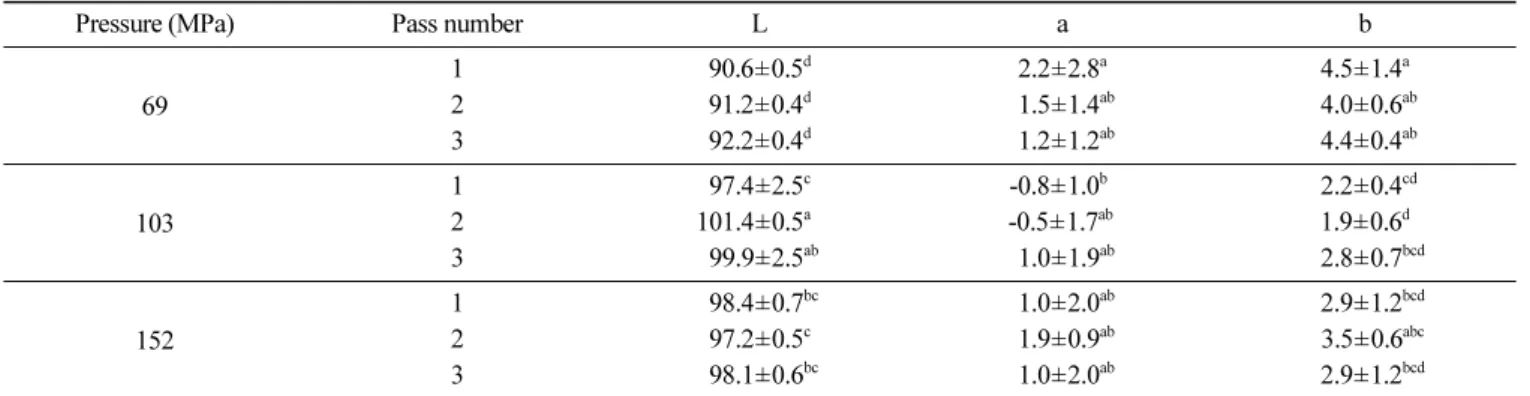
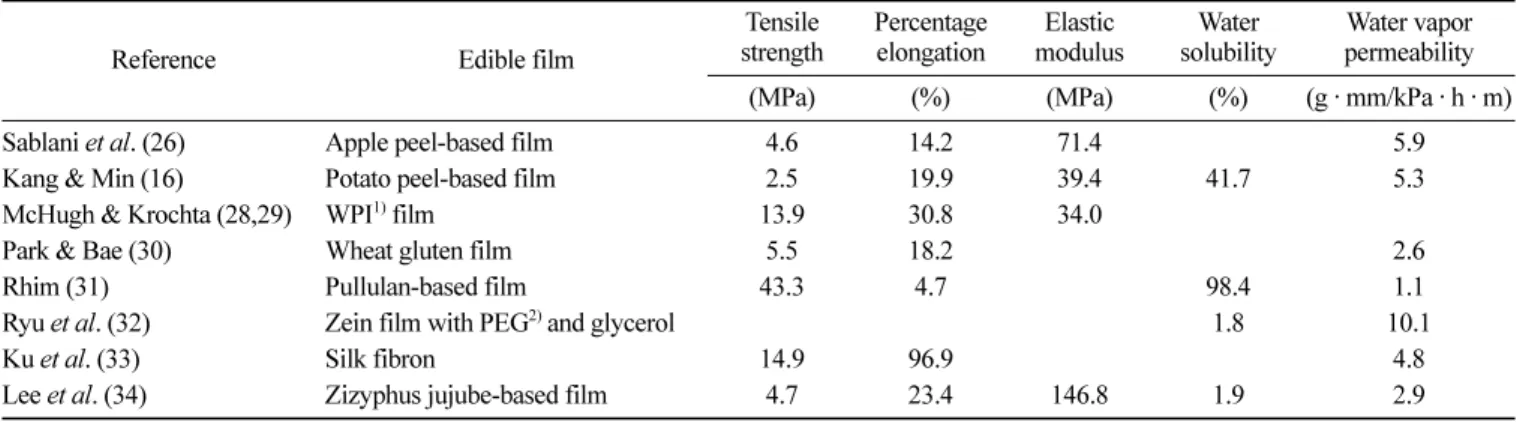
필름의 색 필름 색에 대한 결과는 Table 1에 나타내었다. 필름의 L값은 90.6-101.4, a값은 -0.8-2.2, 그리고 b값은 1.9-4.5로 HPH의 처리 압력과 횟수 모두 필름의 색에 유의적으로 영향을 주지 않았다 (p>0.05). HPH 처리의 압력이 soymilk 고분자의 입자 크기를 변 화시켜 색에 영향을 준다는 결과가 보고된 바 있다(23). 따라서, HPH 처리가 형성된 필름의 색에 영향을 줄 것으로 예상되었지 만 이러한 결과는 나타나지 않았다. 인장 특성 톳 필름의 인장강도와 모쥴러스는 각각 0.4-1.4, 4.9-19.6 MPa이 었다. 필름의 인장강도와 모쥴러스 값은 사용된 압력이 69 또는 103 MPa이었을 때보다 152 MPa이었을 때 유의적으로 높았다 (p<0.05)(Fig. 1, 2). 톳 필름은 보고된 다른 가식성 필름들보다 인 장강도와 모쥴러스가 낮았다(Table 2). 톳 필름 제작에 사용된 높 은 함량의 글리세롤이 생고분자 필름 매트릭스 내 분자 사이의 자유 공간(free volume)을 크게 하였고 분자간 당기는 힘을 작게 하여 필름에 윤활효과(plasticizing effect)를 주었기 때문으로 사료 되었다(16,24). 신장률은 6.15-11.22%로 pullulan 필름보다 높았다 (Table 2). 톳 필름은 다른 가식성 필름들의 인장 특성들과 비교 했을 때 랩(wrap) 형태의 적용 보다는 코팅 또는 롤을 비롯한 필 름 형태로서의 식품 적용이 더욱 적합한 것으로 판단되었다. 수증기 투과율 개발된 톳 필름의 수증기 투과율은 2.1-3.3 g · mm/kPa · h · m2이 었고, HPH 처리 압력과 횟수는 수증기 투과율 값에 유의적인 영 향을 주지 않았다(p>0.05). HPH 처리 압력이 증가할수록 생고분 자 크기가 감소하여 필름 구조 내 구부러짐(tortuousity)의 증가로 수분의 이동속도가 줄 수 있어 수증기 투과율 값도 감소할 것으 로 예상되었으나(25), 수증기 투과율은 HPH 처리의 영향을 받지 않았다. 이러한 결과는 사과 껍질 기초 필름에 대한 연구에서도 나타났다(26). HPH 처리를 통해 작아진 용액 내 생고분자 입자들 이 건조를 통해 필름이 형성되는 시간 동안 다시 응집되어 HPH 처리에 의한 작은 생고분자 입자 형성의 수증기 투과율에 대한 영 향을 볼 수 없었던 것으로 생각되었다(26). 생고분자 입자들이 다 시 응집되지 않고 용액 내에서 안정되어 HPH 처리가 주는 필름 의 수증기 투과율에 대한 영향을 보기 위해서는 HPH 처리 후 적 절한 유화제와 농도를 사용해야 할 것으로 사료되었다(26). Table 1. Effects of HPH pressure and pass number on the color of hijiki-based filmsPressure (MPa) Pass number L a b
69 1 90.6±0.5d 2.2±2.8a 4.5±1.4a 2 91.2±0.4d 01.5±1.4ab 04.0±0.6ab 3 92.2±0.4d 01.2±1.2ab 04.4±0.4ab 103 1 97.4±2.5c -0.8±1.0b- 02.2±0.4cd 2 101.4±0.5a0 -0.5±1.7ab, 1.9±0.6d 3 099.9±2.5ab 01.0±1.9ab 002.8±0.7bcd 152 1 098.4±0.7bc 01.0±2.0ab 002.9±1.2bcd 2 97.2±0.5c 01.9±0.9ab 003.5±0.6abc 3 098.1±0.6bc 01.0±2.0ab 002.9±1.2bcd
Different letters within the same column differ significantly (p<0.05)
Fig. 2. Effects of HPH pressure and pass number on the elastic modulus of hijiki-based films. Different letters on the bars indicate significant difference at p<0.05.
Fig. 1. Effects of HPH pressure and pass number on the tensile strength of hijiki-based films. Different letters on the bars indicate significant difference at p<0.05.
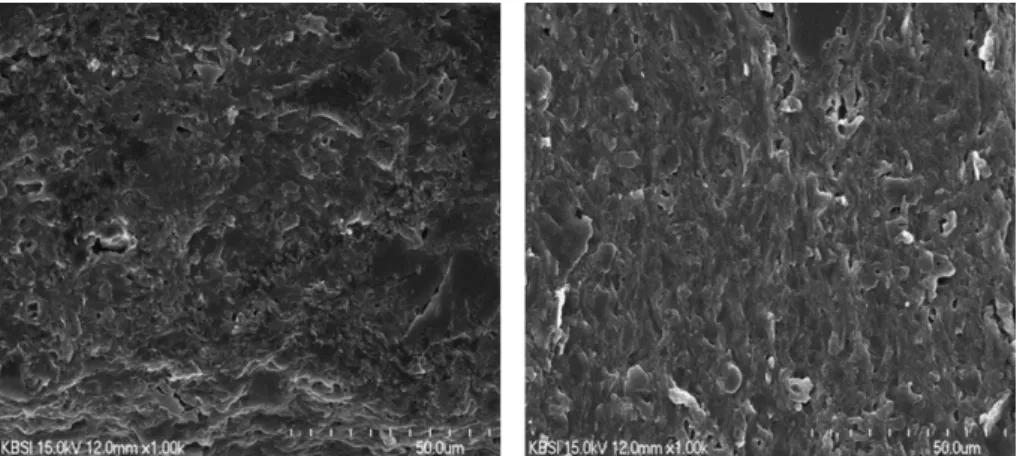
톳 필름의 수증기 투과율은 사과 껍질 기초 필름, 감자 껍질 기초 필름, zein 필름, 그리고 silk fibron 필름보다는 낮았고, wheat gluten 필름, 대추 필름과는 비슷했으며 pullulan 필름의 수 증기 투과율 보다는 높았다(Table 2). 용해도 톳 필름의 용해도는 0.4-1.0%로 HPH의 처리 압력과 횟수는 톳 필름의 용해도에 유의적으로 영향을 주지 않았다(p>0.05). 대추 필름, zein 필름, 감자 껍질 기초 필름, 그리고 pullulan 필름 등 다른 가식성 필름의 용해도보다 낮았다(Table 2). 수증기 투과율 과 용해도 결과를 보고 기존에 개발된 많은 다른 생고분자 가식 성 필름에 비해 수분에 대한 저항력이 높다는 것을 알 수 있었 다. 이로써 개발된 톳 필름은 다른 많은 생고분자 필름들에 비해 상대적으로 수분함량이 높은 식품에 적용 가능성이 있을 것으로 사료되었다. 향 프로파일 HPH 처리 횟수가 1 pass일 때, 처리 압력이 69 MPa로 얻어진 필름과 103 또는 152 MPa로 만들어진 필름에 있어 향 프로파일 이 달랐고(Fig. 3), HPH 처리 압력이 152 MPa이었을 때, 1 pass 로 제작된 필름과 2 pass로 제작된 필름의 향 프로파일은 3 pass 로 제작된 필름의 향 프로파일과 차이가 있었다(Fig. 3). HPH 처 리 압력과 횟수의 증가에 의해 제작되는 톳 필름의 향 프로파일 이 영향을 받는다는 것을 알 수 있었다. 이는 HPH 처리 압력과 횟수의 증가로 입자 크기가 작아지고, 이에 따라 표면적 대 부피 비율이 커져서 향 성분이 더 많이 감지되었기 때문으로 생각되었다. 필름 단면 미세 구조 필름 단면 미세 구조를 관찰한 결과 1 pass 처리를 통해 만들 어진 필름의 경우 처리 압력이 152 MPa이었을 때 69 MPa에서 보 다 필름 단면의 기공의 수나 크기가 줄어들어 그 구조가 더 조 밀하고 균일하였음을 알 수 있었다(Fig. 4). HPH 처리 압력이 152 MPa일 때 처리 횟수가 증가할수록 필름의 단면이 더 조밀해졌 음을 또한 관찰할 수 있었다(Fig. 5). 유사한 결과가 고압 균질 (처리 압력: 165 MPa, 처리 횟수: 1 pass, 10 pass)을 통해 제작된 microfibrillated cellulose 필름에서도 보여졌다(27). 압력이 165 MPa에서 처리 횟수가 10 pass이었을 때가 1 pass이었을 때보다 표면이 고른 필름이 형성되었다(27). 압력의 증가에 대한 구조의 조밀성 증가는 인장강도 및 모쥴러스의 증가와 연관된다고 사료 되었다. 또한, 구조의 조밀성 증가는 처리 압력과 횟수를 달리해 서 제작된 필름들의 향 프로파일 차이의 원인이 되었을 수 있었 을 것이다. 하지만 본 연구에서 관찰된 HPH 처리에 의한 조밀 성 증가는 수증기 투과율을 변화시킬 정도는 되지 않았음을 알 수 있었다.
Fig. 3. Discriminant function analysis (DFA) plots of the results from the hijiki-based film analysis by the mass spectrometer-based electronic nose. (A) Effects of pressures of 69, 103, and 152 MPa (1 pass) and (B) pass numbers of 1, 2, and 3 (152 MPa) on flavor profiles of the hijiki-based film.
Table 2. Reported physical properties of selected edible films
Reference Edible film
Tensile strength Percentage elongation Elastic modulus Water solubility Water vapor permeability (MPa) (%) (MPa) (%) (g · mm/kPa · h · m)
Sablani et al. (26) Apple peel-based film 4.6 14.2 71.4 5.9
Kang & Min (16) Potato peel-based film 2.5 19.9 39.4 41.7 5.3 McHugh & Krochta (28,29) WPI1) film 13.9 30.8 34.0
Park & Bae (30) Wheat gluten film 5.5 18.2 2.6
Rhim (31) Pullulan-based film 43.3 4.7 98.4 1.1
Ryu et al. (32) Zein film with PEG2) and glycerol 1.8 10.1
Ku et al. (33) Silk fibron 14.9 96.9 4.8
Lee et al. (34) Zizyphus jujube-based film 4.7 23.4 146.8 1.9 2.9 1)Whey protein isolate
요
약
톳으로부터 HPH를 이용해 식품에 적용 가능성이 있는 가식성 필름을 제작할 수 있었다. HPH 처리 압력의 증가는 필름의 강 도와 깨짐성을 증가시켰고, 단면이 조밀하고 균일한 필름을 형성 시켰다. HPH의 처리 횟수의 증가 또한 필름의 단면을 조밀하게 하였다. 개발된 톳 필름은 보고된 많은 다른 생고분자 필름들에 비해 상대적으로 강도, 깨짐성, 그리고 수분 저항력이 낮아 코팅 또는 롤을 비롯한 필름 형태로 건조 식품 또는 중간 수분 식품 에 적용될 수 있는 가능성을 보여주었다.감사의 글
본 연구과제는 농심 그룹 율촌 재단의 재원을 지원받아 수행 한 과제입니다.문
헌
1. Kester JJ, Fennenma O. Edible films and coatings: A review. Food Technol. 40: 47-59 (1986)
2. Krochta JM, Mulder-Johnston CD. Edible and biodegradable polymer films. Food Thechnol. 51: 61-74 (1997)
3. Gennadios A, Weller CL, Testin RF. Property modification of wheat, gluten-based films. Trans. ASAE 36: 465-470 (1993) 4. Ara J, Sultana V, Qasim R, Ehteshamu-Haque S, Ahmad VU.
Biological activity of Spatoglossum asperum: A brown alga.
Phy-tother. Res. 19: 618-623 (2005)
5. Bae SJ, Choi YH. Methanol extract of the seaweed Gloiopeltis furcate induces G2/Marrest and inhibits cyclooxygenase-2 activity in human hepatocarcinoma HepG2 cells. Phytother. Res. 21: 52-57 (2007)
6. Kang KA, Bu HD, Park DS, Go GM, Jee Y, Shin T, Hyun JW. Antioxidant activity of ethanol extract of Callophyllis japonica. Phytother. Res. 19: 506–510 (2005)
7. Yuan YV, Walsh NA. Antioxidant and antiproliferative activities of extracts from a variety of edible seaweeds. Food Chem. Toxi-col. 44: 1144-1150 (2006)
8. Li Bo, Wei XJ, Suna JL, Xub SY. Structural investigation of a fucoidan containing a fucose-free core from the brown seaweed, Hizikia fusiforme. Carbohyd. Res. 341: 1135-1146 (2006)
9. Lahaye M, Kaeffer B. Seaweed dietary fibers: Structure, physio-chemical, and biological properties relevant to intestinal physiol-ogy. Sci. Aliment. 17: 563-584 (1997)
10. Mabeau S, Kloareg B. Isolation and analysis of the cell of brown algae: Fucus spiralis, F. Ceranodies, F. serratus, Bifurcaria bifu-racata, and Laminaria digita. J. Exp. Bot. 194: 1573-1580 (1987) 11. Kim KI, Seo HD, Lee HS, Cho HY, Yang HC. Studies on the
blood anticoagulant polysaccharide isolated from hot water extracts of Hizikia fusiforme. J. Food Sci. Nutr. 27: 1204-1210 (1998)
12. Siriwardhana N, Jeon YJ, Kim SH, Ha JH, Heo SJ, Lee KW. Enzymatic hydrolysis for effective extraction of antioxidative compounds from Hizikia fusiformis. Algae 19: 59-68 (2004) 13. Rhim JW, Kim JH. Preparation of bio-degradable films using
var-ious marine algae powder. Korean J. Food Sci. Technol. 36: 69-74 (2004)
14. Bouaouina H, Desrumaux A, Loisel C, Legrand J. Functional Fig. 4. Scanning electron micrographs of cross-sections of the hijiki-based films formed from the film-forming solutions prepared with high pressure homogenization with 1 pass at 69 (left) and 152 MPa (right).
Fig. 5. Scanning electron micrographs of cross-sections of the hijiki-based films formed from the film-forming solutions prepared with high pressure homogenization at 152 MPa with 1 (left), 2 (center), and 3 passes (right).
properties of whey proteins as affected by dynamic high-pressure treatment. Int. Dairy J. 16: 275-284 (2006)
15. Hayes MG, Kelly AL. High pressure homogenization of raw whole bovine milk: (a) Effect on fat globule size and other prop-erties. J. Dairy Res. 70: 297-305 (2003)
16. Kang HJ, Min SC. Potato peel-based biopolymer film develop-ment using high-pressure homogenization, irradiation, and ultra-sound. Food Sci. Technol. 43: 903-909 (2010)
17. Sanchex C, Pouliot M, Gauthier SF, Paquin P. Thermal aggrega-tion of whey protein isolate containing microparticulated or hydrolyzed whey proteins. J. Agr. Food Chem. 45: 2384-2392 (1997)
18. McClements DJ. Food Emulsions: Principles, Practices, and Tech-niques. CRC Press, Boca Raton, FL, USA. pp. 515-543 (2005) 19. Banerjee R, Chen H, Wu J. Milk protein-based edible film
mechanical strength changes due to ultrasound process. J. Food Sci. 61: 824-828 (1996)
20. ASTM. Standard test method for tensile properties of thin plastic sheeting. D822-01. American Society for Testing and Materials, Philadelphia, PA, USA (1997)
21. McHugh TH, Avena-Bustillos R, Krochta JM. Hydrophilic edible films: modified procedure for water vapor permeability and explanation of thickness effects. J. Food Sci. 58: 899-903 (1993) 22. Hong EJ, Son HJ, Kang JH, Noh BS. Analysis of binding
trime-thylamine with rice-washed solution using electronic nose based on mass spectrometer. Korean J. Food Sci. Technol. 41: 509-514 (2009)
23. Cruz N, Capellas M, Hernandez M, Trujillo AJ, Guamis B, Fer-ragut V. Ultra high pressure homogenization of soymilk: Microbi-ological, physicochemical, and microstructural characteristics. Food Res. Int. 40: 725-732 (2007)
24. Gontard N, Guilbert S, Cuq JL. Water and glycerol as plasticizers
affect mechanical and water vapor barrier properties of an edible wheat gluten film. J. Food Sci. 58: 206-211 (1993)
25. Yang HJ, Noh BS, Kim JH, Min SC. Effect of a carbohydrase mixture, ultrasound, and irradiation treatments on the physical properties of defatted mustard meal-based edible films. Korean J. Food Sci. Technol. 43: 30-38 (2011)
26. Sablani SS, Dasse F, Bastarrachea L, Dhawan S, Hendrix KM, Min SC. Apple peel-based edible film development using a high-pressure homogenization. J. Food Sci. 74: 372-381 (2009)
27. Aulin C, Gallstedt M, Lindstrom T. Oxygen and oil barrier prop-erties of microfibrillated cellulose films and coatings. Cellulose 17: 559-574 (2010)
28. McHugh TH, Krochta JM. Sorbitol- vs glycerol-plasticized whey protein edible films: Integrated oxygen permeability and tensile property evaluation. J. Agr. Food Chem. 42: 841-845 (1994) 29. McHugh TH, Krochta JM. Water vapor permeability properties of
edible whey protein-lipid emulsion films. J. Am. Oil Chem. Soc. 71: 307-312 (1994)
30. Park SK, Bae DH. Antimicrobial properties of wheat gluten-chi-tosan composite film in intermediate-moisture food systems. Food Sci. Biotechnol. 15: 133-137 (2006)
31. Rhim JW. Characteristics of pullulan-based edible films. Food Sci. Biotechnol. 12: 161-165 (2003)
32. Ryu SY, Rhim JW, Lee WJ, Yoon JR, Kim SS. Relationship between moisture barrier properties and sorption characteristics of edible composite films. Food Sci. Biotechnol. 14: 68-72 (2005) 33. Ku KJ, Hong YH, Song KB. Preparation of a silk fibroin film
containing catechin and its application. Food Sci. Biotechnol. 17: 1203-1206 (2008)
34. Lee HB, Yang HJ, Ahn JB, Lee YS, Min SC. Zizyphus jujube-based edible film development by the Depolymerization pro-cesses. Korean J. Food Sci. Technol. 43: 321-328 (2011)