INTRODUCTION
Allogeneic hematopoietic stem cell transplantation (HSCT) with myeloablative conditioning has previously been used as a treatment for patients who suffer from hematological malignancies. However, this approach involves considerable toxicity, particularly in elderly patients and those exhibiting severe organ dysfunctions. Therefore, reduced intensity con- ditioning was designed, in order to more safely conduct HSCT on such patients.
The allografts perform two important functions. The first of these functions is the restoration of conditioning-induced cytopenia, and the second is the exertion of an anti-tumor effect, commonly referred to as the graft-versus-malignancy effect (1, 2). A conditioning regimen is known to facilitate the success of HSCT, but this does not appear to be crucial.
In some situations, the ability of HSCT to cure the patient seems to be dependent to a greater degree on the immuno- logical control of the malignancy by the graft (2). Several investigators have reported comparable results for reduced
intensity and myeloablative transplantations in the treatment of patients suffering from hematological malignancies of diverse disease status (3-8). Reduced intensity conditioning depends on graft-versus-tumor (GVT) effects for the eradi- cation of malignant cells. When the intensity of condition- ing is reduced, a loss of control of the malignant cells might become apparent in the early period after transplantation. If this is, indeed, the case, reduced intensity transplantation may be difficult to perform on patients with advanced hema- tological malignancies. Therefore, we have conducted a direct comparison of the outcomes of reduced intensity and mye- loablative transplantation in the treatment of patients exhibit- ing advanced hematological malignancies.
MATERIALS AND METHODS Patients
We compared the outcomes of allogeneic HSCT using Inho Kim*,�,�, Kyung-Hun Lee*,
Yunhee Choi�, Bhumsuk Keam*, Nam Hee Koo*, Sung-Soo Yoon*,�, Keun-Young Yoo�, Seonyang Park*,�,�, Byoung Kook Kim*,�
Department of Internal Medicine*, Seoul National University College of Medicine; Diagnostic DNA Chip Center�, The Ilchun Molecular Medicine Institute, Medical Research Center, Seoul National University;
Cancer Research Insitutute�, Seoul National University;
Department of Preventive Medicine�, Seoul National University College of Medicine, Seoul, Korea
Address for correspondence Seonyang Park, M.D.
Department of Internal Medicine, Seoul National University College of Medicine, 28 Yeongeon-dong, Jongno-gu, Seoul 110-744, Korea
Tel : +82.2-2072-3347, Fax : +82.2-744-6075 E-mail : [email protected]
*This study was supported by a grant of the Korea Health 21 R&D Project, Ministry of Health & Welfare, Republic of Korea (0405-BC02-0604-0004).
227
Allogeneic Stem Cell Transplantation for Patients with Advanced
Hematological Malignancies: Comparison of Fludarabine-based Reduced Intensity Conditioning versus Myeloablative Conditioning
We compared the outcomes of allogeneic hematopoietic stem cell transplantation using reduced intensity and myeloablative conditioning for the treatment of patients with advanced hematological malignancies. A total of 75 adult patients received transplants from human leukocyte antigen-matched donors, coupled with either reduced intensity (n=40; fludarabine/melphalan, 28; fludarabine/cyclophosphamide, 12) or myeloablative conditioning (n=35, busufan/cyclophosphamide). The patients receiving reduced intensity conditioning were elderly, or exhibited contraindications for myeloablative conditioning. Neutrophil and platelet engraftment occurred more rapidly in the reduced intensity group (median, 9 days vs. 18 days in the myeloab- lative group, p<0.0001; median 12 days vs. 22 days in the myeloablative group, p=0.0001, respectively). Acute graft-versus-host disease (≥≥grade II) occurred at comparable frequencies in both groups, while the incidence of hepatic veno-occlu- sive disease was lower in the reduced intensity group (3% vs. 20% in the myeloab- lative group, p=0.02). The overall 1-yr survival rates of the reduced intensity and myeloablative group patients were 44% and 15%, respectively (p=0.16). The results of present study indicate that patients with advanced hematological malignancies, even the elderly and those with major organ dysfunctions, might benefit from reduced intensity transplantation.
Key Words : Allogeneic Stem Cell Transplantation; Advanced Hematological Malignancy; Reduced Intensity Conditioning
Received : 21 July 2006 Accepted : 19 September 2006
reduced intensity or myeloablative conditioning for the treat- ment of patients with advanced hematological malignancies.
Between January 2001 and December 2004, 75 adult patients, all of whom exhibited advanced hematological malignan- cies, received transplantations from human leukocyte anti- gen (HLA)-matched donors, either related or unrelated, cou- pled with myeloablative (n=40) or reduced intensity (n=35) conditioning, at the Seoul National University Hospital in Korea. Advanced hematological malignancies were defined as follows: acute leukemia beyond 1st remission, chronic mye- loid leukemia (CML) beyond 1st chronic phase (CP), refrac- tory Non-Hodgkin’s lymphoma (NHL), and refractory mul- tiple myeloma (MM) that had progressed after autologous HSCT. A full explanation of the transplantation methods was provided to the patients, and informed consent was obtained from all patients who enrolled in the study.
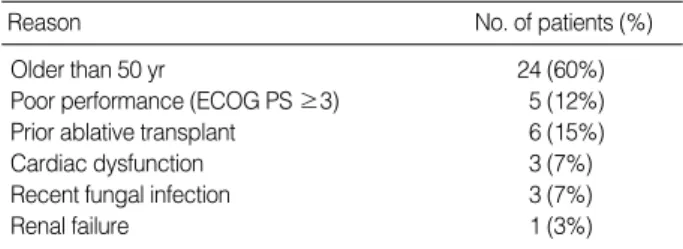
All patients receiving transplantation with reduced inten- sity conditioning were determined to exhibit contraindica- tions to the myeloablative approach. Contraindications to myeloablative conditioning included advanced age, prior HSCT, major organ dysfunction, or an ECOG performance status of ≥3. The individual reasons for performing reduced intensity HSCT are described in Table 1.
Conditioning regimens
In the reduced intensity group, we used two different fluda- rabine-based conditioning regimens (Table 2). Among these, the melphalan-containing regimen was used for myeloid ma- lignancies such as acute myeloid leukemia (AML) and CML, and MM. The cyclophosphamide-containing regimen was used for the treatment of lymphoid malignancies (acute lym- phoblastic leukemia, NHL) except MM. However, the mel- phalan-containing regimen was also applied to patients with poor cardiac ejection fractions. Busulfan and cyclophosphamide were used for all of the patients in the myeloablative group.
GVHD prophylaxis and treatment
All patients in the reduced intensity group received cyclos- porine (CSP) as a post-transplantation immunosuppressant.
CSP was scheduled to be administered at a dosage of 3 mg/
kg/day intravenously, or 6 mg/kg/day orally, from days -1 to +30, and then tapered off until day +70 unless the patient
developed GVHD. All of the patients in the myeloablative group received four doses of intravenous methotrexate (MTX) combined with CSP (9). The intravenous CSP was replaced by an oral dose in cases in which the patient could tolerate it. The CSP was tapered off and discontinued 6 months after HSCT, contingent on the absence of GVHD. The dosage of CSP was determined on the basis of blood levels in both gro- ups. Acute GVHD was graded from 0 to IV according to the criteria established by Thomas (10), and chronic GVHD was defined and classified according to the Sullivan’s criteria (11).
In both groups of patients, GVHD treatment normally con- sisted of methylprednisolone and resumption of CSP, if already tapered.
Supportive care
Supportive cares between the groups were comparable. Pro- phylaxis against infections was accomplished by the oral ad- ministration of ciprofloxacin and fluconazole during the neu- tropenic period, when the patient’s absolute neutrophil count (ANC) was less than 1×10⁹/L. Sulfamethoxazole/trimetho- prim was administered as a prophylactic agent against Pneu- mocystis jiroveci, after the ANC had risen to a level in excess of 1×10⁹/L. Patients exhibiting chronic GVHD were treated via prolonged sulfamethoxazole/trimethoprim prophylaxis.
Statistical analyses
Means were compared by Student’s t-tests. Categorical variables were compared by chi-squared tests. Overall sur- vival and progression-free survival curves were determined using Kaplan-Meier product-limit estimates. Survival curves were compared by log-rank tests, taking the censored data into account. The probability of nonrelapse mortality was calculated using cumulative incidence estimates. Relapse was considered to be a competing risk for nonrelapse mortality.
We used the Cox regression model to evaluate the indepen- dent effects on survival of several variables. These variables included: type of conditioning, gender of the patient and
ECOG PS, Eastern Cooperative Oncology Group Performance Status.
Reason No. of patients (%)
Older than 50 yr 24 (60%)
Poor performance (ECOG PS ≥3) 5 (12%)
Prior ablative transplant 6 (15%)
Cardiac dysfunction 3 (7%)
Recent fungal infection 3 (7%)
Renal failure 1 (3%)
Table 1.Reasons to perform reduced intensity transplantation
Conditioning regimen No. of
patients (%)
Reduced Intensity 40
Fludarabine (30 mg/m2×5d)+Melphan (90 mg/m2×2d) 24 (60) Fludarabine (30 mg/m2×5d)+Melphan (70 mg/m2×2d) 4 (10) Fludarabine (30 mg/m2×5d)+Cyclophosphamide 12 (30)
(60 mg/kg×2d)
Myeloablative 35
i.v. Busulfan (3.2 mg/kg×4d)+Cyclophosphamide 32 (91) (60 mg/kg×2d)
oral Busulfan (4 mg/kg×4d)+Cyclophosphamide 3 (9) (60 mg/kg×2d)
Table 2.Conditioning regimens used in hematopoietic stem cell transplantation
i.v., intravenous.
donor, patient age, type of hematological malignancy, stem cell source, donor source, prior HSCT, and interval between diagnosis and transplantation. All p-values were predicated on likelihood ratio statistics, and were two-sided. Multivari- ate p-values for a variable reflected the adjustments for all of the other variables in the model. Statistical analyses were conducted using the SPSS version 12.0 program (SPSS, Inc., Chicago, IL, U.S.A.).
RESULTS Patient and transplant characteristics
The median follow-up times of the patients with reduced intensity and myeloablative conditionings were 27 and 23 months, respectively. The characteristics of all patients are summarized in Table 3. The median ages of the reduced in- tensity and myeloablative groups were 50 yr (range, 21-70) and 29 yr (range, 17-49) yr, respectively (p=0.0001). The
median ages of the donors for the reduced intensity and mye- loablative groups were 46 and 31 yr (p=0.0001). The diag- noses differed slightly between the two groups (p=0.014), as there were more patients with NHL and MM in the reduced intensity group, and also less patients with ALL. The medi- an intervals between the diagnosis and transplantation of the reduced intensity and myeloablative groups were 359 (range, 75-4,328) and 349 (range, 83-4,605) days (p=0.64). Ninety percent of the patients in the reduced intensity group received peripheral blood stem cells (PBSC), as compared with 17%
of the myeloablative group patients (p=0.0001). Sixty-eight percent of the reduced intensity group patients and 66% of the myeloablative group patients received transplants from related matched donors (p=0.87). Six of the reduced intensi- ty group patients (15%) had previously received autologous HSCT, and all of them had gone into relapse before being treated via reduced intensity transplantation, whereas none of the myeloablative patients had ever received autologous transplantation (p=0.03). The median cell dose infused for the reduced intensity and myeloablative groups were 5.2×
106CD34+cells/kg (range, 1.4-25.7×10⁶CD34+cells/kg), and 3.3×10⁶CD34+cells/ kg (range, 0.9-13.1×10⁶CD34+ cells/kg), respectively (p=0.003). The median duration of hospital stay for the reduced intensity group patients was 30 days, which was significantly shorter than the 43 days for the myeloablative group patients (p=0.01).
Hematological recovery
Engraftment failure was detected in 1 patient in the reduced intensity group and 4 patients in the myeloablative group.
This was not a significant difference (1/40 vs. 4/35, p=0.18).
Neutrophil engraftment (i.e., time to ANC>0.5×10⁹/L) occurred more rapidly in the reduced intensity group (medi- an, 9 days; range, 0-19 days) than in the myeloablative group (median, 18 days; range, 11-38 days) (p<0.0001). The time required to achieve a platelet count in excess of 20×109/L was 12 days (median; range, 7-28 days) in the reduced inten- sity group, as compared with 22 days (median; range, 9-64 days) in the myeloablative group (p=0.0001).
Graft-versus-host disease
The incidences of grades II to IV acute graft-versus-host disease (GVHD) between the reduced intensity and myeloab- lative groups were comparable, at 25% vs. 26%, respectively (p=0.60). The median day of onset of acute GVHD in the reduced intensity group was day +20 (range 11-35), and also day +20 (range 13-59) in the myeloablative group (p=
0.46). The incidence of chronic GVHD among the patients who survived more than 100 days after transplantation was 29% in the reduced intensity group and 14% in the myelo- ablative group (p=0.30).
Characteristics Reduced
Intensity Myeloablative p- value
No. of patients 40 35
Median age (range), yr 50 (21-70) 29 (17-49) 0.0001 Donor age (range), yr 46 (20-66) 31 (17-63) 0.0001 Sex of patients
Male/Female 29/11 18/17 0.06
Sex of donors
Male/Female 29/11 24/11 0.71
Diagnosis, No. 0.014
AML 19 13
ALL 4 16
ABL 3 1
NHL 7 3
CML 4 2
MM 3 0
Time to transplantation, 359 (75-4328) 349 (83-4605) 0.64 days (range)
Stem cell source, No. (%) 0.0001
PBSC 36 (90) 6 (17)
BM 4 (10) 29 (83)
Type of transplant, No. (%) 0.87
MRD 27 (68) 23 (66)
URD 13 (32) 12 (34)
GVHD prophylaxis, No. (%)
Cyclosporine 40
Cyclosporine/MTX 35
Prior autologous transplant, 6 (15) 0 (0) 0.03 No. (%)
CD34+ cell dose (×106/kg) 5.2 (1.4-25.7) 3.3 (0.9-13.1) 0.003 Table 3.Patient characteristics
AML, acute myelogenous leukemia; ALL, acute lymphocytic leukemia;
ABL, acute biphenotypic leukemia; NHL, non-Hodgkin lymphoma; CML, chronic myelogenous leukemia; MM, multiple myeloma; GVHD, graft- versus-host disease; PBSC, peripheral blood stem cell; BM, bone mar- row; MRD, matched related donor; URD, unrelated donor.
Early toxicities
Hepatic veno-occlusive disease (VOD) developed in 1 of the patients (3%) in the reduced intensity group, and 7 pati- ents (20%) in the myeloablative group. These incidences were statistically significant (p=0.02). Febrile neutropenia devel- oped in 33 of the patients (83%) in the reduced intensity group, whereas all of the myeloablative group patients exhib- ited febrile neutropenia (p=0.01). We noted a trend toward a higher incidence of bacteremia in the myeloablative group (12 patients, 34%), as compared with the reduced intensity group (8 patients, 20%, p=0.16). The frequencies of fungal infection and cytomegalovirus (CMV) disease were similar between the reduced intensity (7% and 3%) and myeloabla- tive groups (9% and 3%). Toxicity profiles are summarized in Table 4.
Nonrelapse mortality
Nonrelapse death and disease recurrence were considered to be competing events for the purposes of this analysis. We
detected no difference in the nonrelapse mortality (NRM) of patients receiving reduced intensity and myeloablative con- ditioning. Day-100 and 1-yr NRMs were 33% and 47% for the reduced intensity group patients, as compared with 38%
and 56% in the myeloablative patients, respectively (p=0.68, Fig. 1). The causes of NRM did not differ between the groups (Table 5). The most frequently encountered cause of NRM was infection in both the reduced intensity and myeloablative groups (15% and 17%), followed by pulmonary complica- tions and GVHD. Hepatic VOD, as a cause of NRM, was more prevalent in the myeloablative group patients than in the reduced intensity group patients (5% and 0%, p=0.10).
Overall survival and progression-free survival
One year overall survival (OS) rates for the reduced inten-
Reduced Intensity (%)
Myeloablative
(%) p-value
Acute GVHD (≥II) 10 (25) 7 (26) 0.60
Chronic GVHD 8 (29*) 3 (14*) 0.30
Hepatic VOD 1 (3) 7 (20) 0.02
Febrile neutropenia 33 (83) 35 (100) 0.013
Bacteremia 8 (20) 12 (34) 0.16
Fungal infection 3 (7) 3 (9) 1.0
CMV disease 1 (3) 1 (3) 1.0
Table 4.Toxicity and complication profile of the patients
GVHD, graft-versus-host disease; VOD, veno-occlusive disease; CMV, cytomegalovirus
*Among the patients who survived more than 100 days.
Reduce intensity (n=40)
Myeloablative (n=35) Causes of death, No. (%)
Infection 6 (15) 6 (17)
Pulmonary complication 5 (13) 3 (9)
GVHD 2 (5) 1 (3)
CNS 3 (8) 1 (3)
VOD of liver 0 (0) 2 (5)
CHF 1 (3) 0 (0)
HUS 0 (0) 1 (3)
ARF 1 (3) 0 (0)
Total 18 (45) 14 (40)
Cumulative incidence, % (p=0.68) 47 56
Table 5.Comparison of the causes of 1-yr nonrelapse mortality for patients receiving either reduced intensity or myeloablative transplants
GVHD, graft-versus-host-disease; CNS, central nervous system toxici- ty; VOD, veno-occlusive disease; CHF, congestive heart failure; HUS, hemolytic uremic syndrome; ARF, acute renal failure.
%
100
75
50
25
00 6 12 18 24 30 36 42 48
Months after transplantation
Reduced intensity Myeloablative p=0.68
Fig. 1.Cumulative incidences of nonrelapse mortality of patents with advanced hematological malignancies treated by reduced intensity and myeloablative conditionings.
Probability
100
75
50
25
00 6 12 18 24 30 36 42 48
Time, mos
Reduced intensity Myeloablative p=0.16
Fig. 2.Overall survivals for patients with advanced hematological malignancies after reduced intensity and myeloablative transplan- tations.
sity and myeloablative groups were 44% and 15%, and the 2-yr rates were 36% and 12%, respectively (p=0.16, Fig. 2).
Univariate analysis was conducted using the following fac- tors: conditioning regimen (reduced intensity versus myelo- ablative), age, stem cell source (PBSC versus bone marrow), donor type (related versus unrelated), prior autologous stem cell transplantation, sex of donor, the interval from diagnosis to transplantation, and diagnosis (acute leukemia and CML versus NHL and MM). None of these factors were found to significantly influence OS. In our multivariate analysis, using Cox regression hazard models, age was determined to be the single significant factor for OS (p=0.01; HR, 1.045; range, 1.011-1.081). We noted a clear trend toward more favorable OS in the reduced intensity group patients. The adjusted hazard ratio of the myeloablative group, as compared to that of the reduced intensity group, with regard to OS, was 2.21 (p=0.09; range, 0.87-5.61). Conditioning type, donor type, and interval from diagnosis to transplantation and disease type were associated with p values of less than 0.1 (Table 6).
The proportional hazard assumption was satisfied for all vari- ables in the model. Overall 1-yr progression-free survival (PFS) rates of the reduced intensity and myeloablative group patients were 30% and 10%, respectively (p=0.15, Fig. 3).
None of the factors utilized in the univariate and multivari- ate analyses had any significant influence on PFS.
DISCUSSION
In this study, we compared the outcome of 40 reduced intensity transplantations with 35 myeloablative transplan- tations, all of which were conducted at a single institution during the same span of time. Several differences were found between 2 groups. Reduced intensity patients were older and had more major organ dysfunctions than myeloablative
patients at the time of transplantation. Allogeneic stem cell transplantation has the potential to cure some of patients with advanced hematological malignancies, but some of the pati- ents, specifically the elderly and those exhibiting severe organ dysfunctions, could not be treated by myeloablative trans- plantation. Reduced intensity conditioning was developed in order to enable such patients to receive transplants (12- 14). Some physicians have raised concerns regarding the pos- sibility of rapid disease progression and resultant treatment failure after reduced intensity transplantation, particularly in patients with advanced hematological malignancies. How- ever, recent reports (3-8) comparing the outcomes of reduced intensity and myeloablative transplantations have obtained results which generally favor reduced intensity transplanta- tion. Our data also support this conclusion. In this study, the 1-yr OS of the reduced intensity and myeloablative groups were 44% and 15%, respectively. Although this is not statis- tically significant (p=0.16), we noted a clear trend toward higher survival rates for the reduced intensity group. This becomes even more impressive when considering that the patients with reduced intensity conditioning were older, and more frequently exhibited organ dysfunctions, than did the patients with myeloablative conditioning at the time of trans- plantation.
In this study, we employed two types of fludarabine-based conditioning regimens. One involved melphalan, 180 mg/m2, and the other included cyclophosphamide, 120 mg/kg. The dosages of these drugs (melphalan and cyclophosphamide) were relatively higher than have been used in other fludara- bine-based conditioning regimens which included melpha- lan or cyclophosphamide (8, 15-17). Therefore, the potent anti-malignancy effect associated with the relatively intense reduced intensity conditioning employed in this study might explain the similarities between the PFS rates of the reduced intensity and myeloablative groups in the short-term, and may have also facilitated the establishment of the graft-ver- sus-malignancy effect. Clinical results using identical dosages of melphalan (15) or cyclophosphamide (18) for good-risk patients resulted in PFS rates of 57% and 75%, respectively.
Factor Hazard ratio 95% CI p-value
Conditioning, myeloablative 2.20 0.87-5.61 0.09 Stem cell source, PBSC 0.56 0.24-1.31 0.18
Donor type, URD 2.00 0.93-4.30 0.07
Patient age, older* 1.05 1.01-1.08 0.01
Donor sex, female 1.23 0.63-2.42 0.55
Interval from Dx to TPL, >1 yr 0.56 0.30-1.07 0.08 Disease type�, non-leukemia 2.33 0.86-6.31 0.09 Table 6.Multivariate proportional hazard analysis on overall sur- vival
CI, confidence interval; PBSC, peripheral blood stem cell; URD, unre- lated donor; Dx, diagnosis; TPL, transplantation. *Older, the hazard ratio of older person is 1.05 by annual increase; �Disease type, advanced leukemia versus all others.
Probability
100
80
60
40
20
00 6 12 18 24 30 36 42 48
Time, mos
Reduced intensity Myeloablative p=0.15
Fig. 3.Progression free survivals for patients with advanced hema- tological malignancies after reduced intensity and myeloablative transplantations.
Hematological recovery after reduced intensity transplan- tation has generally been reported to occur fairly rapidly.
According to our results, the median days required for the completion of neutrophil and platelet engraftment were 9 and 12 days, and the engraftment rates were significantly more rapid than those associated with myeloablative trans- plantation. Such rapid engraftments were reproducibly re- ported in early studies regarding reduced intensity transplan- tation (12, 13). In our study, the engraftment failure rate in the reduced intensity group was quite low, comparable to that of the myeloablative group (1/40 vs. 4/35, p=0.18). Reduced intensity conditioning has been known to be associated with a higher risk of engraftment failure than myeloablative con- ditioning (19). However, the incidence of engraftment fail- ure appears to differ with different reduced intensity condi- tioning regimens. For example, the administration of fluda- rabine, combined with 2 Gy of TBI, resulted in a 12% rejec- tion frequency (19). The combination of fludarabine com- bined with melphalan (8), or the combination of fludarabine with cyclophosphamide (18), as in our study, have tended to report relatively low graft rejection rates.
The development and severity of GVHD has been correlat- ed with cytotoxic tissue injury and the resultant inflamma- tory cytokine milieu (20). Some investigators have reported lower acute GVHD incidence rates in cases of reduced inten- sity transplantation (21), while contradictory results also exist (3, 5, 6). The diversity of conditioning regimens, stem cell sources, and GVHD prophylaxis protocols in reduced inten- sity transplantation might be one reason for this discrepan- cy. In this study, the incidence of acute GVHD (≥Gr II) in the reduced intensity group (25%) was fairly similar to that of the myeloablative group (26%). The onset of acute GVHD was reported to have been delayed in cases of reduced intensity transplantation, but we noted no differences in acute GVHD onset between our study groups. The single use of CSP as a GVHD prophylaxis and a rapid tapering off of the treatment might explain why we observed no such differences. We also noted a trend toward a higher incidence of chronic GVHD in the reduced intensity transplantation patients (29% vs.
14%). Extant reports also differ (5, 22) with regard to the inci- dence rates of chronic GVHD in reduced intensity transplan- tation patients. We believed that higher proportions of PBSC (90% of reduced intensity transplantation) might have ex- plained the higher incidence of chronic GVHD noted in the reduced intensity transplantation group (23).
Most reports, although some exceptions exist, have asso- ciated reduced intensity transplantation with less severe infec- tious complications, especially with regard to bacterial infec- tions (24-27), than are seen in myeloablative transplantation.
The lower incidence of infectious complications in reduced intensity transplantation has been explained as follows: i) myeloablative conditioning, which causes an extensive break- down of mucosal barriers, might result in bacterial translo- cations within immunocompromised hosts (24, 28), ii) the
shorter neutropenic period and prolonged persistence of host immunity after reduced intensity transplantation might also contribute to a lower risk of infection (29). Our study revealed similar results. The incidence of febrile neutropenia (83%) was determined to be significantly lower in the reduced inten- sity transplantation patients, as compared with the ablative transplantation group (100%). We noted a trend toward a lower incidence of bacteremia in the reduced intensity trans- plantation group (25%), as compared to the myeloablative transplantation group (43%). However, the degree to which infection contributed to NRM appeared to be similar between the groups (15% and 17%). It is possible that the poor per- formance status and frequent active infections at the time of transplantation among the patients with reduced intensity conditioning explain, at least in part, the similar infectious death rate between the groups in our study.
The incidence of hepatic VOD in the reduced intensity group was lower than those detected in the myeloablative group, and this difference was significant in our study (3%
vs. 20%). In other studies (5, 30), similar results have been reported. Myeloablative conditioning has been associated with harmful cytotoxicity, and appears to result in an inflam- matory cytokine milieu around the hepatocytes (31, 32).
GVHD prophylaxis containing methotrexate, which was used only in the myeloablative transplantation group in this study, might also have contributed to the higher incidence rates of VOD in the myeloablative group (33).
The cumulative NRM of the reduced intensity and mye- loablative transplantation groups were reported to be signif- icantly lower in the reduced intensity group (32% vs. 50%
(3) and 16% vs. 30% [5]). However, some investigators have reported similar cumulative NRM incidence rates (4, 6). We detected no differences in the NRM incidence rates between the groups in this study (47% vs. 56%), although our study involved a somewhat higher incidence rate than was report- ed in previous studies. However, it should be kept in mind that all of the patients in this study had been heavily treat- ed, and were suffering from advanced disease at the time of transplantation. The reduced intensity group patients were all individuals at high risk for NRM (due to old age, poor performance, prior transplantation, recent fungal infections, or major organ dysfunction).
This study clearly has some unique merits. The outcomes of reduced intensity and myeloablative transplantation were determined for the patients treated at a single institution during the same period. Therefore, the so-called ‘center effect’
and ‘time effect’, which tend to confound the results of ret- rospective multicenter or registry studies, had no influence on our results. Also, in our study, the conditioning regimens of the reduced intensity and myeloablative transplantation groups could be assured to be relatively homogeneous.
In conclusion, the results of the current study indicate that patients who suffer from advanced hematological malignan- cies, even the elderly and those with major organ dysfunc-
tions, might benefit from reduced intensity transplantation.
However, this study has several limitations. Firstly, it was a retrospective study. Secondly, the sample size was fairly small.
Thirdly, this study did not select for a specific disease type.
Therefore, in order to refine applications of allogeneic stem cell transplantation, a large scale randomized clinical trial of reduced intensity and myeloablative conditioning will be re- quired.
REFERENCES
1. Gale RP, Champlin RE. How dose bone marrow transplantation cure leukemia? Lancet 1984; 2: 28-30.
2. Kolb HJ, Schattenberg A, Goldman JM, Hertenstein B, Jacobsen N, Arcese W, Ljungman P, Ferrant A, Verdonck L, Niederwieser D, van Rhee F, Mittermueller J, de Witte T, Holler E, Ansari H. Graft-versus- leukemia effect of donor lymphocyte transfusions in marrow grafted patients. Blood 1995; 86: 2041-50.
3. Alyea EP, Kim HT, Ho V, Cutler C, Gribben J, DeAngelo DJ, Lee SJ, Windawi S, Ritz J, Stone RM, Antin JH, Soiffer RJ. Comparative outcome of nonmyeloablative and myeloablative allogeneic hema- topoietic cell transplantation for patients older than 50 years of age.
Blood 2005; 105: 1810-4.
4. Sorror ML, Maris MB, Storer B, Sandmaier BM, Diaconescu R, Flowers C, Maloney DG, Storb R. Comparing morbidity and mor- tality of HLA-matched unrelated donor hematopoietic cell transplan- tation after nonmyeloablative and myeloablative conditioning: influ- ence of pretransplantation comorbidities. Blood 2004; 104: 961-8.
5. Diaconescu R, Flowers CR, Storer B, Sorror ML, Maris MB, Mal- oney DG, Sandmaier BM, Storb R. Morbidity and mortality with nonmyeloablative compared with myeloablative conditioning before hematopoietic cell transplantation from HLA-matched related donors.
Blood 2004; 104: 1550-8.
6. Vela-Ojeda J, Garcia-Ruiz Esparza MA, Tripp-Villanueva F, Ayala- Sanchez M, Delgado-Lamas JL, Garces-Ruiz O, Rubio-Jurado B, Montiel-Cervantes L, Sanchez-Cortes E, Garcia-Chavez J, Xolotl- Castillo M, Rosas-Cabral A, Salazar-Exaire D, Galindo-Rodriguez G, Avina-Zubieta A. Allogeneic peripheral blood stem cell trans- plantation using reduced intensity versus myeloablative condition- ing regimens for the treatment of leukemia. Stem Cells Dev 2004;
13: 571-9.
7. Le Blanc K, Remberger M, Uzunel M, Mattsson J, Barkholt L, Ring- den O. A comparison of nonmyeloablative and reduced-intensity con- ditioning for allogeneic stem-cell transplantation Transplantation 2004; 78: 1014-20.
8. Valcarcel D, Martino R, Sureda A, Canals C, Altes A, Briones J, Sanz MA, Parody R, Constans M, Villela SL, Brunet S, Sierra J. Conven- tional versus reduced-intensity conditioning regimen for allogeneic stem cell transplantation in patients with hematological malignan- cies. Eur J Haematol 2005; 74: 144-51.
9. Kim I, Park S, Kim BK, Chang HM, Bang SM, Byun JH, Kim DJ, Min WS, Kim HJ, Kim CC. Allogeneic bone marrow transplanta- tion for chronic myeloid leukemia: a retrospective study of busulfan-
cytoxan versus total body irradiation-cytoxan as preparative regimen in Koreans. Clin Transplant 2001; 15: 167-72.
10. Thomas ED, Storb R, Clift RA, Fefer A, Johnson L, Neiman PE, Lerner KG, Glucksberg H, Buckner CD. Bone-marrow transplanta- tion (second of two parts). N Engl J Med 1975; 292: 895-902.
11. Sullivan KM. Acute and chronic graft-versus-host disease in man.
Int J Cell Cloning 1986; 4: 42-93.
12. Slavin S, Nagler A, Naparstek E, Kapelushnik Y, Aker M, Cividalli G, Varadi G, Kirschbaum M, Ackerstein A, Samuel S, Amar A, Braut- bar C, Ben-Tal O, Eldor A, Or R. Nonmyeloablative stem cell trans- plantation and cell therapy as an alternative to conventional bone marrow transplantation with lethal cytoreduction for the treatment of malignant and nonmalignant hematologic diseases. Blood 1998;
91: 756-63.
13. Giralt S, Estey E, Albitar M, van Besien K, Rondon G, Anderlini P, O’Brien S, Khouri I, Gajewski J, Mehra R, Claxton D, Andersson B, Beran M, Przepiorka D, Koller C, Kornblau S, Korbling M, Keat- ing M, Kantarjian H, Champlin R. Engraftment of allogeneic hema- topoietic progenitor cells with purine analog-containing chemother- apy: harnessing graft versus leukemia without myeloablative thera- py. Blood 1997; 89: 4531-6.
14. Storb R, Yu C, Wagner JL, Deeg HJ, Nash RA, Kiem HP, Leisen- ring W, Shulman H. Stable mixed hematopoietic chimerism in DLA- identical littermate dogs given sublethal total body irradiation before and pharmacological immunosuppression after marrow transplan- tation. Blood 1997; 89: 3048-54.
15. Giralt S, Thall PF, Khouri I, Wang X, Braunschweig I, Ippolitti C, Claxton D, Donato M, Bruton J, Cohen A, Davis M, Andersson BS, Anderlini P, Gajewski J, Kornblau S, Andreeff M, Przepiorka D, Ueno NT, Molldrem J, Champlin R. Melphalan and purine analog- conditioning preparative regimens: reduced-intensity conditioning for patients with hematologic malignancies undergoing allogeneic progenitor cell transplantation. Blood 2001; 97: 631-7.
16. Ueno NT, Cheng YC, Rondon G, Tannir NM, Gajewski JL, Couriel DR, Hosing C, de Lima MJ, Anderlini P, Khouri IF, Booser DJ, Hor- tobagyi GN, Pagliaro LC, Jonasch E, Giralt SA, Champlin RE. Rapid induction of complete donor chimerism by the use of a reduced-inten- sity conditioning regimen composed of fludarabine and melphalan in allogeneic stem cell transplantation for metastatic solid tumors.
Blood 2003; 102: 3829-36.
17. Khouri IF, Keating M, Korbling M, Przepiorka D, Anderlini P, O’Brien S, Giralt S, Ippoliti C, von Wolff B, Gajewski J, Donato M, Claxton D, Ueno N, Andersson B, Gee A, Champlin R. Transplant-lite: induc- tion of graft-versus-malignancy using fludarabine-based nonablative chemotherapy and allogeneic blood progenitor-cell transplantation as treatment for lymphoid malignancies. J Clin Oncol 1998; 16: 2817-24.
18. Nakajima H, Oki M, Kishi K, Ueyama J, Miyakoshi S, Hatsumi N, Sakura T, Miyawaki S, Yokota A, Fujisawa S, Mori S, Tanaka Y, Sakamaki H. Nonmyeloablative stem cell transplantation with flu- darabine and cyclophosphamide for patients with hematologic malig- nancies. Clin Lab Haematol 2003; 25: 383-91.
19. Niederwieser D, Maris M, Shizuru JA, Petersdorf E, Hegenbart U, Sandmaier BM, Maloney DG, Storer B, Lange T, Chauncey T, Dei- ninger M, Ponisch W, Anasetti C, Woolfrey A, Little MT, Blume KG,
McSweeney PA, Storb RF. Low-dose total body irradiation (TBI) and fludarabine followed by hematopoietic cell transplantation (HCT) from HLA-matched or mismatched unrelated donors and postgrafting im- munosuppression with cyclosporine and mycophenolate mofetil (MMF) can induce durable complete chimerism and sustained remissions in patients with hematological diseases. Blood 2003; 101: 1620-9.
20. Perez-Simon JA, Diez-Campelo M, Martino R, Brunet S, Urbano A, Caballero MD, de Leon A, Valcarcel D, Carreras E, del Canizo MC, Lopez-Fidalgo J, Sierra J, San Miguel JF. Influence of the intensity of the conditioning regimen on the characteristics of acute and chronic graft-versus-host disease after allogeneic transplantation. Br J Hae- matol 2005; 130: 394-403.
21. Parker JE, Shafi T, Pagliuca A, Mijovic A, Devereux S, Potter M, Prentice HG, Garg M, Yin JA, Byrne J, Russell NH, Mufti GJ. Allo- geneic stem cell transplantation in the myelodysplastic syndrome:
interim results of outcome following reduced-intensity conditioning compared with standard preparative regimens. Br J Haematol 2002;
119: 144-54.
22. Couriel DR, Saliba RM, Giralt S, Khouri I, Andersson B, de Lima M, Hosing C, Anderlini P, Donato M, Cleary K, Gajewski J, Neumann J, Ippoliti C, Rondon G, Cohen A, Champlin R. Acute and chronic graft-versus-host disease after ablative and nonmyeloablative con- ditioning for allogeneic hematopoietic transplantation. Biol Blood Marrow Transplant 2004; 10: 178-85.
23. Cutler C, Giri S, Jeyapalan S, Paniagua D, Viswanathan A, Antin JH.
Acute and chronic graft-versus-host disease after allogeneic periph- eral-blood stem-cell and bone marrow transplantation: a meta-anal- ysis. J Clin Oncol 2001; 19: 3685-91.
24. Junghanss C, Marr KA, Carter RA, Sandmaier BM, Maris MB, Mal- oney DG, Chauncey T, McSweeney PA, Storb R. Incidence and out- come of bacterial and fungal infections following nonmyeloablative compared with myeloablative allogeneic hematopoietic stem cell transplantation: a matched control study. Biol Blood Marrow Trans- plant 2002; 8: 512-20.
25. Busca A, Locatelli F, Barbui A, Ghisetti V, Cirillo D, Serra R, Aud- isio E, Falda M. Infectious complications following nonmyeloabla- tive allogeneic hematopoietic stem cell transplantation. Transpl Infect Dis 2003; 5: 132-9.
26. Daly A, McAfee S, Dey B, Colby C, Schulte L, Yeap B, Sackstein R, Tarbell NJ, Sachs D, Sykes M, Spitzer TR. Nonmyeloablative bone marrow transplantation: infectious complications in 65 recipients of HLA-identical and mismatched transplants. Biol Blood Marrow Transplant 2003; 9: 373-82.
27. Meijer E, Dekker AW, Lokhorst HM, Petersen EJ, Nieuwenhuis HK, Verdonck LF. Low incidence of infectious complications after non- myeloablative compared with myeloablative allogeneic stem cell transplantation. Transpl Infect Dis 2004; 6: 171-8.
28. Filicko J, Lazarus HM, Flomenberg N. Mucosal injury in patients undergoing hematopoietic progenitor cell transplantation: new app- roaches to prophylaxis and treatment. Bone Marrow Transplant 2003;
31: 1-10.
29. Maris M, Boeckh M, Storer B, Dawson M, White K, Keng M, Sand- maier B, Maloney D, Storb R, Storek J. Immunologic recovery after hematopoietic cell transplantation with nonmyeloablative condition- ing. Exp Hematol 2003; 31: 941-52.
30. Hogan WJ, Maris M, Storer B, Sandmaier BM, Maloney DG, Schoch HG, Woolfrey AE, Shulman HM, Storb R, McDonald GB. Hepatic injury after nonmyeloablative conditioning followed by allogeneic hematopoietic cell transplantation: a study of 193 patients. Blood 2004; 103: 78-84.
31. McDonald GB, Hinds MS, Fisher LD, Schoch HG, Wolford JL, Banaji M, Hardin BJ, Shulman HM, Clift RA. Veno-occlusive dis- ease of the liver and multiorgan failure after bone marrow transplan- tation: a cohort study of 355 patients. Ann Intern Med 1993; 118:
255-67.
32. Schots R, Kaufman L, Van Riet I, Ben Othman T, De Waele M, Van Camp B, Demanet C. Proinflammatory cytokines and their role in the development of major transplant-related complications in the early phase after allogeneic bone marrow transplantation. Leukemia 2003; 17: 1150-6.
33. Essell JH, Thompson JM, Halvorson RD, Snyder MJ, Johnson RA, Rubinsak JR. Marked increase in veno-occlusive disease of the liver associated with methotrexate use for graft-versus-host disease pro- phylaxis in patients receiving busulfan/cyclophosphamide. Blood 1992; 79: 2784-8.