ISSN 1225-6552, eISSN 2287-7630 https://doi.org/10.7853/kjvs.2017.40.3.219
< Short Communication >
Veterinary Service
Available online at http://kjves.org
*Corresponding author: Hu Jang Lee, Tel. +82-55-772-2352, Fax. +82-55-772-2308, E-mail. [email protected]
경남지역에서 유방염 젖소로부터 분리한 포도상구균에 대한 세팔렉신과 겐타마이신 합제의 항균상승효과
차춘남
1ㆍ유창열
2ㆍ박은기
3ㆍ손송이
4ㆍ김 석
4ㆍ이후장
4*
경상대학교 공과대학 산업시스템공학과1, 경남도립남해대학 스마트융합정보과2,
고신대학교 인문사회의학교실3, 경상대학교 수의과대학4
Synergistic antibacterial effects of the combination of cephalexin with gentamicin against Staphylococci isolated from dairy cows with
clinical mastitis in Gyeongnam province
Chun-Nam Cha
1, Chang-Yeol Yoo
2, Eun-Kee Park
3, Song-Ee Son
4, Suk Kim
4, Hu-Jang Lee
4*
1Engineering Research Institute and Department of Industrial Systems Engineering, Gyeongsang National University, Jinju 52828, Korea
2Department of Computer Information, Gyeongnam Provincial Namhae College, Namhae 52422, Korea
3Department of Medical Humanities and Social Medicine, College of Medicine, Kosin University, Busan 49267, Korea
4College of Veterinary Medicine and Institute of Animal Medicine, Gyeongsang National University, Chinju 52828, Korea (Received 15 June 2017; revised 1 July 2017; accepted 1 July 2017)
Abstract
This study was investigated the synergistic effects from the combination of cefalexin and gentamicin (CCG) against Staphylococcus spp. isolated from bovine milk. Minimum inhibitory concentrations (MICs) and fractional inhibitory concentration (FIC) index were determined for 16 bacteria from 13 bo- vine farms in Gyeongsangnam province by the National Committee for Clinical Laboratory Standards broth microdilution procedure. Antimicrobial agents tested included cefalexin, gentamicin and CCG.
Against Staphylococcus spp. tested, the MIC ranges of cefalexin, gentamicin and CCG were 0.25∼1.0, 0.5∼0.125 and 0.06∼0.125 g/mL, respectively. In addition, the FIC index ranges of CCG against most of the isolates was 0.28∼0.43 and the FIC index of CCG against 2 strains of Staphylococcus hae- molyticus (S. haemolyticus) was 0.59. In conclusion, CCG has a high antibacterial activity against Staphylococcus isolates, then the combination may be applied for the treatment of bovine mastitis caused by Staphylococcus spp.
Key words : Staphylococcus species, Bovine mastitis, Cefalexin, Gentamicin, FIC index
서 론
유방염은 젖소에서 가장 흔하게 발생하는 세균성 질병으로, 우유의 체세포수 증가로 인한 유질 저하, 우유 생산량의 감소, 치료비용 증가, 도태 등으로 인 해 낙농산업에 막대한 경제적 손실을 초래하는 질병
으로 알려져 있다(Bradley, 2002). 젖소 유방염 원인균 은 일반적으로 전염성 균과 환경성 균으로 분류된다.
전염성 유방염 원인균들에는 Staphylococcus aureus (S. aureus), Streptococcus agalactiae, Streptococcus dys- galactiae 등이 있으며, 이들은 유방의 유선에 감염되 어 착유과정을 통해 젖소들에게 전파되어 지속적으 로 준임상형 및 만성 유방염을 일으키는 것으로 알려 져 있다(Bradley, 2002; Lee 등, 2007). 한편, 환경성 유
방염 원인균들에는 Streptococcus uberis, Enterococcus spp., 대장균군, Arcanobacterium pyogenes, coagulase-nega- tive staphylococci (CNS) 등이 있으며, 이들은 토양, 분 변 및 생식기 분비물, 깔짚, 유방 및 유두, 그리고 착 유기 세척에 사용되는 오염된 물 등의 주변 환경을 통해 유선조직에 침입하여 기회감염을 일으켜 일시 적으로 임상형 유방염을 일으키는 것으로 보고되고 있다(Rysanek 등, 2009; Kibebew, 2017).
최근, 연쇄상구균에 의한 젖소 유방염의 발생은 항 생물질의 사용과 우군의 위생향상으로 급격히 감소 하고 있으나, 포도상구균에 의한 젖소 유방염의 발생 은 지속적으로 증가하고 있는 것으로 보고되고 있다 (Idriss 등, 2014). 유럽과 미국에서의 연구에 따르면, 젖소 유방염의 주된 원인균들로는 포도상구균, 연쇄 상구균, 대장균 등인 것으로 보고되었다(Bradley 등, 2007; Ericssoon 등, 2009). 국내에서도 최근 몇 년 동 안 전국의 젖소목장에서 체세포수 20만개 이상의 원 유를 채취하여 유방염 원인균에 대한 조사를 실시한 결과, 포도상구균과 대장균 등이 지속적으로 가장 높 은 분포율을 나타낸 것으로 보고되었다(Nam, 2010;
Nam 등, 2010).
지난 수십 년 동안, 항생물질은 일반적으로 젖소 유방염의 예방과 치료를 위해 사용되어 왔다. 최근 들어, 항생제 내성균들의 출현으로 인해 항생물질의 사용에도 불구하고, 젖소유방염의 치료율이 저하됨에 따라 과량의 항생물질이 사용되고 있다(Barkema 등, 2006). 젖소 유방염으로부터 분리된 몇몇 포도상구균 들은 penicillin-G, gentamicin, streptomycin, ampicillin, ciprofloxacin, oxytetracycline 등과 같은 항생제들에 대 해 다제내성을 갖는 것으로 보고되고 있다(Kumar 등, 2011). 일반적으로, 항생제 내성균의 출현과 항생제 내성 유전결정인자들이 먹이사슬을 통해 사람으로 전파되는 것에 대한 공중보건학적인 관심이 증대되 고 있다(Piddock, 1996).
포도상구균은 젖소 유방염의 주요한 원인체로서, 45종과 21아종이 존재하는 것으로 보고되고 있다 (Bergeron 등, 2011). CNS는 대부분의 나라에서 젖소 의 유방 내 감염의 주요 원인균으로 인식되고 있다 (Unal 등, 2012). CNS는 젖소 유방염 유발과 관련된 중요한 독성인자들을 갖고 있으며, 높은 항생제 내성 율을 보이며, 만성적 젖소유방염을 야기하는 것으로 알려져 있다(Rajala-Schultz 등, 2009). 앞서 수행된 젖 소 유즙으로부터 분리한 균들에 대한 항생제 내성 검
사에서(Nam 등, 2013), S. aureus는 gentamicin에 대해 감수성을 나타낸 반면에, CNS는 6.9%가 gentamicin에 대해 내성을 나타내었다고 보고하였다. 또한, 유방염 젖소로부터 분리한 methicillin-resistant CNS의 70%가 gentamicin에 대해 내성을 나타내었다고 보고하였다 (Bochniarz과 Wawron, 2011). 다른 연구에서, 유방염 젖소의 우유로부터 분리한 CNS 120 균주들에 대해 항생물질들에 대한 감수성을 조사한 결과, ampicillin 과 penicillin에 대해 39%가 내성을 보였으며, amox- icillin/clavulanic acid, ceftiofur, 그리고 cephalothin 등 에 대해 6%가 내성을 갖고 있는 것으로 나타났다. 또 한, gentamicin과 kanamycin은 상대적으로 낮은 2%의 내성을 보였다고 보고하였다(Moser 등, 2013). 한편, 준임상형 유방염을 보이는 젖소의 유즙 시료들로부 터 포도상구균 196균주를 분리하여, 항생제 감수성 검사를 실시한 결과, cefalexin과 gentamicin에 대해 각 각 약 55.6%와 5.6%가 내성을 나타내었다고 보고하 였다(Islam 등, 2014).
본 연구에서는 경남지역의 젖소농장에서 임상적으 로 유방염을 보이는 젖소의 유즙으로부터 분리한 포 도상구균 4종(S. aureus, S. auricularis, S. simulans, S.
haemolyticus)에 대해 cefalexin, gentamicin 그리고 두 항생제 합제의 감수성과 두 항생제 합제의 상승효과 를 조사하였다.
재료 및 방법
공시재료
2016년 7월부터 2016년 12월까지 경남지역의 17개 젖소농장에서 채취한 유즙으로부터 분리한 S. aureus 5주, S. auricularis 4주, S. simulans 3주 그리고 S. hae- molyticus 4주를 시험에 사용하였다. 또한, 각각의 표 준균주인 S. aureus ATCC 29740, S. auricularis ATCC 13813, S. simulans ATCC 11631, S. haemolyticus ATCC 29970와 S. aureus ATCC 29213을 American Type Culture Collection (ATCC, Manassas, VA)으로부터 구 입하여 사용하였다. Cefalexin과 gentamicin의 표준품 은 Sigma-Aldrich Korea (용인)로부터 구입하여, 멸균 증류수를 이용하여 1 mg/mL의 용액을 각각 조제하여 냉장고에 보관하면서 시험에 사용하였다.
균 배양 및 항생물질의 준비
항균물질 최소억제농도 시험은 Clinical and Laboratory Standards Institute (CLSI, 20012)의 방법에 준하여 액 체배지 희석법으로 실시하였다. 유방염에 걸린 젖소로 부터 분리한 균주들을 Mueller-Hinton agar (Oxoid, UK) 에 각각 접종하여 37°C에서 24시간 동안 배양하였다.
배양 후, 4∼6개의 단일 콜로니를 취하여 Mueller-Hinton broth에 접종한 후, 다시 37°C에서 24시간 배양하였 다. 배양된 세균의 탁도를 MacFarland No. 0.5 (약 1.5×10⁸ CFU/mL)로 조정한 후, 희석액으로 희석하여 약 1.5×10⁶ CFU/mL의 균액을 준비하였다. 앞서 조제 한 cefalexin과 gentamicin의 표준용액(1 mg/mL)을 각 각 멸균증류수로 희석하여 0.0128∼4.0 g/mL의 농도 로 준비하였다. Lim 등(2003)의 연구를 참고로 하여, cefalexin과 gentamicin의 합제(10:7, w/w) (CCG)를 조 성한 다음, 멸균증류수로 희석하여 0.0128∼4.0 g/mL 의 농도로 준비하였다.
최소억제농도 산출
최소억제농도(minimum inhibitory concentration, MIC) 산출 시험은 Clinical and Laboratory Standards Institute (CLSI) Document, M31-A3 (CLSI, 2008)에 준하여 실 시하였다. 96-well microplate (flat-bottom, Corning, USA) 를 미리 준비하여, 각 항생물질의 각각의 농도에 대 해 8개의 반복 well을 사용하였다. 최고 농도군의 well에 항생물질 0.05 mL를 분주하여 혼합한 다음, 0.05 mL를 다시 취하여 다음 농도군의 well에 분주되 어 있는 broth와 공비 2로 단계 희석하여 총 9 단계의 항생물질 농도군으로 구성하였다. 각 well에 앞서 준 비한 균액 0.05 mL씩을 분주한 다음, 37°C에서 24시 간 동안 배양하였다. 배양 후, 해당 농도에서 균의 성 장저해 유무를 육안으로 관찰하여, 시험물질을 투여 하지 않은 대조군과 비교하여, 최초로 균의 성장이 저해된 농도를 MIC로 결정하였다.
Fractional inhibitory concentration (FIC) index 산출 각각의 대상균주들을 대상으로 cefalexin, gentami- cin 그리고 CCG의 MIC를 구한 다음, 앞선 연구방법 을 참고하여(Buyck 등, 2015), 아래 식에 따라 FIC in- dex를 구하였다. FIC≤0.5인 경우, 상승작용, 0.5<FIC
<2인 경우, 부분적 상승작용, FIC≥2 이상인 경우,
길항 작용으로 판정하였다.
FIC
index= 합제 중 A의 MIC 농도
+ 합제 중 B의 MIC 농도
A의 MIC 농도 B의 MIC 농도
(A: cefalexin, B: gentamicin)
결과 및 고찰
MIC 산출
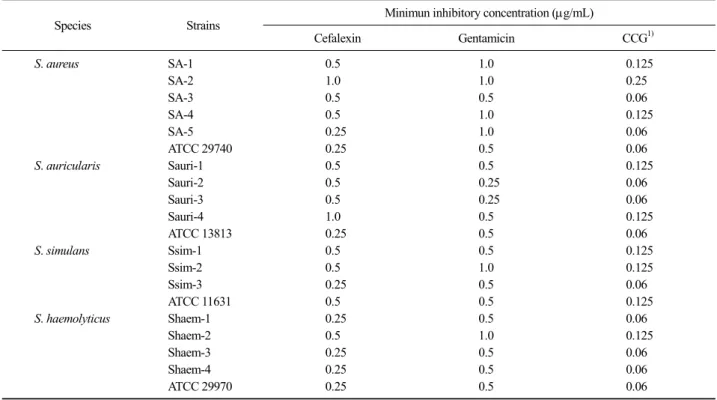
유방염 젖소로부터 분리한 포도상구균 균주들에 대한 cefalexin, gentamicin 그리고 CCG의 MIC는 Table 1 과 같았다. S. aureus 야외분리균주들에 대한 cefalex- in, gentamicin, CCG의 MIC 범위는 각각 0.25∼1.0, 0.5∼1.0, 0.06∼0.25 g/mL이었으며, S. auricularis 분 리균주들에 대한 cefalexin, gentamicin, CCG의 MIC 범위는 각각 0.25∼1.0, 0.25∼0.5, 0.06∼0.125 g/mL 로 나타났다. 또한, S. simulans 분리균주들에 대한 ce- falexin, gentamicin, CCG의 MIC 범위는 각각 0.25∼
0.5, 0.5∼1.0, 0.06∼0.125 g/mL로 나타났으며, S.
haemolyticus의 야외분리균주들에 대한 cefalexin, gen- tamicin, CCG의 MIC 범위는 각각 0.25∼0.5, 0.5∼1.0, 0.06∼0.125 g/mL로 나타났다. 포도상구균 분리균주 들에 대한 cefalexin, gentamicin, CCG의 MIC 범위는 각각 0.25∼1.0, 0.5∼0.125, 0.06∼0.125 g/mL로 나타 나, cefalexin, gentamicin 그리고 CCG는 유방염 젖소 로부터 분리한 포도상구균들에 대해 높은 항균활성 을 나타내었다. 앞선 연구에서(Klimiene 등, 2016), 유 방염 젖소로부터 분리한 CNS에 대해 항생제 감수성 을 조사한 결과, CNS 42 균주들에 대해 gentamincin 의 MIC 범위가 2.0∼8.0 g/mL이었다고 보고하였다.
또한, 유럽전역에 걸쳐 급성 유방염 젖소로부터 분리 한 유방염 원인균들에 대한 항생제 감수성을 조사한 연구에서(Thomas 등, 2015), S. aureus에 대한 cefalex- in의 MIC 범위가 0.06∼1.0 g/mL이었다고 보고하였 다. Taponen 등(2016)은 유방염 젖소로부터 착유한 유 즙에서 CNS를 분리하여 항생제 감수성을 조사한 결 과, S. haemolyticus와 S. simulans에 대한, gentamicin의 MIC 범위는 각각 0.25와 0.25∼1.0 g/mL이었으며, cefalexin과 같은 계열의 cephalothin의 MIC 범위는 모 두 0.12∼0.5 g/mL이었다고 보고하였다. 본 연구에 서, 포도상구균에 대한 gentamicin의 감수성은 Klimiene
Table 1. Minimum inhibitory concentration of Staphylococcus spp. isolated from bovine mastitis
Species Strains Minimun inhibitory concentration (g/mL)
Cefalexin Gentamicin CCG1)
S. aureus SA-1 0.5 1.0 0.125
SA-2 1.0 1.0 0.25
SA-3 0.5 0.5 0.06
SA-4 0.5 1.0 0.125
SA-5 0.25 1.0 0.06
ATCC 29740 0.25 0.5 0.06
S. auricularis Sauri-1 0.5 0.5 0.125
Sauri-2 0.5 0.25 0.06
Sauri-3 0.5 0.25 0.06
Sauri-4 1.0 0.5 0.125
ATCC 13813 0.25 0.5 0.06
S. simulans Ssim-1 0.5 0.5 0.125
Ssim-2 0.5 1.0 0.125
Ssim-3 0.25 0.5 0.06
ATCC 11631 0.5 0.5 0.125
S. haemolyticus Shaem-1 0.25 0.5 0.06
Shaem-2 0.5 1.0 0.125
Shaem-3 0.25 0.5 0.06
Shaem-4 0.25 0.5 0.06
ATCC 29970 0.25 0.5 0.06
1)Combination of cefalexin with gentamicin (10:7, w/w).
등(2016)의 연구결과와 비교하여 보다 높게 나타났으 나, S. haemolyticus와 S. simulans에 대한 gentamicin의 감수성은 Taponen 등(2016)의 연구결과와 비교하여 다소 낮은 것으로 나타났다. 또한, S. aureus에 대한 cefalexin의 감수성은 Thomas 등(2015)의 연구결과보 다 다소 낮았으며, S. haemolyticus와 S. simulans에 대 한 cefalexin의 감수성도 Taponen 등(2016)의 연구에서 사용한 cephalothin 보다 낮은 것으로 확인되었다. 이 러한 항생물질에 대한 젖소 유방염 원인균들의 감수 성 차이는 국가와 지역에 따른 항생물질 사용량과 빈 도의 차이에 의해 발생한 것으로 사료된다.
FIC index
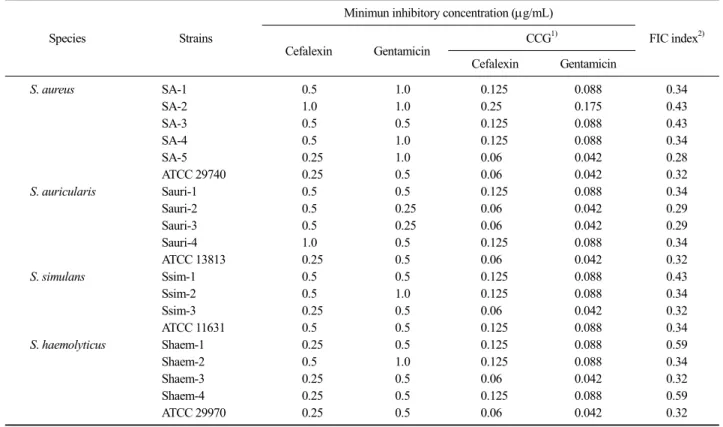
유방염 젖소로부터 분리한 포도상구균 균주들에 대한 cefalexin과 gentamicin의 합제인 CCG의 FIC in- dex를 Table 2에 나타내었다. 각 포도상구균 균주들에 대한 cefalexin, gentamicin, CCG의 MIC를 기초로 FIC index를 산출한 결과, 대부분의 균주들의 FIC index는 0.28∼0.43 범위 내에 있어서 cefalexin과 gentamicin이 포도상구균들에 대해 서로 상승효과를 보이는 것으 로 나타났다. 그러나 S. haemolyticus의 야외분리균주 2주의 경우, FIC index가 0.59로 cefalexin과 gentamicin
이 부분적인 상승효과를 보이는 것으로 나타났다.
Yang 등(2009)은 젖소 유방염 유래 S. aureus에 대한 amoxicillin과 levofloxacin 합제의 FIC index가 0.375로 나타나 상승효과를 나타내었다고 보고하였다. 또한, Choi 등(2011)은 젖소유방염 유래 S. aureus에 대한 florfenicol과 amoxicillin 합제의 FIC index가 0.05로 두 항생제 합제의 상승효과가 매우 뛰어난 것으로 나타 났다고 보고하였다. 한편, 젖소 유방염 유래 S. aureus 에 대해, Fillar 등(2009)은 cefalexin과 kanamycin 합제 의 FIC index가 1.1로 나타났으며, Choi 등(2011)은 florfenicol과 cefuroxime 합제의 FIC index가 1.03으로 나타나 모두 두 항생제의 부분적 상승효과를 나타내 었다고 보고하였다. 앞선 연구들과 비교하여, 본 연 구에서 사용한 CCG의 S. aureus에 대한 항균효과는 Fillar 등(2009)이 사용한 cefalexin과 kanamycin 합제 와 Choi 등(2011)이 사용한 florfenicol과 cefuroxime 합 제보다는 높게 나타났으며, Yang 등(2009)이 사용한 amoxicillin과 levofloxacin 합제와는 유사한 효과를 나 타내었다. 그러나 Choi 등(2011)이 사용한 florfenicol 과 amoxicillin 합제 보다는 낮은 효과를 보였다. 이와 같이, 항생제 합제의 젖소 유방염 유래 원인균들에 대한 항균활성 차이는 나라와 지역에 따라 분리된 균 주들의 각 항생제들에 대한 내성 형성 여부에 따라
Table 2. Fractional inhibitory concentration (FIC) index of Staphylococcus spp. isolated from bovine mastitis
Species Strains
Minimun inhibitory concentration (g/mL)
FIC index2)
Cefalexin Gentamicin CCG1)
Cefalexin Gentamicin
S. aureus SA-1 0.5 1.0 0.125 0.088 0.34
SA-2 1.0 1.0 0.25 0.175 0.43
SA-3 0.5 0.5 0.125 0.088 0.43
SA-4 0.5 1.0 0.125 0.088 0.34
SA-5 0.25 1.0 0.06 0.042 0.28
ATCC 29740 0.25 0.5 0.06 0.042 0.32
S. auricularis Sauri-1 0.5 0.5 0.125 0.088 0.34
Sauri-2 0.5 0.25 0.06 0.042 0.29
Sauri-3 0.5 0.25 0.06 0.042 0.29
Sauri-4 1.0 0.5 0.125 0.088 0.34
ATCC 13813 0.25 0.5 0.06 0.042 0.32
S. simulans Ssim-1 0.5 0.5 0.125 0.088 0.43
Ssim-2 0.5 1.0 0.125 0.088 0.34
Ssim-3 0.25 0.5 0.06 0.042 0.32
ATCC 11631 0.5 0.5 0.125 0.088 0.34
S. haemolyticus Shaem-1 0.25 0.5 0.125 0.088 0.59
Shaem-2 0.5 1.0 0.125 0.088 0.34
Shaem-3 0.25 0.5 0.06 0.042 0.32
Shaem-4 0.25 0.5 0.125 0.088 0.59
ATCC 29970 0.25 0.5 0.06 0.042 0.32
1)A combination of cefalexin with gentamicin (10:7, w/w).
2)FIC index = MIC of A in the combination
+ MIC of B in the CCG
MIC of A MIC of B
(A: cefalexin, B: gentamicin; CCG: mixture of cefalexin and gentamicin (10:7, w/w))
발생하는 것으로 생각된다.
본 연구는 유방염 젖소로부터 분리된 포도상구균 들에 대한 ceflalexin, gentamicin 그리고 이들 합제인 CCG의 MIC와 CCG의 FIC index를 조사하여 향후 포 도상구균에 의한 젖소 유방염 치료에 활용할 수 있는 기초자료를 제공할 목적으로 수행되었다. 본 연구를 통해, 경남 지역 유방염 젖소로부터 분리된 포도상구 균들에 대해 cefalexin과 gentamicin의 합제인 CCG가 높은 상승작용을 나타내는 것으로 확인되어, 향후, 유방염 젖소에 대한 야외적용실험을 통해 효능을 검 증할 필요성이 있는 것으로 사료된다.
결 론
본 연구는 경남지역의 12개 젖소농장에서 채취한 우유시료로부터 분리한 Staphylococcus aureus 5주, Staphylococcus auricularis 4주, Staphylococcus simulans 3주 그리고 Staphylococcus haemolyticus (S. haemolyti-
cus) 4주를 대상으로 cefalexin, gentamicin 그리고 ce- falexin과 gentamicin 합제(CCG)의 최소억제농도를 구 하고, CCG의 분할농도지수를 구하였다. 분리한 포도 상구균 16주에 대한 cefalexin, gentamicin, CCG의 MIC 범위는 각각 0.25∼1.0, 0.5∼0.125, 0.06∼0.125
g/mL로 낮게 나타났다. CCG의 분할농도지수는 대 부분의 포도상구균 분리균주들에 대해 0.28∼0.43 범 위로 나타나, 두 항생제 합제의 상승효과가 확인되었 다. 그러나 S. haemolyticus 2균주의 경우, CCG의 분 할농도지수가 0.59로 나타나, 두 항생제 합제의 부분 적 상승효과가 확인되었다. 이상의 연구결과로부터, cefalexin과 gentamicin의 합제는 포도상구균에 의한 젖소 유방염 치료에 적용될 수 있을 것으로 생각된다.
감사의 글
본 연구는 대한뉴팜 (주) (서울)의 지원에 의해 이 루어진 것이다.
REFERENCES
Barkema HW, Schukken YH, Zadoks RN. 2006. The role of cow, pathogen, and treatment regimen in the therapeutic suc- cess of bovine Staphylococcus aureus mastitis. J Dairy Sci 89: 1877-1895.
Bergeron M, Dauwalder O, Gouy M, Freydiere AM, Bes M, Meugnier H, Benito Y, Etienne J, Lina G, Vandenesch F, Boisset S. 2011. Species identification of staph- ylococci by amplification and sequencing of the tuf gene compared to the gap gene and by matrix-assisted laser desorption ionization time-of-flight mass spectrometry.
Eur J Clin Microbiol Infect Dis 30: 343-354.
Bochniarz M, Wawron W. 2011. Antibiotic susceptibility of me- thicillin-resistant and methicillin-susceptible coagulase- negative staphylococci isolated from bovine mastitis. Pol J Vet Sci 14: 405-410.
Bradley A. 2002. Bovine mastitis: an evolving disease. Vet J 164:
116-128.
Bradley AJ, Leach KA, Breen JE, Green LE, Green MJ. 2007.
Survey of the incidence and aetiology of mastitis on dai- ry farms in England and Wales. Vet Rec 160: 253-257.
Buyck JM, Tulkens PM, Van Bambeke F. 2015. Activities of an- tibiotic combinations against resistant strains of Pseudo- monas aeruginosa in a model of infected THP-1 mono- cytes. Antimicrob Agents Chemother 59: 258-268.
Choi MJ, Lee EM, Lee SJ, Reza MA, Lee JS, Gebru E, Rhee MH, Park SC. 2011. The in vitro antibacterial activity of florfenicol in combination with amoxicillin or cefurox- ime against pathogenic bacteria of animal origin. Pak Vet J 31: 141-144.
Clinical and Laboratory Standards Institute (CLSI). 2008.
Performance standard for antimicrobial disk and dilution susceptibility tests for bacterial isolated from animals;
Approved standard. CLSI document M31-A3. 3rd ed.
Wayne, Pennsylvania, 2008.
Ericsson UH, Lindberg A, Persson WK, Ekman T, Artursson K, Nilsson-Ost M, Bengtsson B. 2009. Microbial aetiology of acute clinical mastitis and agent-specific risk factors.
Vet Microbiol 137: 90-97.
Idriss SE, Foltys V, Tancin V, Kirchnerová K, Tancinová D, Zaujec K. 2014. Mastitis pathogens and their resistance against antimicrobial agents in dairy cows in Nitra, Slovakia. Slovak J Anim Sci 47: 33-38.
Islam NN, Farzana Z, Msudul Azad Chowdhury AM, Mannan A, Kamaruddin KM, Zonaed Siddiki AMAM, Uddin I.
2014. haracterization of bovine subclinical mastitis caused by Staphylococcus aureus in southern Bangladesh by bacteriological and molecular approaches. Asian J Biol Sci 7: 1-12.
Kibebew K. 2017. Bovine mastitis: A review of causes and epi- demiological point of view. J Biol Agric Healthc 7:
1-14.
Klimiene I, Virgailis M, Pavilonis A, Siugzdiniene R,
Mockeliunas R, Ruzauskas M. 2016. Phenotypical and genotypical antimicrobial resistance of coagulase-neg- ative staphylococci isolated from cow mastitis. Pol J Vet Sci 19: 639-646.
Kumar R, Yadav BR, Singh RS. 2011. Antibiotic resistance and pathogenicity factors in Staphylococcus aureus isolated from mastitic Sahiwal cattle. J Bio Sci 36: 175-188.
Lee ES, Kang HM, Chung C, Moon JS. 2007. Antimicrobial sus- ceptibility and prevalence of gram-negative bacteria iso- lated from bovine mastitis. Korean J Vet Res 47: 67-75.
Lim JH, Hwang YH, Park BK, Yun H. 2003. Combination effects of cephalexin and gentamicin on Edwardsiella tarda and Streptococcus iniae. Int J Antimicrob Agents 22: 67-69.
Moser A, Stephan R, Ziegler D, Johler S. 2013. Species dis- tribution and resistance profiles of coagulase-negative staphylococci isolated from bovine mastitis in Switzerland.
Schweiz Arch Tierheilkd 155: 333-338.
Nam HM, Kim JM, Lim SK, Jang KC, Jung SC. 2010. Infectious aetiologies of mastitis on Korean dairy farms during 2008. Res Vet Sci 88: 372-374.
Nam HM, Lim SK, Jang GC, Joung DY, Kim H, Lee CS, Jung SC. 2013. Culture results from quarter milk samples submitted to veterinary diagnostic laboratories during January∼November 2012 in Korea. J Prev Vet Med 37:
111-119.
Nam HM. 2010. Current situation of mastitis and relative fre- quency of pathogens isolated from subclinical mastitis in dairy cattle in Korea. Kor J Vet Publ Hlth 34: 265-272.
Piddock LJ. 1996. Does the use of antimicrobial agents in veteri- nary medicine and animal husbandry select anti- biotic-resistant bacteria that infect man and compromise antimicrobial chemotherapy? J Antimicrob Chemother 38: 1-3.
Pillar CM, Goby L, Draghi D, Grover P, Thornsberry C. 2009.
Evaluating the in vitro susceptibility of bovine mastitis pathogens to a combination of kanamycin and cefalexin:
Recommendations for a disk diffusion test. J Dairy Sci 92: 6217-6227.
Rajala-Schultz PJ, Torres AH, Degraves FJ, Gebreyes WA, Patchanee P. 2009. Antimicrobial resistance and geno- typic characterization of coagulase-negative staph- ylococci over the dry period. Vet Microbiol 134: 55-64.
Rysanek D, Zouharova M, Babak V. 2009. Monitoring major mastitis pathogens at the population level based on ex- amination of bulk tank milk samples. J Dairy Res 76:
117-123.
Taponen S, Nykäsenoja S, Pohjanvirta T, Pitkälä A, Pyörälä S.
2016. Species distribution and in vitro antimicrobial sus- ceptibility of coagulase-negative staphylococci isolated from bovine mastitic milk. Acta Vet Scand 58: 12.
Thomas V, de Jong A, Moyaert H, Simjee S, El Garch F, Morrissey I, Marion H, Vallé M. 2015. Antimicrobial susceptibility monitoring of mastitis pathogens isolated from acute cases of clinical mastitis in dairy cows across Europe: VetPath results. Int J Antimicrob Agents 46:
13-20.
Unal N, Askar S, Macun HC, Sakarya F, Altun B, Yildirim M.
2012. Panton-Valentine leukocidin and some exotoxins of Staphylococcus aureus and antimicrobial susceptibility profiles of staphylococci isolated from milks of small ruminants. Trop Anim Health Prod 44: 573-579.
Yang X, Ouyang W, Li X, Zhang W, Liu Y. 2009. Combination antibacterial effect of compound amoxicillin and levo- floxacin hydrochloride nanoemulsion against three main pathogenic bacteria of cow mastitis in vitro. J Zhejiang Univ - Agric Life Sci 35: 585-590.