This is an Open Access article distributed under the terms of the Creative Commons Attribution License (http://creativecommons.org/licenses/by/4.0) which permits unrestricted use, distribution, and reproduction in any medium, provided the original work is properly cited.
Copyright © 2020 Korean Society of Women Health Nursing
Introduction
Intimate partner violence (IPV), which includes controlling be- havior, is one of the most common forms of violence against women [1]. In the study of García-Moreno et al. [2], IPV was defined as “any behavior within an intimate relationship that causes physical, psychological, or sexual harm to those in the re- lationship”. In recent years, IPV has become an important public health issue. The incidence of violence against women, includ-
Received: June 23, 2020 Revised: November 1, 2020 Accepted: November 15, 2020 Corresponding author:
Yoonjung Kim
#104 Hellen Hall, 52 Ewhayeodae- gil, Seodaemun-gu, Seoul 03760, Korea
Tel: +82-02-3277-2875 E-mail: [email protected] Purpose: The purpose of this study was to analyze and synthesize the literature on intimate partner
violence (IPV) against women in South Korea.
Methods: Whittemore and Knafl’s integrative review method was used. Studies in English and Ko- rean were searched in seven electronic databases using the following combination of terms: “Korea,”
“females or women or girls,” “intimate partner violence or domestic violence or domestic abuse.”
Results: Twenty-five studies were ultimately selected, all of which met the quality appraisal criteria with a grade of medium or higher, using Gough’s weight of evidence. IPV was divided into marital violence and dating violence. Factors related to IPV were classified into intrapersonal, interpersonal, and social factors, and these three factors were linked together. Intrapersonal factors included gener- al characteristics, perceptions, attitudes, psychological factors, and violent experiences. Interpersonal factors involved relationships with parents and partners. Finally, social factors and attributes were in- tegrated into social support and influences on life.
Conclusion: In order to minimize and prevent harm to women from IPV when caring for women who experienced IPV, multiple factors should be considered. Specifically, general and psychological characteristics, perceptions and attitudes toward IPV, relationships with families and partners, and available social support systems and resources should be considered. Moreover, these findings will be helpful for assessing women or providing interventions for victims of violence. Finally, more di- verse IPV studies should be conducted by nurses in the future.
Keywords: Domestic violence; Intimate partner violence; Review literature; Women
An integrative literature review on intimate partner violence against women in South Korea
Hye Young Min
1, Jung Min Lee
2, Yoonjung Kim
11
Division of Nursing Science, Graduate School, Ewha Womans University, Seoul, Korea
2
School of Nursing, University of North Carolina at Greensboro, USA Korean J Women Health Nurs 2020;26(4):260-273
https://doi.org/10.4069/kjwhn.2020.11.15
ing sexual assault, is high worldwide [3], and despite ongoing
movements and interest in fighting against violence - women, its
incidence is not decreasing. According to a World Health Orga-
nization (WHO) report, 59% of women aged between 15 and
49 years worldwide have experienced forced sexual or physical
abuse by their partners at least once [3]. A 2018 report in Korea
also reported that at least 824 women had been killed, and at
least 602 women had been placed at risk of death, in the past 9
years by IPV [4]. This finding indicates that IPV is also a prob-
lem that cannot be overlooked in Korea.
Violence, caused by a power imbalance in close relationships, has recently been acknowledged as a serious social problem that needs to be addressed [5]. The power imbalance within tradi- tional gender norms and close relationships directly or indirectly increases the vulnerability to violence within close relationships, causing the victim to be receptive to the other party’s violent be- havior [6]. Moreover, traditional gender norms and power dis- parities increase society’s tendency to accept traditional gender roles and prevent women from flatly rejecting male proposals for sex. This increases the vulnerability of women to become sexual victims and exacerbates their inability to refuse unpro- tected sex [6,7]. Previous studies [2,8] have shown that women with more stringent traditional gender norms have lower sexual self-assertion and self-efficacy within relationships, leading to an increase in the likelihood of experiencing sexual violence from their partners. These findings show that people who have no power in sexual relationships and who have a low level of sexual self-assertion are vulnerable to unwanted physical and mental harm, and are less capable of making actions or decisions related to sexual activities on their own. Women with these characteris- tics are more vulnerable to IPV, and efforts are needed to reduce its harm.
Sexual violence, in particular, is often caused by unilateral co- ercion during dating, without consent from the partner. IPV is often committed by dating partners [7], and the incidence of sex crimes (e.g., sexual violence, dating violence; wife-beating) continues to grow in Korea [9]. The percentage of people who reported dating violence reported in South Korea increased from 16.2% in 2016 to 19.9% in 2017 [10]. In addition, most perpetrators were male, and it was found that people in their 20s experienced more dating violence than in other age groups [10].
Another Korean study [11] also reported similar results: about 97% of victims of sexual violence were women. Of these, 64.4%
were adult women, and 55.7% were in their 20s.
The physical or mental harm of violence against women is se- vere, both in the short and long term [12]. Victims of violence need immediate and long-term health care and psychological treatment. Violent experiences such as sexual assault, physical abuse, and stalking cause physical harm, which may include sex- ually transmitted diseases, as well as mental disorders such as post-traumatic disorder, depression, and insomnia [12]. In addi- tion, because IPV occurs regularly and repeatedly due to the na- ture of the relationship between the victim and the perpetrator, women exposed to harm experience difficulties in forming sup- portive social relationships, have poor subjective health, and face limitations in daily activities [3,13]. Furthermore, violence reduces women’s ability to work and opportunities to care for their families and contribute to society. Children who witness violence at home are also more likely to have behavioral and emotional problems [14].
There is a lack of systematic reviews on IPV experienced by Korean women, as well as a lack of research in Korea that distin- guishes gender and power on IPV against women. However, since IPV has recently been recognized to be caused by power imbal- ances within close relationships, integrated consideration of exist- ing research on IPV is essential. Therefore, this study sought to analyze and evaluate studies of IPV against Korean women, with the aim of identifying the characteristics and attributes of prior studies related to IPV against Korean women.
Methods
Ethics statement: This study is a literature review of previously published studies and was therefore exempt from institutional review board approval.
Summary statement
• What is already known about this topic?
Intimate partner violence (IPV) is often committed by dating and marital partners, and the incidence of sex crimes continues to increase.
• What this paper adds
IPV involves intrapersonal, interpersonal, and social factors, which are interlinked.
• Implications for practice, education, and/or policy
Nurses should be sufficiently prepared to prevent IPV and reduce the resulting harm. It is necessary to improve nurses’ knowledge
of related factors through education and to apply that knowledge in nursing care.
Research design
This study is an integrative literature review that comprehen- sively analyzed research related to IPV against Korean women.
Research procedure
In accordance with the integrative review guidelines of Whitte- more and Knafl [15], the research questions were clarified; the literature was searched and selected; data evaluation, data analy- sis, and semantic analysis of selected papers were conducted;
and five stages of integrated data extraction were carried out. In addition, a quality assessment of the selected studies was con- ducted using Gough’s weight of evidence (WOE) [16].
Clarifying the research question
To clarify the research problems and objectives, the researchers described the research question and objectives at the beginning of the study. The main research question of this study was,
‘What does the nature of the studies related to IPV against Ko- rean women show?’
Search and selection of literature
The researchers wanted to find meaningful and appropriate ma- terials that fit the research problems and objectives, and record- ed the process in detail to increase the accuracy of the literature search and the reliability of the research. Through meetings, the three researchers prepared the final analysis based on the follow- ing selection criteria. The criteria for selecting the papers includ- ed in the literature review were (1) studies of Korean women, (2) studies that included the keyword “intimate partner vio- lence,” (3) research papers published in Korean and internation- al journals after peer review, and (4) studies in English or Kore- an. The criteria for exclusion from the literature review were (1) studies in which the study design was arbitration to see the ef- fects of a literature review, tool development, and programs; (2) studies including males (because a separate analysis was not possible); and (3) government reports, dissertations, letters to editors, or papers published in academic conferences.
The first search and analysis of the literature was conducted from November 16 to December 16, 2019, and a second search was conducted from October 12 to October 21, 2020. There were no restrictions on the year of publication of the searched papers. The following three databases (DBs) were used: the Ko- rean Studies Information Service System (KISS), the Research Information Sharing Service (RISS), and the National Digital Science Library (NDSL) in Korea and the keywords used for the search were a combination of “women,” “IPV,” “intimate partner violence,” “close relationship violence,” and “close part-
ner violence.” For international DBs, four search engines were used: Cumulative Index to Nursing and Allied Health Literature (CINAHL), PubMed, PsycINFO, and Scopus and the keywords were a combination of “Korea*,” “females or women or girls,” and
“domestic violence or domestic abuse or intimate partner vio- lence” (Supplementary Table 1).
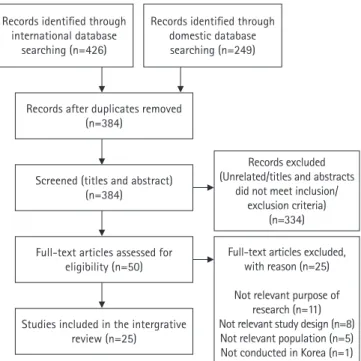
Using the combined search terms, a total of 675 studies were identified, including 249 studies from Korean DBs and 426 studies from foreign DBs. From this pool, the titles and the ab- stracts were reviewed based on the selection criteria. In total, 334 studies and 291 duplicates were excluded. After carefully examining the full text of the remaining 50 studies and further applying exclusion criteria, we finally selected 25 studies [17- 41] (Figure 1).
Evaluation of data
To evaluate the quality of the selected literature, Gough’s WOE [16] was used, and researchers assessed whether the research problems, research purposes, methods, selection of subjects, grounds, and results were described in the selected literature.
The first item (WOE a) of the weighted value was evaluated with a focus on the context and evidence of the study by assess- ing the consistency and integration of the evidence presented in the study in relation to the research problem. The second item (WOE b) was to determine whether the form of evidence pre- sented in the study in relation to the research question was con- sistent with the study question and purpose, thereby evaluating
Records identified through international database
searching (n=426)
Records identified through domestic database searching (n=249)
Records after duplicates removed (n=384)
Records excluded (Unrelated/titles and abstracts
did not meet inclusion/
exclusion criteria) (n=334) Full-text articles excluded,
with reason (n=25) Not relevant purpose of
research (n=11) Not relevant study design (n=8) Not relevant population (n=5) Not conducted in Korea (n=1) Studies included in the intergrative
review (n=25) Screened (titles and abstract)
(n=384)
Full-text articles assessed for eligibility (n=50)
Figure 1. Flow diagram of study selection.
whether the study was properly designed for the study question and purpose. The third item (WOE c) evaluated whether the research methods or research analyses were appropriate for the research problems, and the studies were evaluated with items such as selection of subjects, data collection and data analysis, and ethical aspects. Finally, the fourth item (WOE d) was evalu- ated comprehensively based on the three preceding items. A study was classified as “medium” or “high” if two or more of the three items evaluated earlier were “high” or “medium.” However, in Gough’s study [16], there was no clear standard for ratings based on the evaluation scores, so in this study, we referred to the study of Haßler et al. [42], which clearly presented evalua- tion criteria using Gough’s WOE.
Analyzing data and interpreting meaning
Analyzing data and interpreting meaning are steps to analyze the finally selected research through quality evaluation and to syn- thesize its meaning. The researchers reviewed all the data inde- pendently, then organized and analyzed them individually.
When the researchers compiled the selected papers, they ex- tracted the year of publication, study design, participants, pur- pose of research and research questions, variables, and results of research, and also discussed what other selected studies found on IPV among Korean women. Subsequently, each of the sum- maries was compared and reviewed through regular meetings, and six offline and online meetings were conducted to coordi- nate opinions and to reach agreement on discrepancies in the data. In addition, the decision-making and progress processes from the beginning to the end of the study were described in de- tail so that other researchers could clearly understand these as- pects of the study and reach a reasonable level of agreement with the opinions that emerged through the analysis.
Integration of data
The final step of the integrated consideration of study findings was to present how the attributes identified through the researchers ’ consensus were derived from the data . The analysis was conducted using the reference matrix to derive the properties of the research , and the final properties were confirmed by checking whether the derived properties were closely linked to the main data .
Results
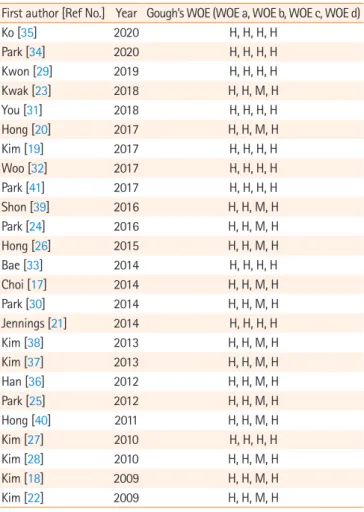
Upon quality assessment, all 25 studies on IPV against Korean women analyzed in this study used data of medium or higher (Table 1). The characteristics of the analyzed studies were as follows (Table 2); fifteen studies (60.0%) were conducted
Table 1. Quality appraisal of reviewed articles (N=25)
First author [Ref No.] Year Gough’s WOE (WOE a, WOE b, WOE c, WOE d)
Ko [35] 2020 H, H, H, H
Park [34] 2020 H, H, H, H
Kwon [29] 2019 H, H, H, H
Kwak [23] 2018 H, H, M, H
You [31] 2018 H, H, H, H
Hong [20] 2017 H, H, M, H
Kim [19] 2017 H, H, H, H
Woo [32] 2017 H, H, H, H
Park [41] 2017 H, H, H, H
Shon [39] 2016 H, H, M, H
Park [24] 2016 H, H, M, H
Hong [26] 2015 H, H, M, H
Bae [33] 2014 H, H, H, H
Choi [17] 2014 H, H, M, H
Park [30] 2014 H, H, M, H
Jennings [21] 2014 H, H, H, H
Kim [38] 2013 H, H, M, H
Kim [37] 2013 H, H, M, H
Han [36] 2012 H, H, M, H
Park [25] 2012 H, H, M, H
Hong [40] 2011 H, H, M, H
Kim [27] 2010 H, H, H, H
Kim [28] 2010 H, H, M, H
Kim [18] 2009 H, H, M, H
Kim [22] 2009 H, H, M, H
Ref No.: reference number; WOE: weight of evidence.
H: high; M: medium; WOE a: methodological trustworthiness; WOE b:
methodological relevance; WOE c: topic relevance; WOE d: overall score.
among married women and 10 studies (40.0%) were conducted among single women. Quantitative studies were the most com- mon (60.0%), of which 12 (48.0%) were descriptive studies.
There were nine qualitative studies (36.0%) and one mixed-
methods study (4.0%). Four studies on intimate relationship vi-
olence against women were published before 2011, 10 were
published between 2011 and 2015, and 11 were published from
2016 to the present, indicating that studies related to women’s
violence have been steadily published. The main variables of the
reviewed papers related to marital violence (32.0%), dating vio-
lence (40.0%), and victims’ beliefs, attitudes, and influencing
factors for each type of abuse (28.0%). Most studies were con-
ducted in fields in the social sciences such as social welfare
(n = 7), psychology (n = 5), and law and criminology (n = 5),
followed by nursing (n = 5) and medicine (n = 1). Although
there were relatively few studies in the health field, the four stud-
ies published within the last 2 years were from nursing, suggest-
ing an increasing interest in the study of IPV in nursing research.
Analysis of data for selected papers
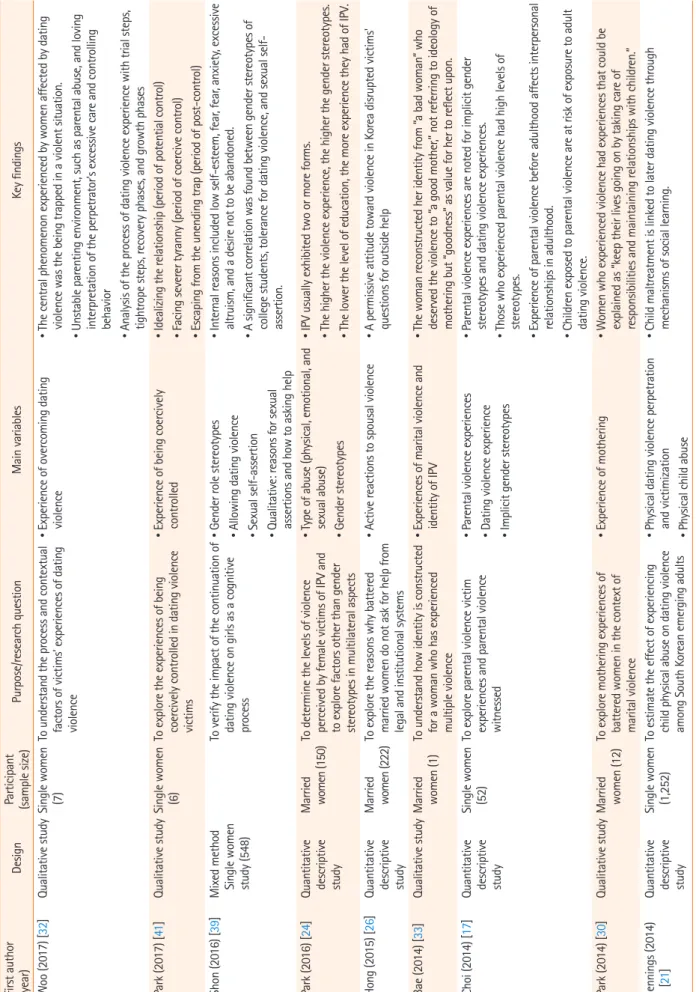
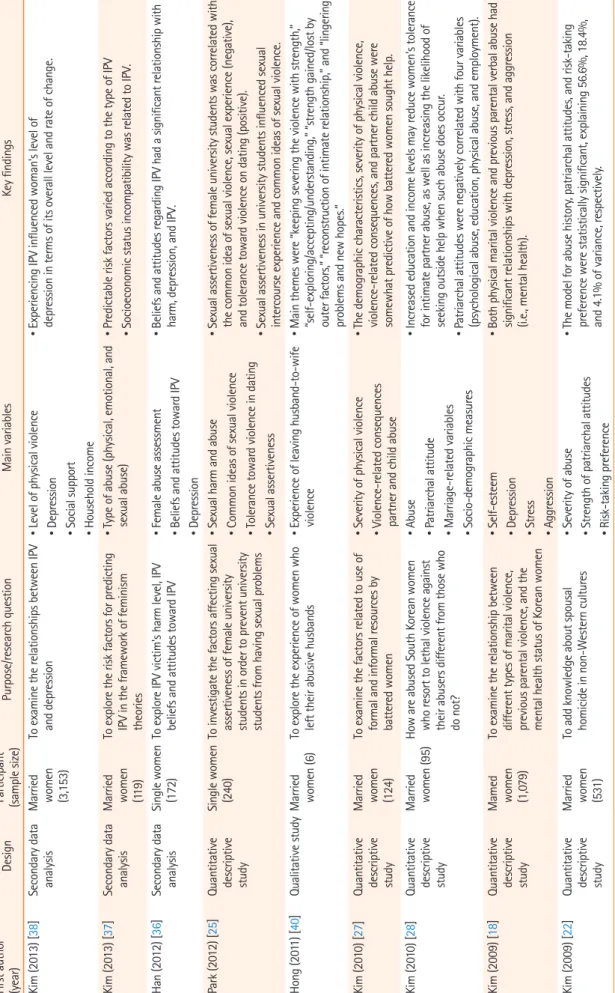
In this study, 25 studies on IPV were analyzed according to the study questions (Table 3). The 12 descriptive studies presented research on experiences of IPV [17-19], influencing factors [20- 25], the legal and support system [26,27], and women who re- lied on the perpetrators of IPV [28]. The nine qualitative stud- ies explored experiences of IPV [29-32], women’s experience of building their identity after IPV [33], experiences of seeking help to overcome IPV [34], and experiences after IPV ended [17,35]. Quantitative studies investigated the level of harm caused by IPV [36], predictors of risk [37], the relationship of IPV with depression [38], and gender awareness and self-asser- tion [39]. Among the major variables used in IPV studies were demographic and sociological characteristics related to marital status and household income [22,28,38], stereotypes such as dating violence beliefs or tolerance [17,24,25,36,39], and sexual self-assertion related to perceptions of violence against women [23,25,39]. In addition, studies on coping [29,31,32,34] and the coping process [31,32,35] were conducted in studies dealing with post-IPV experiences.
Women’s experiences of spousal violence were closely related to their experiences of parental verbal violence in childhood [18] and subsequently were associated with women’s depres-
sion, stress, and diminished self-esteem. The most commonly investigated risk factor was the experience of parental violence against the child, and if violence was experienced as a child, this was likely to become transposed to a violent relationship in adulthood [33,38]. Conversely, a study that evaluated the causal relationship between child abuse victims and adult dating vio- lence offenders [21] found that experiencing child abuse by parents did not have a statistically significant impact on subse- quent physical dating violence and youth harm. Those who ex- perienced parental violence or watched their mothers be abused since childhood [30,33] or grew up in patriarchal home envi- ronments [22,28] developed stereotypes about gender roles and showed low sexual self-assertion as women [17,37]. Experienc- es of parental violence before adulthood affect interpersonal re- lationships due to depression and stress, and increase the risk of intimate violence after adulthood. The results of analyzing the selected studies suggest that steps must be taken to educate par- ents on how to correct their children’s behavior without physical punishment or verbal violence, and that mediation programs to prevent marital violence in the community should be imple- mented more actively.
Some of the studies [24,25,29,32,41] regarding dating vio- lence showed that gender stereotypes and sexual self-assertion Table 2. General characteristics of the included studies (N=25)
Characteristic Categories n (%) Reference number
Participants Single women 15 (60.0) [17], [19], [20], [21], [23], [25], [27], [29], [31], [32], [34-36], [39], [41]
Married women 10 (40.0) [18], [22], [24], [26], [28], [30], [32], [33], [38], [40]
Research design Quantitative descriptive study 12 (48.0) [17-28]
Qualitative study 9 (36.0) [29-35], [40], [41]
Secondary data analysis 3 (12.0) [36-38]
Mixed-methods study 1 (4.0) [39]
Publication year Before 2011 4 (16.0) [18], [22], [27], [28]
2011–2015 10 (40.0) [17], [21], [25], [26], [30], [33], [37], [38], [40]
2016 and beyond 11 (44.0) [19], [20], [23], [24], [29], [31], [32], [34], [35], [39], [41]
Sample size Less than 100 13 (52.0) [17], [29], [20], [28-35], [40], [41]
101–500 7 (28.0) [23-27], [36], [37]
501–1,000 2 (8.0) [22], [39]
> 1,000 3 (12.0) [18], [21], [38]
Main variables Marital violence 8 (32.0) [18], [20], [24], [26], [28], [30], [33], [40]
Dating violence 10 (40.0) [17], [21], [22], [29], [31], [32], [34], [35], [39], [41]
Factors affecting violence 7 (28.0) [19], [23], [25], [27], [36], [37], [38]
Study field Social welfare 7 (28.0) [18], [19], [24], [26], [30], [32], [38]
Counseling 2 (8.0) [31], [41]
Psychology 5 (20.0) [17], [20], [25], [32], [40]
Law and criminology 5 (20.0) [21], [22], [26], [28], [37]
Nursing 5 (20.0) [23], [29], [34-36]
Medicine 1 (4.0) [39]
Table 3. Major contents of the reviewed articles (N=25) First author (year) Design Participant (sample size) Purpose/research question Main variables Key findings Ko (20 20) [ 35 ] Qualitative study Single women (13) To understand young female adults' experiences of building a new intimate relationship after ending their abusive relationship
•
Exploring IPV experiences
•Process of escaping IPV relationships
•Experiences after the IPV relationship had ended
•Experiences of new intimate relationships
•
The victim-survivors of IPV experienced numerous negative consequences even after their abusive relationships ended.
•Care, safety planning, and emotional support for IPV victims are needed. Park (20 20) [ 34 ] Qualitative study Single women (14) To understand South K orean female IPV victims' experiences in seeking help
•
Experiences when seeking help according to selection of supporters
•
Revealed the victims' experiences according to their choice of support and noted four factors that appear to influence their support selection, which were (a) recognition of the consequent harm after seeking help, (b) recognition of serious danger , (c) recognition of the probability of coping, and (d) recognition of the relationship.
•
Factors influencing supporter selection Kwon (20 19) [ 29 ] Qualitative study Single women (14) To explore the experiences of being coercively controlled in female victims who had experienced dating violence
•
Experience of dating violence
•Coping with dating violence
•Changes after the end of the relationship
•Life impact of violent experiences
•
Starting the relationship by idealizing it (period of potential control)
•Facing with visible coercive control (period of coercive control)
•Escaping from the unending trap (period of post-control) Kwak (20 18) [ 23 ] Quantitative descriptive study
Single women (137) To investigate the effects of adult attachment, responsibility attribution, and self-esteem of adult women on psy - chological aspect in intimate relationships
•
Adult attachment
•Responsibility attribution
•Self-esteem
•Psychological violence
•
The older , more dating experiences, and higher sense of responsibility , the higher the harm of psychological violence.
•The older , more dating experiences, and more adult attachment, the higher the harms of psychological violence. You (20 18) [ 31 ] Qualitative study Single women (17) To explore how women affected by dating violence experience the psychology of increasing levels of physi - cal and sexual violence from mental vio - lence
•
Beginning of a relationship
•First IPV experience
•IPV coping
•Relationship with parents
•What would have changed if I had realized that IPV had occurred?
•
Causal conditions: weird, painfully pleasant, embarrassed, and scared
•Contextual conditions: experiencing acceptance of violence and unusual love
•Arbitral conditions: level of experience of violence, the level of violence response, and the level of relationship immersion affect Hong (20 17) [ 20 ] Quantitative descriptive study
Single women (65) To explore factors affecting the battered women's decision to return to the abu - sive relationship
•
Learned helplessness
•The more learned helplessness and the more severe IPV, the less likely the battered women could escape from abusive relationships.
•Social support
•Spousal assault risk Kim (20 17) [ 19 ] Quantitative Single women (16) To examine psychological difficulties and stress levels in abused and non-abused K orean women and analyze the relationship between psychological outcomes and stress level
•
Psychological variables
•W omen who experienced IPV had more life stress events and lower antioxidant levels than non-abused women.
•Oxidative stress biomarkers
•Relationships between a women's physical health and life stress arising from IPV had significant implications. (Continued to the next page)
W oo (20 17) [ 32 ] Qualitative study Single women (7) To understand the process and contextual factors of victims’ experiences of dating violence
•
Experience of overcoming dating violence
•
The central phenomenon experienced by women affected by dating violence was the being trapped in a violent situation.
•Unstable parenting environment, such as parental abuse, and loving interpretation of the perpetrator's excessive care and controlling behavior
•Analysis of the process of dating violence experience with trial steps, tightrope steps, recovery phases, and growth phases Park (20 17) [ 41 ] Qualitative study Single women (6) To explore the experiences of being coercively controlled in dating violence victims
•
Experience of being coercively controlled
•
Idealizing the relationship (period of potential control)
•Facing severer tyranny (period of coercive control)
•Escaping from the unending trap (period of post-control) Shon (20 16) [ 39 ] Mixed method Single women study (548)
To verify the impact of the continuation of dating violence on girls as a cognitive process
•
Gender role stereotypes
•Allowing dating violence
•Sexual self-assertion
•Qualitative: reasons for sexual assertions and how to asking help
•
Internal reasons included low self-esteem, fear , fear , anxiety , excessive altruism, and a desire not to be abandoned.
•A significant correlation was found between gender stereotypes of college students, tolerance for dating violence, and sexual self- assertion. Park (20 16) [ 24 ] Quantitative descriptive study
Married women (150) To determine the levels of violence perceived by female victims of IPV and to explore factors other than gender stereotypes in multilateral aspects
•
T ype of abuse (physical, emotional, and sexual abuse)
•
IPV usually exhibited two or more forms.
•The higher the violence experience, the higher the gender stereotypes.
•The lower the level of education, the more experience they had of IPV.
•Gender stereotypes Hong (20 15) [ 26 ] Quantitative descriptive study
Married women (222) To explore the reasons why battered married women do not ask for help from legal and institutional systems
•
Active reactions to spousal violence
•A permissive attitude toward violence in K orea disrupted victims' questions for outside help Bae (20 14) [ 33 ] Qualitative study Married women (1) To understand how identity is constructed for a woman who has experienced multiple violence
•
Experiences of marital violence and identity of IPV
•
The woman reconstructed her identity from “ a bad woman” who deserved the violence to “ a good mother ,” not referring to ideology of mothering but “goodness” as value for her to reflect upon. Choi (20 14) [ 17 ] Quantitative descriptive study
Single women (52) To explore parental violence victim experiences and parental violence witnessed
•
P arental violence experiences
•Dating violence experience
•Implicit gender stereotypes
•
P arental violence experiences are noted for implicit gender stereotypes and dating violence experiences.
•Those who experienced parental violence had high levels of stereotypes.
•Experience of parental violence before adulthood affects interpersonal relationships in adulthood.
•Children exposed to parental violence are at risk of exposure to adult dating violence. Park (20 14) [ 30 ] Qualitative study Married women (12) To explore mothering experiences of battered women in the context of marital violence
•
Experience of mothering
•W omen who experienced violence had experiences that could be explained as “keep their lives going on by taking care of responsibilities and maintaining relationships with children.” Jennings (20 14) [ 21 ] Quantitative descriptive study
Single women (1,252) To estimate the effect of experiencing child physical abuse on dating violence among South K orean emerging adults
•
Physical dating violence perpetration and victimization
•
Child maltreatment is linked to later dating violence through mechanisms of social learning.
•Physical child abuse
Table 3. Continued (Continued to the next page)
First author (year) Design Participant (sample size) Purpose/research question Main variables Key findings
Kim (20 13) [ 38 ] Secondary data analysis Married women (3,153) To examine the relationships between IPV and depression
•
Level of physical violence
•Experiencing IPV influenced woman's level of depression in terms of its overall level and rate of change.
•Depression
•Social support
•Household income Kim (20 13) [ 37 ] Secondary data analysis Married women (1 19)
To explore the risk factors for predicting IPV in the framework of feminism theories
•
T ype of abuse (physical, emotional, and sexual abuse)
•
Predictable risk factors varied according to the type of IPV
•Socioeconomic status incompatibility was related to IPV. Han (20 12) [ 36 ] Secondary data analysis Single women (172) To explore IPV victim's harm level, IPV beliefs and attitudes toward IPV
•
Female abuse assessment
•Beliefs and attitudes regarding IPV had a significant relationship with harm, depression, and IPV.
•Beliefs and attitudes toward IPV
•Depression Park (20 12) [ 25 ] Quantitative descriptive study
Single women (240) To investigate the factors affecting sexual assertiveness of female university students in order to prevent university students from having sexual problems
•
Sexual harm and abuse
•Common ideas of sexual violence
•T olerance toward violence in dating
•Sexual assertiveness
•
Sexual assertiveness of female university students was correlated with the common idea of sexual violence, sexual experience (negative), and tolerance toward violence on dating (positive).
•Sexual assertiveness in university students influenced sexual intercourse experience and common ideas of sexual violence. Hong (20 11) [ 40 ] Qualitative study Married women (6) To explore the experience of women who left their abusive husbands
•
Experience of leaving husband-to-wife violence
•
Main themes were “keeping severing the violence with strength,” “self-exploring/accepting/understanding,” “strength gained/lost by ou te r f ac to rs ,” “r ec on st ru ct io n of in tim at e re la tio ns hi p, ” a nd “l in ge rin g problems and new hopes.” Kim (20 10) [ 27 ] Quantitative descriptive study
Married women (124) To examine the factors related to use of formal and informal resources by battered women
•
Severity of physical violence
•The demographic characteristics, severity of physical violence, violence-related consequences, and partner child abuse were somewhat predictive of how battered women sought help.
•Violence-related consequences partner and child abuse Kim (20 10) [ 28 ] Quantitative descriptive study
Married women (95) How are abused South K orean women who resort to lethal violence against their abusers different from those who do not?
•
Abuse
•P atriarchal attitude
•Marriage-related variables
•Socio-demographic measures
•
Increased education and income levels may reduce women's tolerance for intimate partner abuse, as well as increasing the likelihood of seeking outside help when such abuse does occur .
•P atriarchal attitudes were negatively correlated with four variables (psychological abuse, education, physical abuse, and employment). Kim (2009) [ 18 ] Quantitative descriptive study
Mamed women (1,0 79) To examine the relationship between different types of marital violence, previous parental violence, and the mental health status of K orean women
•
Self-esteem
•Both physical marital violence and previous parental verbal abuse had significant relationships with depression, stress, and aggression (i.e., mental health).
•Depression
•Stress
•Aggression Kim (2009) [ 22 ] Quantitative descriptive study
Married women (53 1) To add knowledge about spousal homicide in non-W estern cultures
•
![Table 3. Major contents of the reviewed articles (N=25) First author (year)DesignParticipant (sample size)Purpose/research questionMain variablesKey findings Ko (2020) [35]Qualitative studySingle women (13)To understand young female adults' experiences o](https://thumb-ap.123doks.com/thumbv2/123dokinfo/5363382.402726/6.892.83.738.126.1104/contents-designparticipant-questionmain-variableskey-qualitative-studysingle-understand-experiences.webp)