- 1783 -
샘플치 퍼지 제어기를 이용한 이산 퍼지 시스템 제어
송민국*, 박진배*, 김종선**, 주영훈**, ,
*연세대학교 전기전자공학과, **군산대학교 전자공학부
Sampled Fuzzy Controller for discrete networked control systems
Song Min Kook*, Park Jin Bae*, Jong Seon Kim**, and Joo Young Hoon**
*Electrical and Electronic Engineering, Yonsei University
**School of Electronics and Information Engineering, Kunsan National University
Abstract - This paper presents a novel control technique to deal with networked control systems with neutral time- delay, which is known to highly degrade the control performance of the controlled system. The stability analysis and design method for a sampled-data fuzzy controller for discrete networked control systems (NCS). The neutral time-delay and sampling activity will complicate the NCS.
And it make the stability analysis much more difficult than that for a continuous-time NCS. Based on the fuzzy control approach, linear matrix inequality (LMI)-based stability conditions are derived to guarantee the neutral T-S fuzzy system stability. The simulation results and practical experiments illustrate that the proposed controller design is realistic.
1. Introduction
Networked control systems (NCSs) are feedback control loops closed through network. That is, in NCSs, communication networks are employed to exchange information and control signals (reference input, plant output, control input, etc.) between control system components (sensors, controllers, actuators, etc.) With the growth in computing and networking abilities, Internet-based control systems allow the remote monitoring and adjustment of plants and this subject has received much attention in recent years, because of the potential industrial benefits. The main advantages of networked control systems are low cost, reduced weight, simple installation and maintenance, and high reliability. Despite the advantages, communication networks in control loops make the analysis and design of a NCS complicate. The notion of networked control system is quite new and the theory is still in its infancy, some initial research work has produced promising results [1][4].
This kind of control systems involves controlling a plant from a remote location through a communication channel. The uncertain communication time delays caused by the routes of the data transmission and the network traffic [2] highly degrade the control performance of the controlled systems. It is known that the occurrence of delay degrades the stability and control performance of closed-loop control systems. Many researchers have studied stability, controller design for stabilization and performance of networked control systems in the presence of network-induced delays.
Recently, the stability of NCSs has been studied based on the fuzzy-model-based approach. A modified Takagi-Sugeno (T-S) fuzzy model was proposed to represent the nonlinear plant with neutral time-delay. Owing to rapid growth of the digital circuit technologies, powerful digital computers can be made available at low cost. The overall control system becomes a sampled-data systems of which the control system becomes a sampled-data system of which the control signals are kept constant during the sampling period and are allowed to change only at the sampling instant.
In this paper, the system stability of a neutral time-delay NCS with a sampled-data fuzzy controller is proposed. To
facilitate the stability analysis, the T-S fuzzy model with neutral time-delay is employed to represent the nonlinear plant. Then. the sufficient conditions on the existence of stabilizing controllers are give, and an alterative linear matrix inequalities (LMIs) approach is used to calculate the controllers. An inverted pendulum example is considered to illustrate the proposed metho.
2. T-S Fuzzy Model and Sampled-data controller
Consider the networked control setup, where the plant is a nonlinear discrete-tine system via T-S fuzzy models, is the neutral type of time-delay, and the sampled fuzzy controller is to be designed.
Using the center-average defuzzification, product inference, and singletone fuzzifier, the global dynamics of this discrete-time T-S fuzzy system is described by
(1)
where
and
is the membership value of
∈ .
A sampled-data fuzzy controller is designed based on the T-S fuzzy model of the nonlinear plant.
≦ (2)
It can be seen from (2) that
, which holds contant value. The sampled-data fuzzy controller of (2) can be represented as
(3)
Then, the problem of designing the controller (3) has been converted to find
so that
∥∥is driven to zero as
→∞3. Stability analysis and controller Design
2008년도 대한전기학회 하계학술대회 논문집 2008. 7. 16 - 18
- 1784 -
0 2 4 6 8 10 12 14 16 18 20
-0.4 -0.2 0 0.2 0.4 0.6 0.8 1
k x1(k)
Figure 1. Closed loop system response of state
0 2 4 6 8 10 12 14 16 18 20
-0.4 -0.2 0 0.2 0.4 0.6 0.8 1 1.2
k x2(k)
Figure 2. Closed loop system response of state
0 2 4 6 8 10 12 14 16 18 20
-2.5 -2 -1.5 -1 -0.5 0 0.5 1
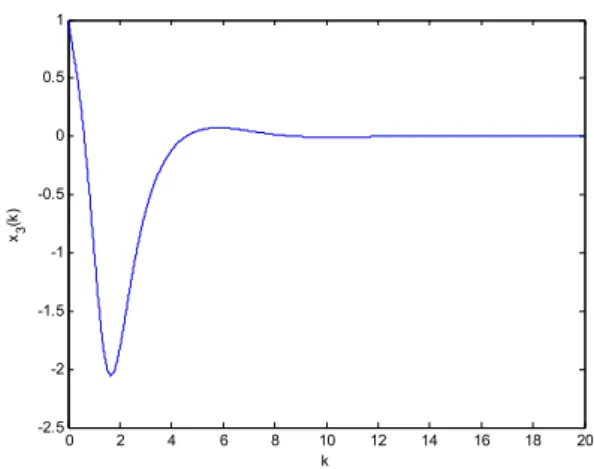
k x3(k)
0 2 4 6 8 10 12 14 16 18 20
-2.5 -2 -1.5 -1 -0.5 0 0.5
k x4(k)
Figure 4. Closed loop system response of state
Figure 3. Closed loop system response of state
The nonlinear system stability and stabilization of the sampled-data T-S fuzzy system is investigated in this section. Based on the Lyapunov-Krasovskii approach, LMI-based stability sufficient conditions will be derived. The LMi-based stability conditions are then used to design stable sampled-data fuzzy controller. These conditions are expressed as LMIs and hence easily tractable numerically.
The stability conditions are readily extended to the sufficient conditions for the existence of stabilizing state-feedback gains for fuzzy neutral systems.
A more relaxed stabilization criterion, in which the interactions among the fuzzy subsystems are represented in a single matrix, is stated.
4. Simulation results
Consider the cart and inverted pendulum problem in [5], where
is the cart mass,
is the pendulum mass, is the length from the point of rotation to the center of gravity of the pendulum,
is the cart position,
is the pendulum angular position, and
is the input force.
The state variables are
,
,
and
. Assume that
,
m2 = 0:5,
, and the surface is friction free. The sampling time is
as same in [5].
The state trajectories of the closed-loop system caused by the T-S fuzzy model and the obtained sampled-data fuzzy controller are shown in Fig. 1-4. It can be seen that the closed-loop NCS is stable.
5. Conclusion
In this paper, the new method for NCS has been proposed using the sampled-data fuzzy controller. The sampled-data fuzzy controller can be impremented digital computer to reduce the time and cost.
LMI based sufficient stability conditionds have been derived based on Lyapunov-Krasovskii functionals. An application example gan been given to show the effectiveness of the proposed method.
감사의글 : 본 연구는 학술진흥재단(KRF-2007-521- D00159) 프로젝트에 의해 일부 지원 받았음.