JESK
http://jesk.or.kr eISSN:2093-8462Identification of user's Motion Patterns using Motion Capture System
Kwang Tae Jung, Jaein Lee
Koreatech, Industrial Design Engineering 307 Cheonan, Chungnam, 330-708
Corresponding Author Kwang Tae Jung
Koreatech, Industrial Design Engineering 307 Cheonan, Chungnam, 330-708 Mobile : +82-10-8838-9306 Email : [email protected]
Received : August 16, 2014 Revised : October 06, 2014 Accepted : October 20, 2014
Objective:The purpose of this study is to identify motion patterns for cellular phone and propose a method to identify motion patterns using a motion capture system.
Background: In a smart device, the introduction of tangible interaction that can provide new experience to user plays an important role for improving user's emotional satisfaction. Firstly, user's motion patterns have to be identified to provide an interaction type using user's gesture or motion.
Method: In this study, a method to identify motion patterns using a motion capture system and user's motion patterns for using cellular phone was studied. Twenty- two subjects participated in this study. User's motion patterns were identified through motion analysis.
Results: Typical motion patterns for shaking, shaking left and right, shaking up and down, and turning for using cellular phone were identified. Velocity and acceleration for each typical motion pattern were identified, too.
Conclusion: A motion capture system could be effectively used to identify user's motion patterns for using cellular phone.
Application: Typical motion patterns can be used to develop a tangible user interface for handheld device such as smart phone and a method to identify motion patterns using motion analysis can be applied in motion patterns identification of smart device.
Keywords: Motion capture system, Motion patterns, Emotional satisfaction, Tangible interface
Copyright@2014 by Ergonomics Society of Korea. All right reserved.
○cc This is an open-access article distributed under the terms of the Creative Commons Attribution Non-Commercial License (http://
creativecommons.org/licenses/by-nc/3.0/), which permits unrestricted non-commercial use, distribution, and reproduction in any medium, provided the original work is properly cited.
1. Introduction
User expectation on the technological level of smart devices is on the rise, due to recent popularization of smart devices. The provision of an interaction mode that can offer a new experience to users from function-focused product development plays a pivotal role in improving user satisfaction on products. Users have a strong tendency to simultaneously pursue digital convenience, and analog emotion, and prefer more human-friendly interface (Lee, 2008). According to such a need, many products offering intuitive and innovative interface were recently developed. Especially, tangible user interface having analog emotion is getting the limelight as one of the modes providing pleasure to users (Schlomer, et al., 2008). The tangible interface is an interface technology manipulating digital information through motions similar to
Journal of the Ergonomics Society of Korea
general human motions, such as touching, feeling, holding and transferring a thing. Using natural objects or activities in everyday life, the tangible user interaction makes intuitive and natural type of interaction with digital information possible. Utility can be found from tangible user interface in that it provides comfortable and pleasant experiences to a user. The typical product using the tangible user interface is Nintendo Wii, which adopts a tangible user interface, based on motion recognition (Schlomer, et al., 2008). The motion recognition technology is recently applied to smartphones or smart TVs. As such, products to offer emotional satisfaction to consumers are increasing by introducing tangible user interface that uses various new technologies such as a motion recognition sensor. Especially, the interface method using user's gestures or motions is regarded as an important research field in the interactive environment, because of the merit offering the environment similar to actual living (Gyeong et al., 2006).
Concerning the interaction function using user's motions, the control of mobile device is carried out using user's motions, and therefore, the analysis of users' motions is very important above all. As a method to effectively measure and analyze user's motions, a motion capture system enables accurate analysis of motion patterns, since it can measure and quantify motions at high level of accuracy. To simply identify user's motion trajectory, it will be enough with just a video camera. However, the use of the motion capture system is necessary to acquire data, such as the velocity, acceleration and displacement of motions that can be used for motion interface design. The motion capture system is a device measuring the location and bearing on the movement of an object in 3D space. Braido and Zhang (2004) conducted an analysis on the human's finger motions using the motion capture system, and Kamat, et al. (2014) used the motion capture system to comparatively analyze the motions of hands and fingers in motions to squeeze out content from a plastic bottle targeting elderly men and women. Yun et al. (2008) used motion capture equipment to collect data on the upper limb motions in drinking motion. From the studies mentioned above, it is understood that a motion capture system can be effectively used to identify motion patterns on user's motions, and therefore, this study researched a method to identify a standard pattern of user's motions by using a motion capture system. In particular, this study presented the applicability by studying cases to identify several motion patterns targeting cellular phone, one of the most recently generalized personal products.
2. Experimental Method
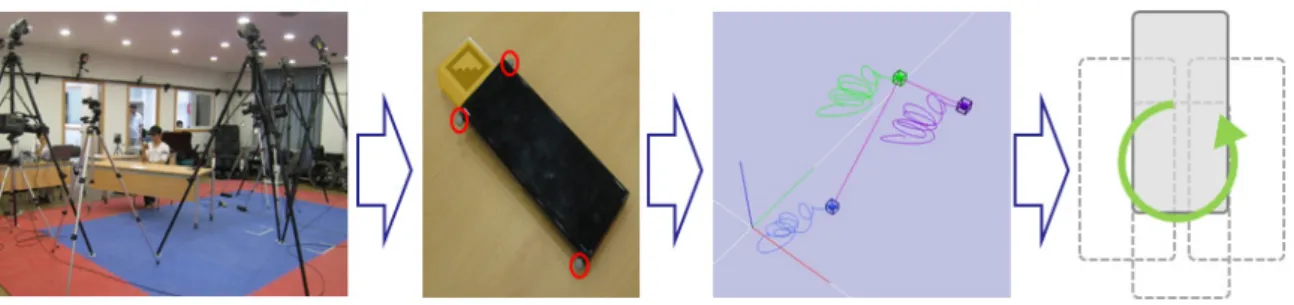
This study measured the use motions of a cellular phone using motion capture equipment, and tried to identify standard motion patterns, based on the use motions. This study used motion capture equipment, composed of six Hawk digital cameras. To measure motions, 5mm-markers attached to a cellular phone. Figure 1 shows the procedure to draw standard motion patterns for using a cellular phone. The user's use motions of the cellular phone attached with markers were measured using the motion capture system, and typical motion patterns were identified by using the movement trajectory.
Figure 1. Process to draw a standard motion
For example, to identify the cellular phone shaking motion pattern, the shaking motions using the motion capture equipment were measured, and the typical motion pattern by analyzing the movement trajectory was identified. And then, the pattern with the highest frequency by analyzing subject's motion frequency by each motion pattern was decided as the standard.
2.1 Subjects
Twenty-two subjects (16 males and 6 females) participated in this experiment. The subjects without disorder in arm motions were selected. The males' age was 23~32, and the females' age was 21~25. Three males among the male subjects were left- handed, and the rest were all right-handed.
2.2 Experimental task
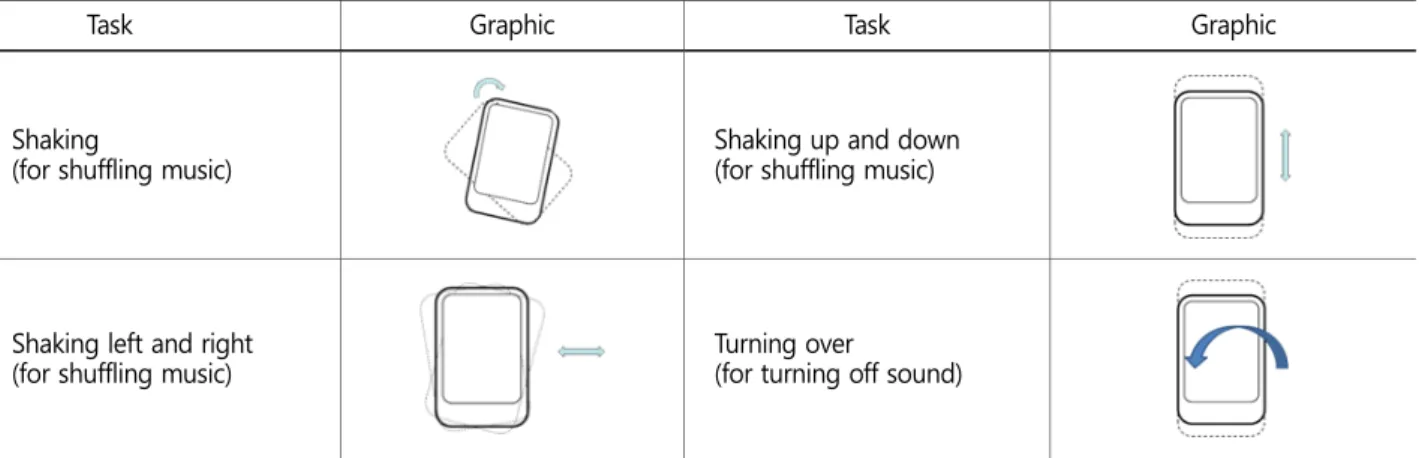
Three motions, namely, shaking, shaking left and right, and shaking up and down, which are highly used for shuffling motion in the MP3 player function of a cellular phone, and a turning over motion used for turning off the sound of a cellular phone were selected in this experiment (Table 1).
As shown in Figure 2, three fluorescent markers at the top left and right and bottom left of a cellular phone were attached to the cellular phone to identify the movement, velocity and acceleration of the cellular phone.
Table 1. Experimental tasks
Task Graphic Task Graphic
Shaking
(for shuffling music) Shaking up and down
(for shuffling music)
Shaking left and right
(for shuffling music) Turning over
(for turning off sound)
Figure 2. Experimental material
Journal of the Ergonomics Society of Korea
3. Identification of Motion Pattern 3.1 Shaking
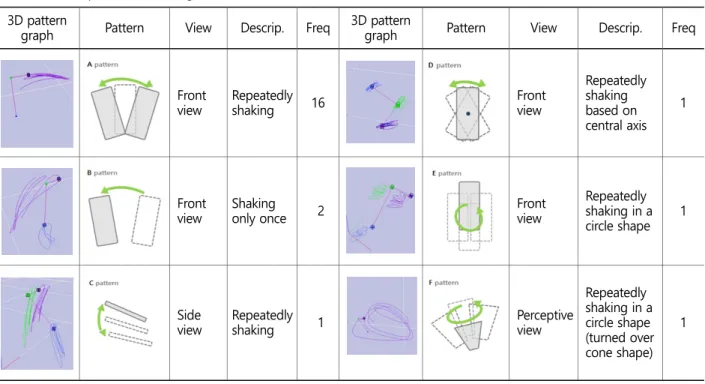
This study detected six patterns by analyzing the measured and videotaped data on the shaking motions of 22 subjects by using motion capture equipment. As shown in Table 2, the six patterns were drawn by analyzing the trajectory of markers attached to the cellular phone measured through motion capture.
In Table 2, the first column (3D pattern graph) shows the trajectory of markers attached to the cellular phone measured from motion capture. The second column (pattern) shows the pattern identified through subjects' shaking motions analysis. The number in the last column (freq.) shows the number of the subjects who made the motion in each pattern. Consequently, typical patterns on shaking motions were identified through the number of the subjects by motion pattern.
Figure 3 shows the number of the subjects, who conducted motions by pattern, through an analysis of 22 subjects' shaking motions. From the figure, the number of the subjects who carried out shaking motion with repeated shaking was the most.
Therefore, it is reasonable to decide A pattern as the typical pattern of shaking motion.
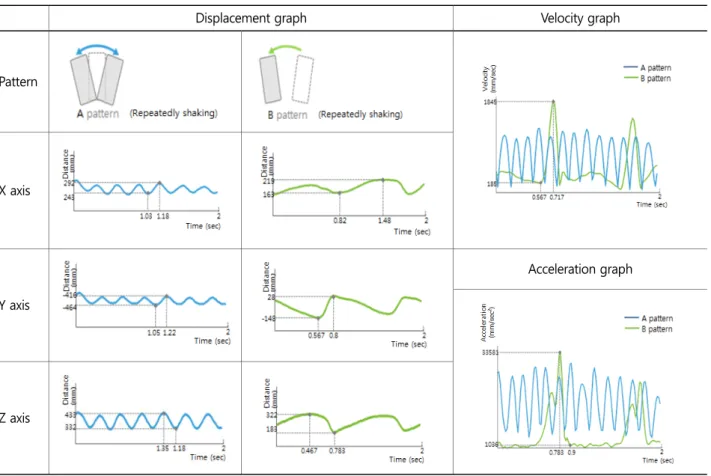
In this regard, the repeatedly shaking motion (A pattern) was identified as the standard motion in Figure 4 in terms of shaking motion. This study conducted a detailed analysis on the motion patterns of patterns A and B, whose frequencies were the most among the user's motion patterns on shaking motion. In the detailed analysis, the displacement, velocity and acceleration in a motion in the directions of x, y and z axes on each motion pattern were analyzed. The results are as follows: As demonstrated in Table 3, the displacement is small in the directions of x, y and z axes, and the frequency's cycle time is short in A pattern.
Table 2. Motion pattern for shaking 3D pattern
graph Pattern View Descrip. Freq 3D pattern
graph Pattern View Descrip. Freq
Front
view Repeatedly
shaking 16 Front
view
Repeatedly shaking based on central axis
1
Front
view Shaking
only once 2 Front
view
Repeatedly shaking in a circle shape 1
Side
view Repeatedly
shaking 1 Perceptive
view
Repeatedly shaking in a circle shape (turned over cone shape)
1
Figure 1. Process to draw a standard motion
Meanwhile, displacement is large, and the frequency's cycle time is long in B pattern. Such a phenomenon is shown equally in the velocity and acceleration components analysis as well.
Table 3. Component analysis for typical shaking patterns
Displacement graph Velocity graph
Pattern
X axis
Y axis
Acceleration graph
Z axis
Figure 3. Frequency for each movement pattern Figure 4. Typical shaking pattern
Journal of the Ergonomics Society of Korea
3.2 Shaking left and right
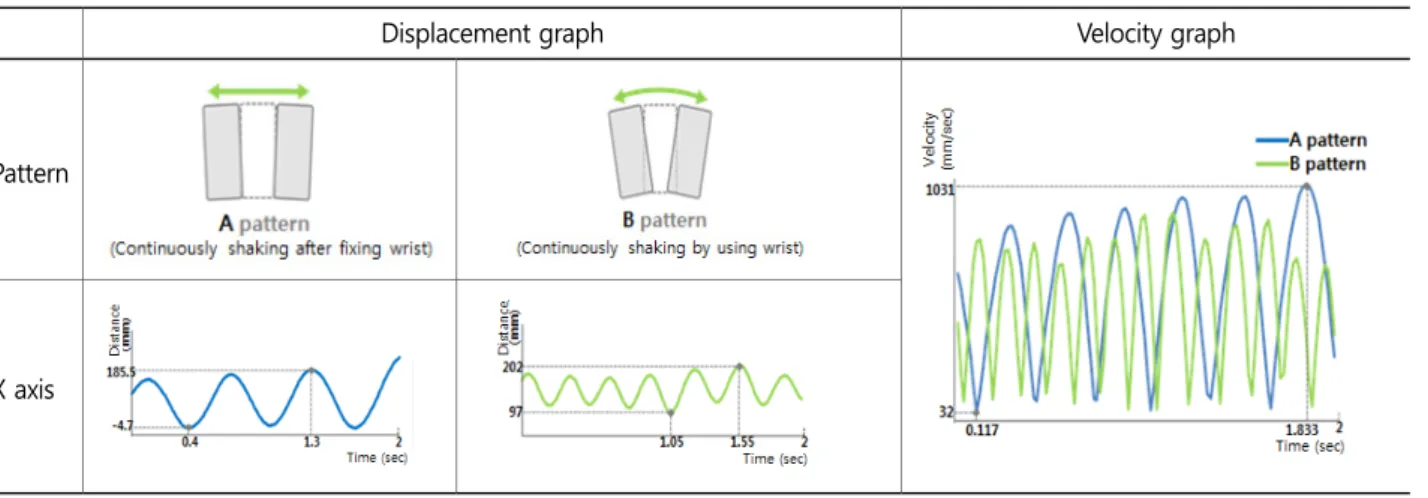
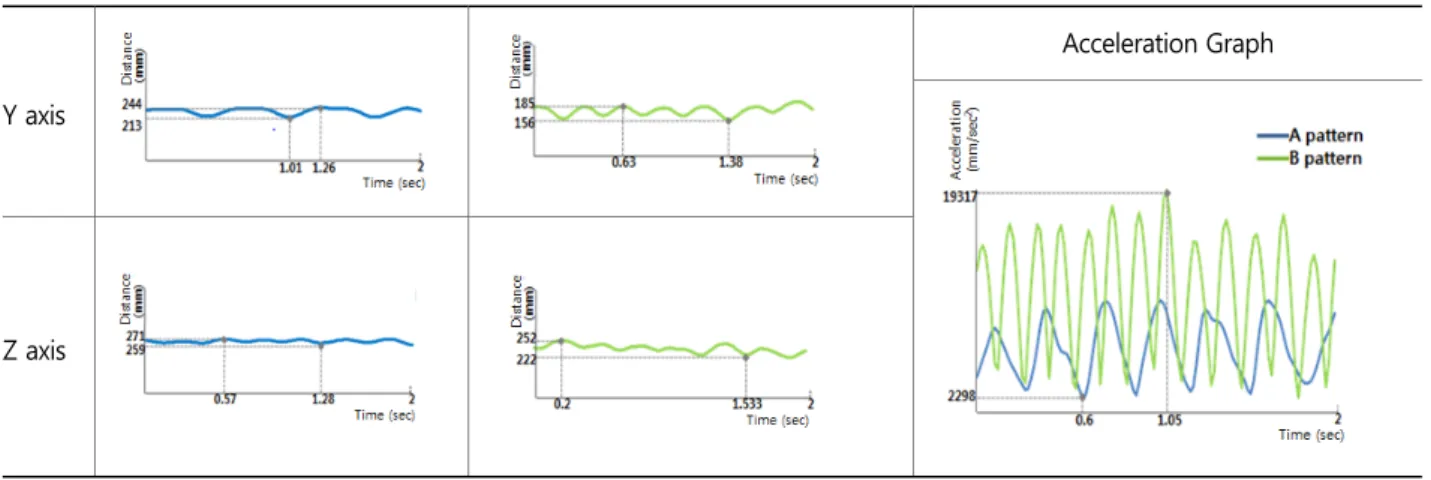
Through the same method as motion pattern identification on shaking motion, the motion pattern on shaking left and right was identified targeting 22 subjects. According to the analysis results in Table 4, A pattern, in which continuously shaking is conducted after fixing wrist, is the most typical motion pattern. However, A pattern does not show over 50% frequency. As a result of analyzing the displacement by X axis, Y axis and Z axis, the displacement in the X axis direction is shown cyclically, but almost no displacements in Y axis and Z axis directions are found (Table 5). That is, the subjects conducting a motion in this pattern shake the cellular phone left and right in the x axis direction. Looking at the graph showing the velocity and acceleration components of A pattern, the increase and decrease of velocity and acceleration are repeated cyclically (Table 5).
Table 4. Motion pattern for shaking left and right 3D pattern
graph Pattern Descrip. Freq 3D pattern
graph Pattern Descrip. Freq
Continuously shaking after
fixing wrist 8
Continuously shaking by making the motion small after fixing wrist
2
Continuously shaking by
using wrist 5 Shaking only once
by using wrist 2
Shaking twice by
using wrist 4 Shaking only once
by fixing wrist 1
Table 5. Component analysis for typical shaking left and right patterns
Displacement graph Velocity graph
Pattern
X axis
3.3 Shaking up and down
This study identified six typical patterns by analyzing the shaking up and down motion of 22 subjects. As shown in the shaking motion pattern identification, the six patterns were analyzed and drawn through X, Y and Z axes of trajectory of the markers attached to the cellular phone measured by motion capture.
According to the analysis results in Table 6, the motion repeatedly shaking up and down looking at the front can be checked as the most typical pattern from motion capture. Consequently, it is judged to adopt A pattern (repeatedly shaking up and Table 5. Component analysis for typical shaking left and right patterns (Continued)
Y axis
Acceleration Graph
Z axis
Table 6. Motion pattern for shaking up and down 3D pattern
graph Pattern View Descrip. Freq 3D pattern
graph Pattern View Descrip. Freq
Front
view Repeatedly
shaking 10 Front
view
Shaking twice (after fixing
wrist) 2
Side view
Repeatedly shaking (after fixing wrist)
4 Side
view
Shaking only once (after fixing wrist) 2
Side view
Repeatedly shaking (by
using wrist) 3 Side
view
Shaking only once (after fixing wrist) 1
Journal of the Ergonomics Society of Korea
down) as the standard motion of shaking up and down.
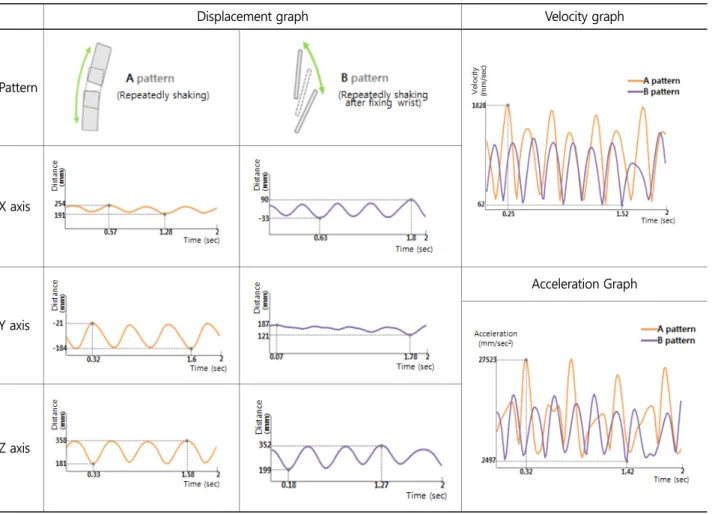
Looking into the displacement analysis of A pattern and B pattern by X axis, Y axis and Z axis, displacement in the X axis direction is small, but the displacements in the Y and Z axes are large. According to the graphs showing the velocity and acceleration components on A pattern, the increase and decrease of velocity and acceleration are repeated cyclically (Table 7).
3.4 Turning over
This study identified six typical patterns by analyzing turning over motions of 22 subjects. As shown in shaking motion pattern, the six patterns were analyzed and drawn by analyzing the trajectory of makers attached to the cellular phone in the X, Y and Z axes measured through motion capture.
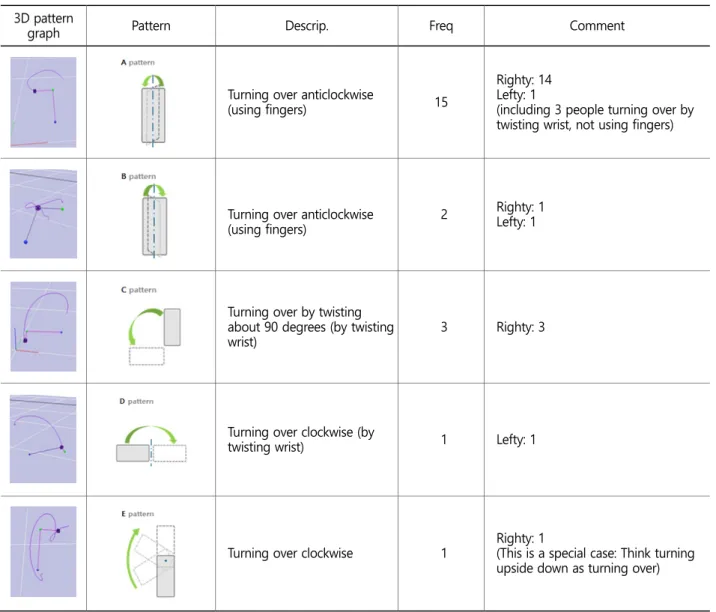
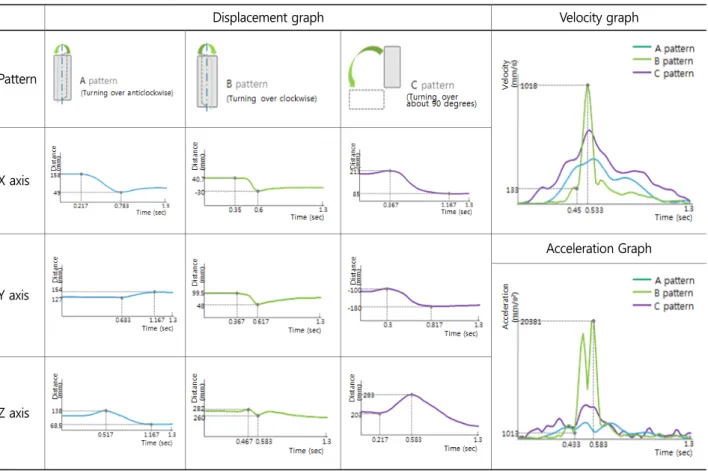
According to the number of subjects who conducted motions in each pattern in Table 8, A pattern that turns over the cellular phone anticlockwise is the most typical pattern. Through the displacement analysis by X axis, Y axis and Z axis, maximum displacement can be drawn. Looking into the graphs showing the velocity and acceleration components of A, B and C patterns, the velocity and acceleration upon turning over hugely increase (Table 9).
Table 7. Component analysis for typical shaking up and down patterns
Displacement graph Velocity graph
Pattern
X axis
Y axis
Acceleration Graph
Z axis
4. Conclusion
As offering new experiences to users recently emerges as a core competitive factor of a product, the provision of an interface mode that can offer user's emotional satisfaction can be one of the most important factors. The mode enabling interaction with a device by user's motions is considered as one of the important methods to provide better use experiences to users. To offer an interaction mode through motions, it is necessary to observe user's motions on device function performance, from which the pattern to be used as the standard of a motion is identified. This study identified motion patterns on the four basic motions used for interaction with a device basically, and extracted basic data for each pattern. To identify a simple motion pattern, it can be identified by observing motions; however, it is impossible to draw detailed design indicators on the motion's velocity and displacement, and components by coordinate axis through just observation. Therefore, this study used motion capture equipment.
As the experiment results of motion pattern identification using motion capture equipment, this study extracted specific motion patterns and design data on such four motions as shaking, shaking left and right, shaking up and down, and turning over.
Table 8. Motion pattern for turning over 3D pattern
graph Pattern Descrip. Freq Comment
Turning over anticlockwise
(using fingers) 15
Righty: 14 Lefty: 1
(including 3 people turning over by twisting wrist, not using fingers)
Turning over anticlockwise
(using fingers) 2 Righty: 1
Lefty: 1
Turning over by twisting about 90 degrees (by twisting
wrist) 3 Righty: 3
Turning over clockwise (by
twisting wrist) 1 Lefty: 1
Turning over clockwise 1 Righty: 1
(This is a special case: Think turning upside down as turning over)
Journal of the Ergonomics Society of Korea
The results in this study can be used as important basic design data for motion interface development. However, a supplementary experiment targeting more subjects is required to enhance the reliability of patterns and attributes data. A further study to complement such an issue needs to be carried out in the future.
References
Braido, P. and Zhang X., Quantitative analysis of finger motion coordination in hand manipulative and gestic acts, Human Movement Science, 22, 661-678, 2004.
Cai, L. and Chen, H., "Touchlogger: Inferring keystrokes on touch screen from smartphone motion". Proc. of HotSec’11, 2011.
Gyeong, D., Han, E., Yang, J. and Jeong, G., Interface Study in Tangible Interactive Environment, Journal of Multimedia and Information Systems, 10(3), 64-72, 2006.
Kamat, S.R. and Yoxall, A., "A Kinetic Study: Understanding Hand and Finger Motion Whilst Squeezing Bottles", Proceedings of the 2014 International Conference on Industrial Engineering and Operations Management, 2014.
Kang, S. and Son, W., Analysis of Drive Motion by Grip Type in Table Tennis, Korean Journal of Sport Science, 17(3), 67-78, 2006.
Table 9. Component analysis for typical turning over patterns
Displacement graph Velocity graph
Pattern
X axis
Y axis
Acceleration Graph
Z axis
Lee, A., Interface Technology to Improve Product Value, SERI Economy Focus, SERI, 2008.
Pavlovic, V., Sharma, R. and Huang, T., Visual interpretation of hand gestures for human-computer interaction: A review. IEEE Trans. Pattern Anal. Mach. Intell., 19(7), 677-695, 1997.
Quek, F., "Toward a Vision-based Hand Gesture Interface", Proceedings of Virtual Reality Software and Technology Conference (VRST), 17-31, 1994.
Sanders, M.S. and McCormick, E.J., Human factors in engineering and design, 7th ed., McGraw Hill, 1993.
Schloemer, T., Poppinga, B., Henze, N. and Boll, S., "Gesture recognition with a wii controller", Proceedings of the Second International Conference on Tangible and Embedded Interaction (TEI’08), ACM, 1-4, 2008.
Witte, K., Schobesberger, H. and Peham, C., Motion pattern analysis of gait in horseback riding by means of Principal Component Analysis, Human Movement Science, 28(3), 394-405, 2009.
Yun, S., Lee, T., Park, S., Yi, J. and Kim, J., Muscle Activity and a Kinematic Analysis of Drinking Motion, The Journal of Korean Society of Occupational Therapy, 16(1), 77-88, 2008.
Author listings
Kwang Tae Jung: [email protected]
Highest degree: PhD, Department of Industrial Engineering, KAIST
Position title: Professor, Department of Industrial Design Engineering, Koreatech.
Areas ofinterest: Applied Ergonomics and Design, Emotional Design, HCI
Jaein Lee: [email protected]
Highest degree: PhD, Department of Industrial Engineering, KAIST
Position title: Part-time Instructor, Department of Industrial Design Engineering, Koreatech.
Areas ofinterest: UI/UX, Human Error