• 검색 결과가 없습니다.

Occurrence of Phytopythium vexans Causing Stem Rot on Anthurium andraeanum in Korea

N/A
N/A
Protected

Academic year: 2021

Share "Occurrence of Phytopythium vexans Causing Stem Rot on Anthurium andraeanum in Korea"

Copied!
4
0
0

로드 중.... (전체 텍스트 보기)

전체 글

(1)

443 This is an Open Access article

distributed under the terms of the Creative Commons Attribution Non-Commercial License (http: //creativecommons.org/licenses/by- nc/4.0/) which permits unrestricted non-commercial use, distribution, and reproduction in any medium, provided the original work is properly cited.

The Korean Journal of Mycology 2019 Vol.47

The Korean Journal of Mycology www.kjmycology.or.kr

© 2019 THE KOREAN SOCIETY OF MYCOLOGY.

Accepted: December 20, 2019 Revised: December 20, 2019 Received: December 20, 2019 https://doi.org/10.4489/KJM.20190049 Kor. J. Mycol. 2019 December, 47(4): 443-6

OPEN ACCESS pISSN : 0253-651X eISSN : 2383-5249

RESEARCH NOTE

Occurrence of Phytopythium vexans Causing Stem Rot on Anthurium andraeanum in Korea

Mi-Jeong Park

*

, Chang-Gi Back, Jong-Han Park

Horticultural and Herbal Crop Environment Division, National Institute of Horticultural and Herbal Science, Rural Development Administration, Wanju 55365, Korea

*
Corresponding author: [email protected]

ABSTRACT

In 2017, wilting symptom was observed on seedlings of Anthurium andraeranum in Youngin, Korea. Brownish lesions with water soaking were developed on the stems and roots of the infected plants. The stems and leaves wilted and finally died. One fungal isolate was obtained in pure culture. Morphological features and nucleotide sequences of internal transcribed spacer rDNA and cytochrome oxidase subunit II mt DNA were analyzed. The results of this study indicated that the fungus is identified as Phytopythium vexans. Pathogenicity tests showed the isolate was pathogenic to the seedlings of A. andraeanum. To our knowledge, this is the first report of P. vexans causing stem rot on A. andraeanum in Korea.

Keywords: Anthurium andraeanum, cytochrome oxidase subunit 2, Phytopythium vexans, Stem rot

Anthurium andraeanum Linden (also called flamingo flower or flamingo lily) is grown for potted and cut- flower plant worldwide because of its attractive spathe and foliage. In September 2017, wilting symptoms appeared on seedlings of A. andraeanum in a farm located in Yongin, Korea (37°05′57.6″N, 127°08′26.3″E).

The lower parts of the affected stems developed water-soaked appearance and brown discoloration which later extended upward into leaves. (Fig. 1A, 1B, 1C). Under moist conditions, white mycelium was found around the infected stems. The severely diseased leaves wilted, collapsed, dried, and finally died. These symptoms occurred on approximately 5% of seedlings.

A fungal isolate was obtained from the diseased plant tissues by single hyphal tip isolation. For isolation of

the fungus, small size of plant tissue was surface-disinfected with 70% ethanol and 1% sodium hypochlorite,

and then placed on potato dextrose agar (PDA) for cultivation. The colony on PDA grew slowly, producing

white fluffy aerial mycelium, with an irregular margin, reaching 80 mm diam. after 4 weeks (Fig. 1E). The

culture was deposited in the Korean Agricultural Culture Collection (accession number KACC48403). To

observe morphological characteristics, the fungus was grown on water agar containing sterile grass blade

for 7 days. Primary hyphae were up to 5.5 μm in width, and hyphal swellings were not observed. Sporangia

(2)

Park et al.

The Korean Journal of Mycology 2019 Vol.47 444

were papillate or non-papillate, globose to subglobose, terminal, 33-38 μm long × 20-28 μm wide (Fig. 1F, 1G). Encysted zoospores were 9-11 μm in diameter (Fig. 1H). The culture seems to be sterile as the sexual

organs, oogonia and antheridia, were not produced on media. The morphological features are insufficient to identify the fungal species. Thus, the identity of the pathogen was confirmed by the data from the molecular sequence analysis.

Genomic DNA was extracted from fungal mycelia using DNeasy Plant Mini Kit (Qiagen, Valencia, USA) according to the manufacturer's protocol. The internal transcribed spacer (ITS) of ribosomal DNA region was amplified using the primers ITS1 (5 ′-TCC GTA GGT GAA CCT GCG G-3′) and ITS4 (5′

-TCC TCC GCT TAT TGA TAT GC-3 ′) [1]. The cytochrome oxidase subunit II (cox2) mt DNA was

amplified using the primers Cox2-F (5'-GGC AAA TGG GTT TTC AAG ATC C-3') and Cox2-RC4

(5'-TGA TTW AYN CCA CAA ATT TCR CTA CAT TG-3') [2]. The PCR products were sequenced by

BIOFACT (Daejeon, Korea). The resulting sequences were edited using SeqMan program (DNASTAR

Lasergene, Madison, WI, USA) and submitted to GenBank (accession number MH478301 for ITS,

MH492367 for cox2). The NCBI BLASTn searches of the present sequences showed 100% identity with

cox2 sequence (NBRC100105) and 99% with ITS sequence (CBS119.80) of Phytopythium vexans. The

Fig. 1. Characteristics of stem rot caused by Phytopythium vexans on Anthurium andraeanum. A, Diseased

seedlings with wilting symptom; B, Lower parts of affected plants showing lesions of brown discoloration and

rotting; C, Discolored vascular tissues; D, Inoculated plant(left) showing wilting symptom and uninoculated

plant(right) showing no visible symptoms in pathogenicity test; E, Colony grown on PDA after incubation for 4

weeks; F, Subglobose sporangium with papilla; G, Globose sporangium; H, Zoospores. (scale bars: F-H = 10 µm).

(3)

Stem Rot Caused by Phytopythium vexans on Anthurium andraeanum

The Korean Journal of Mycology 2019 Vol.47 445

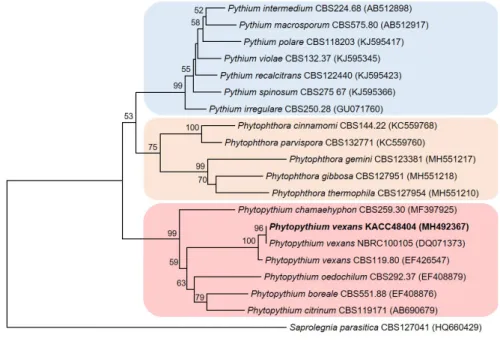
phylogenetic relationship was inferred from the cox2 sequences for P. vexans and related species belonging to three allied genera, Phytopythium, Pythium, and Phytophthora. The reference sequences were retrieved from GenBank. Saprolegnia parasitica (CBS 127041) was used as an outgroup. A neighbor-joining tree was constructed by MEGA7 [3]. In the phylogenetic tree, the present isolate formed a well-supported clade with the reference isolates of P. vexans (bootstrap value 100%) (Fig. 2). Phytopythium species including P. vexans, formerly classified under the genus Pythium, were phylogenetically distinct from the current species of the genus Pythium (Fig. 2). The genus Phytopythium was newly established for Pythium species showing combined characteristics of both Pythium and Phytophthora [4, 5]. The result of molecular phylogeny indicates that the present isolate is identified as P. vexans [4].

Pathogenicity of the fungal isolate was tested on the seedlings of Anthurium andraeanum. For preparation of the fungal inoculum, mycelial mats were harvested from cultures grown for 2 weeks on PDA. The hyphal suspensions were poured into 5 pots (one seedling per pot). Five seedlings treated with sterile water served as control. All plants were kept in the glasshouse at 26 °C. The soils in pot were kept in moist condition. After 2 weeks of inoculation, wilting symptom appeared on the leaves of the fungus-inoculated plants (Fig. 1D). No symptoms were observed on control plants. The fungus was consistently re-isolated from all inoculated plants. The pathogenicity testing showed that the isolate of P. vexans is pathogenic to A.

andraeanum.

Fig. 2. Neighbor-joining tree based on the sequences of cytochrome oxidase subunit II mtDNA, showing a

phylogenetic affinity of the Korean isolate (in boldface) with other Phytopythium species. Saprolegnia parasitica

was designated as the outgroup. Bootstrap values above 50% were shown at the nodes. The scale bar represents 0.02

nucleotide substitutions per site.

(4)

Park et al.

The Korean Journal of Mycology 2019 Vol.47 446

Phytopythium vexans known as saprobe and phytopathogen, displays a broad host range including economically important crops and trees worldwide [6]. The fungal species has been reported to cause root rot of A. andraeanum in Hawaii [7, 8]. However, there has been no previous record of A. andraeanum associated with P. vexans in Korea. To our knowledge, this is the first report of stem rot disease occurring on seedlings of A. andraeanum in Korea.

Acknowledgements

This work was carried out with the support of the "Cooperative Research Program for Agriculture Science

& Technology Development (Project No. PJ01136802)" Rural Development Administration, Republic of Korea.

References

1. White TJ, Bruns T, Lee S, Taylor J. Amplification and direct sequencing of fungus ribosomal RNA genes for phylogenetics. In: Innis MA, Gelfand DH, Sninsky JJ, White TJ, editors. PCR protocols: a guide to methods and applications. San Diego: Academic Press; 1990. p. 315-22.

2. Choi YJ, Beakes G, Glockling S, Kruse J, Nam B, Nigrelli L, Ploch S, Shin HD, Shivas RG, Telle S, Voglmayr H, Thines M. Towards a universal barcode of oomycetes – a comparison of the cox1 and cox2 loci. Mol Ecol Resour 2015;15:1275-88.

3. Tamura K, Stecher G, Tamua K. MEGA7: molecular evolutionary genetics analysis version 7.0. for bigger datasets. Mol Biol Evol 2016;33:1870-4.

4. de Cock AWAM, Lodhi AM, Rintoul TL, Bala K, Robideau GP, Gloria Abad Z, Coffey MD, Shahzad S, Lévesque CA. Phytopythium: molecular phylogeny and systematics. Persoonia 2015;34:25-39.

5. Bala K, Robideau GP, Lévesque A, de Cock AWAM, Abad ZG, Lodhi AM, Shahzad S, Ghaffar A, Coffey MD. Phytopythium Abad, de Cock, Bala, Robideau & Levesque, gen. nov.

and Phytopythium sindhum Lodhi, Shahzad & Levesque, sp. nov. Persoonia 2010;24:136-7.

6. van der Plaats-Niterink AJ. Monograph of the genus Pythium. Stud Mycol 1981;21:1-242.

7. Guo LY, Ko WH. Survey of root rot of Anthurium. Plant Pathol Bull 1994;3:18-23.

8. Farr DF, Rossman AY. Fungal Databases. Systematic Mycology and Microbiology Laboratory,

ARS, USDA, Retrieved December 7, 2019, from http://nt.ars-grin.gov/fungaldatabases/.

수치

Fig. 2.  Neighbor-joining tree based on the sequences of cytochrome oxidase subunit II mtDNA, showing a  phylogenetic affinity of the Korean isolate (in boldface) with other Phytopythium species

참조

관련 문서

계통학적 유연 관계 분석을 위하여, large subunit rDNA 영역 및 cytochrome c oxidase subunit 3 (CO3) 유전자 영역을 이용하여 계통학 적 유연관계를 분석한

A phylogenetic analysis based on the 16S rRNA gene sequence suggested that Ra3 related to the genus Pseudomonas, and further studies based on the combined gyrB and

A neighbor-joining tree based on the combined internal transcribed spacer (ITS) rDNA and cox2 gene sequence datas- ets showing phylogenetic affinities of the two isolates

Phylogenetic tree using internal transcribed spacer sequences showing closest known relatives of Sclerotium rolfsii, including sclerotium rot fungus infecting cucumber

This study was performed to discriminate the genetic variances by the partial sequences of the mitochondrial cytochrome c oxidase subunit I (COI) genes and

Phylogenetic tree constructed with neighbor-joining (NJ) method, based on the concatenated ITS and tub2 gene sequences, shows the phylogenetic position of Acrophialophora

Neighbor-joining phylogenetic tree based on a combined alignment of internal transcribed spacer, large subunit rDNA, and beta-tubulin rDNA sequences.. Nectria dacryocarpa was used

2] Molecular phylogenetic tree by neighbor- joining analysis constructed based on partial nucleotide sequences of MCP gene in various megalocytiviruses including