• 검색 결과가 없습니다.

The Impact of Responsible Accounting on Organizational Performance: A Case Study of Pharmaceutical Enterprises in Vietnam

N/A
N/A
Protected

Academic year: 2021

Share "The Impact of Responsible Accounting on Organizational Performance: A Case Study of Pharmaceutical Enterprises in Vietnam"

Copied!
7
0
0

로드 중.... (전체 텍스트 보기)

전체 글

(1)

Print ISSN: 2288-4637 / Online ISSN 2288-4645 doi:10.13106/jafeb.2021.vol8.no3.1065

The Impact of Responsible Accounting on Organizational Performance:

A Case Study of Pharmaceutical Enterprises in Vietnam *

Thieu Manh NGUYEN

1

Received: November 30, 2020 Revised: February 01, 2021 Accepted: February 16, 2021

Abstract

This study seeks to analyze the impact, and provides more empirical evidence on the effect, of the responsible accounting model combined with scorecards on the organizational performance of pharmaceutical companies. The research methodology uses questionnaires survey distributed to pharmaceutical companies. Quantitative research was done with SPSS 25 software. After excluding invalid questionnaires due to many blank boxes, 306 questionnaires could be used by the author. Research results show that seven elements of the responsible accounting model combined with the balance scorecard all positively affect the organizational performance of enterprises in the pharmaceutical industry including: (1) dividing organizational structure into centers of responsibility according to strategy; (2) assigning management to management according to vision; (3) allocating costs and revenue; (4) making budget estimates according to balanced scorecard (BSC);

(5) evaluating estimates with reality by BSC; (6) making BSC analysis reports; and (7) rewarding based on BSC. Cost allocation and revenue are the factors that have the strongest impact on the organizational efficiency of pharmaceutical enterprises. Based on the research results, the author has proposed recommendations to improve the good application of the responsible accounting model combined with the balance scorecard, thereby contributing to improving the organizational efficiency of pharmaceutical enterprises.

Keywords: Responsible Accounting, Balanced Scorecard, Organizational Performance, Pharmaceutical Enterprises JEL Classification Code: G30, M40, M41

Balanced Scorecard (BSC) is a modern, goal-based management method. Accordingly, the development orientation of the business is shown by the targets. The targets are harmoniously organized and balanced by the pharmaceutical enterprise based on the important priorities of the enterprise. BSC helps guide the behavior of the entire system in the business, helps all parts of the business toward common goals, and serves as the basis for job management and evaluation. BSC is exploited to communicate the interconnected goals set by businesses, both assessing the past and the prospects of the business. The main aspects of BSC include: financial prospect, customer prospect, internal process prospect, and learning and development prospect.

These prospects have a close relationship with each other.

One of the causes creating risks for the pharmaceutical enterprises in particular in Vietnam is the unstable macro environment (Pham, 2020). According to the national strategy to develop Vietnam’s pharmaceutical industry to 2020 and vision to 2030, the Vietnamese government has identified the pharmaceutical industry as a key industry in fostering economic development and create welfare for

*Acknowledgements:

[1] The author is thankful to Academy of Finance for funding this research.

[2] I would like to thank the anonymous referees for their helpful comments and suggestions.

1

First Author and Corresponding Author. Head of the Organization Staff, Academy of Finance, Vietnam [Postal Address: 58 Le Van Hien Road, Bac Tu Liem District, Hanoi, 130500, Vietnam]

Email: [email protected]

© Copyright: The Author(s)

This is an Open Access article distributed under the terms of the Creative Commons Attribution Non-Commercial License (https://creativecommons.org/licenses/by-nc/4.0/) which permits unrestricted non-commercial use, distribution, and reproduction in any medium, provided the original work is properly cited.
1. Introduction

Responsible accounting is a part of the accounting system

with the function of collecting, consolidating and reporting

information related to the managerial responsibilities at all

levels in the organization. Thereby, providing information

related to costs, income, and performance of each department

for which they are responsible (Anthony et al., 2001).

(2)

the people in the future. The focus areas of the National Strategy include: Universal Health Insurance, Affordable Patient Access to Quality Medicine, and Development of the Domestic Pharmaceutical Industry. In order to achieve the targets in the above focus areas, the government has enacted many policies. In the National Strategy for the Development of the Pharmaceutical Industry, the government aims to reduce dependence on imports and focus on modernization, so that Vietnam’s pharmaceutical industry becomes on par with other countries in the world. In the long run, the government aims to meet the basic health needs of the country through localization of production, and at the same time toward the production of therapies for therapeutic purposes. Vietnam also aims to make pharmaceuticals capable of producing vaccines and biological products to prevent epidemics, and to develop testing systems, drug distribution and drug information equivalent to that of advanced countries in this area. Furthermore, the leaders should be confident of their own ability and consistency with company’s goals (Nguyen et al., 2019). In Halal, knowledge had more influence on consumer intention to consume halal pharmaceuticals than cosmetics and food products (Sudarsono & Nugrohowati, 2020).

With the development strategies of Vietnam’s pharmaceutical industry in the coming years and the current integration context, pharmaceutical businesses will have many opportunities and challenges. Therefore, in order to provide more comprehensive and accurate information, accountants need to combine with a balance scorecard to help administrators give the best business decisions to improve the competitiveness of the sector.

2. Literature Review

2.1. Responsibility Accounting Model

The empirical studies on responsible accounting are also gradually deployed and applied. Bloomfield et al. (1992) analyzed hospital management information systems in the UK. Shih (1997) looked at the process of investigating how firms design performance evaluation systems for crop managers.

In addition to emphasizing more research on responsible accounting, Antle and Demski (1988) shed light on what is a controllable principle in accounting. Okoye (2009) presented studies on the relationship between responsible accounting and management performance in manufacturing firms; responsible accounting is a tool to assess a business’s managerial responsibility.

Research by Hyršlová and Hájek (2006), Okoye (2009), and Larsson and Svensson (2010) is very meaningful in bringing environmental issues into accounting. In addition, one of the studies on social responsibility accounting that

needs to be mentioned is the study by Gholami et al. (2012) showing that, besides financial goals, the enterprise must pay attention to social responsibility because unethical behaviors will greatly affect the performance of the unit. The studies on responsible accounting are also inseparable from the above trend.

Sarkar and Yeshmin (2005), doing research on accountability in Bangladesh, showed that there are units surveyed that have designed four responsibility centers in their unit and also design units of three responsibility centers. A common tool used to evaluate effectiveness is budgeting. Leadership of sales centers is assessed using segment reporting (Sarkar & Yeshmin, 2005).

Muthulakshmi (2014) found that responsible accounting consists of five responsibility centers, which are cost center, revenue center, profit center, investment center, and profit contribution center.

Thus, in recent years, accounting in general and responsible accounting in particular have gone deep into issues of environment, social responsibility, and sustainable development. To evaluate the results of the departments, the performance evaluation models have been researched and proposed by scientists. One of the evaluation models that combines all three economic (financial), environmental, and social issues for sustainable development is Knowledge Management Star (KM Star) model by Nirmal Pal and public associates, published in 2004. Specifically, this model evaluates the department’s performance based on five elements: financial, sustainability, customer, process, and perception.

In summary, responsible accounting is a very effective control tool that has been studied by foreign authors from different angles. These are very useful contents for applying the responsible accounting system in practical conditions in Vietnam.

2.2. Balanced Scorecard

The BSC method is a strategic planning and management system used by business organizations, non-profit organizations, and governments to guide business operations according to vision and strategy. It improves the efficiency of internal and external communication and monitor the performance of the business against the set target. It gives managers and senior officials in organizations a more balanced view of the overall performance of the organization (Kaplan & Norton, 1992).

The original purpose of the BSC was to balance financial

ratios with the future value orientation of the business,

and later on, more and more organizations are using this

tool to align their business activities. BSC is exploited to

communicate the interconnected goals set by businesses,

both assessing the past and the prospects of the business.

(3)

The main aspects of BSC include: financial prospect, customer prospect, internal process prospect, and learning and development prospect. These prospects have a close relationship with each other.

In short, BSC directs the entire enterprise to the main stages toward the breakthrough; helps to consolidate various corporate programs such as quality, innovation, initiative, and customer satisfaction. More importantly, the balanced scorecard is a tool to break local strategic measures, so that business owners, managers, and employees can clearly see their role in implementing the organization’s strategy and focus wholeheartedly on those strategies. However, this is a very difficult method to apply as it requires consensus of the whole enterprise, and it takes a lot of time and resources to apply.

2.3. The Responsible Accounting Model Combined with the Balance Scorecard

Mojgan (2012) has studied the role of responsible accounting in the organization by qualitative methods.

Research results show that the purpose of responsible accounting is designed to report and accrue costs according to individual liability purposes. Each monitoring area is charged only with the cost of responsibility and the cost over which it has control. There are three types of responsibility centers: cost center, revenue center, and investment center.

The criteria given to evaluate the company’s performance include: return on investment (ROI), residual income (RI), return on revenue (ROS), economic value added (EVA), and balance score card (BSC).

Al-Baidhani (2013) studies the use of balanced scorecards as an effective management and estimation tool. Companies need to establish strategic guidelines and operational goals on all levels. The equilibrium scorecard provides such indications; it provides the link between measurement systems and strategy. The transformation from the industrial economy to the knowledge economy around the world motivates us to use BSC. Hanini (2013), when studying the implementation level of the responsible accounting characteristics in Jordan banks, gave some recommendations such as: it is necessary to set goals and budget for the responsibility centers at banks. Banks in Jordan should be encouraged to use other modern methods of management accounting in business such as Balanced Scorecard (BSC).

Van (2017) said that responsible accounting is an important economic and financial management tool in the business, through decentralization of management responsibilities for the responsibility-minded administrators who evaluate the responsibilities and achievements of each department specifically and accurately. Tran (2020) shows that the application of the responsible accounting model combined with scorecards among Vietnamese pharmaceutical

companies is low. Since then, recommendations are also proposed to improve the application of the responsible accounting model incorporating balance scorecard in the enterprise.

3. Research Methodology 3.1. Research Method

The research method used includes a questionnaire survey of pharmaceutical companies to evaluate the impact of responsible accounting combined with balanced scorecards on organizational performance. Organizational efficiency and the seven elements of the responsible accounting model combined with the balance scorecard, are measured on the five-point Likert scale – Very good, Good, Average, Not good, Weak. The Likert scale is a familiar tool in many studies, so the author quantifies each factor of internal control according to five levels. Quantitative research was performed using SPSS 25 software.

The research scope encompasses all pharmaceutical companies. Research data is collected in the form of direct interviews and email interviews of managers and employees working in many different positions in the pharmaceutical enterprises. Researchers collected 315 questionnaires from 350 distributed. After excluding invalid questionnaires due to many blank boxes, 306 questionnaires remained for further analysis.

3.2. Hypotheses

In order to be able to provide managers better and more comprehensive information than the traditional responsible accounting model, responsible accounting needs to be combined with a balanced scorecard. Therefore, the content- based approach of the responsible accounting will be selected to carry out the research to study the model of responsible accounting combined with the balance scorecard (BSC).

From the research model, to assess the impact of responsible accounting in combination with the balanced scorecard on organizational performance in the pharmaceutical industry in Vietnam, the study formulated the following hypotheses:

H1: The pharmaceutical enterprise’s division of its organizational structure into strategic responsibility centers significantly impacts the organizational effectiveness.

H2: The pharmaceutical enterprise’s decentralization to administrators according to a better vision significantly impacts the organizational effectiveness.

H3: The pharmaceutical enterprise’s distribution of

costs and revenue significantly impacts the organizational

effectiveness.

(4)

H4: The pharmaceutical enterpriss making estimates according to BSC significantly impacts the organizational effectiveness.

H5: The pharmaceutical enterprise’s assessment of estimates with the reality according to BSC significantly impacts the organizational effectiveness.

H6: The pharmaceutical enterprise’s application of analysis report according to BSC significantly impacts the organizational effectiveness.

H7: The better the pharmaceutical enterprise applies BSC-based Reward's the bigger the organization will be.

4. Research Results 4.1. Scale Test

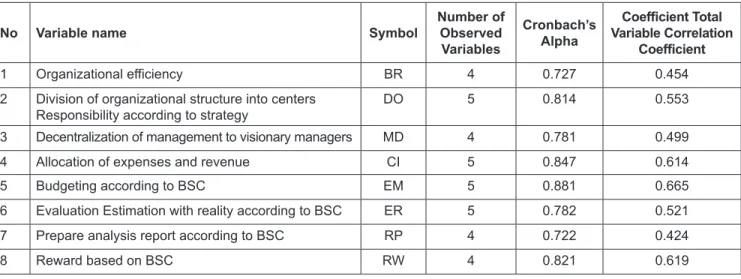
The results of evaluating the reliability of the scale with Cronbach’s Alpha showed that all scales had reliability greater than 0.6 and total variable correlation coefficient greater than 0.3. All scales satisfy the conditions to analyze discovery factors EFA. The reliability of the scales is summed up in Table 1.

4.2. Explore Factor Analysis EFA

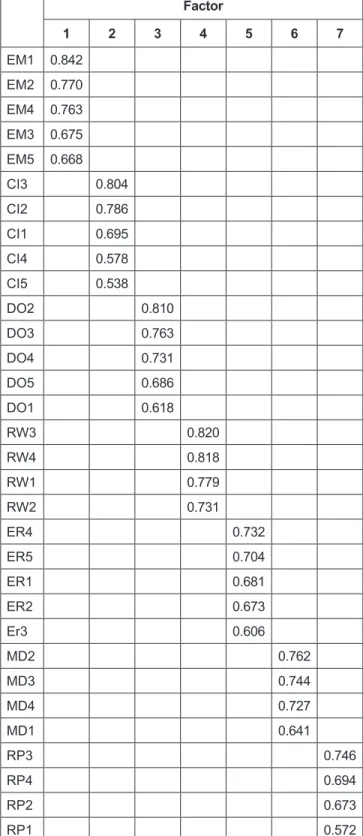
Factor analysis was performed with Principle Component extraction and Varimax rotation for the dependent observed variable. The results showed that the coefficient KMO = 0.847 meets the condition > 0.5); Significance level and Bartlett test = 0.000 (<0.05) show that the EFA analysis is appropriate. The total extracted variance is 63.676% >

50%; load factors are greater than 0.5, thus, should meet the requirements. The official scale after handling EFA includes 32 observed variables as proposed.

4.3. Regression Analysis

R squared reflects the influence of the independent variables on the variation of the dependent variable, in this case seven elements (Divide organizational structure into centers of responsibility according to Strategy, Assign management to management according to vision, Allocate costs and revenue, Make budget estimates according to BSC, Evaluate estimates with reality by BSC, Make BSC analysis reports, and Reward based in BSC). They explain 63.2% of the organizational performance of pharmaceutical companies. Other factors outside the model and random error affect 36.8% of the organizational performance factor of pharmaceutical companies. The Durbin-Watson coefficient is 1,810, in the range from 1.5 to 2.5, so there is no first-order series autocorrelation.

In order to check whether this regression model is suitable with the collected data set and has application significance, the author continues to test the suitability of the model through ANOVA test as follows:

Sig. tested F = 0.000 < 0.05, so the regression model assesses the impact level of the seven factors (see above) on the organizational performance of pharmaceutical companies.

The model’s F-statistic has the value Sig. = 0.000 <

0.05, which indicates that the model is suitable for the data set and can be deduced overall. VIF coefficients are all less than 2, so there is no multicollinearity phenomenon between components that does not appear in the research model.

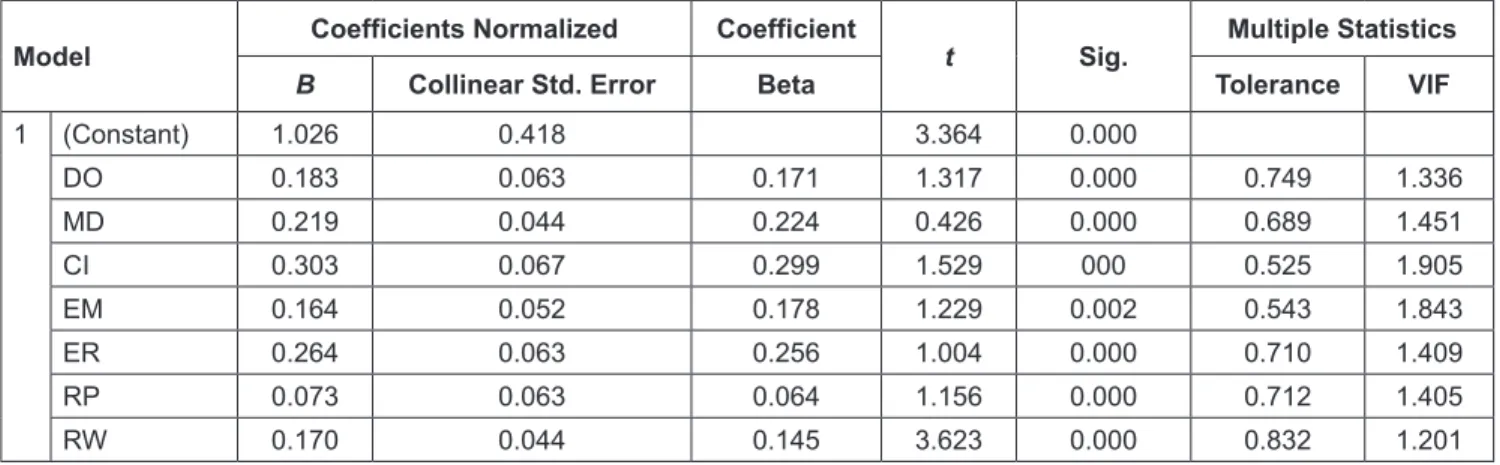
The regression results show that the influence of the seven elements of the responsible accounting model combined with the balanced scorecard on the organizational efficiency of pharmaceutical enterprises is shown in Table 5.

Table 1: Scale Test Results

No Variable name Symbol Number of

Observed Variables

Cronbach’s Alpha

Coefficient Total Variable Correlation

Coefficient

1 Organizational efficiency BR 4 0.727 0.454

2 Division of organizational structure into centers

Responsibility according to strategy DO 5 0.814 0.553

3 Decentralization of management to visionary managers MD 4 0.781 0.499

4 Allocation of expenses and revenue CI 5 0.847 0.614

5 Budgeting according to BSC EM 5 0.881 0.665

6 Evaluation Estimation with reality according to BSC ER 5 0.782 0.521

7 Prepare analysis report according to BSC RP 4 0.722 0.424

8 Reward based on BSC RW 4 0.821 0.619

(5)

Table 2: Results of Factor Analysis to Discover EFA Independent Variables

Factor

1 2 3 4 5 6 7

EM1 0.842 EM2 0.770 EM4 0.763 EM3 0.675 EM5 0.668

CI3 0.804

CI2 0.786

CI1 0.695

CI4 0.578

CI5 0.538

DO2 0.810

DO3 0.763

DO4 0.731

DO5 0.686

DO1 0.618

RW3 0.820

RW4 0.818

RW1 0.779

RW2 0.731

ER4 0.732

ER5 0.704

ER1 0.681

ER2 0.673

Er3 0.606

MD2 0.762

MD3 0.744

MD4 0.727

MD1 0.641

RP3 0.746

RP4 0.694

RP2 0.673

RP1 0.572

The regression model is written as follows:

BR = 1.026 + 0.171DO + 0.224MD + 0.299CI + 0.178EM + 0.256ER + 0.064RP + 0.145RW + E

Histogram normalized residual frequency chart with very small mean value close to 0 (Mean = 3.4 E – 16) and standard deviation is close to 1 (0.988). Thus, the normal distribution of the remainder is not violated.

5. Discussion and Recommendations 5.1. Discussion

Based on the results of the quantitative research on the factors of accounting model responsibility combined with Balanced Scorecard to effectively organize the business sectors of Pharmaceuticals, we can draw some conclusions:

As regards the method, the multiple linear regressions extracted by the standardized Beta show that the cost and revenue factors have a higher normalized Beta coefficient (0.299) than all other factors. The standardized Beta coefficients of the remaining factors in turn are: Divide the organizational structure into strategic responsibility centers (0.171), Decentralize management for administrators according to vision (0.224), Accounting according to BSC (0.178), Evaluating estimates with reality according to BSC (0.256), Prepare analysis report according to BSC (0.064), and Rewards based on BSC (0.145).

Thus, cost allocation and revenue are the factors that have the strongest impact on the organizational efficiency of pharmaceutical companies. This can be explained by the fact that, for specific pharmaceutical companies, applying good cost allocation and revenue will positively affect the organizational performance, in particular, and the business performance, in general.

5.2. Recommendations

From the research results on the impacts of the responsible

accounting model combined with the balanced scorecard

on the organizational performance of the pharmaceutical

(6)

Table 5: Results Multiple Regression Results

Model Coefficients Normalized Coefficient

t Sig. Multiple Statistics

B Collinear Std. Error Beta Tolerance VIF

1 (Constant) 1.026 0.418 3.364 0.000

DO 0.183 0.063 0.171 1.317 0.000 0.749 1.336

MD 0.219 0.044 0.224 0.426 0.000 0.689 1.451

CI 0.303 0.067 0.299 1.529 000 0.525 1.905

EM 0.164 0.052 0.178 1.229 0.002 0.543 1.843

ER 0.264 0.063 0.256 1.004 0.000 0.710 1.409

RP 0.073 0.063 0.064 1.156 0.000 0.712 1.405

RW 0.170 0.044 0.145 3.623 0.000 0.832 1.201

Table 3: Results Statistical Value Factors

Model Abstract

Model R R squared Adjusted

R-squared Error Estimate of

Standard Deviation Coefficient Durbin-Watso

1 0.790

a

648 0.632 0.60167 1.810

a. Predictors: (Constant), RW, ER, MD, DO, RP, EM, CI.

b. Dependent Variable: Correct-BR.

Table 4: Suitability Test (ANOVA)

Model Sum of Squares df Mean Square F Sig.

1 Regression 57.500 7 8.214 22.691 0.000

b

Residual 107.877 298 0.362

Total 165.377 305

a. Dependent Variable: BR.

b. Predictors: (Constant), RW, ER, MD, DO, RP, EM, CI.

industry, the author gives some recommendations to improve efficiency. Organizational efficiency can contribute to improve the operational efficiency of pharmaceutical enterprises as follows:

Cost allocation and revenue are the factors that have the strongest impact on the organizational efficiency of pharmaceutical enterprises. Therefore, when applying a responsible accounting model combined with a balanced scorecard, pharmaceutical companies need to apply in an effective manner the allocation of costs and revenue. To build a suitable cost norm, businesses need to control well the actual costs incurred in the past, and then combine them with market factors to build a suitable cost norm. In addition, the manager needs to identify factors affecting costs to minimize them in the allowed conditions. It is the responsibility of the

cost center to ensure quality, but minimize costs incurred, especially variable costs.

In addition, pharmaceutical companies need to apply a responsible accounting model combined with a balance score card, namely: Divide the organizational structure into strategic responsibility centers, decentralization of management for managers according to vision, Estimate according to BSC, Evaluate estimates with reality according to BSC, Prepare analytical reports according to BSC and Rewards based on BSC.

References

Al-Baidhani, D. (2013). The Use of Balanced Scorecard as a Tool

for Performance Management and Planning. Available at SSRN

2313780. https://dx.doi.org/10.2139/ssrn.2313780.

(7)

Antle, R., & Demski, JS (1988). The controllability principle in responsibility accounting. Accounting Review, 6(4), 700–718.

https://www.jstor.org/stable/247908.

Bloomfield, B. P., Coombs, R., Cooper, D. J., & Rea, D. (1992).

Machines and manoeuvres: responsibility accounting and the construction of hospital information systems. Accounting, Management and Information Technologies, 2(4), 197–219.

https://doi.org/10.1016/0959-8022(92)90009-H

Gholami, S., Parvizi, M., TamriNeia, A., Nemati, S., Abgineh, M.,

& Emami, M. (2012). Social Responsibility Accounting: From Theory to Practice. Journal of Basic and Applied Scientific Research, 2(10), 10111–10117.

Hanini, A. (2013). The Extent of Implementing Responsibility Accounting Features in the Jordanian Banks. European Journal of Business and Management, 5(1), 217–229.

Hyršlová, J., & Hájek, M. (2006). Environmental Accounting- an important part of an information system in the conditions when the company approach to the environment influences its prosperity. Vadyba / Management, 3(4).

Kaplan, R. S., & Norton, D. P. (1992). The balanced scorecard measures that drive performance. Harvard Business Review, 70(1), 71–79.

Larsson S, F., & Svensson, S. (2011). Does corporate environmentalism have an influence on management accounting practices? A study of companies in environmental- sensitive industries. https://gupea.ub.gu.se/handle/2077/786.

Mojgan, S. (2012). Examining the role of responsibility accounting in organizational structure. American Academic & Scholarly Research Journal, 4(5), 1.

Muthulakshmi, P. (2014). Examining the role of responsibility accounting in organizational structure. International Journal of Scientific Research, 3(4), 1–3.

Nguyen, H. M., Mai, L. T., & Huynh, T. L. (2019). The role of transformational leadership toward work performance through intrinsic motivation: A study in the Pharmaceutical field in Vietnam. Journal of Asian Finance, Economics and Business, 6(4), 201–212. https://doi.org/10.13106/jafeb.2019.

vol6.no4.201

Okoye, E. I. (2009). Improvement of Managerial Performance in Manufacturing Organizations-An Application of Responsibility Accounting. Journal of the Management Sciences, 9(1). https://

ssrn.com/abstract=1788827

Pham, C. D. (2020). The Effect of Capital Structure on Financial Performance of Vietnamese Listing Pharmaceutical Enterprises.

The Journal of Asian Finance, Economics, and Business, 7(9), 329–340. https://doi.org/10.13106/jafeb.2020.vol7.no9.329 Sarkar, J. & Yeshmin, F. (2005). Application of responsibility

accounting: Bangladesh perspective. The Cost and Management, 33(6), 82–88.

Shih, M. S. (1997). Responsibility accounting and controllability:

Determinants of performance evaluation systems for plant managers in Canada. Available at SSRN 42131.

Sudarsono, H., & Nugrohowati, R. N. I. (2020). Determinants of the Intention to Consume Halal Food, Cosmetics and Pharmaceutical Products. Journal of Asian Finance, Economics and Business, 7(10), 831–841. https://doi.org/10.13106/

jafeb.2020.vol7.no10.831

Tran, T. T. (2020). Responsible accounting model combined with balance scorecard in Vietnam construction enterprises. Journal of Economy & Development, 275, 86–92.

Van, T. T. T. (2017). Using Balanced Scorecard in Responsible accounting to Evaluate Performance at Logistics Enterprises.

Journal of Finance, 7(3).

수치

Table 1: Scale Test Results
Table 2: Results of Factor Analysis to Discover EFA  Independent Variables Factor 1 2 3 4 5 6 7 EM1 0.842 EM2 0.770 EM4 0.763 EM3 0.675 EM5 0.668 CI3 0.804 CI2 0.786 CI1 0.695 CI4 0.578 CI5 0.538 DO2 0.810 DO3 0.763 DO4 0.731 DO5 0.686 DO1 0.618 RW3 0.820
Table 4: Suitability Test (ANOVA)

참조

관련 문서

Thus, the research results show a positive relationship between business resources satisfying VRIN criteria (resources - VRIN), dynamic capability, and performance of export

In addition to the two direct impact factors mentioned in the research content, namely organizational culture and sustainable competitive advantage, the study also mentions

The main objectives of this research were to illuminate the role of transformational leadership in organizational performance and to further explore to what extent

Thus, after performing the analysis of the SEM linear structure model, the study has shown the relationship between organizational culture (measured through