Print ISSN: 2288-4637 / Online ISSN 2288-4645 doi:10.13106/jafeb.2021.vol8.no5.0495
Impact of Psychological Capital on Job Performance and Job Satisfaction: A Case Study in Vietnam
Trung Thanh NGO
1Received: January 15, 2021 Revised: March 21, 2021 Accepted: April 01, 2021
Abstract
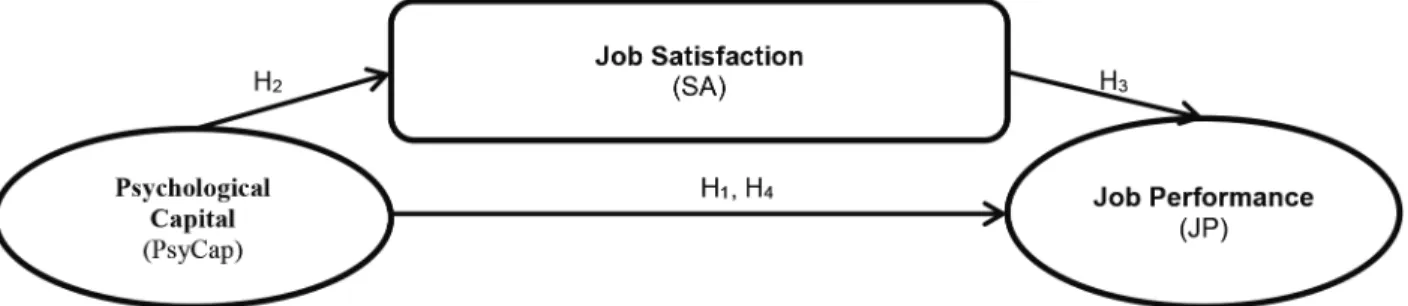
Business leaders have made great efforts to increase their organizations’ competitive capability, and raising employees’ job performance is considered as one of the essential solutions. Thus, it is vital to properly identify factors that affect the job performance since this will be the basis for managers to propose recommendations to increase employees’ job performance. The study seeks to investigate the relationships between psychological capital, job satisfaction, and job performance of employees in Vietnam, a developing country in South-East Asia.
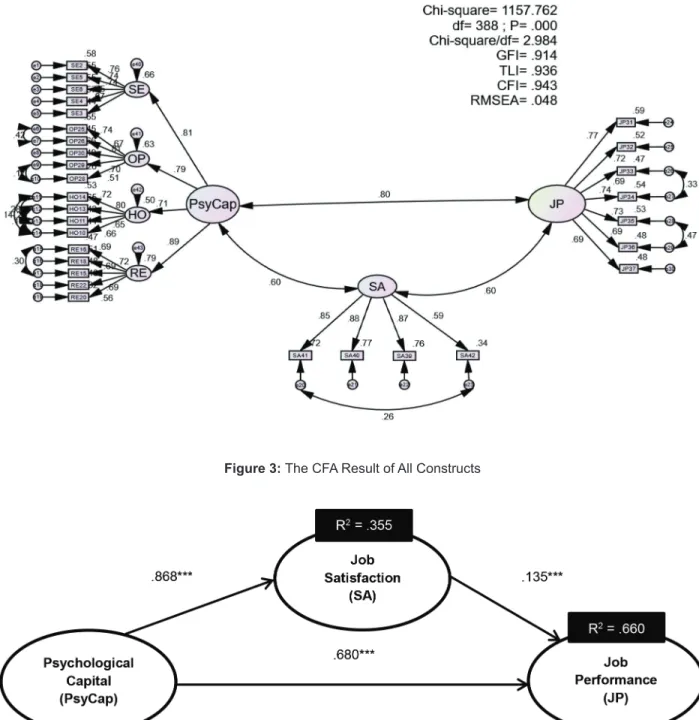
In this study, psychological capital is considered as a high-order construct. The mixed research method is used in this study. Qualitative research method is used to form the official survey questionnaire. Quantitative research method is used for investigating the relationships between concepts. Research data are collected from 848 interviewees via both face-to-face and email surveys. The findings show that psychological capital has positive relationships with job satisfaction and job performance. Job satisfaction also has a positive impact on job performance. In particular, job satisfaction shows the mediating role in the impact of employees’ psychological capital on their job performance. Based on the results, the study also provides recommendations related to psychological capital and job satisfaction assisting managers to increase employees’ job performance.
Keywords: Employee, Psychological Capital, Job Satisfaction, Job Performance, Vietnam JEL Classification Code: M12, M54, D91
Pulakos, 1999). An employee with high job performance can help their organization achieve its goals and gain a competitive advantage (Sonnentag, 2003).
According to Luthans, Avolio, Walumbwa, and Li (2005), investment and development of psychological capital brings many benefits, such as increasing job performance and establishing a competitive advantage. After human capital and social capital, psychological capital is a new and superior form of capital (Luthans et al., 2005; Luthans, Luthans, &
Luthans, 2004). Besides, in the theory of psychology, attitude leads behavior is a prominent topic. Researchers on clinical psychology and organizational psychology suggest that attitudes and behaviors are closely related. There are a lot of employee’s job attitudes that exist in the working context.
Employee’s job satisfaction is a specific attitude towards employee’ job. Job satisfaction is a delightful emotional state that arises from assessing an individual’s job when attaining or facilitating the achievement of work values (Locke, 1969).
Theories and previous empirical studies have shown the relationship between psychological capital, employee’s job satisfaction, and employee’s job performance. There is a positive impact of psychological capital on employees’ job
1
First Author and Corresponding Author. Lecturer, Ho Chi Minh City Open University, Vietnam [Postal Address: No. 35–37, Ho Hao Hon Street, Co Giang Ward, District 1, Ho Chi Minh City 700000, Vietnam] Email: [email protected]
© Copyright: The Author(s)
This is an Open Access article distributed under the terms of the Creative Commons Attribution Non-Commercial License (https://creativecommons.org/licenses/by-nc/4.0/) which permits unrestricted non-commercial use, distribution, and reproduction in any medium, provided the original work is properly cited.