GC-ECD/MS를 이용한 농산물 중 Captan, Folpet, Captafol 및 Chlorothalonil의 잔류분석법
이수진1 ․ 황영선1 ․ 김영학1 ․ 권찬혁2 ․ 도정아2 ․ 임무혁3 ․ 이영득4 ․ 정명근1*
1강원대학교 생약자원개발학과, 2식품의약품안전평가원 화학물질과, 3식품의약품안전청 식품기준과, 4대구대학교 생명환경학부 (2010년 6월 11일 접수, 2010년 6월 25일 수리)
Determination of Captan, Folpet, Captafol and Chlorothalonil Residues in Agricultural Commodities using GC-ECD/MS
Su-Jin Lee
1, Young-Sun Hwang
1, Young-Hak Kim
1, Chan Hyeok Kwon
2, Jung-A Do
2, Moo Hyeog Im
3, Young Deuk Lee
4and Myoung-Gun Choung
1*(
1Dept. of Herbal Medicine Resource, Kangwon National University, Samcheok 245-711, Korea,
2Food Chemical Residues Division, NIFDS, KFDA, Seoul 122-704, Korea,
3Food Standardization Division, KFDA, Seoul 122-704, Korea and
4Division of Life and Environmental Science, Daegu University, Gyeongsan 712-714, Korea)
A gas chromatographic (GC) method was developed to determine residues of captan, folpet, captafol, and chlorothalonil, known as broad-spectrum protective fungicides for the official purpose. All the fungicide residues were extracted with acetone containing 3% phosphoric acid from representative samples of five agricultural products which comprised rice, soybean, apple, pepper, and cabbage. The extract was diluted with saline, and dichloromethane partition was followed to recover the fungicides from the aqueous phase.
Florisil column chromatography was additionally employed for final cleanup of the extracts. The analytes were then determined by gas chromatography using a DB-1 capillary column with electron capture detection. Reproducibility in quantitation was largely enhanced by minimization of adsorption or thermal degradation of analytes during GLC analysis. Mean recoveries generated from each crop sample fortified at two levels in triplicate ranged from 89.0~113.7%. Relative standard deviations (RSD) were all less than 10%, irrespective sample types and fortification levels. As no interference was found in any samples, limit of quantitation (LOQ) was estimated to be 0.008 mg/kg for the analytes except showing higher sensitivity of 0.002 mg/kg for chlorothalonil. GC/Mass spectrometric method using selected-ion monitoring technique was also provided to confirm the suspected residues. The proposed method was reproducible and sensitive enough to determine the residues of captan, folpet, captafol, and chlorothalonil in agricultural commodities for routine analysis.
Key Words: Captafol, Captan, Chlorothalonil, Crop analysis, Folpet, Gas chromatography
165
*연락저자:
Tel: +82-33-570-6491 Fax: +82-33-570-6499 E-mail: [email protected]
서 론
현대 농업에 있어 병해충 및 잡초를 방제하기 위한 농약 의 사용량이 매년 증가함에 따라 농산물 중 잔류 농약에 의 한 만성 독성학적 위해 유발 가능성이 지속적으로 제기되어 왔으며 , 이에 따라 농산물의 안전성 확보가 커다란 사회적 문
제로 대두되고 있다 (Park and Lee, 2003). 현행 사용되는
농약의 경우 일부 속효성 약제를 제외하고는 방제 목적상 살
포 후 일정기간 잔류되는 약제 특성이 있어 최종 수확물에
살포농약이 잔류할 가능성은 상존한다 . 따라서 살포 농약의
잔류 수준을 면밀히 조사 , 평가하는 것은 농산물 중 안전성
확보를 위하여 반드시 이루어져야 한다 (Kwon and Lee,
2003). 정확하고 재현성 있는 잔류분석법은 잔류농약에 대한
농산물의 안전성 평가를 위한 필수적인 도구이며 , 특히 국가
공정 분석법의 확립은 잔류 수준의 조사 및 평가뿐만 아니라
농약 안전사용을 위한 잔류관리 측면에서도 매우 중요한 연
N S CCl3 O
O Captan
N S CCl3 O
O Folpet
N S CCl2CHCl2 O
O Captafol
CN
Cl
CN Cl Cl
Cl
Chlorothalonil Fig. 1. Chemical structures of captan, folpet, captafol and chlorothalonil.
구 과제라고 할 수 있다 .
본 연구에서 잔류분석법을 확립하고자 한 대상 성분은 phthalimide계 살균제인 captan (1,2,3,6-tetrahydro-N- (trichloromethylthio) phthalimide), folpet (2-[(trichlo- romethyl)thio]-1H-isoindole-1,3(2H)-dione, captafol (1,2,3,6-tetrahydro-N-(1,1,2,2-tetrachloroethylthio) phthalimide) 및 arylnitrile계 살균제인 chlorothalonil (2,4,5,6-tetrachloro-1,3-benzenedicarbonitrile)의 4종이 다 . 이들 농약들은 식물 병원균 체내 효소나 단백질의 -SH 작용기와 반응하여 호흡을 저해함으로써 살균효과를 발휘하 는 것으로 알려져 있고 , 각종 과수 및 밭작물에 이용되는 광 범위 살균제들이다 . 이 중 captafol은 잔류분에 의한 발암성 우려와 작물 개화기의 약해 등의 문제로 인하여 1993년부터 사용이 금지되어 있으나 (Jung et al., 2004), 대상농약은 쌀, 밀 , 보리 등을 포함한 곡류, 사과 및 배를 포함한 다양한 과 실류 , 고추, 오이, 양파 등을 포함한 대부분의 채소류, 대두를 포함한 두류 등에서 동일 작물에 처리되고 있는 농약이며 , 전 세계적으로는 아직도 많이 사용되고 있어 수입 농산물 중 잔 류 검색이 요구되는 성분이다 .
Captan, folpet, captafol 및 chlorothalonil의 물리화학 적 특성을 살펴보면 대상농약은 일상적 조건에서 해리하지 않는 중성 화합물로
n-octanol/water 분배계수(log Pow,25℃)는 2.8∼3.8 범위로 보고되어 있어 중간 극성~비극성 성분들이다 . 증기압은 0.02∼1.3 mPa 범위이고, 물에 대한 용해도는 0.8~5.2 mg/L인 반면, 비극성 및 수용성 유기 용 매에는 잘 용해되는 특성이 있다 .
Phthalimide계 살균제인 captan, folpet 및 captafol의 잔류분석은 분석법 개발 초기에는 colorimetric method가 사용된 바 있으나 (Akiyama et al., 1996; Fillion et al, 2000), 현재 가장 일반적으로 이용되는 기기분석법은 gas
chromatography(GC)를 이용하여 electron capture detector(ECD)로 검출, 정량하는 방법이다(Fishbein, 1973;
Zweig and Sherma, 1978). 선행 연구에서는 GC 분석 중 분리용 packed column내에서 대상 화합물들이 흡착과 열분해가 일부 발생 , 재현성이 열등하다는 보고가 있고 (Carlstrom, 1971), 이에 따라 몇몇 연구자들은 quantitative- TLC(Pomerantz and Ross, 1968; Francoeur and Mallet, 1977) 및 HPLC-FPD(Martinez et al., 1996) 분석법을 적 용한 바 있다 .
Arylnitrile계 살균제인 chlorothalonil의 잔류분석은 대 부분 GLC-ECD를 이용하나(Daroon et al., 1995; Zhao and Fan, 1996; Peñuela and Barceló, 1998), 일부 농산물 시료에서 함께 추출되는 방해물질에 의한 간섭이 관찰된 바 있으며 , 이에 따라 일상적인 모니터링 방법으로 HPLC-FPD 혹은 HPLC-UVD 등 보완적 방법이 소개된 바 있다(Neger et al., 2000).
현재 phthalimide계 살균제인 captan, folpet 및 captafol 의 경우 일부 동시분석법이 보고된 바 있으나 (Martinez et al., 1996), 물리화학적 특성과 살포 농작물 대상이 유사한 chlorothalonil을 함께 포함하는 동시분석법은 발표된 바 없다 . 국내 식품공전(Korea Food and Drug Admini- stration, 2009) 상의 잔류분석법은 packed column 채용에 따라 GLC 분석 시 열분해 및 column의 분리능 저하가 우 려되며 , 시료 추출액을 농축하거나 유지 제거 과정이 과다한 단점이 있고 , 또한 Florisil/활성탄/셀루로우즈를 이용한 흡 착 크로마토그래피 정제법이 이중적으로 적용되는 등 기기분 석 조건 및 정제과정이 최적화 되어 있지 않다고 판단된다 .
따라서 본 연구에서는 물리화학적 특성이 유사한 captan,
folpet, captafol 및 chlorothalonil을 대상으로 농약의 잔류
유무를 판단하는 모니터링 수준이 아니라 , 시료 조제과정을
통합하여 편이성이 확보된 새로운 계열별 동시 정량분석법을 확립하고자 하였다 . 즉, 시료 추출, 정제 및 기기분석 과정을 최적화하여 신뢰성 높은 GC-ECD/MS 동시분석법을 확립 하고 , 아울러 일상적 검사/검색법으로서의 활용성을 높이기 위하여 시료 조제과정을 효율적으로 간편화하고자 하였다 .
재료 및 방법
시약 및 기구
Captan, folpet, captafol 및 chlorothalonil의 분석용 표준품은 순도 98% 이상의 분석용 표준품을 Chem Service (USA)로부터 구입하여 사용하였다. 표준용액은 n-hexane에 500 mg/L 농도로 stock solution을 조제하고, -20℃ 냉동 고에 보관하면서 필요시마다 소정의 농도로 희석하여 사용하 였다 . Florisil (60~100 mesh, 잔류분석용)은 J.T. Baker (USA)로부터 구입하여 130℃에서 하룻밤 이상 가열, 활성화 한 후 사용하였다 . n-Hexane, dichloromethane 및 ethyl acetate는 잔류분석용, acetone, deionized water 및 phosphoric acid는 HPLC용, 기타 유기용매 및 무기시약은 시약특급 또는 ACS급을 사용 하였다. 농산물 시료의 마쇄 추출에는 고속 호모게나이저 (IKA, Ultra-Turrax T-25, USA)를 이용하였다.
농산물 시료
식품의 농약 잔류허용기준 (Korea Food and Drug Administration, 2009)에 captan, folpet, captafol 및 chlorothalonil을 대상성분으로 등록되어 있는 농산물 종류 와 Codex Alimentarius Commission에서 정한 농산물 부 류별 대표시료 분류표를 참조하여 (Codex Alimentarius Commission, 2003) 곡류에서는 현미, 두류 및 유지류에서 는 콩 , 채소류에서 고추 및 배추, 과실류에서는 사과를 대표 작물로 선정하였다 . 분석에 사용된 현미, 콩, 고추, 배추 및 사과의 무농약 시료는 지역 대형마트에서 유기농 인증시료를 구입한 후 식품공전 상 검체 처리방법에 따라 전처리 하였으 며 (Korea Food and Drug Administration, 2009), 대조 구 시료는 잔류농약 검사를 실시하여 무농약 시료임을 확인 한 후 사용하였다 .
시료 추출 및 분배
세절 또는 분쇄 농산물 시료 25 g을 균질기 용기에 달아 넣었다 (현미 및 콩의 경우 약 1kg을 분쇄한 후 표준 420 ㎛ 체를 통과시켜 25 g을 달아 넣은 후 증류수 20 mL을 가하 여 습윤화 ). Acetone 100 mL와 3% phosphoric acid 수용 액 5 mL을 가하고 2분간 고속 균질화한 후 여지가 깔려있는 부흐너깔대기를 통과시켜 흡인 여과하였다 . 잔류물 및 용기 를 여분의 acetone 40 mL로 씻어 내려 앞서의 여액과 합하 였다 . 합친 여액을 분액깔대기에 옮기고 잔류물과 용기를
acetone 10 mL로 씻어 옮긴 후 증류수 450 mL와 포화식 염수 50 mL을 첨가하였다. 분액깔대기에 dichloromethane 50 mL을 가하여 5분간 격렬하게 진탕, 정치하여 하부의 dichloromethane 층을 취하고, 재차 dichloromethane 50 mL을 가하여 분배 과정을 반복하였다. 합친 dichloro- methane 추출액을 anhydrous sodium sulfate 15 g에 통 과시켜 탈수하고 , 40℃의 수욕 상에서 감압 농축하여 용매를 모두 날려버렸다 . 배추, 고추 및 사과 시료의 경우 건고물을 dichloromethane/n-hexane 혼합액(20/80, v/v) 10 mL 에 녹여 Florisil column chromatography에 공시하였다.
현미 및 콩 시료의 경우 잔류물에 acetonitrile로 미리 포 화시킨
n-hexane 40 mL을 가하여 녹인 후 250 mL 용량의분액깔대기에 옮겼다 . 분액깔대기에 n-hexane으로 미리 포 화시킨 acetonitrile 40 mL을 가하여 5분간 격렬하게 진탕, 정치하였다 . 분리된 하부 acetonitrile층을 125 mL 용량 의 증류 플라스크에 옮기고 , 분액깔때기에 남은 n-hexane 층에 재차
n-hexane으로 미리 포화시킨 acetonitrile 40mL을 가하여 위의 과정을 반복하였다. 합친 acetonitrile 추출액을 40℃의 수욕 상에서 감압 농축하여 건고한 후 잔 류물을 dichloromethane/n-hexane 혼합액 (20/80, v/v) 10 mL에 녹여 Florisil column chromatography에 공시 하였다 .
Florisil column chromatography
내경 15 mm, 길이 40 cm의 유리제 column에 활성화시 킨 Florisil 10 g을 건식 충전하고, 그 위에 anhydrous sodium sulfate를 1 cm 높이로 추가 충전한 후 n-hexane 50 mL를 표면이 노출되기 직전까지 용출시켜 버렸다. 여기 에 앞서의 dichloromethane/n-hexane 혼합액 (20/80, v/v)에 녹인 시료 용액 10 mL을 가한 후 약 3 mL/min의 유속으로 흘려버렸다 . 충전제 표면이 노출되기 직전 dichloromethane/n-hexane 혼합액(20/80, v/v) 100 mL 을 가하여 유출시켜 버리고 , 재차 dichloromethane/
acetonitrile/n-hexane 혼합액(50/1.5/48.5, v/v/v) 150 mL로 용출시켜 받았다. 이 용출액을 40℃의 수욕 상에서 감 압 농축하고 , 건고물을 n-hexane 10 mL에 재용해하여 시험 용액으로 사용하였다 .
GC-ECD/MS 기기분석
Captan, folpet, captafol 및 chlorothalonil의 기기 분
석은 분석의 재현성을 극대화하기 위한 조건으로 수행하였다 .
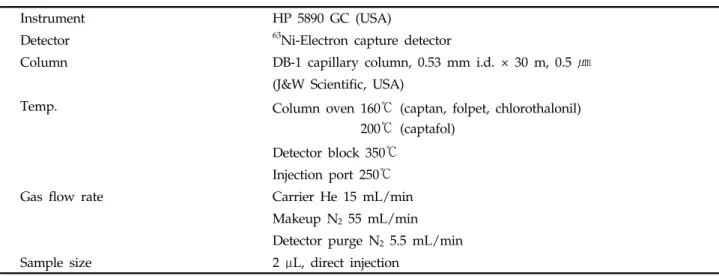
즉 , Table 1에 나타낸 바와 같이 HP 5890(USA) GC (ECD
부착 )상에서 분리용 column은 내경이 0.53 mm인 capillary
column을 등온조건으로 사용하였다. 또한 시료주입은
packed inlet을 이용, syringe내 용액 전량을 컬럼 내로 직
접 주입하는 방법을 채택하였다 . 분석 성분 중 captafol은 등
온 분석 시 기타 세 성분과 머무름 시간이 너무 차이가 났으
Table 1. GC-ECD operating parameters for the analysis of captan, folpet, captafol and chlorothalonil in crops
Instrument HP 5890 GC (USA)
Detector 63Ni-Electron capture detector
Column DB-1 capillary column, 0.53 mm i.d. × 30 m, 0.5 ㎛
(J&W Scientific, USA)
Temp. Column oven 160℃ (captan, folpet, chlorothalonil)
200℃ (captafol) Detector block 350℃
Injection port 250℃
Gas flow rate Carrier He 15 mL/min
Makeup N2 55 mL/min Detector purge N2 5.5 mL/min
Sample size 2 μL, direct injection
Table 2. GC-MS operating parameter for the confirmation of chlorothalonil, captan, folpet and captafol in crops
Instrument Agilent 6890/5975 GC-MSD (USA)
Column DB-1 capillary column, 0.2 mm i.d. × 30 m, 0.32 ㎛
(J&W Scientific, USA)
Temp. Column oven 240℃
Injection port 260℃
Gas flow rate Carrier He 2 mL/min
Sample size 1 μL, split (30:1)
Ionization Electron ionization (EI), 70 eV
Mass range m/z 50 - 500
므로 별도의 등온 조건을 추가 설정하여 분석하였다 . 한편 GC/MS 분석은 Agilent 6890/5975 GC-MSD (USA)를 사용 , Table 2에 나타낸 조건으로 분석하였다.
표준검량선 및 정량한계 (Limit of quantitation, LOQ) Captan, folpet, captafol 및 chlorothalonil의 성분별 농도가 0.002~0.5 mg/L가 되도록 차례로 표준 혼합액을 조제하고 , 각 2 μL를 GC-ECD에 주입하여 peak의 면적을 기준으로 표준 검량선을 작성하였다 . 분석법의 정량한계는 무농약 농산물 시료에서 간섭물질이 존재하지 않음을 확인한 후 분석기기의 정량한계 (LOQ)와 시료량 그리고 분석과정 중의 농축배율을 계상 , 아래의 식에 의하여 산출하였다.
LOQ (mg/kg) = [기기 정량한계 (ng)/주입량 (μL)]
× [시료용액 (mL)/시료량 (g)]
분석법의 대표 농산물에 대한 회수율 검정
본 연구에서 확립한 잔류분석법의 효율 및 신뢰성을 검정 하기 위하여 회수율 시험을 수행하였다 . 즉, 무농약 농산물 시료 25 g에 LOQ의 10배 및 50배에 해당하는 captan,
folpet, captafol 및 chlorothalonil 표준용액을 첨가한 후 상기 분석과정을 수행하여 회수율을 측정하였다 .
결과 및 고찰
최적 기기분석 조건 및 정량한계 (LOQ)의 설정
GC-ECD를 이용하여 captan, folpet, captafol 및
chlorothalonil을 분석하기 위한 최적의 분석 column을 선
정하기 위해 컬럼의 극성별로 분리 정도를 조사하였다 .
Phenylsiloxane/methylsiloxane 함량별로 극성을 달리하
여 분리능을 조사한 결과 phenylsiloxane이 각각 5% 및
50% 함유된 DB-5 및 DB-17에서는 column 온도를 비롯한
모든 인자를 변화시켜도 분석성분 중 captan과 folpet이 서
로 분리되지 않았다 . 반면 100% methylsiloxane인 비극성
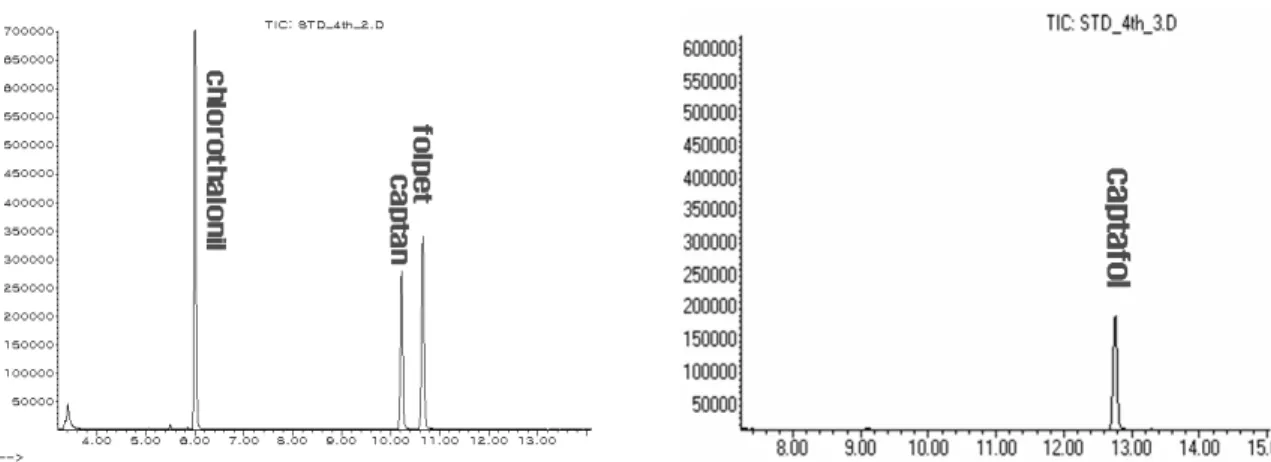
DB-1에서는 Fig. 2에 나타낸 바와 같이 captan과 folpet이
완전히 분리되었다 . Table 1과 같이 확립된 기기 분석조건에
서 chlorothalonil, captan 및 folpet의 머무름 시간은
column 온도 160℃에서 각각 5.8분, 13.5분, 14.4분이었으
며 , captafol의 머무름 시간은 column 온도 200℃에서 9.3
분이었다 .
Table 3. Liquid-liquid partition1) of crude extract by three different solvents
Compound Recovery (%)2)
Partition Ⅰ3) Partition Ⅱ Partition III
Chlorothalonil 89.7 ± 0.9 88.9 ± 1.0 94.6 ± 0.8
Captan 99.9 ± 1.1 100.5 ± 1.0 101.6 ± 0.6
Folpet 97.6 ± 0.6 103.7 ± 0.7 103.8 ± 1.1
Captafol 85.6 ± 0.9 96.7 ± 1.2 104.5 ± 0.9
1)Partition mixture : 150 mL of acetone containing 3% phosphoric acid + 50 mL of saturated NaCl + 450 mL distilled water.
2)Mean values of triplicate samples.
3)Partition solvent : I, n-hexane 100 mL, Ⅱ, dichloromethane/n-hexane (20/80, v/v) 100 mL, III, dichloromethane 50 mL x 2.
Fig. 2. GC-ECD chromatograms of chlorothalonil, captan, and folpet. Top, DB-5 capillary column; bottom, DB-1 capillary column.
분석기기의 정량한계는 크로마토그램에서 peak로서 나타 난 대상 성분의 분석 결과를 신뢰성 있게 수치화할 수 있는 한계농도로서 크로마토그램 상에서 검출된 peak의 S/N (signal/noise)의 비가 최소 10일 때 대상성분의 양을 의미 한다 (Fong et al., 1999; Miller, 2005). Table 1의 GLC- ECD 조건에서 다양한 농도의 captan, folpet, captafol 및 chlorothalonil의 표준용액을 주입하여 S/N비를 계산한 결 과 정량한계 (S/N≥10)는 chlorothalonil의 경우 0.01 ng이 었으며 , captan, folpet 및 captafol은 0.04 ng 수준이었다.
Chlorothalonil, captan, folpet 및 captafol의 표준 혼합용 액을 성분별 농도가 0.002~0.5 mg/L이 되도록 조제하고, 각 2 μL를 GC-ECD에 주입하여 얻은 표준 검량선의 회귀방 정식은 각각 Y = 282.6 X + 6.1 (R
2=0.999), Y = 63.4 X + 1.5 (R
2=0.997), Y = 48.6 X + 1.0 (R
2=0.997) 및 Y = 62.5 X + 1.6 (R
2=0.999) (Y : peak area, 10
3counts, X : 성분 량 , ng)로 직선성이 우수하였다.
시료 추출 및 분배과정의 확립
농산물 시료로부터 chlorothalonil, captan, folpet 및 captafol 성분을 추출하기 위한 용매로는 acetone을 사용하 였다 . Acetone은 US FDA법이나 AOAC법에서 대상 성분 과 유사한 물리화학적 특성을 나타내는 농약 잔류분을 추출 하는데 보편적으로 사용되는 표준적 용매로서 이미 많은 연 구자들에 의하여 농약 추출에 그 효율과 재현성이 인정된 바 있다 . Chlorothalonil의 경우 시료 내 존재하는 염기성 물질 에 의하여 분해가 될 수 있다는 보고가 있으며 (US FDA, 1999; AOAC, 2000), 실제 예비실험을 수행한 결과, 배추시 료에서 일부 분해가 관찰되었으므로 이를 방지하기 위하여 3%의 인산 수용액을 첨가하였다.
농산물 추출액로부터 대상 성분과 함께 추출되는 방해물 질을 1차적으로 제거하기 위한 조정제법으로는 액-액 분배법 을 사용하였다 . 즉, 수용성 유기용매 추출액을 다량의 포화식 염수 /증류수로 희석한 후 직접 비극성 용매로 분배 추출하는 방법을 사용하였는데 , 이는 US FDA법이나 AOAC법에서 중간~비극성 농약 성분에 대하여 보편적으로 사용되며 (AOAC, 2000; Lee et al., 2008), 번거로운 추출액의 농축 과정을 생략할 수 있는 장점이 있다 . 분배 용매로 n-hexane, dichloromethane/n-hexane 혼합액, dichloromethane 3종을 공시, 대상 성분별로 분배효율을 조사한 결과는 Table 3과 같다. Hexane을 분배용매로 사용하였을 경우, captan 과 folpet의 분배효율은 우수하였으나, chlorothalonil과 captafol의 회수율이 열등하였다. 또한 dichloromethane/
n-hexane 혼합액을 분배용매로 사용하였을 경우에도 chloro-
thalonil의 회수율이 저조하였다. 반면, dichloromethane 50 mL 씩으로 2회 분배하였을 때 모든 대상 성분에 대한 분 배효율이 우수하였으므로 본 연구에서는 dichloromethane 2회 분배법을 사용하였다.
Dichloromethane 액-액 분배과정에 의하여 시료 중에
포함된 상당량의 극성 및 기타 방해물질이 제거될 것으로 기
대되나 , 유지 성분은 dichloromethane 층으로 대상 성분과
함께 분배되기 때문에 제거되지 않는다 . 이러한 유지 성분은
Table 4. Efficiency of n-hexane/ acetonitrile partition
Compound Recovery (%)
Double partition Triple partition
Chlorothalonil 98.1 97.5
Captan 97.5 97.3
Folpet 101.2 99.9
Captafol 98.5 101.6
*Mother liquor : 40 mL of n-hexane saturated with acetonitrile containing target analytes, partition solvent : 40 mL of acetonitrile saturated with n-hexane each.
Table 5. Elution profile of fungicides on Florisil column Eluting solvent
(v/v)
Recovery (%)
0 - 50 mL 51 - 100 mL 101 - 150 mL Total
A1) B C D A B C D A B C D A B C D
20/80 2) 0 0 0 0 0 0 0 0 0 0 0 0 0 0 0 0
50/1.0/49.0 3) 71 0 96 11 24 91 0 83 1 6 0 0 96 97 96 94
50/1.5/48.5 3) 94 52 96 73 5 47 0 20 1 0 0 0 100 99 96 93
50/2.0/48.0 3) 94 78 96 86 4 18 0 7 0 0 0 0 98 96 96 93
1)A, chlorothalonil; B, captan; C, folpet; D, captafol.
2)Dichloromethane/n-hexane (20/80, v/v)
3)Pre-washed with 100 mL of dichloromethane/n-hexane (20/80, v/v), and then eluted with dichloromethane/
acetonitrile/n-hexane (v/v/v)
기기분석 시 치명적 간섭 또는 분리용 column 및 검출기의 급격한 열화를 초래하므로 반드시 제거하여야 할 간섭물질이 다 . 대상 시료 중 현미와 콩은 지방 함량이 각각 2.7~2.9%
및 19.9% 함유되어 있는 유지시료이므로 이러한 유지 제거 를 위하여
n-hexane/acetonitrile 분배법을 추가로 공시하였다 (US FDA, 1999; AOAC, 2000). Table 4에 나타낸 바 와 같이 미리
n-hexane으로 포화시킨 acetonitrile로 2회 분배하였을 때 , 각 성분별 회수율이 최소 98% 이상을 나타내었 고 , 3회 분배를 수행하여도 회수율이 크게 향상되지 않았으 므로 분배회수는 2회로 설정하였다. 한편 유지 함량이 0.2~
0.4%로 비유지 시료로 분류되는 배추, 사과 및 고추에서는 제거되는 불순물의 양이 매우 적고 크로마토그램 상에서 그 정제 효과 또한 미미하였으므로
n-hexane/acetonitrile 분배과정을 생략할 수 있었다 .
Florisil 흡착 크로마토그래피의 최적화
액 -액 분배 및 n-hexane/acetonitrile 분배법을 거친 추 출액은 색소 등 여전히 상당한 간섭물질이 존재하였으므로 기기분석에 앞서 추가적 정제과정이 필요하였다 . 흡착 크로 마토그래피는 이온성을 띄지 않는 chlorothalonil, captan, folpet 및 captafol과 같은 중성 화합물의 잔류농약 분석 시 가장 많이 이용하는 방법이며 , 흡착제로는 silica gel, Florisil 및 alumina가 많이 사용되고 있는데, 이중 Florisil
은 색소와 유지의 제거가 뛰어나 가장 보편적으로 사용되는 흡착제이다 (US FDA, 1999; AOAC, 2000). 본 연구에서도 Florisil을 흡착제로 선정하였으며, 분석대상 성분의 극성 등 을 고려하여 dichloromethane, acetonitrile 및 n-hexane 의 혼합용매를 이용한 최적의 용출체계를 확립하고자 하였다 . Table 5에 나타낸 바와 같이 dichloromethane/n-hexane (20/80, v/v) 혼합액에서 전 대상 성분은 용출되지 않았으 므로 비극성 성분들의 세정용 용매로 사용할 수 있었다 . 세정 용매 용출 후 dichloromethane/acetonitrile/n-hexane (50/1.5/48.5, v/v/v) 혼합액을 순차 용출시키면 chloro- thalonil, captan, folpet 및 captafol을 93~100% 회수할 수 있었다 . 용출 순서는 folpet, chlorothalonil, captan 및 captafol 순이었으며, 흡착제 1 g 당 10 mL의 용출용매를 사용하는 표준적 흡착 크로마토그래피 용출체계와도 잘 부합 하였다 (US FDA, 1999; AOAC, 2000; Lee, 2009).
정량한계 및 회수율
본 연구에서 확립한 시료 추출 및 정제 , 그리고 기기분석
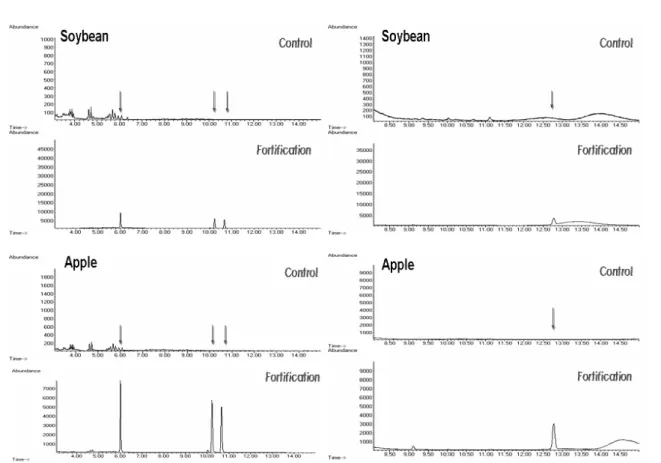
과정을 무농약 농산물 시료에 적용한 결과 , Fig. 3에 나타낸
바와 같이 모든 무농약 농산물의 최종 시료용액에서 대상농
약 부근에 간섭물질이 존재하지 않음을 확인하였다 . 따라서
분석기기의 정량한계 (LOQ)와 시료량, 그리고 분석과정 중의
농축배율을 계상하여 분석법의 정량한계를 산출할 수 있었다 .
Fig. 3. GC-ECD chromatograms of different agricultural commodity extracts. Top left, control for the analysis of chlorothalonil, captan and folpet; top right, control for the analysis captafol; bottom left, fortified with chlorothalonil, captan and folpet at 0.02, 0.08 and 0.08 mg/ kg respectively; bottom right, fortified with captafol at 0.08 mg/ kg.
산출된 chlorothalonil, captan, folpet 및 captafol의 정량 한계는 chlorothalonil이 0.002 mg/kg 이었고, captan, folpet 및 captafol이 0.008 mg/kg 이었다. 이러한 분석법 의 감도는 국제 기준인 Codex(Codex Alimentarius
Commission, 2003) 및 식품공전 잔류농약분석법 실무 해설
서 (Lee, 2009)에서 권장하는 잔류농약 분석법 기준인 0.05
mg/kg 이하 또는 허용기준의 1/2 이하의 정량한계 기준에
적합하였다 . 즉, 국내 식품의약품안전청에서 chlorothalonil,
Table 6. Recovery of chlorothalonil from fortified crop samples
Crop Fortification(mg/kg) Recovery ± SD(%)1) LOQ (mg/kg)
Hulled rice 0.02 108.6 ± 1.6
0.002
0.1 98.1 ± 1.0
Apple 0.02 99.0 ± 1.4
0.002
0.1 91.2 ± 0.9
Green pepper 0.02 101.3 ± 2.5
0.002
0.1 93.7 ± 2.6
Chinese cabbage 0.02 104.8 ± 3.6
0.002
0.1 99.3 ± 1.5
Soybean 0.02 98.1 ± 5.3
0.002
0.1 96.7 ± 0.6
1)Mean values of triplicate samples with standard deviations
Table 7. Recovery captan, folpet and captafol from fortified crop samples
Crop Fortification
(mg/kg)
Recovery ± SD(%)1)
LOQ (mg/kg)
Captan Folpet Captafol
Soybean 0.08 97.1 ± 2.3 94.6 ± 6.8 90.6 ± 3.0
0.008 0.4 96.9 ± 1.3 91.4 ± 3.5 94.1 ± 1.6
Hulled rice 0.08 101.9 ± 1.5 102.4 ± 2.4 113.7 ± 0.9
0.008 0.4 105.3 ± 1.1 99.3 ± 5.6 89.0 ± 3.2
Apple 0.08 95.7 ± 4.7 97.9 ± 5.1 94.2 ± 3.2
0.008 0.4 97.2 ± 2.2 93.5 ± 2.8 92.2 ± 2.0
Green pepper 0.08 95.8 ± 2.0 108.3 ± 1.3 100.4 ± 3.9
0.008 0.4 92.3 ± 2.7 100.8 ± 0.8 97.3 ± 0.6
Chinese cabbage 0.08 100.7 ± 5.1 102.8 ± 1.7 98.4 ± 6.4
0.008 0.4 99.2 ± 3.8 99.8 ± 2.6 94.2 ± 4.5
1)Mean values of triplicate samples with standard deviations
captan, folpet 및 captafol에 대하여 설정한 식품의 농약 허용기준 (Korea Food and Drug Administration, 2009) 은 각각 0.05~7.0, 2.0~10.0, 1.0~5.0 및 0.02~5.0 mg/kg 이므로 본 연구에서 확립한 분석법은 최소한 허용기 준의 1/2 이하를 충분히 정량할 수 있었다.
각각의 농산물 무처리 시료에 chlorothalonil, captan, folpet 및 captafol 표준용액을 정량한계의 10배 및 50배의 농도가 되도록 첨가하고 , 확립된 분석방법에 의하여 3반복으 로 회수율을 조사한 결과는 Table 6 및 7과 같다. Captafol 의 경우 chlorothalonil, captan 및 folpet에 비하여 회수율 의 변이가 다소 크게 나타났으나 , 정량한계의 10배 처리 수 준에서는 90.6~113.7%, 50배 처리 수준에서는 89.0~
105.0%의 양호한 회수율을 보였고, 재현성도 양호하여 분 석오차는 7.2% 미만으로 관찰되었다. 분석성분, 처리수준 및 농산물 시료의 종류에 관계없이 잔류분석 기준인 회수율 70~120% 범위와 분석오차 10 % 이내를 만족하였다. 따
라서 본 연구에서 확립된 분석법은 chlorothalonil, captan, folpet 및 captafol에 대해 잔류허용 기준이 설정 된 농산물의 잔류분석 및 검사에 충분히 적용할 수 있다고 판단되었다 .
현재 대상 농약의 국내 식품공전 (Korea Food and
Drug Administration, 2009) 상의 잔류분석법은 packed
column 채용에 따라 GLC 분석 시 열분해 및 column의 분
리능 저하가 발생하고 , 시료 추출액을 농축하거나 유지 제거
과정이 과다한 단점 , 또한 Florisil/활성탄/셀루로우즈를 이
용한 흡착 크로마토그래피 정제법이 이중적으로 적용되는 등
기기분석 조건 및 정제과정이 최적화 되어 있지 않은 점이
있으나 , 본 연구에 의해 확립된 대상 화합물의 신규 정량분석
법은 capillary column 채용에 따라 고 분리능을 유지하고,
시료 추출액의 농축과정 없이 액 -액 분배를 통한 분리가 가
능하며 , n-hexane/acetonitrile 분배법의 적용을 통해 유지
제거과정을 간편화 하였을 뿐만 아니라 , 기존 최종 정제를 위
Fig. 5. Total-ion chromatograms of chlorothalonil, captan, folpet and captafol in GC/ MSD.
Fig. 6. EI mass spectra of chlorothalonil, captan, folpet and captafol.
해 적용하였던 Florisil/활성탄/셀루로우즈를 이용한 흡착 크로마토그래피의 다중 정제법을 Florisil 단일 정제법으로 개선 , 보완하여 기존 분석법에 비해 개별 성분의 정량성을 유 지하면서 시료 조제과정을 통합한 분석법으로 간편성과 편이 성이 확보된 계열별 동시 정량분석법이라 판단된다 .
잔류분의 재확인
개발된 분석법의 정성적 신뢰성을 확보하기 위하여 GC-MS에 의한 재확인 과정을 추가로 확립하였다. Narrow bore capillary column을 사용, 전 대상 성분을 완전 분 리하는 조건으로 표준용액을 주입하여 Fig. 5에 나타낸 바
와 같이 GC-MS의 total-ion chromatogram (TIC)을 얻 었다 . 이러한 TIC로부터 Fig. 6에 나타낸 바와 같은 각 성 분별 EI spectrum을 조사한 결과, chlorothalonil은 충분 한 intensity로 M
+ion이 관찰되었다. Chlorothalonil의 평 균 분자량은 265.9이나 분자 내 염소원자를 4개 보유하고 있 으므로 모두가
35Cl 동위원소로 존재할 경우로 환산한 exact mass는 263.9이다. 따라서 염소원자 4개의 동위원소 비율에 따라 m/z 264 (A), 266 (A+2) 및 268 (A+4)이 각각 78%, 100% 및 48%의 abundance를 나타내게 되는데, 이러한 비 율을 EI spectrum으로부터 명확히 확인할 수 있었다.
Captan, folpet 및 captafol의 경우도 M
+ion의 intensity
Fig. 7. SIM chromatograms of extracts of soybean and apple samples fortified with chlorothalonil, captan, folpet and captafol.
가 chlorothalonil에 비하여 비록 낮게 관찰되었으나, 염소 원자들의 동위원소 비율은 잘 반영하여 분자구조를 확인할 수 있었다 .
GC-MS를 selected ion monitoring(SIM) mode로 작 동하여 콩 및 사과 시료 중 chlorothalonil, captan, folpet 및 captafol의 잔류분을 재확인한 chromatogram을 Fig. 7 에 나타내었다 . GC-MS SIM chromatogram에서 간섭물질 은 관찰되지 않았으며 , LOQ의 10배 농도로 처리한 시료에 서 대상성분의 peak를 명확히 재확인할 수 있었다. 본 연구 에서 사용한 GC-MS의 SIM조건을 이용할 경우 상당한 감도 로 대상성분들을 선택적으로 검출 , 정량할 수 있으므로 GC-ECD를 이용한 정량법과 더불어 추가적인 정량법으로도 사용이 가능할 것으로 판단되었다 .
결 론
GC-ECD/MS를 이용하여 농산물 시료에서 phthalimide 계 살균제인 captan, folpet, captafol 및 arylnitrile계 살균 제인 chlorothalonil의 잔류분석법을 확립하였다. 농산물 시 료에 3% 인산이 함유된 acetone을 가하여 추출된 captan, folpet, captafol 및 chlorothalonil의 잔류분은 dichlo- romethane 분배법과 Florisil 흡착 크로마토그래피법으로
정제하여 분석대상 시료로 하였다 . DB-1 capillary column 을 이용한 GC-ECD 분석 시 불순물의 간섭은 없었으며, 대 표 농산물 중 chlorothalonil의 분석정량한계(LOQ)는 0.002 mg/kg이었으며, captan, folpet, captafol의 분석정량한계 는 0.008 mg/kg 이었다. 전체 농산물에 대한 회수율은 89.
0~113.7% 범위였으며, 농산물 시료 및 처리수준에 관계 없이 10%미만의 분석오차를 나타내어 잔류농약 분석법 개 발 기준을 충족하였다 . 본 연구에서 확립한 잔류분석법은 정량한계 , 회수율 및 분석오차 면에서 국제적 분석기준을 만족할 뿐만 아니라 , GC/MS SIM을 이용한 잔류분의 재 확인과정의 추가와 분석과정의 편이성 등을 고려할 때 대 상성분의 정량적 공정분석법으로 사용이 가능 할 것으로 판단되었다 .
참고문헌
Akiyama, Y., Yano, M., Mitsuhashi, T., Takeda, N., Tauji, M., 1996. Simultaneous determination of pesticides in agricultural products by solid-phase extraction and gas chromatography-mass spectro- metry, J. Food Hyg. Soc. 37, 351-362.
AOAC, 2000. Pesticide and industrial chemical resi-
dues, In official method of analysis, 17th ed., pp.
1-88, AOAC International, Arlington, VA, USA.
Carlstrom, A.A., 1971. Collaborative study of a gas chromatographic method for determining captan in formulations, J. Assoc. Off. Anal. Chem. 54, 688-696.
Codex Alimentarius Commission, 2003. Guidelines on good laboratory practice in residue analysis, CAC/
GL 40-1993, Rev.1-2003, Rome, Italy.
Daroon, C.V., Vink, M., Poll, J.M.V.D., 1995. Gas chromatographic determination of chlorothalonil and its metabolite 4-hydroxy-2,5,6-trichloro-isophtalonitrile (HTI) in water, Chromatographia 40, 458-462.
Fillion, J., Sauve, F., Selwyn, J., 2000. Multi residue method for the determination of residues of 251 pesticides in fruits and vegetables by gas chromato- graphy/mass spectrometry and liquid chromato- graphy with fluorescence detection, J. Assoc. Off.
Anal. Chem. 83, 698-713.
Fishbein, L., 1973. Chromatography of environmental hazards, Vol. I, pp.169-179, Elsevier, NY, USA.
Fong, W.G., Moye, H.A., Seiber, J.N., Toth, J.P., 1999.
Pesticide Residues in Food: Methods, Technologies, and Regulations, pp. 3-4 and 40-44, Wiley Interscience, Canada.
Francoeur, Y., Mallet, V., 1977. Simultaneous deter- mination of captan and captafol in apples and potatoes by thin layer chromatography and in situ fluorometry, J. Assoc. Off. Anal. Chem. 60, 1328-1330.
Jung, Y.H., Kim, J.E., Kim, J.H., Lee, Y.D., Im, C.H., Hur, J.H., 2004. Pesticide Science, 2nd ed., Sigma Press, Seoul, Korea, pp.197.
Korea Food and Drug Administration, 2009. Korean code of food.
Korea Food and Drug Administration, 2009. Maximum residue limits for pesticides in foods.
Kwon, C.H., Lee, Y.D., 2003. Terminal residues of monocrotophos and phosphamidon in apples, Life
Sci. Res. 1(3), 277-286.Lee, J., Park, H., Keum, Y., Kwon, C., Lee, Y., Kim, J.,
2008. Dissipation pattern of boscalid in cucumber under green house condition, Kor. J. Pestic. Sci. 12, 67-73.
Lee, Y.D., 2009. Manual of official method of analysis for pesticide residues in foods, Korea food and drug adiministration.
Martinez, R.C., Gonzalo, E.R., Jimenez, M.G.G., Pinto, C.G., Pavon, J.L.P., Mendez, J.H., 1996. Determina- tion of the fungicides folpet, captan and captafol by cloud-point preconcentration and high-perfor- mance lquid chromatography with electrochemical detection, J. Chromatogr. A 754, 85-96.
Miller, J.M., 2005. Chromatography: Concepts and Contrasts, 2nd ed., pp. 286-287, Wiley Intersciense, USA.
Neger, B.O., Foster, G.D., Khan, S.U., 2000. Determi- nation of chlorothalonil residues in coffee, Toxi-
cotogical and Environmental Chemistry, 77, 41-47.Park, C.J., Lee, Y.D., 2003. Persistence of the fungicide boscalid in grapes and strawberries, Life Sci. Res.
2(2), 9-16.
Peñuela, G.A., Barceló, D., 1998. Photodegradation and stability of chlorothalonil in water studied by solid-phase disk extraction, followed by gas chro- matographic techniques, Chromatographia A 823, 81-90.
Pomerantz, I.H., Ross, R., 1968. Captan and struc- turally related compounds, thin-layer and gas liquid chromatography, J. Assoc. Off. Anal. Chem.
51, 1058-1062.
US FDA, 1999. Pesticide Analytical Manual, Vol 1:
Multi-residue Methods, 3rd ed., US Food and Drug Administration, USA.
Zhao, L., Fan, D.F., 1996. Gas chromatographic determination of chlorothalonil in leaves and roots of scrophularia and in soil, J. Assoc. Off. Anal.
Chem. 79, 587-588.