ORIGINAL ARTICLE
저탄소 녹색도시 조성을 위한 정책 우선순위 연구
신연희 민미연 황은주 김종대*
인하대학교 지속가능경영학전공
Study on the Policy Priority for Low Carbon Green City
Yeon-Hee Shin, Mi-Youn Min, Eun-Joo Hwang, Jong Dae Kim*
Department of Sustainability Management, Inha University, Incheon 22212, Korea
Abstract
The purpose of this study is to establish common indicators that constitute a "low-carbon green city" and determine their priorities from the perspective of Incheon Metropolitan City with a view to help develop its climate change strategy strategic city. Several major cities, domestic and overseas, were benchmarked to come up with preliminary indicators consisting of six areas, twenty two planning factors, and 74 indicators. In order to evaluate the validity and relevance of preliminary indicators, expert FGI (Focus Group Interview) was conducted that changed the numbers of final indicators to six areas, twenty two planning factors, and 82 indicators. Finally, AHP (Analytic Hierarchy Process) was conducted to assign relative importance (i.e. weights) to each indicator. Through the layering process of AHP, the upper category of "field" and lower category of
"planning factors" were set up as policy prerequisites for constructing a low-carbon green city (6 fields, 22 planning factors).
The AHP results for the first level (fields), green city space was ranked first, followed by energy and resource circulation, green traffic, ecological preservation, green logistics, and governance. Among all planning factors, land use, energy efficiency, traffic system improvement, location planning, securing of ecological area, efficiency of logistics, and cooperative organization showed the highest priorities.
Key words : Climate change, Low carbon green city, Green city planning indicators, Incheon Metropolitan City
1)
1. 서 론최근 전 지구적 이상기후와 생태계의 변화는 지구 촌 환경을 급속도로 위협하고 있다. 특히 대기 중 온실 가스(CO2, CH4, N2O, HFCs, PFCs, SF6 등)는 이상기 후뿐만 아니라 식량 부족, 자원과 에너지 고갈 등 심각 한 글로벌 사회 문제를 야기하고 있다. 이를 극복하기 위하여, 유엔(UN)은 제21차 기후변화협약 당사국총
회(COP21,2015년)에서 196개 회원국의 신(新)기후 체제 합의를 이끌어내고 이른바 “파리협정(Paris Agreement”을 채택하여 공동 대응하기에 이르렀다.
우리나라도 Post-2020 신(新)기후체제에 대응하기 위 하여 중장기 기후변화전략 및 구체적인 액션플랜을 담은 제1차 국가기후변화대응 기본계획 을 마련하 여 온실가스 감축, 기후변화대응, 국제협력 등 저탄소 사회로의 패러다임 전환을 추진하고 있다.
Received 13 July, 2017; Revised 16 August, 2017;
Accepted 18 August, 2017
*
Corresponding author: Jong Dae Kim, Department of Sustainability Management, Inha University, Incheon 22212, Korea
Phone: +82-32-860-7757 E-mail: [email protected]
ⓒ The Korean Environmental Sciences Society. All rights reserved.
This is an Open-Access article distributed under the terms of the Creative Commons Attribution Non-Commercial License (http://
creativecommons.org/licenses/by-nc/3.0) which permits unrestricted
non-commercial use, distribution, and reproduction in any medium,
provided the original work is properly cited.
이러한 기후변화에 맞서는 국제 정세변화와 우리 나라의 온실가스 감축목표를 달성하기 위한 전략의 일환으로 도시 공간 전반을 저탄소 녹색도시로 전환 하는 도시 형태들이 제안되었다. 저탄소 녹색도시는
“기존의 생태보전, 자연공생, 청정 환경을 내세웠던
‘친환경도시’와 지속가능발전, 에너지자립, 자원순환 개념의 ‘지속가능도시’에 탄소저감, 탄소흡수, 신재생 에너지 등 ‘탄소저감도시’가 망라된 총괄 개념”으로 (Cho, 2015), “기존의 경제성장 패러다임을 친환경적 으로 전환함으로써 시너지효과를 극대화 한다”고 할 수 있다(Wang et al., 2013). 특히 한국적인 상황에서 의 저탄소 녹색도시는 “도시인프라와 생활양식을 저 탄소형으로 개편하여 온실가스와 환경오염을 줄이고 신성장동력과 일자리를 창출하여 녹색성장을 견인하 는 도시”로 정의된다(Korea Ministry Environment, 2011). 이는 탄소중립도시 원칙을 준수하며, 에너지 효율극대화를 위한 다양한 분야의 첨단기술 개발 및 에너지 절약형 도시공간구조를 갖는 재생가능 에너지 기반의 지속가능한 도시를 말한다(Kim et al., 2013).
Wang(2010)은 녹색도시조성을 위한 계획수립 방 안연구 에서 저탄소 녹색도시의 개념과 정부주도의 부처별 녹색도시 관련 사업추진 현황 및 사례를 종합 하여 저탄소 녹색도시 계획을 위한 가이드라인을 제 시하였다. 또한 Chang(2010)은 기후변화에 대응한 저탄소 녹색도시 계획요소 도출 탄소저감 방안에 관 한 연구 에서 기후변화에 대응하기 위한 국내 외 동 향 및 사례조사를 통해 저탄소 녹색도시 계획요소를 도출하여 녹색도시 사례대상지를 선정하고 탄소저감 효과를 산정 제시하였으며, Yoon(2010)은 저탄소 녹색도시 계획요소에 관한 연구 에서 저탄소 녹색도 시에 대한 국내 외 주요정책 및 기존 연구 사례를 토 대로 중요 계획요소를 비교하여 도출한 결과를 제시 하였다.
Kim(2013)의 탄소중립녹색도시 구현을 위한 계 획지표 및 평가기준 연구 는 기존 선행연구 및 국내 외 선진사례 등 종합적인 고찰을 통해 1차 계획지표를 구축하고 FGI를 거쳐 적합성 검증 결과 구축된 최종 지표체계를 바탕으로 AHP 분석을 실시하여 마련한
‘평가기준’ 체계에 의해 신도시와 기성도시를 비교 평가하여 개선안을 도출하였다. 또한 Kim et al.(2013)
의 연구는 탄소중립도시의 개념 및 국내 외 사례를 중심으로 각각의 중요 계획요소를 종합 분석하여 제 시하였으며, Lee(2013)은 국내 외 사례 및 연구자료 등의 평가항목을 종합하여 저탄소 녹색도시에 대한 정량적인 평가기준 지표 도출과 적용결과를 보여주었 다.
정부차원의 가이드라인으로 Korea Ministry of Land, Infrastructure and Transport(2015)는 저탄소 녹색도시 조성을 위한 도시 군 계획수립 지침 을 훈 령으로 발표하였다. 이는 국토의 계획 및 이용에 관 한 법률 에 의해 도시 군 관리계획 수립기준을 정하 여 저탄소 녹색도시 조성을 위한 종합적인 공간계획 수립을 유도하기 위한 지침이다. Korea Ministry of Environment(2010)는 저탄소 녹색도시 조성 가이드 라인 및 평가지표 연구 를 통해 저탄소 녹색도시 조성 의 확산을 위한 가이드라인과 평가지표를 개발하여 평가체계 및 활용방법을 제안하였으며, 2011년 저탄 소 녹색도시 확산방안 연구 에서는 저탄소 녹색도시 조성을 위한 정량 평가지표를 마련하여 지자체가 활 용할 수 있는 평가지원 프로그램을 개발 보급하였 다.
본 연구의 목적은 인천이 가지고 있는 환경적인 취 약성을 저탄소 녹색도시로 재구상하는 계기로 마련하 기 위하여 “저탄소 녹색도시”를 구성하는 공통지표를 설정하고, 우선순위를 선정함으로써 지역특성에 맞는 전략적 도시개발을 조성하는데 있다. 인천광역시는 서해안에 위치한 항구도시로 인천국제공항과 인천항 을 중심으로 경제자유구역(송도, 영종, 청라) 개발, 녹 색기후기금(GCF) 유치, 해양도서자원 등 무한 잠재력 을 가진 동북아 관문 도시로 발전하고 있다. 그러나 전 국 232개 지방자치단체를 대상으로 탄소중립 수준을 측정한 연구 자료에 의하면, 인천은 탄소중립 종합평 가 결과 152위로 하위그룹에 속하고 있다. 특히 저탄 소 녹색도시의 평가 척도인 탄소중립지표는 7대 특 광역시 중에서 가장 낮은 순위를 나타나고 있다.
본 연구의 지표구축 과정은 크게 3단계로 구분한 다. 첫째, 기존 선행연구 및 정책자료 분석, 국내 외 선진사례에 대한 종합적인 고찰과 공항과 항만 등 배 후단지에 인접해 있는 인천의 지역 특성을 반영하여 1 차 지표체계를 도출한다. 둘째, 1차 지표체계에 대한
전문가 FGI를 실시하여 개별 지표의 적합성을 검증 보완하는 과정을 거쳐 최종 지표체계를 도출한다. 마 지막으로 동 지표체계에 AHP 기법을 활용하여 중요 도 부여 후 계층화 하여 최종 결과를 도출하였다.
2. 분석 방법
2.1. 1차~최종 지표체계 도출
저탄소 녹색도시에 대한 선행연구와 정책연구 자 료, 국내 외 선진사례 등 기존에 수행되어 온 사례연 구 결과를 비교 검토하여 1차 계획지표를 도출하였다.
본 연구에서 기존의 녹색도시 지표를 참조하여 지표 구성의 출발점으로 삼기 위해 국내 외 사례 조사를 실시하였다. 대상이 된 도시는 강릉시, 수원시, 부산광 역시, 독일 프라이부르크, 일본 요코하마, 스웨덴 하마 비, 브라질 쿠리치바 등 7개이며, 각 도시별 저탄소 녹 색도시를 조성하기 위한 지표설정 및 세부 실행요소 에 대하여 검토하였다.
여기에 선행연구 자료나 정책 자료에는 저탄소 녹 색도시 조성을 위한 계획지표에 물류부문을 포함하고 있지 않아 온실가스 배출에 상당한 비중을 차지하는 수송 분야가 저탄소 녹색도시의 계획요소로 적합할지 여부를 추가로 검토하였다. 녹색물류산업의 선진운영 사례를 통해 국내 녹색물류 실현을 위한 추진 전망 및 정책적 발전방향을 제시한 국내 외 온실가스 감축 정책 및 녹색물류체계 구축방향(Min et al., 2010) ,
녹색물류산업의 해외동향 및 시사점(Lee, 2011) , 그린경영의 사례연구: 물류기업을 중심으로(Lee et al., 2012) , 기후변화대응을 위한 주요국의 물류분 야 법제 동향에 관한 연구(Choi, 2016) 등 물류관련 문헌자료 및 인터넷 자료, 현재 추진 중인 정책 등을 바탕으로 별도로 조사하였다.
주요 도시 중 수원시, 프라이버그, 하마비의 저탄소 녹색도시 계획요소를 종합하여 검토한 결과, 친환경 토지이용, 녹색교통, 에너지효율화, 자원순환, 자연생 태 등 제도적 측면에서 5개 분야, 그리고 녹색생활 등 실천적 측면에서 1개 분야별 계획 요소들이 분류되었 다(Table 1). 이와 함께 이전 문헌 중 Chang(2010)과 Lee(2013)에서 제시된 사례와 Land & Housing Institute (2009), Korea Ministry of Land, Infrastructure and
Transport(2015)에서 개발한 지표들에 대해서도 검토 하였다(Table 2&3).
결과적으로 1차 지표체계는 6개 분야, 22개 계획요 소에 74개 세부지표로 구성되었으며, 지표체계 구성 과 각 세부지표의 분류가 적합한지, 본 연구에서 고려 하지 못한 지표들은 없는지 등에 대한 전반적인 의견 을 수렴하기 위하여 전문가를 대상으로 FGI (Focus Group Interviews)를 실시하였다. FGI 대상은 대학교 수, 서울연구원, 국토연구원 등 관련 연구에 전문적 지 식을 갖춘 전문가들이며 E-mail을 통해 실시하였다.
2.2. AHP 분석
전략적 저탄소 녹색도시 조성을 위한 상대적 중요 도 분석을 실시하여 인천광역시 관점에서 최종 계획 요소의 우선순위를 선정하고자 AHP 기법을 활용한 실증분석을 실시하였다.
AHP (Analytic Hierarchy Process) 기법은 합리적인 의사결정을 지원하기 위하여 1970년대 초반 Thomas L. Saaty에 의해 개발된 다기준 의사결정방법(Multiple Criteria Decision Making) 중의 하나로, ‘복합적이고 다수의 의사결정 요소들을 계층(Hierarchy)화하여 각 요소간 쌍대 비교(Pairwise Comparison)를 통해 중요 도를 산출하는 분석 방법’이다.
본 연구에서 구축된 최종지표는 6개 분야, 22개 계 획요소, 82개 세부지표들은 AHP 기법의 계층화 과정 에는 2차 계층(6개 분야, 22개 계획요소) 구조로 설계 하여 중요도 분석을 실시하였다. 82개의 세부지표는 실행단계에서 중요지표이기는 하나, 저탄소 녹색도시 를 구성하기 위한 정책적 선행요소로 상위 항목인 ‘분 야’와 하위 항목인 ‘계획요소’로 구분하여 2단계 구조 로 계층화하여 분석하였다.
이와 함께, 최종 선정된 지표체계를 중심으로 지표 들간의 중요도를 분석할 수 있는 설문조사를 실시하 였다. 설문조사 대상은 계층분석의 특성상 전문가를 대상으로 설문을 시행하였으며, AHP 기법을 활용한 우선순위 및 가중치 산정을 위하여 대학교수, 연구원, 정책입안자, 지역시민단체, 환경분야 컨설턴트 등 관 련 분야에 수년간 경력이 있는 전문가를 대상으로 실 시하였다. 설문방식은 종축과 횡축의 평가항목을 이 원 비교하여 종축의 평가항목이 횡축의 평가항목에
Cities
Factors Suwon (Korea) Freiburg (Germany) Hammarby (Sweden)
Sys- tem
Eco- friendly land use
⁕Redifing downtown space structure
⁕Expansion of open space
⁕Set-up walking green network
⁕Enlargement of eco-friendly building
⁕Protecting heat island effect
⁕Multi-purpose intensive space plan
⁕Building height restriction
⁕Green rooftop and plant preservation
⁕Minimal road pavement
⁕Protecting heat island using waterway
⁕Securing view axis by waterfront space
⁕Securing open space
⁕Instalation of pedestrian mall between residential complexes
⁕Ecological roads
Green transpor-
tation
⁕Eco-friendly transportation (surface car, electric bus, bio modal tram)
⁕ Metropolitan traffic network, beltway network
⁕Transit transfer centers
⁕Pedestrian and bicycle road
⁕Car sharing
⁕11-year free public transportation pass, 50%
off rail price
⁕Introducing tram and street car
⁕Promoting bicycle and bicycle road
⁕Mandatory parking space
⁕Introducing car-sharing system
⁕Use of light rail transit, water taxi and bicycle
⁕Provision of car sharing vehicles
⁕Using bio gas as automobile fuel
⁕Free toll for bio-gas cars
⁕Restriction of car ownership for individual household (< 1.5)
Natural ecology
⁕Adoption of biotops area ratio
⁕Securing green-blue network
⁕Creating ecological spae
⁕Securing carbon sinks
⁕Vitalizing urban agriculture
⁕Preserving existing vegetation
⁕Protecting habitat of small animals
⁕Converting children playground to eco-park
⁕Artificial waterway for rain water
⁕Connecting green network
⁕Cultivating edible plants
⁕Use of wooden fences
⁕Installing wooden observation deck
Energy efficiency
⁕Waste to energy
⁕Biomass to energy
⁕Energy self-supporting
⁕Dissemination of renewable energy(e.g. solar and wind)
⁕Compulsory energy-saving building
⁕Establishing energy saving indicators for new buildings
⁕Installing heat recovery facilities
⁕Rotating photovoltaic building
⁕Photovoltaic and solar heat
⁕Small hydraulic and co-generation power
⁕Establishing energy circulation system using renewable energy
⁕Purchasing eco-friendly renewable energy
⁕Solar heat use and installing heat panels (50% of heating)
Resource circula-
tion
⁕Building waste resource recycle system
⁕Building integrated water management system
⁕Reuse of rain and waste water
⁕Use of waterway, protecting heat islands
⁕Reuse of wastewater and sewage
⁕Reuse of rain water and treated water
⁕Waste resource recycling
⁕Building resource circulation system for waste and waste water
Imple- men- tation
Green life-style
⁕Implementing green card (carbon point system)
⁕Green car insurance
⁕Implementing civic education and advertising
⁕Green consumption (establish civil corporation, participation of citizen and environmental group)
⁕Environmental information
(education and publicizing)
Table 1. Planning factors for low carbon green cities
Factors Chang(2010) Lee(2013)
Land use
Intensive urban space Multiple use planning
Layout considering sunshine and thermal environment Layout considering wind way
Multiple use intensive space planning Building eco-friendly residential complex Securing wind way
Complex layout and greening
Renewable energy
Solar energy Geothermal energy Wind energy Bio energy Fuel cell Unused energy
Enlarging use of renewable energy Production of waste energy
Green transportation
Activating walk and bicycle Vitalizing public transportation Car-sharing
Auto-restricted zone New transportation vehicle Use of eco-friendly fuel
Vitalizing public transportation Low carbon transportation Activating bicycle
Green belt
Carbon sink park
Planting for carbon absorption Establishing buffer green zone Establishing green axis Greening building
Establishing green network
Establishing carbon absorbing green parks Greening building surface and rooftop
Resource circulation
Recycling wastes
Technology development for waste treatment Use of recycled resources
Recycling food waste
Building resource circulation system Reuse of waste
Green building
Passive house
High efficiency equipment Natural lighting and ventilation Atrium
Building energy management system Smart grid system
Energy saving building
Use of high performance insulation Passive solar system
Water circulation
Reuse of rain and treated water Waterside parks
River and streamlet Securing ecological areas
Reuse of rain water Use of treated water Increasing ecological areas Preserving urban river and wetland
Green economy -
Mitigation projects
Mitigation efficiency improvement Low carbon products
Low carbon production process Table 2. Planning factors considered in previous literatures
비해 상대적으로 어느 정도 중요한지, 또는 어느 정도 비효율적인지를 평가기준에 따라 “1, 3, 5, 7, 9” 또는
“-1, -3, -5, -7, -9”까지의 척도를 기입하도록 하였다.
설문조사는 E-mail을 통해 진행되었으며, 전체 42부 설문지를 배부하여 38부(회수율 90.5%)를 회수하였 다.
AHP는 설문 응답결과의 신뢰성 검증을 위하여 일 관성비율(CR: Consistency Ratio)로 응답의 일관성을 판단하는데, CR값이 10%(0.1)보다 작을 경우 응답자 에 신뢰성을 갖는다고 판단하고 CR값이 10%(0.1)보 다 크면 신뢰성이 부족한 것으로 판단하였다. 분석결 과 친환경 도시공간 분야의 하위 2차 계층에서 CR값이
Factors Land & Housing Institute(2009) Ministry of Land, Infrastructure and Transport(2015)
Eco-friendly land use and landscape
Wind way
Compositive land use Natural river Streamlet Aquatic biotop
Establishing urban space High density compositive land use Location analysis
Wind way
Renewable energy and energy saving
Use of solar heat
Photovoltaic power generation Solar heat system
Wind power generation Small hydraulic generation Use of geothermal energy Use of biomass energy Waste energy production Energy saving building facility
Introducing renewable energy Supply of group energy Cogeneration Clean energy Use of waste heat
Green transportation
Public transportation linkage system Pedestrian and bicycle road Eco-friendly transportation Job-housing proximity
Densification of public transportation node
Public transportation, bicycle, pedestrian focused green transportation system transformation
Public transportation exclusive district Public transportation composit transfer facility Three dimensional transportation
Low emission automobile
Vitalizing non-powered transportation including walk and bicycle
Enlarging public transportation including BRT, subway, light subway
Pedestrian-friendly street network Functional roadway layout Automobile stations
Green zone
Establishing green network
Carbon absorption parks and green zone Ecological space
Three dimensional greening
Creating ecological forests
Urban greening(building, parking lot) Enlarging parks and green zone
Greening rooftop landscape and building surface Waterfront space
Preserving forests
Creating streamlet, permeable pavement
Resource circulation
Permeable pave materials Recycling waste Rain water recycle facility
Utilizing rain water and water resources Treated water recycle system
Increasing ecological space
Dispersal rain water management system Installing rain water management facility Restoring water circulation system Reduction of waste
Waste reuse and recycling
Green building Eco-friendly building materials Greening building
Introducing green building/home Planting in the vicinity of building Table 3. Planning factors considered in policy reports
10%(0.1)보다 큰 Data 4부가 일관성이 부족하다고 나 타난 것을 제외하고 모든 자료는 CR값이 10%(0.1)보
다 작게 나타나 일관성을 가지는 것으로 분석되었다.
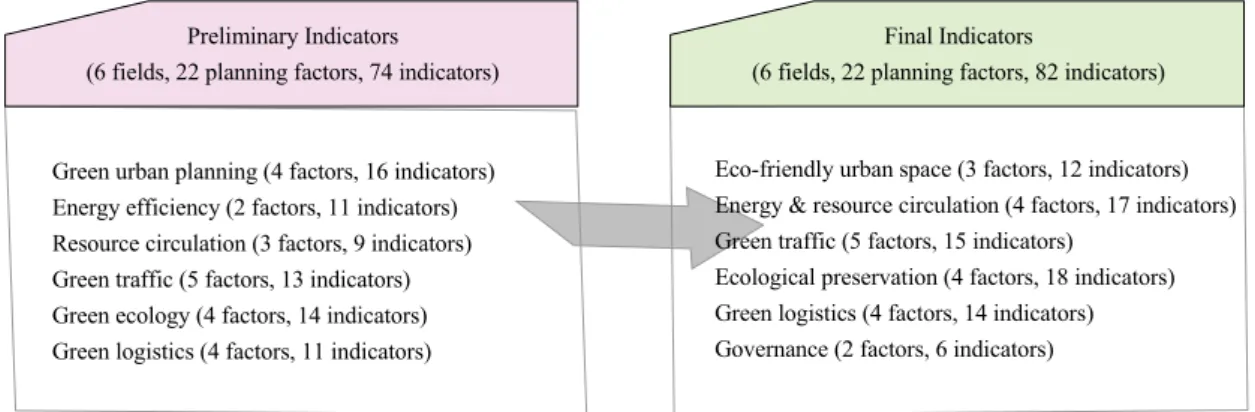
Green urban planning (4 factors, 16 indicators) Energy efficiency (2 factors, 11 indicators) Resource circulation (3 factors, 9 indicators) Green traffic (5 factors, 13 indicators) Green ecology (4 factors, 14 indicators) Green logistics (4 factors, 11 indicators)
Preliminary Indicators (6 fields, 22 planning factors, 74 indicators)
Eco-friendly urban space (3 factors, 12 indicators) Energy & resource circulation (4 factors, 17 indicators) Green traffic (5 factors, 15 indicators)
Ecological preservation (4 factors, 18 indicators) Green logistics (4 factors, 14 indicators) Governance (2 factors, 6 indicators)
Final Indicators
(6 fields, 22 planning factors, 82 indicators)
Fig. 1. Final indicators reflecting FGI results.
3. 분석 결과 및 고찰
3.1. 1차 지표체계 도출 결과
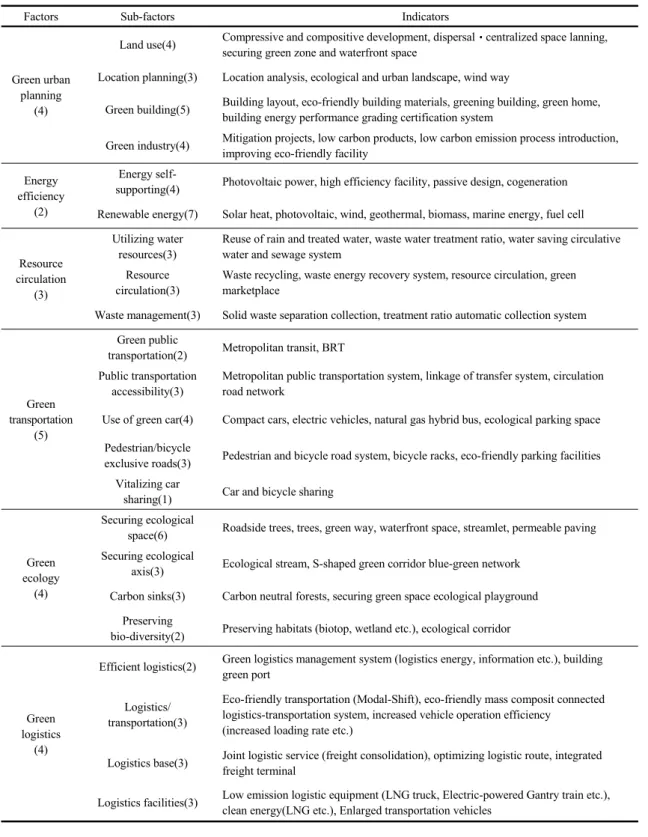
기존 선행연구와 정책자료, 국내 외 사례를 고찰 하여 각각의 계획요소를 비교 검토한 결과, 유사하고 상관성 있는 종합적인 공통지표를 추출하여 1차 계획 요소를 도출하였다(Table 4). 앞에서 제시된 선행연구 와 문헌조사 및 선진사례에서 제시된 각각의 계획요 소를 바탕으로 비교 분석하여 유사하고 상관성 있는 공통지표를 추출한 결과, 녹색도시계획(4), 에너지효 율화(2), 자원순환(3), 녹색교통(5), 녹색생태(4)의 5 개 분야에 18개의 계획요소를 설정하여 총 63개의 세 부지표를 도출하였다. 여기에 기후변화와 대기오염에 상당한 영향을 미치고 있는 분야인 물류부분에 대한 지표를 설정하기 위해 각종 인터넷 자료와 녹색물류 에 대한 연구자료, 현재 추진되고 있는 정책 및 기술 등을 종합 분석하여 녹색물류 분야에 4개의 계획요소 와 11개의 세부지표를 더하여 총 6개 분야에 22개 계 획요소, 74개의 세부지표를 1차 계획요소로 도출하였 다.
3.2. 최종 지표체계 도출 결과
FGI를 수행한 결과 분야별 계획요소 및 세부지표 를 보완하여 총 6개 분야, 22개 계획요소에 82개 세부 지표로 재구성하였으며, 1차 지표에서 전체 분야 및 계획요소의 증감은 없었으나, 분야별 구성요소의 분 류에는 아래 그림에서 보듯이 변화된 지표체계를 보 이고 있으며, 세부지표에서는 1차의 74개에서 8개 지
표가 증가된 82개 세부지표를 구성하면서 최종 지표 체계를 구축하였다(Fig. 1).
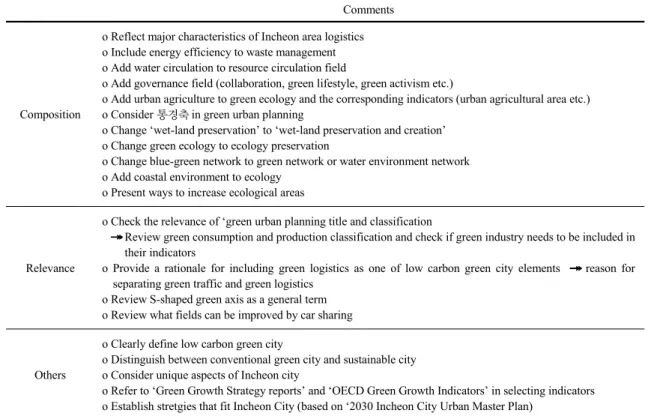
1차 지표에 대한 전문가들의 인터뷰 결과 녹색도 시계획 이라는 분야명칭이 포괄적인 의미를 내포하 고 있어 저탄소 녹색도시 구성에 적합한 친환경 도 시공간 으로 분야명칭을 변경하였다. 또, 녹색산업 은 산업계에서 종합적으로 온실가스를 줄이려는 프로 세스를 운영하고 있어 도시를 구성하는 지표에서는 제외하였다. 이와 함께, 자원 및 폐자원을 에너지화 하 는 추세를 고려하여 ‘에너지’와 ‘자원순환’ 분야를 ‘에 너지 및 자원순환’으로 하나로 묶었으며, 기존에는 정 량적인 측정이 어려운 부분이라 제외되었던 ‘거버넌 스’ 분야도 도시구성에 있어서 지역사회와의 커뮤니 티와 협력이 점차 강조되고 있는 현실을 고려하여 추 가로 반영하였다. 이외에 녹색물류 추가, 녹색생활실 천, ‘2030 인천도시기본계획(Incheon, 2015)’과 ‘제2 차 녹색성장 5개년 계획(Korea Government, 2014)’
에서 제시된 지표들도 검토하여 반영하였다(Table 5).
최종 구축된 지표체계는 6개 분야, 22개 계획요소, 82개 세부지표로 재구성되었으며, 다양한 녹색기술과 프로그램들을 포함한 더 많은 지표들을 포함하게 되 었다(Table 6).
3.3. 분야별 중요도 분석 결과
본 연구의 저탄소 녹색도시 지표체계에서 1차 계층 구조에 해당하는 친환경 도시공간, 에너지 및 자원순 환, 녹색교통, 생태보전, 녹색물류, 거버너스 등 6개 분야에 대한 상대적 중요도 분석을 실시하였다.
Factors Sub-factors Indicators
Green urban planning
(4)
Land use(4) Compressive and compositive development, dispersal centralized space lanning, securing green zone and waterfront space
Location planning(3) Location analysis, ecological and urban landscape, wind way
Green building(5) Building layout, eco-friendly building materials, greening building, green home, building energy performance grading certification system
Green industry(4) Mitigation projects, low carbon products, low carbon emission process introduction, improving eco-friendly facility
Energy efficiency
(2)
Energy self-
supporting(4) Photovoltaic power, high efficiency facility, passive design, cogeneration Renewable energy(7) Solar heat, photovoltaic, wind, geothermal, biomass, marine energy, fuel cell
Resource circulation
(3)
Utilizing water resources(3)
Reuse of rain and treated water, waste water treatment ratio, water saving circulative water and sewage system
Resource circulation(3)
Waste recycling, waste energy recovery system, resource circulation, green marketplace
Waste management(3) Solid waste separation collection, treatment ratio automatic collection system
Green transportation
(5)
Green public
transportation(2) Metropolitan transit, BRT Public transportation
accessibility(3)
Metropolitan public transportation system, linkage of transfer system, circulation road network
Use of green car(4) Compact cars, electric vehicles, natural gas hybrid bus, ecological parking space Pedestrian/bicycle
exclusive roads(3) Pedestrian and bicycle road system, bicycle racks, eco-friendly parking facilities Vitalizing car
sharing(1) Car and bicycle sharing
Green ecology
(4)
Securing ecological
space(6) Roadside trees, trees, green way, waterfront space, streamlet, permeable paving Securing ecological
axis(3) Ecological stream, S-shaped green corridor blue-green network Carbon sinks(3) Carbon neutral forests, securing green space ecological playground
Preserving
bio-diversity(2) Preserving habitats (biotop, wetland etc.), ecological corridor
Green logistics (4)
Efficient logistics(2) Green logistics management system (logistics energy, information etc.), building green port
Logistics/
transportation(3)
Eco-friendly transportation (Modal-Shift), eco-friendly mass composit connected logistics-transportation system, increased vehicle operation efficiency
(increased loading rate etc.)
Logistics base(3) Joint logistic service (freight consolidation), optimizing logistic route, integrated freight terminal
Logistics facilities(3) Low emission logistic equipment (LNG truck, Electric-powered Gantry train etc.), clean energy(LNG etc.), Enlarged transportation vehicles
Table 4. Preliminary indicators for low carbon green city
Comments
Composition
o Reflect major characteristics of Incheon area logistics o Include energy efficiency to waste management o Add water circulation to resource circulation field
o Add governance field (collaboration, green lifestyle, green activism etc.)
o Add urban agriculture to green ecology and the corresponding indicators (urban agricultural area etc.) o Consider 통경축 in green urban planning
o Change ‘wet-land preservation’ to ‘wet-land preservation and creation’
o Change green ecology to ecology preservation
o Change blue-green network to green network or water environment network o Add coastal environment to ecology
o Present ways to increase ecological areas
Relevance
o Check the relevance of ‘green urban planning title and classification
Review green consumption and production classification and check if green industry needs to be included in their indicators
o Provide a rationale for including green logistics as one of low carbon green city elements reason for separating green traffic and green logistics
o Review S-shaped green axis as a general term o Review what fields can be improved by car sharing
Others
o Clearly define low carbon green city
o Distinguish between conventional green city and sustainable city o Consider unique aspects of Incheon city
o Refer to ‘Green Growth Strategy reports’ and ‘OECD Green Growth Indicators’ in selecting indicators o Establish stretgies that fit Incheon City (based on ‘2030 Incheon City Urban Master Plan)
Table 5. FGI results
분석결과, 친환경 도시공간이 0.389로 가장 중요한 요인으로 나타났고 다음은 에너지 및 자원순환(0.155), 녹색교통(0.143), 생태보전(0.131), 녹색물류(0.093), 거버넌스(0.089)의 순으로 나타났다(Table 7).
1차 계층구조의 하위 항목들(계획요소)간 중요도 분석을 실시한 결과, 첫 번째 친환경 도시공간의 하위 2차 계층에 해당하는 토지이용이 0.645로 가장 높게 나타났고, 입지계획(0.228), 녹색건축(0.127)의 순으 로 상대적 중요도가 분석되었다(Table 8).
두 번째 에너지 및 자원순환의 하위 2차 계층 분석 결과, 에너지 효율화(0.476), 물순환(0.206), 폐자원 에너지화(0.177), 폐기물 관리(0.141)의 순으로 상대 적 중요도가 높게 나타났다(Table 9).
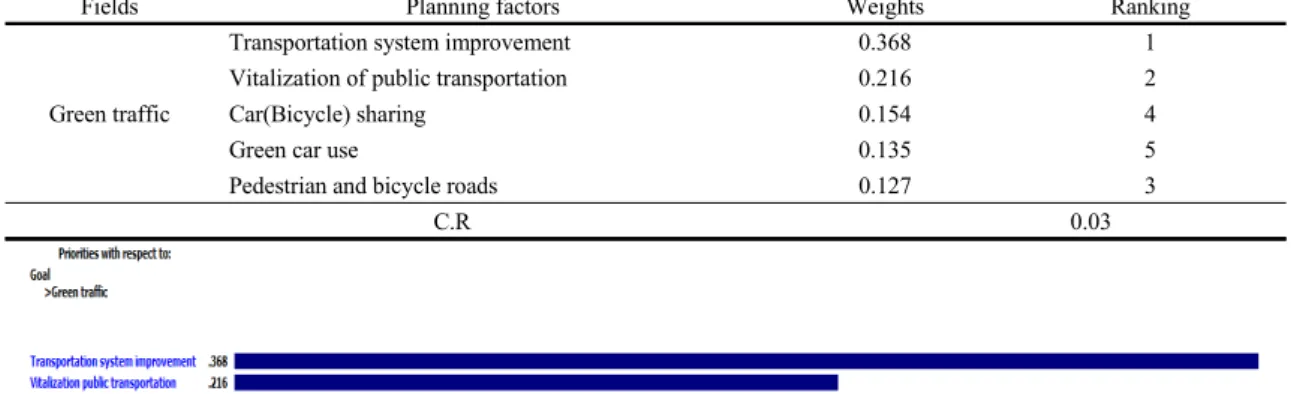
세 번째 녹색교통의 하위 2차 계층 분석결과는, 교 통체계 개선(0.368), 대중교통 활성화(0.216), 자동차 (자전거) Sharing(0.154), 그린카 이용(0.135), 보행자 및 자전거 전용도로(0.127)의 순으로 상대적 중요도
가 높은 것으로 분석되었다(Table 10). 네 번째 생태보 전의 하위 2차 계층 분석결과, 생태면적 확보(0.497), 생태축 확보(0.277), 탄소흡수원(0.136), 생물다양성 (0.090) 순으로 상대적 중요도가 분석되었고(Table 11), 다섯 번째 녹색물류의 하위 2차 계층 분석결과, 물류효율화(0.476), 물류운송(0.258), 물류거점(0.133), 물류장비(0.133)의 순으로 상대적 중요도가 분석되었 다(Table 12). 마지막으로 거버넌스의 하위 2차 계층 분 석결과는, 협력조직(0.644), 녹색실천(0.356)의 순으로 분석되었다(Table 13).
3.4. 계층간(전체지표) 분석 결과
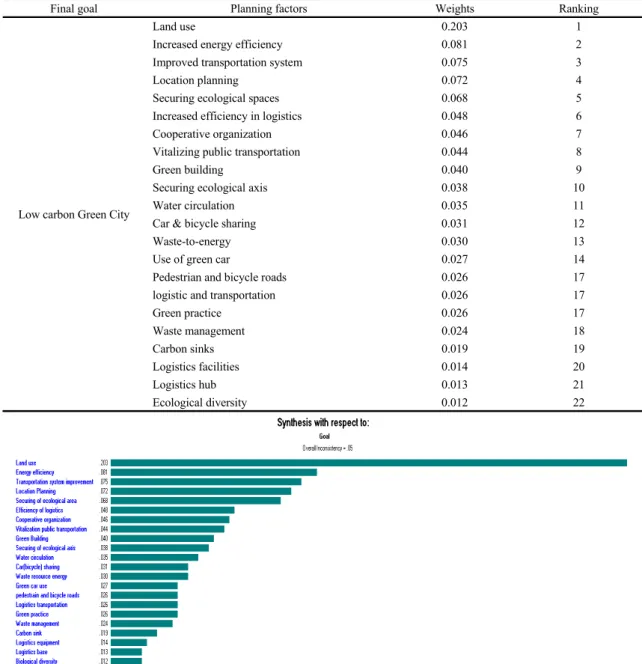
전체요인별 상대적 중요도를 분석하기 위하여 계 층 간, 요인 간 분석결과, 토지이용(0.203)이 가장 높 은 것으로 나타났고 에너지 효율화(0.081), 교통체계 개선(0.075), 입지계획(0.072), 생태면적 확보(0.068), 물류 효율화(0.048), 협력조직(0.046) 등의 순으로 상 대적 중요도가 높게 나타났다. 위의 분석결과 22개
Factors Sub-factors Indicators
Eco-friendly urban space
(3)
Land use(3) Compressive and compositive development, usable land ratio
Location planning(5) Location analysis, concentrated space layout, view axis, wind way, securing open space
Green building(5) Eco-building, energy-zero building, eco-friendly building materials, greening building, building energy performance grading certification system
Energy and resource circulation
(4)
Energy efficiency(4) Renewable energy use, high efficiency energy saving products, energy self supporting, cogeneration
Waste energy(2) Waste energy recovery system, unused energy supply system Waste management
(5)
Waste recycling, waste treatment ratio, reduction of food waste, automatic waste collection system, resource circulation flea market
Water circulation(6)
Dispersed rain management system, reuse of rain and treated water, waste water treatment ratio, circulative water and sewage system retention pond and reservoir, water saving equipments
Green transportstion
(5)
Improving traffic system(4)
Establishing ITS, three-dimensional traffic system, inter-islands water transportation system, pedestrian-friendly roads
Public transportation
vitalization(3) Metropolitan public transportation system, BRT, metropolitan compositive transfer system
Use of green car(2) Eco-friendly cars, ecological parking space
Pedestrian/bicycle
exclusive roads(3) Pedestrian and bicycle road system, bicycle racks Car & bicycle
sharing(3) Operating car sharing system, establishing car sharing base, car sharing use ratio
Ecology preservation
(4)
Securing ecological space(7)
Natural ground green areas, green area ratio, waterfront space, streamlet, permeable paving, urban agriculture areas, ecological playground
Securing ecological
axis(4) Ecological stream, metropolitan green axis, securing waterfront areas, eco trail Carbon sinks(4) Urban afforestation, marine afforestation, enlarging green parks, afforestation projects
Preserving
bio-diversity(3) Preserving habitats (biotop, wetland etc.), creating wetlands, ecological corridor
Green logistics (4)
Efficient logistics(3) Integrated logistics support system, green logistics management system (logistics energy, information etc.), building green port
Logistics/
transportation(4)
Eco-friendly transportation (Modal-Shift), Composit connected logistics-transportation system, establishing CVO, increased vehicle operation efficiency (increased loading rate etc.)
logistics base(3) Joint logistic service (freight consolidation), optimizing logistic route, integrated freight terminal
Logistics facilities(3) Low emission logistic equipment, shift to low emission facility, clean energy use, enlarged transportation vehicles
Governance (2)
Cooperative
organization(3) Citizen participatory organization, cross-sectoral network, local community council Green
lifestyle(3) Participation in green point system, eco-drive, fostering green leaders
Table 6. Final indicators for low carbon green city
Fields Planning factors Weights Ranking Eco-friendly land
use
Land use 0.645 1
Location planning 0.228 2
Green building 0.127 3
C.R 0.08
Table 8. Second hierarchy evaluation for eco-friendly land use
Fields Weights Ranking
First hierarchy
Eco-friendly urban space 0.389 1
Energy and resource circulation 0.155 2
Green traffic 0.143 3
Ecological preservation 0.131 4
Green logistics 0.093 5
Governance 0.089 6
C.R 0.04
Table 7. First hierarchy weight evaluation
Fields Planning factors Weights Ranking
Energy and resource circulation
Energy efficiency 0.476 1
Waste energy 0.177 3
Waste management 0.141 4
Water circulation 0.206 2
C.R 0.09
Table 9. Second hierarchy evaluation for energy & resource circulation
Fields Planning factors Weights Ranking
Green traffic
Transportation system improvement 0.368 1
Vitalization of public transportation 0.216 2
Car(Bicycle) sharing 0.154 4
Green car use 0.135 5
Pedestrian and bicycle roads 0.127 3
C.R 0.03
Table 10. Second hierarchy evaluation for green traffic
Fields Planning factors Weights Ranking
Ecological preservation
Securing ecological area 0.497 1
Securing ecological axis 0.277 2
Carbon sinks 0.136 3
Ecology diversity 0.090 4
C.R 0.08
Table 11. Second hierarchy evaluation for ecological preservation
Fields Planning factors Weights Ranking
Green logistics
Efficiency of logistics 0.476 1
Logistics transportation 0.258 2
Logistics base 0.133 4
Logistics equipment 0.133 4
C.R 0.08
Table 12. Second hierarchy evaluation for green logistics
Fields Planning factors Weights Ranking
Governance Cooperative organization 0.644 1
Green practice 0.356 2
C.R 0.00
Table 13. Second hierarchy evaluation for governance
지표에 대한 평균 종합가중치는 0.045로 나타났으며, 평균 수치를 기준으로 중요도가 높은 상위그룹에 속 하는 지표들과 상대적 하위그룹을 구분하면 7개의 지 표가 상위그룹에 속하는 것으로 나타났다(Table 14).
위 분석결과를 종합해 보면, 전체 22개의 지표 중 상위그룹의 7개 지표와 1차 계층분석 결과에서 나타 난 순위는 일관성을 보인다. 1차 계층분석 결과 친환 경 도시공간이 가장 높은 순위로 나타났으며, 에너지 및 자원순환, 녹색교통, 생태보전, 녹색물류, 거버넌스 순이였으며, 전체 지표중 상위그룹에 속하는 7개 지표 에서도 가장 우선 고려하여 할 요소로 토지이용이 중 요한 요인으로 나타났으며, 다음은 에너지 효율화, 교 통체계 개선, 입지계획, 생태면적 확보, 물류효율화, 협력조직의 순으로, 하위계층(2차)의 지표가 1차 계층 분석의 중요도에 따라 상위그룹에 고루 분포하는 결 과를 보이고 있다.
이와 같이 상위계층(1차)과 하위계층(2차)간 지표 우선순위에 모든 분야의 계획요소 지표들이 고루 포 함되어 있다는 것은 인천광역시 관점에서 저탄소 녹 색도시를 만들려면 모든 범위의 우선지표를 고려하여 야 전략적인 도시개발이 가능하다는 것을 보여준 결 과라고 할 수 있다.
4. 결 론
본 연구는 저탄소 녹색도시 조성을 위한 전략적 개 발계획을 추진하는데 있어 적용가능한 공통지표 체계
를 구축하고, 인천광역시 관점에서 AHP 기법을 활용 한 중요도 분석을 실시하여 저탄소 녹색도시 조성을 위한 지표간 우선순위를 선정하는데 목적이 있다.
기존연구(선행연구, 정책자료, 선진사례 등)를 종 합하여 1차 지표 체계를 도출하고, FGI를 통한 적합성 검증 및 AHP 기법을 활용한 중요도 분석을 실시하여 최종 지표체계를 구축하였다. 특히 본 연구에서는 대 형유통단지, 복합쇼핑몰, 택배물량 증가 등 도심을 중 심으로 한 물류환경이 변화하고 있는 점을 고려하여 도시구성 요소에 물류부문을 포함하여 지표화 하였 다.
최종 지표는 6개 분야, 22개 계획요소, 82개 세부지 표체계가 도출되었으며, 중요도 분석을 통해 인천광 역시 관점에서 저탄소 녹색도시 조성을 위한 전략적 개발계획의 우선순위를 선정하였다. AHP 기법의 계 층화 과정에서 저탄소 녹색도시를 구성하기 위한 정 책적 선행요소로 상위 항목인 ‘분야’와 하위 항목인
‘계획요소’를 대상으로 설정하고, 2차 계층(6개 분야, 22개 계획요소) 구조로 계층화하여 분석하였다.
분석결과, 1차 계층(분야)에서는 친환경 도시공간, 에너지 및 자원순환, 녹색교통, 생태보전, 녹색물류, 거버넌스 순으로 중요도가 나타났다. 전체 지표중 상 위그룹에 속하는 7개 지표를 보면 토지이용, 에너지 효율화, 교통체계 개선, 입지계획, 생태면적 확보, 물 류효율화, 협력조직의 순으로 나타남으로써, 상위계 층(1차) 분석의 중요도에 따라 하위계층(2차)의 지표 가 상위그룹에 고루 분포하는 결과를 보이고 있다.
Final goal Planning factors Weights Ranking
Low carbon Green City
Land use 0.203 1
Increased energy efficiency 0.081 2
Improved transportation system 0.075 3
Location planning 0.072 4
Securing ecological spaces 0.068 5
Increased efficiency in logistics 0.048 6
Cooperative organization 0.046 7
Vitalizing public transportation 0.044 8
Green building 0.040 9
Securing ecological axis 0.038 10
Water circulation 0.035 11
Car & bicycle sharing 0.031 12
Waste-to-energy 0.030 13
Use of green car 0.027 14
Pedestrian and bicycle roads 0.026 17
logistic and transportation 0.026 17
Green practice 0.026 17
Waste management 0.024 18
Carbon sinks 0.019 19
Logistics facilities 0.014 20
Logistics hub 0.013 21
Ecological diversity 0.012 22
Table 14. Weights and ranking of factors
결국 인천지역의 저탄소 녹색도시를 조성하기 위 해서는 토지이용이 가장 중요한 요인으로, 에너지효 율화, 교통체계 개선, 입지계획, 생태면적 확보, 물류 효율화, 협력조직 등의 상위 그룹에 속한 각 분야별 계 획요소들을 모두 고려하여야 전략적인 개발이 가능하 다는 것을 알 수 있다.
이러한 분석결과를 종합해 볼 때, 친환경 도시공간 의 계획요소인 토지이용과 입지계획이 전체 지표 중 상위그룹에 속한 것은 저탄소 녹색도시를 조성함에 있어 토지이용과 입지계획이 도시형태를 구상하는 초 기 기획단계에서부터 가장 먼저 반영되어야 하는 중 요성을 보여준다. 즉, 에너지 효율성, 교통체계, 생태
면적 확보, 물류 효율화, 협력조직 등의 우선순위를 고 려하여 개발계획에 적용하는 것이 향후 인천광역시의 탄소중립지표를 높이는 전략적인 도시개발이 가능할 것으로 기대된다.
본 연구의 시사점은 인천광역시의 전략적인 도시 개발을 수행하기 위해서는 도시구상 초기 입안단계에 서부터 어떤 요소를 적용하여 반영하느냐와 시민과 지역사회가 함께 참여하여 다양한 의견수렴 과정을 거쳐야 효율적이고 일관성 있는 저탄소 녹색도시의 개발이 가능할 것이다. 또한, 저탄소 녹색도시 조성을 위하여 초기 기획단계에서부터 유지관리에 이르기까 지 전 과정에 대하여 지속적인 지표별 모니터링을 통 한 사후 성과관리와 도시개발에 참여하는 모든 요소 들이 하나의 공감대를 형성하여야 지속가능한 미래 도시모델로 인천광역시가 발전할 수 있을 것이다.
또한, 인천광역시 관점에서 저탄소 녹색도시 계획 지표의 우선순위를 선정하였지만, 대부분의 도시에서 저탄소 녹색도시를 개발하는데 유사한 패턴과 동일한 분야를 고려할 수 있는 지표로써, 모든 저탄소 녹색도 시 개발지표의 적용에 기여하는 것이 가능할 것으로 기대한다.
감사의 글
이 논문은 인하대학교의 지원에 의하여 연구되었음.
REFERENCES